EXPONENTS AND ITS LAWS
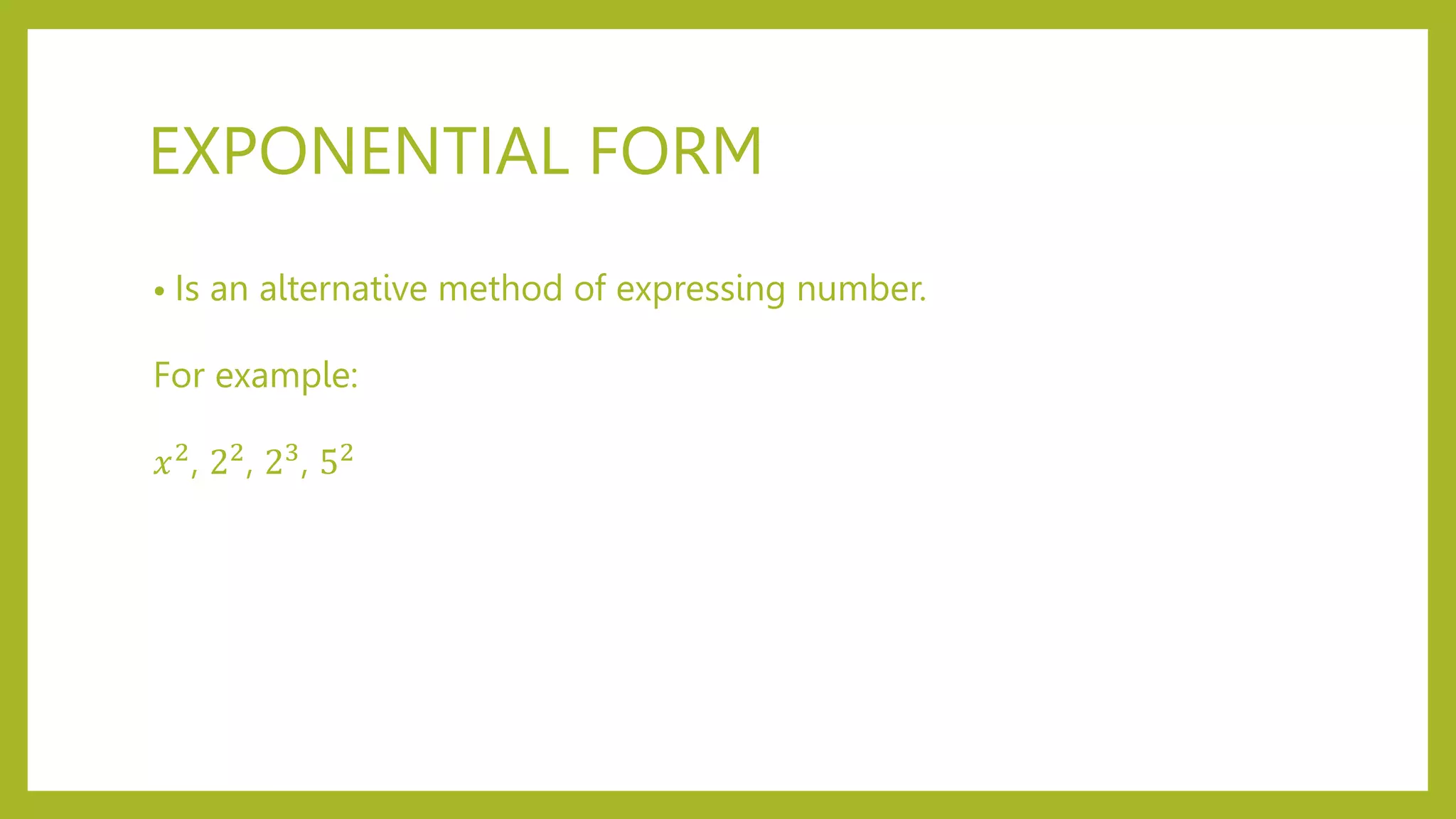
EXPONENTIAL FORM
• Is an alternative method of expressing number.
For example:
𝑥2
, 22
, 23
, 52
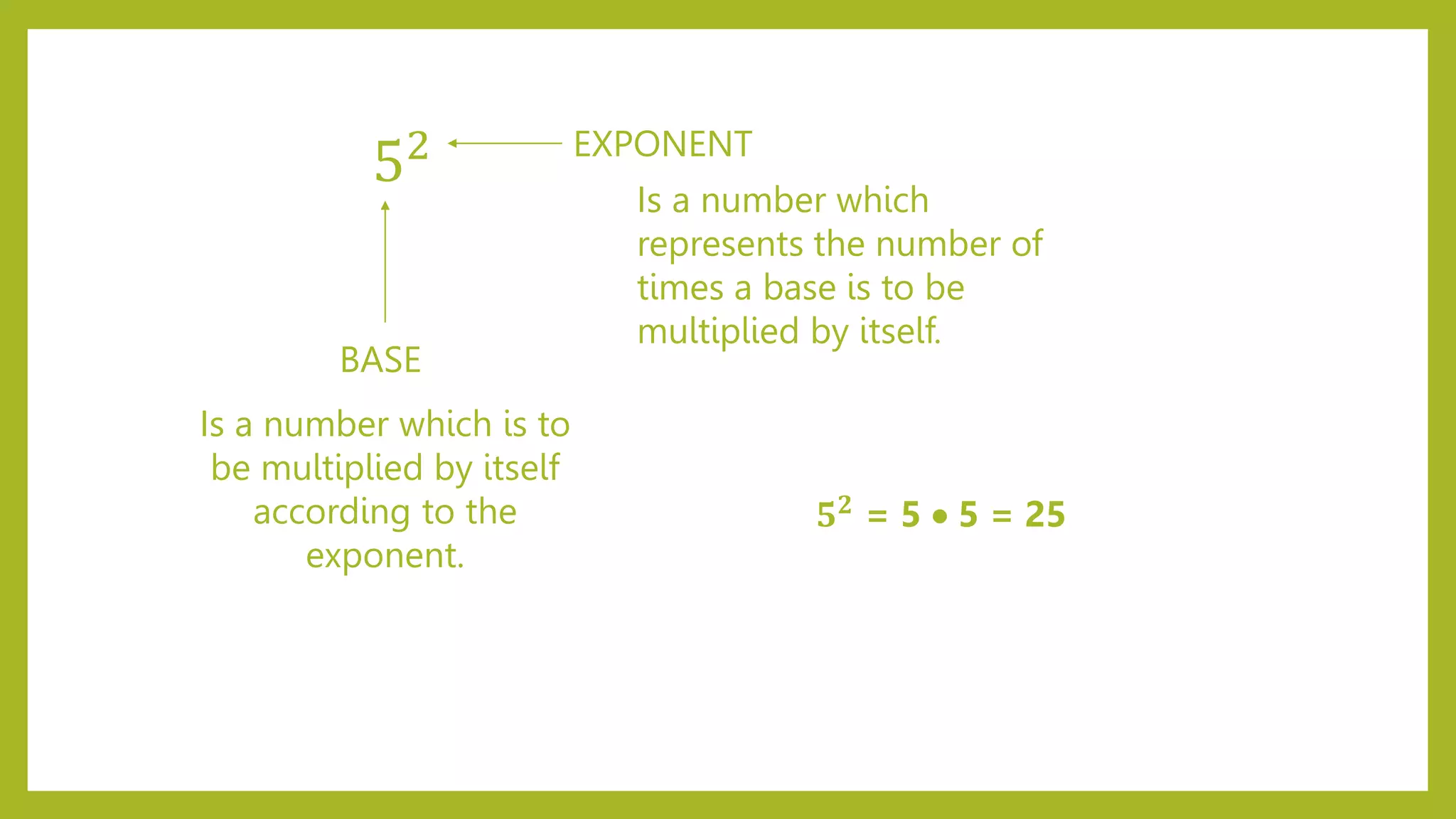
52 EXPONENT
BASE
Is a number which
represents the number of
times a base is to be
multiplied by itself.
Is a number which is to
be multiplied by itself
according to the
exponent.
𝟓𝟐
= 5  5 = 25
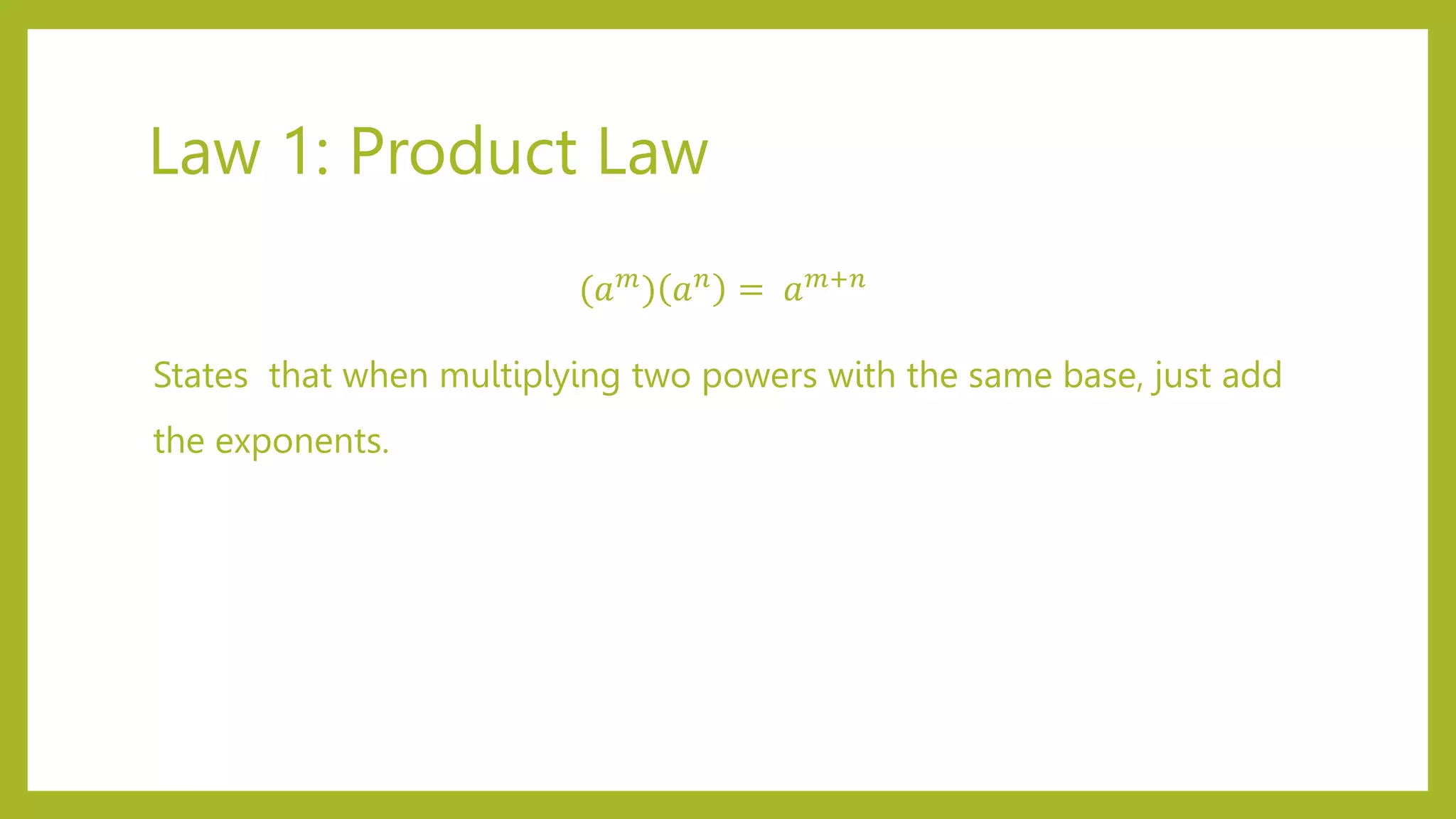
Law 1: Product Law
(𝑎𝑚) 𝑎𝑛 = 𝑎𝑚+𝑛
States that when multiplying two powers with the same base, just add
the exponents.
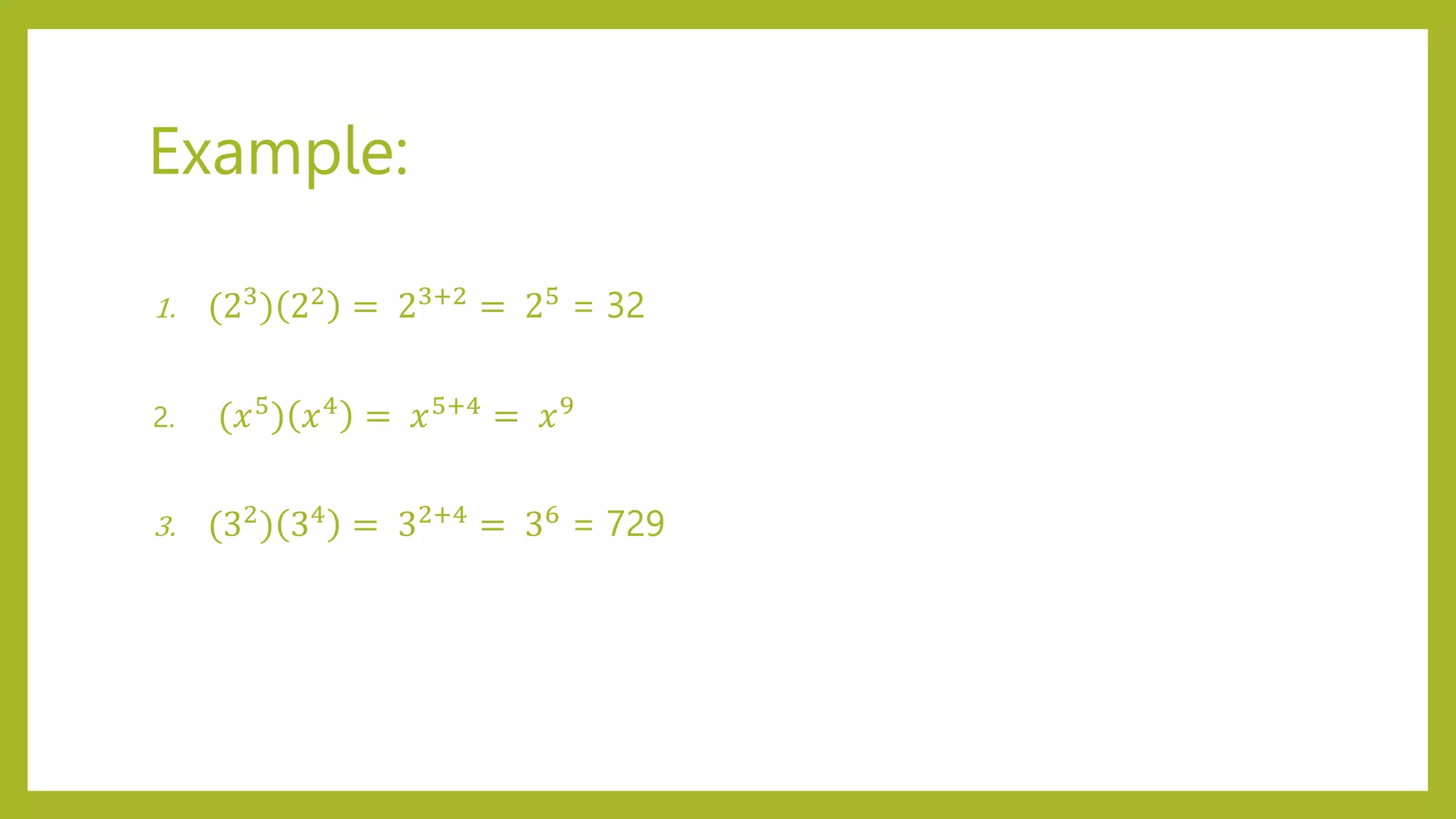
Example:
1. (23) 22 = 23+2 = 25 = 32
2. (𝑥5
) 𝑥4
= 𝑥5+4
= 𝑥9
3. (32) 34 = 32+4 = 36 = 729
You try!
1. (24) 25 =
2. (𝑥32
) 𝑥25
=
3. (𝑦59
) 𝑦51
=
Law 2: Quotient Law
𝑎𝑚
𝑎𝑛
= 𝑎𝑚−𝑛
States that when dividing two powers with the same base, just subtract
the exponents.
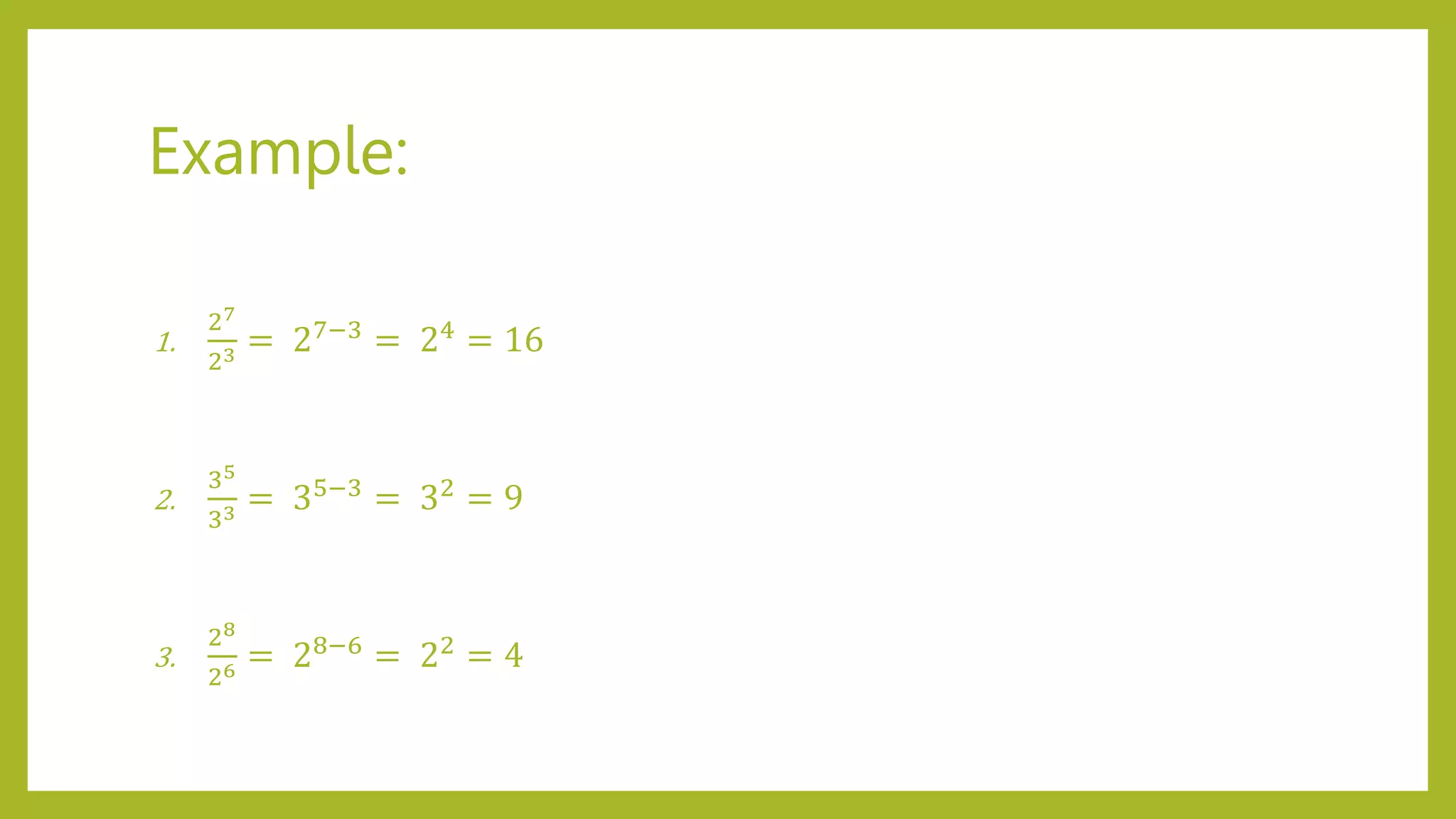
Example:
1.
27
23 = 27−3 = 24 = 16
2.
35
33 = 35−3
= 32
= 9
3.
28
26 = 28−6 = 22 = 4
You try!
1.
43
42 =
2.
𝑥20
𝑥13 =
3.
𝑦105
𝑦87 =
Law 3: Power of a power
𝑥𝑚 𝑛 = 𝑥𝑚𝑛
To simplify any power of power, simply multiply the exponents.
Example:
1. 23 2 = 2(3)(2) = 26 = 64
2. 𝑥4 3 = 𝑥(4)(3) = 𝑥12
3. 32 2 = 3(2)(2) = 34 = 81
You try!
1. 𝑎2 5 =
2. 22 3
=
3. 𝑥100 3 =
Law 4: Power with different bases
𝑏𝑐 𝑛 = 𝑏𝑛𝑐𝑛
𝑎
𝑏
𝑛
=
𝑎𝑛
𝑏𝑛
In dividing different bases, it can’t be simplified unless the exponents
are equal.
Example:
1. 2𝑥 2 = 22𝑥2 = 4𝑥2
2. 5𝑥𝑦 3
= 53
𝑥3
𝑦3
= 125𝑥3
𝑦3
3.
𝑥
3
2
=
𝑥2
32 =
𝑥2
9
4.
4
𝑎
2
=
42
𝑎2 =
16
𝑎2
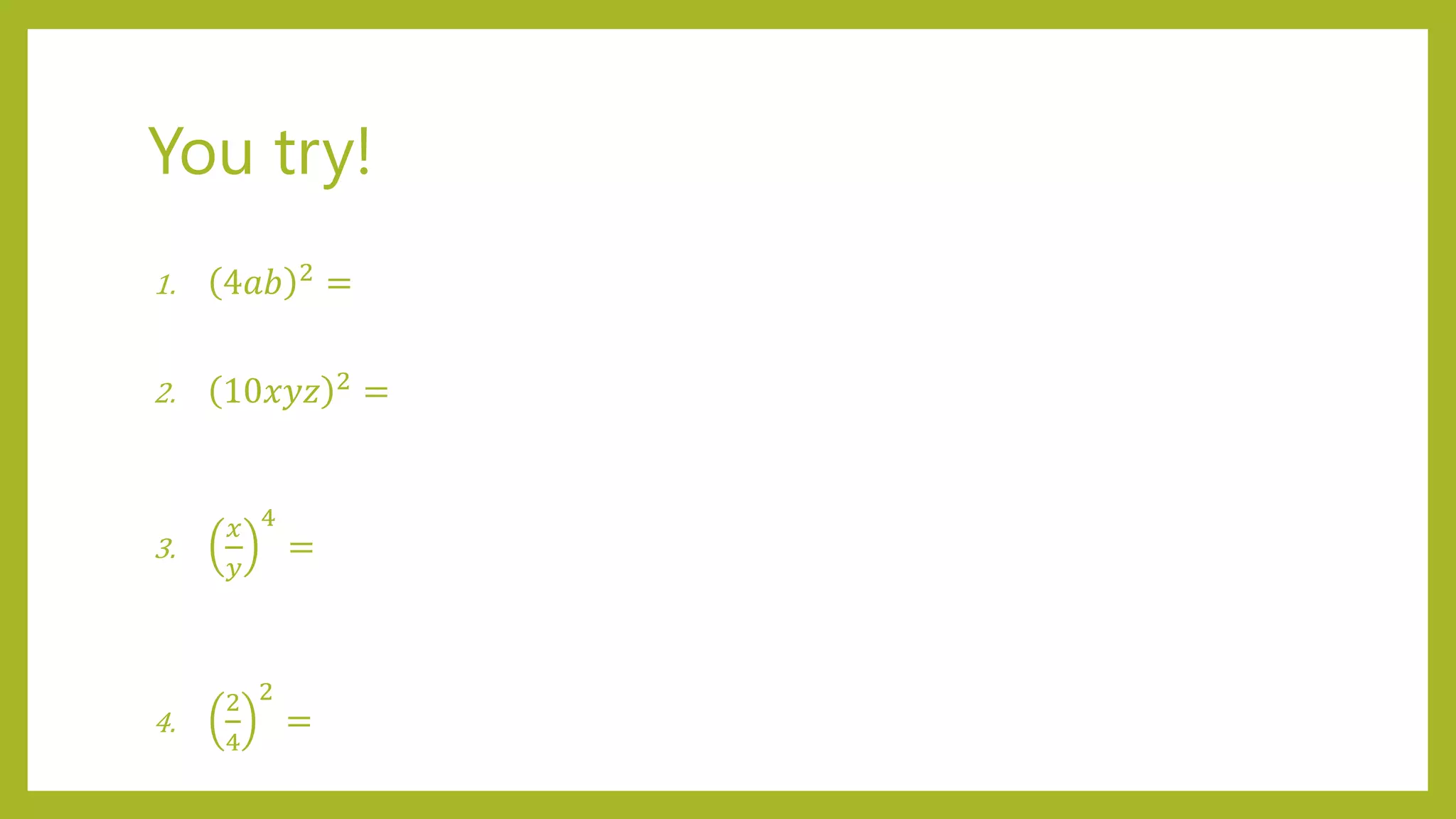
You try!
1. 4𝑎𝑏 2 =
2. 10𝑥𝑦𝑧 2
=
3.
𝑥
𝑦
4
=
4.
2
4
2
=
Law 5: Zero Exponent
𝑎0 = 1
A nonzero base raised to zero the result is equal to one.
For example:
30 = 1
𝑥0 = 1
3𝑥
𝑦
0
= 1
You try!
1. 7, 645, 321 0
=
2. 30 + 𝑥0 + 3𝑦 0 =
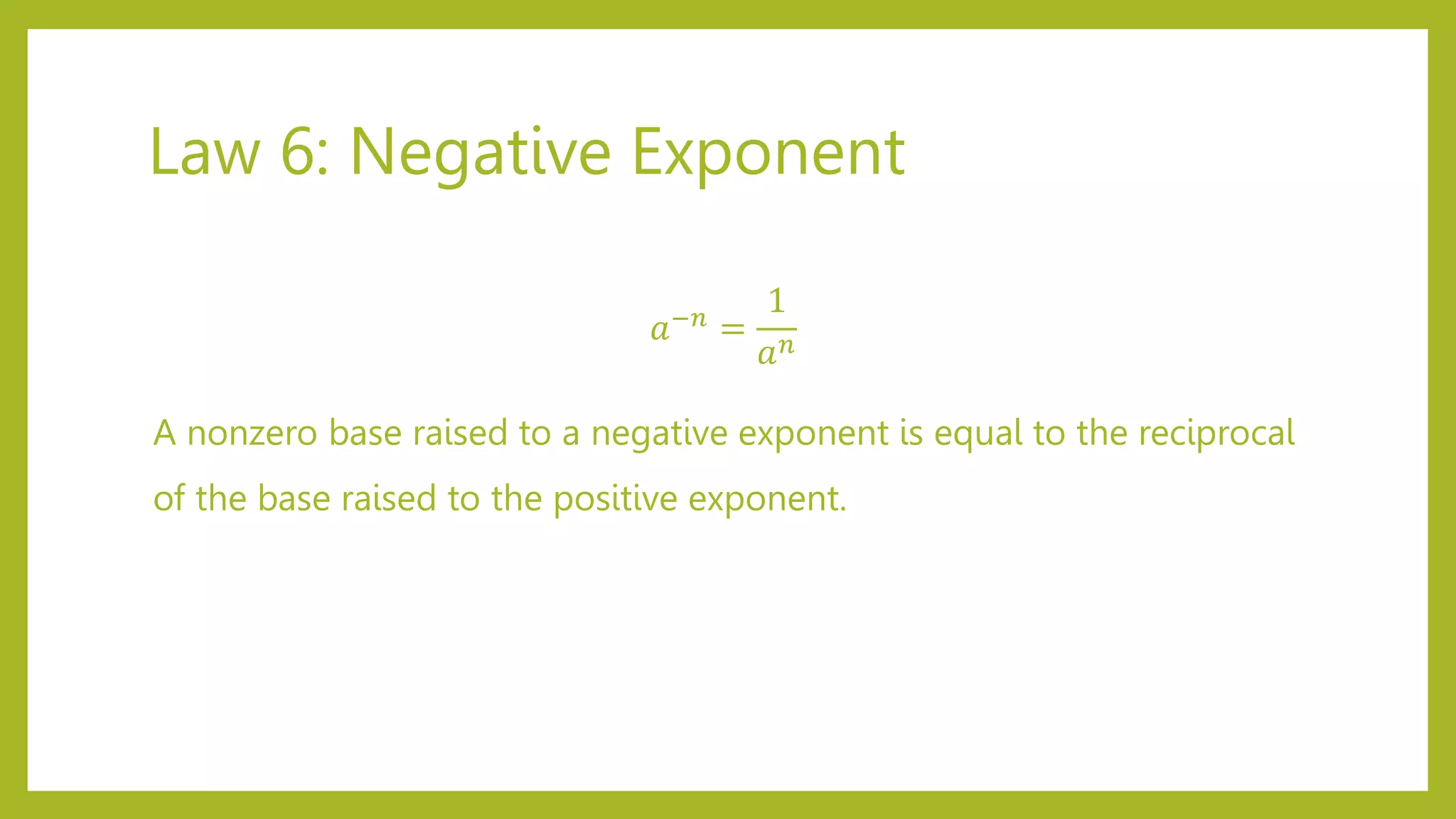
Law 6: Negative Exponent
𝑎−𝑛 =
1
𝑎𝑛
A nonzero base raised to a negative exponent is equal to the reciprocal
of the base raised to the positive exponent.
Example:
1. 3−2 =
1
32 =
1
9
2. 2−8 =
1
28 =
1
256
3.
2
5
−6
=
5
2
6
=
56
26 =
15,625
64
You try!
1. 𝑥−2 =
2. 3−3
=
3. 5 − 3 −2
=
Law 1: Product Law (𝑎𝑚) 𝑎𝑛 = 𝑎𝑚+𝑛
Law 2: Quotient Law
𝑎𝑚
𝑎𝑛 = 𝑎𝑚−𝑛
Law 3: Power of a power 𝑥𝑚 𝑛 = 𝑥𝑚𝑛
Law 4: Power with different bases 𝑏𝑐 𝑛 = 𝑏𝑛𝑐𝑛 𝑎
𝑏
𝑛
=
𝑎𝑛
𝑏𝑛
Law 5: Zero Exponent
Let’s simplify!
1. (𝑥10) 𝑥12 =
2. (𝑦−3) 𝑦8 =
3. 𝑚15 3 =
4. 𝑑−3 2
=
5.
𝑏8
𝑏12 =
6. 𝑎−4 −4 =
7.
𝑧23
𝑧15 =
8.
𝑐3
𝑐−2 =
9.
𝑥7𝑦10
𝑥3𝑦5 =
10.
𝑎8𝑏2𝑐0
𝑎5𝑏5 =

Exponents and its laws.pptx

  • 1.
  • 2.
    EXPONENTIAL FORM • Isan alternative method of expressing number. For example: 𝑥2 , 22 , 23 , 52
  • 3.
    52 EXPONENT BASE Is anumber which represents the number of times a base is to be multiplied by itself. Is a number which is to be multiplied by itself according to the exponent. 𝟓𝟐 = 5  5 = 25
  • 4.
    Law 1: ProductLaw (𝑎𝑚) 𝑎𝑛 = 𝑎𝑚+𝑛 States that when multiplying two powers with the same base, just add the exponents.
  • 5.
    Example: 1. (23) 22= 23+2 = 25 = 32 2. (𝑥5 ) 𝑥4 = 𝑥5+4 = 𝑥9 3. (32) 34 = 32+4 = 36 = 729
  • 6.
    You try! 1. (24)25 = 2. (𝑥32 ) 𝑥25 = 3. (𝑦59 ) 𝑦51 =
  • 7.
    Law 2: QuotientLaw 𝑎𝑚 𝑎𝑛 = 𝑎𝑚−𝑛 States that when dividing two powers with the same base, just subtract the exponents.
  • 8.
    Example: 1. 27 23 = 27−3= 24 = 16 2. 35 33 = 35−3 = 32 = 9 3. 28 26 = 28−6 = 22 = 4
  • 9.
  • 10.
    Law 3: Powerof a power 𝑥𝑚 𝑛 = 𝑥𝑚𝑛 To simplify any power of power, simply multiply the exponents.
  • 11.
    Example: 1. 23 2= 2(3)(2) = 26 = 64 2. 𝑥4 3 = 𝑥(4)(3) = 𝑥12 3. 32 2 = 3(2)(2) = 34 = 81
  • 12.
    You try! 1. 𝑎25 = 2. 22 3 = 3. 𝑥100 3 =
  • 13.
    Law 4: Powerwith different bases 𝑏𝑐 𝑛 = 𝑏𝑛𝑐𝑛 𝑎 𝑏 𝑛 = 𝑎𝑛 𝑏𝑛 In dividing different bases, it can’t be simplified unless the exponents are equal.
  • 14.
    Example: 1. 2𝑥 2= 22𝑥2 = 4𝑥2 2. 5𝑥𝑦 3 = 53 𝑥3 𝑦3 = 125𝑥3 𝑦3 3. 𝑥 3 2 = 𝑥2 32 = 𝑥2 9 4. 4 𝑎 2 = 42 𝑎2 = 16 𝑎2
  • 15.
    You try! 1. 4𝑎𝑏2 = 2. 10𝑥𝑦𝑧 2 = 3. 𝑥 𝑦 4 = 4. 2 4 2 =
  • 16.
    Law 5: ZeroExponent 𝑎0 = 1 A nonzero base raised to zero the result is equal to one. For example: 30 = 1 𝑥0 = 1 3𝑥 𝑦 0 = 1
  • 17.
    You try! 1. 7,645, 321 0 = 2. 30 + 𝑥0 + 3𝑦 0 =
  • 18.
    Law 6: NegativeExponent 𝑎−𝑛 = 1 𝑎𝑛 A nonzero base raised to a negative exponent is equal to the reciprocal of the base raised to the positive exponent.
  • 19.
    Example: 1. 3−2 = 1 32= 1 9 2. 2−8 = 1 28 = 1 256 3. 2 5 −6 = 5 2 6 = 56 26 = 15,625 64
  • 20.
    You try! 1. 𝑥−2= 2. 3−3 = 3. 5 − 3 −2 =
  • 21.
    Law 1: ProductLaw (𝑎𝑚) 𝑎𝑛 = 𝑎𝑚+𝑛 Law 2: Quotient Law 𝑎𝑚 𝑎𝑛 = 𝑎𝑚−𝑛 Law 3: Power of a power 𝑥𝑚 𝑛 = 𝑥𝑚𝑛 Law 4: Power with different bases 𝑏𝑐 𝑛 = 𝑏𝑛𝑐𝑛 𝑎 𝑏 𝑛 = 𝑎𝑛 𝑏𝑛 Law 5: Zero Exponent
  • 22.
    Let’s simplify! 1. (𝑥10)𝑥12 = 2. (𝑦−3) 𝑦8 = 3. 𝑚15 3 = 4. 𝑑−3 2 = 5. 𝑏8 𝑏12 = 6. 𝑎−4 −4 = 7. 𝑧23 𝑧15 = 8. 𝑐3 𝑐−2 = 9. 𝑥7𝑦10 𝑥3𝑦5 = 10. 𝑎8𝑏2𝑐0 𝑎5𝑏5 =