Angles and Triangles
Terry Scates
Newton, Kansas
Instructor Notes
• Subject Area(s): Math
• Grade level: 7th
grade
• Lesson Length: 50 minute class period
• Synopsis: Name triangles by angles and sides.
• Objective/goals: Students will classify triangles
according to types or angles and sides.
(This PowerPoint presentation was designed as a supplemental piece to the
presentation entitled Classifying Triangles by James Wiens for students in
the special education math class.)
• Standard: ▲ identifies angle and side properties of triangles and
quadrilaterals (KS standard 7.3.1.k3)
• Pre-requisite skills: Vocabulary – Acute, Obtuse, Right, Equilateral,
Isosceles, Scalene
• TurningPoint functions: standard question slides
• Materials: All instructional points and practice problems are provided
within the power point slides. Practice questions are designed to be used
with the TurningPoint clickers.
(This PowerPoint presentation was designed as a supplemental piece to
the presentation entitled Classifying Triangles by James Wiens for
students in the special education math class.)
Instructor Notes
Lesson Outline
1. Warm-up: Angle classification
2. Setting the Stage:
3. Guided practice:
Turning Point Questions
4. Independent practice: Paper & pencil
5. Closure: Write about triangles
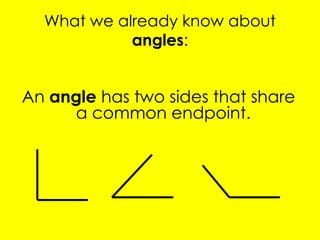
What we already know about
angles:
An angle has two sides that share
a common endpoint.
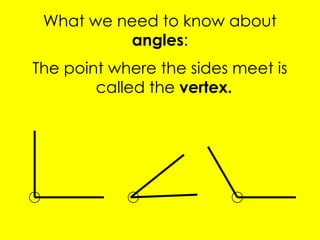
What we need to know about
angles:
The point where the sides meet is
called the vertex.
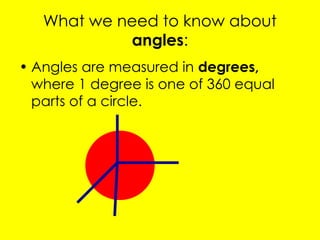
What we need to know about
angles:
• Angles are measured in degrees,
where 1 degree is one of 360 equal
parts of a circle.
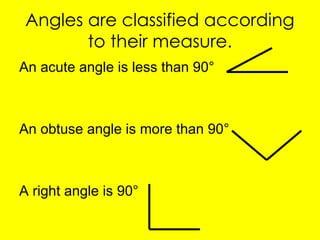
Angles are classified according
to their measure.
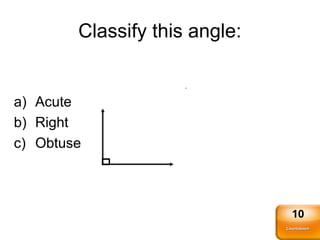
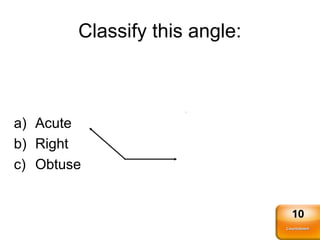
An acute angle is less than 90°
An obtuse angle is more than 90°
A right angle is 90°
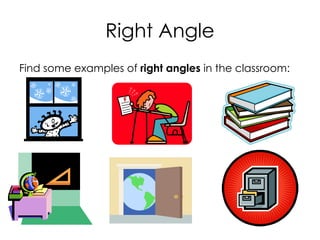
Right Angle
Find some examples of right angles in the classroom:
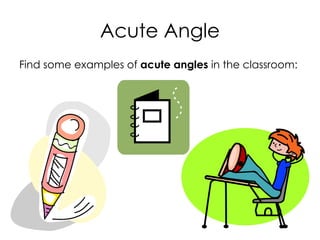
Acute Angle
Find some examples of acute angles in the classroom:
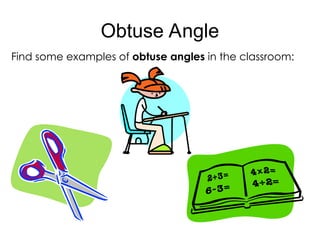
Obtuse Angle
Find some examples of obtuse angles in the classroom:
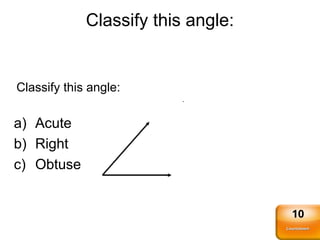
Classify this angle:
a) Acute
b) Right
c) Obtuse
Classify this angle:
Countdown
Countdown
10
Classify this angle:
a) Acute
b) Right
c) Obtuse
Countdown
Countdown
10
Classify this angle:
a) Acute
b) Right
c) Obtuse
Countdown
Countdown
10
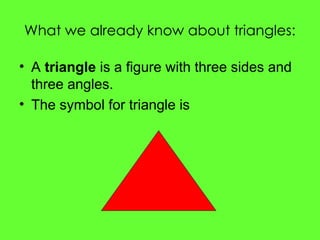
What we already know about triangles:
• A triangle is a figure with three sides and
three angles.
• The symbol for triangle is
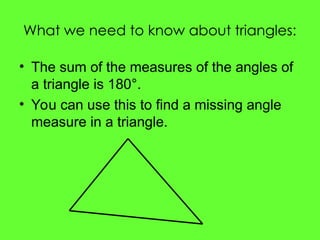
What we need to know about triangles:
• The sum of the measures of the angles of
a triangle is 180°.
• You can use this to find a missing angle
measure in a triangle.
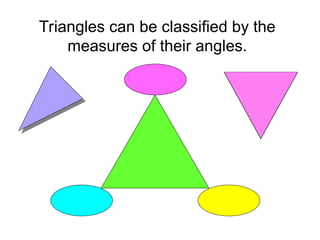
Triangles can be classified by the
measures of their angles.
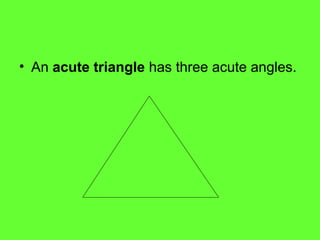
• An acute triangle has three acute angles.
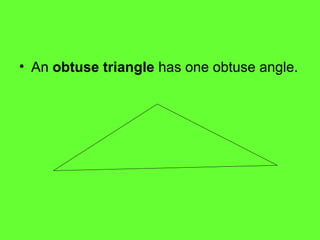
• An obtuse triangle has one obtuse angle.
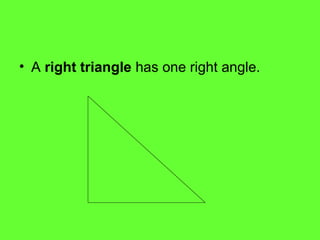
• A right triangle has one right angle.
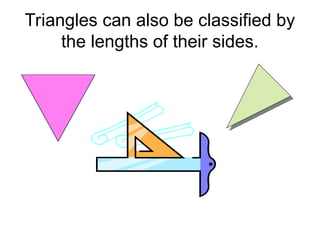
Triangles can also be classified by
the lengths of their sides.
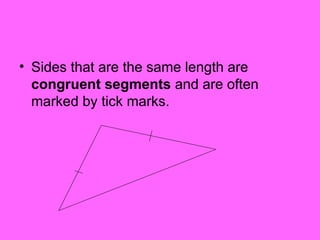
• Sides that are the same length are
congruent segments and are often
marked by tick marks.
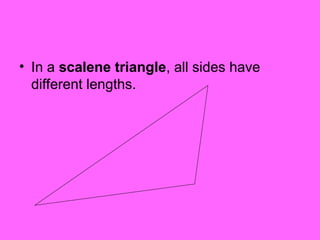
• In a scalene triangle, all sides have
different lengths.
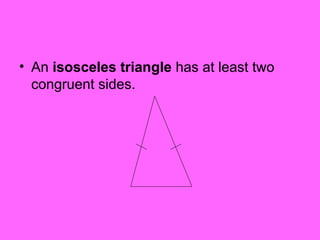
• An isosceles triangle has at least two
congruent sides.
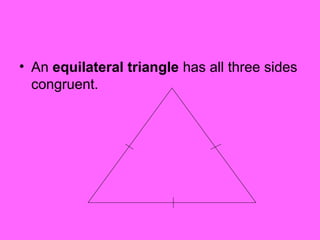
• An equilateral triangle has all three sides
congruent.
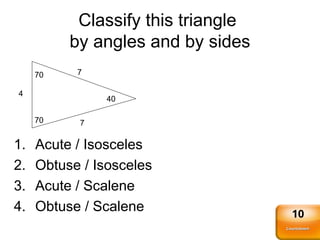
Classify this triangle
by angles and by sides
1. Acute / Isosceles
2. Obtuse / Isosceles
3. Acute / Scalene
4. Obtuse / Scalene
4
7
7
70
70
40
Countdown
Countdown
10
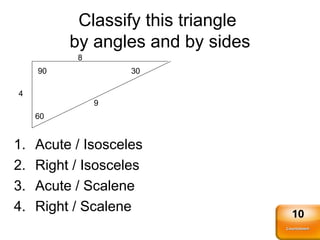
Classify this triangle
by angles and by sides
4
8
90
60
30
9
1. Acute / Isosceles
2. Right / Isosceles
3. Acute / Scalene
4. Right / Scalene
Countdown
Countdown
10
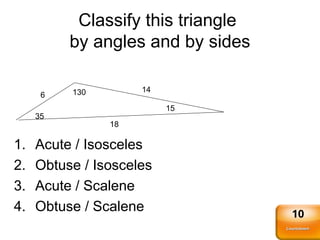
Classify this triangle
by angles and by sides
1. Acute / Isosceles
2. Obtuse / Isosceles
3. Acute / Scalene
4. Obtuse / Scalene
6
14
18
130
35
15
Countdown
Countdown
10
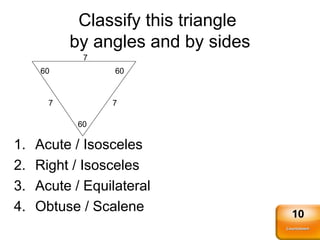
Classify this triangle
by angles and by sides
7
7
7
60
60
60
1. Acute / Isosceles
2. Right / Isosceles
3. Acute / Equilateral
4. Obtuse / Scalene
Countdown
Countdown
10
You are ready to try on your own!
• Think about what you have learned.
• Think about what you already knew.
• Think about what you can teach others.
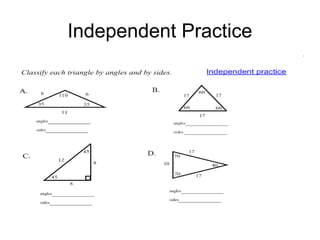
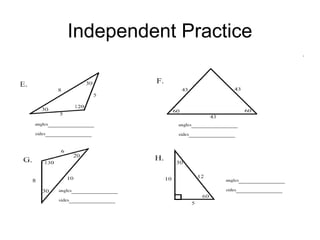
Independent Practice
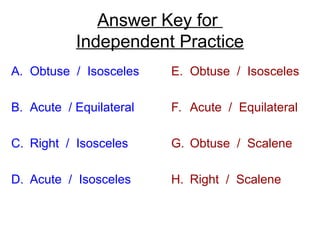
Answer Key for
Independent Practice
A. Obtuse / Isosceles
B. Acute / Equilateral
C. Right / Isosceles
D. Acute / Isosceles
E. Obtuse / Isosceles
F. Acute / Equilateral
G. Obtuse / Scalene
H. Right / Scalene
Closure/Summary
• Is the sum of the angles of an obtuse
triangle greater than the sum of the angles
of an acute triangle? Explain your answer.
References
Glencoe McGraw-Hill Math Connects
Course 2, Study Guide and Intervention
and Practice Workbook, 2008.
Wiens, James, Classifying Triangles,
PowerPoint presentation, November 2008.

angles.ppt . This is purely for education purpose

  • 1.
    Angles and Triangles TerryScates Newton, Kansas
  • 2.
    Instructor Notes • SubjectArea(s): Math • Grade level: 7th grade • Lesson Length: 50 minute class period • Synopsis: Name triangles by angles and sides. • Objective/goals: Students will classify triangles according to types or angles and sides. (This PowerPoint presentation was designed as a supplemental piece to the presentation entitled Classifying Triangles by James Wiens for students in the special education math class.)
  • 3.
    • Standard: ▲identifies angle and side properties of triangles and quadrilaterals (KS standard 7.3.1.k3) • Pre-requisite skills: Vocabulary – Acute, Obtuse, Right, Equilateral, Isosceles, Scalene • TurningPoint functions: standard question slides • Materials: All instructional points and practice problems are provided within the power point slides. Practice questions are designed to be used with the TurningPoint clickers. (This PowerPoint presentation was designed as a supplemental piece to the presentation entitled Classifying Triangles by James Wiens for students in the special education math class.) Instructor Notes
  • 4.
    Lesson Outline 1. Warm-up:Angle classification 2. Setting the Stage: 3. Guided practice: Turning Point Questions 4. Independent practice: Paper & pencil 5. Closure: Write about triangles
  • 5.
    What we alreadyknow about angles: An angle has two sides that share a common endpoint.
  • 6.
    What we needto know about angles: The point where the sides meet is called the vertex.
  • 7.
    What we needto know about angles: • Angles are measured in degrees, where 1 degree is one of 360 equal parts of a circle.
  • 8.
    Angles are classifiedaccording to their measure. An acute angle is less than 90° An obtuse angle is more than 90° A right angle is 90°
  • 9.
    Right Angle Find someexamples of right angles in the classroom:
  • 10.
    Acute Angle Find someexamples of acute angles in the classroom:
  • 11.
    Obtuse Angle Find someexamples of obtuse angles in the classroom:
  • 12.
    Classify this angle: a)Acute b) Right c) Obtuse Classify this angle: Countdown Countdown 10
  • 13.
    Classify this angle: a)Acute b) Right c) Obtuse Countdown Countdown 10
  • 14.
    Classify this angle: a)Acute b) Right c) Obtuse Countdown Countdown 10
  • 15.
    What we alreadyknow about triangles: • A triangle is a figure with three sides and three angles. • The symbol for triangle is
  • 16.
    What we needto know about triangles: • The sum of the measures of the angles of a triangle is 180°. • You can use this to find a missing angle measure in a triangle.
  • 17.
    Triangles can beclassified by the measures of their angles.
  • 18.
    • An acutetriangle has three acute angles.
  • 19.
    • An obtusetriangle has one obtuse angle.
  • 20.
    • A righttriangle has one right angle.
  • 21.
    Triangles can alsobe classified by the lengths of their sides.
  • 22.
    • Sides thatare the same length are congruent segments and are often marked by tick marks.
  • 23.
    • In ascalene triangle, all sides have different lengths.
  • 24.
    • An isoscelestriangle has at least two congruent sides.
  • 25.
    • An equilateraltriangle has all three sides congruent.
  • 26.
    Classify this triangle byangles and by sides 1. Acute / Isosceles 2. Obtuse / Isosceles 3. Acute / Scalene 4. Obtuse / Scalene 4 7 7 70 70 40 Countdown Countdown 10
  • 27.
    Classify this triangle byangles and by sides 4 8 90 60 30 9 1. Acute / Isosceles 2. Right / Isosceles 3. Acute / Scalene 4. Right / Scalene Countdown Countdown 10
  • 28.
    Classify this triangle byangles and by sides 1. Acute / Isosceles 2. Obtuse / Isosceles 3. Acute / Scalene 4. Obtuse / Scalene 6 14 18 130 35 15 Countdown Countdown 10
  • 29.
    Classify this triangle byangles and by sides 7 7 7 60 60 60 1. Acute / Isosceles 2. Right / Isosceles 3. Acute / Equilateral 4. Obtuse / Scalene Countdown Countdown 10
  • 30.
    You are readyto try on your own! • Think about what you have learned. • Think about what you already knew. • Think about what you can teach others.
  • 31.
  • 32.
  • 33.
    Answer Key for IndependentPractice A. Obtuse / Isosceles B. Acute / Equilateral C. Right / Isosceles D. Acute / Isosceles E. Obtuse / Isosceles F. Acute / Equilateral G. Obtuse / Scalene H. Right / Scalene
  • 34.
    Closure/Summary • Is thesum of the angles of an obtuse triangle greater than the sum of the angles of an acute triangle? Explain your answer.
  • 35.
    References Glencoe McGraw-Hill MathConnects Course 2, Study Guide and Intervention and Practice Workbook, 2008. Wiens, James, Classifying Triangles, PowerPoint presentation, November 2008.