Classifying triangles
Similarity and congruency
Introduction
Do you still remember what is a triangle?
A triangle is a polygon with three sides and three angles.
side
angle
We can classify a triangle in 2 ways
By the length of the sides
Equilateral
Isosceles
Scalene
By the measurement of the
angles
• Acute
• Obtuse
• Right-angle
• Equiangular
Objectives
At the end of the lesson, learners must be able to:
Recognize different types of triangles and their properties.
Determine congruent triangles.
Determine similar triangles.
Classification according to
Sides
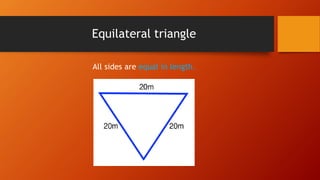
Equilateral triangle
All sides are equal in length.
Isosceles triangle
• Two sides are equal in length
𝐴𝐵 = 𝐴𝐶
Scalene triangle
• All sides have different lengths
Classification according to
Angles
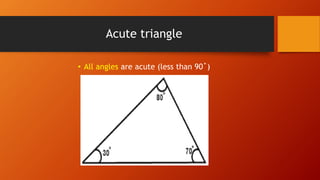
Acute triangle
• All angles are acute (less than 90˚)
Obtuse triangle
• One angle is obtuse (more than 90˚)
Obtuse angle
Right-angled triangle
• One angle is right-angled (equal to 90˚)
Equiangular triangle
• All angles are equal (60˚)
Angles of a triangle
• The sum of interior angles of a triangle add up to 180˚
What is the size of the missing angle?
𝐶 = 180˚ − 38˚ − 85˚ = 57˚
Exercise: Classify these triangles.
A B
Right-angled triangle Scalene
Exercise: Classify these triangles.
conti
Isosceles Obtuse triangle
C D
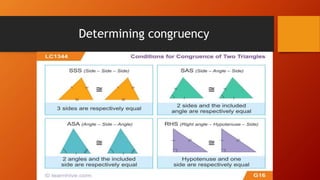
Conditions for congruency and similarity
Congruency
SSS
SAS
ASA
RHS
Similarity
AAA
SSS
SAS
Determining congruency
Determining Similarity
To check if you understand:
Access the link below for an activity on congruency and
similarity:
http://goo.gl/thJNqR

Classifying triangles