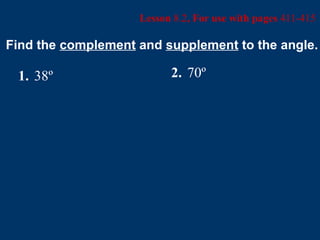
Lesson  8.2 , For use with pages  411-415 Find the  complement  and  supplement  to the angle. 1. 38º 2. 70º
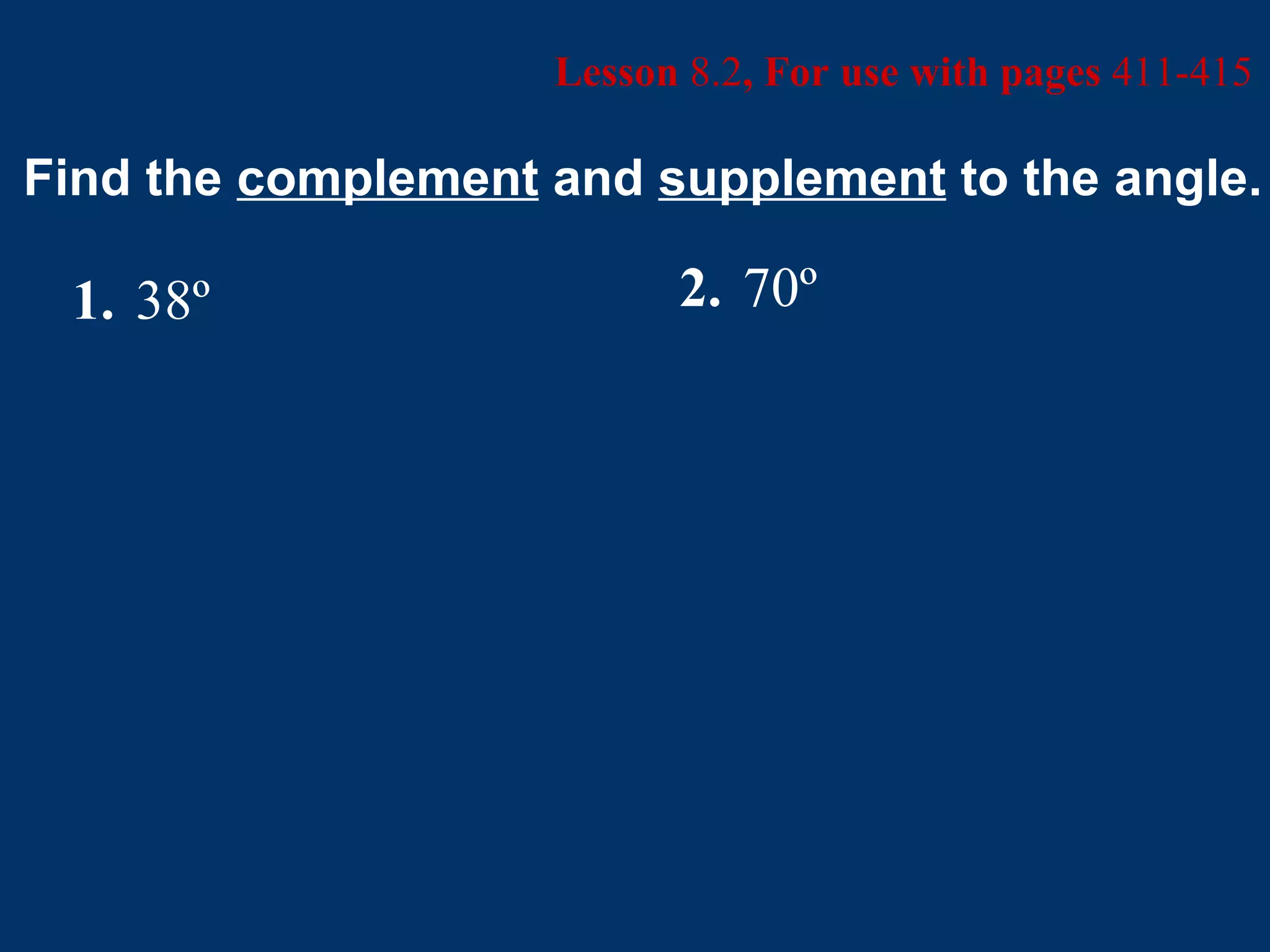
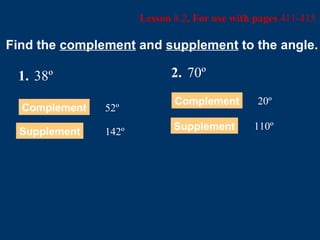
Lesson  8.2 , For use with pages  411-415 Find the  complement  and  supplement  to the angle. 1. 38º 2. 70º Complement 20º Complement 52º Supplement 142º Supplement 110º
8.2 Classifying Triangles
Essential Questions Why is it important to be able to identify congruent triangles in everyday life? Where in real life can you use the properties of isosceles and equilateral triangles? How are the relationships between lines and planes used in the real world? What areas in the real world are properties of parallel lines important?
Triangle: a closed figure with three sides made with line segments.
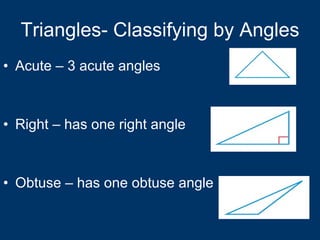
Triangles- Classifying by Angles Acute – 3 acute angles Right – has one right angle Obtuse – has one obtuse angle
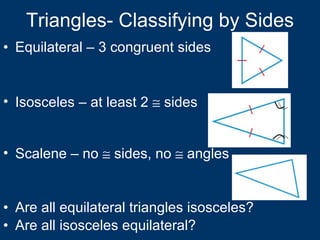
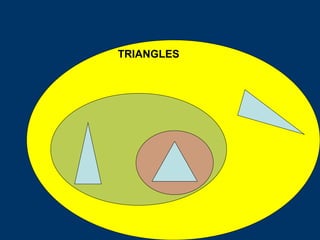
Triangles- Classifying by Sides Equilateral – 3 congruent sides Isosceles – at least 2    sides Scalene – no    sides, no    angles Are all equilateral triangles isosceles? Are all isosceles equilateral?
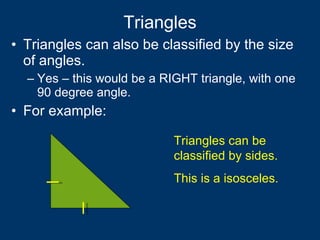
Triangles Triangles can also be classified by the size of angles. Yes – this would be a RIGHT triangle, with one 90 degree angle. For example: Triangles can be classified by sides. This is a isosceles.
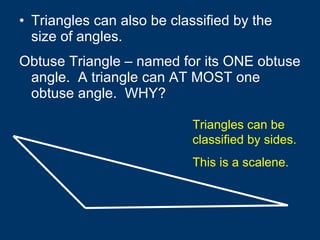
Triangles can also be classified by the size of angles. Obtuse Triangle – named for its ONE obtuse angle.  A triangle can AT MOST one obtuse angle.  WHY? Triangles can be classified by sides. This is a scalene.
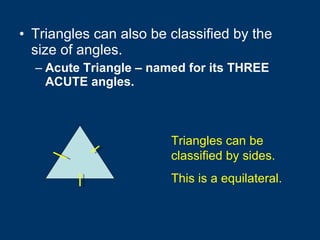
Triangles can also be classified by the size of angles. Acute Triangle – named for its THREE ACUTE angles.  Triangles can be classified by sides. This is a equilateral.
TRIANGLES Isosceles Equilateral Scalene
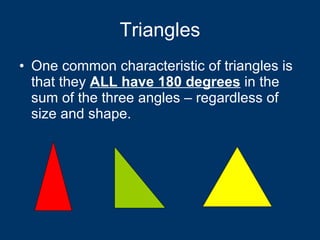
Triangles One common characteristic of triangles is that they  ALL have 180 degrees  in the sum of the three angles – regardless of size and shape.
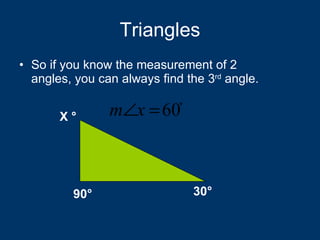
Triangles So if you know the measurement of 2 angles, you can always find the 3 rd  angle. 90 ° 30 ° X  ° °
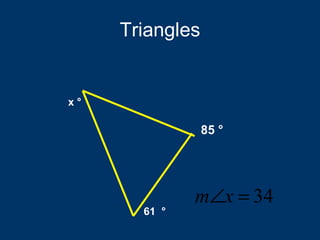
Triangles 85 ° 61  ° x °
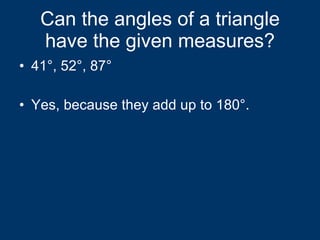
Can the angles of a triangle have the given measures? 41°, 52°, 87° Yes, because they add up to 180°.
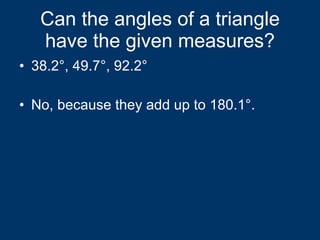
Can the angles of a triangle have the given measures? 38.2°, 49.7°, 92.2° No, because they add up to 180.1°.
Homework Page 413 #1-22, 29-31 Use pencil

8.2 classifying triangles 1

  • 1.
    Lesson 8.2, For use with pages 411-415 Find the complement and supplement to the angle. 1. 38º 2. 70º
  • 2.
    Lesson 8.2, For use with pages 411-415 Find the complement and supplement to the angle. 1. 38º 2. 70º Complement 20º Complement 52º Supplement 142º Supplement 110º
  • 3.
  • 4.
    Essential Questions Whyis it important to be able to identify congruent triangles in everyday life? Where in real life can you use the properties of isosceles and equilateral triangles? How are the relationships between lines and planes used in the real world? What areas in the real world are properties of parallel lines important?
  • 5.
    Triangle: a closedfigure with three sides made with line segments.
  • 6.
    Triangles- Classifying byAngles Acute – 3 acute angles Right – has one right angle Obtuse – has one obtuse angle
  • 7.
    Triangles- Classifying bySides Equilateral – 3 congruent sides Isosceles – at least 2  sides Scalene – no  sides, no  angles Are all equilateral triangles isosceles? Are all isosceles equilateral?
  • 8.
    Triangles Triangles canalso be classified by the size of angles. Yes – this would be a RIGHT triangle, with one 90 degree angle. For example: Triangles can be classified by sides. This is a isosceles.
  • 9.
    Triangles can alsobe classified by the size of angles. Obtuse Triangle – named for its ONE obtuse angle. A triangle can AT MOST one obtuse angle. WHY? Triangles can be classified by sides. This is a scalene.
  • 10.
    Triangles can alsobe classified by the size of angles. Acute Triangle – named for its THREE ACUTE angles. Triangles can be classified by sides. This is a equilateral.
  • 11.
  • 12.
    Triangles One commoncharacteristic of triangles is that they ALL have 180 degrees in the sum of the three angles – regardless of size and shape.
  • 13.
    Triangles So ifyou know the measurement of 2 angles, you can always find the 3 rd angle. 90 ° 30 ° X ° °
  • 14.
    Triangles 85 °61 ° x °
  • 15.
    Can the anglesof a triangle have the given measures? 41°, 52°, 87° Yes, because they add up to 180°.
  • 16.
    Can the anglesof a triangle have the given measures? 38.2°, 49.7°, 92.2° No, because they add up to 180.1°.
  • 17.
    Homework Page 413#1-22, 29-31 Use pencil