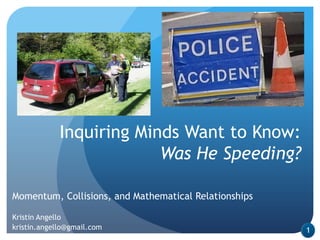
Inquiring Minds Want to Know:
                          Was He Speeding?

Momentum, Collisions, and Mathematical Relationships

Kristin Angello
kristin.angello@gmail.com                              1
Before Collision:

      TOWN POLICE
Automobile Collision Report
A Honda Odyssey minivan was
parked legally on the shoulder
of Tulip Road. A Toyota Corolla           Tulip Road
was turning onto Tulip Road from
Daisy Drive.        The Corolla


                                                       Daisy Drive
collided into the van broad side,
resulting in the van travelling
2.3 meters before coming to
rest.                               After Collision:
No skid marks were observed.
No witnesses, aside from the
driver of the Corolla, were


                                                       2.3m
present.   No injuries were
reported.
                                          Tulip Road


                                                            Daisy Dr.   2
Was Speed a Factor in this Crash?
The police need help in developing a method to determine the
speed of the car right before it hit the van.

What do we know about physics that could help the police
determine whether or not the driver was speeding?

 momentum = mass x velocity
 A change in momentum can be related to force

Consider this: What if we simulated
the crash in our lab? What if we
crashed the car into the van at
different velocities? What would that
tell us?

                                                               3
Goals of Laboratory Exercise
                            1. Students will develop a
                               laboratory procedure to
                               simulate a real-life
                               situation in the laboratory.


                         0.07
                                  Relationship Between Velocity of Car and
                                            Distance Van Moved
                         0.06                                                                      2. Students will interpret graphs
                                                                                                      to determine the mathematical
Distance Van Moved (m)


                         0.05


                         0.04
                                                                                                      relationship between two
                         0.03
                                                                                                      variables.
                                                                    y = 0.0188x + 0.0061
                         0.02

                                                                        R² = 0.95822
                                                                                                   3. Students will understand that
                         0.01
                                                                                                      the impulse imparted to an
                         0.00                                                                         object causes a change in its
                                                                                                      momentum.
                                0.00    0.50   1.00       1.50     2.00       2.50   3.00   3.50
                                                      Velocity of Car (m/s)

                                                                                                                                      4
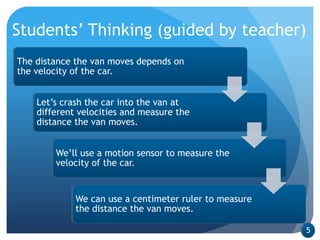
Students’ Thinking (guided by teacher)
The distance the van moves depends on
the velocity of the car.


    Let’s crash the car into the van at
    different velocities and measure the
    distance the van moves.


        We’ll use a motion sensor to measure the
        velocity of the car.


             We can use a centimeter ruler to measure
             the distance the van moves.

                                                        5
Student-Developed Procedure

                   Computer        Motion Detector
                 (Connected to
                Motion Detector)


“minivan”   “car”


                                                     6
Recording Data

                     Velocity of Car


Distance Van Moved
   After Collision

                                       7
Minimizing Error, Maximizing Success

  Each group will be     • Assigning velocities to each group
 assigned 2 different      will ensure that the class data will
                           cover a wide range of velocities
      velocities

                         • Students will verify their data with
 Each velocity will be     another group that took
 assigned to 2 groups      measurements at the same velocity


Each group will collect • Multiple trials will reduce the
 data at least 3 times    influence of data anomalies and
                          error
   for each velocity

                                                                  8
Students input their data into a
class spreadsheet


                                   9
Students develop a graph and a
“best fit” line, displaying the
equation of the line on the graph
                                        Relationship Between Velocity of Car and Distance Van Moved
                            7.0


                            6.0
  Distance Van Moved (cm)


                            5.0


                            4.0


                            3.0                                                                       Class Data
                                                                                                      Linear (Class Data)
                            2.0


                            1.0
                                                                                             y = 0.0188x + 0.0061
                                                                                                 R² = 0.95822
                            0.0
                                  0.0       0.5    1.0      1.5        2.0       2.5   3.0    3.5
                                                         Velocity of Car (m/s)


                                                                                                                            10
Post-Lab Discussion
 What are your observations about the best fit line? Why do
  you think it depicts a linear relationship rather than a
  logarithmic or quadratic relationship?

 Using the equation we developed, can you estimate how far
  the van would move if the car had a velocity of 1.0m/s?

 Would this equation work for Lego cars of different masses?
  Why not? How can we use the class data to develop a chart
  for momentum of car vs. distance van moved? How could
  that information be useful to crash scene investigators?

 How can what we learned today help the police develop a
  method to determine if the driver of the car was speeding?


                                                                11
References
Laboratory exercise adapted from:
Bonneau, Jacklyn. (2007). Forensics with Vernier. Sargent-Welch, New
  York.

Images:
Slide 1: http://local.stv.tv/aberdeen/news/24840-man-suffers-minor-injuries-as-
  van-collides-with-wall/

Slide 2:http://www.seedsofgrowth.com/the-power-of-realtime-feedback-for-your-
  business

Slide 4: http://oregonstate.edu/terra/2008/09/pipeline-to-science/

Slide 9:
  http://www.visualphotos.com/image/2x4778942/germany_emmering_students_us
  ing_computer_in


                                                                                  12

Angello module 3.9 inquiry

  • 1.
    Inquiring Minds Wantto Know: Was He Speeding? Momentum, Collisions, and Mathematical Relationships Kristin Angello kristin.angello@gmail.com 1
  • 2.
    Before Collision: TOWN POLICE Automobile Collision Report A Honda Odyssey minivan was parked legally on the shoulder of Tulip Road. A Toyota Corolla Tulip Road was turning onto Tulip Road from Daisy Drive. The Corolla Daisy Drive collided into the van broad side, resulting in the van travelling 2.3 meters before coming to rest. After Collision: No skid marks were observed. No witnesses, aside from the driver of the Corolla, were 2.3m present. No injuries were reported. Tulip Road Daisy Dr. 2
  • 3.
    Was Speed aFactor in this Crash? The police need help in developing a method to determine the speed of the car right before it hit the van. What do we know about physics that could help the police determine whether or not the driver was speeding?  momentum = mass x velocity  A change in momentum can be related to force Consider this: What if we simulated the crash in our lab? What if we crashed the car into the van at different velocities? What would that tell us? 3
  • 4.
    Goals of LaboratoryExercise 1. Students will develop a laboratory procedure to simulate a real-life situation in the laboratory. 0.07 Relationship Between Velocity of Car and Distance Van Moved 0.06 2. Students will interpret graphs to determine the mathematical Distance Van Moved (m) 0.05 0.04 relationship between two 0.03 variables. y = 0.0188x + 0.0061 0.02 R² = 0.95822 3. Students will understand that 0.01 the impulse imparted to an 0.00 object causes a change in its momentum. 0.00 0.50 1.00 1.50 2.00 2.50 3.00 3.50 Velocity of Car (m/s) 4
  • 5.
    Students’ Thinking (guidedby teacher) The distance the van moves depends on the velocity of the car. Let’s crash the car into the van at different velocities and measure the distance the van moves. We’ll use a motion sensor to measure the velocity of the car. We can use a centimeter ruler to measure the distance the van moves. 5
  • 6.
    Student-Developed Procedure Computer Motion Detector (Connected to Motion Detector) “minivan” “car” 6
  • 7.
    Recording Data Velocity of Car Distance Van Moved After Collision 7
  • 8.
    Minimizing Error, MaximizingSuccess Each group will be • Assigning velocities to each group assigned 2 different will ensure that the class data will cover a wide range of velocities velocities • Students will verify their data with Each velocity will be another group that took assigned to 2 groups measurements at the same velocity Each group will collect • Multiple trials will reduce the data at least 3 times influence of data anomalies and error for each velocity 8
  • 9.
    Students input theirdata into a class spreadsheet 9
  • 10.
    Students develop agraph and a “best fit” line, displaying the equation of the line on the graph Relationship Between Velocity of Car and Distance Van Moved 7.0 6.0 Distance Van Moved (cm) 5.0 4.0 3.0 Class Data Linear (Class Data) 2.0 1.0 y = 0.0188x + 0.0061 R² = 0.95822 0.0 0.0 0.5 1.0 1.5 2.0 2.5 3.0 3.5 Velocity of Car (m/s) 10
  • 11.
    Post-Lab Discussion  Whatare your observations about the best fit line? Why do you think it depicts a linear relationship rather than a logarithmic or quadratic relationship?  Using the equation we developed, can you estimate how far the van would move if the car had a velocity of 1.0m/s?  Would this equation work for Lego cars of different masses? Why not? How can we use the class data to develop a chart for momentum of car vs. distance van moved? How could that information be useful to crash scene investigators?  How can what we learned today help the police develop a method to determine if the driver of the car was speeding? 11
  • 12.
    References Laboratory exercise adaptedfrom: Bonneau, Jacklyn. (2007). Forensics with Vernier. Sargent-Welch, New York. Images: Slide 1: http://local.stv.tv/aberdeen/news/24840-man-suffers-minor-injuries-as- van-collides-with-wall/ Slide 2:http://www.seedsofgrowth.com/the-power-of-realtime-feedback-for-your- business Slide 4: http://oregonstate.edu/terra/2008/09/pipeline-to-science/ Slide 9: http://www.visualphotos.com/image/2x4778942/germany_emmering_students_us ing_computer_in 12

Editor's Notes

  • #3 This slide is what will be used to capture ideas from the Bell Ringer/DIN.
  • #7 Focus of the day’s lesson
  • #8 Focus of the day’s lesson
  • #10 Students should populate this. This will be left on the screen during the activity as a reminder as to what the scientific method is.
  • #11 Students should populate this. This will be left on the screen during the activity as a reminder as to what the scientific method is.
  • #13 Try this…2 carts, 1 stationary, 1 with velocity. Crash them. What happened to the stationary cart? It moved! What happened to the car that had velocity? It slowed down. What happened to the momentum? Yes, it was transferred!(set animation so that “momentum is transferred” is not visible at first)