Text: Physics: Principles & Problems, Merrill-Glencoe

                                            NYS STANDARD/KEY IDEA/PERFORMANCE
 MONTH            CONTENT                             INDICATOR 5.1 a-e                                                          LAB THEMES/SKILLS

                                                                                                                         LAB THEMES:
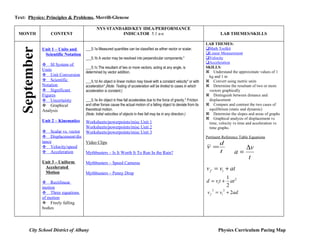
                                     ___5.1a Measured quantities can be classified as either vector or scalar.            Toolkit
                                                                                                                         Math       
  September
              Unit 1 – Units and
               Scientific Notation                                                                                       
                                                                                                                         Linear Measurement 
                                     ___5.1b A vector may be resolved into perpendicular components.*                     
                                                                                                                         Velocity
                                                                                                                         
                                                                                                                         Acceleration
                                                                                                                                    
              SI System 
                        of
                                     ___5.1c The resultant of two or more vectors, acting at any angle, is               SKILLS:
              Units                                                                                                      Understand the approximate values of 1
                                     determined by vector addition.
              Unit Conversion
                                                                                                                      kg and 1 m
              Scientific
                                 ___5.1d An object in linear motion may travel with a constant velocity* or with     Convert using metric units
              Notation               acceleration*.(Note: Testing of acceleration will be limited to cases in which      Determine the resultant of two or more
              Significant
                                 acceleration is constant.)                                                           vectors graphically
              Figures                                                                                                    Distinguish between distance and
              Uncertainty
                                 ___5.1e An object in free fall accelerates due to the force of gravity.* Friction    displacement
              Graphical            and other forces cause the actual motion of a falling object to deviate from its    Compare and contrast the two cases of
              Analysis               theoretical motion.                                                                  equilibrium (static and dynamic)
                                     (Note: Initial velocities of objects in free fall may be in any direction.)         Determine the slopes and areas of graphs
                                                                                                                         Graphical analysis of displacement vs
              Unit 2 – Kinematics    Worksheets/powerpoints/misc Unit 1                                                   time, velocity vs time and acceleration vs
                                     Worksheets/powerpoints/misc Unit 2                                                   time graphs.
              Scalar vs. vector
                                 Worksheets/powerpoints/misc Unit 3
              Displacement/dis
                                                                                                                     Pertinent Reference Table Equations
              tance               Video Clips                                                                                    d
              Velocity/speed
                                                                                                                     v =                    ∆v
              Acceleration
                              Mythbusters – Is It Worth It To Run In the Rain?                                               t       a=
                                                                                                                                                 t
              Unit 3 – Uniform       Mythbusters – Speed Cameras
               Accelerated                                                                                               v f = vi + at
               Motion                Mythbusters – Penny Drop
                                                                                                                                  1
              Rectilinear
                                                                                                                     d = vit + at 2
              motion                                                                                                              2
                                                                                                                            2      2
              Three equations
                                                                                                                     v f = vi + 2ad
              of motion
              Freely falling
              bodies


       City School District of Albany                                                                                           Physics Curriculum Pacing Map
Text: Physics: Principles & Problems, Merrill-Glencoe

                                         NYS STANDARD/KEY IDEA/PERFORMANCE
 MONTH          CONTENT                                                                                                       LAB THEMES/SKILLS
                                                   INDICATOR 5.1b-u
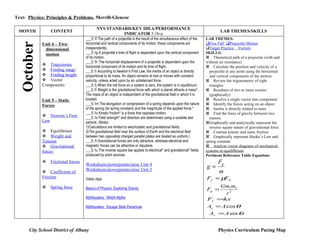
                                  ___5.1f The path of a projectile is the result of the simultaneous effect of the   LAB THEMES:
                                  horizontal and vertical components of its motion; these components act              Fall 
                                                                                                                     Free  Projectile Motion     
  October
            Unit 4 – Two-
             dimensional          independently.                                                                     Target Practice Vectors
             motion               ___5.1g A projectile’s time of flight is dependent upon the vertical component     SKILLS:
                                  of its motion.                                                                     Theoretical path of a projectile (with and
                                  ___5.1h The horizontal displacement of a projectile is dependent upon the          without air resistance)
            Trajectories        horizontal component of its motion and its time of flight.                         Calculate the position and velocity of a
            Finding range       ___5.1i According to Newton’s First Law, the inertia of an object is directly        projectile at any point using the horizontal
            Finding height      proportional to its mass. An object remains at rest or moves with constant           and vertical components of the motion
            Vector              velocity, unless acted upon by an unbalanced force.                                Review the trigonometry of right
            Components            ___5.1j When the net force on a system is zero, the system is in equilibrium.        triangles
                                  ___5.1l Weight is the gravitational force with which a planet attracts a mass*.    Resultant of two or more vectors
                                  The mass of an object is independent of the gravitational field in which it is       (graphically)
            Unit 5 – Static       located.                                                                           Resolve a single vector into component
            Forces                ___5.1m The elongation or compression of a spring depends upon the nature          Identify the forces acting on an object
                                  of the spring (its spring constant) and the magnitude of the applied force.*       Inertia is directly related to mass
                                  ___5.1o Kinetic friction* is a force that opposes motion.                          Find the force of gravity between two
            Newton’s First      ___5.1s Field strength* and direction are determined using a suitable test           masses
            Law                   particle. (Notes:                                                                  Graphically and analytically represent the
                                  1)Calculations are limited to electrostatic and gravitational fields.                inverse square nature of gravitational force
            Equilibrium         2)The gravitational field near the surface of Earth and the electrical field       Contrast kinetic and static friction
            Weight and          between two oppositely charged parallel plates are treated as uniform.)            Graphically represent Hooke’s Law and
            Tension               ___5.1t Gravitational forces are only attractive, whereas electrical and           spring constant
            Gravitational       magnetic forces can be attractive or repulsive.                                    Analyze vector diagrams of mechanical
                                                                                                                                                             
            forces                ___5.1u The inverse square law applies to electrical* and gravitational* fields    systems in equililbrium
                                  produced by point sources.                                                         Pertinent Reference Table Equations
            Frictional forces
                                  Worksheets/powerpoints/misc Unit 4                                                        Fg
                                  Worksheets/powerpoints/misc Unit 5
                                                                                                                     g=
            Coefficient of                                                                                                 m
            Friction              Video clips                                                                        F f = µFN
            Spring force                                                                                               Gm1m2
                                  Basics of Physics: Exploring Gravity                                               Fg =
                                                                                                                            r2
                                  Mythbusters: NASA Myths                                                            Fs =kx
                                  Mythbusters: Escape Slide Parachute                                                Ax = A cosθ
                                                                                                                       Ay = A sin θ


      City School District of Albany                                                                                        Physics Curriculum Pacing Map
Text: Physics: Principles & Problems, Merrill-Glencoe


                                            NYS STANDARD/KEY IDEA/PERFORMANCE
 MONTH            CONTENT                                                                                                   LAB THEMES/SKILLS
                                                    INDICATOR 5.1 k,n,p,q,r
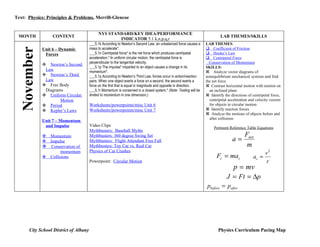
                                       ___5.1k According to Newton’s Second Law, an unbalanced force causes a      LAB THEMES:
                                       mass to accelerate*.                                                        Coefficient of Friction
                                                                                                                                           
  November
             Unit 6 – Dynamic
              Forces                   ___5.1n Centripetal force* is the net force which produces centripetal      Hooke’s Law
                                                                                                                                  
                                       acceleration.* In uniform circular motion, the centripetal force is         Centripetal Force
                                                                                                                                      
                                       perpendicular to the tangential velocity.                                    onservation of Momentum
                                                                                                                     C
             Newton’s Second
                                       ___5.1p The impulse* imparted to an object causes a change in its           SKILLS:
              Law                      momentum*.                                                                  Analyze vector diagrams of
             Newton’s Third          ___5.1q According to Newton’s Third Law, forces occur in action/reaction    nonequilibrium mechanical systems and find
              Law                      pairs. When one object exerts a force on a second, the second exerts a      the net force
             Free Body               force on the first that is equal in magnitude and opposite in direction.     Contrast horizontal motion with motion on
              Diagrams                 ___5.1r Momentum is conserved in a closed system.* (Note: Testing will be      an inclined plane
             Uniform Circular        limited to momentum in one dimension.)                                       Identify the directions of centripetal force,
                     Motion                                                                                           centripetal acceleration and velocity vectors
             Period                  Worksheets/powerpoints/misc Unit 6                                             for objects in circular motion
             Kepler’s Laws           Worksheets/powerpoints/misc Unit 7                                           Identify reaction forces
                                                                                                                    Analyze the motions of objects before and
                                                                                                                      after collisions
             Unit 7 – Momentum
              and Impulse              Video Clips
                                                                                                                        Pertinent Reference Table Equations
                                       Mythbusters: Baseball Myths
             Momentum
                                   Mythbusters: 360 degree Swing Set                                                                   Fnet
             Impulse
                                   Mythbusters: Flight Attendant Free Fall                                                      a=
             Conservation 
                         of         Mythbusters: Toy Car vs. Real Car                                                                    m
                                       Physics of Car Crashes
                     momentum                                                                                                                         v2
             Collisions
                                                                                                                     Fc = mac                ac =
                                       Powerpoint: Circular Motion                                                                                    r
                                                                                                                                    p = mv
                                                                                                                                J = Ft = ∆p
                                                                                                                    pbefore = pafter


      City School District of Albany                                                                                       Physics Curriculum Pacing Map
Text: Physics: Principles & Problems, Merrill-Glencoe

                                       NYS STANDARD/KEY IDEA/PERFORMANCE
 MONTH            CONTENT                                                   LAB THEMES/SKILLS
                                                 INDICATOR 4.1 a-i


      City School District of Albany                                       Physics Curriculum Pacing Map
Text: Physics: Principles & Problems, Merrill-Glencoe

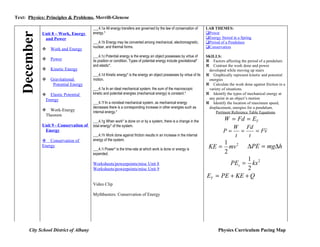
                                        ___4.1a All energy transfers are governed by the law of conservation of       LAB THEMES:
  December   Unit 8 – Work, Energy      energy.*                                                                       
                                                                                                                      Power
              and Power                                                                                               
                                                                                                                      Energy Stored in a Spring
                                                                                                                                              
                                        ___4.1b Energy may be converted among mechanical, electromagnetic,            
                                                                                                                      Period of a Pendulum
                                                                                                                                          
                                        nuclear, and thermal forms.                                                   
                                                                                                                      Conservation
                                                                                                                                  
             Work and Energy
                                        ___4.1c Potential energy is the energy an object possesses by virtue of       SKILLS:
             Power                    its position or condition. Types of potential energy include gravitational*   Factors affecting the period of a pendulum
                                        and elastic*.                                                                 Contrast the work done and power
             Kinetic Energy                                                                                          developed while moving up stairs
                                        ___4.1d Kinetic energy* is the energy an object possesses by virtue of its    Graphically represent kinetic and potential
             Gravitational            motion.                                                                        energies
                Potential Energy                                                                                      Calculate the work done against friction in a
                                        ___4.1e In an ideal mechanical system, the sum of the macroscopic              variety of situations
             Elastic Potential        kinetic and potential energies (mechanical energy) is constant.*              Identify the types of mechanical energy at
              Energy                                                                                                   any point in an object’s motion
                                        ___4.1f In a nonideal mechanical system, as mechanical energy                 Identify the location of maximum speed,
                                        decreases there is a corresponding increase in other energies such as          displacement, energies for a pendulum.
             Work-Energy              internal energy.*                                                                  Pertinent Reference Table Equations
              Theorem
                                        ___4.1g When work* is done on or by a system, there is a change in the                  W = Fd = ET
             Unit 9 - Conservation of   total energy* of the system.                                                                  W Fd
              Energy                                                                                                            P=      =   = Fv
                                        ___4.1h Work done against friction results in an increase in the internal                     t   t
             Conservation 
                         of          energy of the system.
                                                                                                                                 1 2
             Energy
                                        ___4.1i Power* is the time-rate at which work is done or energy is             KE =        mv         ∆PE = mg∆h
                                        expended.                                                                                2
                                                                                                                                    1 2
                                        Worksheets/powerpoints/misc Unit 8                                                          PEs =
                                                                                                                                      kx
                                        Worksheets/powerpoints/misc Unit 9                                                          2
                                                                                                                      ET = PE + KE + Q
                                        Video Clip

                                        Mythbusters: Conservation of Energy


      City School District of Albany                                                                                         Physics Curriculum Pacing Map
Text: Physics: Principles & Problems, Merrill-Glencoe


      City School District of Albany                    Physics Curriculum Pacing Map
Text: Physics: Principles & Problems, Merrill-Glencoe

                                        NYS STANDARD/KEY IDEA/PERFORMANCE
 MONTH             CONTENT                                                   LAB THEMES/SKILLS
                                                 INDICATOR 4.1j, 5.1s-u


      City School District of Albany                                        Physics Curriculum Pacing Map
Text: Physics: Principles & Problems, Merrill-Glencoe

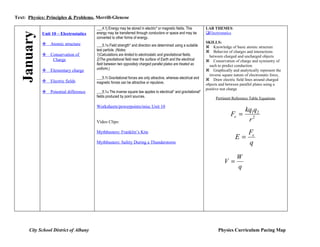
                                       ___4.1j Energy may be stored in electric* or magnetic fields. This         LAB THEMES:
  January   Unit 10 – Electrostatics   energy may be transferred through conductors or space and may be           
                                                                                                                  Electrostatics
                                                                                                                              
                                       converted to other forms of energy.
            Atomic structure
                                                                                                              SKILLS:
                                       ___5.1s Field strength* and direction are determined using a suitable      Knowledge of basic atomic structure
                                       test particle. (Notes:                                                     Behavior of charges and interactions
            Conservation 
                        of          1)Calculations are limited to electrostatic and gravitational fields.        between charged and uncharged objects
               Charge                  2)The gravitational field near the surface of Earth and the electrical     Conservation of charge and symmetry of
                                       field between two oppositely charged parallel plates are treated as          such to predict conduction
            Elementary charge
                                   uniform.)                                                                  Graphically and analytically represent the
                                                                                                                    inverse square nature of electrostatic force
                                       ___5.1t Gravitational forces are only attractive, whereas electrical and   Draw electric field lines around charged
            Electric fields
                                   magnetic forces can be attractive or repulsive.                            objects and between parallel plates using a
                                                                                                                  positive test charge
            Potential difference
                                   ___5.1u The inverse square law applies to electrical* and gravitational*
                                       fields produced by point sources.                                                Pertinent Reference Table Equations

                                       Worksheets/powerpoints/misc Unit 10
                                                                                                                                          kq1q2
                                                                                                                                 Fe =
                                       Video Clips:                                                                                        r2
                                       Mythbusters: Franklin’s Kite                                                                         Fe
                                                                                                                                    E=
                                       Mythbusters: Safety During a Thunderstorm                                                            q
                                                                                                                                    W
                                                                                                                             V =
                                                                                                                                    q


      City School District of Albany                                                                                     Physics Curriculum Pacing Map
Text: Physics: Principles & Problems, Merrill-Glencoe

                                          NYS STANDARD/KEY IDEA/PERFORMANCE
 MONTH              CONTENT                                                                                                LAB THEMES/SKILLS
                                                    INDICATOR 4.1 n,o
                                                                                                                  LAB THEMES:
                                                                                                                  
                                                                                                                  Using Multimeters 
  February
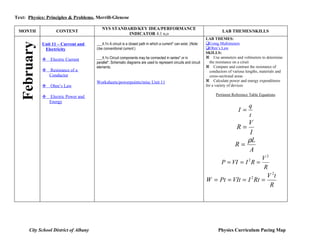
             Unit 11 – Current and     ___4.1n A circuit is a closed path in which a current* can exist. (Note:
              Electricity              Use conventional current.)                                                 
                                                                                                                  Ohm’s Law   
                                                                                                                  SKILLS:
                                       ___4.1o Circuit components may be connected in series* or in               Use ammeters and voltmeters to determine
             Electric Current
                         
                                       parallel*. Schematic diagrams are used to represent circuits and circuit     the resistance on a ciruit
                                       elements.                                                                  Compare and contrast the resistance of
             Resistance of a
                                                                                                                conductors of various lengths, materials and
               Conductor                                                                                            cross-sectional areas
                                       Worksheets/powerpoints/misc Unit 11                                        Calculate power and energy expenditures
             Ohm’s Law
                                                                                                              for a variety of devices

             Electric Power and
                                                                                                                    Pertinent Reference Table Equations
               Energy
                                                                                                                                           q
                                                                                                                                     I=
                                                                                                                                           t
                                                                                                                                      V
                                                                                                                                    R=
                                                                                                                                       I
                                                                                                                                      ρL
                                                                                                                                   R=
                                                                                                                                       A
                                                                                                                                      V2
                                                                                                                      P = VI = I R =       2

                                                                                                                                       R
                                                                                                                                        V 2t
                                                                                                                  W = Pt = VIt = I Rt =
                                                                                                                                  2

                                                                                                                                         R


      City School District of Albany                                                                                     Physics Curriculum Pacing Map
Text: Physics: Principles & Problems, Merrill-Glencoe

                                        NYS STANDARD/KEY IDEA/PERFORMANCE
 MONTH             CONTENT                                                    LAB THEMES/SKILLS
                                                INDICATOR 4.1 j 5.1 t,u


      City School District of Albany                                        Physics Curriculum Pacing Map
Text: Physics: Principles & Problems, Merrill-Glencoe

                                       ___4.1j Energy may be stored in electric* or magnetic fields. This         LAB THEMES:
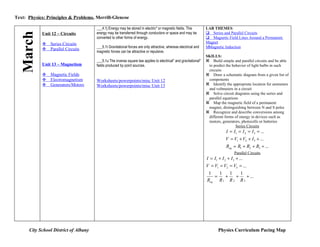
  March     Unit 12 – Circuits         energy may be transferred through conductors or space and may be           Series and Parallel Circuits
                                                                                                                                          
                                       converted to other forms of energy.                                        Magnetic Field Lines Around a Permanent
                                                                                                                                                      
            Series Circuits
                                                                                                              Magnet
                                       ___5.1t Gravitational forces are only attractive, whereas electrical and   MMagnetic Induction
            Parallel Circuits
                         
                                       magnetic forces can be attractive or repulsive.
                                                                                                                  SKILLS:
                                       ___5.1u The inverse square law applies to electrical* and gravitational*   Build simple and parallel circuits and be able
            Unit 13 – Magnetism        fields produced by point sources.                                           to predict the behavior of light bulbs in such
                                                                                                                   circuits
            Magnetic Fields
                                                                                                              Draw a schematic diagram from a given list of
            Electromagnetism
                                   Worksheets/powerpoints/misc Unit 12                                         components
            Generators/Motors
                                   Worksheets/powerpoints/misc Unit 13                                        Identify the appropriate location for ammeters
                                                                                                                   and voltmeters in a circuit
                                                                                                                  Solve circuit diagrams using the series and
                                                                                                                   parallel equations
                                                                                                                  Map the magnetic field of a permanent
                                                                                                                   magnet, distinguishing between N and S poles
                                                                                                                  Recognize and describe conversions among
                                                                                                                   different forms of energy in devices such as
                                                                                                                   motors, generators, photocells or batteries
                                                                                                                                    Series Circuits
                                                                                                                               I = I1 = I 2 = I 3 = ...
                                                                                                                              V = V1 + V2 + I 3 + ...
                                                                                                                               Req = R1 + R2 + R3 + ...
                                                                                                                                    Parallel Circuits
                                                                                                                  I = I1 + I 2 + I 3 + ...
                                                                                                                  V = V1 = V2 = V3 = ...
                                                                                                                   1   1   1   1
                                                                                                                     =   +   +    + ...
                                                                                                                  Req R 1 R 2 R 3


      City School District of Albany                                                                                     Physics Curriculum Pacing Map
Text: Physics: Principles & Problems, Merrill-Glencoe


                                       NYS STANDARD/KEY IDEA/PERFORMANCE
 MONTH              CONTENT                                                                                                    LAB THEMES/SKILLS
                                                 INDICATOR 4.3a-k
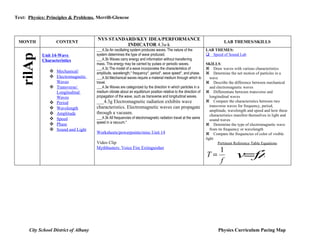
                                       ___4.3a An oscillating system produces waves. The nature of the             LAB THEMES:
                                       system determines the type of wave produced.                                Speed of Sound Lab
                                                                                                                                  
  rilAp
            Unit 14-Wave
            Characteristics            ___4.3b Waves carry energy and information without transferring
                                       mass. This energy may be carried by pulses or periodic waves.               SKILLS:
                                       ___4.3c The model of a wave incorporates the characteristics of             Draw waves with various characteristics
                 Mechanical/          amplitude, wavelength,* frequency*, period*, wave speed*, and phase.        Determine the net motion of particles in a
                 Electromagnetic      ___4.3d Mechanical waves require a material medium through which to            wave
                    Waves              travel.                                                                     Describe the difference between mechanical
                 Transverse/          ___4.3e Waves are categorized by the direction in which particles in a         and electromagnetic waves
                    Longitudinal       medium vibrate about an equilibrium position relative to the direction of   Differentiate between transverse and
                    Waves              propagation of the wave, such as transverse and longitudinal waves.            longitudinal waves
                   Period             ___4.3g Electromagnetic radiation exhibits wave                             Compare the characteristics between two
                                       characteristics. Electromagnetic waves can propagate                           transverse waves for frequency, period,
                   Wavelength
                                                                                                                      amplitude, wavelength and speed and how these
                   Amplitude          through a vacuum.                                                              characteristics manifest themselves in light and
                   Speed              ___4.3k All frequencies of electromagnetic radiation travel at the same
                                                                                                                      sound waves
                   Phase              speed in a vacuum.*
                                                                                                                   Determine the type of electromagnetic wave
                   Sound and Light                                                                                   from its frequency or wavelength
                                       Worksheets/powerpoints/misc Unit 14                                         Compare the frequencies of color of visible
                                                                                                                   light
                                       Video Clip                                                                          Pertinent Reference Table Equations
                                       Mythbusters: Voice Fire Extinguisher
                                                                                                                   T=
                                                                                                                           1
                                                                                                                           f
                                                                                                                                      v=fλ


      City School District of Albany                                                                                      Physics Curriculum Pacing Map
Text: Physics: Principles & Problems, Merrill-Glencoe

                                        NYS STANDARD/KEY IDEA/PERFORMANCE
 MONTH             CONTENT                                                                                                  LAB THEMES/SKILLS
                                                  INDICATOR 4.3f-n
            Unit 15 - Wave Behaviors                                                                         LAB THEMES:
                                                                                                             
                                                                                                             Reflection of Light 
                                                                                                                                   Refraction of Light
                                                                                                                                                       
  May
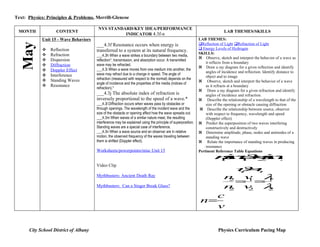
                                       ___4.3f Resonance occurs when energy is
            Reflection                                                                                     
                                                                                                              Energy Levels of Hydrogen  
                                       transferred to a system at its natural frequency.
            Refraction                                                                                     SKILLS:
                                       ___4.3h When a wave strikes a boundary between two media,
                                                                                                             Observe, sketch and interpret the behavior of a wave as
            Dispersion               reflection*, transmission, and absorption occur. A transmitted
                                                                                                                 it reflects from a boundary
            Diffraction              wave may be refracted.
                                                                                                             Draw a ray diagram for a given reflection and identify
            Doppler Effect           ___4.3i When a wave moves from one medium into another, the
                                                                                                                 angles of incidence and reflection. Identify distance to
            Interference             wave may refract due to a change in speed. The angle of
                                                                                                                 object and to image
            Standing Waves           refraction (measured with respect to the normal) depends on the
                                                                                                              Observe, sketch and interpret the behavior of a wave
                                       angle of incidence and the properties of the media (indices of
            Resonance                                                                                          as it refracts at a boundary
                                       refraction).*
                                                                                                              Draw a ray diagram for a given refraction and identify
                                       ___4.3j The absolute index of refraction is                               angles of incidence and refraction.
                                       inversely proportional to the speed of a wave.*                        Describe the relationship of a wavelength to that of the
                                       ___4.3l Diffraction occurs when waves pass by obstacles or                size of the opening or obstacle causing diffraction
                                       through openings. The wavelength of the incident wave and the         Describe the relationship between source, observer
                                       size of the obstacle or opening affect how the wave spreads out.          with respect to frequency, wavelength and speed
                                       ___4.3m When waves of a similar nature meet, the resulting                (Doppler effect)
                                       interference may be explained using the principle of superposition.   Predict the superposition of two waves interfering
                                       Standing waves are a special case of interference.                        constructively and destructively
                                       ___4.3n When a wave source and an observer are in relative            Determine amplitude, phase, nodes and antinodes of a
                                       motion, the observed frequency of the waves traveling between             standing wave
                                       them is shifted (Doppler effect).                                      Relate the importance of standing waves in producing
                                                                                                                 resonance

                                                                                                                                  ϑ                       ϑ
                                       Worksheets/powerpoints/misc Unit 15                                   Pertinent Reference Table Equations
                                                                                                                      s =i
                                                                                                                      n 1n 2
                                                                                                                      1n
                                                                                                                       i 2n
                                                                                                                          s
                                       Video Clip
                                                                                                                                  ϑϑ
                                                                                                                                   =  i           r
                                       Mythbusters: Ancient Death Ray                                                       n   v  λ
                                                                                                                             2
                                                                                                                               = 1= 1
                                       Mythbusters: Can a Singer Break Glass?                                               n v
                                                                                                                             2   2 λ2
                                                                                                                        c
                                                                                                              n=
                                                                                                                        v


      City School District of Albany                                                                                     Physics Curriculum Pacing Map
Text: Physics: Principles & Problems, Merrill-Glencoe


                                              NYS STANDARD/KEY IDEA/PERFORMANCE
 MONTH             CONTENT                                                                                                        LAB THEMES/SKILLS
                                                        INDICATOR 5.3a-i
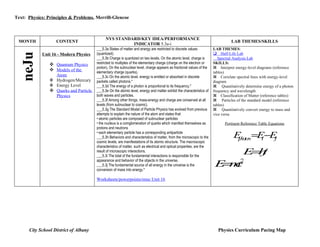
                                        ___5.3a States of matter and energy are restricted to discrete values           LAB THEMES:
                                        (quantized).                                                                    Half-Life Lab
                                                                                                                                    
  neJu
            Unit 16 - Modern Physics
                                        ___5.3b Charge is quantized on two levels. On the atomic level, charge is        Spectral Analysis Lab
                                                                                                                          
                 Quantum Physics       restricted to multiples of the elementary charge (charge on the electron or     SKILLS:
                                        proton). On the subnuclear level, charge appears as fractional values of the    Interpret energy-level diagrams (reference
                 Models of the         elementary charge (quarks).                                                     tables)
                  Atom                  ___5.3c On the atomic level, energy is emitted or absorbed in discrete          Correlate spectral lines with energy-level
                 Hydrogen/Mercury      packets called photons.*                                                        diagram
                 Energy Level          ___5.3d The energy of a photon is proportional to its frequency.*                Quantitatively determine energy of a photon
                 Quarks and Particle   ___5.3e On the atomic level, energy and matter exhibit the characteristics of   frequency and wavelength
                  Physics               both waves and particles.                                                       Classification of Matter (reference tables)
                                        ___5.3f Among other things, mass-energy and charge are conserved at all          Particles of the standard model (reference
                                        levels (from subnuclear to cosmic).                                             tables)
                                        ___5.3g The Standard Model of Particle Physics has evolved from previous         Quantitatively convert energy to mass and
                                        attempts to explain the nature of the atom and states that:                     vice versa
                                        • atomic particles are composed of subnuclear particles
                                        • the nucleus is a comglomeration of quarks which manifest themselves as              Pertinent Reference Table Equations
                                        protons and neutrons
                                        • each elementary particle has a corresponding antiparticle
                                        ___5.3h Behaviors and characteristics of matter, from the microscopic to the               Ehoton =E−E
                                                                                                                                    p       i f
                                        cosmic levels, are manifestations of its atomic structure. The macroscopic
                                        characteristics of matter, such as electrical and optical properties, are the
                                        result of microscopic interactions.
                                        ___5.3i The total of the fundamental interactions is responsible for the
                                                                                                                                          =f
                                                                                                                                         E h
                                                                                                                          =c
                                        appearance and behavior of the objects in the universe.
                                        ___5.3j The fundamental source of all energy in the universe is the
                                        conversion of mass into energy.*
                                                                                                                         E m2
                                        Worksheets/powerpoints/misc Unit 16


      City School District of Albany                                                                                      Physics Curriculum Pacing Map

Regents Physics Pacing Map

  • 1.
    Text: Physics: Principles& Problems, Merrill-Glencoe NYS STANDARD/KEY IDEA/PERFORMANCE MONTH CONTENT INDICATOR 5.1 a-e LAB THEMES/SKILLS LAB THEMES: ___5.1a Measured quantities can be classified as either vector or scalar.  Toolkit Math  September Unit 1 – Units and Scientific Notation  Linear Measurement  ___5.1b A vector may be resolved into perpendicular components.*   Velocity  Acceleration  SI System   of ___5.1c The resultant of two or more vectors, acting at any angle, is SKILLS: Units Understand the approximate values of 1 determined by vector addition. Unit Conversion   kg and 1 m Scientific   ___5.1d An object in linear motion may travel with a constant velocity* or with Convert using metric units Notation acceleration*.(Note: Testing of acceleration will be limited to cases in which Determine the resultant of two or more Significant   acceleration is constant.) vectors graphically Figures Distinguish between distance and Uncertainty   ___5.1e An object in free fall accelerates due to the force of gravity.* Friction displacement Graphical and other forces cause the actual motion of a falling object to deviate from its Compare and contrast the two cases of Analysis theoretical motion. equilibrium (static and dynamic) (Note: Initial velocities of objects in free fall may be in any direction.) Determine the slopes and areas of graphs Graphical analysis of displacement vs Unit 2 – Kinematics Worksheets/powerpoints/misc Unit 1 time, velocity vs time and acceleration vs Worksheets/powerpoints/misc Unit 2 time graphs. Scalar vs. vector   Worksheets/powerpoints/misc Unit 3 Displacement/dis   Pertinent Reference Table Equations tance Video Clips d Velocity/speed   v = ∆v Acceleration   Mythbusters – Is It Worth It To Run In the Rain? t a= t Unit 3 – Uniform Mythbusters – Speed Cameras Accelerated v f = vi + at Motion Mythbusters – Penny Drop 1 Rectilinear   d = vit + at 2 motion 2 2 2 Three equations   v f = vi + 2ad of motion Freely falling bodies City School District of Albany Physics Curriculum Pacing Map
  • 2.
    Text: Physics: Principles& Problems, Merrill-Glencoe NYS STANDARD/KEY IDEA/PERFORMANCE MONTH CONTENT LAB THEMES/SKILLS INDICATOR 5.1b-u ___5.1f The path of a projectile is the result of the simultaneous effect of the LAB THEMES: horizontal and vertical components of its motion; these components act  Fall  Free  Projectile Motion  October Unit 4 – Two- dimensional independently. Target Practice Vectors motion ___5.1g A projectile’s time of flight is dependent upon the vertical component SKILLS: of its motion. Theoretical path of a projectile (with and ___5.1h The horizontal displacement of a projectile is dependent upon the without air resistance) Trajectories horizontal component of its motion and its time of flight. Calculate the position and velocity of a Finding range ___5.1i According to Newton’s First Law, the inertia of an object is directly projectile at any point using the horizontal Finding height proportional to its mass. An object remains at rest or moves with constant and vertical components of the motion Vector velocity, unless acted upon by an unbalanced force. Review the trigonometry of right Components ___5.1j When the net force on a system is zero, the system is in equilibrium. triangles ___5.1l Weight is the gravitational force with which a planet attracts a mass*. Resultant of two or more vectors The mass of an object is independent of the gravitational field in which it is (graphically) Unit 5 – Static located. Resolve a single vector into component Forces ___5.1m The elongation or compression of a spring depends upon the nature Identify the forces acting on an object of the spring (its spring constant) and the magnitude of the applied force.* Inertia is directly related to mass ___5.1o Kinetic friction* is a force that opposes motion. Find the force of gravity between two Newton’s First ___5.1s Field strength* and direction are determined using a suitable test masses Law particle. (Notes: Graphically and analytically represent the 1)Calculations are limited to electrostatic and gravitational fields. inverse square nature of gravitational force Equilibrium 2)The gravitational field near the surface of Earth and the electrical field Contrast kinetic and static friction Weight and between two oppositely charged parallel plates are treated as uniform.) Graphically represent Hooke’s Law and Tension ___5.1t Gravitational forces are only attractive, whereas electrical and spring constant Gravitational magnetic forces can be attractive or repulsive. Analyze vector diagrams of mechanical   forces ___5.1u The inverse square law applies to electrical* and gravitational* fields systems in equililbrium produced by point sources. Pertinent Reference Table Equations Frictional forces Worksheets/powerpoints/misc Unit 4 Fg Worksheets/powerpoints/misc Unit 5 g= Coefficient of m Friction Video clips F f = µFN Spring force Gm1m2 Basics of Physics: Exploring Gravity Fg = r2 Mythbusters: NASA Myths Fs =kx Mythbusters: Escape Slide Parachute Ax = A cosθ Ay = A sin θ City School District of Albany Physics Curriculum Pacing Map
  • 3.
    Text: Physics: Principles& Problems, Merrill-Glencoe NYS STANDARD/KEY IDEA/PERFORMANCE MONTH CONTENT LAB THEMES/SKILLS INDICATOR 5.1 k,n,p,q,r ___5.1k According to Newton’s Second Law, an unbalanced force causes a LAB THEMES: mass to accelerate*. Coefficient of Friction   November Unit 6 – Dynamic Forces ___5.1n Centripetal force* is the net force which produces centripetal Hooke’s Law   acceleration.* In uniform circular motion, the centripetal force is Centripetal Force   perpendicular to the tangential velocity.  onservation of Momentum C Newton’s Second ___5.1p The impulse* imparted to an object causes a change in its SKILLS: Law momentum*. Analyze vector diagrams of Newton’s Third ___5.1q According to Newton’s Third Law, forces occur in action/reaction nonequilibrium mechanical systems and find Law pairs. When one object exerts a force on a second, the second exerts a the net force Free Body force on the first that is equal in magnitude and opposite in direction.  Contrast horizontal motion with motion on Diagrams ___5.1r Momentum is conserved in a closed system.* (Note: Testing will be an inclined plane Uniform Circular limited to momentum in one dimension.)  Identify the directions of centripetal force, Motion centripetal acceleration and velocity vectors Period Worksheets/powerpoints/misc Unit 6 for objects in circular motion Kepler’s Laws Worksheets/powerpoints/misc Unit 7  Identify reaction forces  Analyze the motions of objects before and after collisions Unit 7 – Momentum and Impulse Video Clips Pertinent Reference Table Equations Mythbusters: Baseball Myths Momentum   Mythbusters: 360 degree Swing Set Fnet Impulse   Mythbusters: Flight Attendant Free Fall a= Conservation   of Mythbusters: Toy Car vs. Real Car m Physics of Car Crashes momentum v2 Collisions   Fc = mac ac = Powerpoint: Circular Motion r p = mv J = Ft = ∆p pbefore = pafter City School District of Albany Physics Curriculum Pacing Map
  • 4.
    Text: Physics: Principles& Problems, Merrill-Glencoe NYS STANDARD/KEY IDEA/PERFORMANCE MONTH CONTENT LAB THEMES/SKILLS INDICATOR 4.1 a-i City School District of Albany Physics Curriculum Pacing Map
  • 5.
    Text: Physics: Principles& Problems, Merrill-Glencoe ___4.1a All energy transfers are governed by the law of conservation of LAB THEMES: December Unit 8 – Work, Energy energy.*   Power and Power  Energy Stored in a Spring  ___4.1b Energy may be converted among mechanical, electromagnetic,  Period of a Pendulum  nuclear, and thermal forms.  Conservation  Work and Energy ___4.1c Potential energy is the energy an object possesses by virtue of SKILLS: Power its position or condition. Types of potential energy include gravitational* Factors affecting the period of a pendulum and elastic*. Contrast the work done and power Kinetic Energy developed while moving up stairs ___4.1d Kinetic energy* is the energy an object possesses by virtue of its Graphically represent kinetic and potential Gravitational motion. energies Potential Energy Calculate the work done against friction in a ___4.1e In an ideal mechanical system, the sum of the macroscopic variety of situations Elastic Potential kinetic and potential energies (mechanical energy) is constant.* Identify the types of mechanical energy at Energy any point in an object’s motion ___4.1f In a nonideal mechanical system, as mechanical energy Identify the location of maximum speed, decreases there is a corresponding increase in other energies such as displacement, energies for a pendulum. Work-Energy internal energy.* Pertinent Reference Table Equations Theorem ___4.1g When work* is done on or by a system, there is a change in the W = Fd = ET Unit 9 - Conservation of total energy* of the system. W Fd Energy P= = = Fv ___4.1h Work done against friction results in an increase in the internal t t Conservation   of energy of the system. 1 2 Energy ___4.1i Power* is the time-rate at which work is done or energy is KE = mv ∆PE = mg∆h expended. 2 1 2 Worksheets/powerpoints/misc Unit 8 PEs = kx Worksheets/powerpoints/misc Unit 9 2 ET = PE + KE + Q Video Clip Mythbusters: Conservation of Energy City School District of Albany Physics Curriculum Pacing Map
  • 6.
    Text: Physics: Principles& Problems, Merrill-Glencoe City School District of Albany Physics Curriculum Pacing Map
  • 7.
    Text: Physics: Principles& Problems, Merrill-Glencoe NYS STANDARD/KEY IDEA/PERFORMANCE MONTH CONTENT LAB THEMES/SKILLS INDICATOR 4.1j, 5.1s-u City School District of Albany Physics Curriculum Pacing Map
  • 8.
    Text: Physics: Principles& Problems, Merrill-Glencoe ___4.1j Energy may be stored in electric* or magnetic fields. This LAB THEMES: January Unit 10 – Electrostatics energy may be transferred through conductors or space and may be  Electrostatics  converted to other forms of energy. Atomic structure   SKILLS: ___5.1s Field strength* and direction are determined using a suitable Knowledge of basic atomic structure test particle. (Notes: Behavior of charges and interactions Conservation   of 1)Calculations are limited to electrostatic and gravitational fields. between charged and uncharged objects Charge 2)The gravitational field near the surface of Earth and the electrical Conservation of charge and symmetry of field between two oppositely charged parallel plates are treated as such to predict conduction Elementary charge   uniform.) Graphically and analytically represent the inverse square nature of electrostatic force ___5.1t Gravitational forces are only attractive, whereas electrical and Draw electric field lines around charged Electric fields   magnetic forces can be attractive or repulsive. objects and between parallel plates using a positive test charge Potential difference   ___5.1u The inverse square law applies to electrical* and gravitational* fields produced by point sources. Pertinent Reference Table Equations Worksheets/powerpoints/misc Unit 10 kq1q2 Fe = Video Clips: r2 Mythbusters: Franklin’s Kite Fe E= Mythbusters: Safety During a Thunderstorm q W V = q City School District of Albany Physics Curriculum Pacing Map
  • 9.
    Text: Physics: Principles& Problems, Merrill-Glencoe NYS STANDARD/KEY IDEA/PERFORMANCE MONTH CONTENT LAB THEMES/SKILLS INDICATOR 4.1 n,o LAB THEMES:  Using Multimeters  February Unit 11 – Current and ___4.1n A circuit is a closed path in which a current* can exist. (Note: Electricity Use conventional current.)  Ohm’s Law  SKILLS: ___4.1o Circuit components may be connected in series* or in Use ammeters and voltmeters to determine Electric Current   parallel*. Schematic diagrams are used to represent circuits and circuit the resistance on a ciruit elements. Compare and contrast the resistance of Resistance of a   conductors of various lengths, materials and Conductor cross-sectional areas Worksheets/powerpoints/misc Unit 11 Calculate power and energy expenditures Ohm’s Law   for a variety of devices Electric Power and   Pertinent Reference Table Equations Energy q I= t V R= I ρL R= A V2 P = VI = I R = 2 R V 2t W = Pt = VIt = I Rt = 2 R City School District of Albany Physics Curriculum Pacing Map
  • 10.
    Text: Physics: Principles& Problems, Merrill-Glencoe NYS STANDARD/KEY IDEA/PERFORMANCE MONTH CONTENT LAB THEMES/SKILLS INDICATOR 4.1 j 5.1 t,u City School District of Albany Physics Curriculum Pacing Map
  • 11.
    Text: Physics: Principles& Problems, Merrill-Glencoe ___4.1j Energy may be stored in electric* or magnetic fields. This LAB THEMES: March Unit 12 – Circuits energy may be transferred through conductors or space and may be Series and Parallel Circuits   converted to other forms of energy. Magnetic Field Lines Around a Permanent   Series Circuits   Magnet ___5.1t Gravitational forces are only attractive, whereas electrical and MMagnetic Induction Parallel Circuits   magnetic forces can be attractive or repulsive. SKILLS: ___5.1u The inverse square law applies to electrical* and gravitational* Build simple and parallel circuits and be able Unit 13 – Magnetism fields produced by point sources. to predict the behavior of light bulbs in such circuits Magnetic Fields   Draw a schematic diagram from a given list of Electromagnetism   Worksheets/powerpoints/misc Unit 12 components Generators/Motors   Worksheets/powerpoints/misc Unit 13 Identify the appropriate location for ammeters and voltmeters in a circuit Solve circuit diagrams using the series and parallel equations Map the magnetic field of a permanent magnet, distinguishing between N and S poles Recognize and describe conversions among different forms of energy in devices such as motors, generators, photocells or batteries Series Circuits I = I1 = I 2 = I 3 = ... V = V1 + V2 + I 3 + ... Req = R1 + R2 + R3 + ... Parallel Circuits I = I1 + I 2 + I 3 + ... V = V1 = V2 = V3 = ... 1 1 1 1 = + + + ... Req R 1 R 2 R 3 City School District of Albany Physics Curriculum Pacing Map
  • 12.
    Text: Physics: Principles& Problems, Merrill-Glencoe NYS STANDARD/KEY IDEA/PERFORMANCE MONTH CONTENT LAB THEMES/SKILLS INDICATOR 4.3a-k ___4.3a An oscillating system produces waves. The nature of the LAB THEMES: system determines the type of wave produced. Speed of Sound Lab   rilAp Unit 14-Wave Characteristics ___4.3b Waves carry energy and information without transferring mass. This energy may be carried by pulses or periodic waves. SKILLS: ___4.3c The model of a wave incorporates the characteristics of Draw waves with various characteristics  Mechanical/ amplitude, wavelength,* frequency*, period*, wave speed*, and phase. Determine the net motion of particles in a  Electromagnetic ___4.3d Mechanical waves require a material medium through which to wave Waves travel. Describe the difference between mechanical  Transverse/ ___4.3e Waves are categorized by the direction in which particles in a and electromagnetic waves Longitudinal medium vibrate about an equilibrium position relative to the direction of Differentiate between transverse and Waves propagation of the wave, such as transverse and longitudinal waves. longitudinal waves  Period ___4.3g Electromagnetic radiation exhibits wave Compare the characteristics between two characteristics. Electromagnetic waves can propagate transverse waves for frequency, period,  Wavelength amplitude, wavelength and speed and how these  Amplitude through a vacuum. characteristics manifest themselves in light and  Speed ___4.3k All frequencies of electromagnetic radiation travel at the same sound waves  Phase speed in a vacuum.* Determine the type of electromagnetic wave  Sound and Light from its frequency or wavelength Worksheets/powerpoints/misc Unit 14 Compare the frequencies of color of visible light Video Clip Pertinent Reference Table Equations Mythbusters: Voice Fire Extinguisher T= 1 f v=fλ City School District of Albany Physics Curriculum Pacing Map
  • 13.
    Text: Physics: Principles& Problems, Merrill-Glencoe NYS STANDARD/KEY IDEA/PERFORMANCE MONTH CONTENT LAB THEMES/SKILLS INDICATOR 4.3f-n Unit 15 - Wave Behaviors LAB THEMES:  Reflection of Light   Refraction of Light  May ___4.3f Resonance occurs when energy is Reflection   Energy Levels of Hydrogen  transferred to a system at its natural frequency. Refraction SKILLS: ___4.3h When a wave strikes a boundary between two media, Observe, sketch and interpret the behavior of a wave as Dispersion reflection*, transmission, and absorption occur. A transmitted it reflects from a boundary Diffraction wave may be refracted. Draw a ray diagram for a given reflection and identify Doppler Effect ___4.3i When a wave moves from one medium into another, the angles of incidence and reflection. Identify distance to Interference wave may refract due to a change in speed. The angle of object and to image Standing Waves refraction (measured with respect to the normal) depends on the  Observe, sketch and interpret the behavior of a wave angle of incidence and the properties of the media (indices of Resonance as it refracts at a boundary refraction).*  Draw a ray diagram for a given refraction and identify ___4.3j The absolute index of refraction is angles of incidence and refraction. inversely proportional to the speed of a wave.*  Describe the relationship of a wavelength to that of the ___4.3l Diffraction occurs when waves pass by obstacles or size of the opening or obstacle causing diffraction through openings. The wavelength of the incident wave and the Describe the relationship between source, observer size of the obstacle or opening affect how the wave spreads out. with respect to frequency, wavelength and speed ___4.3m When waves of a similar nature meet, the resulting (Doppler effect) interference may be explained using the principle of superposition. Predict the superposition of two waves interfering Standing waves are a special case of interference. constructively and destructively ___4.3n When a wave source and an observer are in relative Determine amplitude, phase, nodes and antinodes of a motion, the observed frequency of the waves traveling between standing wave them is shifted (Doppler effect).  Relate the importance of standing waves in producing resonance ϑ ϑ Worksheets/powerpoints/misc Unit 15 Pertinent Reference Table Equations s =i n 1n 2 1n i 2n s Video Clip ϑϑ = i r Mythbusters: Ancient Death Ray n v λ 2 = 1= 1 Mythbusters: Can a Singer Break Glass? n v 2 2 λ2 c n= v City School District of Albany Physics Curriculum Pacing Map
  • 14.
    Text: Physics: Principles& Problems, Merrill-Glencoe NYS STANDARD/KEY IDEA/PERFORMANCE MONTH CONTENT LAB THEMES/SKILLS INDICATOR 5.3a-i ___5.3a States of matter and energy are restricted to discrete values LAB THEMES: (quantized). Half-Life Lab   neJu Unit 16 - Modern Physics ___5.3b Charge is quantized on two levels. On the atomic level, charge is  Spectral Analysis Lab   Quantum Physics restricted to multiples of the elementary charge (charge on the electron or SKILLS: proton). On the subnuclear level, charge appears as fractional values of the Interpret energy-level diagrams (reference  Models of the elementary charge (quarks). tables) Atom ___5.3c On the atomic level, energy is emitted or absorbed in discrete Correlate spectral lines with energy-level  Hydrogen/Mercury packets called photons.* diagram  Energy Level ___5.3d The energy of a photon is proportional to its frequency.*  Quantitatively determine energy of a photon  Quarks and Particle ___5.3e On the atomic level, energy and matter exhibit the characteristics of frequency and wavelength Physics both waves and particles. Classification of Matter (reference tables) ___5.3f Among other things, mass-energy and charge are conserved at all  Particles of the standard model (reference levels (from subnuclear to cosmic). tables) ___5.3g The Standard Model of Particle Physics has evolved from previous  Quantitatively convert energy to mass and attempts to explain the nature of the atom and states that: vice versa • atomic particles are composed of subnuclear particles • the nucleus is a comglomeration of quarks which manifest themselves as Pertinent Reference Table Equations protons and neutrons • each elementary particle has a corresponding antiparticle ___5.3h Behaviors and characteristics of matter, from the microscopic to the Ehoton =E−E p i f cosmic levels, are manifestations of its atomic structure. The macroscopic characteristics of matter, such as electrical and optical properties, are the result of microscopic interactions. ___5.3i The total of the fundamental interactions is responsible for the =f E h =c appearance and behavior of the objects in the universe. ___5.3j The fundamental source of all energy in the universe is the conversion of mass into energy.* E m2 Worksheets/powerpoints/misc Unit 16 City School District of Albany Physics Curriculum Pacing Map