PLANNING and HAVING CUSTOMER
CONVERSATIONS
March 7th, 2012


Andrew Rudin,
Managing Principal, Outside Technologies, Inc.
Certified Social Media Strategist

www.outsidetechnologies.com

703.371.1242 (mobile)
arudin@outsidetechnologies.com
www.xeeme.com/andyrudin
Who is our facilitator,
and why is he here?
                                       Andy Rudin
• 20 + years B2B sales experience in
commercial, government, non-profit
• Focus on sales strategy & execution
• Work with technology companies
• MS in management information technology
from University of Virginia
• Certified Social Media Strategist (2010)
Key Problems to Solve


How to discover information that matters, and
 how to use it to produce outcomes that are
 valuable for you and for your customer.
What this workshop is—and isn’t
  Is:
  • an interactive forum to share ideas and best
  practices to help advance your business goals
  • A set of frameworks you don’t have to
  memorize, and that you can use repeatedly in
  a wide range of situations
  Isn’t:
  • a tutorial that’s designed to turn everyone
  into sales pros
  • A set of recommendations that will
  undermine what you already do well
  • Proprietary shelf-ware
Customers
+ Engagement
Today’s Roadmap
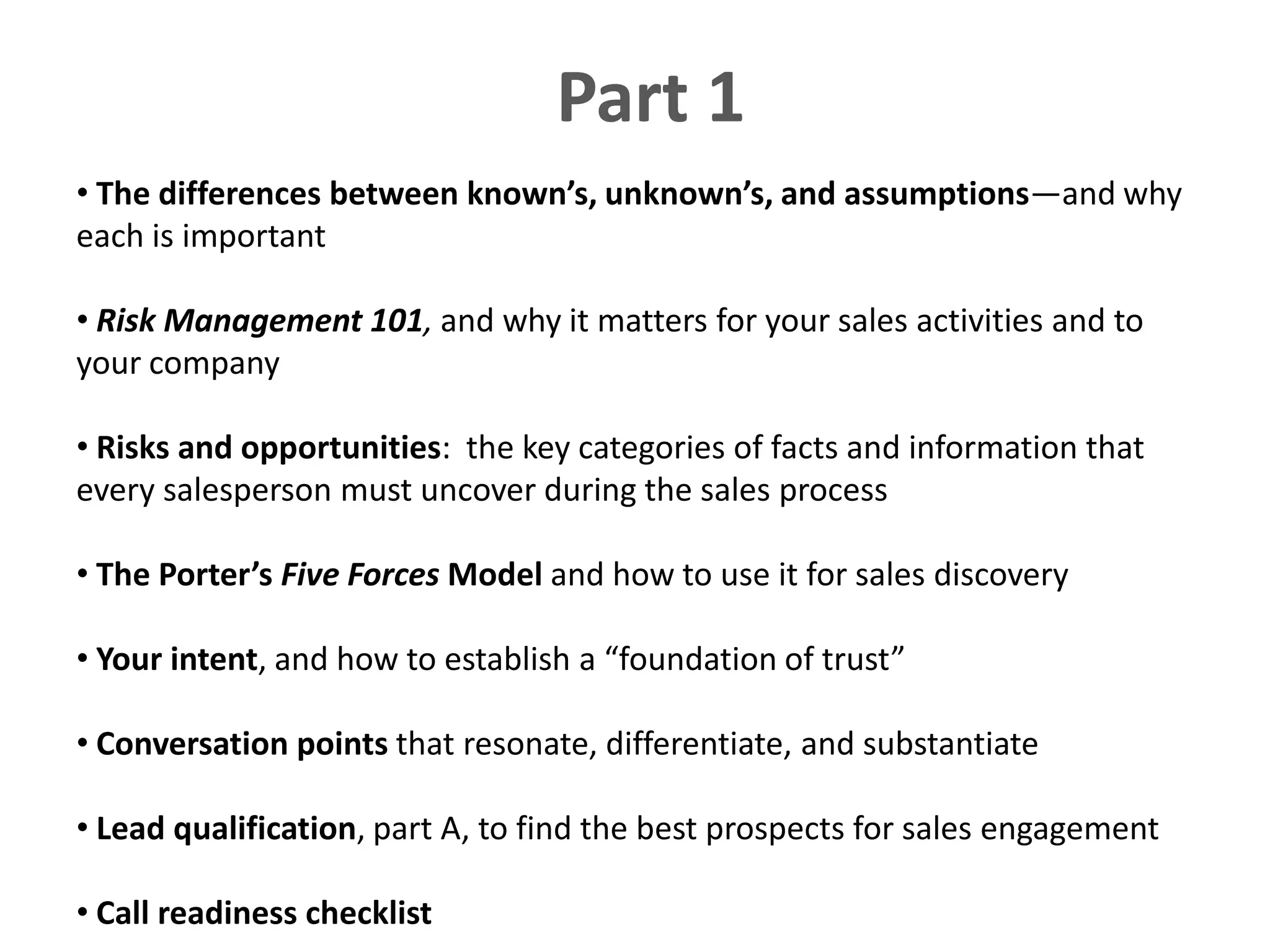
Part 1
• The differences between known’s, unknown’s, and assumptions—and why
each is important

• Risk Management 101, and why it matters for your sales activities and to
your company

• Risks and opportunities: the key categories of facts and information that
every salesperson must uncover during the sales process

• The Porter’s Five Forces Model and how to use it for sales discovery

• Your intent, and how to establish a “foundation of trust”

• Conversation points that resonate, differentiate, and substantiate

• Lead qualification, part A, to find the best prospects for sales engagement

• Call readiness checklist
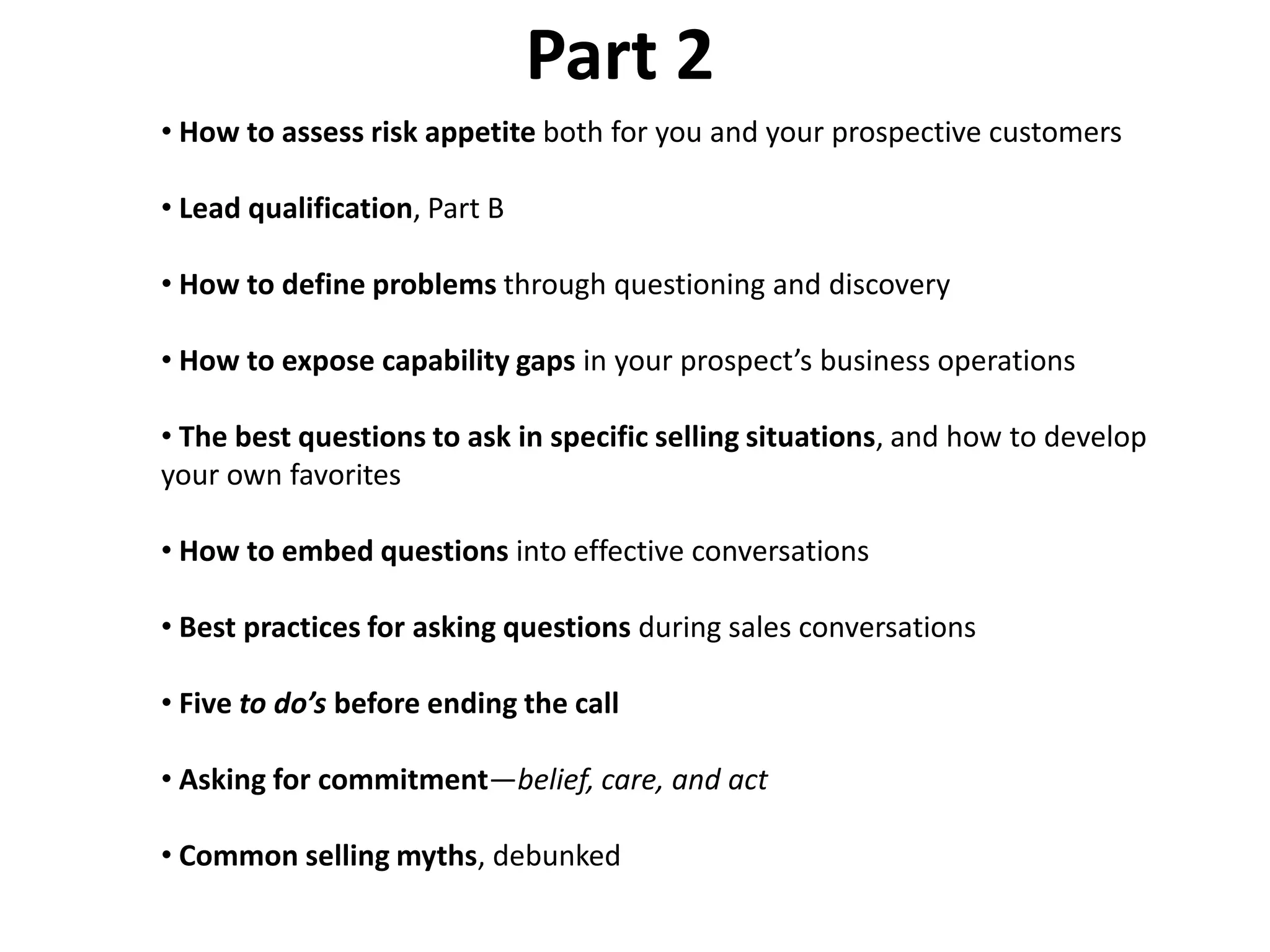
Part 2
• How to assess risk appetite both for you and your prospective customers

• Lead qualification, Part B

• How to define problems through questioning and discovery

• How to expose capability gaps in your prospect’s business operations

• The best questions to ask in specific selling situations, and how to develop
your own favorites

• How to embed questions into effective conversations

• Best practices for asking questions during sales conversations

• Five to do’s before ending the call

• Asking for commitment—belief, care, and act

• Common selling myths, debunked
Part 3
•Nurturing interest and conversations after the call

•Providing value and eliminating friction: integrating the buying and
selling process

•Reciprocal expectations for following through on commitments

•Ensuring ongoing interest and interaction
Part 1
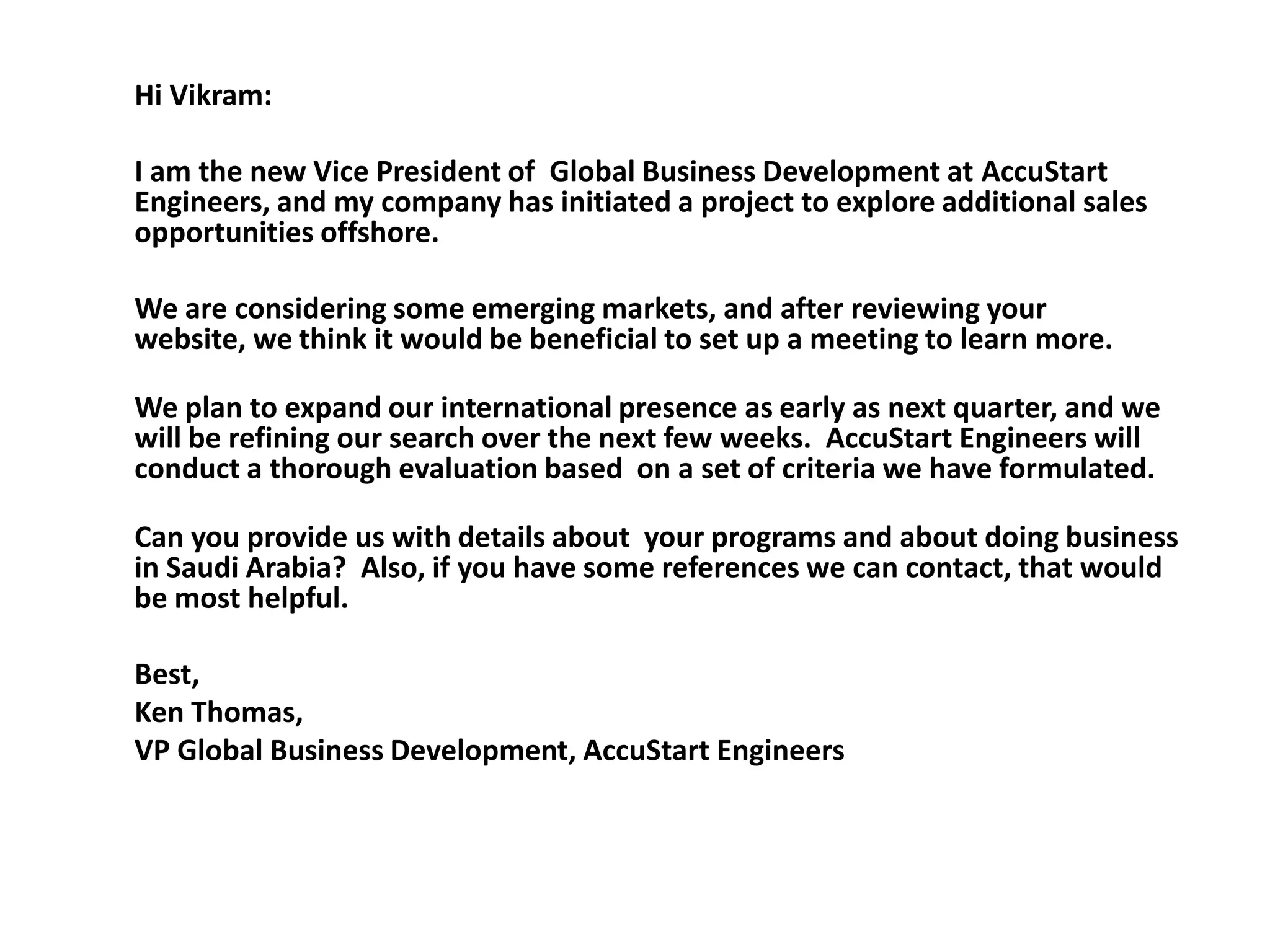
Hi Vikram:

I am the new Vice President of Global Business Development at AccuStart
Engineers, and my company has initiated a project to explore additional sales
opportunities offshore.

We are considering some emerging markets, and after reviewing your
website, we think it would be beneficial to set up a meeting to learn more.

We plan to expand our international presence as early as next quarter, and we
will be refining our search over the next few weeks. AccuStart Engineers will
conduct a thorough evaluation based on a set of criteria we have formulated.

Can you provide us with details about your programs and about doing business
in Saudi Arabia? Also, if you have some references we can contact, that would
be most helpful.

Best,
Ken Thomas,
VP Global Business Development, AccuStart Engineers
1-minute Exercise:

Write down the first three questions
that come to mind.

Note: there are no “right” or “wrong”
questions.
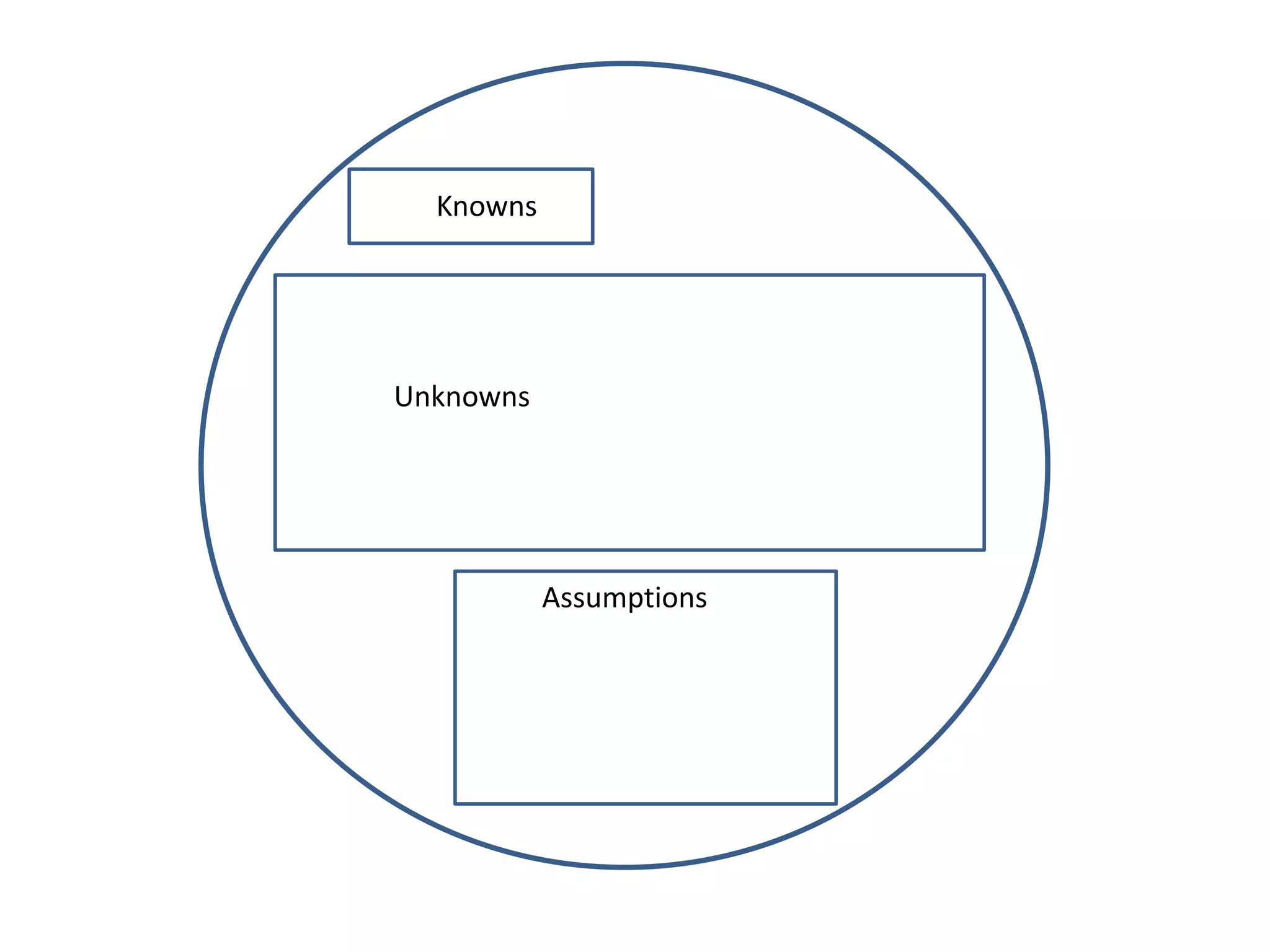
Knowns


Unknowns


           Assumptions
5-minute Exercise:

When you begin your first sales
conversation,

Which assumptions do you have?
What’s typically known?
What’s typically unknown?
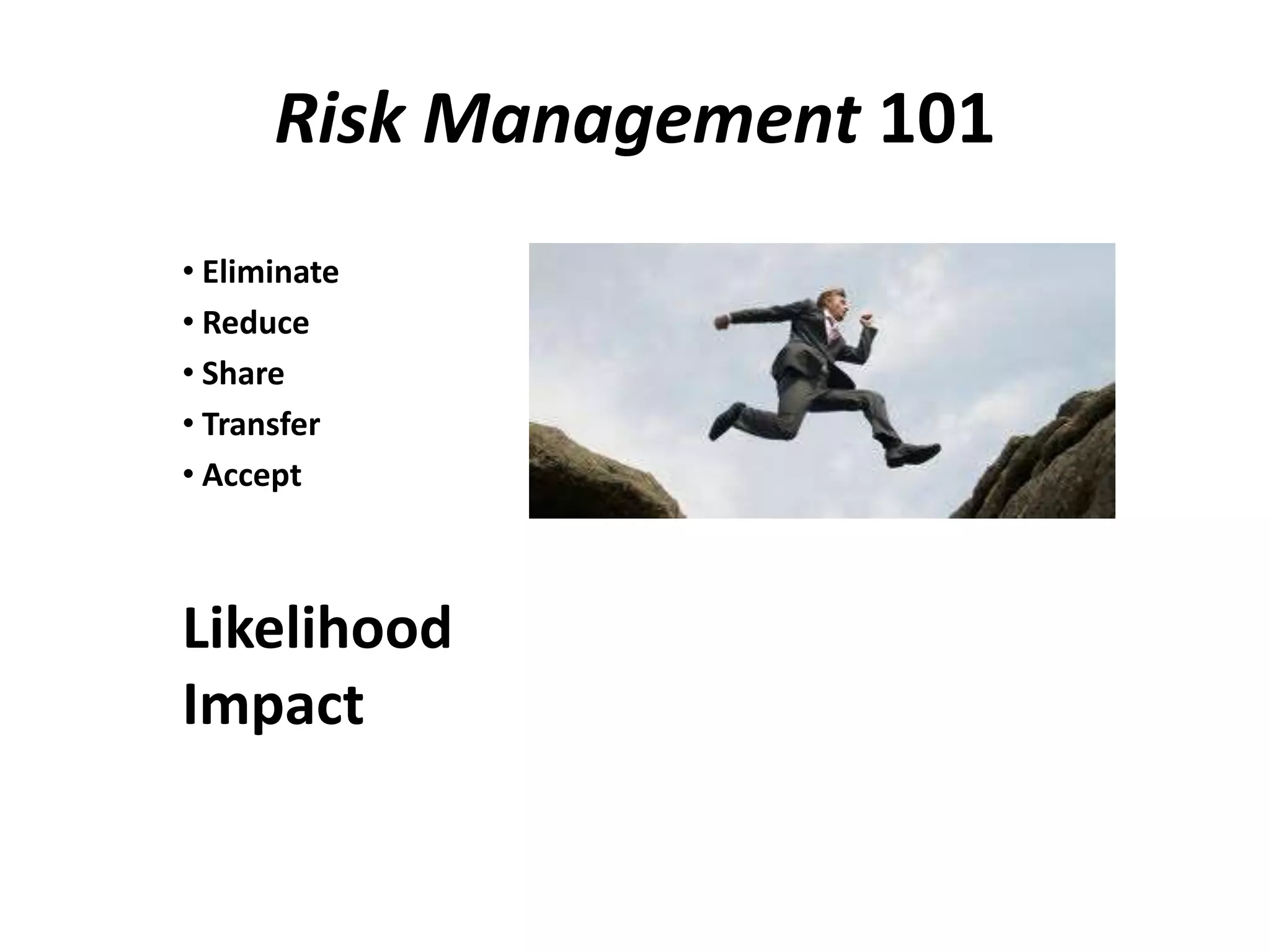
Risk Management 101
• Eliminate
• Reduce
• Share
• Transfer
• Accept


Likelihood
Impact
Opportunities and Risks
                     for salespeople
Trust and Rapport
• Build rapport
• Build trust
• Be credible
• Listen and understand
• Be transparent (open)

Accessibility
• Build community (reach)
• Be approachable (findable)
• Connect with individuals (engagement)

Value
• Be valuable
• Advocate, persuade, and enable others to do so
• Be current (information flow)
• Be clear
• Be different
• Appeal to ego and emotion
Categories of Questions to ask
1.   Qualification
2.   Situation (consequence/impact)
3.   Networking
4.   Attitude/sentiment
5.   Validation
6.   Vision
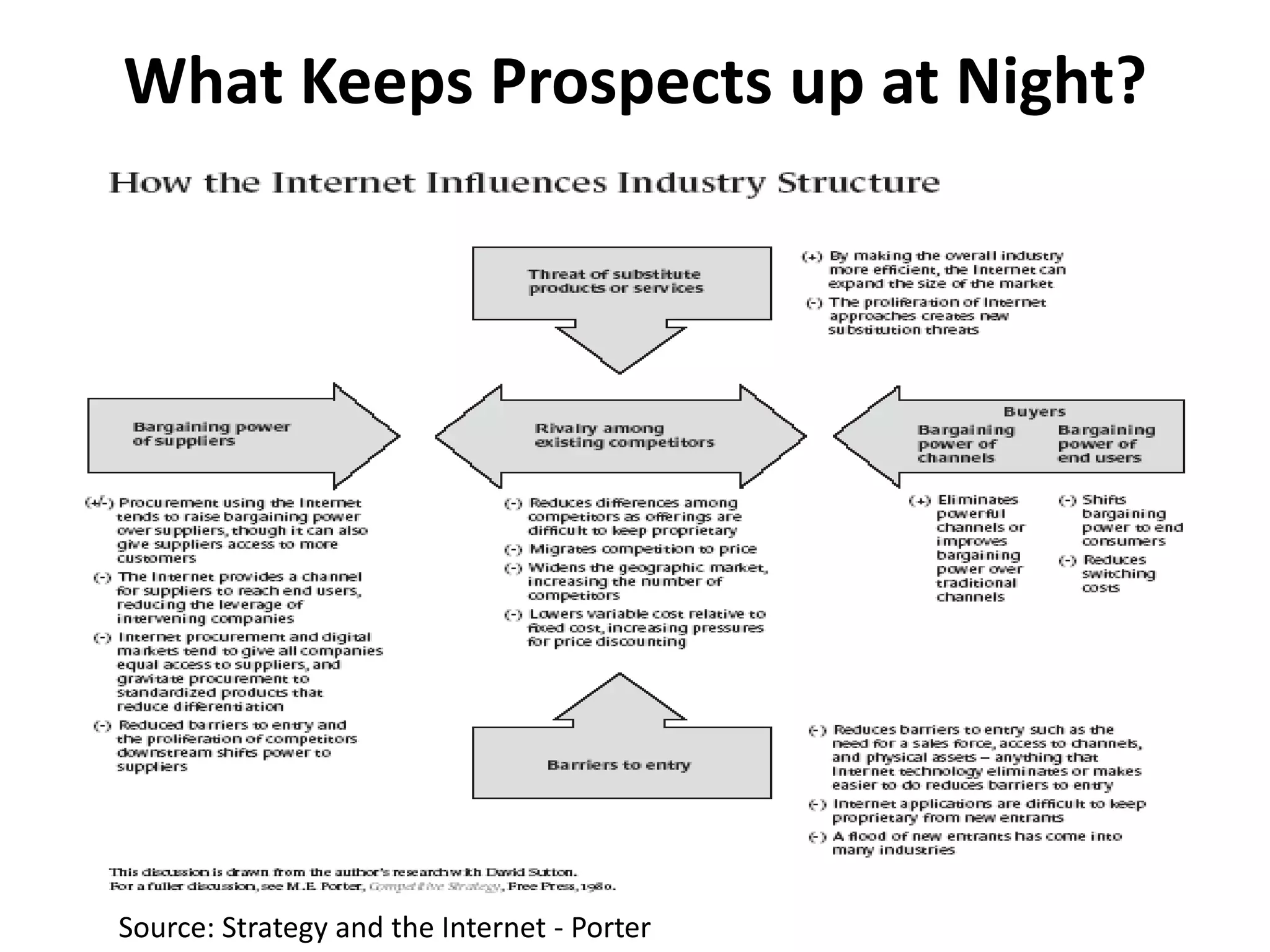
What Keeps Prospects up at Night?


Source: Strategy and the Internet - Porter
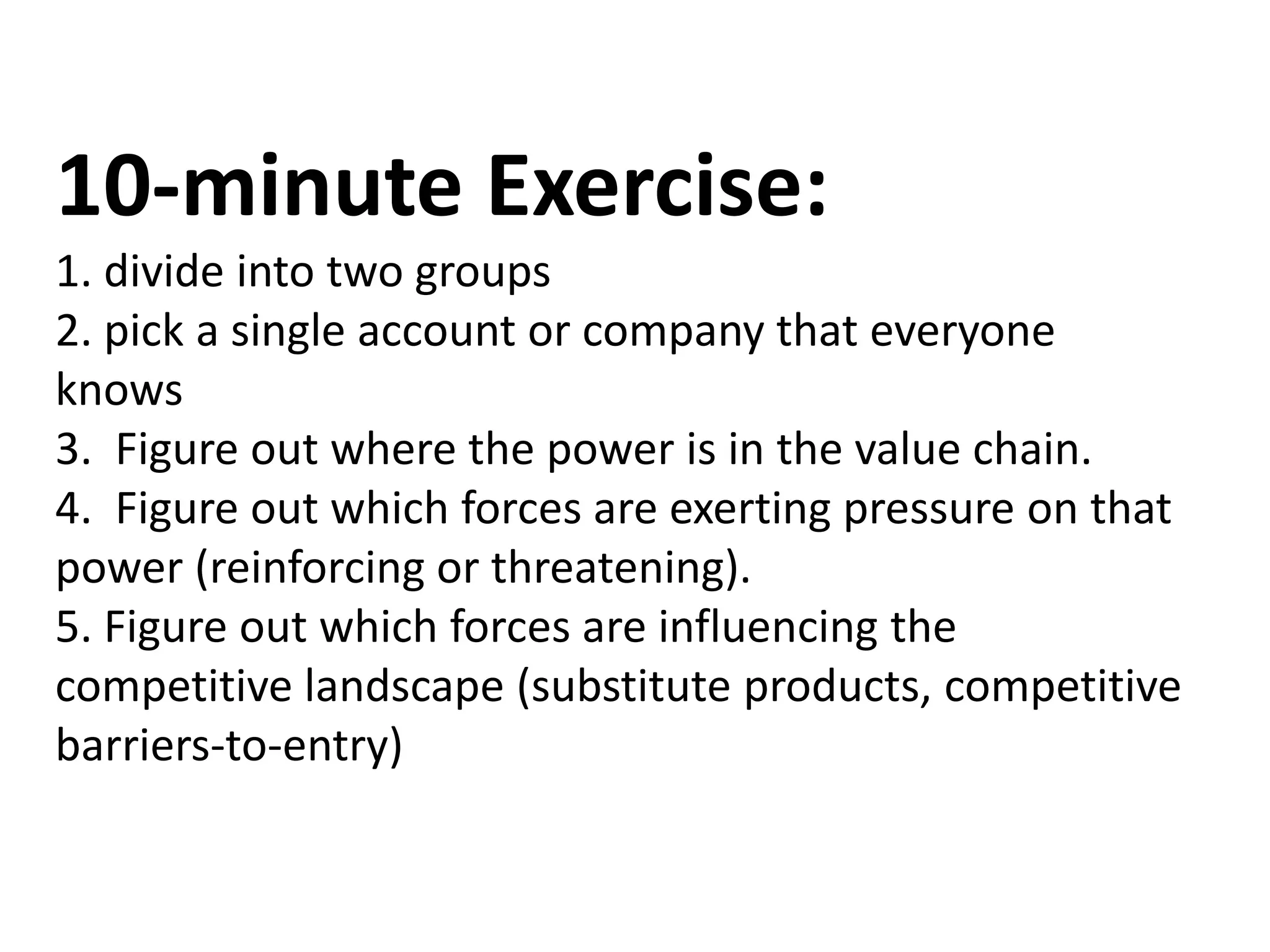
10-minute Exercise:
1. divide into two groups
2. pick a single account or company that everyone
knows
3. Figure out where the power is in the value chain.
4. Figure out which forces are exerting pressure on that
power (reinforcing or threatening).
5. Figure out which forces are influencing the
competitive landscape (substitute products, competitive
barriers-to-entry)
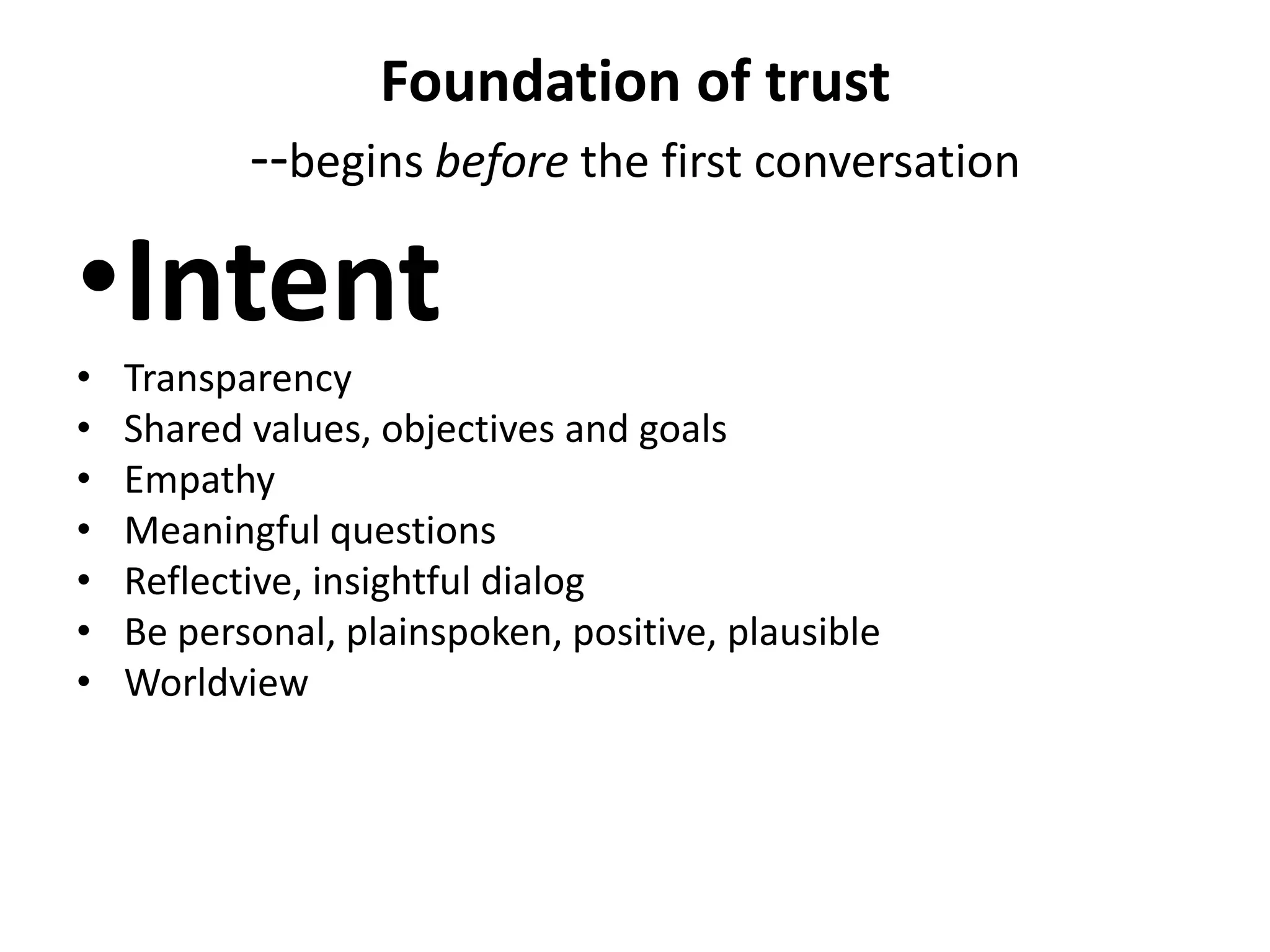
Foundation of trust
           --begins before the first conversation

•Intent
•   Transparency
•   Shared values, objectives and goals
•   Empathy
•   Meaningful questions
•   Reflective, insightful dialog
•   Be personal, plainspoken, positive, plausible
•   Worldview
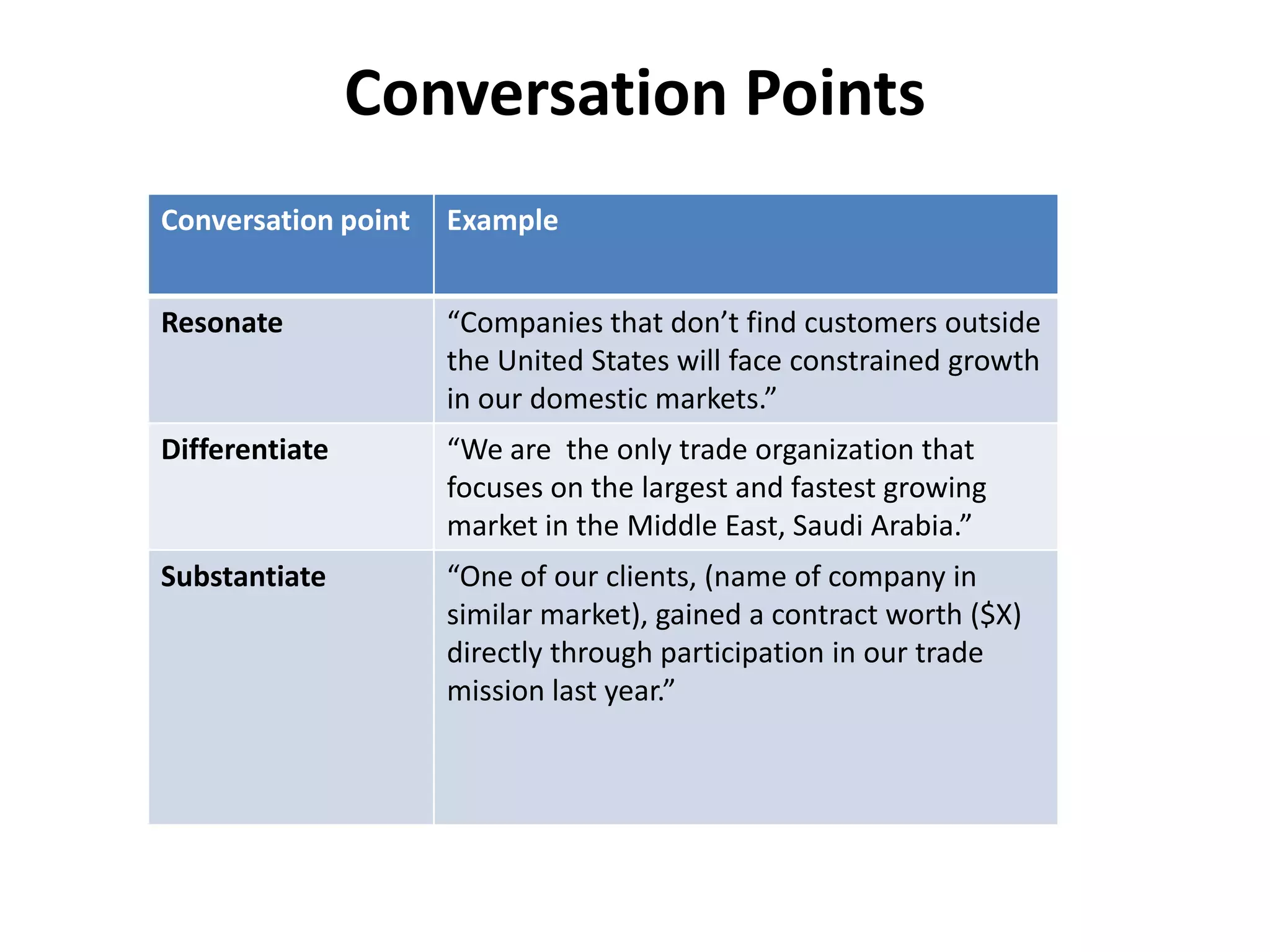
Conversation Points
Conversation point   Example


Resonate             “Companies that don’t find customers outside
                     the United States will face constrained growth
                     in our domestic markets.”
Differentiate        “We are the only trade organization that
                     focuses on the largest and fastest growing
                     market in the Middle East, Saudi Arabia.”
Substantiate         “One of our clients, (name of company in
                     similar market), gained a contract worth ($X)
                     directly through participation in our trade
                     mission last year.”
Conversation points
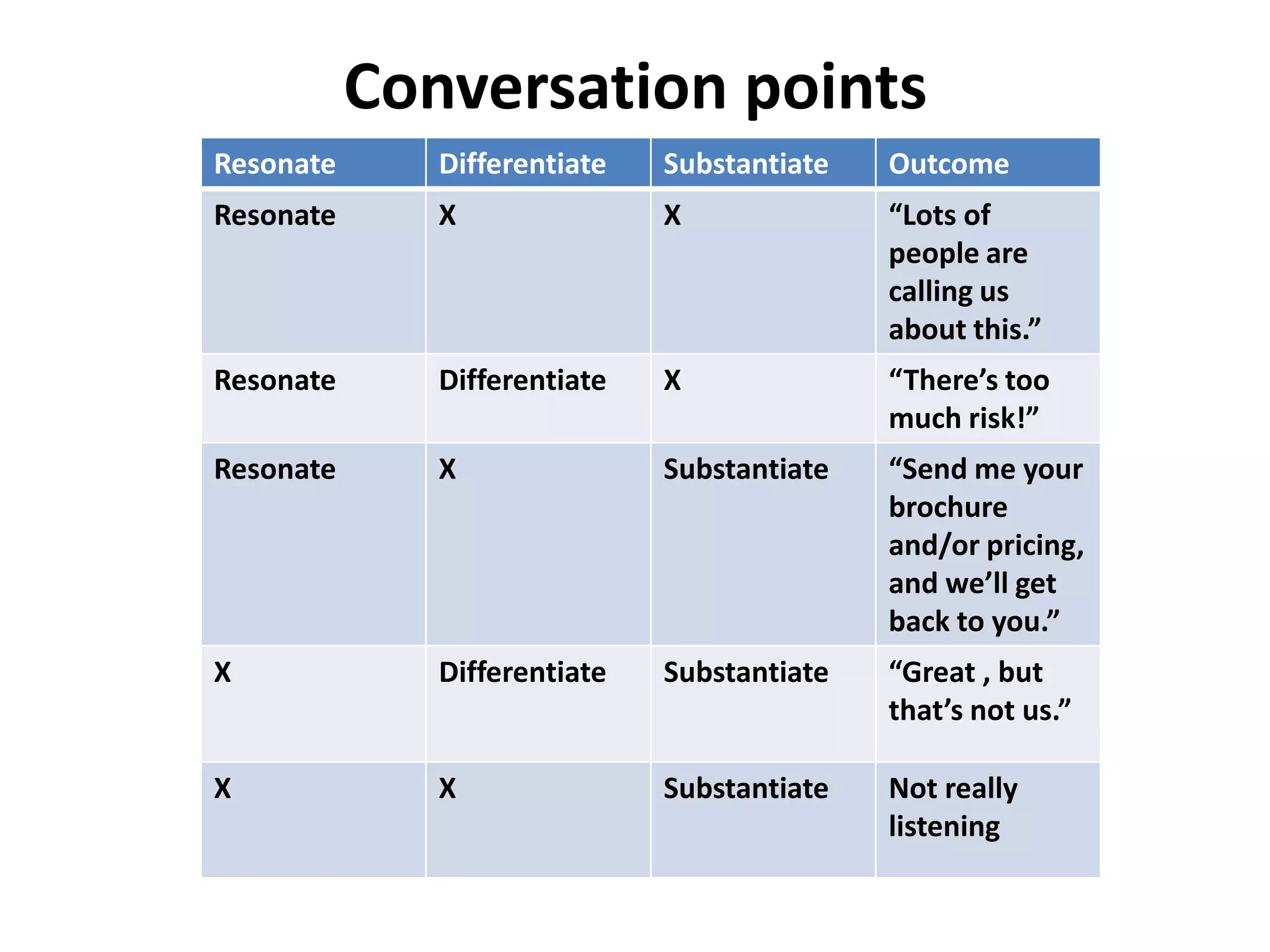
Resonate      Differentiate   Substantiate   Outcome
Resonate      X               X              “Lots of
                                             people are
                                             calling us
                                             about this.”
Resonate      Differentiate   X              “There’s too
                                             much risk!”
Resonate      X               Substantiate   “Send me your
                                             brochure
                                             and/or pricing,
                                             and we’ll get
                                             back to you.”
X             Differentiate   Substantiate   “Great , but
                                             that’s not us.”

X             X               Substantiate   Not really
                                             listening
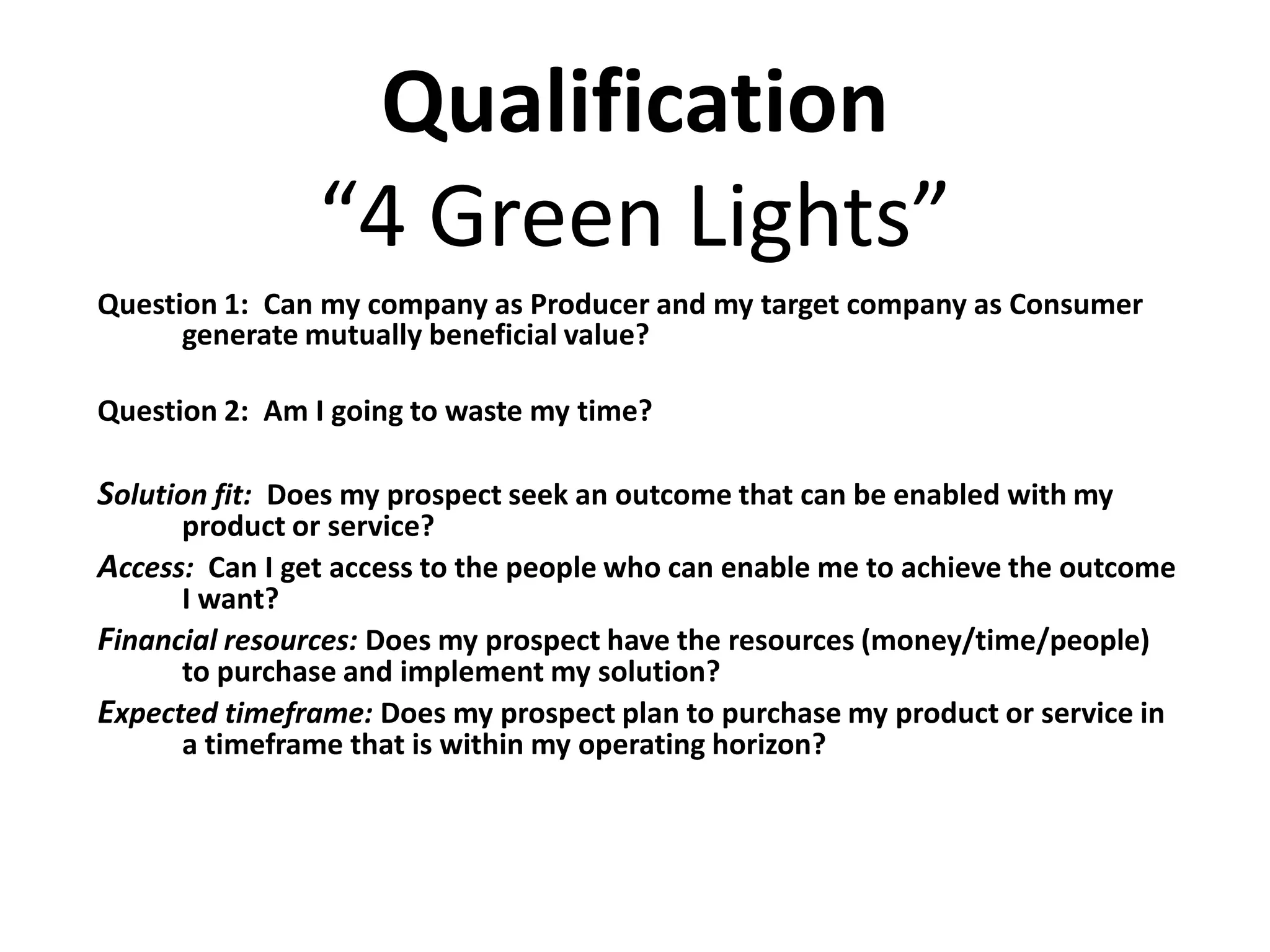
Qualification
                “4 Green Lights”
Question 1: Can my company as Producer and my target company as Consumer
      generate mutually beneficial value?

Question 2: Am I going to waste my time?

Solution fit: Does my prospect seek an outcome that can be enabled with my
      product or service?
Access: Can I get access to the people who can enable me to achieve the outcome
      I want?
Financial resources: Does my prospect have the resources (money/time/people)
      to purchase and implement my solution?
Expected timeframe: Does my prospect plan to purchase my product or service in
      a timeframe that is within my operating horizon?
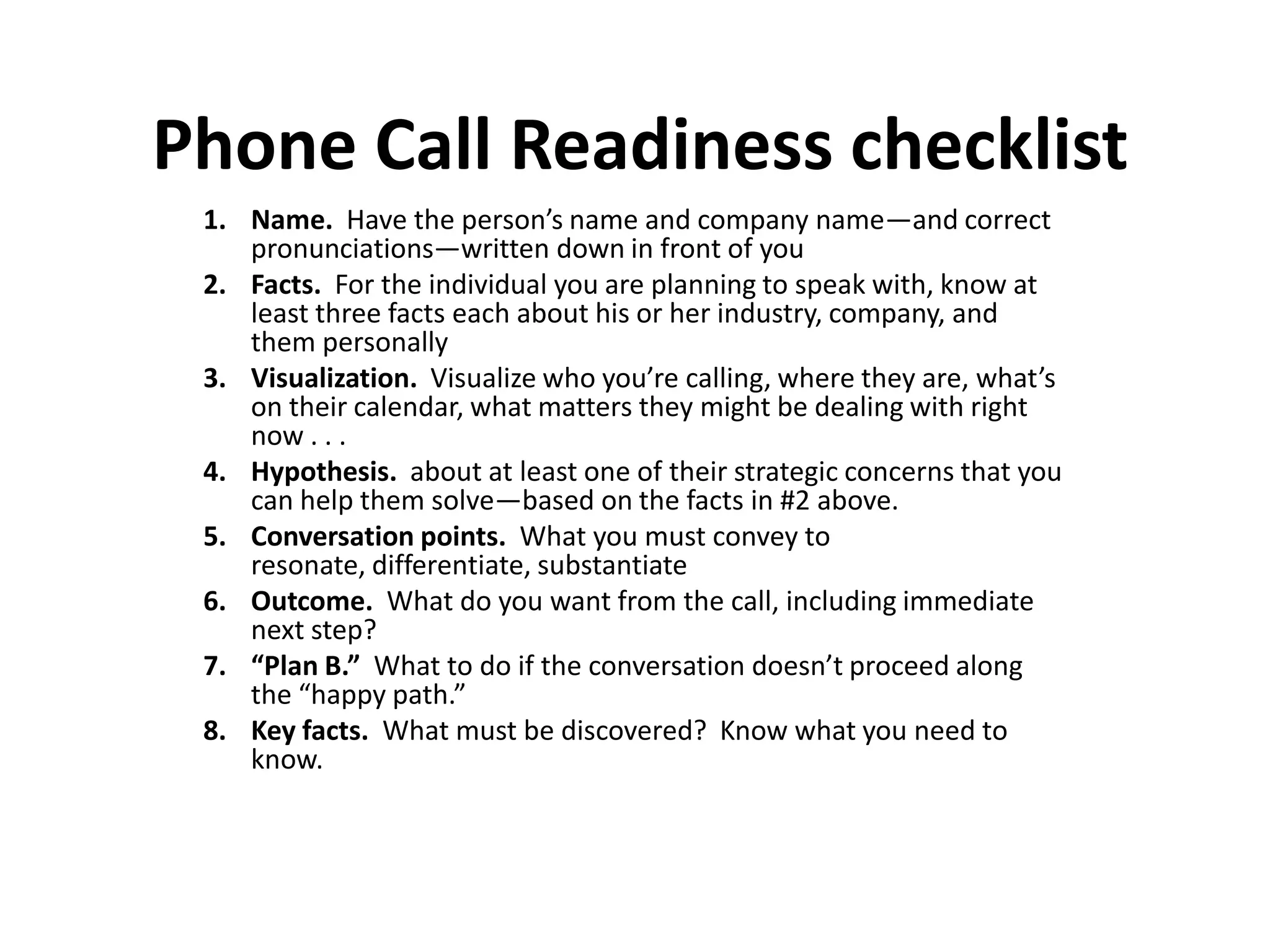
Phone Call Readiness checklist
 1. Name. Have the person’s name and company name—and correct
    pronunciations—written down in front of you
 2. Facts. For the individual you are planning to speak with, know at
    least three facts each about his or her industry, company, and
    them personally
 3. Visualization. Visualize who you’re calling, where they are, what’s
    on their calendar, what matters they might be dealing with right
    now . . .
 4. Hypothesis. about at least one of their strategic concerns that you
    can help them solve—based on the facts in #2 above.
 5. Conversation points. What you must convey to
    resonate, differentiate, substantiate
 6. Outcome. What do you want from the call, including immediate
    next step?
 7. “Plan B.” What to do if the conversation doesn’t proceed along
    the “happy path.”
 8. Key facts. What must be discovered? Know what you need to
    know.
Break!
Part 2
• How to assess risk appetite both for you and your prospective customers

• Lead qualification, part B

• How to define problems through questioning and discovery

• How to expose capability gaps in your prospect’s business operations

• The best questions to ask in specific selling situations, and how to develop
your own favorites

• How to embed questions into effective conversations

• Best practices for asking questions during sales conversations

• Five to do’s before ending the call

• Asking for commitment—belief, care, and act

• Common selling myths, debunked
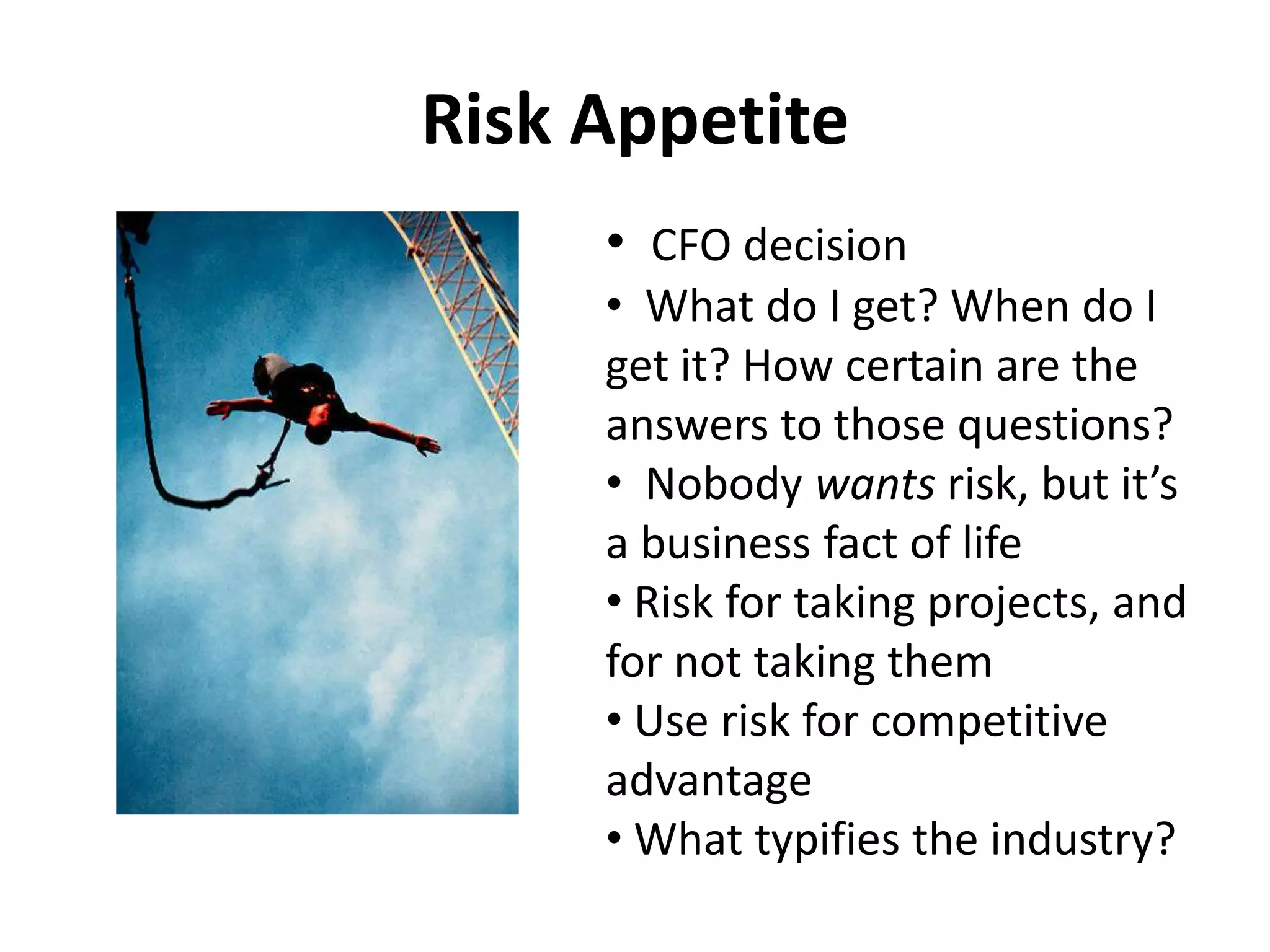
Risk Appetite
     • CFO decision
     • What do I get? When do I
     get it? How certain are the
     answers to those questions?
     • Nobody wants risk, but it’s
     a business fact of life
     • Risk for taking projects, and
     for not taking them
     • Use risk for competitive
     advantage
     • What typifies the industry?
Lead qualification—Part B
Second-level qualification risks (in plain
English, “What caused my last opportunity to
tank?”)
• Implementation resources, operational
capability, bias, certifications, size, sector, known sales activities in the
Middle East.
Resources requested—Trade off question
Resources given—time and access
Red Flags—withheld information, etc.
Organizational will
Change-induced—new points of
contact, event “triggers”
How to define problems
People need water.
Is access to water a human right?
Is it exploitative for companies to
profit from people who require basic
necessities, such as water, to live?
How do we get water to people who
need it?
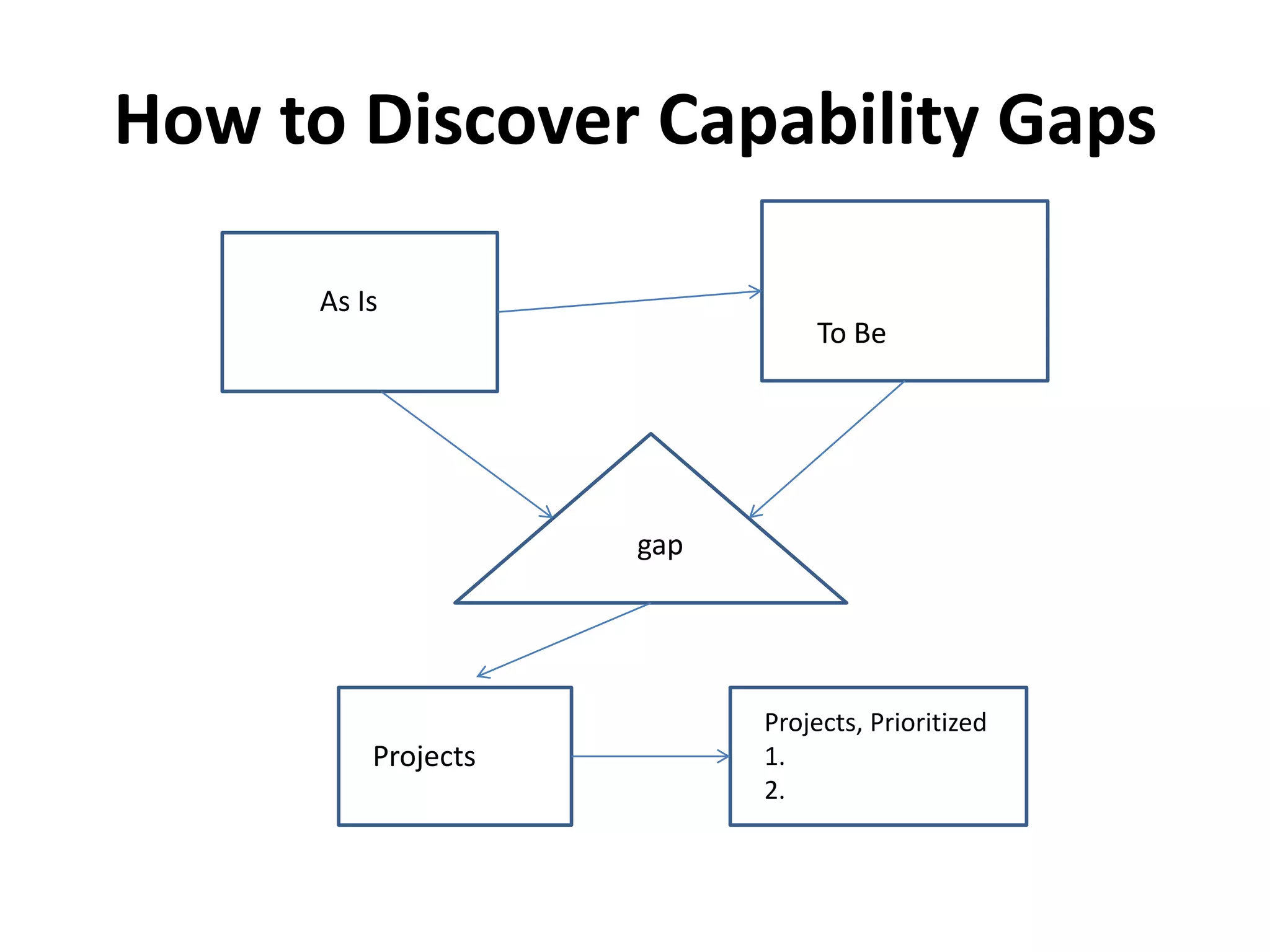
How to Discover Capability Gaps

      As Is
                               To Be


                     gap


                           Projects, Prioritized
          Projects         1.
                           2.
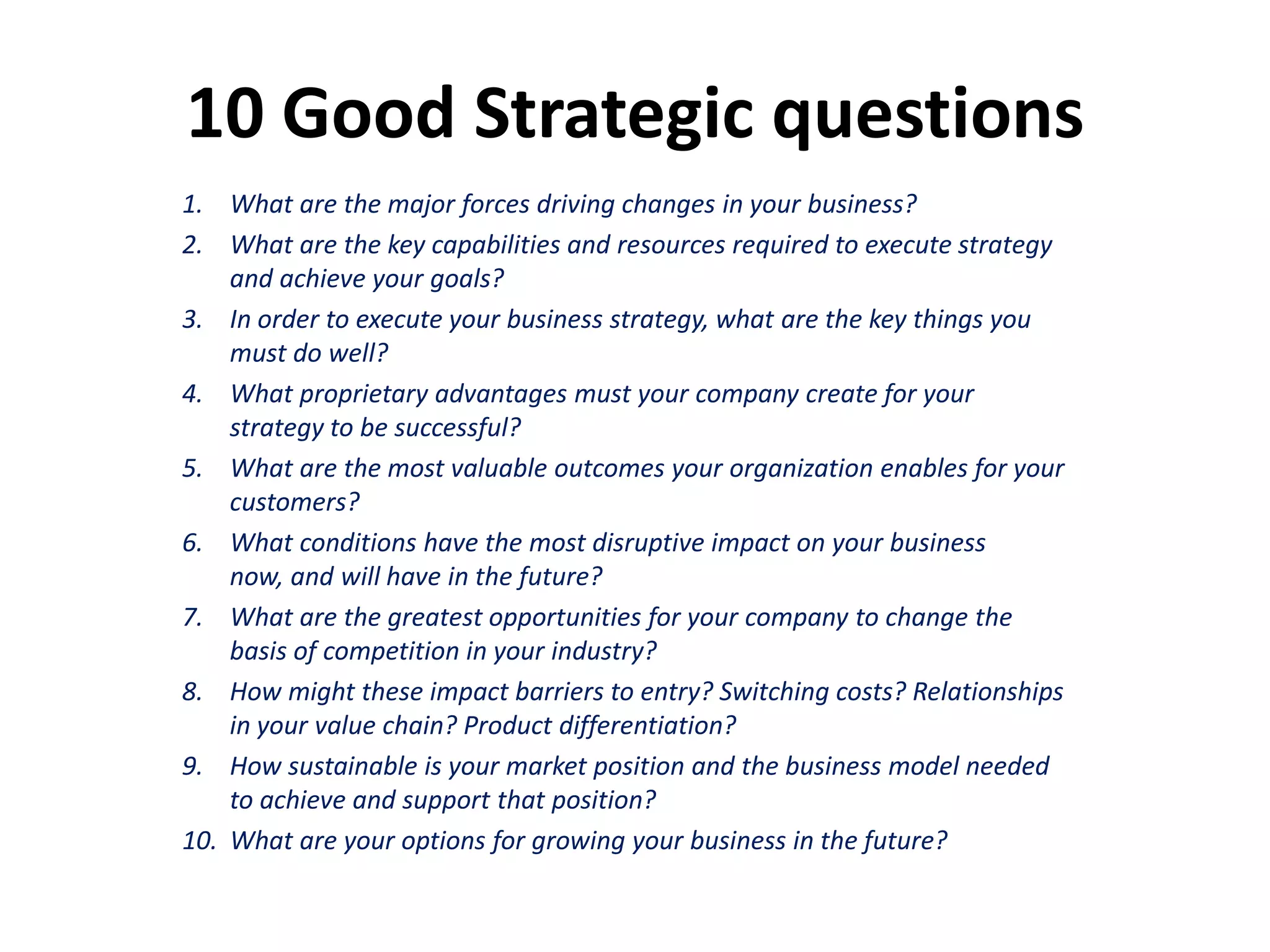
10 Good Strategic questions
1. What are the major forces driving changes in your business?
2. What are the key capabilities and resources required to execute strategy
    and achieve your goals?
3. In order to execute your business strategy, what are the key things you
    must do well?
4. What proprietary advantages must your company create for your
    strategy to be successful?
5. What are the most valuable outcomes your organization enables for your
    customers?
6. What conditions have the most disruptive impact on your business
    now, and will have in the future?
7. What are the greatest opportunities for your company to change the
    basis of competition in your industry?
8. How might these impact barriers to entry? Switching costs? Relationships
    in your value chain? Product differentiation?
9. How sustainable is your market position and the business model needed
    to achieve and support that position?
10. What are your options for growing your business in the future?
How to embed questions into
       conversations
Trust your instincts!

“Telling is not selling,” but neither is interrogation.
Some useful habits:

• Restate answers as you heard them
• Ask for help in clarifying and validating
• “Triangulate” the problem
• Connect answers or desired outcomes/results with something
that you do or provide, but make sure you’re on the target
• When applicable, always mention a related customer
challenge, and the role you played in solving it
Best practices for asking questions
  1. Bring great curiosity to your
     conversations
  2. Don’t assume you know the answers
     before you ask your question
  3. Endeavor to see the world through your
     customer’s eyes
  4. Listen for unexpected answers
  5. Have the agility to pursue a different
     pathway
  6. Dig beyond the “most plausible” answer.
5 to-do’s before ending the call
 1. Look at the person’s name on your
    screen or notepad, and use it.
 2. Thank them for their time, and remind
    them how helpful you found the
    information that they shared.
 3. Summarize the key points you heard.
 4. Remind them of what you’re going to do,
    AND what you’re expecting, and WHEN.
    Note: this is not one-sided.
 5. Confirm the next step, including WHEN.
Commitment has more than one step

   Believe 
   Care 
   Act
Common Selling Myths--debunked
 • It’s important to know everything you can about your
 prospect.
 • It’s always best to start a sales conversation by uncovering
 the customer’s pain.
 • Following “trigger events” will help you know the best
 time to contact a prospect.
 • Prospects are busy these days, and they don’t have time to
 talk to salespeople.
 • CXO’s don’t want to talk to salespeople, they want to talk
 to other CXO’s.
 • Customers have all the information power anyway.

 * But each of these has a shred of truth . . .
Break!
Part 3
•Nurturing interest and conversations after the
call

•Providing value and eliminating friction:
integrating the buying and selling process

•Reciprocal expectations for following through on
commitments

•Ensuring ongoing interest and interaction
Nurturing Interest and
     conversations after the call
Rule #1: You are not ‘just following up’!
Rule #2: You are valuable, and you must live up to it!
Rule #3: Be confident. If you have provided a
requested resource, you have earned the conversation.

1.   Review your conversation notes, and match to company
     and competitor news and announcements. This reminds
     your prospect that you are tracking developments.
2.   Follow social media, including Facebook and Twitter for
     fast-breaking information.
3.   Set up Alerts and RSS feeds, and monitor them regularly.
4.   Ask and tell.
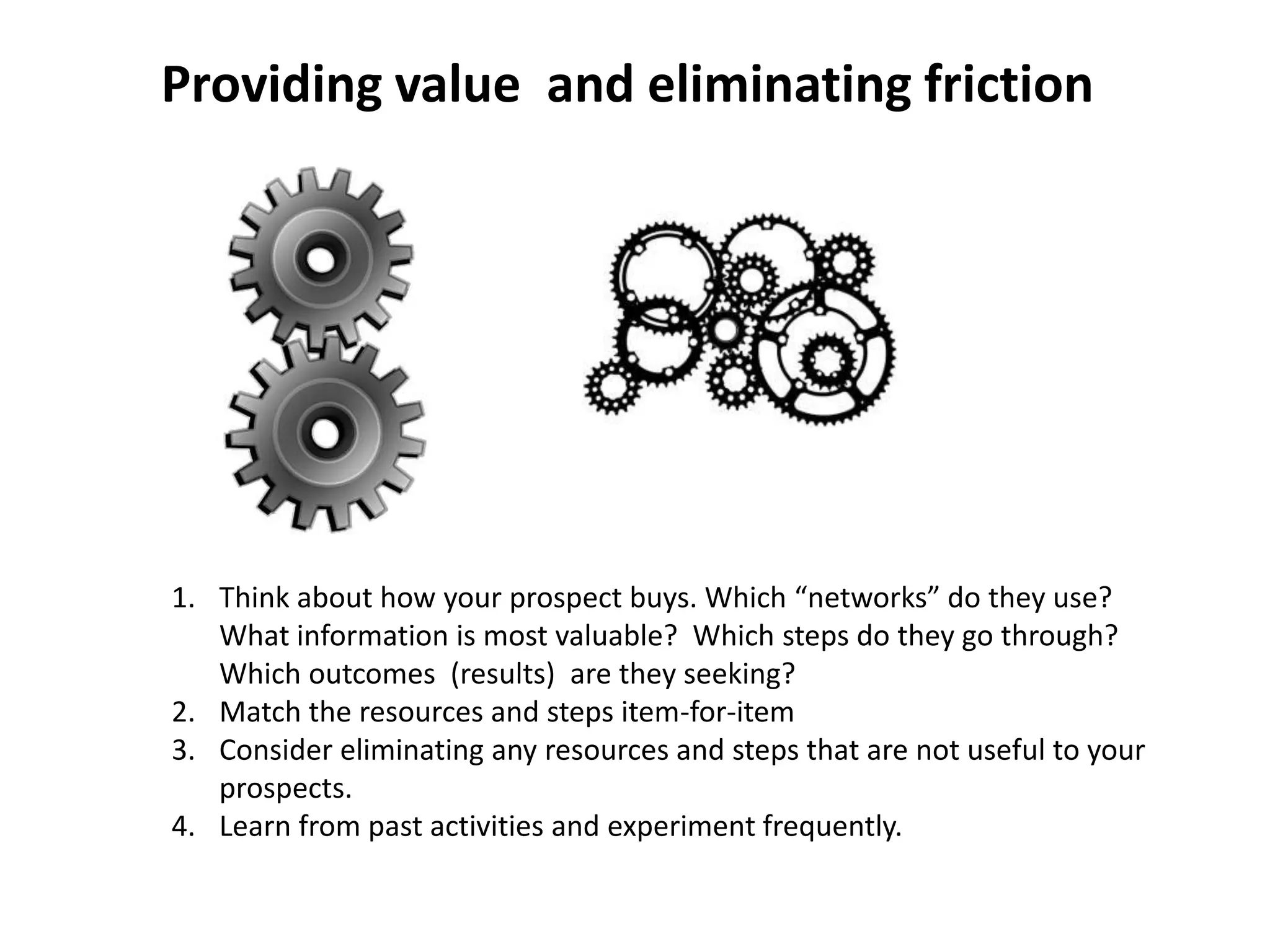
Providing value and eliminating friction


1. Think about how your prospect buys. Which “networks” do they use?
   What information is most valuable? Which steps do they go through?
   Which outcomes (results) are they seeking?
2. Match the resources and steps item-for-item
3. Consider eliminating any resources and steps that are not useful to your
   prospects.
4. Learn from past activities and experiment frequently.
Reciprocal expectations . . .
Or, ask not just ‘what can I do for my prospect?’
ask ‘what can my prospect do for me?’

   1. You offer value, including
      time, expertise, and resources.
   2. When your intent is positive, and you
      demonstrate your integrity, it is fair to
      expect the same.
   3. If you don’t receive it, you must always
      ask whether you should continue the
      business development effort.
Create ongoing interest and
             interaction
1.  Develop and/or find outstanding content, and not
    just about your product.
2. Create a blog to share the content
3. Use social media, but focus on where your
    prospects are, and how they use information
4. Examine hashtags and integrate the terms in your
    online content
5. Keep everything online current!
6. Assign someone to do this.
7. Measure your activities to learn what’s getting
    used. (assumption: used = valuable)
8. Parse!
9. Personalize!
10. Use references (quantifiable benefit / time).
Time for questions . . .


                Andrew (Andy) Rudin
                        703.371.1242
      arudin@outsidetechnologies.com

Ussabc 030712 export

  • 1.
    PLANNING and HAVINGCUSTOMER CONVERSATIONS March 7th, 2012 Andrew Rudin, Managing Principal, Outside Technologies, Inc. Certified Social Media Strategist www.outsidetechnologies.com 703.371.1242 (mobile) arudin@outsidetechnologies.com www.xeeme.com/andyrudin
  • 2.
    Who is ourfacilitator, and why is he here? Andy Rudin • 20 + years B2B sales experience in commercial, government, non-profit • Focus on sales strategy & execution • Work with technology companies • MS in management information technology from University of Virginia • Certified Social Media Strategist (2010)
  • 3.
    Key Problems toSolve How to discover information that matters, and how to use it to produce outcomes that are valuable for you and for your customer.
  • 4.
    What this workshopis—and isn’t Is: • an interactive forum to share ideas and best practices to help advance your business goals • A set of frameworks you don’t have to memorize, and that you can use repeatedly in a wide range of situations Isn’t: • a tutorial that’s designed to turn everyone into sales pros • A set of recommendations that will undermine what you already do well • Proprietary shelf-ware
  • 5.
  • 6.
  • 7.
  • 8.
    Part 1 • Thedifferences between known’s, unknown’s, and assumptions—and why each is important • Risk Management 101, and why it matters for your sales activities and to your company • Risks and opportunities: the key categories of facts and information that every salesperson must uncover during the sales process • The Porter’s Five Forces Model and how to use it for sales discovery • Your intent, and how to establish a “foundation of trust” • Conversation points that resonate, differentiate, and substantiate • Lead qualification, part A, to find the best prospects for sales engagement • Call readiness checklist
  • 9.
    Part 2 • Howto assess risk appetite both for you and your prospective customers • Lead qualification, Part B • How to define problems through questioning and discovery • How to expose capability gaps in your prospect’s business operations • The best questions to ask in specific selling situations, and how to develop your own favorites • How to embed questions into effective conversations • Best practices for asking questions during sales conversations • Five to do’s before ending the call • Asking for commitment—belief, care, and act • Common selling myths, debunked
  • 10.
    Part 3 •Nurturing interestand conversations after the call •Providing value and eliminating friction: integrating the buying and selling process •Reciprocal expectations for following through on commitments •Ensuring ongoing interest and interaction
  • 11.
  • 12.
    Hi Vikram: I amthe new Vice President of Global Business Development at AccuStart Engineers, and my company has initiated a project to explore additional sales opportunities offshore. We are considering some emerging markets, and after reviewing your website, we think it would be beneficial to set up a meeting to learn more. We plan to expand our international presence as early as next quarter, and we will be refining our search over the next few weeks. AccuStart Engineers will conduct a thorough evaluation based on a set of criteria we have formulated. Can you provide us with details about your programs and about doing business in Saudi Arabia? Also, if you have some references we can contact, that would be most helpful. Best, Ken Thomas, VP Global Business Development, AccuStart Engineers
  • 13.
    1-minute Exercise: Write downthe first three questions that come to mind. Note: there are no “right” or “wrong” questions.
  • 14.
    Knowns Unknowns Assumptions
  • 15.
    5-minute Exercise: When youbegin your first sales conversation, Which assumptions do you have? What’s typically known? What’s typically unknown?
  • 16.
    Risk Management 101 •Eliminate • Reduce • Share • Transfer • Accept Likelihood Impact
  • 17.
    Opportunities and Risks for salespeople Trust and Rapport • Build rapport • Build trust • Be credible • Listen and understand • Be transparent (open) Accessibility • Build community (reach) • Be approachable (findable) • Connect with individuals (engagement) Value • Be valuable • Advocate, persuade, and enable others to do so • Be current (information flow) • Be clear • Be different • Appeal to ego and emotion
  • 18.
    Categories of Questionsto ask 1. Qualification 2. Situation (consequence/impact) 3. Networking 4. Attitude/sentiment 5. Validation 6. Vision
  • 19.
    What Keeps Prospectsup at Night? Source: Strategy and the Internet - Porter
  • 20.
    10-minute Exercise: 1. divideinto two groups 2. pick a single account or company that everyone knows 3. Figure out where the power is in the value chain. 4. Figure out which forces are exerting pressure on that power (reinforcing or threatening). 5. Figure out which forces are influencing the competitive landscape (substitute products, competitive barriers-to-entry)
  • 21.
    Foundation of trust --begins before the first conversation •Intent • Transparency • Shared values, objectives and goals • Empathy • Meaningful questions • Reflective, insightful dialog • Be personal, plainspoken, positive, plausible • Worldview
  • 22.
    Conversation Points Conversation point Example Resonate “Companies that don’t find customers outside the United States will face constrained growth in our domestic markets.” Differentiate “We are the only trade organization that focuses on the largest and fastest growing market in the Middle East, Saudi Arabia.” Substantiate “One of our clients, (name of company in similar market), gained a contract worth ($X) directly through participation in our trade mission last year.”
  • 23.
    Conversation points Resonate Differentiate Substantiate Outcome Resonate X X “Lots of people are calling us about this.” Resonate Differentiate X “There’s too much risk!” Resonate X Substantiate “Send me your brochure and/or pricing, and we’ll get back to you.” X Differentiate Substantiate “Great , but that’s not us.” X X Substantiate Not really listening
  • 24.
    Qualification “4 Green Lights” Question 1: Can my company as Producer and my target company as Consumer generate mutually beneficial value? Question 2: Am I going to waste my time? Solution fit: Does my prospect seek an outcome that can be enabled with my product or service? Access: Can I get access to the people who can enable me to achieve the outcome I want? Financial resources: Does my prospect have the resources (money/time/people) to purchase and implement my solution? Expected timeframe: Does my prospect plan to purchase my product or service in a timeframe that is within my operating horizon?
  • 25.
    Phone Call Readinesschecklist 1. Name. Have the person’s name and company name—and correct pronunciations—written down in front of you 2. Facts. For the individual you are planning to speak with, know at least three facts each about his or her industry, company, and them personally 3. Visualization. Visualize who you’re calling, where they are, what’s on their calendar, what matters they might be dealing with right now . . . 4. Hypothesis. about at least one of their strategic concerns that you can help them solve—based on the facts in #2 above. 5. Conversation points. What you must convey to resonate, differentiate, substantiate 6. Outcome. What do you want from the call, including immediate next step? 7. “Plan B.” What to do if the conversation doesn’t proceed along the “happy path.” 8. Key facts. What must be discovered? Know what you need to know.
  • 26.
  • 27.
    Part 2 • Howto assess risk appetite both for you and your prospective customers • Lead qualification, part B • How to define problems through questioning and discovery • How to expose capability gaps in your prospect’s business operations • The best questions to ask in specific selling situations, and how to develop your own favorites • How to embed questions into effective conversations • Best practices for asking questions during sales conversations • Five to do’s before ending the call • Asking for commitment—belief, care, and act • Common selling myths, debunked
  • 28.
    Risk Appetite • CFO decision • What do I get? When do I get it? How certain are the answers to those questions? • Nobody wants risk, but it’s a business fact of life • Risk for taking projects, and for not taking them • Use risk for competitive advantage • What typifies the industry?
  • 29.
    Lead qualification—Part B Second-levelqualification risks (in plain English, “What caused my last opportunity to tank?”) • Implementation resources, operational capability, bias, certifications, size, sector, known sales activities in the Middle East. Resources requested—Trade off question Resources given—time and access Red Flags—withheld information, etc. Organizational will Change-induced—new points of contact, event “triggers”
  • 30.
    How to defineproblems People need water. Is access to water a human right? Is it exploitative for companies to profit from people who require basic necessities, such as water, to live? How do we get water to people who need it?
  • 31.
    How to DiscoverCapability Gaps As Is To Be gap Projects, Prioritized Projects 1. 2.
  • 32.
    10 Good Strategicquestions 1. What are the major forces driving changes in your business? 2. What are the key capabilities and resources required to execute strategy and achieve your goals? 3. In order to execute your business strategy, what are the key things you must do well? 4. What proprietary advantages must your company create for your strategy to be successful? 5. What are the most valuable outcomes your organization enables for your customers? 6. What conditions have the most disruptive impact on your business now, and will have in the future? 7. What are the greatest opportunities for your company to change the basis of competition in your industry? 8. How might these impact barriers to entry? Switching costs? Relationships in your value chain? Product differentiation? 9. How sustainable is your market position and the business model needed to achieve and support that position? 10. What are your options for growing your business in the future?
  • 33.
    How to embedquestions into conversations Trust your instincts! “Telling is not selling,” but neither is interrogation. Some useful habits: • Restate answers as you heard them • Ask for help in clarifying and validating • “Triangulate” the problem • Connect answers or desired outcomes/results with something that you do or provide, but make sure you’re on the target • When applicable, always mention a related customer challenge, and the role you played in solving it
  • 34.
    Best practices forasking questions 1. Bring great curiosity to your conversations 2. Don’t assume you know the answers before you ask your question 3. Endeavor to see the world through your customer’s eyes 4. Listen for unexpected answers 5. Have the agility to pursue a different pathway 6. Dig beyond the “most plausible” answer.
  • 35.
    5 to-do’s beforeending the call 1. Look at the person’s name on your screen or notepad, and use it. 2. Thank them for their time, and remind them how helpful you found the information that they shared. 3. Summarize the key points you heard. 4. Remind them of what you’re going to do, AND what you’re expecting, and WHEN. Note: this is not one-sided. 5. Confirm the next step, including WHEN.
  • 36.
    Commitment has morethan one step Believe  Care  Act
  • 37.
    Common Selling Myths--debunked • It’s important to know everything you can about your prospect. • It’s always best to start a sales conversation by uncovering the customer’s pain. • Following “trigger events” will help you know the best time to contact a prospect. • Prospects are busy these days, and they don’t have time to talk to salespeople. • CXO’s don’t want to talk to salespeople, they want to talk to other CXO’s. • Customers have all the information power anyway. * But each of these has a shred of truth . . .
  • 38.
  • 39.
    Part 3 •Nurturing interestand conversations after the call •Providing value and eliminating friction: integrating the buying and selling process •Reciprocal expectations for following through on commitments •Ensuring ongoing interest and interaction
  • 40.
    Nurturing Interest and conversations after the call Rule #1: You are not ‘just following up’! Rule #2: You are valuable, and you must live up to it! Rule #3: Be confident. If you have provided a requested resource, you have earned the conversation. 1. Review your conversation notes, and match to company and competitor news and announcements. This reminds your prospect that you are tracking developments. 2. Follow social media, including Facebook and Twitter for fast-breaking information. 3. Set up Alerts and RSS feeds, and monitor them regularly. 4. Ask and tell.
  • 41.
    Providing value andeliminating friction 1. Think about how your prospect buys. Which “networks” do they use? What information is most valuable? Which steps do they go through? Which outcomes (results) are they seeking? 2. Match the resources and steps item-for-item 3. Consider eliminating any resources and steps that are not useful to your prospects. 4. Learn from past activities and experiment frequently.
  • 42.
    Reciprocal expectations .. . Or, ask not just ‘what can I do for my prospect?’ ask ‘what can my prospect do for me?’ 1. You offer value, including time, expertise, and resources. 2. When your intent is positive, and you demonstrate your integrity, it is fair to expect the same. 3. If you don’t receive it, you must always ask whether you should continue the business development effort.
  • 43.
    Create ongoing interestand interaction 1. Develop and/or find outstanding content, and not just about your product. 2. Create a blog to share the content 3. Use social media, but focus on where your prospects are, and how they use information 4. Examine hashtags and integrate the terms in your online content 5. Keep everything online current! 6. Assign someone to do this. 7. Measure your activities to learn what’s getting used. (assumption: used = valuable) 8. Parse! 9. Personalize! 10. Use references (quantifiable benefit / time).
  • 44.
    Time for questions. . . Andrew (Andy) Rudin 703.371.1242 arudin@outsidetechnologies.com

Editor's Notes

  • #6 http://thebusinessimpact.com/customer-care/increase-success-by-serving-your-customers-at-a-higher-level/
  • #16 My basic assumptions:There is a gap between the “as is” and “to be”Prospects have good intentions for my product or serviceProspects will behave in an ethical manner
  • #18 What’s at risk: time and resources.List only! What’s missing? Timelines, embeddedness, dependencies . . .
  • #20 Porter’s Five Forces Model
  • #26 http://www.entrepreneur.com/article/207016
  • #29 http://www.google.com/imgres?q=knitting&hl=en&gbv=2&tbm=isch&tbnid=iKTQq8p5mp8J6M:&imgrefurl=http://orlandograce.org/2010/11/will-there-be-knitting-at-the-mens-retreat/&docid=FSwXSq__AimusM&imgurl=http://orlandograce.org/wordpress/wp-content/uploads/2010/11/knitting_649.jpg&w=621&h=450&ei=XZOXTuL_O8j10gHq8t27BA&zoom=1&iact=hc&vpx=454&vpy=175&dur=1397&hovh=191&hovw=264&tx=140&ty=86&sig=100018578372430745217&page=1&tbnh=111&tbnw=140&start=0&ndsp=24&ved=1t:429,r:2,s:0&biw=1366&bih=598
  • #30 Resource: MahanKhalsa, Let’s Get Real, or Let’s Not Play
  • #31 Source: The Blue Sweater, by Jacqueline Novogratz
  • #37 Resource: Chip Heath and Dan Heath, Made to Stick
  • #42 http://www.google.com/imgres?q=gears&hl=en&gbv=2&tbm=isch&tbnid=fkaNJHG4oPojIM:&imgrefurl=http://www.dipity.com/tickr/Flickr_gears/&docid=mnMm41ccwfgrdM&w=500&h=343&ei=IGaUTsXUMoTq0gGN6KCTCA&zoom=1&iact=hc&vpx=396&vpy=306&dur=718&hovh=181&hovw=264&tx=132&ty=153&page=8&tbnh=105&tbnw=153&start=151&ndsp=24&ved=1t:429,r:10,s:151&biw=1366&bih=598http://www.wpclipart.com/tools/miscellaneous/gears/gray_gears_large.png.html
  • #44 http://docs.cdn.marketo.com/best-practices-for-lead-nurturing-wdfm.pdf