Medical Research
and the
Health Insurance Industry
Shared Goals Andrew Searles BEc, Dip Ed, MMedStat, PhD
Associate Director, HMRI
Health ResearchEconomics
Acknowledging:
Ms PennyReeves,HealthEconomist, HMRI
Dr Tracey Tay, HNEH
Scene setting
• Differences: perspectives, operations etc;
• Shared goal: cost-effectively improve health outcomes
• Examples of shared goals:
– Health technology assessment: Better decisions on
whether to use / stop health care?
– Health & medical research: How to efficiently translate
cost-effective research outcomesinto policy & practice?
Agenda
• Introduction to HMRI
• Stream with mutual benefit
– Better decisions in healthcare (HTA)
• The problem – waste in healthcare
• How we addressed the problem (methods)
• A solution: HTAIm
• Conclusion
Introduction to HMRI: About us …
• HMRI is one of NSW’s largest independent research
institutions, second only to the Garvan Institute
• A ‘facilitating’ MRI – meaning we create an
environment for health and medical research to thrive
• A member of the recently (June2017) announced NHMRC
Regional Health Partners Centre for Innovation in
Regional Health (RHP CIRH)
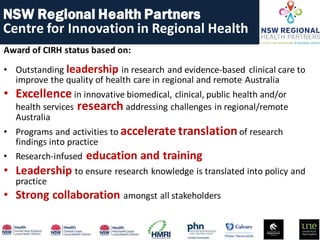
Award of CIRH status based on:
• Outstanding leadership in research and evidence-based clinical care to
improve the quality of health care in regional and remote Australia
• Excellence in innovative biomedical, clinical, public health and/or
health services research addressing challenges in regional/remote
Australia
• Programs and activities to accelerate translationof research
findings into practice
• Research-infused education and training
• Leadership to ensure research knowledge is translated into policy and
practice
• Strong collaboration amongst all stakeholders
NSW Regional Health Partners
Centre for Innovation in Regional Health
Introduction to HMRI: Our footprint
• Covers 32 Local Government Areas,
• 1.4 million people living in remote rural, rural, regional and
urban centres
• 11 percent of Australia’s Indigenous population live in this
footprint
• And substantialhealth infrastructure, including …
– One Acute-Tertiary Referral Hospital
– Two Principal Referral Hospitals, and
– Six Major Hospitals (Group 1-2)
– 11 Aboriginal Medical Services
– 1,700 GPs and
– Over 70 community health centres
Introduction to HMRI: Our RHP CIRH footprint
A project to support
better decisions in
healthcare
HTAIm: Health Technology Assessment and Implementation
The problem…
Declining affordability of the cost of healthcare
The annual real increase in health spending has outpaced
GDP growth for nearly a decade.
Australian Instituteof HealthandWelfare(2016). Australia's Health 2016. Canberra, AustralianInstituteof Health and Welfare.
Compounded by …
Of the $160 BILLION we spend on health in Australia each year
about $30 BILLION is waste… which, for
payers of healthcare (& patients),is the problem …
$30b derived fromAustralian Government: Productivity Commission (2015). Efficiency in Health. Productivity Commission research paper.Canberra.
Waste in healthcare is…
• Over or under use of health technologies;
• Use of technologies that don’t work or even
cause harm;
• The existence of errors; and,
• Unexplainable variation in the cost, use or consequence of a
technology between hospitals or regions.
….So, what are these “technologies”?
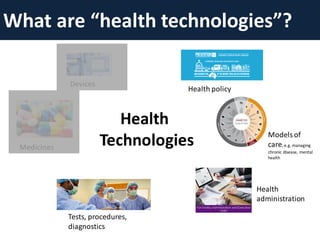
What are “health technologies”?
Medicines
Modelsof
care, e.g. managing
chronic disease, mental
health
Tests, procedures,
diagnostics
Health
administration
Health policy
Devices
Health
Technologies
What are “health technologies”?
Medicines
Modelsof
care, e.g. managing
chronic disease, mental
health
Tests, procedures,
diagnostics
Health
administration
Health policy
Devices
Health
Technologies
What is “health technology assessment”?
• HTA is a ‘best practice’ activity
• Related to EBM (provides evidence to be considered in context of the patient)
• HTA is the evaluation of technologies within a
given healthcare model to understand their
short and long-term clinical, organisational,
economic, social and ethical implications.1,2
• A process to determine value for money
1 Sampietro-ColomL, Lach K,Haro IE, et al.The AdHopHTA Handbook. AHandbook ofHospital-Based Health Assessment Technology; 2015.
2 JonssonE. History ofhealthtechnology assessmentin Sweden.InternationalJournalof Technology Assessment in Health Care2009;25(S1): 42-52.
Case study of HTA (Part 1)
Improving outcomes after stroke
 Setting: 1995 in the UK.
 The need: Stroke was typically managed in general hospitals. At the time it was
debated how to best manage stroke patients.
 The HTA: Study had three arms:
1) a stroke unit (24 hour care from a specialist multidisciplinary team in a
specialised ward);
2) a stroke team that involved specialist team support on general wards; and,
3) a stroke specialist in a general ward.
 HTA outcome: The stroke unit was determined to be a more cost-effective
intervention than the alternatives.
 HTAimpact: Reported in the Lancet and cited in Cochrane.Multiple policy
guidelinescite this HTA. For patients, the HTAshowed reduced mortality and
morbidityas a consequenceof stroke units.
Sweden: Physicians required to
document local disease profiles.
Distinguish medicine from
quackery.
Concerns over rapid use of
expensive technologies – need for
better understanding of
effectiveness and cost
AU National Health
Tech. Panel
Swedish Council on HTA
(SBU)
Quebec HTA -
AETMIS
AU National Health Act: Mandate
assessment of effect and cost for
new drugs on PBS
Finland:
Officefor
HTA
UK National Inst.For
Clinical excellence(NICE)
Germany: Agency
for HTA)
NSW: Greater Metro.
Clinical Taskforce
HMRI
CReDITSS
(Applied
unit)
NSW Agency for
Clinical
Innovation (ACI)
HMRI Health
Economics
(Applied unit)
1663 1970s 1982 1987 1988 1993 1995 1999 2000 2004 2007 2010 2011
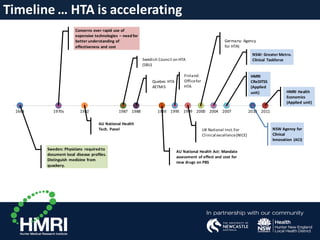
Timeline … HTA is accelerating
Views on HTA from key bodies…
• Australian Productivity Commission:
Governments and patients spend a considerable amountof money on health
interventions thatare irrelevant, duplicative or excessive;provide very low or
no benefits; or, in some cases, cause harm. Weaknessesin Australia’s health
technologyassessment(HTA)systemare part of the problem.1
• NSW Health: Decisions made regardingthe introduction of new
health technologies in NSW should be balanced by the available evidence,
cost implications and the requirementof the health systemto provide
contemporaryhigh quality clinical services.2
1 Australian Government: ProductivityCommission (2015).Efficiencyin Health. ProductivityCommission research paper. Canberra..
2 NSW Government(2017). NSWFramework for NewHealthTechnologies and SpecialisedServices.NSW Health. Sydney, Health SystemPlanning andInvestment Branch..
A need for local level HTA in Australia
• HTA used for nationally important, publicly
funded technologies (e.g. medicines)
• Are local & national HTA needs different?
• Relevant comparator (how will the
technology be used locally?)
• Cost / Availablebudgets
• Population / patient characteristics
• Access issues (including cost)
• Preferences,ethics, workforce,skills
• Local level = An example - regional areas
such as the RHP CIRH; individual LHDs or
grouping of LHDs
Case study of HTA (Part 2)
Improving outcomes after stroke – the local context
 The intervention: Mechanical thrombectomy for acute stroke with large artery occlusion.
 The HTA: An effective, although time-dependent, treatment for certain types of ischaemic stroke.
 However: the specialist medical skills + low rates of patient eligibility (between 4 to 14% of
ischaemic stroke patients), mean that widespread implementation, particularly in smaller regional
hospitals, is not viable. Centralised service is suggested BUT it limits access to this time-
dependent procedure.An access problem.
 Local solution: Frontline clinical staff observe local needs and develop innovative solutions to
improve patient outcomes.
 Prehospital Acute Stroke Triage (PAST) protocol was developed within the NSW RHP
CIRH, to reduce the time between ‘stroke event and treatment’ for patients in regional
Australia.
 HTA impact: PAST evaluated and proven to be an effective model of care: by reducing the
time to treatment,the PAST protocol increased access to effective stroke therapy.
All health technologies can be evaluated to see if
they are cost-effective. In some cases we do this
evaluation extraordinarily well …
Australia spends
about 10% of the
health budget on
medicines.The
evaluationdone
here is
international
BEST PRACTICE.
THE PROBLEM
We spend most
health $ at the
local level
healthcare
(hospitals and
primary health),
BUT we do much
less evaluationin
this space.
Of $160 billion annual spend, about $30 billion is waste – can be better spent
A
to support better decisions in healthcare
(at the local level)
Project aims
1. Document the current state of evaluation
of health technology across our footprint
(NSW RHP CIRH); and,
2. Design an innovative platform to meet the
health technology assessment needs (of the RHP
CIRH) now and into the future.
Methods
1. Review the literature;
2. Stakeholder consultations*; and,
3. Iterative model building to design a
blueprint to help improve decisions
around health technologies.
* LHD and PHN staff (managers,clinicians,clinician-researchers),all RHPCIRHpartners,exitingHTA committee,
state,Commonwealthandinternational HTA practitioners,Private HealthInsurersandpolicymakers.
Methods +
Our project was selected for CSIRO’s ‘On-
Prime’ – a ‘start up’ incubator.
Resulted in:
• Further stakeholder consultations;and,
• Business model development;
• Media – Australian Financial Review 9 May 2017
Results – the literature
• International leaders in HTA1 identified
sixteen principles for a best practice HTA
platform;
• These principles, along with other insights
from the literature, shaped the design of
the recommended platform.
1 DrummondMF, Schwartz JS, Jönsson B, et al.Keyprinciples for the improved conductofhealth technology assessments for resource allocation decisions. International journal of
technology assessmentin health care 2008; 24(03): 244-58
Results – stakeholder consultations
Key findings
• The RHP CIRH has significant existing HTA evaluation capabilities, definite need
to consider local context, don’t replicate work of existing HTA agencies, models
of care, procedures and policies are in need of better evaluation;
• Most evaluation capacity is at HMRI (epidemiology, medical statistics, health
economics, bioinformatics, IT and clinical trials) & is the pilot of HTAIm;
• A common theme: ensure the outcomes from the ‘evaluation’ strategies are
appropriately ‘implemented’ (i.e. translation);
• The implementation of these decisions optimises the use of cost-effective technologies and
minimises the use of low value healthcare in frontline health services.
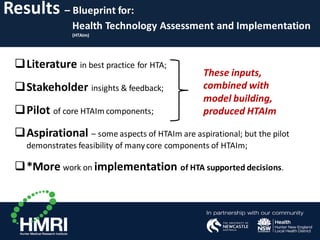
Results – Blueprint for:
Health Technology Assessment and Implementation
(HTAIm)
Literature in best practice for HTA;
Stakeholder insights & feedback;
Pilot of core HTAIm components;
Aspirational – some aspects of HTAIm are aspirational; but the pilot
demonstrates feasibility of manycore components of HTAIm;
*More work on implementation of HTA supported decisions.
These inputs,
combined with
model building,
produced HTAIm
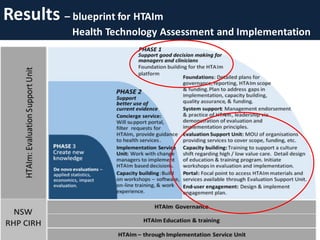
Results – blueprint for HTAIm
Health Technology Assessment and Implementation
Results – blueprint for HTAIm
Health Technology Assessment and Implementation
Results – blueprint for HTAIm
Health Technology Assessment and Implementation
Results – blueprint for HTAIm
Health Technology Assessment and Implementation
Results – Strengths of HTAIm: Capacity building
 Skills in evaluation and implementation:
 Broad skills development:
 Use existing models of knowledge exchange that have demonstrated
success. (E.g. Researching Important Clinical questions to improve
Health outcomes – RICH)
 Clinician / health manager workshops
 Tailored skills development:
 Work with partners (UoN and UNE) to develop & deliver short courses
in HTA related skills.
 Contributeto qualification in HTA
 Embed HTA in medical training (as per EBM)
Results – Strengths of HTAIm: Implementation
 The implementation gap
 Referred to in the literature & by stakeholders:a clear need
 Implementation of HTA supported decisions is underdeveloped
 Excellence in evaluation will have nil/limitedIMPACT without
IMPLEMENTATION
 HTAIm next steps
 Acknowledgeneed for more work in this space:review of existing
implementation expertise in RHP CIRH / insights from literature
 Embed implementationspecialistwithin healthservices to translate
HTA outcomes to health services’ change managers
 Evaluate various implementation strategies – are they cost-effective?
Results – case studies of local HTAIm
Reducing avoidable ED admissions from aged care facilities
 Need: Some residents in Aged Care Facilities (ACFs) were being transferred, unnecessarily, to
hospital EDs. The cost of these avoidable transfers included ambulance, ED and increased
stress on patients.
A locally designed intervention: Evidence suggested that some of these patients could be
adequately managed within ACFs with support from services such as telephone triage. The
Aged Care Emergency (ACE) program is a telephone triage service that offers assistance with
the management of ACF residents experiencing an unexpected deterioration in health.
HTA: Routinely collected data used to determine avoided ambulance transfers &ED
presentations attributable to ACE. The evaluation valued resources saved via the ACE service.
 HTA outcome: ACE was associated with ≈ 1000 avoided ED presentations annually,
with estimated annual savings of ≈ $920,000 for health services.
Results – case studies of local HTAIm
HTA: An intervention to reducere-fracture in at-risk populations
 The need: Minimal trauma fractures (MTFs)and re-fracturesamong Australians over
50, are a major national health issue, proving a significant cost burden to the health
system.
 The intervention: Fracture liaison services (FLS) are an accepted approach to lowering
rates of osteoporotic re-fracturesthrough post-fracture care.
 HTA evaluation: The HTA study estimated the operating cost of an FLS, from the
perspective of the Australian health system. Compared patients with MTF at an
intervention (FLS cohort) and control (Usual Care cohort) hospital - 6 mth period.
 HTA outcome: Compared to Usual Care, FLS Cohort had 62 fewer fractures per
1,000 patients. FLS service resulted in nearly $500,000 of savings over three
years. The HTA concluded that the FLS was financially effective.
The cost-effectiveness plane
High value care: Compared to
alternatives, the technology is cost-
effective, that is, delivers desired
outcome at a cost the community can
afford … value for money
Low value care: Compared to
alternatives, the technology offers
little or no benefit, may even cause
harm. Do not introduce / if currently
being used, disinvest
More of
this
Less of
this
Results – the benefit of evaluation & implementation
What we are doing now…
Developing a
business case
Take HTAIm
beyond pilot.
Exploring investment opportunities
Preparing a detailed budget. Case
studies show major cost savings
from HTAIm; a path to improving better
value for money for every health
dollar
Looking to make a direct case to
government;engage industry,
apply for grants
Concluding issues
Conclusion: Shared goals
 HTAIm assists better healthcare decisions
 A shared goal of medical research & private health insurers
 Ethics – providing care that improves patient health
outcomes
 Equity – many of the models of care improve access to
healthcare for rural & regional, & disadvantaged
Australians
 Reducing waste
 Value for money
QUESTIONS?
& / OR
COMMENT?

Andrew Searles

  • 1.
    Medical Research and the HealthInsurance Industry Shared Goals Andrew Searles BEc, Dip Ed, MMedStat, PhD Associate Director, HMRI Health ResearchEconomics Acknowledging: Ms PennyReeves,HealthEconomist, HMRI Dr Tracey Tay, HNEH
  • 2.
    Scene setting • Differences:perspectives, operations etc; • Shared goal: cost-effectively improve health outcomes • Examples of shared goals: – Health technology assessment: Better decisions on whether to use / stop health care? – Health & medical research: How to efficiently translate cost-effective research outcomesinto policy & practice?
  • 3.
    Agenda • Introduction toHMRI • Stream with mutual benefit – Better decisions in healthcare (HTA) • The problem – waste in healthcare • How we addressed the problem (methods) • A solution: HTAIm • Conclusion
  • 4.
    Introduction to HMRI:About us … • HMRI is one of NSW’s largest independent research institutions, second only to the Garvan Institute • A ‘facilitating’ MRI – meaning we create an environment for health and medical research to thrive • A member of the recently (June2017) announced NHMRC Regional Health Partners Centre for Innovation in Regional Health (RHP CIRH)
  • 5.
    Award of CIRHstatus based on: • Outstanding leadership in research and evidence-based clinical care to improve the quality of health care in regional and remote Australia • Excellence in innovative biomedical, clinical, public health and/or health services research addressing challenges in regional/remote Australia • Programs and activities to accelerate translationof research findings into practice • Research-infused education and training • Leadership to ensure research knowledge is translated into policy and practice • Strong collaboration amongst all stakeholders NSW Regional Health Partners Centre for Innovation in Regional Health
  • 6.
    Introduction to HMRI:Our footprint
  • 7.
    • Covers 32Local Government Areas, • 1.4 million people living in remote rural, rural, regional and urban centres • 11 percent of Australia’s Indigenous population live in this footprint • And substantialhealth infrastructure, including … – One Acute-Tertiary Referral Hospital – Two Principal Referral Hospitals, and – Six Major Hospitals (Group 1-2) – 11 Aboriginal Medical Services – 1,700 GPs and – Over 70 community health centres Introduction to HMRI: Our RHP CIRH footprint
  • 8.
    A project tosupport better decisions in healthcare HTAIm: Health Technology Assessment and Implementation
  • 9.
    The problem… Declining affordabilityof the cost of healthcare The annual real increase in health spending has outpaced GDP growth for nearly a decade. Australian Instituteof HealthandWelfare(2016). Australia's Health 2016. Canberra, AustralianInstituteof Health and Welfare.
  • 10.
    Compounded by … Ofthe $160 BILLION we spend on health in Australia each year about $30 BILLION is waste… which, for payers of healthcare (& patients),is the problem … $30b derived fromAustralian Government: Productivity Commission (2015). Efficiency in Health. Productivity Commission research paper.Canberra.
  • 11.
    Waste in healthcareis… • Over or under use of health technologies; • Use of technologies that don’t work or even cause harm; • The existence of errors; and, • Unexplainable variation in the cost, use or consequence of a technology between hospitals or regions. ….So, what are these “technologies”?
  • 12.
    What are “healthtechnologies”? Medicines Modelsof care, e.g. managing chronic disease, mental health Tests, procedures, diagnostics Health administration Health policy Devices Health Technologies
  • 13.
    What are “healthtechnologies”? Medicines Modelsof care, e.g. managing chronic disease, mental health Tests, procedures, diagnostics Health administration Health policy Devices Health Technologies
  • 14.
    What is “healthtechnology assessment”? • HTA is a ‘best practice’ activity • Related to EBM (provides evidence to be considered in context of the patient) • HTA is the evaluation of technologies within a given healthcare model to understand their short and long-term clinical, organisational, economic, social and ethical implications.1,2 • A process to determine value for money 1 Sampietro-ColomL, Lach K,Haro IE, et al.The AdHopHTA Handbook. AHandbook ofHospital-Based Health Assessment Technology; 2015. 2 JonssonE. History ofhealthtechnology assessmentin Sweden.InternationalJournalof Technology Assessment in Health Care2009;25(S1): 42-52.
  • 15.
    Case study ofHTA (Part 1) Improving outcomes after stroke  Setting: 1995 in the UK.  The need: Stroke was typically managed in general hospitals. At the time it was debated how to best manage stroke patients.  The HTA: Study had three arms: 1) a stroke unit (24 hour care from a specialist multidisciplinary team in a specialised ward); 2) a stroke team that involved specialist team support on general wards; and, 3) a stroke specialist in a general ward.  HTA outcome: The stroke unit was determined to be a more cost-effective intervention than the alternatives.  HTAimpact: Reported in the Lancet and cited in Cochrane.Multiple policy guidelinescite this HTA. For patients, the HTAshowed reduced mortality and morbidityas a consequenceof stroke units.
  • 16.
    Sweden: Physicians requiredto document local disease profiles. Distinguish medicine from quackery. Concerns over rapid use of expensive technologies – need for better understanding of effectiveness and cost AU National Health Tech. Panel Swedish Council on HTA (SBU) Quebec HTA - AETMIS AU National Health Act: Mandate assessment of effect and cost for new drugs on PBS Finland: Officefor HTA UK National Inst.For Clinical excellence(NICE) Germany: Agency for HTA) NSW: Greater Metro. Clinical Taskforce HMRI CReDITSS (Applied unit) NSW Agency for Clinical Innovation (ACI) HMRI Health Economics (Applied unit) 1663 1970s 1982 1987 1988 1993 1995 1999 2000 2004 2007 2010 2011 Timeline … HTA is accelerating
  • 17.
    Views on HTAfrom key bodies… • Australian Productivity Commission: Governments and patients spend a considerable amountof money on health interventions thatare irrelevant, duplicative or excessive;provide very low or no benefits; or, in some cases, cause harm. Weaknessesin Australia’s health technologyassessment(HTA)systemare part of the problem.1 • NSW Health: Decisions made regardingthe introduction of new health technologies in NSW should be balanced by the available evidence, cost implications and the requirementof the health systemto provide contemporaryhigh quality clinical services.2 1 Australian Government: ProductivityCommission (2015).Efficiencyin Health. ProductivityCommission research paper. Canberra.. 2 NSW Government(2017). NSWFramework for NewHealthTechnologies and SpecialisedServices.NSW Health. Sydney, Health SystemPlanning andInvestment Branch..
  • 18.
    A need forlocal level HTA in Australia • HTA used for nationally important, publicly funded technologies (e.g. medicines) • Are local & national HTA needs different? • Relevant comparator (how will the technology be used locally?) • Cost / Availablebudgets • Population / patient characteristics • Access issues (including cost) • Preferences,ethics, workforce,skills • Local level = An example - regional areas such as the RHP CIRH; individual LHDs or grouping of LHDs
  • 19.
    Case study ofHTA (Part 2) Improving outcomes after stroke – the local context  The intervention: Mechanical thrombectomy for acute stroke with large artery occlusion.  The HTA: An effective, although time-dependent, treatment for certain types of ischaemic stroke.  However: the specialist medical skills + low rates of patient eligibility (between 4 to 14% of ischaemic stroke patients), mean that widespread implementation, particularly in smaller regional hospitals, is not viable. Centralised service is suggested BUT it limits access to this time- dependent procedure.An access problem.  Local solution: Frontline clinical staff observe local needs and develop innovative solutions to improve patient outcomes.  Prehospital Acute Stroke Triage (PAST) protocol was developed within the NSW RHP CIRH, to reduce the time between ‘stroke event and treatment’ for patients in regional Australia.  HTA impact: PAST evaluated and proven to be an effective model of care: by reducing the time to treatment,the PAST protocol increased access to effective stroke therapy.
  • 20.
    All health technologiescan be evaluated to see if they are cost-effective. In some cases we do this evaluation extraordinarily well … Australia spends about 10% of the health budget on medicines.The evaluationdone here is international BEST PRACTICE. THE PROBLEM We spend most health $ at the local level healthcare (hospitals and primary health), BUT we do much less evaluationin this space. Of $160 billion annual spend, about $30 billion is waste – can be better spent
  • 21.
    A to support betterdecisions in healthcare (at the local level)
  • 22.
    Project aims 1. Documentthe current state of evaluation of health technology across our footprint (NSW RHP CIRH); and, 2. Design an innovative platform to meet the health technology assessment needs (of the RHP CIRH) now and into the future.
  • 23.
    Methods 1. Review theliterature; 2. Stakeholder consultations*; and, 3. Iterative model building to design a blueprint to help improve decisions around health technologies. * LHD and PHN staff (managers,clinicians,clinician-researchers),all RHPCIRHpartners,exitingHTA committee, state,Commonwealthandinternational HTA practitioners,Private HealthInsurersandpolicymakers.
  • 24.
    Methods + Our projectwas selected for CSIRO’s ‘On- Prime’ – a ‘start up’ incubator. Resulted in: • Further stakeholder consultations;and, • Business model development; • Media – Australian Financial Review 9 May 2017
  • 25.
    Results – theliterature • International leaders in HTA1 identified sixteen principles for a best practice HTA platform; • These principles, along with other insights from the literature, shaped the design of the recommended platform. 1 DrummondMF, Schwartz JS, Jönsson B, et al.Keyprinciples for the improved conductofhealth technology assessments for resource allocation decisions. International journal of technology assessmentin health care 2008; 24(03): 244-58
  • 26.
    Results – stakeholderconsultations Key findings • The RHP CIRH has significant existing HTA evaluation capabilities, definite need to consider local context, don’t replicate work of existing HTA agencies, models of care, procedures and policies are in need of better evaluation; • Most evaluation capacity is at HMRI (epidemiology, medical statistics, health economics, bioinformatics, IT and clinical trials) & is the pilot of HTAIm; • A common theme: ensure the outcomes from the ‘evaluation’ strategies are appropriately ‘implemented’ (i.e. translation); • The implementation of these decisions optimises the use of cost-effective technologies and minimises the use of low value healthcare in frontline health services.
  • 27.
    Results – Blueprintfor: Health Technology Assessment and Implementation (HTAIm) Literature in best practice for HTA; Stakeholder insights & feedback; Pilot of core HTAIm components; Aspirational – some aspects of HTAIm are aspirational; but the pilot demonstrates feasibility of manycore components of HTAIm; *More work on implementation of HTA supported decisions. These inputs, combined with model building, produced HTAIm
  • 28.
    Results – blueprintfor HTAIm Health Technology Assessment and Implementation
  • 29.
    Results – blueprintfor HTAIm Health Technology Assessment and Implementation
  • 30.
    Results – blueprintfor HTAIm Health Technology Assessment and Implementation
  • 31.
    Results – blueprintfor HTAIm Health Technology Assessment and Implementation
  • 32.
    Results – Strengthsof HTAIm: Capacity building  Skills in evaluation and implementation:  Broad skills development:  Use existing models of knowledge exchange that have demonstrated success. (E.g. Researching Important Clinical questions to improve Health outcomes – RICH)  Clinician / health manager workshops  Tailored skills development:  Work with partners (UoN and UNE) to develop & deliver short courses in HTA related skills.  Contributeto qualification in HTA  Embed HTA in medical training (as per EBM)
  • 33.
    Results – Strengthsof HTAIm: Implementation  The implementation gap  Referred to in the literature & by stakeholders:a clear need  Implementation of HTA supported decisions is underdeveloped  Excellence in evaluation will have nil/limitedIMPACT without IMPLEMENTATION  HTAIm next steps  Acknowledgeneed for more work in this space:review of existing implementation expertise in RHP CIRH / insights from literature  Embed implementationspecialistwithin healthservices to translate HTA outcomes to health services’ change managers  Evaluate various implementation strategies – are they cost-effective?
  • 34.
    Results – casestudies of local HTAIm Reducing avoidable ED admissions from aged care facilities  Need: Some residents in Aged Care Facilities (ACFs) were being transferred, unnecessarily, to hospital EDs. The cost of these avoidable transfers included ambulance, ED and increased stress on patients. A locally designed intervention: Evidence suggested that some of these patients could be adequately managed within ACFs with support from services such as telephone triage. The Aged Care Emergency (ACE) program is a telephone triage service that offers assistance with the management of ACF residents experiencing an unexpected deterioration in health. HTA: Routinely collected data used to determine avoided ambulance transfers &ED presentations attributable to ACE. The evaluation valued resources saved via the ACE service.  HTA outcome: ACE was associated with ≈ 1000 avoided ED presentations annually, with estimated annual savings of ≈ $920,000 for health services.
  • 35.
    Results – casestudies of local HTAIm HTA: An intervention to reducere-fracture in at-risk populations  The need: Minimal trauma fractures (MTFs)and re-fracturesamong Australians over 50, are a major national health issue, proving a significant cost burden to the health system.  The intervention: Fracture liaison services (FLS) are an accepted approach to lowering rates of osteoporotic re-fracturesthrough post-fracture care.  HTA evaluation: The HTA study estimated the operating cost of an FLS, from the perspective of the Australian health system. Compared patients with MTF at an intervention (FLS cohort) and control (Usual Care cohort) hospital - 6 mth period.  HTA outcome: Compared to Usual Care, FLS Cohort had 62 fewer fractures per 1,000 patients. FLS service resulted in nearly $500,000 of savings over three years. The HTA concluded that the FLS was financially effective.
  • 36.
  • 37.
    High value care:Compared to alternatives, the technology is cost- effective, that is, delivers desired outcome at a cost the community can afford … value for money Low value care: Compared to alternatives, the technology offers little or no benefit, may even cause harm. Do not introduce / if currently being used, disinvest More of this Less of this Results – the benefit of evaluation & implementation
  • 38.
    What we aredoing now… Developing a business case Take HTAIm beyond pilot. Exploring investment opportunities Preparing a detailed budget. Case studies show major cost savings from HTAIm; a path to improving better value for money for every health dollar Looking to make a direct case to government;engage industry, apply for grants
  • 39.
  • 40.
    Conclusion: Shared goals HTAIm assists better healthcare decisions  A shared goal of medical research & private health insurers  Ethics – providing care that improves patient health outcomes  Equity – many of the models of care improve access to healthcare for rural & regional, & disadvantaged Australians  Reducing waste  Value for money
  • 41.