Network Analytics to Enable Healthcare
Decision Making
Dr Shahadat Uddin
Complex Systems Research Group
Faculty of Engineering & IT
The University of Sydney, Australia
Health Insurance Summit, 2017
Outline of this presentation
2
 Healthcare stakeholders and Healthcare dataset
 Network analysis principle
 Healthcare dataset used for network analysis
 Application scenario of network analytics for better decision making
 Discussion and Conclusion
3
Some facts about Healthcare data
Source: https://medtechengine.com/resource/big-data-and-healthcare-facts-and-figures/
 Opportunity: This vast volume of healthcare data can be used for decision making
(1ZB=1012 GB)
Healthcare stakeholders
4
Healthcare
funders and
policy makers
Healthcare
Provider
Healthcare
Consumer
Patients
- GPs and Clinical specialists
- Pathology service providers
- Radiology and imaging
providers
- Pharmacies
- Community healthcare centres,
- Ambulance
- Public and private hospitals
- Aged care facilities
- Ancillary health service
providers (e.g., dentists,
physiotherapists, optometrists,
dieticians)
- Health insurance organisations
- Government policy makers
- They are in charge of
administering, monitoring and
funding of the whole healthcare
system.
Healthcare stakeholders (contd...)
5
Healthcare
funders and
policy makers
Healthcare
Provider
Healthcare
Consumer
In the modern healthcare environment, large amounts of electronic health data are
generated at every step of the process as the health consumer traverses through
the health system.
- Patient demographics
- Details of service(s) provided
- Laboratory and radiology results
- Drug prescription details
- Billing details
- Referral details, and
- Other associated establishment
costs, such as accommodation
costs and theatre charges.
Healthcare stakeholders (contd...)
6
Given the complex nature of the healthcare sector and the decisions that the
stakeholders have to make, the key questions to consider are:
(a) Do healthcare consumers have all the information they need to make informed
decisions about their healthcare choices?;
(b) Do service providers like doctors, hospitals, allied health workers, etc. have the
full data that enable them to provide continuity of care to their patients?; and
(c) Do healthcare funders like health insurers, government health departments and
health policy makers have a complete picture of the entire health data to make
informed decisions about healthcare costs and the quality of services provided?
Healthcare stakeholders (contd...)
7
 As in other domains, health system managers use decision support systems
based on statistical analysis and predictive modelling techniques built around
health data repositories assembled from health services administrative data sets.
 This presentation will show how methods and measures from network analytics
can reveal insight from this kind data that can effectively be used for healthcare
decision making
 Different application scenarios (based on healthcare administrative data) will be
explained
Research aim
8
Insurance data
Healthcare
decision making
Graph theory
Socialnetwork
analysis
Statistical
methods
Machine
learning
 Network analytics for better healthcare
decision making
Healthcare dataset organisation
9
Network analysis: measures and methods
10
 A network is a group of two or more individuals or any other entities (e.g.
organisation) that are linked together.
 In the figure below, two nodes are presented by two small circles and a link
shows the relation between them. The two nodes and a link between them form
a network.
Network analysis: measures and methods (contd..)
11
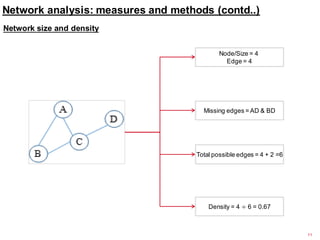
Node/Size = 4
Edge = 4
Missing edges = AD & BD
Total possible edges = 4 + 2 =6
Density = 4 ÷ 6 = 0.67
Network size and density
Network analysis: measures and methods (contd..)
12
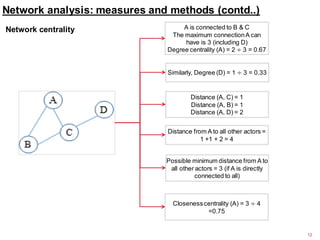
Distance (A, C) = 1
Distance (A, B) = 1
Distance (A, D) = 2
A is connected to B & C
The maximum connectionA can
have is 3 (including D)
Degree centrality (A) = 2 ÷ 3 = 0.67
Similarly, Degree (D) = 1 ÷ 3 = 0.33
Distance from A to all other actors =
1 +1 + 2 = 4
Possible minimum distance from A to
all other actors = 3 (if A is directly
connected to all)
Closenesscentrality (A) = 3 ÷ 4
=0.75
Network centrality
Network analysis: measures and methods (contd..)
13
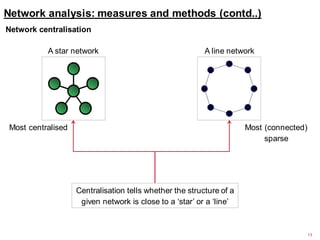
Network centralisation
A star network A line network
Most centralised Most (connected)
sparse
Centralisation tells whether the structure of a
given network is close to a ‘star’ or a ‘line’
Network analysis: measures and methods (contd..)
14
Clique and Subgroup analysis
In this figure, actors A, B, C and D form a clique as
they are directly connected among themselves
2-clique (‘a friend of a friend’): The actors B, D,
E, F and G form a 2-clique as they are connected
among themselves at a maximum distance of 2
Similarly, actors A, B, C, D, E and G form a 2-
clique as they are connected among themselves at
a maximum distance of 2
Research dataset
15
 Provided by an Australian health insurance organisation
 Patient (only those who had hospital admissions) health trajectory information has been
provided
 Disease, socio-demographic and all other information related to hospital admissions of all
these patients have been provided
 For a given disease, we defined ‘low cost’ and ‘high cost’ hospital. Here is the procedure
 Find the average costfor all patients (suffering from the same disease)admitted to the hospital
underconsideration
 In the sameway,we calculatedthe average costof a given diseasefor all hospitals
 The hospitals thatbelong to the lowestquartile are defined as the ‘low cost’hospitals
 The hospitals thatbelong to the highestquartile are definedas the ‘high cost’hospitals
Applied scenario of network analytics
16
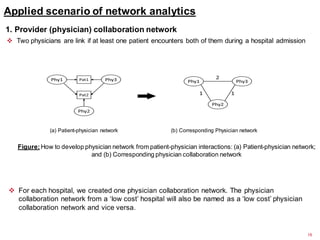
1. Provider (physician) collaboration network
(a) Patient-physician network (b) Corresponding Physician network
 Two physicians are link if at least one patient encounters both of them during a hospital admission
Figure:How to develop physician network from patient-physician interactions: (a) Patient-physician network;
and (b) Corresponding physician collaboration network
 For each hospital, we created one physician collaboration network. The physician
collaboration network from a ‘low cost’ hospital will also be named as a ‘low cost’ physician
collaboration network and vice versa.
Applied scenario of network analytics (contd..)
17
1. Provider (physician) collaboration network (contd..)
Figure:(a) Patient-physician network; and (b) Corresponding physiciancollaboration network from the research
dataset
 Network data for only hip replacement patients from different hospitals
Applied scenario of network analytics (contd..)
18
1. Provider (physician) collaboration network (contd..)
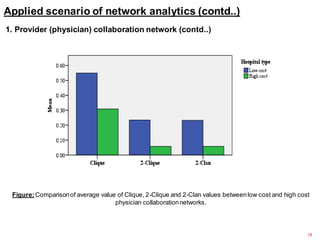
Figure:Comparisonof average value of Clique, 2-Clique and 2-Clan values betweenlow cost and high cost
physician collaborationnetworks.
Applied scenario of network analytics (contd..)
19
1. Provider (physician) collaboration network (contd..)
Findings
 In low cost networks, physicians tend to
work in smaller groups (p<0.05).
 Collaboration in large groups tends to
make the treatment cost high
Applied scenario of network analytics (contd..)
20
2. Team composition
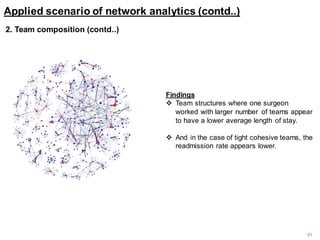
Figure:Tripartite graph showing surgical teams composedof surgeons (red), assistant surgeons (light blue) and
anaesthetists (dark blue).
 Network data for only knee surgery patients from different hospitals
There are some providers
working with several teams, while
some others work in smaller
tightly-knit teams as depicted by
a single triangle.
Node size indicates the number
of surgeries performed
A thicker line between two nodes
indicates that these two surgeons
had more patients in common.
The different clusters give an
indication of how they operate
as teams.
Applied scenario of network analytics (contd..)
21
2. Team composition (contd..)
Findings
 Team structures where one surgeon
worked with larger number of teams appear
to have a lower average length of stay.
 And in the case of tight cohesive teams, the
readmission rate appears lower.
Applied scenario of network analytics (contd..)
22
3. Understanding health trajectory using disease network
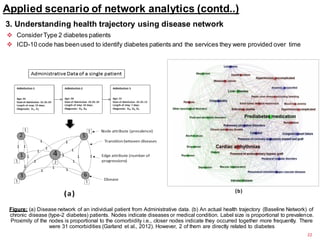
 ConsiderType 2 diabetes patients
 ICD-10 code has beenused to identify diabetes patients and the services they were provided over time
Figure: (a) Disease network of an individual patient from Administrative data. (b) An actual health trajectory (Baseline Network) of
chronic disease (type-2 diabetes) patients. Nodes indicate diseases or medical condition. Label size is proportional to prevalence.
Proximity of the nodes is proportional to the comorbidity i.e., closer nodes indicate they occurred together more frequently. There
were 31 comorbidities (Garland et al., 2012). However, 2 of them are directly related to diabetes
Applied scenario of network analytics (contd..)
23
3. Understanding health trajectory using disease network (contd..)
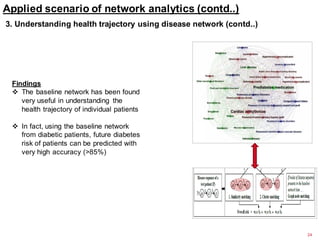
Different methods
- Graph similarity matching
- Graph node matching
- Cluster matching
- Parameter estimation
Figure:Disease riskpredictionforindividual patients
Applied scenario of network analytics (contd..)
24
3. Understanding health trajectory using disease network (contd..)
Findings
 The baseline network has been found
very useful in understanding the
health trajectory of individual patients
 In fact, using the baseline network
from diabetic patients, future diabetes
risk of patients can be predicted with
very high accuracy (>85%)
Summary of findings
25
Provider (physician) collaboration network
 Collaborations in small group tend to make the treatment cost low’
Team composition
 Team structure has been found to have impact on length of stay and readmission rate
Understanding health trajectory using disease network
 Baseline disease network can effectively predict future disease risk
Discussion and Conclusion
26
 The three applications illustrate the potential capability of network analytics to analyse and
visualise information in new ways that enable evidence-based healthcare decision making.
 Network level measures such as density and network distance can provide valuable
understanding of the nature of connections or ties among the actors of the network and the
time it would take to propagate a piece of information across the entire network.
 Sub-group analysis techniques such as clique analysis can provide ways of understanding the
impact of microstructures or small groups within a larger community of providers.
 Governments all over the world are shifting the healthcare paradigms towards e-Health based
system.
 This means that data will be stored and transmitted in a more transparent and accessible ways
that can open a new frontiers of data mining research in order to deliver best possible health
outcome to a world which may face a more extensive burden of chronic disease.
 The tremendous potential of network based analytics can be exploited in all of these new
frontiers that are opening up with the availability of data, in order to effectively deliver quality
care and aid in policy making by the stakeholders.
NetworkAnalytics in Healthcare Decision Making
27

Shahadat Uddin

  • 1.
    Network Analytics toEnable Healthcare Decision Making Dr Shahadat Uddin Complex Systems Research Group Faculty of Engineering & IT The University of Sydney, Australia Health Insurance Summit, 2017
  • 2.
    Outline of thispresentation 2  Healthcare stakeholders and Healthcare dataset  Network analysis principle  Healthcare dataset used for network analysis  Application scenario of network analytics for better decision making  Discussion and Conclusion
  • 3.
    3 Some facts aboutHealthcare data Source: https://medtechengine.com/resource/big-data-and-healthcare-facts-and-figures/  Opportunity: This vast volume of healthcare data can be used for decision making (1ZB=1012 GB)
  • 4.
    Healthcare stakeholders 4 Healthcare funders and policymakers Healthcare Provider Healthcare Consumer Patients - GPs and Clinical specialists - Pathology service providers - Radiology and imaging providers - Pharmacies - Community healthcare centres, - Ambulance - Public and private hospitals - Aged care facilities - Ancillary health service providers (e.g., dentists, physiotherapists, optometrists, dieticians) - Health insurance organisations - Government policy makers - They are in charge of administering, monitoring and funding of the whole healthcare system.
  • 5.
    Healthcare stakeholders (contd...) 5 Healthcare fundersand policy makers Healthcare Provider Healthcare Consumer In the modern healthcare environment, large amounts of electronic health data are generated at every step of the process as the health consumer traverses through the health system. - Patient demographics - Details of service(s) provided - Laboratory and radiology results - Drug prescription details - Billing details - Referral details, and - Other associated establishment costs, such as accommodation costs and theatre charges.
  • 6.
    Healthcare stakeholders (contd...) 6 Giventhe complex nature of the healthcare sector and the decisions that the stakeholders have to make, the key questions to consider are: (a) Do healthcare consumers have all the information they need to make informed decisions about their healthcare choices?; (b) Do service providers like doctors, hospitals, allied health workers, etc. have the full data that enable them to provide continuity of care to their patients?; and (c) Do healthcare funders like health insurers, government health departments and health policy makers have a complete picture of the entire health data to make informed decisions about healthcare costs and the quality of services provided?
  • 7.
    Healthcare stakeholders (contd...) 7 As in other domains, health system managers use decision support systems based on statistical analysis and predictive modelling techniques built around health data repositories assembled from health services administrative data sets.  This presentation will show how methods and measures from network analytics can reveal insight from this kind data that can effectively be used for healthcare decision making  Different application scenarios (based on healthcare administrative data) will be explained
  • 8.
    Research aim 8 Insurance data Healthcare decisionmaking Graph theory Socialnetwork analysis Statistical methods Machine learning  Network analytics for better healthcare decision making
  • 9.
  • 10.
    Network analysis: measuresand methods 10  A network is a group of two or more individuals or any other entities (e.g. organisation) that are linked together.  In the figure below, two nodes are presented by two small circles and a link shows the relation between them. The two nodes and a link between them form a network.
  • 11.
    Network analysis: measuresand methods (contd..) 11 Node/Size = 4 Edge = 4 Missing edges = AD & BD Total possible edges = 4 + 2 =6 Density = 4 ÷ 6 = 0.67 Network size and density
  • 12.
    Network analysis: measuresand methods (contd..) 12 Distance (A, C) = 1 Distance (A, B) = 1 Distance (A, D) = 2 A is connected to B & C The maximum connectionA can have is 3 (including D) Degree centrality (A) = 2 ÷ 3 = 0.67 Similarly, Degree (D) = 1 ÷ 3 = 0.33 Distance from A to all other actors = 1 +1 + 2 = 4 Possible minimum distance from A to all other actors = 3 (if A is directly connected to all) Closenesscentrality (A) = 3 ÷ 4 =0.75 Network centrality
  • 13.
    Network analysis: measuresand methods (contd..) 13 Network centralisation A star network A line network Most centralised Most (connected) sparse Centralisation tells whether the structure of a given network is close to a ‘star’ or a ‘line’
  • 14.
    Network analysis: measuresand methods (contd..) 14 Clique and Subgroup analysis In this figure, actors A, B, C and D form a clique as they are directly connected among themselves 2-clique (‘a friend of a friend’): The actors B, D, E, F and G form a 2-clique as they are connected among themselves at a maximum distance of 2 Similarly, actors A, B, C, D, E and G form a 2- clique as they are connected among themselves at a maximum distance of 2
  • 15.
    Research dataset 15  Providedby an Australian health insurance organisation  Patient (only those who had hospital admissions) health trajectory information has been provided  Disease, socio-demographic and all other information related to hospital admissions of all these patients have been provided  For a given disease, we defined ‘low cost’ and ‘high cost’ hospital. Here is the procedure  Find the average costfor all patients (suffering from the same disease)admitted to the hospital underconsideration  In the sameway,we calculatedthe average costof a given diseasefor all hospitals  The hospitals thatbelong to the lowestquartile are defined as the ‘low cost’hospitals  The hospitals thatbelong to the highestquartile are definedas the ‘high cost’hospitals
  • 16.
    Applied scenario ofnetwork analytics 16 1. Provider (physician) collaboration network (a) Patient-physician network (b) Corresponding Physician network  Two physicians are link if at least one patient encounters both of them during a hospital admission Figure:How to develop physician network from patient-physician interactions: (a) Patient-physician network; and (b) Corresponding physician collaboration network  For each hospital, we created one physician collaboration network. The physician collaboration network from a ‘low cost’ hospital will also be named as a ‘low cost’ physician collaboration network and vice versa.
  • 17.
    Applied scenario ofnetwork analytics (contd..) 17 1. Provider (physician) collaboration network (contd..) Figure:(a) Patient-physician network; and (b) Corresponding physiciancollaboration network from the research dataset  Network data for only hip replacement patients from different hospitals
  • 18.
    Applied scenario ofnetwork analytics (contd..) 18 1. Provider (physician) collaboration network (contd..) Figure:Comparisonof average value of Clique, 2-Clique and 2-Clan values betweenlow cost and high cost physician collaborationnetworks.
  • 19.
    Applied scenario ofnetwork analytics (contd..) 19 1. Provider (physician) collaboration network (contd..) Findings  In low cost networks, physicians tend to work in smaller groups (p<0.05).  Collaboration in large groups tends to make the treatment cost high
  • 20.
    Applied scenario ofnetwork analytics (contd..) 20 2. Team composition Figure:Tripartite graph showing surgical teams composedof surgeons (red), assistant surgeons (light blue) and anaesthetists (dark blue).  Network data for only knee surgery patients from different hospitals There are some providers working with several teams, while some others work in smaller tightly-knit teams as depicted by a single triangle. Node size indicates the number of surgeries performed A thicker line between two nodes indicates that these two surgeons had more patients in common. The different clusters give an indication of how they operate as teams.
  • 21.
    Applied scenario ofnetwork analytics (contd..) 21 2. Team composition (contd..) Findings  Team structures where one surgeon worked with larger number of teams appear to have a lower average length of stay.  And in the case of tight cohesive teams, the readmission rate appears lower.
  • 22.
    Applied scenario ofnetwork analytics (contd..) 22 3. Understanding health trajectory using disease network  ConsiderType 2 diabetes patients  ICD-10 code has beenused to identify diabetes patients and the services they were provided over time Figure: (a) Disease network of an individual patient from Administrative data. (b) An actual health trajectory (Baseline Network) of chronic disease (type-2 diabetes) patients. Nodes indicate diseases or medical condition. Label size is proportional to prevalence. Proximity of the nodes is proportional to the comorbidity i.e., closer nodes indicate they occurred together more frequently. There were 31 comorbidities (Garland et al., 2012). However, 2 of them are directly related to diabetes
  • 23.
    Applied scenario ofnetwork analytics (contd..) 23 3. Understanding health trajectory using disease network (contd..) Different methods - Graph similarity matching - Graph node matching - Cluster matching - Parameter estimation Figure:Disease riskpredictionforindividual patients
  • 24.
    Applied scenario ofnetwork analytics (contd..) 24 3. Understanding health trajectory using disease network (contd..) Findings  The baseline network has been found very useful in understanding the health trajectory of individual patients  In fact, using the baseline network from diabetic patients, future diabetes risk of patients can be predicted with very high accuracy (>85%)
  • 25.
    Summary of findings 25 Provider(physician) collaboration network  Collaborations in small group tend to make the treatment cost low’ Team composition  Team structure has been found to have impact on length of stay and readmission rate Understanding health trajectory using disease network  Baseline disease network can effectively predict future disease risk
  • 26.
    Discussion and Conclusion 26 The three applications illustrate the potential capability of network analytics to analyse and visualise information in new ways that enable evidence-based healthcare decision making.  Network level measures such as density and network distance can provide valuable understanding of the nature of connections or ties among the actors of the network and the time it would take to propagate a piece of information across the entire network.  Sub-group analysis techniques such as clique analysis can provide ways of understanding the impact of microstructures or small groups within a larger community of providers.  Governments all over the world are shifting the healthcare paradigms towards e-Health based system.  This means that data will be stored and transmitted in a more transparent and accessible ways that can open a new frontiers of data mining research in order to deliver best possible health outcome to a world which may face a more extensive burden of chronic disease.  The tremendous potential of network based analytics can be exploited in all of these new frontiers that are opening up with the availability of data, in order to effectively deliver quality care and aid in policy making by the stakeholders.
  • 27.