1
Quality Health Care: Technology
And Data Drive Improvements
H. Stephen Lieber
President & CEO
HIMSS
HIMSS Introduction
• Who is HIMSS
– Global-focused, not for profit organisation of professionals,
clinicians, companies, policy makers and other
stakeholders sharing the vision of better health through IT
• How do we work
– As a dominant voice, convener and thought leader of
health transformation through IT
• Who is HIMSS
– 300.000+ engaged professionals, 65.000+ members, ~400
staff in Europe, Asia, Middle East and North America
2
We work with:
• Governments and Ministries
• Policy makers and strategists
• Care providers
• Suppliers and Vendors
• Professional communities
• Clinical experts & IT professionals
3
What drives our mission
• Hundreds of thousands die in hospitals each year as the result
of medical errors
– Tens of thousands die from medication errors alone
• Hundreds of thousands die each year without access to
appropriate health care
• In the EU, missed healthcare opportunities have a €70 billion
cost to European society
• These measures can be improved and IT is a major driver for
that improvement
4
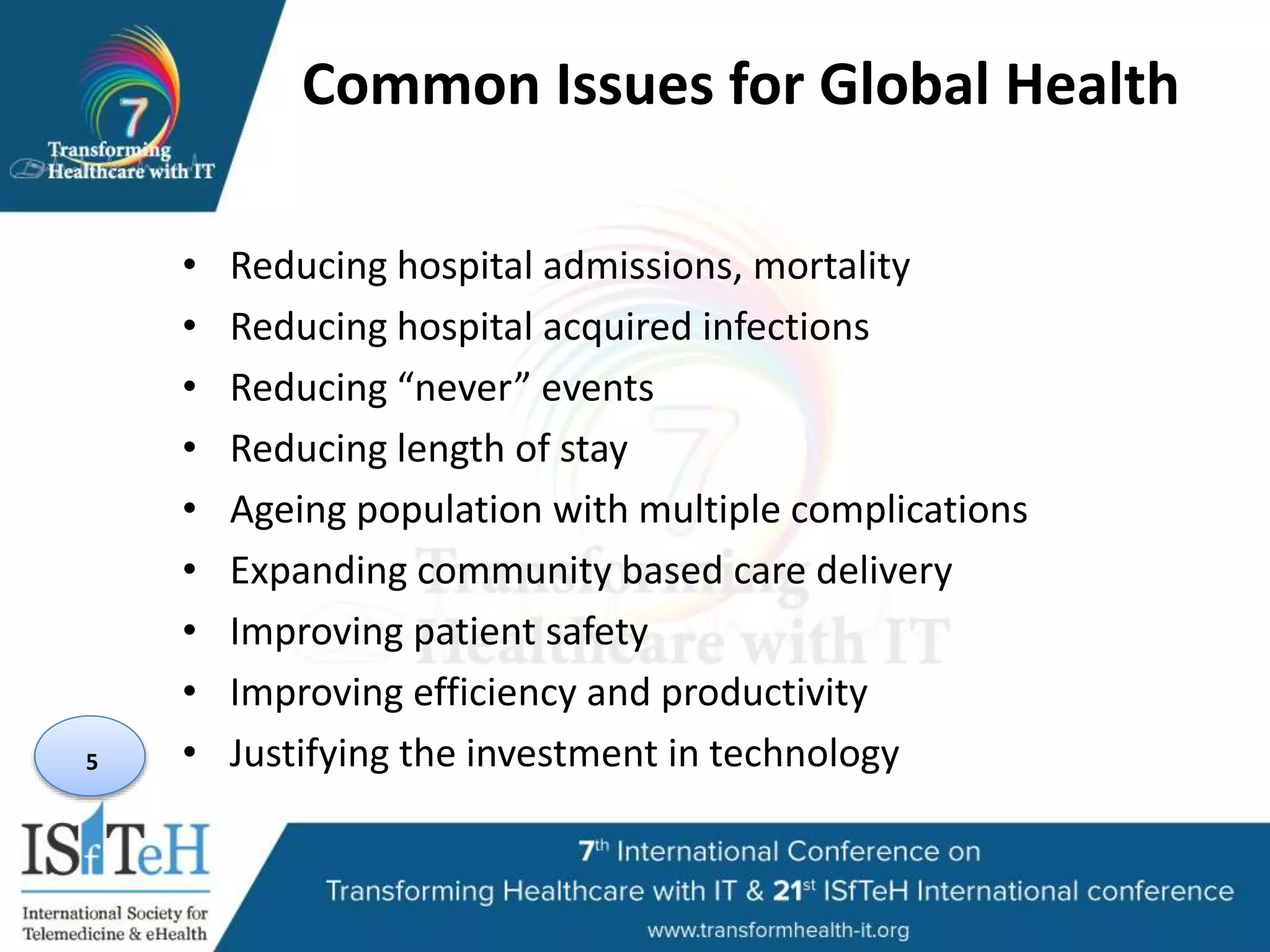
Common Issues for Global Health
• Reducing hospital admissions, mortality
• Reducing hospital acquired infections
• Reducing “never” events
• Reducing length of stay
• Ageing population with multiple complications
• Expanding community based care delivery
• Improving patient safety
• Improving efficiency and productivity
• Justifying the investment in technology5
6
High Correlation:
Advanced EMR
Capabilities and
Quality
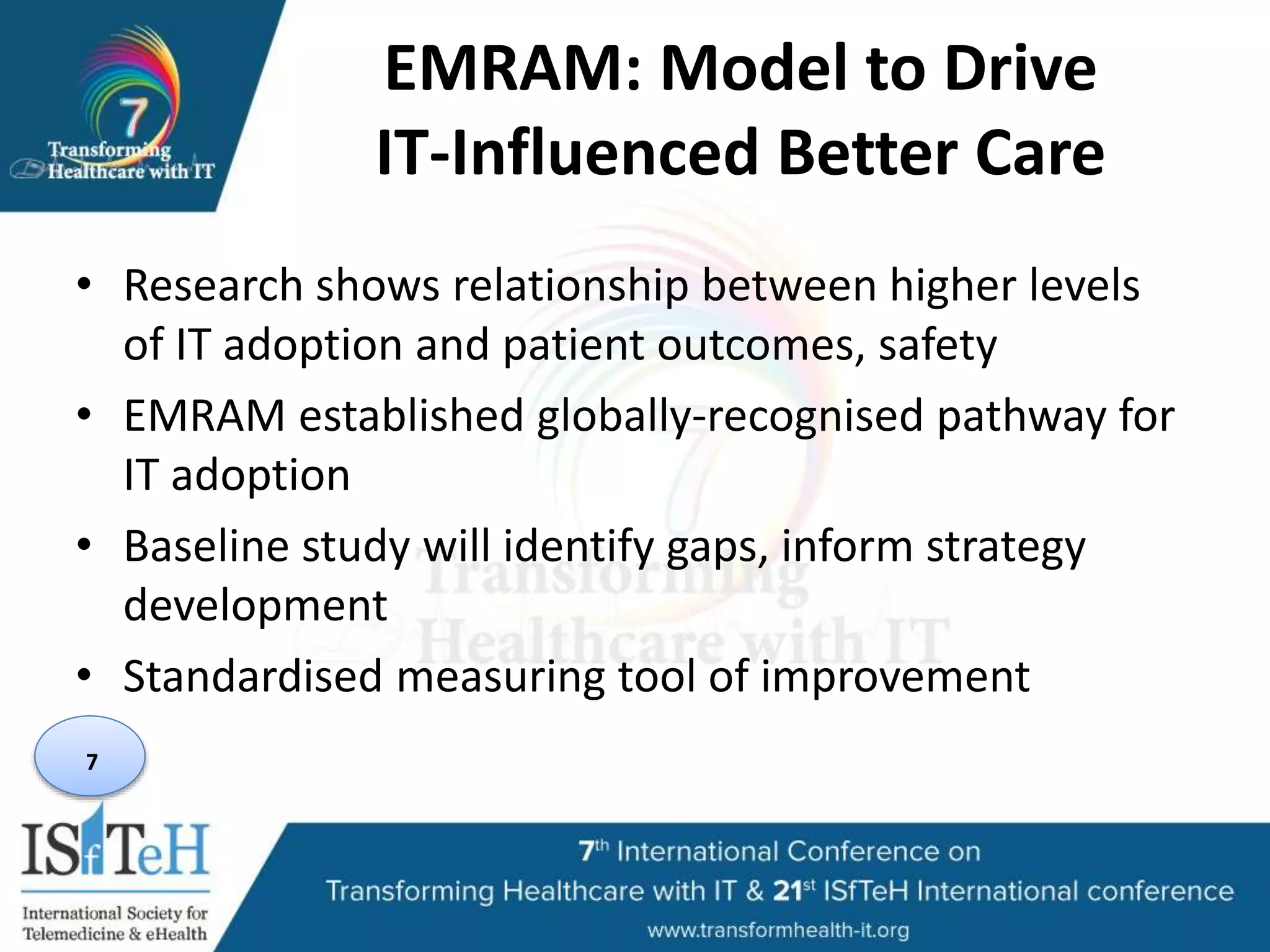
EMRAM: Model to Drive
IT-Influenced Better Care
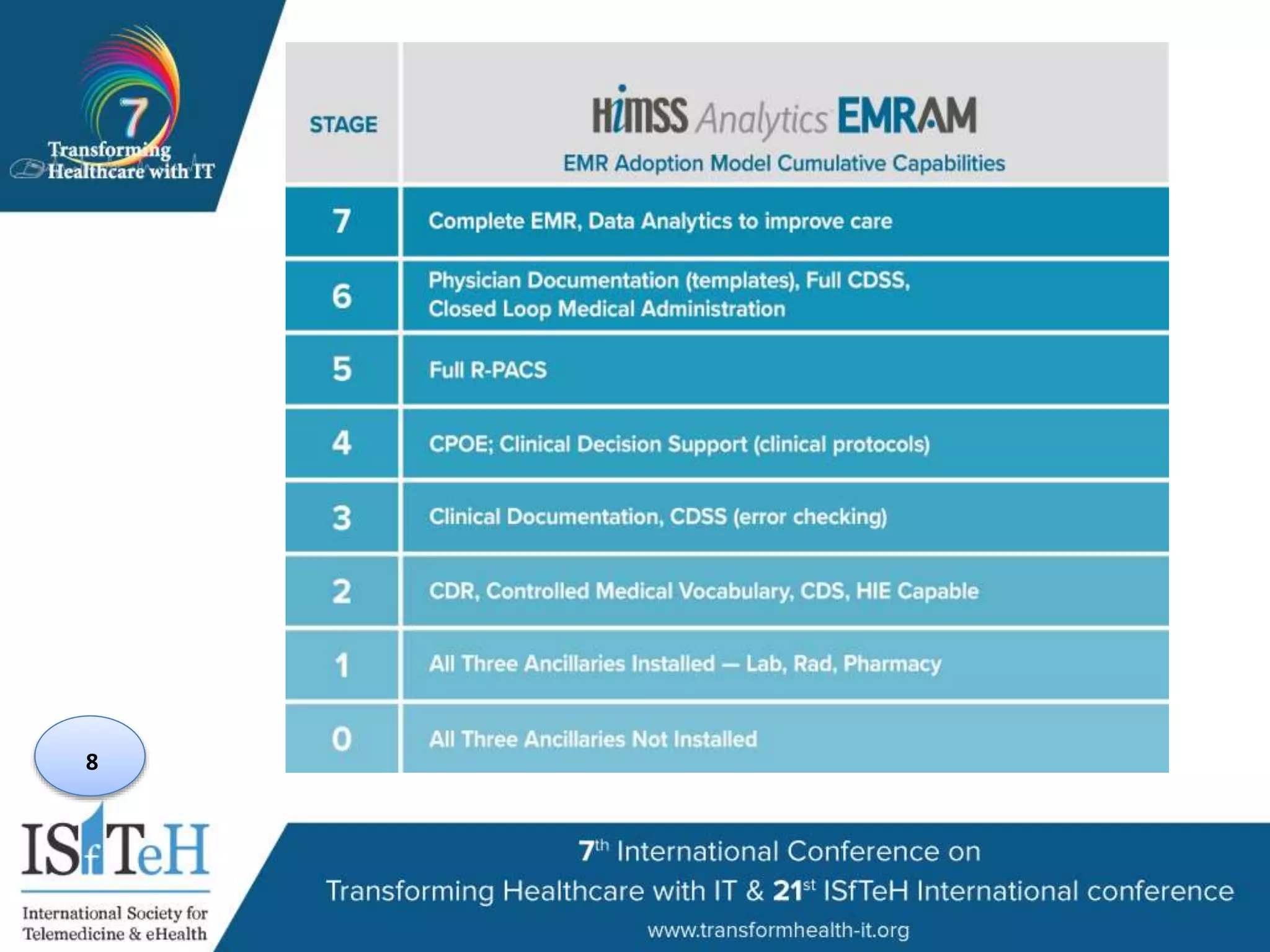
• Research shows relationship between higher levels
of IT adoption and patient outcomes, safety
• EMRAM established globally-recognised pathway for
IT adoption
• Baseline study will identify gaps, inform strategy
development
• Standardised measuring tool of improvement
7
8
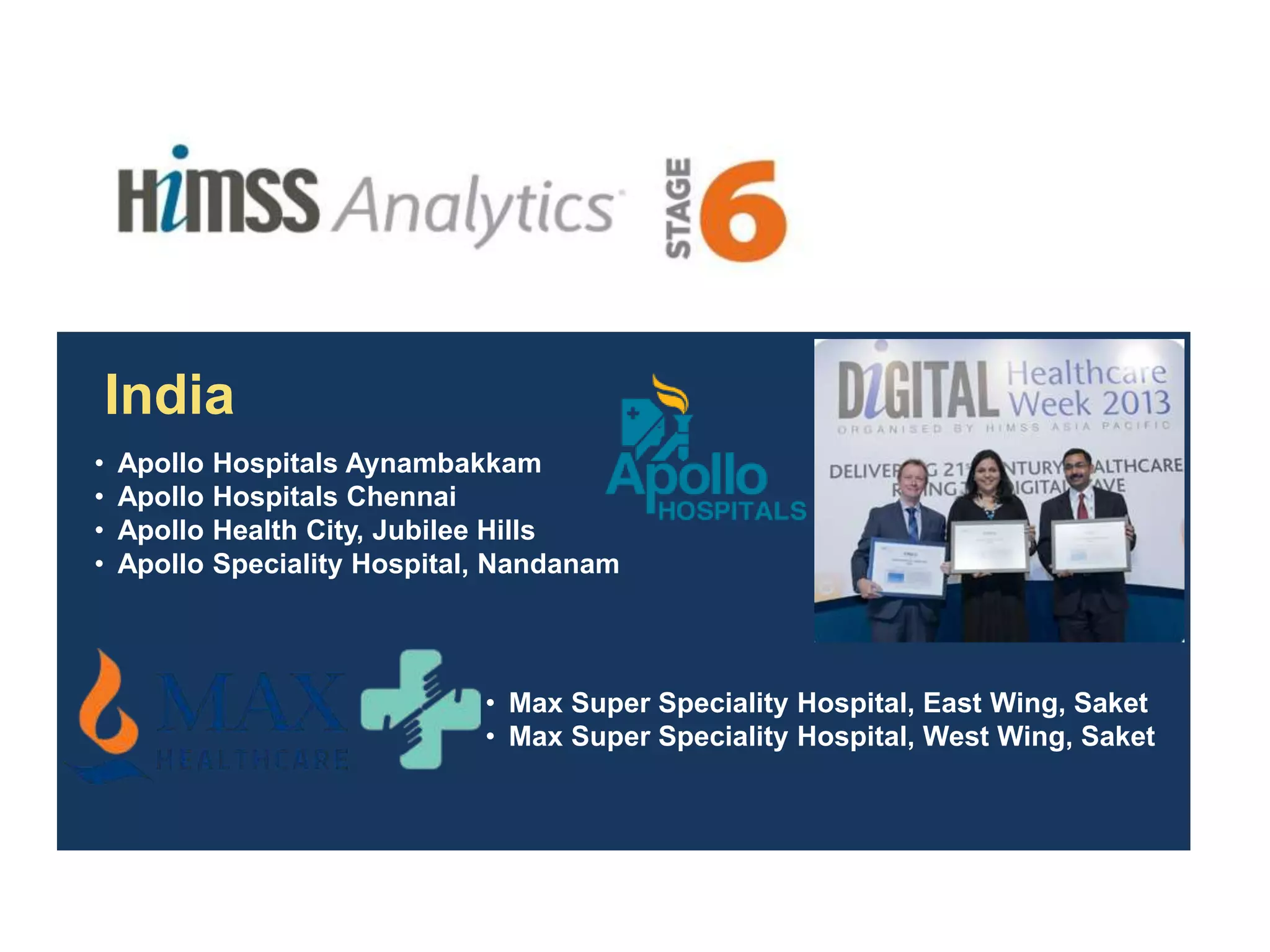
• Apollo Hospitals Aynambakkam
• Apollo Hospitals Chennai
• Apollo Health City, Jubilee Hills
• Apollo Speciality Hospital, Nandanam
India
• Max Super Speciality Hospital, East Wing, Saket
• Max Super Speciality Hospital, West Wing, Saket
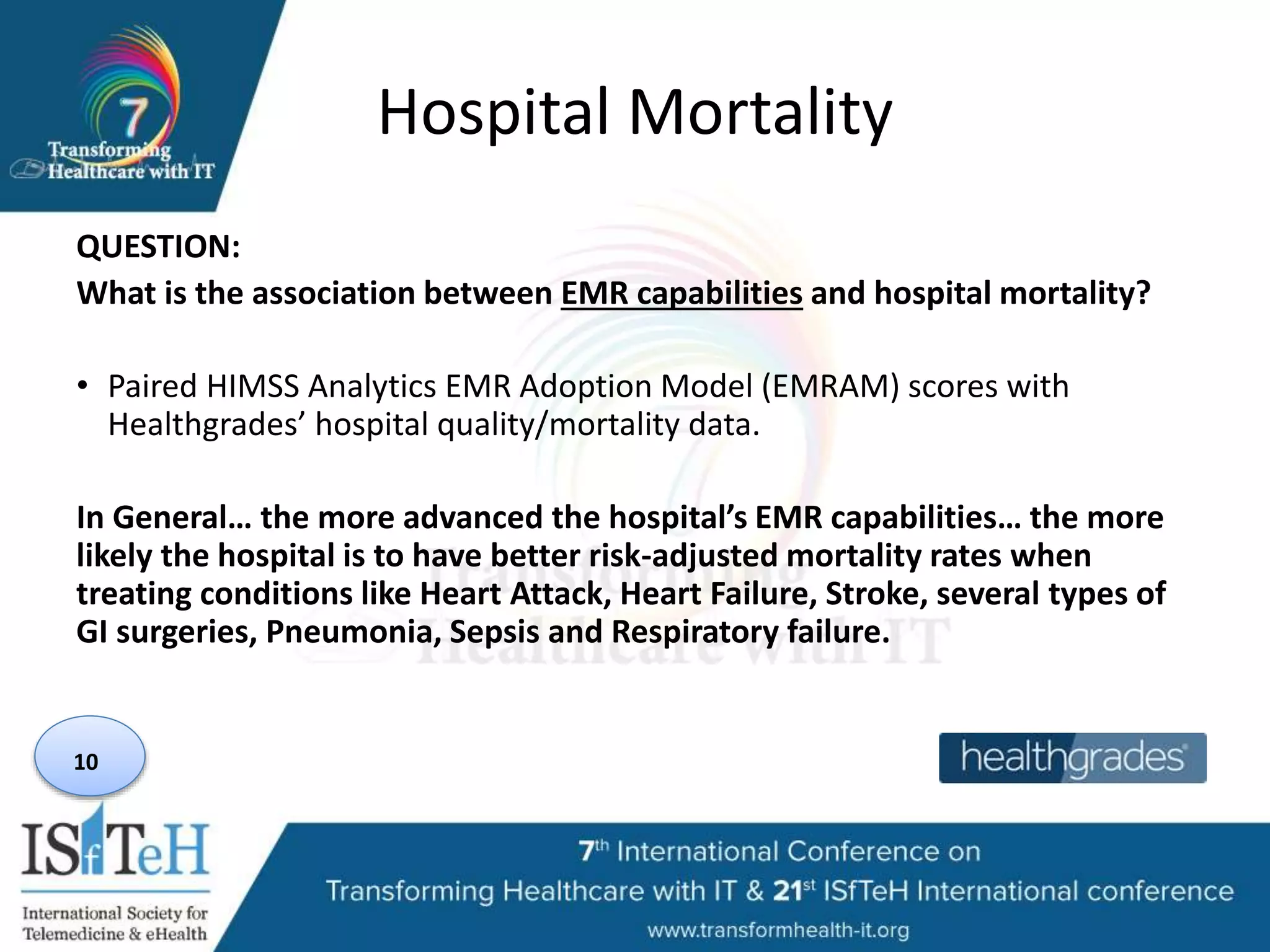
Hospital Mortality
QUESTION:
What is the association between EMR capabilities and hospital mortality?
• Paired HIMSS Analytics EMR Adoption Model (EMRAM) scores with
Healthgrades’ hospital quality/mortality data.
In General… the more advanced the hospital’s EMR capabilities… the more
likely the hospital is to have better risk-adjusted mortality rates when
treating conditions like Heart Attack, Heart Failure, Stroke, several types of
GI surgeries, Pneumonia, Sepsis and Respiratory failure.
10
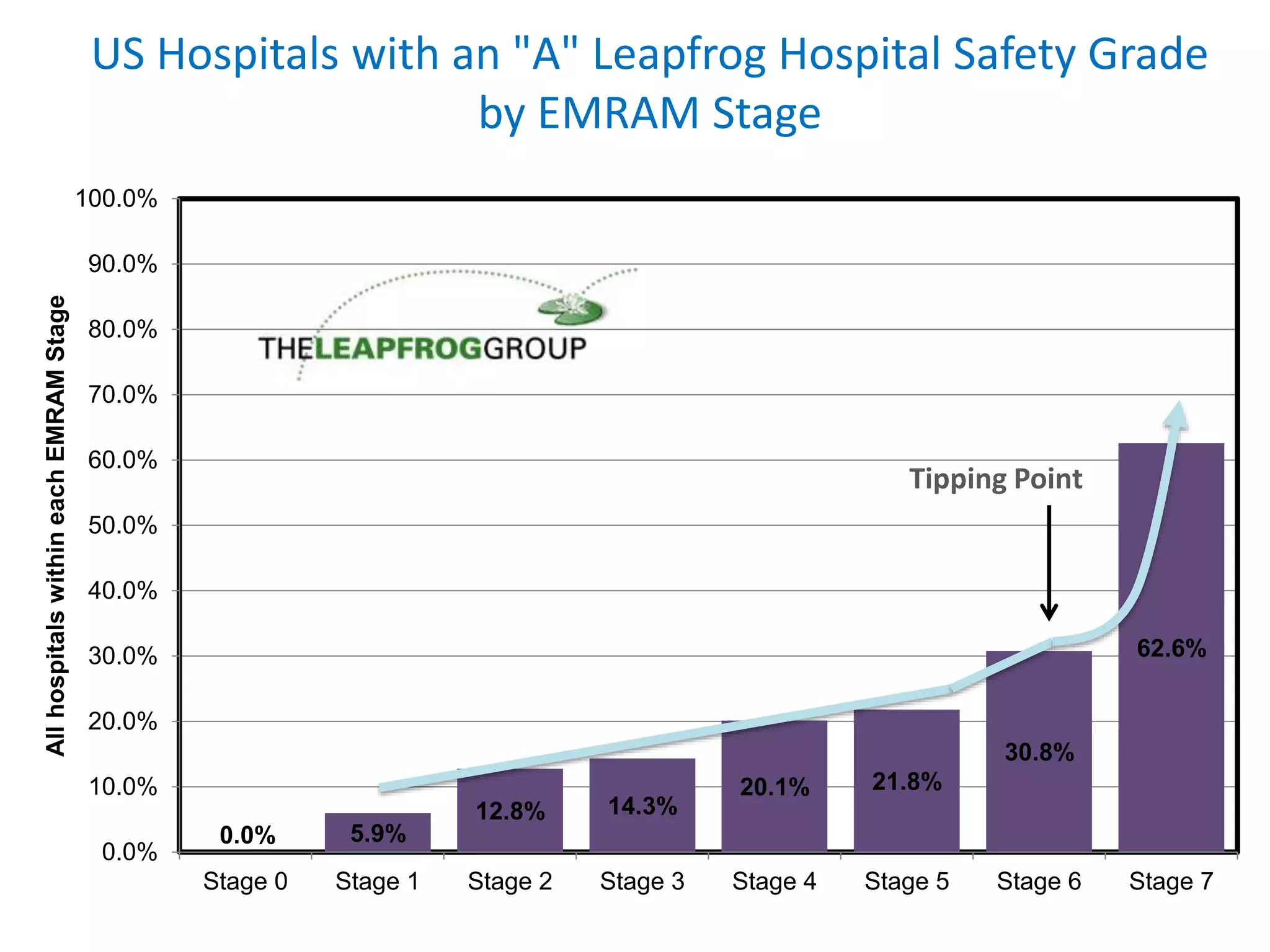
US Hospitals with an "A" Leapfrog Hospital Safety Grade
by EMRAM Stage
0.0% 5.9%
12.8% 14.3%
20.1% 21.8%
30.8%
62.6%
0.0%
10.0%
20.0%
30.0%
40.0%
50.0%
60.0%
70.0%
80.0%
90.0%
100.0%
Stage 0 Stage 1 Stage 2 Stage 3 Stage 4 Stage 5 Stage 6 Stage 7
AllhospitalswithineachEMRAMStage
Tipping Point
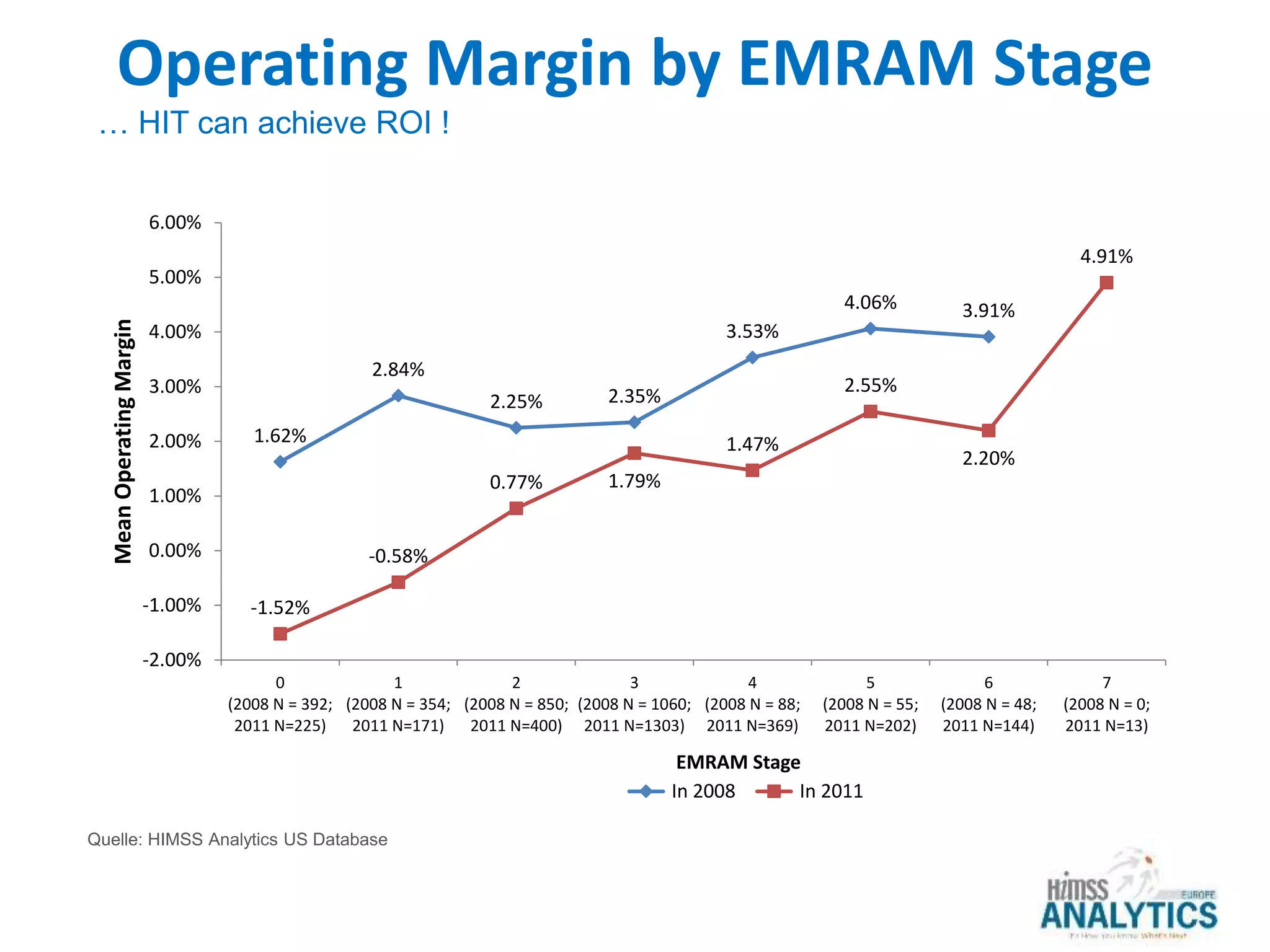
1.62%
2.84%
2.25% 2.35%
3.53%
4.06% 3.91%
-1.52%
-0.58%
0.77% 1.79%
1.47%
2.55%
2.20%
4.91%
-2.00%
-1.00%
0.00%
1.00%
2.00%
3.00%
4.00%
5.00%
6.00%
0
(2008 N = 392;
2011 N=225)
1
(2008 N = 354;
2011 N=171)
2
(2008 N = 850;
2011 N=400)
3
(2008 N = 1060;
2011 N=1303)
4
(2008 N = 88;
2011 N=369)
5
(2008 N = 55;
2011 N=202)
6
(2008 N = 48;
2011 N=144)
7
(2008 N = 0;
2011 N=13)
MeanOperatingMargin
EMRAM Stage
In 2008 In 2011
… HIT can achieve ROI !
Operating Margin by EMRAM Stage
Quelle: HIMSS Analytics US Database
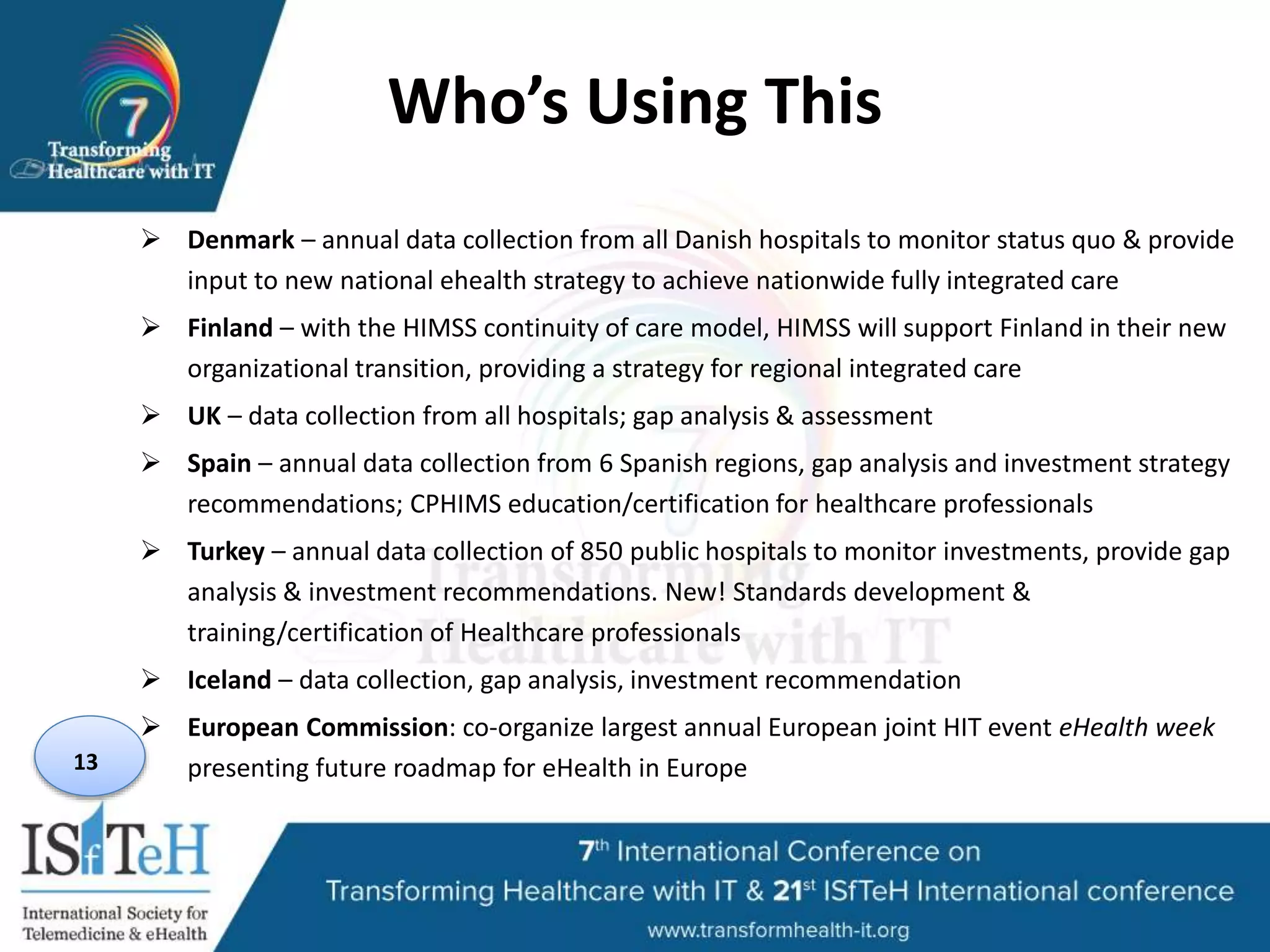
Who’s Using This
 Denmark – annual data collection from all Danish hospitals to monitor status quo & provide
input to new national ehealth strategy to achieve nationwide fully integrated care
 Finland – with the HIMSS continuity of care model, HIMSS will support Finland in their new
organizational transition, providing a strategy for regional integrated care
 UK – data collection from all hospitals; gap analysis & assessment
 Spain – annual data collection from 6 Spanish regions, gap analysis and investment strategy
recommendations; CPHIMS education/certification for healthcare professionals
 Turkey – annual data collection of 850 public hospitals to monitor investments, provide gap
analysis & investment recommendations. New! Standards development &
training/certification of Healthcare professionals
 Iceland – data collection, gap analysis, investment recommendation
 European Commission: co-organize largest annual European joint HIT event eHealth week
presenting future roadmap for eHealth in Europe13
14
IT Drives Care Delivery
Transformation
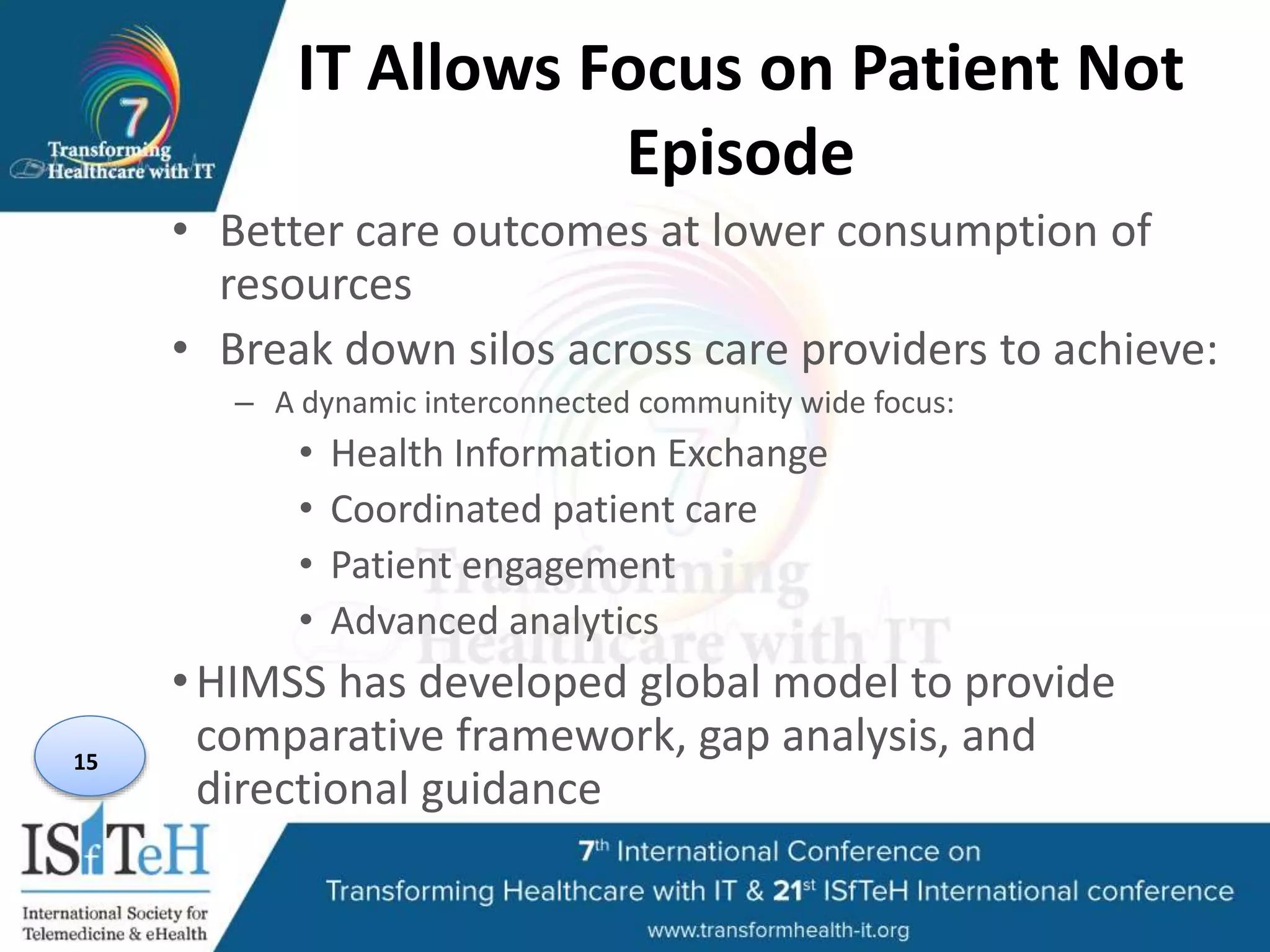
IT Allows Focus on Patient Not
Episode
• Better care outcomes at lower consumption of
resources
• Break down silos across care providers to achieve:
– A dynamic interconnected community wide focus:
• Health Information Exchange
• Coordinated patient care
• Patient engagement
• Advanced analytics
•HIMSS has developed global model to provide
comparative framework, gap analysis, and
directional guidance
15
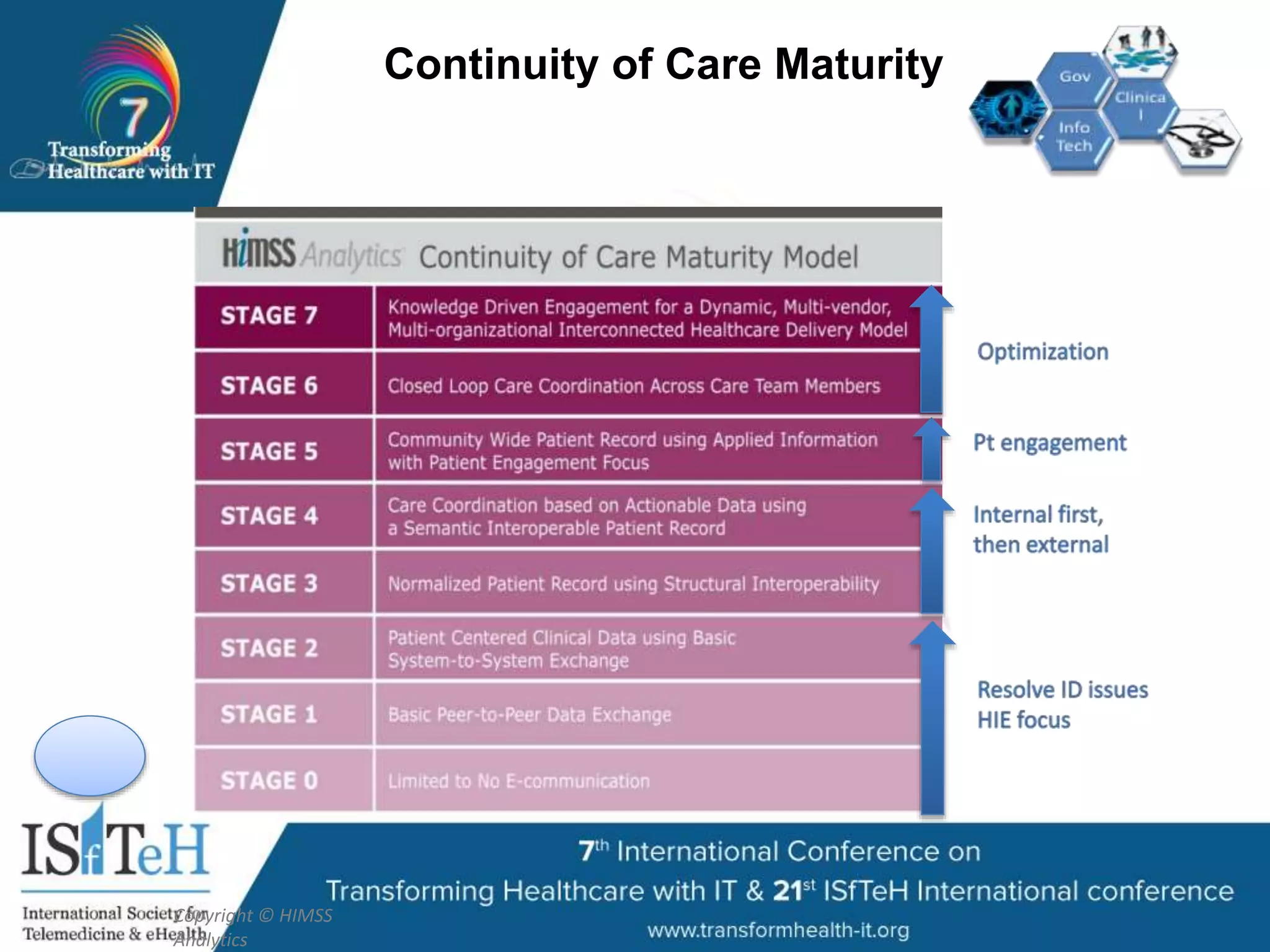
Continuity of Care Maturity
Copyright © HIMSS
Analytics
Continuity of Care Maturation
Model
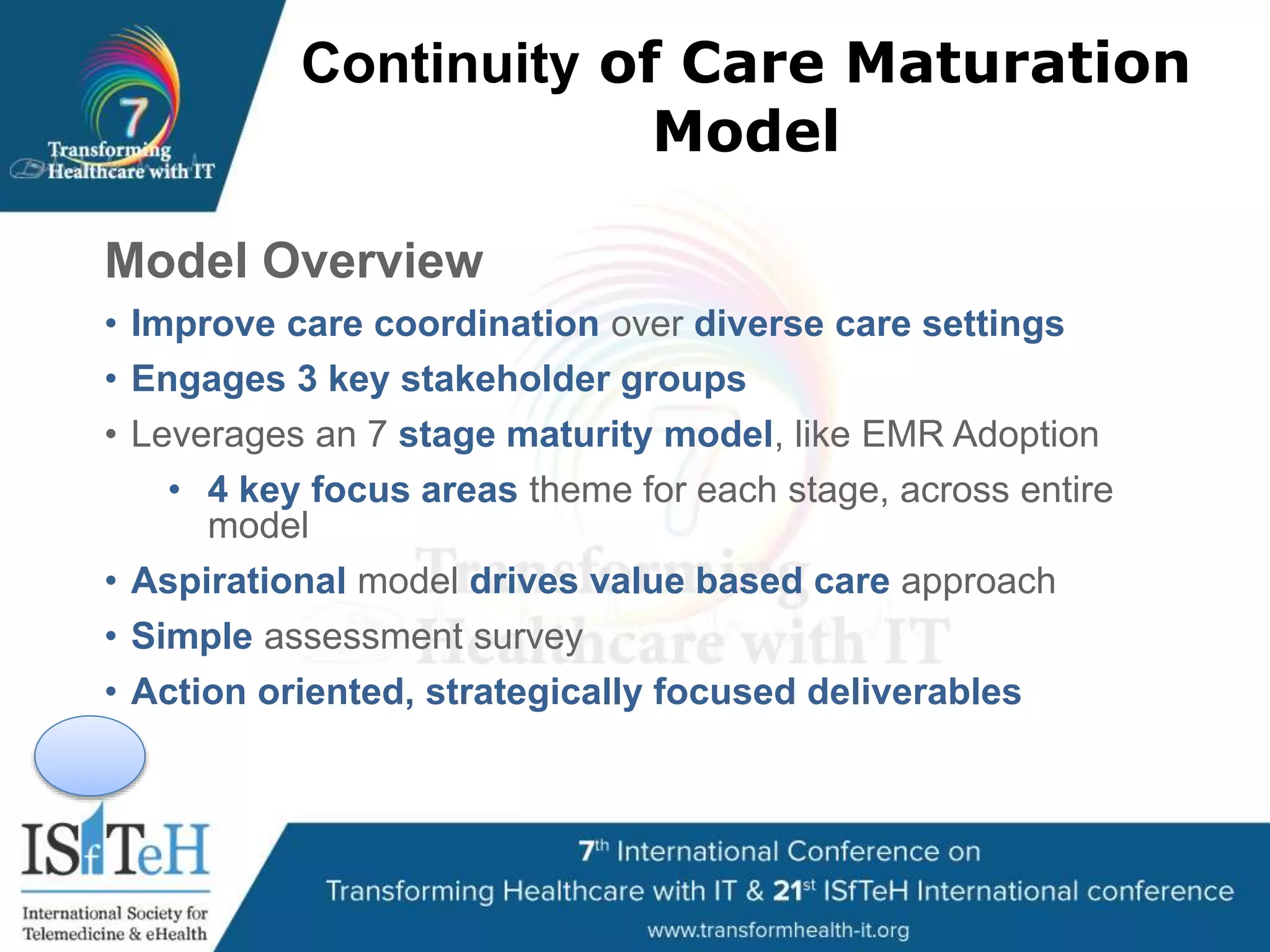
Model Overview
• Improve care coordination over diverse care settings
• Engages 3 key stakeholder groups
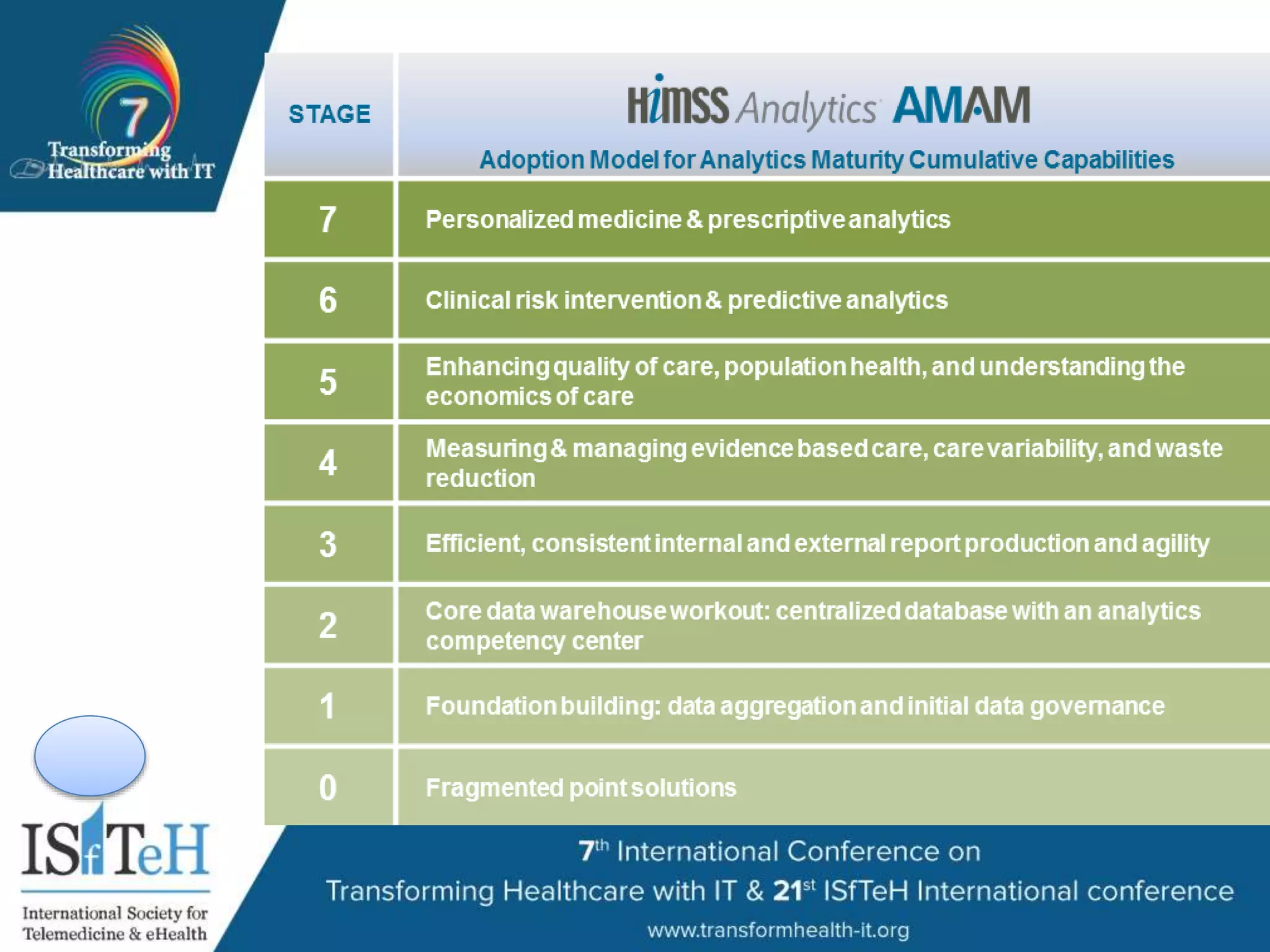
• Leverages an 7 stage maturity model, like EMR Adoption
• 4 key focus areas theme for each stage, across entire
model
• Aspirational model drives value based care approach
• Simple assessment survey
• Action oriented, strategically focused deliverables
18
Data and Analytics:
Going Beyond IT
Systems
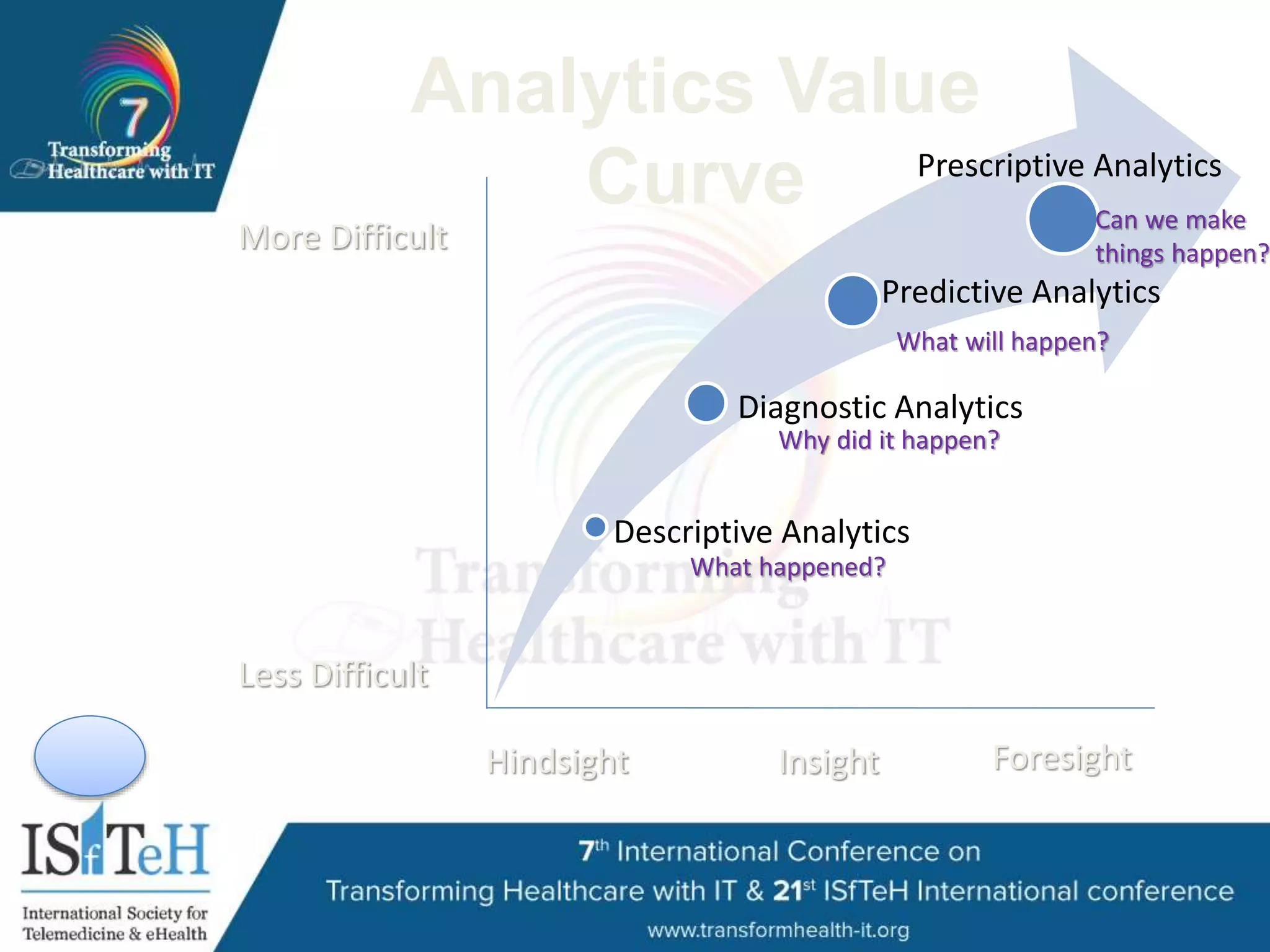
Analytics Value
Curve
Descriptive Analytics
Diagnostic Analytics
Predictive Analytics
Prescriptive Analytics
Hindsight Insight Foresight
What happened?
Why did it happen?
What will happen?
Can we make
things happen?
Less Difficult
More Difficult
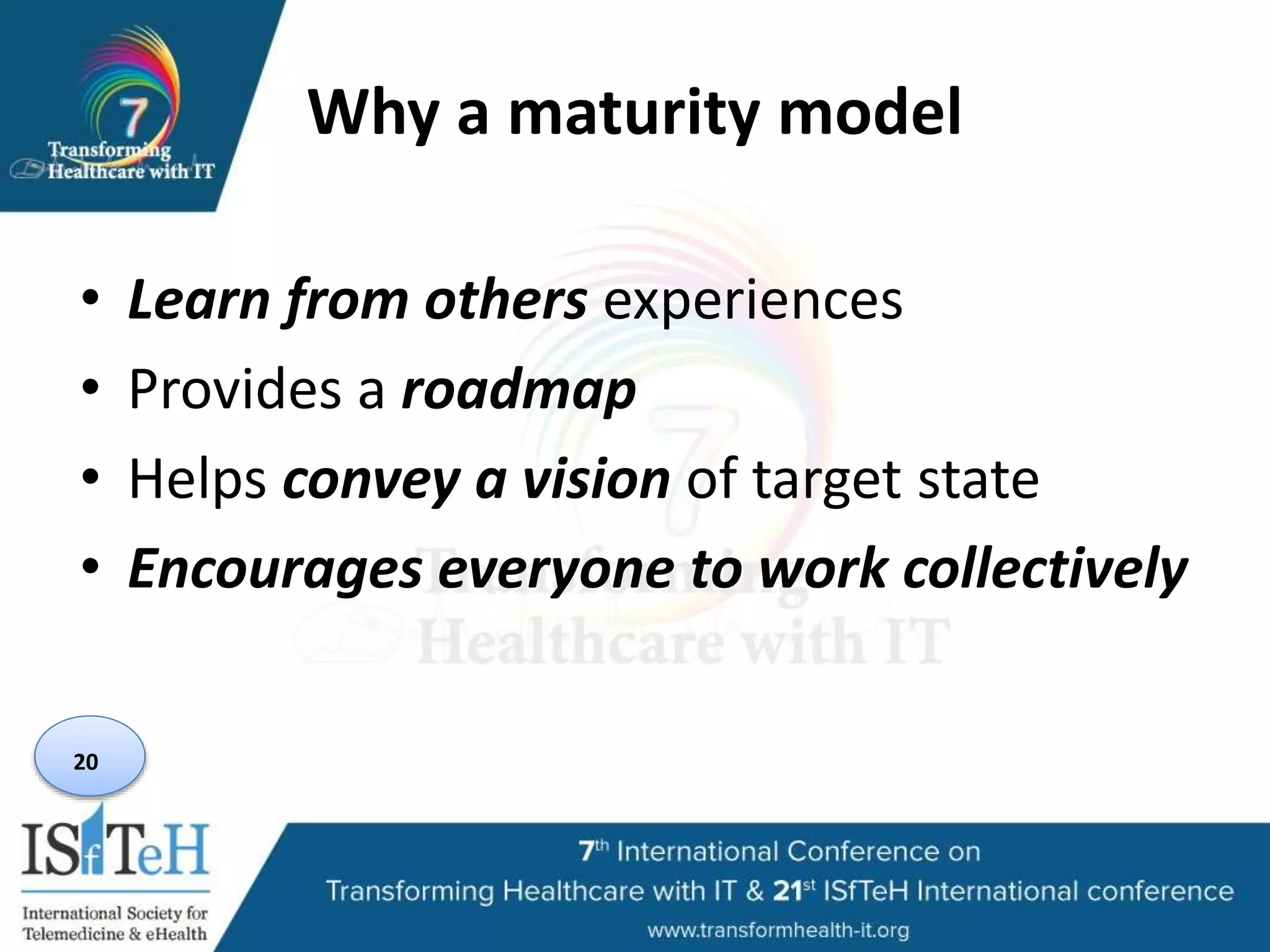
Why a maturity model
• Learn from others experiences
• Provides a roadmap
• Helps convey a vision of target state
• Encourages everyone to work collectively
20
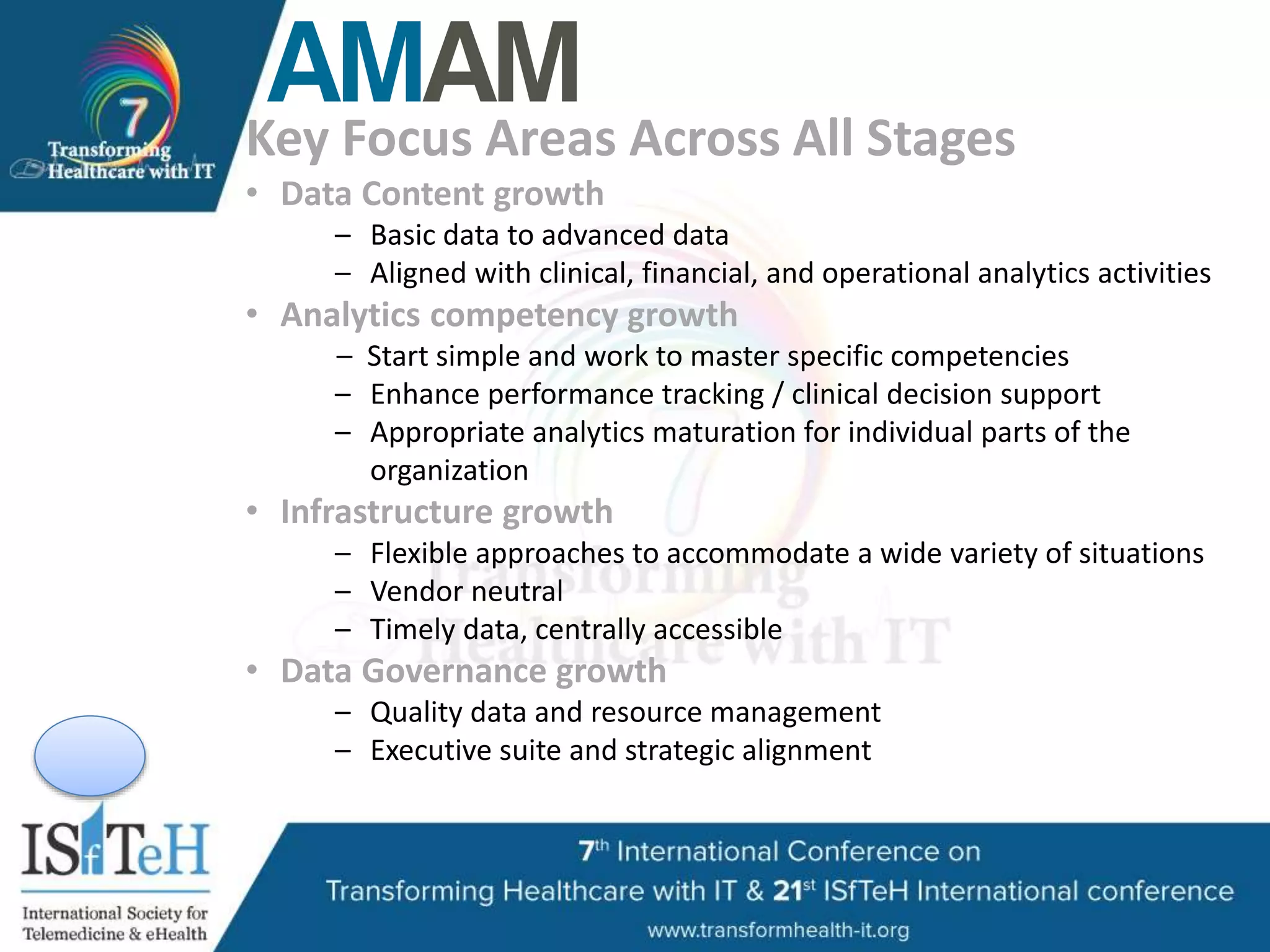
Key Focus Areas Across All Stages
• Data Content growth
– Basic data to advanced data
– Aligned with clinical, financial, and operational analytics activities
• Analytics competency growth
– Start simple and work to master specific competencies
– Enhance performance tracking / clinical decision support
– Appropriate analytics maturation for individual parts of the
organization
• Infrastructure growth
– Flexible approaches to accommodate a wide variety of situations
– Vendor neutral
– Timely data, centrally accessible
• Data Governance growth
– Quality data and resource management
– Executive suite and strategic alignment
Building Blocks to Quality
• Sophisticated IT Adoption
• Continuity of Care
• Data and Analytics
23
24
Thank you
H. Stephen Lieber
slieber@himss.org
www.himss.org

Quality Health Care: Technology and Data Drive Improvement by Stephen Lieber

  • 1.
    1 Quality Health Care:Technology And Data Drive Improvements H. Stephen Lieber President & CEO HIMSS
  • 2.
    HIMSS Introduction • Whois HIMSS – Global-focused, not for profit organisation of professionals, clinicians, companies, policy makers and other stakeholders sharing the vision of better health through IT • How do we work – As a dominant voice, convener and thought leader of health transformation through IT • Who is HIMSS – 300.000+ engaged professionals, 65.000+ members, ~400 staff in Europe, Asia, Middle East and North America 2
  • 3.
    We work with: •Governments and Ministries • Policy makers and strategists • Care providers • Suppliers and Vendors • Professional communities • Clinical experts & IT professionals 3
  • 4.
    What drives ourmission • Hundreds of thousands die in hospitals each year as the result of medical errors – Tens of thousands die from medication errors alone • Hundreds of thousands die each year without access to appropriate health care • In the EU, missed healthcare opportunities have a €70 billion cost to European society • These measures can be improved and IT is a major driver for that improvement 4
  • 5.
    Common Issues forGlobal Health • Reducing hospital admissions, mortality • Reducing hospital acquired infections • Reducing “never” events • Reducing length of stay • Ageing population with multiple complications • Expanding community based care delivery • Improving patient safety • Improving efficiency and productivity • Justifying the investment in technology5
  • 6.
  • 7.
    EMRAM: Model toDrive IT-Influenced Better Care • Research shows relationship between higher levels of IT adoption and patient outcomes, safety • EMRAM established globally-recognised pathway for IT adoption • Baseline study will identify gaps, inform strategy development • Standardised measuring tool of improvement 7
  • 8.
  • 9.
    • Apollo HospitalsAynambakkam • Apollo Hospitals Chennai • Apollo Health City, Jubilee Hills • Apollo Speciality Hospital, Nandanam India • Max Super Speciality Hospital, East Wing, Saket • Max Super Speciality Hospital, West Wing, Saket
  • 10.
    Hospital Mortality QUESTION: What isthe association between EMR capabilities and hospital mortality? • Paired HIMSS Analytics EMR Adoption Model (EMRAM) scores with Healthgrades’ hospital quality/mortality data. In General… the more advanced the hospital’s EMR capabilities… the more likely the hospital is to have better risk-adjusted mortality rates when treating conditions like Heart Attack, Heart Failure, Stroke, several types of GI surgeries, Pneumonia, Sepsis and Respiratory failure. 10
  • 11.
    US Hospitals withan "A" Leapfrog Hospital Safety Grade by EMRAM Stage 0.0% 5.9% 12.8% 14.3% 20.1% 21.8% 30.8% 62.6% 0.0% 10.0% 20.0% 30.0% 40.0% 50.0% 60.0% 70.0% 80.0% 90.0% 100.0% Stage 0 Stage 1 Stage 2 Stage 3 Stage 4 Stage 5 Stage 6 Stage 7 AllhospitalswithineachEMRAMStage Tipping Point
  • 12.
    1.62% 2.84% 2.25% 2.35% 3.53% 4.06% 3.91% -1.52% -0.58% 0.77%1.79% 1.47% 2.55% 2.20% 4.91% -2.00% -1.00% 0.00% 1.00% 2.00% 3.00% 4.00% 5.00% 6.00% 0 (2008 N = 392; 2011 N=225) 1 (2008 N = 354; 2011 N=171) 2 (2008 N = 850; 2011 N=400) 3 (2008 N = 1060; 2011 N=1303) 4 (2008 N = 88; 2011 N=369) 5 (2008 N = 55; 2011 N=202) 6 (2008 N = 48; 2011 N=144) 7 (2008 N = 0; 2011 N=13) MeanOperatingMargin EMRAM Stage In 2008 In 2011 … HIT can achieve ROI ! Operating Margin by EMRAM Stage Quelle: HIMSS Analytics US Database
  • 13.
    Who’s Using This Denmark – annual data collection from all Danish hospitals to monitor status quo & provide input to new national ehealth strategy to achieve nationwide fully integrated care  Finland – with the HIMSS continuity of care model, HIMSS will support Finland in their new organizational transition, providing a strategy for regional integrated care  UK – data collection from all hospitals; gap analysis & assessment  Spain – annual data collection from 6 Spanish regions, gap analysis and investment strategy recommendations; CPHIMS education/certification for healthcare professionals  Turkey – annual data collection of 850 public hospitals to monitor investments, provide gap analysis & investment recommendations. New! Standards development & training/certification of Healthcare professionals  Iceland – data collection, gap analysis, investment recommendation  European Commission: co-organize largest annual European joint HIT event eHealth week presenting future roadmap for eHealth in Europe13
  • 14.
    14 IT Drives CareDelivery Transformation
  • 15.
    IT Allows Focuson Patient Not Episode • Better care outcomes at lower consumption of resources • Break down silos across care providers to achieve: – A dynamic interconnected community wide focus: • Health Information Exchange • Coordinated patient care • Patient engagement • Advanced analytics •HIMSS has developed global model to provide comparative framework, gap analysis, and directional guidance 15
  • 16.
    Continuity of CareMaturity Copyright © HIMSS Analytics
  • 17.
    Continuity of CareMaturation Model Model Overview • Improve care coordination over diverse care settings • Engages 3 key stakeholder groups • Leverages an 7 stage maturity model, like EMR Adoption • 4 key focus areas theme for each stage, across entire model • Aspirational model drives value based care approach • Simple assessment survey • Action oriented, strategically focused deliverables
  • 18.
  • 19.
    Analytics Value Curve Descriptive Analytics DiagnosticAnalytics Predictive Analytics Prescriptive Analytics Hindsight Insight Foresight What happened? Why did it happen? What will happen? Can we make things happen? Less Difficult More Difficult
  • 20.
    Why a maturitymodel • Learn from others experiences • Provides a roadmap • Helps convey a vision of target state • Encourages everyone to work collectively 20
  • 21.
    Key Focus AreasAcross All Stages • Data Content growth – Basic data to advanced data – Aligned with clinical, financial, and operational analytics activities • Analytics competency growth – Start simple and work to master specific competencies – Enhance performance tracking / clinical decision support – Appropriate analytics maturation for individual parts of the organization • Infrastructure growth – Flexible approaches to accommodate a wide variety of situations – Vendor neutral – Timely data, centrally accessible • Data Governance growth – Quality data and resource management – Executive suite and strategic alignment
  • 23.
    Building Blocks toQuality • Sophisticated IT Adoption • Continuity of Care • Data and Analytics 23
  • 24.
    24 Thank you H. StephenLieber slieber@himss.org www.himss.org

Editor's Notes

  • #17 The ultimate goal of BRIDGE project was to increase the safety of citizens by developing technical and organisational solutions that could improve crisis and emergency management
  • #18 HIMSS Analytics Continuity of Care Maturity Model (CCMM) is designed to help healthcare organizations how well they facilitate coordinated care across multiple care settings. It is designed with the same framework as our well known Electronic Medical Record Adoption Mode (EMRAM) with 8 stages from Stage 0 to Stage 7, but the content of those stages is designed around different requirements.
  • #20 The ultimate goal of BRIDGE project was to increase the safety of citizens by developing technical and organisational solutions that could improve crisis and emergency management
  • #22 The ultimate goal of BRIDGE project was to increase the safety of citizens by developing technical and organisational solutions that could improve crisis and emergency management
  • #23 The ultimate goal of BRIDGE project was to increase the safety of citizens by developing technical and organisational solutions that could improve crisis and emergency management