Clinical Engagement and TelemedicineChurch View SurgeryAndrew Innes
Why clinical engagement?Makes senseViewed as self-evident in current UK health policy (1)“ Improvement of the performance of healthcare depends first and foremost on making a difference to the experience of patients and service users, which in turn hinges on changing the day to day decisions of doctors, nurses and other staff”.(2)High Quality Care for All: NHS Next Stage Review final report. London: Stationery Office, 2008.(2)	 Ham C. Improving the performance of health services: the role of clinical leadership. The Lancet 2003;361:1978–80.
General barriers to clinical engagementLack of timePressure of competing demandsLack of understandingLack of expertiseDisinterest Frank prejudice
A question of culture
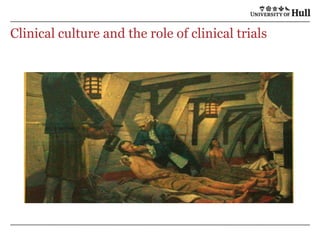
Clinical culture and the role of clinical trials
Cum ScientiaCaritasFirst the scienceThen the caringMedical training
ScienceEpistemological schismMixed quality (better in heart failure than COPD)Problems of considering cost effectiveness
CaritasAntithesis of personalized healthcare?RemoteCost-cutting?Concerns about clinical governance and safety
Overcoming barriers to telehealth – What excites clinicians?Improved quality of care – an additional window on a patient’s problemsImproved clinical relationship with patientsImproved efficiency Improved cost effectivenessA different way of workingApplication of technology
Overcoming barriers to telehealth – What excites patients?Empowerment – the expert patientEffective, timely and safer careImproved access
Why must clinicians change?Tsunami of long term conditionsLTC affect 31% of the population and account for 52% of all GP appointments and 65% of all OPDAround a 25% in the numbers of patients with LTCs over next 25 yearsChanging practice with risk tools and community MDT
Key components of resolving clinical engagementAdopt a communication strategy that addresses the problems and the benefits in terms that clinicians understandGood clinical evidence of benefitPrioritise clinical domains rather than management targetsLocal “Champions”Funding – pump prime through enhanced service or QOF mechanisms. NB. Little evidence to support much of what QOF does and yet GP’s perform well in this framework
Thank youAny questions?andrewinnes@nhs.net

Andrew innes hull wsdan 30 june 2011a

  • 1.
    Clinical Engagement andTelemedicineChurch View SurgeryAndrew Innes
  • 2.
    Why clinical engagement?MakessenseViewed as self-evident in current UK health policy (1)“ Improvement of the performance of healthcare depends first and foremost on making a difference to the experience of patients and service users, which in turn hinges on changing the day to day decisions of doctors, nurses and other staff”.(2)High Quality Care for All: NHS Next Stage Review final report. London: Stationery Office, 2008.(2) Ham C. Improving the performance of health services: the role of clinical leadership. The Lancet 2003;361:1978–80.
  • 3.
    General barriers toclinical engagementLack of timePressure of competing demandsLack of understandingLack of expertiseDisinterest Frank prejudice
  • 4.
  • 5.
    Clinical culture andthe role of clinical trials
  • 6.
    Cum ScientiaCaritasFirst thescienceThen the caringMedical training
  • 7.
    ScienceEpistemological schismMixed quality(better in heart failure than COPD)Problems of considering cost effectiveness
  • 8.
    CaritasAntithesis of personalizedhealthcare?RemoteCost-cutting?Concerns about clinical governance and safety
  • 9.
    Overcoming barriers totelehealth – What excites clinicians?Improved quality of care – an additional window on a patient’s problemsImproved clinical relationship with patientsImproved efficiency Improved cost effectivenessA different way of workingApplication of technology
  • 10.
    Overcoming barriers totelehealth – What excites patients?Empowerment – the expert patientEffective, timely and safer careImproved access
  • 11.
    Why must clinicianschange?Tsunami of long term conditionsLTC affect 31% of the population and account for 52% of all GP appointments and 65% of all OPDAround a 25% in the numbers of patients with LTCs over next 25 yearsChanging practice with risk tools and community MDT
  • 12.
    Key components ofresolving clinical engagementAdopt a communication strategy that addresses the problems and the benefits in terms that clinicians understandGood clinical evidence of benefitPrioritise clinical domains rather than management targetsLocal “Champions”Funding – pump prime through enhanced service or QOF mechanisms. NB. Little evidence to support much of what QOF does and yet GP’s perform well in this framework
  • 13.