Time for Telehealth:
Critical Connection &
Foundational Cornerstone
Tamara Y. Demko, JD, MPH, ABD
Director, Florida TaxWatch Center for Health & Aging
Florida TeleHealth Summit
Winter Park, Florida
December 5, 2014
The Promise of Telehealth
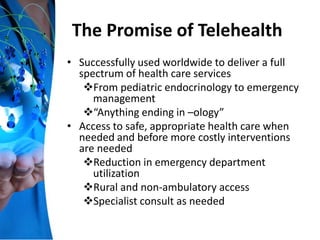
• Successfully used worldwide to deliver a full
spectrum of health care services
From pediatric endocrinology to emergency
management
“Anything ending in –ology”
• Access to safe, appropriate health care when
needed and before more costly interventions
are needed
Reduction in emergency department
utilization
Rural and non-ambulatory access
Specialist consult as needed
The Progress of Telehealth
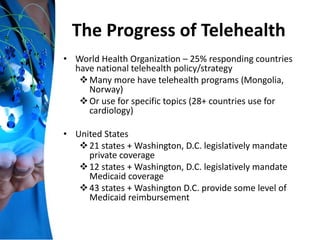
• World Health Organization – 25% responding countries
have national telehealth policy/strategy
Many more have telehealth programs (Mongolia,
Norway)
Or use for specific topics (28+ countries use for
cardiology)
• United States
21 states + Washington, D.C. legislatively mandate
private coverage
12 states + Washington, D.C. legislatively mandate
Medicaid coverage
43 states + Washington D.C. provide some level of
Medicaid reimbursement
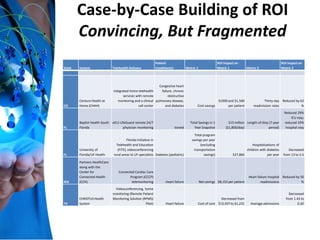
Case-by-Case Building of ROI
Convincing, But Fragmented
State System Telehealth Delivery
Patient
Condition(s) Metric 1
ROI Impact on
Metric 1 Metric 2
ROI Impact on
Metric 2
CO
Centura Health at
Home (CHAH)
integrated home telehealth
services with remote
monitoring and a clinical
call center
Congestive heart
failure, chronic
obstructive
pulmonary disease,
and diabetes Cost savings
$1000 and $1,500
per patient
Thirty-day
readmission rates
Reduced by 62
%
FL
Baptist Health South
Florida
eICU LifeGuard remote 24/7
physician monitoring Varied
Total Savings in 1
Year Snapshot
$15 million
($1,800/day)
Length-of-Stay (7 year
period)
Reduced 29%
ICU stay;
reduced 33%
hospital stay
FL
University of
Florida/UF Health
Florida Initiative in
Telehealth and Education
(FITE), videoconferercing
rural areas to UF specialists Diabetes (pediatric)
Total program
savings per year
(excluding
transportation
savings) $27,860
Hospitalizations of
children with diabetes
per year
Decreased
from 13 to 3.5
MA
Partners HealthCare
along with the
Center for
Connected Health
(CCH)
Connected Cardiac Care
Program (CCCP)
telemonitoring Heart failure Net savings $8,155 per patient
Heart failure hospital
readmissions
Reduced by 50
%
TX
CHRISTUS Health
System
Videoconferencing, home
monitoring (Remote Patient
Monitoring Solution (RPMS)
Pilot) Heart failure Cost of care
Decreased from
$12,937 to $1,231 Average admissions
Decreased
from 1.43 to
0.20
Florida Needs Telehealth
• Potential cost-savings = $1 billion with 1% reduction
in charges across costly hospitalizations and
emergency room visits (2012-13 AHCA data) –
Critical Connections to Care
• Rapid population growth
• Geographic disparities across 67 counties
• Aging & disabilities populations
• Public health preparedness
• Emergency management access
Florida’s Efforts to Move
Telehealth Forward
• Years of introduced legislation
• 2014 Legislative Session
• Board of Medicine
• Industry conferences and discussions
• Florida TeleHealth Workgroup
GAUGING FLORIDA’S STATE OF HEALTH
Population, Economy, Physical Well-being
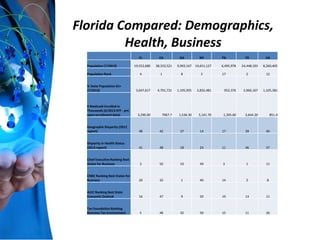
Florida Compared: Demographics,
Health, Business
FL CA GA NY TN TX VA
Population (7/2013) 19,552,680 38,332,521 9,992,167 19,651,127 6,495,978 24,448,193 8,260,405
Population Rank 4 1 8 3 17 2 12
% State Population 65+
(7/2013) 3,647,617 4,791,731 1,195,955 2,832,481 952,376 2,966,167 1,105,381
# Medicaid Enrolled in
Thousands (6/2013 KFF - pre
open enrollment data) 3,290.00 7967.7 1,536.30 5,141.70 1,305.60 3,644.20 851.4
Geographic Disparity (2012
report) 48 42 37 14 17 39 40
Disparity in Health Status
(2013 report) 41 48 18 24 11 46 37
Chief Executive Ranking Best
States for Business 2 50 10 49 3 1 11
CNBC Ranking Best States for
Business 20 32 1 40 14 2 8
ALEC Ranking Best State
Economic Outlook 16 47 9 50 19 13 11
Tax Foundation Ranking
Business Tax Environment 5 48 32 50 15 11 26
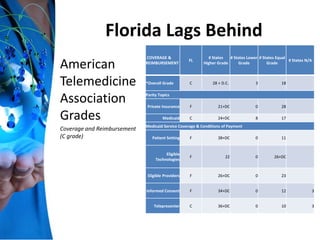
Florida Lags Behind
American
Telemedicine
Association
Grades
Coverage and Reimbursement
(C grade)
COVERAGE &
REIMBURSEMENT
FL
# States
Higher Grade
# States Lower
Grade
# States Equal
Grade
# States N/A
*Overall Grade C 28 + D.C. 3 18
Parity Topics
Private Insurance F 21+DC 0 28
Medicaid C 24+DC 8 17
Medicaid Service Coverage & Conditions of Payment
Patient Setting F 38+DC 0 11
Eligible
Technologies
F 22 0 26+DC
Eligible Providers F 26+DC 0 23
Informed Consent F 34+DC 0 12 3
Telepresenter C 36+DC 0 10 3
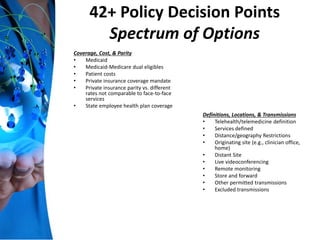
42+ Policy Decision Points
Spectrum of Options
Coverage, Cost, & Parity
• Medicaid
• Medicaid-Medicare dual eligibles
• Patient costs
• Private insurance coverage mandate
• Private insurance parity vs. different
rates not comparable to face-to-face
services
• State employee health plan coverage
Definitions, Locations, & Transmissions
• Telehealth/telemedicine definition
• Services defined
• Distance/geography Restrictions
• Originating site (e.g., clinician office,
home)
• Distant Site
• Live videoconferencing
• Remote monitoring
• Store and forward
• Other permitted transmissions
• Excluded transmissions
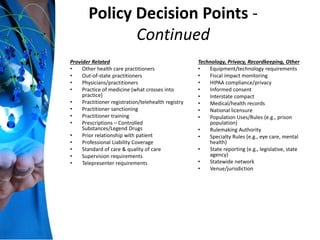
Policy Decision Points -
Continued
Provider Related
• Other health care practitioners
• Out-of-state practitioners
• Physicians/practitioners
• Practice of medicine (what crosses into
practice)
• Practitioner registration/telehealth registry
• Practitioner sanctioning
• Practitioner training
• Prescriptions – Controlled
Substances/Legend Drugs
• Prior relationship with patient
• Professional Liability Coverage
• Standard of care & quality of care
• Supervision requirements
• Telepresenter requirements
Technology, Privacy, Recordkeeping, Other
• Equipment/technology requirements
• Fiscal impact monitoring
• HIPAA compliance/privacy
• Informed consent
• Interstate compact
• Medical/health records
• National licensure
• Population Uses/Rules (e.g., prison
population)
• Rulemaking Authority
• Specialty Rules (e.g., eye care, mental
health)
• State reporting (e.g., legislative, state
agency)
• Statewide network
• Venue/jurisdiction
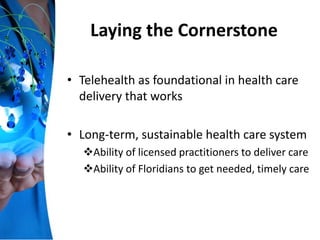
Laying the Cornerstone
• Telehealth as foundational in health care
delivery that works
• Long-term, sustainable health care system
Ability of licensed practitioners to deliver care
Ability of Floridians to get needed, timely care
TELEHEALTH CORNERSTONE
CONFERENCE
 What do policymakers need to know?
 On what policy decision points can we achieve
consensus?
 What is needed to keep the discussion going while
Florida refines decisions?
 What barriers currently exist and how can we
overcome them?
STATE OF THE NATION
American Telemedicine Association
Latoya Thomas
Florida TeleHealth Workgroup
Southeastern Telehealth Resource Center/
Florida State University
Rena Brewer & Mike Smith
STATE OF THE STATE
3 Workshops – 3 Lenses
Different Angles for a Clearer Picture
• Lens 1, Subject Matter: Child health,
aging & disability, access to care,
chronic disease management/
emergent issues
• Lens 2 – Industry: Providers,
practitioners, payers,
business/innovation
• Lens 3 – Consensus-Building: Out-of-
state providers, scope, financials,
technology & innovation
Lunch Panel – How to Build Telehealth
Policy Discussion Highlights
Speaker Pro Tempore Matt Hudson
State Representative John Wood
Mike Smith – Florida TeleHealth Workgroup
Phillis Oeters – Baptist Health South Florida
Justin Senior – Agency for Health Care Administration
Dr. Mark Stavros – Florida State University
Tom Feeney – Associated Industries of Florida
KEY POLICY MESSAGES
• Not every issue requires legislation,
• There will not be consensus on all issues
• Top policy priorities going into the 2015
Legislative Session:
– defining telehealth/telemedicine and what
telehealth success entails
– examining avenues for funding incentives
and reimbursement
– revisiting logical and safe licensure options
– writing legislation to be technology neutral
KEY TAKE-HOME POLICY MESSAGES
– making it easier for practitioners who engage in
telehealth
– leveraging existing technology (e.g., electronic
health records)
• Legislation should
– seek to make telehealth more available
– avoid language that imposes arbitrary
restrictions
– not detract from the current successful
provision of telehealth occurring across the
state (First do no harm)
– consider the convening of an continuous
advisory body while preliminary legislation goes
forward
– Lay the cornerstone by moving on policy issues
for which there is clearer consensus
NEXT STEPS: MOVING FROM
CONFERENCES TO CORNERSTONE
It’s Time for Telehealth
Building Tools
Right Tool Depends on Job
• Policymakers
– ROI data
– Information & decision tools
– Real people/constituents (bringing the message
home)
• Patients
– Social marketing push/market demand
– Safety & awareness
• Practitioners
– Assurance of standards of practice within
specialty
– Clear guidelines, including reimbursement
Building Tools
• Providers
– Better understanding of costs (up front and
long-term) & ROI
– Negotiating contracts & options
• Payers
– ROI financial and outcome based
– Patient demand; contract demand;
alternative business models
• Businesses & Innovators
– Understanding of cost pass-through ESI,
utilization, & employee productivity
– Telecom successes, ROI potential
– Grant partners & contracts
Building Tools
• Telehealth Champions (Everyone in this
room!)
– Share your successes
– Inventory & data collection
– Find creative collaborations
– Realistic policy expectations
• Walking before running
• Getting creative
• Avoid polarized silos
• All-or-nothing bets
– Framing telehealth as win-win
• Health care generally is zero sum
• Telehealth can be uniquely different
Florida TaxWatch
Tamara Y. Demko, JD, MPH, ABD
tdemko@floridataxwatch.org
Telehealth reports and conference materials are available at
floridataxwatch.org

Demko ftp -wp 12.05.2014

  • 1.
    Time for Telehealth: CriticalConnection & Foundational Cornerstone Tamara Y. Demko, JD, MPH, ABD Director, Florida TaxWatch Center for Health & Aging Florida TeleHealth Summit Winter Park, Florida December 5, 2014
  • 2.
    The Promise ofTelehealth • Successfully used worldwide to deliver a full spectrum of health care services From pediatric endocrinology to emergency management “Anything ending in –ology” • Access to safe, appropriate health care when needed and before more costly interventions are needed Reduction in emergency department utilization Rural and non-ambulatory access Specialist consult as needed
  • 3.
    The Progress ofTelehealth • World Health Organization – 25% responding countries have national telehealth policy/strategy Many more have telehealth programs (Mongolia, Norway) Or use for specific topics (28+ countries use for cardiology) • United States 21 states + Washington, D.C. legislatively mandate private coverage 12 states + Washington, D.C. legislatively mandate Medicaid coverage 43 states + Washington D.C. provide some level of Medicaid reimbursement
  • 4.
    Case-by-Case Building ofROI Convincing, But Fragmented State System Telehealth Delivery Patient Condition(s) Metric 1 ROI Impact on Metric 1 Metric 2 ROI Impact on Metric 2 CO Centura Health at Home (CHAH) integrated home telehealth services with remote monitoring and a clinical call center Congestive heart failure, chronic obstructive pulmonary disease, and diabetes Cost savings $1000 and $1,500 per patient Thirty-day readmission rates Reduced by 62 % FL Baptist Health South Florida eICU LifeGuard remote 24/7 physician monitoring Varied Total Savings in 1 Year Snapshot $15 million ($1,800/day) Length-of-Stay (7 year period) Reduced 29% ICU stay; reduced 33% hospital stay FL University of Florida/UF Health Florida Initiative in Telehealth and Education (FITE), videoconferercing rural areas to UF specialists Diabetes (pediatric) Total program savings per year (excluding transportation savings) $27,860 Hospitalizations of children with diabetes per year Decreased from 13 to 3.5 MA Partners HealthCare along with the Center for Connected Health (CCH) Connected Cardiac Care Program (CCCP) telemonitoring Heart failure Net savings $8,155 per patient Heart failure hospital readmissions Reduced by 50 % TX CHRISTUS Health System Videoconferencing, home monitoring (Remote Patient Monitoring Solution (RPMS) Pilot) Heart failure Cost of care Decreased from $12,937 to $1,231 Average admissions Decreased from 1.43 to 0.20
  • 5.
    Florida Needs Telehealth •Potential cost-savings = $1 billion with 1% reduction in charges across costly hospitalizations and emergency room visits (2012-13 AHCA data) – Critical Connections to Care • Rapid population growth • Geographic disparities across 67 counties • Aging & disabilities populations • Public health preparedness • Emergency management access
  • 6.
    Florida’s Efforts toMove Telehealth Forward • Years of introduced legislation • 2014 Legislative Session • Board of Medicine • Industry conferences and discussions • Florida TeleHealth Workgroup
  • 7.
    GAUGING FLORIDA’S STATEOF HEALTH Population, Economy, Physical Well-being
  • 8.
    Florida Compared: Demographics, Health,Business FL CA GA NY TN TX VA Population (7/2013) 19,552,680 38,332,521 9,992,167 19,651,127 6,495,978 24,448,193 8,260,405 Population Rank 4 1 8 3 17 2 12 % State Population 65+ (7/2013) 3,647,617 4,791,731 1,195,955 2,832,481 952,376 2,966,167 1,105,381 # Medicaid Enrolled in Thousands (6/2013 KFF - pre open enrollment data) 3,290.00 7967.7 1,536.30 5,141.70 1,305.60 3,644.20 851.4 Geographic Disparity (2012 report) 48 42 37 14 17 39 40 Disparity in Health Status (2013 report) 41 48 18 24 11 46 37 Chief Executive Ranking Best States for Business 2 50 10 49 3 1 11 CNBC Ranking Best States for Business 20 32 1 40 14 2 8 ALEC Ranking Best State Economic Outlook 16 47 9 50 19 13 11 Tax Foundation Ranking Business Tax Environment 5 48 32 50 15 11 26
  • 9.
    Florida Lags Behind American Telemedicine Association Grades Coverageand Reimbursement (C grade) COVERAGE & REIMBURSEMENT FL # States Higher Grade # States Lower Grade # States Equal Grade # States N/A *Overall Grade C 28 + D.C. 3 18 Parity Topics Private Insurance F 21+DC 0 28 Medicaid C 24+DC 8 17 Medicaid Service Coverage & Conditions of Payment Patient Setting F 38+DC 0 11 Eligible Technologies F 22 0 26+DC Eligible Providers F 26+DC 0 23 Informed Consent F 34+DC 0 12 3 Telepresenter C 36+DC 0 10 3
  • 10.
    42+ Policy DecisionPoints Spectrum of Options Coverage, Cost, & Parity • Medicaid • Medicaid-Medicare dual eligibles • Patient costs • Private insurance coverage mandate • Private insurance parity vs. different rates not comparable to face-to-face services • State employee health plan coverage Definitions, Locations, & Transmissions • Telehealth/telemedicine definition • Services defined • Distance/geography Restrictions • Originating site (e.g., clinician office, home) • Distant Site • Live videoconferencing • Remote monitoring • Store and forward • Other permitted transmissions • Excluded transmissions
  • 11.
    Policy Decision Points- Continued Provider Related • Other health care practitioners • Out-of-state practitioners • Physicians/practitioners • Practice of medicine (what crosses into practice) • Practitioner registration/telehealth registry • Practitioner sanctioning • Practitioner training • Prescriptions – Controlled Substances/Legend Drugs • Prior relationship with patient • Professional Liability Coverage • Standard of care & quality of care • Supervision requirements • Telepresenter requirements Technology, Privacy, Recordkeeping, Other • Equipment/technology requirements • Fiscal impact monitoring • HIPAA compliance/privacy • Informed consent • Interstate compact • Medical/health records • National licensure • Population Uses/Rules (e.g., prison population) • Rulemaking Authority • Specialty Rules (e.g., eye care, mental health) • State reporting (e.g., legislative, state agency) • Statewide network • Venue/jurisdiction
  • 12.
    Laying the Cornerstone •Telehealth as foundational in health care delivery that works • Long-term, sustainable health care system Ability of licensed practitioners to deliver care Ability of Floridians to get needed, timely care
  • 13.
    TELEHEALTH CORNERSTONE CONFERENCE  Whatdo policymakers need to know?  On what policy decision points can we achieve consensus?  What is needed to keep the discussion going while Florida refines decisions?  What barriers currently exist and how can we overcome them?
  • 15.
    STATE OF THENATION American Telemedicine Association Latoya Thomas Florida TeleHealth Workgroup Southeastern Telehealth Resource Center/ Florida State University Rena Brewer & Mike Smith STATE OF THE STATE
  • 16.
    3 Workshops –3 Lenses Different Angles for a Clearer Picture • Lens 1, Subject Matter: Child health, aging & disability, access to care, chronic disease management/ emergent issues • Lens 2 – Industry: Providers, practitioners, payers, business/innovation • Lens 3 – Consensus-Building: Out-of- state providers, scope, financials, technology & innovation
  • 17.
    Lunch Panel –How to Build Telehealth Policy Discussion Highlights Speaker Pro Tempore Matt Hudson State Representative John Wood Mike Smith – Florida TeleHealth Workgroup Phillis Oeters – Baptist Health South Florida Justin Senior – Agency for Health Care Administration Dr. Mark Stavros – Florida State University Tom Feeney – Associated Industries of Florida
  • 18.
    KEY POLICY MESSAGES •Not every issue requires legislation, • There will not be consensus on all issues • Top policy priorities going into the 2015 Legislative Session: – defining telehealth/telemedicine and what telehealth success entails – examining avenues for funding incentives and reimbursement – revisiting logical and safe licensure options – writing legislation to be technology neutral
  • 19.
    KEY TAKE-HOME POLICYMESSAGES – making it easier for practitioners who engage in telehealth – leveraging existing technology (e.g., electronic health records) • Legislation should – seek to make telehealth more available – avoid language that imposes arbitrary restrictions – not detract from the current successful provision of telehealth occurring across the state (First do no harm) – consider the convening of an continuous advisory body while preliminary legislation goes forward – Lay the cornerstone by moving on policy issues for which there is clearer consensus
  • 20.
    NEXT STEPS: MOVINGFROM CONFERENCES TO CORNERSTONE It’s Time for Telehealth
  • 21.
    Building Tools Right ToolDepends on Job • Policymakers – ROI data – Information & decision tools – Real people/constituents (bringing the message home) • Patients – Social marketing push/market demand – Safety & awareness • Practitioners – Assurance of standards of practice within specialty – Clear guidelines, including reimbursement
  • 22.
    Building Tools • Providers –Better understanding of costs (up front and long-term) & ROI – Negotiating contracts & options • Payers – ROI financial and outcome based – Patient demand; contract demand; alternative business models • Businesses & Innovators – Understanding of cost pass-through ESI, utilization, & employee productivity – Telecom successes, ROI potential – Grant partners & contracts
  • 23.
    Building Tools • TelehealthChampions (Everyone in this room!) – Share your successes – Inventory & data collection – Find creative collaborations – Realistic policy expectations • Walking before running • Getting creative • Avoid polarized silos • All-or-nothing bets – Framing telehealth as win-win • Health care generally is zero sum • Telehealth can be uniquely different
  • 24.
    Florida TaxWatch Tamara Y.Demko, JD, MPH, ABD tdemko@floridataxwatch.org Telehealth reports and conference materials are available at floridataxwatch.org

Editor's Notes

  • #3 You heard about telehealth for ALS, tele-genetic programs, e-ICU, and tele-cardiac among other uses yesterday.
  • #7 Senator Arthenia Joynes has introduced telemedicine legislation several years in a row. You heard from Representatives Mia Jones and Cary Pigman, who have both been great champions of telehealth in the Florida House.
  • #15 Mike Smith mentioned some of our partners yesterday.