Linking Architecture And Education Sustainable
Design Of Learning Environments Anne Taylor
download
https://ebookbell.com/product/linking-architecture-and-education-
sustainable-design-of-learning-environments-anne-taylor-4940838
Explore and download more ebooks at ebookbell.com
Here are some recommended products that we believe you will be
interested in. You can click the link to download.
A Place To Be Happy Linking Architecture Positive Psychology Chuck
First
https://ebookbell.com/product/a-place-to-be-happy-linking-
architecture-positive-psychology-chuck-first-46861494
Linking Theory And Practice Of Digital Libraries 26th International
Conference On Theory And Practice Of Digital Libraries Tpdl 2022 Padua
Italy September 2021 2022 Proceedings 1st Ed 2022 Gianmaria Silvello
https://ebookbell.com/product/linking-theory-and-practice-of-digital-
libraries-26th-international-conference-on-theory-and-practice-of-
digital-libraries-tpdl-2022-padua-italy-
september-2021-2022-proceedings-1st-ed-2022-gianmaria-
silvello-46507686
Linking Language Trade And Migration Economic Partnership Agreements
As Language Policy In Japan Ruriko Otomo
https://ebookbell.com/product/linking-language-trade-and-migration-
economic-partnership-agreements-as-language-policy-in-japan-ruriko-
otomo-50687266
Linking The Americas Race Hybrid Discourses And The Reformulation Of
Feminine Identity 1st Edition Lesley Feracho
https://ebookbell.com/product/linking-the-americas-race-hybrid-
discourses-and-the-reformulation-of-feminine-identity-1st-edition-
lesley-feracho-51416824
Linking Disorders To Delinquency Treating Highrisk Youth In The
Juvenile Justice System 1st Edition Christopher A Mallett
https://ebookbell.com/product/linking-disorders-to-delinquency-
treating-highrisk-youth-in-the-juvenile-justice-system-1st-edition-
christopher-a-mallett-51560746
Linking Sexuality And Gender Naming Violence Against Women In The
United Church Of Canada 1st Edition Tracy J Trothen
https://ebookbell.com/product/linking-sexuality-and-gender-naming-
violence-against-women-in-the-united-church-of-canada-1st-edition-
tracy-j-trothen-51707004
Linking Research To Practice Strengthening Ict For Development
Research Capacity In Asia Arul Chib Editor Roger W Harris Editor
https://ebookbell.com/product/linking-research-to-practice-
strengthening-ict-for-development-research-capacity-in-asia-arul-chib-
editor-roger-w-harris-editor-51765438
Linking Discourse Studies To Professional Practice Lubie
Grujicicalatriste Editor
https://ebookbell.com/product/linking-discourse-studies-to-
professional-practice-lubie-grujicicalatriste-editor-51814410
Linking Civil Society And The State Urban Popular Movements The Left
And Local Government In Peru 19801992 Gerd Schnwlder
https://ebookbell.com/product/linking-civil-society-and-the-state-
urban-popular-movements-the-left-and-local-government-in-
peru-19801992-gerd-schnwlder-51830890
Linking Architecture and Education
Sustainable Design for Learning Environments
Anne Taylor
with Katherine Enggass
Foreword by Andrew Pressman
University of New Mexico Press | Albuquerque
© 2009 by the University of New Mexico Press
All rights reserved. Published 2009
Printed in China by Everbest Printing Company, Ltd.
14 13 12 11 10 09    1 2 3 4 5 6
Library of Congress Cataloging-in-Publication Data
Taylor, Anne P.
Linking architecture and education : sustainable design
for learning environments / Anne Taylor with
Katherine Enggass.
p. cm.
Includes bibliographical references and index.
ISBN 978-0-8263-3407-7 (cloth : alk. paper)
1. School facilities—Design and construction.
2. School buildings—Design and construction.
3. Sustainable design.
I. Enggass, Katherine. II. Title.
LB3205.T39 2008
727—dc22
2008021837
Book and jacket design and type
composition by Kathleen Sparkes.
This book was designed and typeset using the
Fontfont families Scala and Scala Sans otf.
My design incorporates a Fibonacci relationship of
text size, leading, grid, column size, and page size,
in keeping with the philosophy of relationship,
harmony, and rhythm discussed in the text.
To Marion Parker, my mother,
who cultivated beauty
and filled my childhood home
with beautiful repas,
flowers, aesthetic order,
and love.
| vii
Contents
Foreword by Andrew Pressman xiii
Preface: The Knowing Eye xv
A Note on the Book’s Structure: The Nonlinear Approach xix
Part One:
The Philosophical Framework
behind the Knowing Eye
Chapter One:
The Need for New Thinking 3
Designer Perspective:
Randall Fielding, Great Schools of the World:
The Best of DesignShare 16
Chapter Two:
The Learning Environment 21
Designer Perspective:
Gilbert Choy, Preparing Children for the Challenges of
Global Citizenship: 3e International Kindergarten 33
Chapter Three:
Philosophy 101 39
Designer Perspective:
Roger Lewis, Philosophy in Architecture 52
Chapter Four:
Philosophy Applied to the Physical Learning Environment 55
Designer Perspective:
Elliot Washor, The Met: Letting the Outside In and the Inside Out 70
viii |
Stewardship Forum One:
Philosophy and Aesthetics for the Learner
Introduction 75
Eeva Reeder, Can’t Learn in Ugly 79
Janet Carpio, A Native American Head Start
School: Isleta Pueblo, New Mexico 80
Richard Fleischman, Innovation in School Design:
The Mosaic of Diversified Space 81
Kumi Tashiro, School and Learning Space Design in Japan 82
Howard Kaplan, The Time Is Now 85
Legorreta + Legorreta, Legorreta + Legorreta on Educational
Facilities: A Personality of One’s Own 87
Part Two:
Using an Organizing System:
Planning for Educational Environments
with the Knowing Eye
Chapter Five:
Using a Curricular Organizing System for
School Facility Planning 91
Designer Perspective:
Jeffery Lackney, A Case Study in Collaborative School
Design: McWillie School, Jackson, Mississippi 111
Chapter Six:
Habitability of Learning Environments 115
Designer Perspective:
Wolfgang F. E. Preiser, The Triad of Programming,
Post-occupancy Evaluation, and Universal Design:
Toward Continuous Quality Improvement (Including
the Seven Principles of Universal Design) 137
Designer Perspective:
The Center for Universal Design, The Principles of
Universal Design 142
Designer Perspective:
Baker Morrow and Elizabeth Calhoon, Kids Outdoors in
the New Century: Notes on Playground Design 145
| ix
Stewardship Forum Two:
Architectural Programming for the Learner
Introduction 151
John Petronis, Facility Programming:
Focused Decision Making 160
Dee Trout, A Learning Model in Practice: Keystone Early
Learning Center, Montgomery, Alabama 162
Karen Marsh, Designing for Special Needs at the Nye Bilingual
Early Childhood Center, Santa Fe, New Mexico 165
Gaylaird Christopher, School Design that Lasts:
Harold G. Fearn Elementary School 168
Amy Yurko, The Middle School at High Desert:
Excerpts from a Design Narrative 170
Eeva Reeder, Spaces Teachers Need to Be Effective 172
Stephen Wheeler, A Pedagogical Framework for Active
Learning: Education and Sustainability 174
Robert Lurker, Joyce Downing, and Diane Wilson:
The Technology Learning Center 176
Part Three:
Reading the Three-Dimensional Textbook
with the Knowing Eye
Chapter Seven:
Manifestations for Learning 181
Designer Perspective:
Ron Jacobs, A Visual Explosion of Manifestations (Sketches) 216
Designer Perspective:
Paul Tatter, The Meaning Is the Use: Characteristics of
Environments for Thinking and Learning 220
Chapter Eight:
Connecting Manifestations to Learning through
Curriculum and Post-occupancy Evaluation 225
Designer Perspective:
Terry Dunbar, The Schoolyard as Lesson Plan 242
x |
Stewardship Forum Three:
Community and the Learner
Introduction: School as Community,
Community as School 247
Steven Bingler, Common Ground: Schools
as Centers of Community 256
Atsuko Sakai, Key Exercises during the School Design Process:
Bridging Students to Educators to Architects 259
Sherry Eagle, Designing Learning Environments:
A Community Agenda 261
Gaylaird Christopher, Architecture for Education 264
Dale Lang, High School Reform: Opportunities
for Improving Academic Outcomes through
Small Learning Communities 266
Henry Sanoff, Methods of Community Participation 271
Jeffery Lackney, Involving Students in the
Design of a Neighborhood Center within an
Existing Large High School 273
Part Four:
Seeing the Future of the Learning
Environment with the Knowing Eye
Chapter Nine:
Beyond the Existing Classroom 279
Designer Perspective:
Bruce Jilk, Contingency and Place Making for Learning 314
Designer Perspective:
Bruce Jilk, Evolution of a Design for Change 319
Chapter Ten:
Learning Landscapes 323
Designer Perspective:
Janet Hawkes, Agriculture in the Classroom 348
| xi
Stewardship Forum Four:
Ecologically Responsive Design and the Global Learner
Introduction 355
Kuppaswamy Iyengar, Toward a True
Ecohistoric Sense of Place 366
Sim Van der Ryn, Five Broad Principles
of Ecological Design 368
Shannon Horst, The School District Farm and
Areas of Management Concern 369
Robert Becker, Sixteen Building Blocks for High-
Performance School Buildings 373
Stephen Dent, Daylighting and the Environmentally
Responsive School 377
René Dierkx, Project Summary: Sierra Leone, Africa 381
John Crittenden and Stuart Smith, Making the Most of Site:
Remodeling (and Rethinking) a Small Rural School 384
Thomas Vliet, Laguna Family Center: Pueblo of
Laguna, Laguna, New Mexico 386
Conclusion 389
Afterword 395
Acknowledgments 401
Appendix A:
Design Education Portfolio Rubric: Two- and Three-
Dimensional Design Process and Product Evaluation 403
Appendix B:
Ideas for Future Research 406
Appendix C:
Sample User’s Manual from Edward Mazria 409
Glossary of Key Terms and Phrases 416
References and Resources 420
Index 441
| xiii
Foreword
Anne Taylor has produced the definitive guide to creating magical learning
places. This book is the culmination of a lifetime of research, teaching, and
design, elegantly packaged to inspire architects, teachers, school administra-
tors, community members, and, most importantly, students of all ages.
The book is not merely a design primer. It provides readers with a logical—
almost inevitable—framework for an inclusive programming and design pro-
cess that has a strong philosophical underpinning. Moreover, Taylor suggests
ways to translate philosophy and curriculum to an architectural program and
then to actual physical design. Herein lies the brilliance of the book: Ideas
about learning are given life in the buildings, furniture, and landscape archi-
tecture of school facilities. Substantive examples of innovative designs at a
variety of scales are peppered throughout the volume.
Challenging the status quo—not accepting “standards” at face value—is a
continuous theme in the book to promote critical thinking. This is especially
salient during the early phases of a school facility project when the program is
developed. The program is the design problem, the foundation for design deci-
sions, and the tool that empowers stakeholders in helping shape the design.
Taylor underscores the value of a deep and thorough examination of the issues
at this predesign stage in order to produce the most responsive architecture
possible. This is quite a compelling—and essential—way to launch the pro-
cess of building a great facility.
Taylor identifies and describes the critical issues and features of what con-
stitutes the best school facility design. All of these elements, including both
the process and the final product, are viewed as learning opportunities for all
participants. She reminds us to keep our minds open so we can actualize our
full potential as contributors to the process. For seasoned school facility design-
ers, this volume provides fresh insights and new tools. For those who are not
design professionals, it provides ideas that would not have been imagined pre-
viously. For all, it underscores the big picture, which is a mandate to create a
direct linkage of the physical environment with learning and curriculum.
Foreword
xiv |
The opportunity to be part of a team designing a school facility is a privi-
lege. This book implores you to embrace a collaborative approach to produce
the most responsive and highest-quality outcomes, especially in the context of
aggressive schedules and limited budgets.
In their landmark report on the future of architecture education and prac-
tice, the late Ernest Boyer and Lee Mitgang of the Carnegie Foundation called
for practitioners who are capable of creating beauty and who can communicate
clearly and convincingly its value to the public. Boyer and Mitgang saw a need
to elevate the importance of aesthetics in elementary and secondary educa-
tion. Architects must become “more effective advocates for beauty in the struc-
tures that touch so permanently the lives of everyone in society.” One of Anne
Taylor’s primary directives has been to develop ways to enhance public con-
sciousness so people can become active and competent participants in help-
ing shape a responsive built environment of genuine aesthetic quality. Taylor’s
concept of a building as a three-dimensional textbook speaks directly to facili-
tating such an aesthetic education in addition to learning and integrating sub-
ject matter across disciplines.
This book is intended to be not only a prescriptive guide for everyone
involved—even tangentially—in school facility design but also to cultivate a
very special kind of inquiry and discovery. Thinking outside of the box or class-
room is what makes this work such a significant contribution to the literature.
Andrew Pressman,
Fellow of the American
Institute of Architects
Washington DC
| xv
Preface
The Knowing Eye
For the past forty years my mind has been on the topic of learning environ-
ments and how schools, classrooms, playgrounds, homes, museums, and
parks affect children and their learning. As I look back, I see that each year
of experience is layered one upon the next, much as an architect uses trac-
ing paper during early planning to explore iterations and suggest solutions to
design problems. Similar to architects, those of us trying to build new ideas
move from the first quick sketch of thought to increasingly careful renderings,
finally fleshing out our ideas and giving them dimension through design of
models and construction of the final product. The meaning of our work is in
the process as well as in the end result.
As a professor working in the University of New Mexico’s School of
Architecture and Planning, I have had the unique opportunity to act as a pio-
neer, merging the two disciplines of education and architecture in my daily
thinking and experiences in the field. Architecture first impressed me as an
applied learning and teaching tool through its studio design method and its
interdisciplinary nature. Next, as I took students out into the world to develop
their sense of perception and wonder, I saw how architecture and the physi-
cal environment were in themselves teaching tools. This, in turn, suggested a
new path for the architect, who can become an educator of aesthetics, and for
the teacher, who becomes a designer of the mind. This is the personal cycle of
pragmatic learning that informs my book.
My colleagues and I have worked hard to link the disciplines of architec-
ture and education through the investigation and development of architectural
programming processes and the remediation of school design based on best
educational practices. Our key contribution has been to help planners and their
clients translate educational theory, academic goals, and developmental rights
of children into architectural design criteria for schools. As a result of thought-
ful and qualitative planning, educational concepts are built into the learning
Preface
xvi |
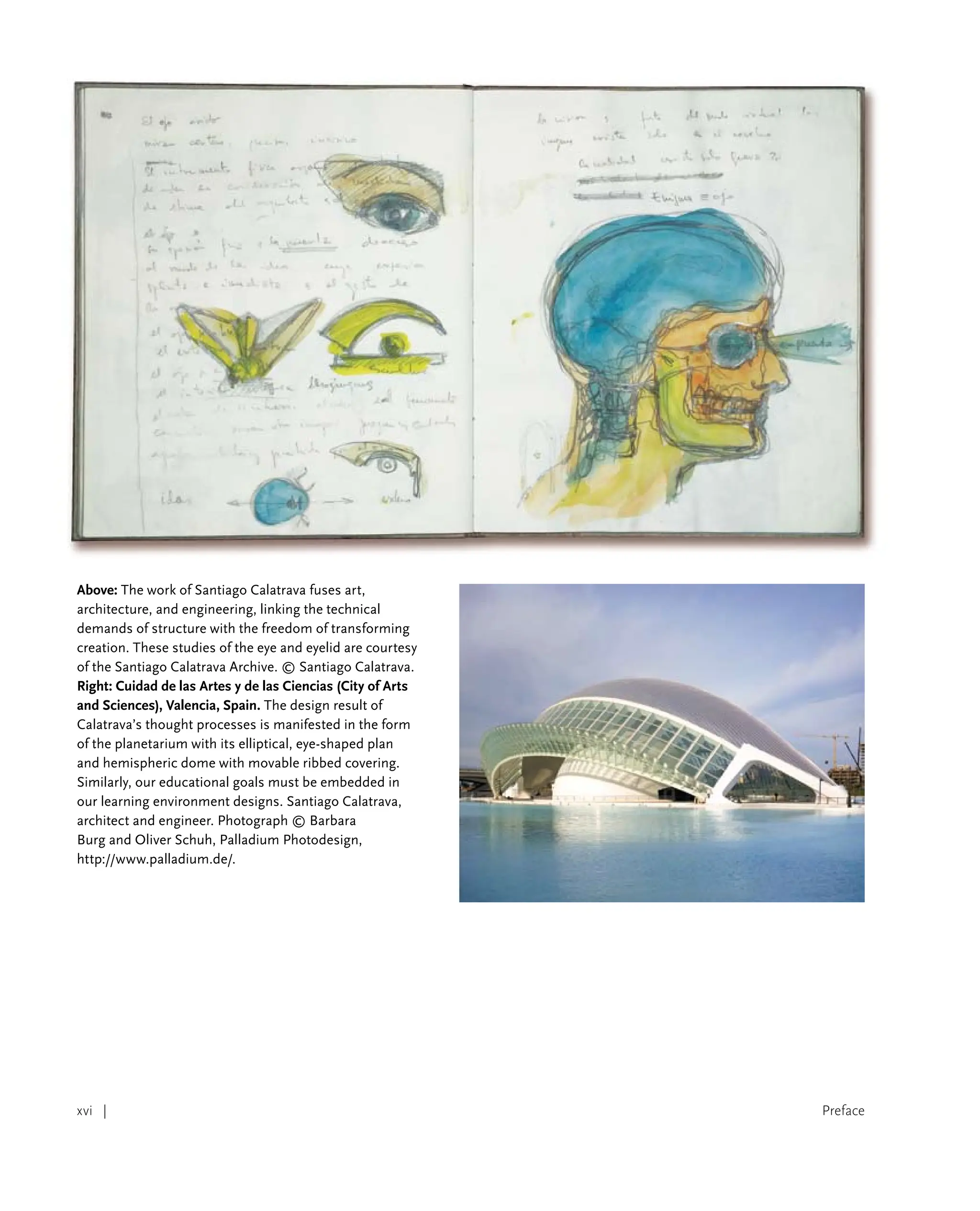
Above: The work of Santiago Calatrava fuses art,
architecture, and engineering, linking the technical
demands of structure with the freedom of transforming
creation. These studies of the eye and eyelid are courtesy
of the Santiago Calatrava Archive. © Santiago Calatrava.
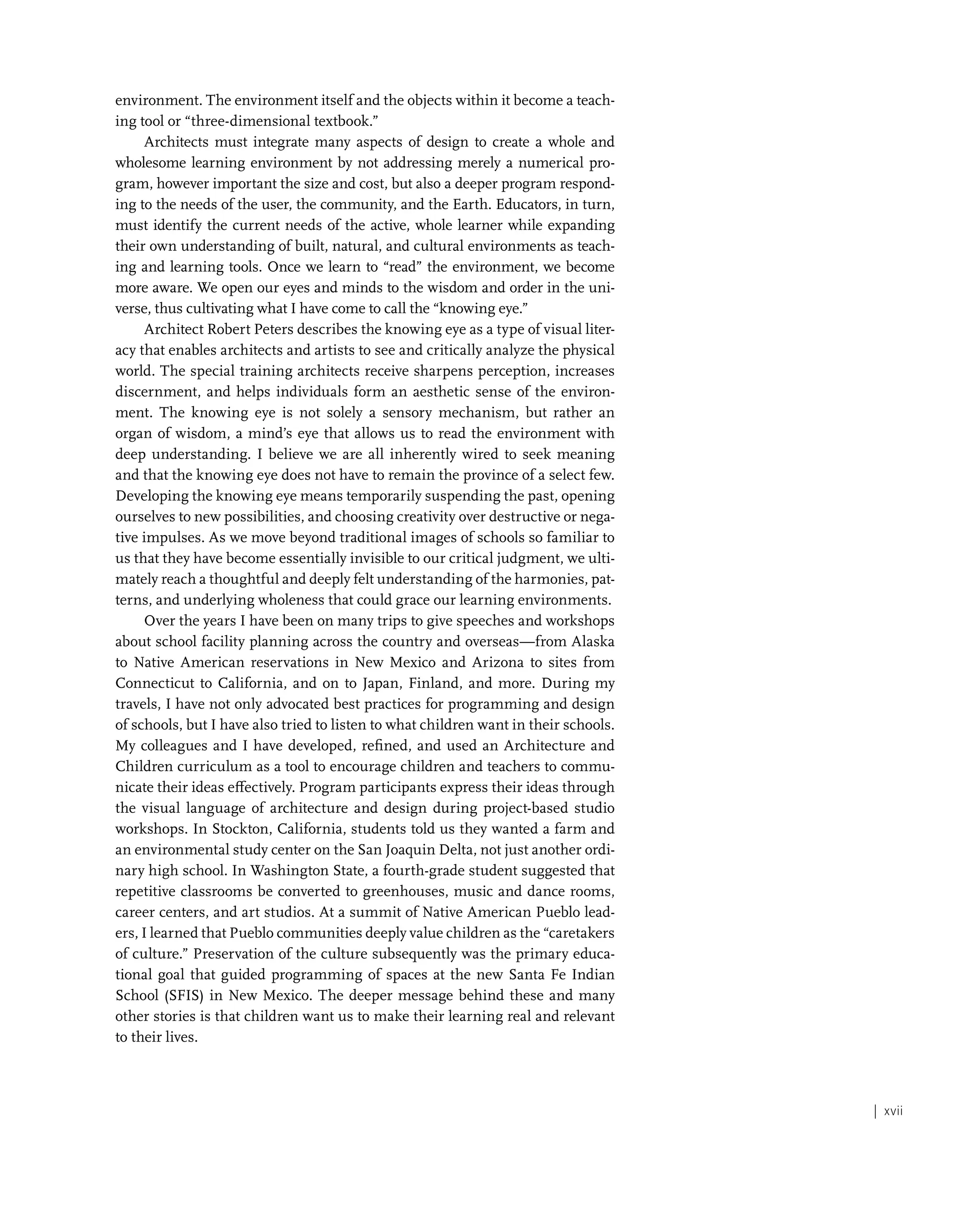
Right: Cuidad de las Artes y de las Ciencias (City of Arts
and Sciences), Valencia, Spain. The design result of
Calatrava’s thought processes is manifested in the form
of the planetarium with its elliptical, eye-shaped plan
and hemispheric dome with movable ribbed covering.
Similarly, our educational goals must be embedded in
our learning environment designs. Santiago Calatrava,
architect and engineer. Photograph © Barbara
Burg and Oliver Schuh, Palladium Photodesign,
http://www.palladium.de/.
| xvii
environment. The environment itself and the objects within it become a teach-
ing tool or “three-dimensional textbook.”
Architects must integrate many aspects of design to create a whole and
wholesome learning environment by not addressing merely a numerical pro-
gram, however important the size and cost, but also a deeper program respond-
ing to the needs of the user, the community, and the Earth. Educators, in turn,
must identify the current needs of the active, whole learner while expanding
their own understanding of built, natural, and cultural environments as teach-
ing and learning tools. Once we learn to “read” the environment, we become
more aware. We open our eyes and minds to the wisdom and order in the uni-
verse, thus cultivating what I have come to call the “knowing eye.”
Architect Robert Peters describes the knowing eye as a type of visual liter-
acy that enables architects and artists to see and critically analyze the physical
world. The special training architects receive sharpens perception, increases
discernment, and helps individuals form an aesthetic sense of the environ-
ment. The knowing eye is not solely a sensory mechanism, but rather an
organ of wisdom, a mind’s eye that allows us to read the environment with
deep understanding. I believe we are all inherently wired to seek meaning
and that the knowing eye does not have to remain the province of a select few.
Developing the knowing eye means temporarily suspending the past, opening
ourselves to new possibilities, and choosing creativity over destructive or nega-
tive impulses. As we move beyond traditional images of schools so familiar to
us that they have become essentially invisible to our critical judgment, we ulti-
mately reach a thoughtful and deeply felt understanding of the harmonies, pat-
terns, and underlying wholeness that could grace our learning environments.
Over the years I have been on many trips to give speeches and workshops
about school facility planning across the country and overseas—from Alaska
to Native American reservations in New Mexico and Arizona to sites from
Connecticut to California, and on to Japan, Finland, and more. During my
travels, I have not only advocated best practices for programming and design
of schools, but I have also tried to listen to what children want in their schools.
My colleagues and I have developed, refined, and used an Architecture and
Children curriculum as a tool to encourage children and teachers to commu-
nicate their ideas effectively. Program participants express their ideas through
the visual language of architecture and design during project-based studio
workshops. In Stockton, California, students told us they wanted a farm and
an environmental study center on the San Joaquin Delta, not just another ordi-
nary high school. In Washington State, a fourth-grade student suggested that
repetitive classrooms be converted to greenhouses, music and dance rooms,
career centers, and art studios. At a summit of Native American Pueblo lead-
ers, I learned that Pueblo communities deeply value children as the “caretakers
of culture.” Preservation of the culture subsequently was the primary educa-
tional goal that guided programming of spaces at the new Santa Fe Indian
School (SFIS) in New Mexico. The deeper message behind these and many
other stories is that children want us to make their learning real and relevant
to their lives.
Preface
xviii |
This book is about progressive, breakthrough thinking. It is intended to
stimulate new ideas in the minds of architects, administrators, educators, school
boards, and community members who want to make a positive and informed
difference in the lives of all children. It presents a new model of learning for stu-
dents and for professional development of educators and architects, and it illus-
trates how inspired design transforms and enriches our world. I am talking not
only about constructing beautiful buildings for our children, but also setting
those buildings in thoughtfully transformed playgrounds called “learning land-
scapes.” Ultimately, our populations must understand, revere, and steward the
environments in which they live, work, and play.
As my father, an educator, once said, one can learn how to earn a living in a
very short time, but it takes a lifetime to learn how to live. My goal is to empower
children to be the leaders of the future, to respect each other and the Earth, and
to become happy people who have truly learned how to live. I want to give all chil-
dren—including my seven grandchildren—an education that optimizes their
talents, exposes them to what is real and true, gives them a sense of ethics and
aesthetics, lifts their spirits, and prepares them to preserve our democratic soci-
ety. I want them to become active global citizens and representatives of a culture
that supports a more loving ambience than we have today. I want children to love
learning, love themselves, and love each other.
| xix
A Note on the Book’s Structure
The Nonlinear Approach
Though it appears to meander randomly, a stream has a logical proportional
flow based on topography and mathematics. The natural geometry of a mean-
dering river is a response to volume and silt load resulting in alternating shal-
lows, deep pools, and cleansing currents. Tampering with these graceful bends
can result in more frequent and extreme flooding.
My work has not taken a purely linear path, and I view my experiences as
interconnected rather than isolated. It has been a challenge to convey this rich
sense of fullness and complexity while providing an orderly narrative. I have
opted for a multifaceted approach to impart my ideas and those of the many peo-
ple who have enriched the journey.
The “spine” of the book is composed of a core narrative in four parts with
ten chapters, a distillation of the main themes I have uncovered and the thinking
that has evolved over the years. The narrative unfolds along the lines of the archi-
tectural planning and design process and concludes with a look to the future
of learning environments. My work achieves continuity through the essential
beliefs and thought processes in the core narrative.
To me, though, this is not enough, so I have saved space “in the margins”
to share related ideas from colleagues—quotes, questions, anecdotes, sidebars,
photographs, illustrations, and charts (Tools for Thought)—all designed to stim-
ulate thinking about learning environments and to encourage an open, diver-
sified approach to the problems school planners and designers face today. The
ideas in this running visual and verbal commentary are identified and separated
graphically into color coded sections.
A designer perspective section written by outside contributors appears at
the end of each chapter. In addition, each major part of the book concludes with
an open stewardship forum of case studies and commentary derived from many
different contributors on selected topics vital to school planning. The idea of
stewardship—the individual’s responsibility to manage and care for life and
property with proper regard for the rights of others—is at the heart of my think-
ing. The forum contributors provide examples of corroborating fieldwork for the
ideas expressed in the book. Their writing is excerpted and consolidated from
longer articles generously shared with me early in the book-writing process. I
remain indebted to these contributors—colleagues, friends, and, of course, the
children—who have been part of a collaborative life’s work.
designer perspective
stewardship forum
tools for thought
sidebar
Part One
The Philosophical
Framework behind
the Knowing Eye
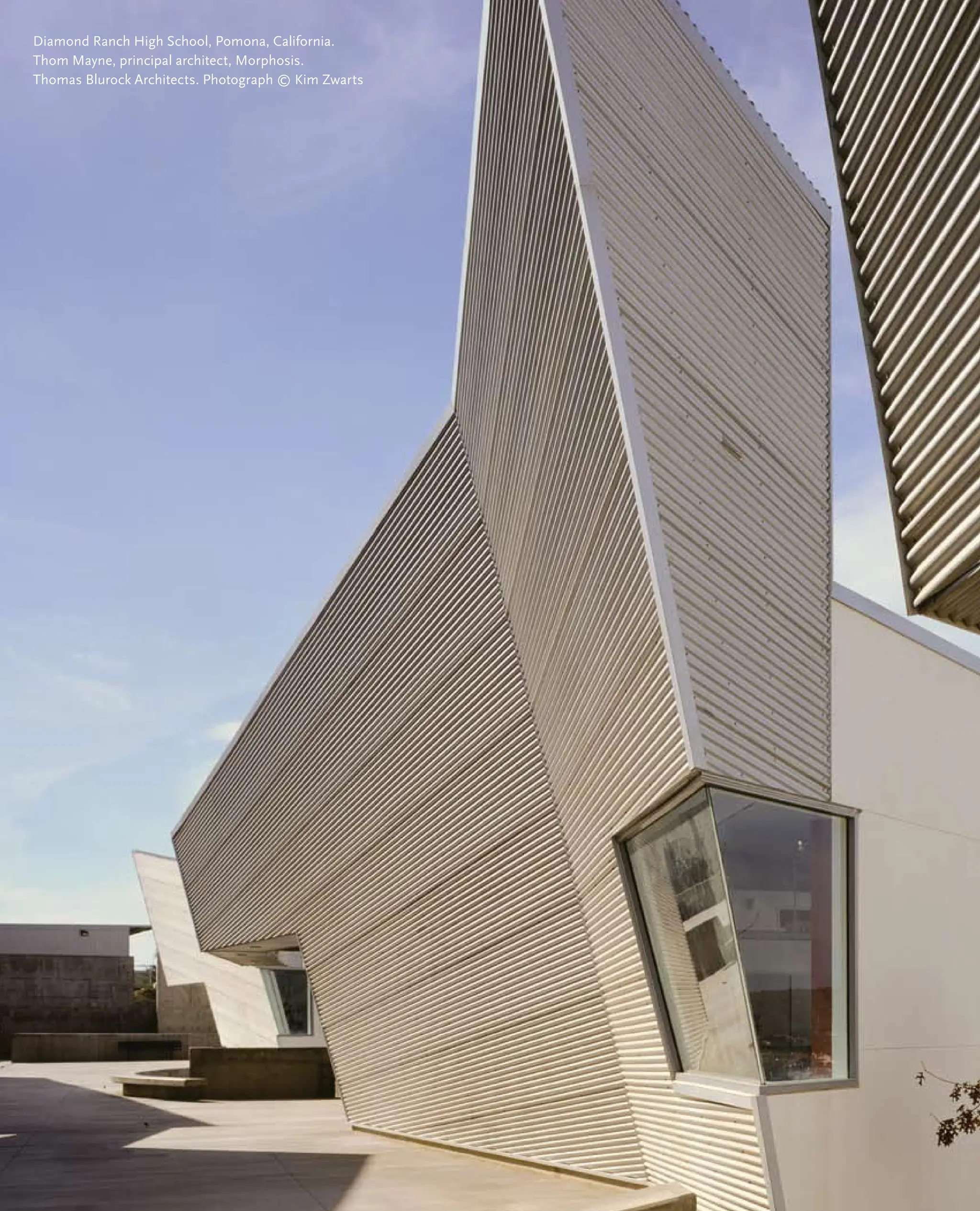
Diamond Ranch High School, Pomona, California.
Thom Mayne, principal architect, Morphosis.
Thomas Blurock Architects. Photograph © Kim Zwarts
| 3
Chapter One
The Need for New Thinking
Overview
Architecture and education intersect when it comes time to plan, design,
build, and use new learning environments. How can educators, archi-
tects, administrators, school boards, parents, and other interested com-
munity members make the most of this interaction? What can architects
do to support education, and how can educators contribute to the design
process? How can we create interactive environments that serve as three-
dimensional textbooks for learning? What elements in the physical learn-
ing environment will compel students to be responsible for their own
intellectual growth and whet their appetites for knowledge?
In discussing these questions, this book connects the two complex
disciplines of architecture and education for their mutual benefit and the
benefit of society. Architects and educators must understand each other
and develop a shared vocabulary encompassing educational theories,
developmental requirements of growing children, aesthetic theory, and
practical issues of designing schools. Our children will reap the rewards
of this integrated approach when they are able to occupy and use spaces
designed expressly to stimulate their natural curiosity, where architec-
ture is not a vacuous space but a learning tool.
Many valuable resources for school facility planning list educational
specifications, cite codes and regulations, outline the planning process,
show precedents, and give predetermined guidelines for design. Other
publications written for educators explain educational philosophy, advo-
cate current trends in instructional methods, or list content standards
for schools. Rarely, however, do authors attempt to explore the connec-
tions between architectural design and learning theory. A goal of this
book is to define the unique territory that can arise from a true interdis-
ciplinary understanding of place. When architects are cognizant of edu-
cational concepts across subject matter areas, they can design spaces
that support those concepts. When educators learn to view the environ-
ment as a source of meaning, they begin to use the world of physical
objects as a teaching tool to help students understand the underlying
laws and principles that govern our complex, precious universe.
This is a book about transcending narrow or limited views of both
education and architecture. It is not merely a catalog of typical existing
schools to be used as precedents for design. Instead, this book looks
| 3
The Philosophical Framework
4 |
forward and outward to design innovations that are not yet com-
monly found in our schools. My aim is to present examples of
informed design to help people everywhere develop the know-
ing eye and attain a heightened state of awareness that allows
them to see and “read” the interconnectedness of all things in
the built, natural, and cultural environment.
The book introduces new ways of thinking about design of
school facilities and encourages a deep sense of responsibility
toward the betterment of society reflected in the choices educa-
tors, architects, parents, and other citizens make on behalf of
children. Educators need to stop talking only to themselves and
initiate a dialogue with the public about more successful ways
to educate children and adults. The call for progressive leader-
ship presents a special challenge to architects, too, not only to
design effectively, but also to explicate the ideas that formulate
their work.
This is an idealistic book that asks architects, educators,
and parents to aim high and set new priorities. It is a book
about entertaining possibilities, suspending disbelief and cyni-
cal thinking, and overcoming apathy and perceived barriers to
high-quality educational environments. It is about choosing the
path of creativity, generosity, and caring over that of distrust,
fear, or destructiveness. An intelligently designed, attractive,
ecologically responsive learning environment is not a waste of
taxpayer money or an unrealistic dream, but rather a vital, con-
crete endorsement of our better nature and our professed con-
cern for children and the future of the world.
Author Jonathan Kozol asserts that America can afford
to pay for good schools for all children. Kozol’s The Shame of
the Nation: The Restoration of Apartheid Schooling in America
(2005) documents inequities in our public schools. During a
recent book tour stop in Portland, Oregon, Kozol expressed his
frustration with the frequently asked question, “Can you really
solve this kind of problem by throwing money at it?” Why is it,
he wonders, that we “allocate funds” to the Pentagon, but we
“throw money” at schools? And why, if money is not important
to education, do so many affluent families pay huge sums for
private education for their children?
In an interview taped for Alternative Radio in Boulder,
Colorado, Kozol’s response to the question of money for schools
was: throw it! “I don’t know a better way to put a new roof on
a collapsing school. I don’t know a better way to stock one of
these sparse and barren libraries with a wonderful, rich, super-
beautiful collection of all those lovely books . . . I don’t know a
better way than money to stock an inner city classroom with
good computers and software. Strange as it seems, they actu-
ally make you pay money for those things.”
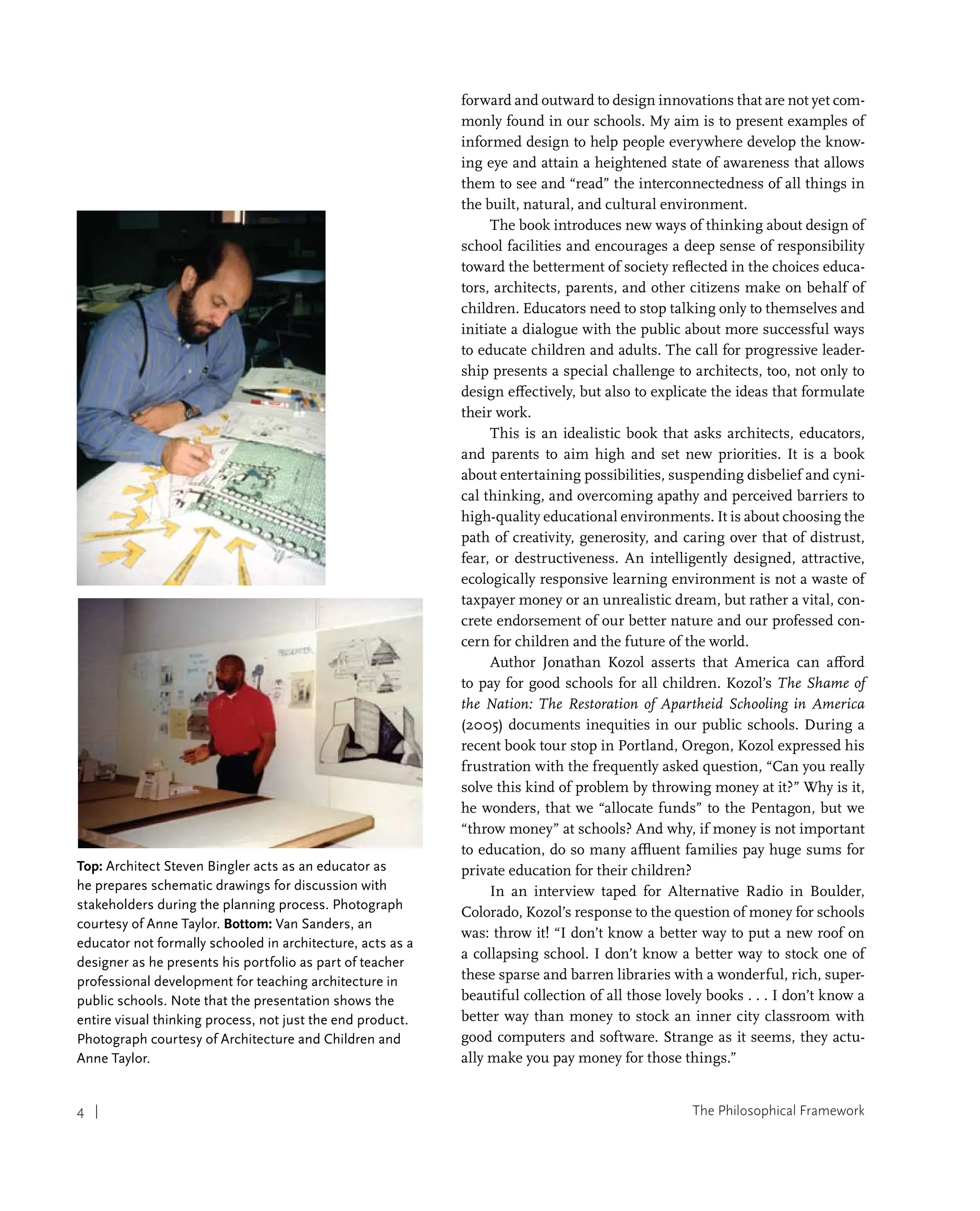
Top: Architect Steven Bingler acts as an educator as
he prepares schematic drawings for discussion with
stakeholders during the planning process. Photograph
courtesy of Anne Taylor. Bottom: Van Sanders, an
educator not formally schooled in architecture, acts as a
designer as he presents his portfolio as part of teacher
professional development for teaching architecture in
public schools. Note that the presentation shows the
entire visual thinking process, not just the end product.
Photograph courtesy of Architecture and Children and
Anne Taylor.
The Need for New Thinking | 5
| 5
Our Priorities
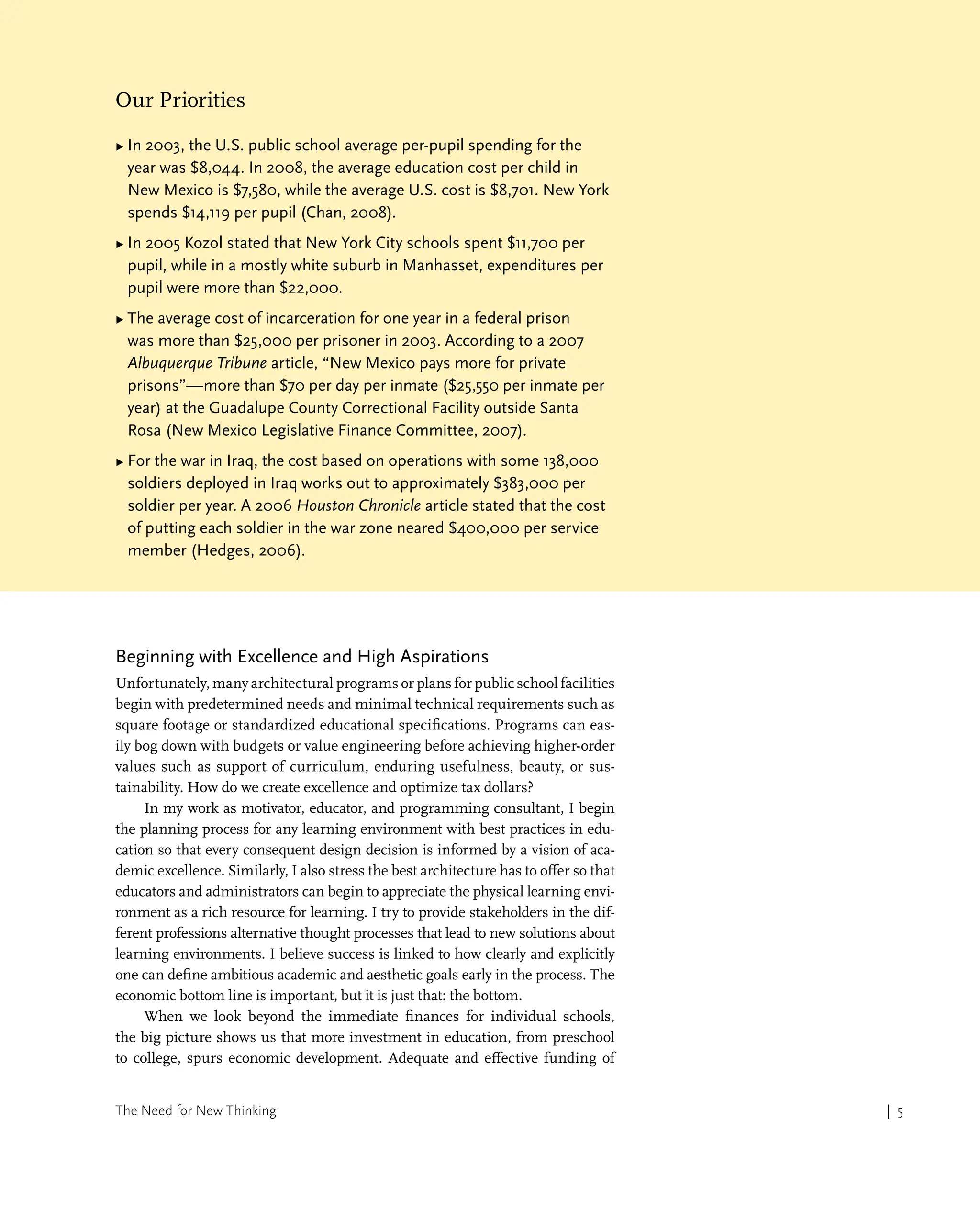
▶ 
In 2003, the U.S. public school average per-pupil spending for the
year was $8,044. In 2008, the average education cost per child in
New Mexico is $7,580, while the average U.S. cost is $8,701. New York
spends $14,119 per pupil (Chan, 2008).
▶ 
In 2005 Kozol stated that New York City schools spent $11,700 per
pupil, while in a mostly white suburb in Manhasset, expenditures per
pupil were more than $22,000.
▶ 
The average cost of incarceration for one year in a federal prison
was more than $25,000 per prisoner in 2003. According to a 2007
Albuquerque Tribune article, “New Mexico pays more for private
prisons”—more than $70 per day per inmate ($25,550 per inmate per
year) at the Guadalupe County Correctional Facility outside Santa
Rosa (New Mexico Legislative Finance Committee, 2007).
▶ 
For the war in Iraq, the cost based on operations with some 138,000
soldiers deployed in Iraq works out to approximately $383,000 per
soldier per year. A 2006 Houston Chronicle article stated that the cost
of putting each soldier in the war zone neared $400,000 per service
member (Hedges, 2006).
Beginning with Excellence and High Aspirations
Unfortunately, many architectural programs or plans for public school facilities
begin with predetermined needs and minimal technical requirements such as
square footage or standardized educational specifications. Programs can eas-
ily bog down with budgets or value engineering before achieving higher-order
values such as support of curriculum, enduring usefulness, beauty, or sus-
tainability. How do we create excellence and optimize tax dollars?
In my work as motivator, educator, and programming consultant, I begin
the planning process for any learning environment with best practices in edu-
cation so that every consequent design decision is informed by a vision of aca-
demic excellence. Similarly, I also stress the best architecture has to offer so that
educators and administrators can begin to appreciate the physical learning envi-
ronment as a rich resource for learning. I try to provide stakeholders in the dif-
ferent professions alternative thought processes that lead to new solutions about
learning environments. I believe success is linked to how clearly and explicitly
one can define ambitious academic and aesthetic goals early in the process. The
economic bottom line is important, but it is just that: the bottom.
When we look beyond the immediate finances for individual schools,
the big picture shows us that more investment in education, from preschool
to college, spurs economic development. Adequate and effective funding of
The Philosophical Framework
6 |
education is the best way to achieve faster growth, more jobs, greater productiv-
ity, and more widely shared prosperity, thus meeting the competitive demands
of our knowledge-based economy (Schweke, 2004).
Even so, tight constraints on budgets and time for school construction are
commonly cited across the nation when planners try to break the “box store”
mentality with high-quality design solutions for schools. A student of mine
recently shared a report from a citizen school oversight committee submitted
to Albuquerque Public Schools (Community Oversight Committee, 2004). The
report stated that it was time to “rein in the designers” and start using proto-
type designs for new schools, following the speedy and cost-effective methods
of Wal-Mart, Costco, McDonald’s, and other economically viable institutions.
The idea of a prototype has some merit, but the inspiration for that prototype
reveals the poverty of our design understanding and our imaginations. This
limited worldview can be frustrating for those trying to reform education and
support that reform with innovative school designs and sustainable architec-
ture. This is why it is so important that our designers share their expertise and
enthusiasm with the general public.
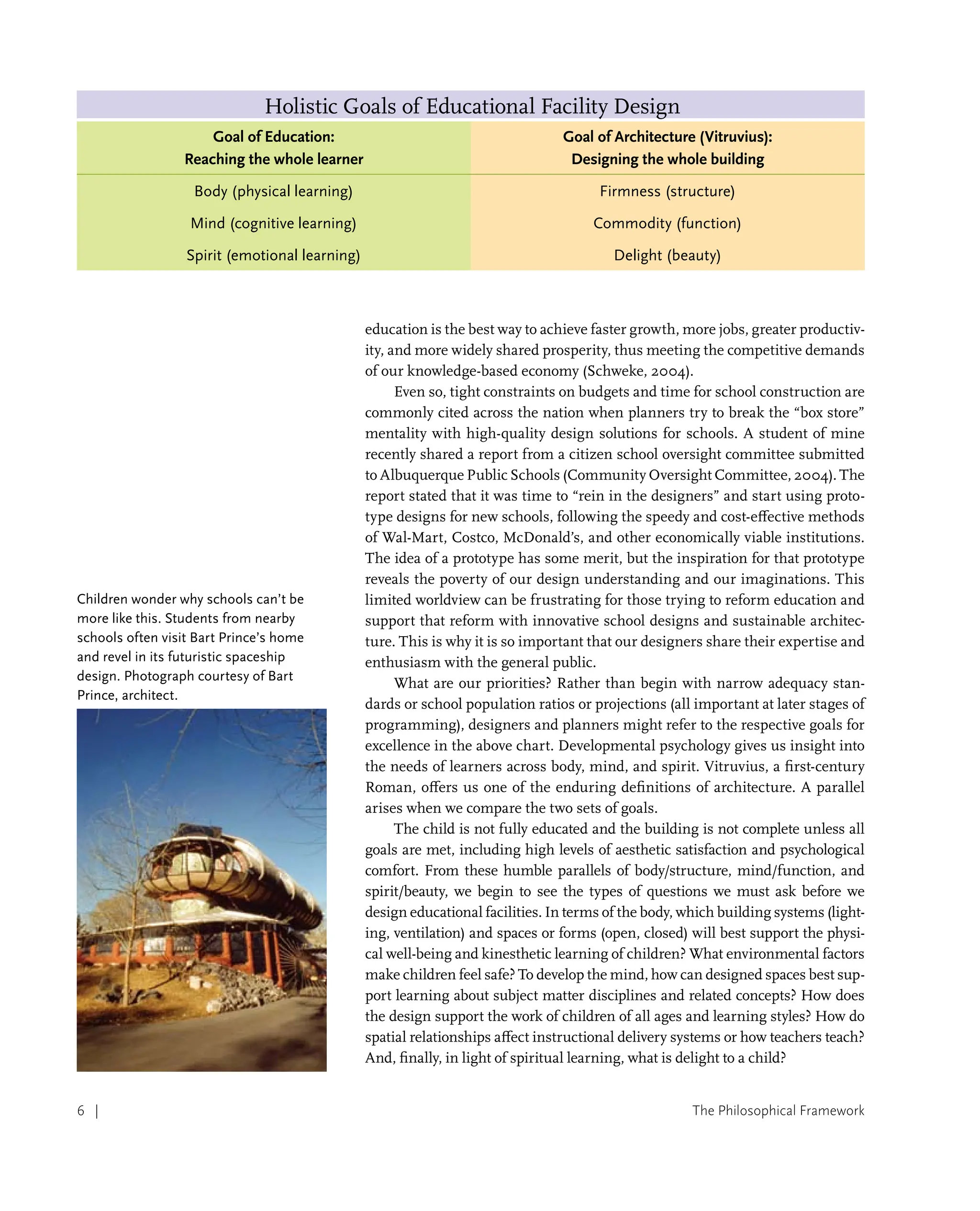
What are our priorities? Rather than begin with narrow adequacy stan-
dards or school population ratios or projections (all important at later stages of
programming), designers and planners might refer to the respective goals for
excellence in the above chart. Developmental psychology gives us insight into
the needs of learners across body, mind, and spirit. Vitruvius, a first-century
Roman, offers us one of the enduring definitions of architecture. A parallel
arises when we compare the two sets of goals.
The child is not fully educated and the building is not complete unless all
goals are met, including high levels of aesthetic satisfaction and psychological
comfort. From these humble parallels of body/structure, mind/function, and
spirit/beauty, we begin to see the types of questions we must ask before we
design educational facilities. In terms of the body, which building systems (light-
ing, ventilation) and spaces or forms (open, closed) will best support the physi-
cal well-being and kinesthetic learning of children? What environmental factors
make children feel safe? To develop the mind, how can designed spaces best sup-
port learning about subject matter disciplines and related concepts? How does
the design support the work of children of all ages and learning styles? How do
spatial relationships affect instructional delivery systems or how teachers teach?
And, finally, in light of spiritual learning, what is delight to a child?
Holistic Goals of Educational Facility Design
Goal of Education:
Reaching the whole learner
Goal of Architecture (Vitruvius):
Designing the whole building
Body (physical learning) Firmness (structure)
Mind (cognitive learning) Commodity (function)
Spirit (emotional learning) Delight (beauty)
Children wonder why schools can’t be
more like this. Students from nearby
schools often visit Bart Prince’s home
and revel in its futuristic spaceship
design. Photograph courtesy of Bart
Prince, architect.
The Need for New Thinking | 7
America, Wake Up!
I admit I have a difficult time understanding our complacency
as a nation when it comes to the current state of our public
school facilities. Perhaps many adults are in denial about or feel
powerless to change the conditions in our schools. If so, con-
sider this book a wake-up call about our need to think differ-
ently. Even in fairly wealthy suburban high schools—let alone
the appalling state of many large inner-city schools—I have
encountered armed police officers patrolling bleak and bar-
ren hallways, prisonlike lockable gates, chain link fences, and
surveillance cameras. Are we preparing students for a democ-
racy or a police state? I have witnessed children sitting on the
cold floor like refugees and gulping their fast food lunches,
then stuffing half-eaten leftovers and wrappers into overflow-
ing garbage cans without a thought for recycling. What does
this “health illiteracy” say about nutritional habits and life-
long wellness? I have seen children stuck in portables with no
plumbing, a lack of storage and order, shades pulled against
the natural light, students sitting at desks that are ergonomi-
cally inappropriate, possessions and clothing piled everywhere,
mouse droppings among the computers, and trash, weeds, and
abandoned furniture on playgrounds. In a discussion with my
granddaughter about school bathrooms, she disclosed that she
only goes to the bathroom at home in the morning and later in
the afternoon because her school bathrooms are dark, scary,
and dirty. At age ten she was knowledgeable enough to sug-
gest windows or skylights, smart lights, smart faucets, and self-
flushing toilets. “Put that in your book, Grandma,” she said.
The obvious question is: what messages are we sending to
our children?
The National Clearinghouse for Educational Facilities
(NCEF) has compiled the world’s largest and most widely used
database about school facilities and how to create, renovate, and
maintain safe, healthy, high-performance schools. A quick trip
to the NCEF Web site reveals the latest evidence that the need
for new or modernized school facilities in the United States is
great. Statistics gathered in preparation for this book include
a 1999 report by the National Center for Education Statistics
(NCES, June 2000), which stated that the average public school
building was forty years old. NCES estimated that it would take
more than $112 billion to update U.S. school facilities, while
the National Education Association (2000) estimated the full
nationwide cost of modernization including new construction
at about $322 billion. The American Society of Civil Engineers’s
2005 report card on America’s infrastructure gave schools a
grade of D, citing aging, outdated, and overcrowded facilities,
and estimated that 75 percent of the buildings were inadequate
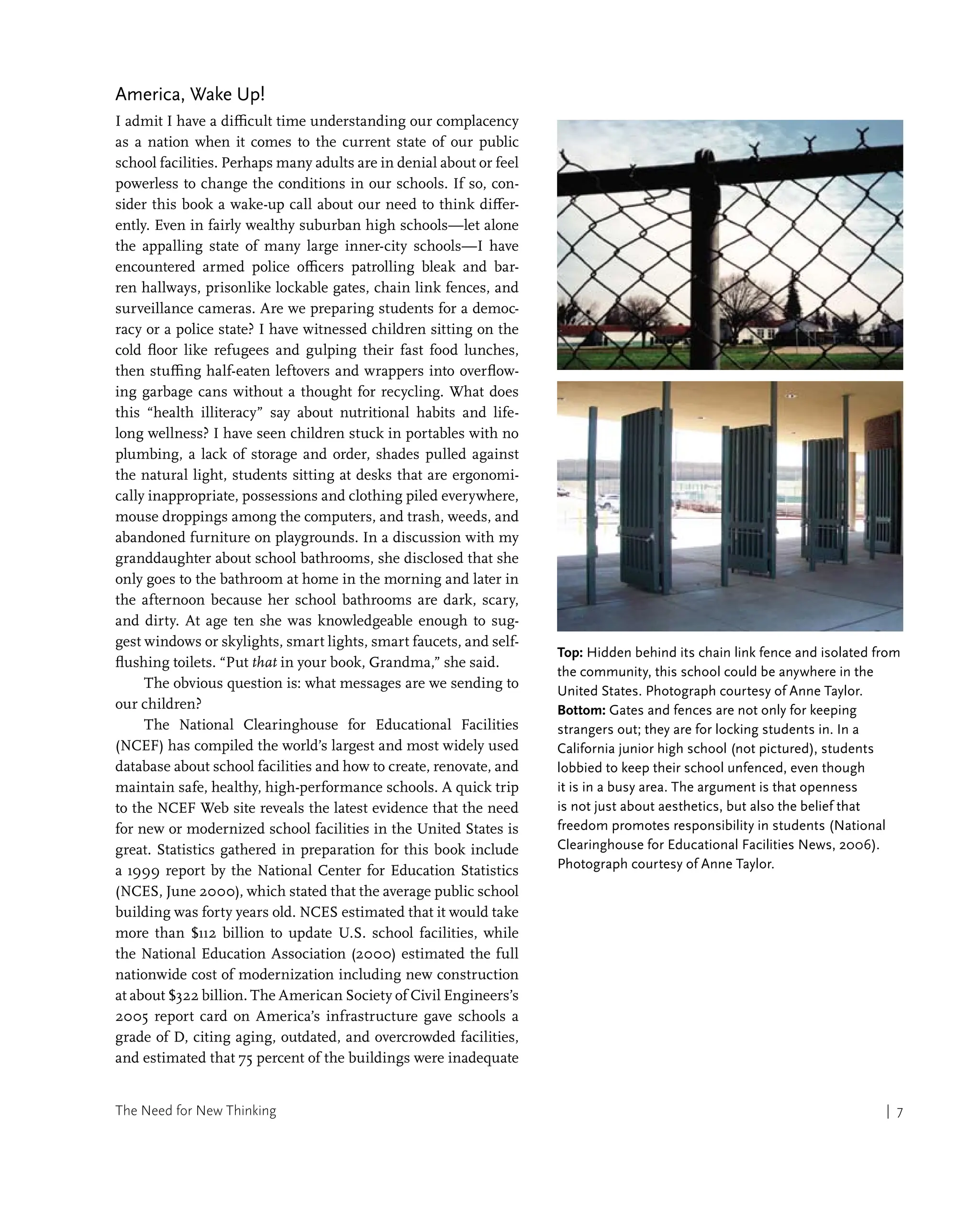
Top: Hidden behind its chain link fence and isolated from
the community, this school could be anywhere in the
United States. Photograph courtesy of Anne Taylor.
Bottom: Gates and fences are not only for keeping
strangers out; they are for locking students in. In a
California junior high school (not pictured), students
lobbied to keep their school unfenced, even though
it is in a busy area. The argument is that openness
is not just about aesthetics, but also the belief that
freedom promotes responsibility in students (National
Clearinghouse for Educational Facilities News, 2006).
Photograph courtesy of Anne Taylor.
The Philosophical Framework
8 |
to meet student requirements. Making necessary repairs in
these schools would cost an average of $3,800 per student.
According to the Government Accounting Office (GAO), one-
third of all schools should receive extensive repair or replace-
ment, and 60 percent require repair or replacement of at least
one major building feature. U.S. Department of Education fig-
ures indicate that enrollment increases are expected, too, with
increases from 53 million students in 2000 to 94 million by the
end of the twenty-first century.
To top it all off, a 2001 IssueTrak briefing online from the
Council of Educational Facility Planners International (CEFPI)
stated that students who attend schools in a good state of repair
score five to seventeen percentile points higher on national tests
than students who attend schools in poor repair. Teachers report
that much of the infrastructure they work in is inadequate to
meet the increasingly strict standards for academic achievement
now in place at all levels of government (Schneider, 2002). It is
vital to student achievement that our schools are in good repair
and that money is escrowed to support ongoing maintenance.
Furthermore, these statistics do not even begin to address
the urgent demand for school improvement, design, and con-
struction worldwide in areas where war, terrorism, revolution,
or natural disasters have destroyed the infrastructure of exist-
ing schools. The list of improvements for educational facilities
is endless.
The call for new and renovated structures opens an oppor-
tunity for the innovative type of school facility programming
and design outlined in this book. It would be a tragedy to
compound the problem of inadequate facilities by repeating
outmoded designs that are unsafe, do not apply the latest edu-
cational discoveries and learning theories, and fail to support
sustainable, ecologically sound design. Our children deserve
schools that give them a sense of dignity, worth, and freedom.
The difficulties outlined above can and must engender
constructive responses rather than apathy or despair. Several
valuable resources look positively on the relationship between
educational planning and facility planning. CEFPI has an
online design portfolio and publishes guides for sound practices
in school design. DesignShare is an excellent online journal and
library of innovative facility planning and award-winning learn-
ing environments from early childhood to university settings.
It shares design research from a global forum of professional
stakeholders. The George Lucas Educational Foundation (GLEF)
tells stories of education through its publication, Edutopia, and
through its Web site, with a special emphasis on creative uses
of technology in education. The Academy of Neuroscience
for Architecture (ANFA) has aimed recent efforts at building
Top: The portable classroom is a temporary solution that
all too often becomes a permanent part of a public school
campus. An estimated 220,000 portables are used by U.S.
public schools. They are springing up across the country
due to poor urban planning, overcrowding, fast growth,
and new laws governing small class size. Portables require
more maintenance and upkeep than regular classrooms
and are often associated with the health effects caused by
indoor pollution (National Clearinghouse for Educational
Facilities News, 2006). Photograph courtesy of Anne
Taylor. Bottom: In a New Orleans classroom before the
2005 hurricanes, termites were consuming window
shades and mullions. The teacher using this room told
me termites were also eating the floors and that she
fully expected to fall through to the basement someday.
Photograph courtesy of Anne Taylor.
The Need for New Thinking | 9
bridges between consciousness research and those who design
places for human use. Among other tasks, researchers hope
to uncover which architectural components trigger delight in
the mind of the user and why those positive responses occur
(Eberhard, 2002).
I offer as another encouraging example the reform efforts
for education in New Orleans, Louisiana. Well before the storms
Katrina and Rita, architect Steven Bingler of Concordia LLC and
others had already begun work on a new grassroots commu-
nity strategy and vision known as the New Orleans Community
Trust, a partnership between schools, city government, and
community dedicated to collaborative public facilities planning.
Neighborhood Learning Center sites would ultimately serve for
the coordination of community services as well as lifelong edu-
cation (Bingler, personal communication, October 4, 2005).
Another initiative from Global Green USA has advanced sus-
tainable building design principles during rebuilding efforts in
New Orleans and Louisiana (2008). It is too soon to tell what
the outcome in New Orleans will be, and there are many strug-
gles ahead, but it is important to remember that the difficul-
ties we face are also opportunities for creating new systems that
will better connect our efforts for reform.
I am encouraged that many groups now support the goals
of stewardship and environmental responsibility in a move-
ment galvanized in part by former vice president Al Gore and
his urgent call for all citizens to face and respond to global
warming. In terms of architecture, important contributions
from Leadership in Energy and Environmental Design (LEED)
Top: The well-proportioned, two dimensional plan
view for the New Orleans Prototype Pre-Kindergarten
embodies primary concepts of shape, form, color,
numbers, and cardinal directions. Image courtesy of
Concordia LLC and Steven Bingler. Bottom: A well-
designed floor plan at the New Orleans Prototype Pre-
Kindergarten translates into three-dimensional forms
that can be aesthetically pleasing without adding much
cost. Neoclassical touches are seen in the graceful
proportions, high ceiling, columns with capitals, and the
symmetrical layout. Image courtesy of Concordia LLC and
Steven Bingler. Photograph by Neil Alexander.
The Philosophical Framework
10 |
include a “green architecture” rating system developed by the
U.S. Green Building Council (2001). The LEED rating system
defines standards for environmentally responsible, healthy, and
profitable architecture. LEED criteria specifically for schools
were launched in early 2007. The rating system offers a volun-
tary certification program that measures four levels of achieve-
ment in green building for schools based on the number of
points awarded to a project across six categories:
▶ 
Sustainable sites
▶ 
Water efficiency
▶ 
Energy and atmosphere
▶ 
Material and resources
▶ 
Indoor environmental quality
▶ 
Innovation and design process
LEED awards a credit for using a school as a teaching tool for sus-
tainable practice if designers provide curriculum based on the
high-performance features of the building. The new LEED for
Schools system (2007) must be used by those interested in certi-
fication for school projects. The LEED criteria specifically address
the uniqueness of school spaces and children’s health issues.
Also, in late 2005, the American Institute of Architects
(AIA) Board of Directors issued a press release calling on archi-
tects to cut by 50 percent the fossil fuels used to construct
and operate buildings by the year 2010 (Mazria, 2005). These
important steps are intended to transform the architectural
profession through a new emphasis on sustainability in build-
ing design, including schools.
Educational Implications for Design
As education changes, so must design. Some commonly cited
changes emphasize new models of teaching and learning and
corresponding ways of planning for school facilities:
▶ 
Schools are moving from the old industrial factory
model (the mode of education that relies on
uniformity, memorization, and lecture learning)
into the digital information age, with a consequent
shift from the old style of “broadcast” learning to
interactive learning (Tapscott, 1998, pp. 127–30).
▶ 
The old “assembly line” model no longer supports
what we know about how the brain/mind learns
(Caine  Caine, 1991, pp. 13–14). This means
The Factory Model
CLASSROOM CLASSROOM
CLASSROOM
CLASSROOM CLASSROOM
CLASSROOM
DOUBLE-LOADED CORRIDOR
TEACHER DESK
The industrial assembly line model for school
design, sometimes known as the factory model,
is still seen in schools being built today even
though its repetitive identical classrooms
and passive classroom configuration no
longer provide support for learning in today’s
interdisciplinary, knowledge-based economy.
Graphic by Atsuko Sakai.
The Need for New Thinking | 11
architects must provide different configurations
for learning environments, more flexibility,
adaptability, movable components, and future
conversion to other uses (Locker  Olson, 2004).
▶ 
The industrial/factory model must be replaced
by a model based on the way the mind develops
(a process), recognizing the variety of children’s
developmental profiles (Greenspan, 1997, p. 314).
▶ 
Current educational best practices and learning
theories indicate that environmentally based, project-
based, hands-on, active, relevant, constructivist
learning can close the achievement gap (Hoody
 Lieberman, 1998). Project-based learning often
requires more learning space and architectural
support for different space usage and for changing
student/teacher/community relationships.
▶ 
Students become responsible for their own learning
(Brooks  Brooks, 1993, p. v), and teachers act
as facilitators (Caine  Caine, 1991, p. 22).
▶ 
Classrooms will become more like studio workplaces
(Second National Invitational Conference on
Architecture and Education Report, 1992, p. 3).
▶ 
Special programs and individualization
of the curriculum are on the rise and
require a variety of specialized spaces
and universal access (Preiser, 2001).
▶ 
Schools must become more community
oriented through shared facilities, multiple
use, and community participation in the
planning process (Brubaker, 1998).
▶ 
School design changes must be driven by new
technology requirements (Myers  Robertson, 2004).
▶ 
Budgeting must shift from short-term, up-front
costs to include whole building life cycle costs
and ongoing maintenance and operations
(Perkins, 2001, pp. 89–90; Council of Educational
Facility Planners International, 2004).
▶ 
Deferred maintenance harms our schools, resulting
in health risks, increased cost of maintenance
and replacement of equipment, and increased
rates of deterioration of facilities (National
Clearinghouse for Educational Statistics, 2000).
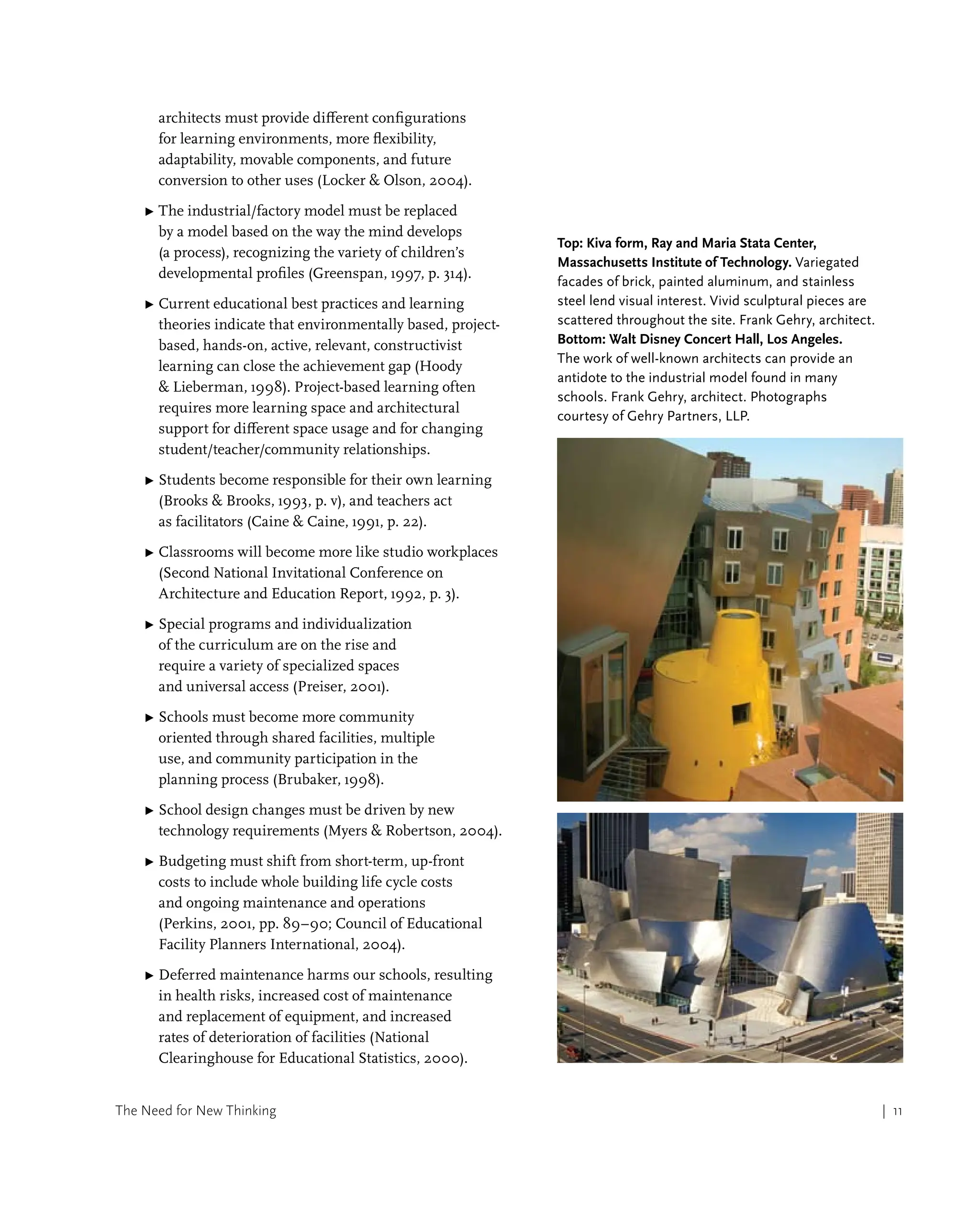
Top: Kiva form, Ray and Maria Stata Center,
Massachusetts Institute of Technology. Variegated
facades of brick, painted aluminum, and stainless
steel lend visual interest. Vivid sculptural pieces are
scattered throughout the site. Frank Gehry, architect.
Bottom: Walt Disney Concert Hall, Los Angeles.
The work of well-known architects can provide an
antidote to the industrial model found in many
schools. Frank Gehry, architect. Photographs
courtesy of Gehry Partners, LLP.
The Philosophical Framework
12 |
Listening to Children
Schools I’d Like
In 1967 and again in 2001, British schoolchildren submitted their ideas to a competition titled
“The School I’d Like.” The ideas collected from children frequently emphasized circular schemes,
suggesting a reaction against authoritarian and controlling “squareness,” according to Burke and
Grosvenor (2004), authors of an excerpted online article about the competition. “Within a circular
school, with circular classrooms and spiral staircases, what becomes challenged is the institutional:
the regulation and order of bodies in precise spaces, the processing of children as in a factory, the
rehabilitation of individuals as in a prison” (p. 2). Other key design concepts participants called
for included comfort, privacy, places for rest and socializing, colorful, softly textured, and inviting
places—the same amenities many adults enjoy in their work and home environments (p. 3).
▶ 
American School Board Journal reports through several
online articles that the business and financial approaches of
education are changing. In “The New Finance,” Verstegen
(2002) writes that the financial system is “antiquated,”
designed to support a minimal education in an industrial
era, and is in need of reinvention with quality for all. For
example, some school districts receive eight times as
much per-pupil spending as others. We must do more to
equalize spending across school districts nationwide.
▶ 
A report from the Economic Policy Institute in Washington
DC states that investment in education advances economic
equality, helping poor, minority, and new immigrant learners
avoid social problems stemming from poverty and inequality
and become skilled, productive workers (Schweke, 2004).
▶ 
New thinking can lead to changes for school management.
In his book Crash Course, Chris Whittle, CEO of Edison
Schools, the largest private operator and designer of public
schools, suggests that students assist in running schools,
that teacher pay be doubled or tripled, that we build a “West
Point” for principals, and that the U.S. government pay for
research and development for schools (Whittle, 2005).
▶ 
Kats (2006) reports in “Greening America’s Schools”
that students in sustainable, high-performance school
buildings experience health and learning benefits tied
to green design and improved ventilation, temperature
controls, good lighting, and better views. Teachers
also benefit, which increases teacher retention.
The Need for New Thinking | 13
▶ 
Global sustainability affects the entire construction market,
including schools and portables. Buildings and their
construction account for nearly half of all the greenhouse
gas emissions and energy consumed in the United
States each year (Mazria, 2004.) Students must become
knowledgeable citizens who understand sustainability.
There is a call for more empirical data and corresponding medical research
to support new findings in education. Researchers are slowly beginning to
compile quantitative evidence about issues in school design that my colleagues
and I have been researching and recommending for years. As long ago as
1969–1971, I conducted an experimental and replication study at Arizona State
University on the effects of selected stimuli on the learning and behavior of
four-year-olds who were placed in a learning environment that was carefully
conceived based on developmental needs of children. The results demon-
strated that environment does indeed affect learning and behavior (Taylor,
1971). How much more time will pass before educators and designers translate
this information into positive action?
The research continues. School size, classroom size, and provision for
secluded study areas (personal space) within classrooms are now shown to impact
student performance (Moore  Lackney, 1992). Mark Schneider and others writ-
ing for NCEF have reviewed the emerging research on daylighting, acoustics, and
other ambient quality issues that affect student achievement and learning out-
comes (National Clearinghouse for Educational Facilities, 2002).
| 13
Bhutan and Gross National Happiness
Greenwald (2004) writes of the tiny country of Bhutan and its people who are trying to reconcile their
Tibetan Buddhist beliefs with the materialism so rampant in the world today. Several years ago, the
young monarch of the Himalayan nation stated his opinion that “gross national happiness” was more
important than “gross national product” (p. 98).
I can’t help but stop and reflect upon the phrase gross national happiness. What would America
and its institutions be like if we were to adopt a similar attitude? What if we were to think more
deeply about the impact our actions have on others? What kinds of school designs and curricula
would encourage a shift from gross national product to gross national happiness?
The New Economics Foundation (NEF), a British think tank, has created a new measurement
tool for more accurately rating nations beyond mere gross domestic product. The “happy planet
index” measures the length and happiness of people’s lives as well as the amount of the Earth’s
resources used. Under this measure, Bhutan scored thirteenth out of 178 nations ranked for the
well-being of its citizens, and the United States scored 150th (New Economics Foundation, 2008).
The Philosophical Framework
14 |
14 |
Diamond Ranch High School, Pomona, California.
Top: The building and site are perceptually
interchangeable, and there are no references to
traditional typology. According to the architectural
firm Morphosis, “The intention of the whole is to
challenge the message sent by a society that routinely
communicates its disregard for the young by educating
them in cheap institutional boxes surrounded by
impenetrable chain link fencing.” Thom Mayne, principal
architect, Morphosis. Thomas Blurock Architects.
Photograph © Kim Zwarts. Bottom: Canyon for student
interaction. Organizational cues come from the natural
topography of the steeply sloped site in the jagged terrain
of the Los Angeles foothills. Two rows of fragmented,
interlocking forms are set tightly on either side of a
long central “canyon,” or street, which cuts through the
face of the hillside as a geologic fault line might. Thom
Mayne, principal architect, Morphosis. Thomas Blurock
Architects. Photograph © Tim Hursley.
Universityof VirginiaProfessorDanielL.Duke(1998),how-
ever, frames the problem of research in a way that resonates
with the themes of this book. In Does it Matter Where Our
Children Learn? Duke says that even though more research is
needed to understand the subtleties of how environment influ-
ences learning, it is important to point out that research is not
required to justify high-quality schools. “Where we choose to
send our children for educational purposes ultimately is a mat-
ter of ethics and morality. . . . Even if no links between learning
and facilities could be demonstrated scientifically, our society
still would have a moral obligation to assign young people to
safe and well-designed schools” (Duke, 1998, p. 4).
Five Key Points
To summarize, this chapter identifies the need for new and ren-
ovated school facilities that support what we now know about
how children learn. The problem is clear, but how do we tackle
it? Here are the five key points I make during the course of this
book, phrased as an action plan for strengthening the connec-
tion between architecture and education through school facil-
ity planning and design.
Point one: Begin with aesthetics and a
philosophical frame of reference.
Point two: Develop and use a curricular
organizing system to govern the school facility
planning and development process.
Point three: Design and learn from the
environment as a three-dimensional textbook.
Point four: Aim for the future.
Point five: Foster ecological stewardship by nurturing
the individual, the community, and the Earth.
| 15
Too
l
s
fo
r
T
h
o
u
g
h
t
The Need for New Thinking
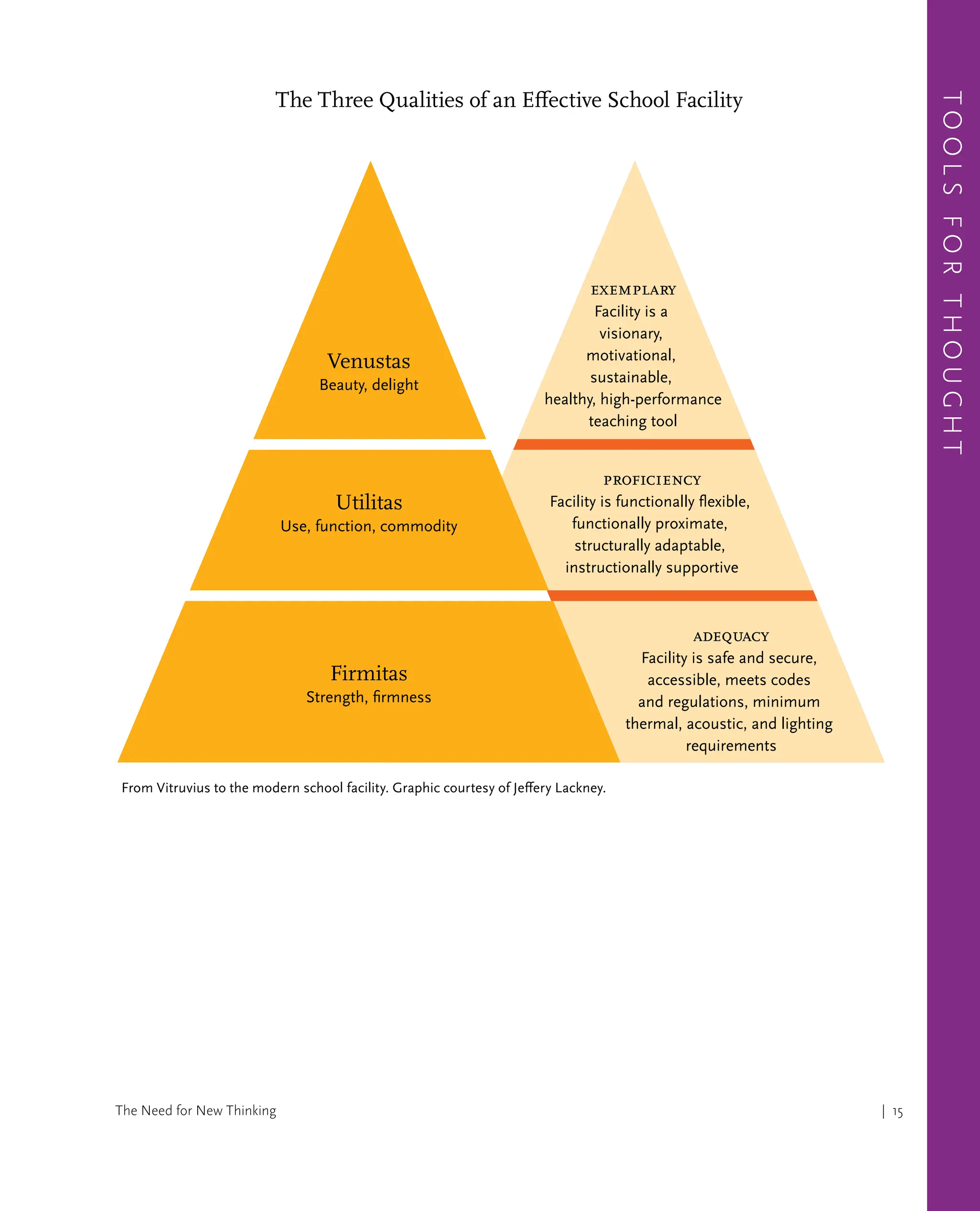
The Three Qualities of an Effective School Facility
Venustas
Beauty, delight
Utilitas
Use, function, commodity
Firmitas
Strength, firmness
���������
Facility is a
visionary,
motivational,
sustainable,
healthy, high-performance
teaching tool
�����������
Facility is functionally flexible,
functionally proximate,
structurally adaptable,
instructionally supportive
��������
Facility is safe and secure,
accessible, meets codes
and regulations, minimum
thermal, acoustic, and lighting
requirements
From Vitruvius to the modern school facility. Graphic courtesy of Jeffery Lackney.
The Three Qualities of an Effective School Facility
D e s i g n e r P e r s p e c t i v e
16 |
Design themes for the 2006 DesignShare awards included small learning
communities, many layers of community, sustainability and constant renewal,
learning outcomes focused on the future, radical flexibility, movement and
collaboration, evolving building projects, and openness and transparency.
Great Schools of the World
The Best of DesignShare
Randall Fielding, American Institute of Architects
Founder and editorial director of DesignShare.com
What do schools of the future look like? By analyzing DesignShare’s database of more than
four hundred award-winning schools from around the world, we find many solutions already
in place. Sharing these ideas is as important as inventing new ones—it is a philosophy that
can sustain our planet. This essay includes an overview of key features of schools of the
future, as well as summary case studies of three selected projects.
Key Features of Great Schools
Schools of the future foster personalized learning, recognizing that every student is different,
learns at her own schedule, and follows her own interest. They provide nooks, niches, and small
spaces for individuals who need “cave” time for reflection.
Great schools organize into small learning communities, fostering collaboration, social
interaction, and caring. More space is devoted to learning and less to nonacademic spaces.
Corridors are often replaced with wider multiuse common areas. Common areas have flexible
furnishings, allowing students and teachers to rearrange elements for different types of real-
world, project-based learning.
Great schools rely on daylighting and use electric lighting artfully. They use water from
the roof and showers to water the grounds and photovoltaic panels for entry canopies. They
draw on thermal mass for heating and cooling. Walls are not limited to right angles, reducing
reverberation and improving sound quality.
Great schools connect fluidly to the outside, recognizing nature and the city as exten-
sions of the learning space. Schools of the future may involve less building but operate as
larger entities because they are interdependent with community and business organizations
and share facilities; this is an ecologically sustainable model at its broadest level, involving
systems of relationships that expand the boundaries between living, learning, and working.
| 17
C a s e s t u d i e s
The Need for New Thinking
c a s e s t u d y
The Learning Street
Peel Education and Tertiary and Further
Education Campus, Mandurah, Australia
HASSELL and Jones Coulter Young, Architects in
Association
This project, built on the site of an existing Tertiary and Further
Education (TAFE) campus, is unique because its master plan
combines senior school students, TAFE, and university students
on a single campus. The facility allows adult education and voca-
tional training to occur within one facility, therefore helping
boost student retention rates and promote the concept of lifelong
learning.
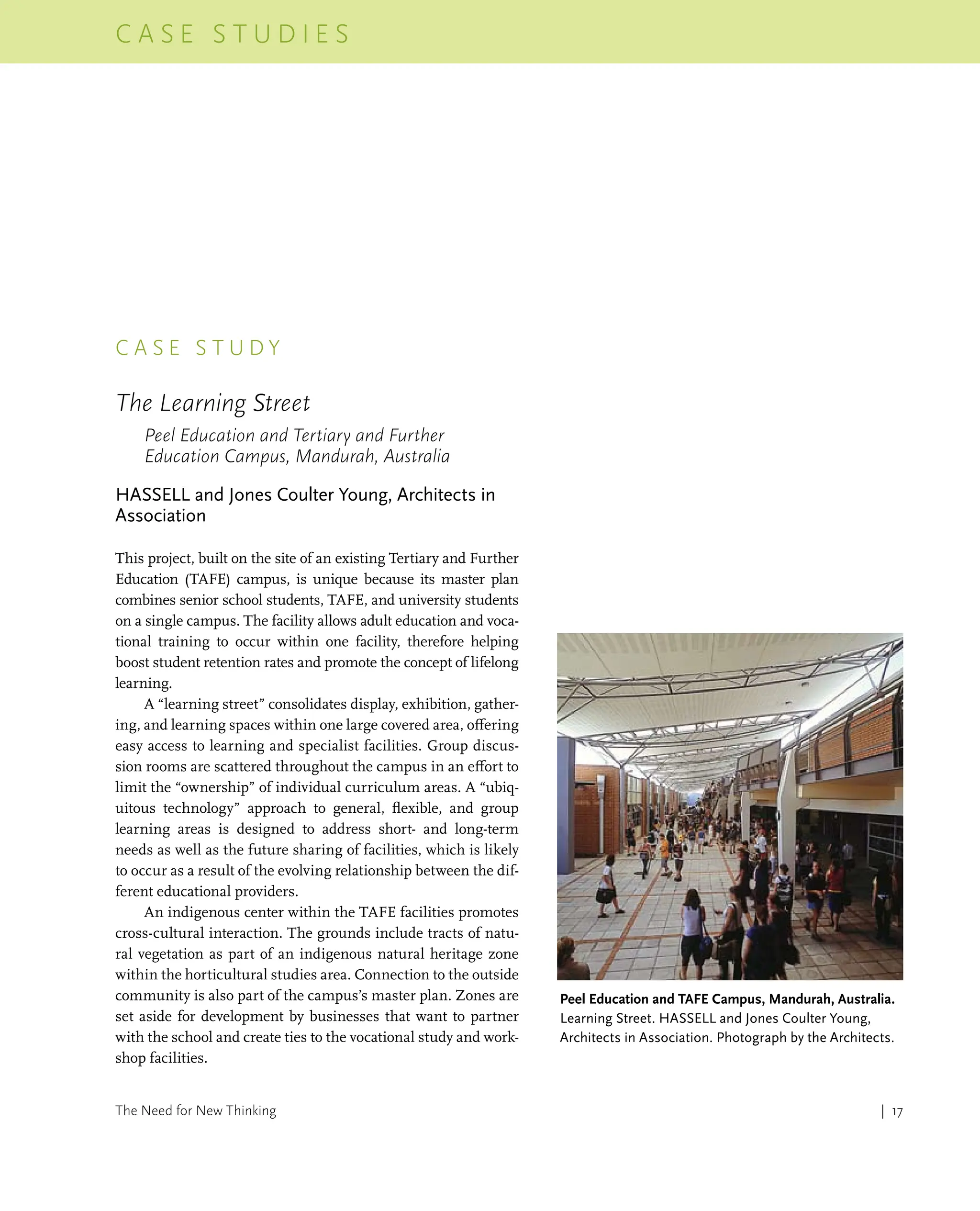
A “learning street” consolidates display, exhibition, gather-
ing, and learning spaces within one large covered area, offering
easy access to learning and specialist facilities. Group discus-
sion rooms are scattered throughout the campus in an effort to
limit the “ownership” of individual curriculum areas. A “ubiq-
uitous technology” approach to general, flexible, and group
learning areas is designed to address short- and long-term
needs as well as the future sharing of facilities, which is likely
to occur as a result of the evolving relationship between the dif-
ferent educational providers.
An indigenous center within the TAFE facilities promotes
cross-cultural interaction. The grounds include tracts of natu-
ral vegetation as part of an indigenous natural heritage zone
within the horticultural studies area. Connection to the outside
community is also part of the campus’s master plan. Zones are
set aside for development by businesses that want to partner
with the school and create ties to the vocational study and work-
shop facilities.
Peel Education and TAFE Campus, Mandurah, Australia.
Learning Street. HASSELL and Jones Coulter Young,
Architects in Association. Photograph by the Architects.
18 |
D e s i g n e r P e r s p e c t i v e
The Philosophical Framework
Harbor City International
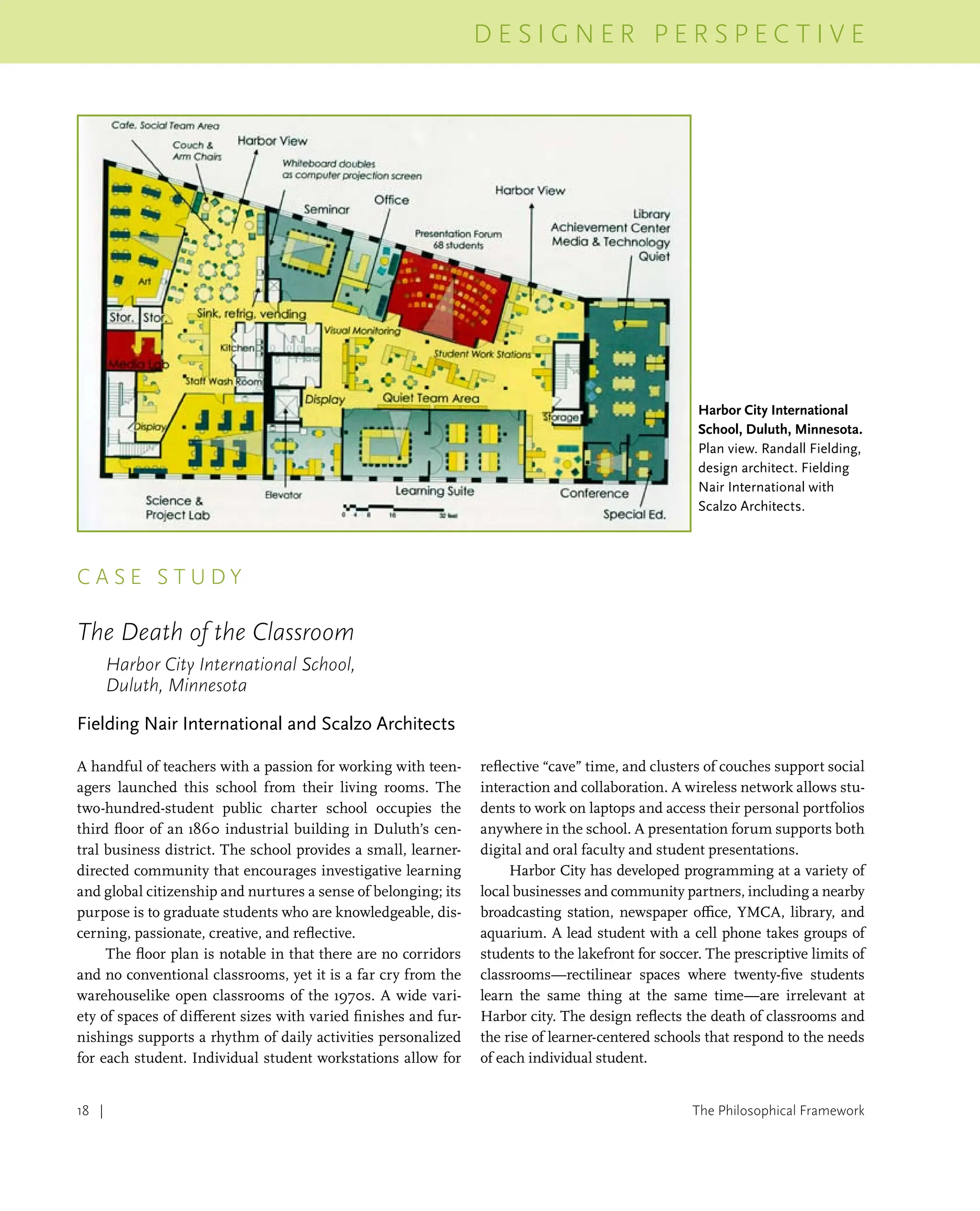
School, Duluth, Minnesota.
Plan view. Randall Fielding,
design architect. Fielding
Nair International with
Scalzo Architects.
c a s e s t u d y
The Death of the Classroom
Harbor City International School,
Duluth, Minnesota
Fielding Nair International and Scalzo Architects
A handful of teachers with a passion for working with teen-
agers launched this school from their living rooms. The
two-hundred-student public charter school occupies the
third floor of an 1860 industrial building in Duluth’s cen-
tral business district. The school provides a small, learner-
directed community that encourages investigative learning
and global citizenship and nurtures a sense of belonging; its
purpose is to graduate students who are knowledgeable, dis-
cerning, passionate, creative, and reflective.
The floor plan is notable in that there are no corridors
and no conventional classrooms, yet it is a far cry from the
warehouselike open classrooms of the 1970s. A wide vari-
ety of spaces of different sizes with varied finishes and fur-
nishings supports a rhythm of daily activities personalized
for each student. Individual student workstations allow for
reflective “cave” time, and clusters of couches support social
interaction and collaboration. A wireless network allows stu-
dents to work on laptops and access their personal portfolios
anywhere in the school. A presentation forum supports both
digital and oral faculty and student presentations.
Harbor City has developed programming at a variety of
local businesses and community partners, including a nearby
broadcasting station, newspaper office, YMCA, library, and
aquarium. A lead student with a cell phone takes groups of
students to the lakefront for soccer. The prescriptive limits of
classrooms—rectilinear spaces where twenty-five students
learn the same thing at the same time—are irrelevant at
Harbor city. The design reflects the death of classrooms and
the rise of learner-centered schools that respond to the needs
of each individual student.
| 19
C a s e s t u d i e s
The Need for New Thinking
c a s e s t u d y
Earth Connections
Kvernhuset Junior High School, Fredrikstad, Norway
Pir II Arkitektkontor AS, Architect
Nature and learning are in love at Kvernhuset Junior High. The organic, varied
furniture arrangements in the “home base” learning wings remind one of leaves
on a forest floor—orderly and random at the same time. Isn’t this how we live and
learn? Inside and out, the rocky, forested site is expressed but never dominated.
To approach the site, you cross a bridge over a pond. Three individual
learning wings/houses are cut into the natural rock on the ground floor, and
forty-ton granite blocks that were removed during excavation were later built
back into the main hall. Holes drilled directly into the rock provide geothermal
energy. Students helped remove the bark from trees harvested on the site for
use as columns in the main hall to hold up a concrete roof covered with living
green sod. The same trees are part of the facade, juxtaposed with concrete to
appear modern and primitive at the same time, like a pagan dance on a twenty-
first-century stage.
Each of the learning houses has a different color and theme, all relating
to the site: The yellow wing focuses on energy—active and passive use of solar
energy, solar cells, and monitoring of energy use. The blue wing focuses on
water, collecting water from the roof, water-saving utilities in toilets, and wash-
basins. The green wing focuses on ecological cycles, including the growth and
recycling of materials, vegetables, and plants inside and outside.
The “home base” learning areas offer a wide variety of furniture configu-
rations supported by movable walls and a flexible structure. Workbenches with
sinks and informal large and small meeting places enhanced by light filtered
through the surrounding forest permit individual, group, and project-based
learning to occur fluidly.
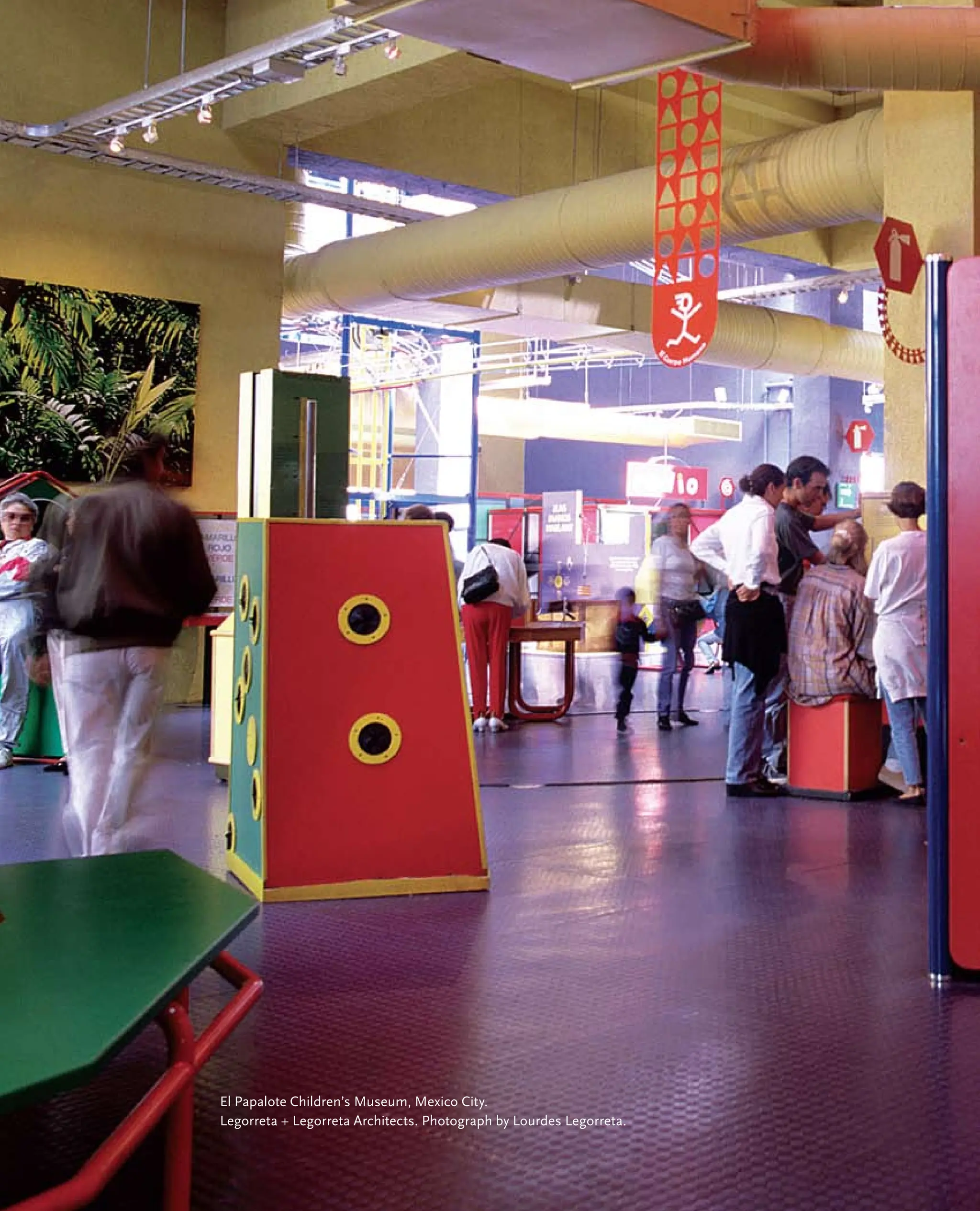
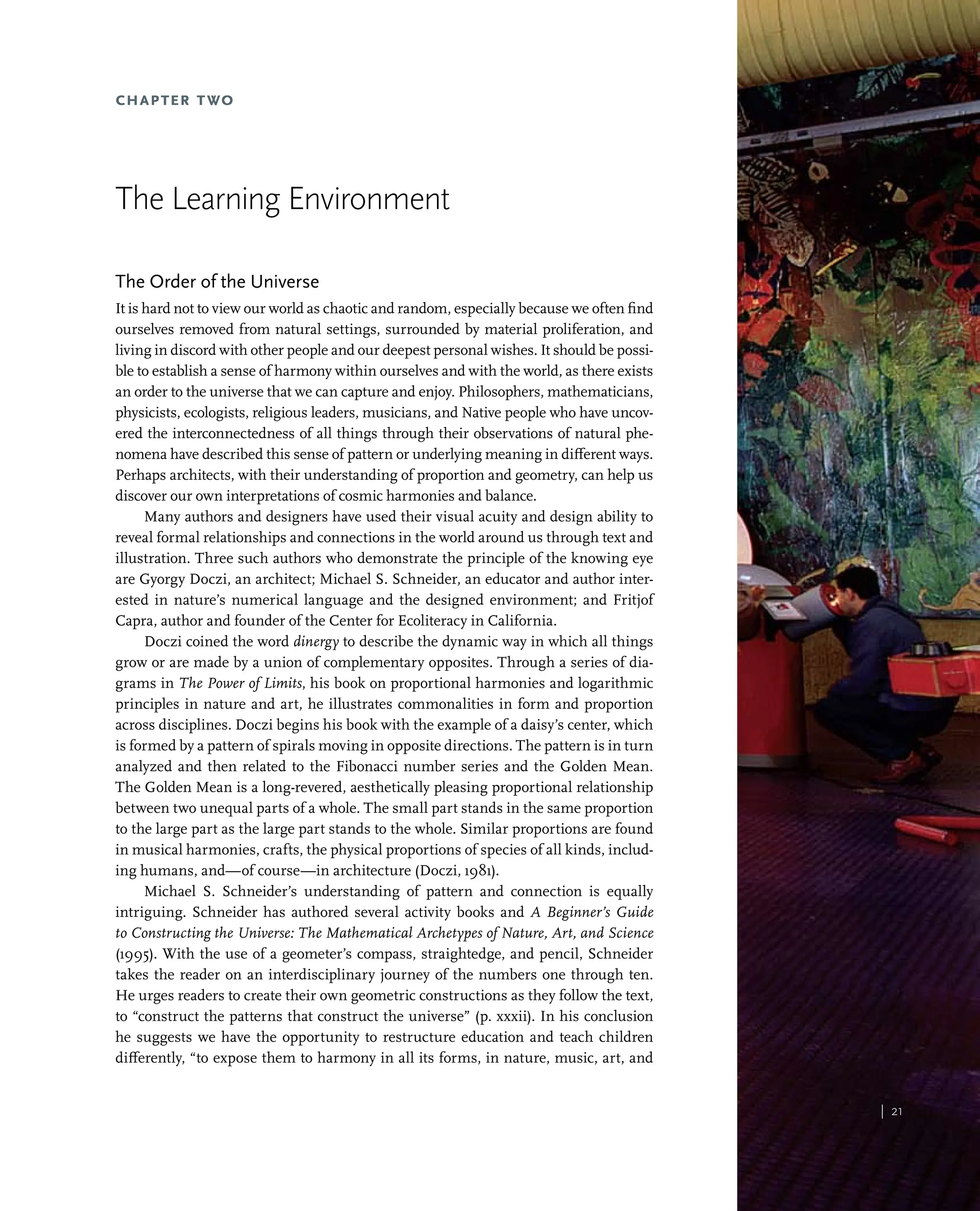
El Papalote Children’s Museum, Mexico City.
Legorreta + Legorreta Architects. Photograph by Lourdes Legorreta.
| 21
| 21
Chapter Two
The Learning Environment
The Order of the Universe
It is hard not to view our world as chaotic and random, especially because we often find
ourselves removed from natural settings, surrounded by material proliferation, and
living in discord with other people and our deepest personal wishes. It should be possi-
ble to establish a sense of harmony within ourselves and with the world, as there exists
an order to the universe that we can capture and enjoy. Philosophers, mathematicians,
physicists, ecologists, religious leaders, musicians, and Native people who have uncov-
ered the interconnectedness of all things through their observations of natural phe-
nomena have described this sense of pattern or underlying meaning in different ways.
Perhaps architects, with their understanding of proportion and geometry, can help us
discover our own interpretations of cosmic harmonies and balance.
Many authors and designers have used their visual acuity and design ability to
reveal formal relationships and connections in the world around us through text and
illustration. Three such authors who demonstrate the principle of the knowing eye
are Gyorgy Doczi, an architect; Michael S. Schneider, an educator and author inter-
ested in nature’s numerical language and the designed environment; and Fritjof
Capra, author and founder of the Center for Ecoliteracy in California.
Doczi coined the word dinergy to describe the dynamic way in which all things
grow or are made by a union of complementary opposites. Through a series of dia-
grams in The Power of Limits, his book on proportional harmonies and logarithmic
principles in nature and art, he illustrates commonalities in form and proportion
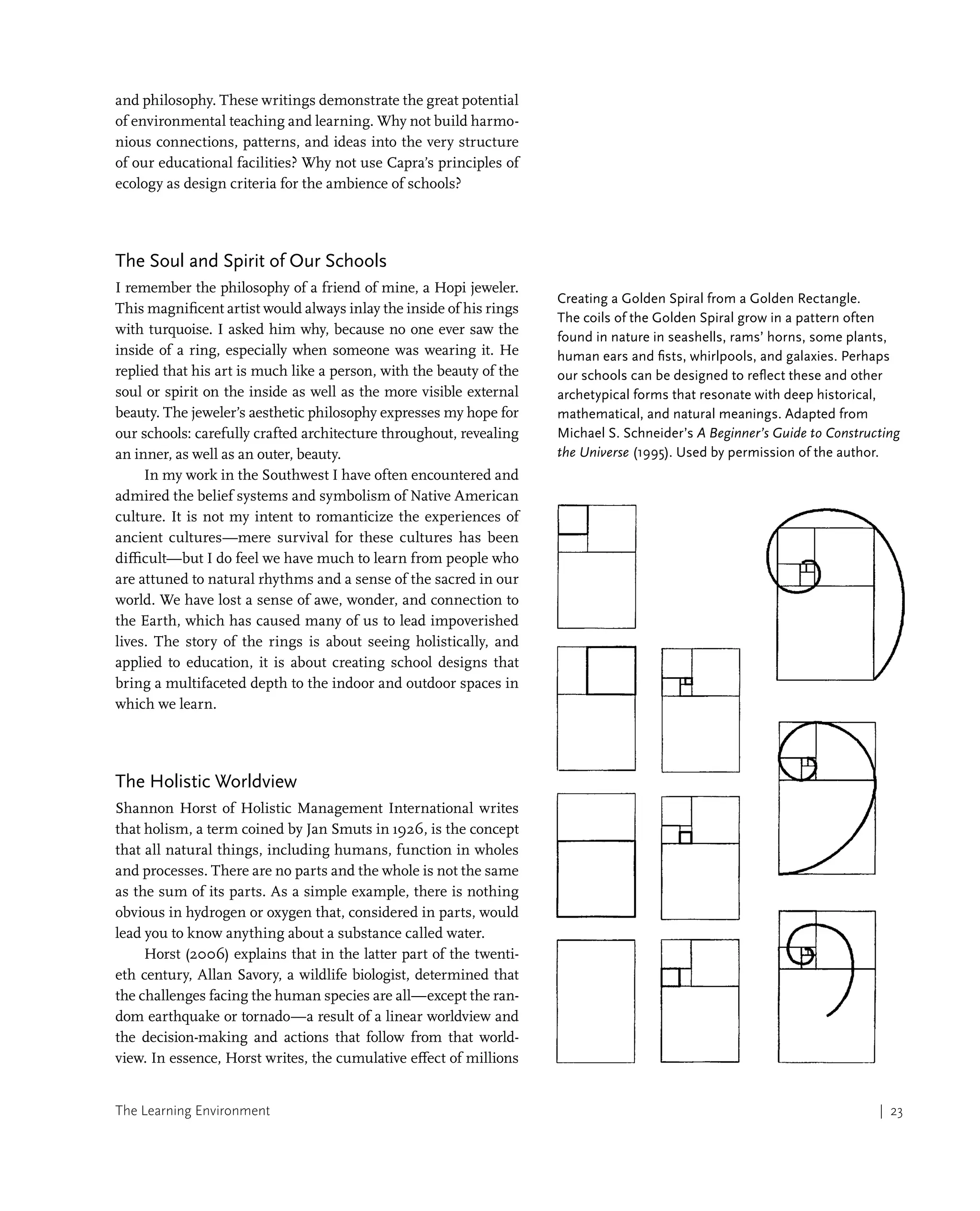
across disciplines. Doczi begins his book with the example of a daisy’s center, which
is formed by a pattern of spirals moving in opposite directions. The pattern is in turn
analyzed and then related to the Fibonacci number series and the Golden Mean.
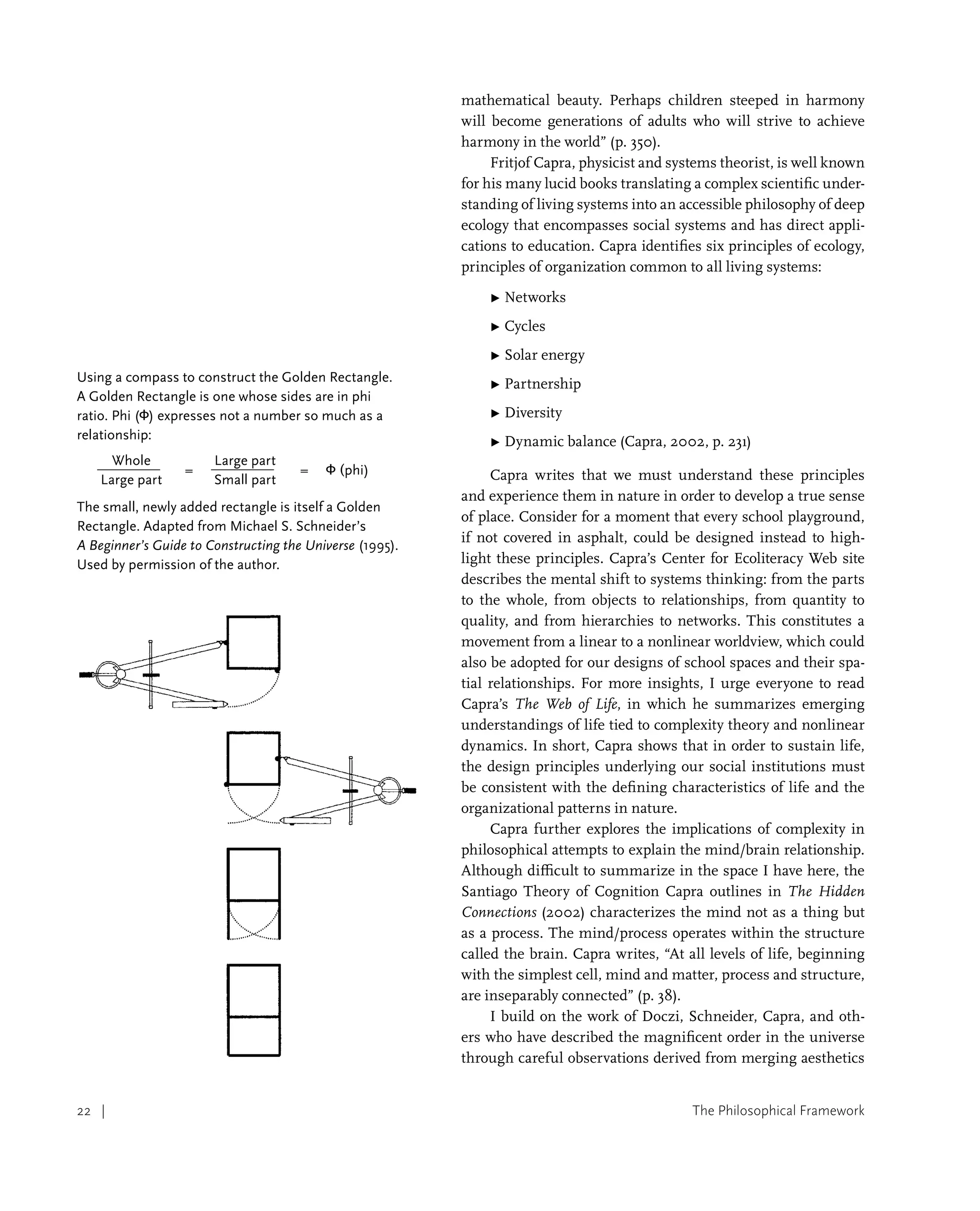
The Golden Mean is a long-revered, aesthetically pleasing proportional relationship
between two unequal parts of a whole. The small part stands in the same proportion
to the large part as the large part stands to the whole. Similar proportions are found
in musical harmonies, crafts, the physical proportions of species of all kinds, includ-
ing humans, and—of course—in architecture (Doczi, 1981).
Michael S. Schneider’s understanding of pattern and connection is equally
intriguing. Schneider has authored several activity books and A Beginner’s Guide
to Constructing the Universe: The Mathematical Archetypes of Nature, Art, and Science
(1995). With the use of a geometer’s compass, straightedge, and pencil, Schneider
takes the reader on an interdisciplinary journey of the numbers one through ten.
He urges readers to create their own geometric constructions as they follow the text,
to “construct the patterns that construct the universe” (p. xxxii). In his conclusion
he suggests we have the opportunity to restructure education and teach children
differently, “to expose them to harmony in all its forms, in nature, music, art, and
The Philosophical Framework
22 |
mathematical beauty. Perhaps children steeped in harmony
will become generations of adults who will strive to achieve
harmony in the world” (p. 350).
Fritjof Capra, physicist and systems theorist, is well known
for his many lucid books translating a complex scientific under-
standing of living systems into an accessible philosophy of deep
ecology that encompasses social systems and has direct appli-
cations to education. Capra identifies six principles of ecology,
principles of organization common to all living systems:
▶ 
Networks
▶ 
Cycles
▶ 
Solar energy
▶ 
Partnership
▶ 
Diversity
▶ 
Dynamic balance (Capra, 2002, p. 231)
Capra writes that we must understand these principles
and experience them in nature in order to develop a true sense
of place. Consider for a moment that every school playground,
if not covered in asphalt, could be designed instead to high-
light these principles. Capra’s Center for Ecoliteracy Web site
describes the mental shift to systems thinking: from the parts
to the whole, from objects to relationships, from quantity to
quality, and from hierarchies to networks. This constitutes a
movement from a linear to a nonlinear worldview, which could
also be adopted for our designs of school spaces and their spa-
tial relationships. For more insights, I urge everyone to read
Capra’s The Web of Life, in which he summarizes emerging
understandings of life tied to complexity theory and nonlinear
dynamics. In short, Capra shows that in order to sustain life,
the design principles underlying our social institutions must
be consistent with the defining characteristics of life and the
organizational patterns in nature.
Capra further explores the implications of complexity in
philosophical attempts to explain the mind/brain relationship.
Although difficult to summarize in the space I have here, the
Santiago Theory of Cognition Capra outlines in The Hidden
Connections (2002) characterizes the mind not as a thing but
as a process. The mind/process operates within the structure
called the brain. Capra writes, “At all levels of life, beginning
with the simplest cell, mind and matter, process and structure,
are inseparably connected” (p. 38).
I build on the work of Doczi, Schneider, Capra, and oth-
ers who have described the magnificent order in the universe
through careful observations derived from merging aesthetics
Using a compass to construct the Golden Rectangle.
A Golden Rectangle is one whose sides are in phi
ratio. Phi (Φ) expresses not a number so much as a
relationship:
Whole
=
Large part
= Φ (phi)
Large part		 Small part
The small, newly added rectangle is itself a Golden
Rectangle. Adapted from Michael S. Schneider’s
A Beginner’s Guide to Constructing the Universe (1995).
Used by permission of the author.
The Learning Environment | 23
and philosophy. These writings demonstrate the great potential
of environmental teaching and learning. Why not build harmo-
nious connections, patterns, and ideas into the very structure
of our educational facilities? Why not use Capra’s principles of
ecology as design criteria for the ambience of schools?
The Soul and Spirit of Our Schools
I remember the philosophy of a friend of mine, a Hopi jeweler.
This magnificent artist would always inlay the inside of his rings
with turquoise. I asked him why, because no one ever saw the
inside of a ring, especially when someone was wearing it. He
replied that his art is much like a person, with the beauty of the
soul or spirit on the inside as well as the more visible external
beauty. The jeweler’s aesthetic philosophy expresses my hope for
our schools: carefully crafted architecture throughout, revealing
an inner, as well as an outer, beauty.
In my work in the Southwest I have often encountered and
admired the belief systems and symbolism of Native American
culture. It is not my intent to romanticize the experiences of
ancient cultures—mere survival for these cultures has been
difficult—but I do feel we have much to learn from people who
are attuned to natural rhythms and a sense of the sacred in our
world. We have lost a sense of awe, wonder, and connection to
the Earth, which has caused many of us to lead impoverished
lives. The story of the rings is about seeing holistically, and
applied to education, it is about creating school designs that
bring a multifaceted depth to the indoor and outdoor spaces in
which we learn.
The Holistic Worldview
Shannon Horst of Holistic Management International writes
that holism, a term coined by Jan Smuts in 1926, is the concept
that all natural things, including humans, function in wholes
and processes. There are no parts and the whole is not the same
as the sum of its parts. As a simple example, there is nothing
obvious in hydrogen or oxygen that, considered in parts, would
lead you to know anything about a substance called water.
Horst (2006) explains that in the latter part of the twenti-
eth century, Allan Savory, a wildlife biologist, determined that
the challenges facing the human species are all—except the ran-
dom earthquake or tornado—a result of a linear worldview and
the decision-making and actions that follow from that world-
view. In essence, Horst writes, the cumulative effect of millions
Creating a Golden Spiral from a Golden Rectangle.
The coils of the Golden Spiral grow in a pattern often
found in nature in seashells, rams’ horns, some plants,
human ears and fists, whirlpools, and galaxies. Perhaps
our schools can be designed to reflect these and other
archetypical forms that resonate with deep historical,
mathematical, and natural meanings. Adapted from
Michael S. Schneider’s A Beginner’s Guide to Constructing
the Universe (1995). Used by permission of the author.
The Philosophical Framework
24 |
of decisions made without considering equally the social, financial, and biologi-
cal ramifications is the destruction of the very “earth ship” that sustains human
life. The same attitudes continue to affect how we plan and manage our educa-
tional facilities.
My own view of the environment begins with three basic principles tied
to holistic thought:
The first principle is that people are a part of, not apart from, the environ-
ment. During our brief history on Earth, human beings have struggled to con-
quer nature and dominate the globe through our inventions and technology.
We Western thinkers in particular have evolved the mistaken view that we are
apart from or superior to our environment. The attitudes expressed in this
book are in direct contrast to this dominating view of the universe. We are a
part of, not apart from, the built, natural, and cultural environment. We must
be aware of the consequences of our actions and act responsibly. Our actions
come full circle and affect each of us.
The second principle is that the order of the universe is holistic and inter-
disciplinary. Seeking to make sense of a complex world, early Western thinkers
artificially divided the principles and laws of the universe into distinct, discrete
subject matter disciplines that are usually taught independently and in isola-
tion (i.e., math, sciences, language arts, philosophy, social studies, the arts,
and physical education). However, the true content of the universe is holistic,
or, in educational terms, integrated and interdisciplinary.
The third principle is that the concept of a split in the body/mind/spirit con-
tinuum is in contrast to our natural capacities as whole learners. The human
mind naturally functions in a holistic, integrated way, which influences how
we learn. Western thought has created a false dichotomy between body and
mind that favors and elevates the intellect at the expense of emotional, prac-
tical, or creative learning in schools. Instead, we learn as whole people across
body, mind, and spirit. We learn in multiple ways through our bodily senses
and movement, through the mind’s problem solving and idea formation abili-
ties, and through our spiritual respect for cultural plurality, emotions, and self-
expression. Psychologist and educational theorist Howard Gardner’s theory of
multiple intelligences explores the many ways in which people process infor-
mation. Gardner has identified eight intelligences or competencies ranging
from verbal/linguistic to kinesthetic, musical, naturalistic, and more. (Please
see chapter 5 and stewardship forum 2 for more on learning processes.)
How can architecture support the three main principles that for me define
environment? We look for an architecture that
▶ 
Establishes a sense of belonging versus isolation from the world
▶ 
Supports an instructional delivery system that connects
disciplines in real-world, holistic contexts
▶ 
Engages the whole learner by reaching highest levels of
satisfaction in the users of schools, across levels of health
and safety (body), functionality (mind), and psychological
comfort and aesthetic satisfaction (spirit)
Linear Thinking
N
o
n
-Linear Think
i
n
g
The Learning Environment | 25
Defining the Learning Environment: A Silent Curriculum
The environment consists of one’s physical surroundings—the natural, built,
and cultural world and the objects within it. The learning environment tradi-
tionally refers to school facilities and settings within schools. Unfortunately,
the physical environment of the school has become nearly invisible to teach-
ers and families in part because it is so familiar; basic school design has not
changed in one hundred years (Brubaker, 1998). There is also that conve-
nient myth that a good teacher can teach anywhere or a willing student can
learn anywhere. We avoid dealing with problems in school facilities by mar-
veling at how adaptable humans are and by making do with poor conditions,
but as architect Gaylaird Christopher asks, why shouldn’t we design quality
environments to enhance the performance of dedicated individuals? I add to
Christopher’s question: why are we ignoring the powerful effect of the physi-
cal learning environment on teaching? The environment is indeed a “silent
curriculum” that can provide positive (or negative) learning experiences.
The key is to view the physical environment and its ambient quality as
active and indispensable parts of the learning process. This is done in part by
responding to the human experience of school facility users. The objects and
buildings we design are not merely things to own, but also represent human
ideas, actions, and beliefs. Good designs serve people well. Remember that
we human beings exist as a part of—and not apart from—the environment.
Regardless of what we are doing, we are always operating in a physical context
in space (Caine  Caine, 1991, p. 40). Our natural ability to learn is directly
linked to constant interaction with the environment. This integrated defini-
tion of learning and environment is crucial to educational facilities design. We
cannot help but interact with our environment. Thus, the quality of the envi-
ronment affects the quality of learning.
A general pattern emerges when we contrast architectural and educational
views of environment. Architects are accustomed to assessing and evaluating
physical spaces and gain considerable practice in spatial thinking. As design-
ers, architects are well versed in the world of matter, of objects and things. They
see and analyze the physical world and its relationships with the knowing eye.
They know how to accurately translate percepts and concepts into functional
objects and buildings that symbolize ideas and provide aesthetic ambiance.
Many educators, however, have little training in space planning. Educators
often refer to “environment” in abstract, behavioral, psychological, or conno-
tative terms while neglecting the implications of the physical condition of the
space, which may be cluttered or overcrowded. The prevalent focus in teacher
professional development is on how to establish and manage the emotional qual-
ity or mood of a place, rather than the actual physical form a space takes. Teacher
textbooks provide advice on how to set an orderly tone through classroom man-
agement techniques, or they define strategies that create an atmosphere con-
ducive to learning, a supportive atmosphere that encourages risk-taking, for
example. Training implies to teachers that their management skills can over-
come deficiencies in the physical learning environment. It also places teachers
at the center of learning as managers and directors, rather than empowering
Apart From
A Part Of
ENVIRONMENT
The Philosophical Framework
26 |
students to interact with the physical environment to create their
own meanings.
Educators and architects often operate as if in a vacuum,
thereby failing to ensure that both the physical place and the
interpretation of that place contribute to the creation of a com-
plete learning environment. This is mirrored in many of the
visual images I have collected over the years. I have beautiful
photographs of children deeply engaged in project-based work,
but often working in drab settings that are an impediment to
their activities. I also have photographs gathered from archi-
tects of beautiful facilities devoid of children. It is my intent to
somehow merge these images into a new aesthetic for schools.
There is a relationship between the individual learner and the
physical environment that cannot be ignored when we think
about how to design high-quality learning environments.
In his classic book on urban design, The Image of the City,
Kevin Lynch states that forming mental maps or images is the
“strategic link” between the individual and his or her exterior
environment. Although he is talking about cities, many of his
observations apply naturally to schools and the learning process:
Environmental images are the result of a two-way
process between the observer and his environment. The
environment suggests distinctions and relations, and
the observer—with great adaptability and in the light of
his own purposes—selects, organizes, and endows with
meaning what he sees. The image so developed now
limits and emphasizes what is seen, while the image
itself is being tested against the filtered perceptual input
in a constant interacting process (Lynch, 1993, p. 6).
For Lynch, the key to his urban study is the “imageability”
or “legibility” of the built environment—a physical clarity that
inspires clear and useful images or representations in the viewer
(p. 9). A muddled setting creates a weak or confused image.
Lynch’s description of the constant interaction of the indi-
vidual with his or her environment is strikingly similar to
descriptions of learning in cognitive neuroscience, and how
learning actually alters the structure of the brain, the engine of
the mind. In The Growth of the Mind (1997), Stanley Greenspan
laments the long-held dichotomy of reason and emotion in our
educational system. He states that new research into infant
development, neuroscience, and clinical work reveals links
between affects and intellect, and that early experiences influ-
ence the structure of the brain itself (p. 7). “In general, dur-
ing the formative years there is a sensitive interaction between
genetic proclivities and environmental experience. Experience
Cluttered Classroom. Although we may be accustomed to
the visual cacophony of the typical American classroom
(alternately known as the supermarket effect), such
images can be confusing to young learners. Embedded
figure and figure ground discrimination are visual
perceptual skills essential to learning how to read. The
careful use of negative space to offset positive forms can
bring clarity and focus to the learning space. Photograph
courtesy of Anne Taylor.
The Learning Environment | 27
appears to adapt the infant’s biology to his or her environment”
(p. 8). How does it affect the development of a child’s mind to
spend years in dull, impersonal, poorly designed environments
that support passive learning?
In Making Connections: Teaching and the Human Brain,
Caine and Caine (1991) suggest that school reform be extrapo-
lated from a growing scientific understanding of how the brain/
mind works. The authors offer a metaphor of the brain as a city,
a complex and busy place with its many physical structures,
simultaneous functions, interconnections, and dependencies
(p. 26). Learning does not occur in a vacuum or by rote memo-
rization, but through a process of immersion in complex, rich
environments (p. 5). Caine and Caine report that brain-based
education involves orchestrated immersion, relaxed alertness,
and active processing.
According to Caine and Caine, orchestrated immersion
means providing rich opportunities for students to make con-
nections between new material and what is already known. It is
characterized by instructional methods such as theme teach-
ing, reality-based project learning, multisensory learning, sto-
rytelling, teamwork, and using the physical and perceptual
context as “packaging” for learning (pp. 107–15).
Relaxed alertness is the desired mental state for learning.
Because children absorb the entire context when learning, if
the atmosphere is intimidating, the brain/mind of the learner
may downshift or basically shut down. The ideal learning state
combines a sense of safety with student self-motivation and
high challenge (pp. 126–33).
The third component identified by Caine and Caine is
active processing, or the work of learning. Some methods of
active processing are reflection, analysis, contemplation, ques-
tioning, using personal analogies, and performance assess-
ment techniques (pp. 146–57).
Caine and Caine and other authors mentioned here pro-
vide a valuable description of the qualities of the optimal mental
state and ideal academic situation for learning. Administrators
and other educators may wish to refer to these same authors, or
they may research, compile, and articulate their own approaches
to education, which can then be translated into architectural
forms during the process of planning educational facilities.
In terms of architecture, how might we characterize qual-
ities of legibility, the importance of the thinking and feeling
individual interacting within a rich environment, and the func-
tioning of the brain/mind? How can our environments reflect
the order in the universe? How can we build these concepts
into the very structure of our schools?
Top: In contrast to the cluttered classroom, endless
double-loaded corridors are often barren, dim, and
prisonlike. Photograph courtesy of Anne Taylor.
Bottom: Curators link architecture and kinesthetic
learning in Japan through clear, well-designed signage.
Children learn how to experience firsthand the forces
at work in a truss structure. Image courtesy of the
Architecture and Children Network in Japan.
The Philosophical Framework
28 |
Children’s Museums as Models
for Learning Environments
Educational theorist Howard Gardner has suggested that a
good design model to keep in mind for the learning environ-
ment of the future is the children’s museum, where teach-
ing and learning are based on the ideas of apprenticeship and
learning by doing. In a children’s museum children are encour-
aged to touch and explore interesting objects in a carefully
arranged setting scaled to young people. It is a highly legible
place that embodies the attributes provided by Caine and Caine
and celebrates childhood developmental rights as advocated by
Greenspan. Effective museums are no longer storehouses of
artifacts in display cases, but rather places where active partici-
pation abounds.
The legibility of museum-quality display, with negative
space around signage, increases clarity and supports perceptual
skills essential for learning how to read. Professional-quality
display offers an alternative to the visual cacophony so preva-
lent in classrooms today—the “visual bombardment of images”
Patricia Tarr (2001) described in her article about the aesthetics
of the typical North American early childhood environment.
Tarr accurately observes that the stereotypical and cartoonlike
art, greeting card and crafts shop aesthetics, as well as skewed
display and profusion of color talk down to young children.
Teens also benefit from legible, authentic learning envi-
ronments that encourage autonomy and offer choice. In many
hands-on museums such as Albuquerque’s ¡explora!, which
is featured later in this book, an open questioning strategy in
museum signage and by docents facilitates learning without
dictating answers.
Perhaps museum exhibit curators and designers could
offer their expertise as part of teacher professional development
or as part of the architectural programming workshop process.
Every school should have a museum for realia (objects used
to relate learning to real life) based on curricular themes and
design related to science, math, local industry, arts, and cul-
ture. Older children can learn curatorial skills by designing set-
tings with adequate display and storage. In any case, the larger
goal is to encourage the development of learning environments
with an overall aesthetic that respects and empowers children,
is based on the real world, and reinforces the concept of hands-
on problem solving.
The Learning Environment | 29
El Papalote Children’s Museum, Mexico City. Top: Interior.
Open floor space and interactive displays enable self-selection
and can be translated to school environments. Photograph
by Lourdes Legorreta. Center: Toddler area. Playful climbing
structures, portholes, and mirrored environments support
early learning. Photograph by Luis Mendez, courtesy of AD
Mexico. Bottom: External learning spaces. Multisensory
environments extend to the outdoor learning environment,
which is also an effective tool for school design. The playful
exterior makes use of traditional Mexican glazed tiles, basic
geometric forms, stone, and water. Photograph by Lourdes
Legorreta. All designs by Legorreta + Legorreta Architects.
Anchorage Museum of History and Art. Top: Phantasmagoria
Structure Gallery. Different capitals show the classical
architectural orders, and signage is incorporated into the
exhibit at the child’s scale. Tensile structures in the foreground
are operable by children. Suspended Nerf balls give the
spatial feel of basic architectural spaces, such as domed
interiors, and teach geometry concepts. A point becomes a
line, a line becomes a shape, and a shape becomes a three-
dimensional architectural form. Bottom: Exhibit entry. A
vaulted hallway teaches architectural elements while acting
as a children’s art gallery in a major museum setting. You can
teach anything to anybody if you bring it to the appropriate
level of understanding. Anne Taylor, curator. George Vlastos,
architect. Assistance from the Anchorage, Alaska, AIA chapter.
Photographs © Paul Warchol.
Another Random Document on
Scribd Without Any Related Topics
THE QUIVER.
THE EMPEROR'S VISIT TO THE HOLY LAND.
By Our Special Commissioner at Berlin.
Illustrated from Photographs.
Few projects of Church extension have attracted so much
attention as the forthcoming opening of the Lutheran
church in Jerusalem: a movement which has been
zealously pushed forward by his Imperial Majesty the
Kaiser of Germany and King of Prussia, and will be
happily consummated by an imposing ceremony, at
which his Majesty and his illustrious consort will be the
central figures, just about the time that this number reaches its
thousands of subscribers. So important is the movement, and with
such close attention has it been watched by the religious bodies of
England, that a special representative was sent to Berlin, who was
fortunate enough to be received by some most distinguished
Personages and kindly furnished with many details of the scheme,
and all the information that it was possible to give—so much in
advance as the exigencies of a monthly periodical demand.
A VIEW OF VENICE.
(The Imperial Party's Place of Embarcation.)
It will be as well to first speak of the requirements for a new
Lutheran church in Jerusalem. For a great many years there has
been a considerable German colony in the city, its members steadily
augmenting year by year. In the time of Frederick William IV. of
Prussia a joint Protestant bishopric (German and English) was
established, the right of appointment to lie with each country
alternately. The first Bishop was a converted German Jew holding
orders in the English Church; two others succeeded him, and then in
1886 Prussia withdrew from the agreement.
THE LATEST PORTRAIT-GROUP OF
THE GERMAN ROYAL FAMILY.
(Photo: J. Baruch, Berlin.)
Nearly twenty years previous to this latter date the Sultan had
presented to King William I. a disused building, which formerly was
the property of the Knights of St. John, in order that a Protestant
Lutheran church might be erected on the site. For some reason, the
work was delayed for a considerable period, and the members of the
German Evangelical Church have been worshipping in a small
temporary chapel, by the side of which the handsome new church
has been reared. The work has been carried on by a pastor and an
assistant teacher, and there has also been a good school in
conjunction with it. The foundation stone of the church was laid on
October 31st, 1893, and it was thought the consecration would take
place in 1897; but things were not in readiness, and so the event
was fixed for October 31st of this year—the anniversary of the birth
of the Evangelical Church, being the day on which Luther nailed his
thesis to the church door in Wittenberg.
The Kaiser and Kaiserin have long cherished a wish to visit the Holy
City and tread the land which Christ trod when on earth; and no
better opportunity could possibly occur than when a new Lutheran
church was about to be consecrated. Both their Majesties have done
much—not only by rightly using the immense influence which they
possess, but also financially—to further Church work; and, apart
from any other cause, the opening of this sacred building for the use
of their countrymen in a foreign land could not fail to enlist their
sympathetic interest. The undertaking is a pious and domestic, and
not a political, one, spite of several assertions to the contrary; and
all who have the cause of true religion at heart cannot but rejoice
that there will be another pulpit from which the risen Saviour will be
proclaimed to the residents of God's chosen land.
Their Imperial Majesties will leave Berlin by special train for Venice,
where a brief rest will be taken previous to the embarkation on the
royal yacht Hohenzollern. The dignitaries of the Lutheran Church and
invited personages will travel in another direction. Leaving Berlin by
train, they embark on the Midnight Sun (an English vessel flying the
English flag) at Trieste; thence they will proceed to Alexandria.
Having explored that city, they will visit Cairo, and thence, returning
to Alexandria, they will go on to Jaffa, and so through Palestine to
Jerusalem, where they arrive about midday on October 25th. The
next few days will be spent in viewing the city and neighbourhood,
and on the 31st the entire party will be present at the formal
opening of the Erlöser-Kirche in the presence of the Kaiser and
Kaiserin.
JAFFA (JOPPA) AT THE PRESENT DAY.
But I wish more particularly to draw your attention to the route
taken by their Majesties, as this was particularly pointed out to me in
Berlin. Venice—the principal port on the Adriatic—will naturally claim
some share of the interest of the Imperial couple, and the Palace of
the Doges, dating from the fourteenth century, with its many
historical and awful associations; the famous cathedral of St. Mark—
a venerable building of the eleventh century, rich in cupolas and
mosaics, and marble columns to the number of five hundred—as
well as other renowned places, will be visited.
At Venice their Majesties will go on board for a voyage of four days
down the Adriatic, and up in a northerly direction through the
Dardanelles and Sea of Marmora, direct to Constantinople and the
Golden Horn. Here the Sultan has made great preparations for their
reception. Special buildings are being erected, old roads widened,
and new roads made; moreover, all streets to be traversed by the
Imperial party are being properly paved—not before it was requisite
—thousands of gas-jets are being added to the meagre number
which have hitherto done duty, and the Yildiz Palace has been
completely overhauled and refitted. In short, Abdul Hamid is
incurring tremendous expense in order to entertain his distinguished
visitors right regally. The sojourn will extend over several days, and
many places will be visited, including the royal palaces—which
abound in Constantinople—the mosques, tombs, towers, and
bazaars; and as their Majesties will be in the city on a Friday, the
Selamlik, or Sultan's procession to the mosque, will be included in
the programme.
On leaving Constantinople, the Imperial yacht will steam round Asia
Minor to the Syrian coast, passing many attractive places, amongst
which may be mentioned the Plains of Troy and the Isle of Patmos. A
run of about three days will bring them to Kaiffa, more generally
known as Haifa. Here the Kaiser and Kaiserin will land about midday
on October 25th, at the special new landing-stage which has lately
been erected for the purpose. The first stone of this was laid amidst
much ceremony by the Mutessarif of Acre, in the presence of the
entire Consular body, the troops, and all the local notabilities. The
ceremony was, of course, a Mohammedan one, a sheep being
sacrificed upon the stone, and the blessing of Allah invoked upon the
coming Imperial guests.
A VIEW OF MODERN JERUSALEM.
Once landed at Haifa, thenceforth the Imperial expedition will be
entirely under the guidance of Messrs. Thomas Cook and Son, the
well-known tourist agents, Mr. Cook himself personally conducting
the party to Jerusalem. The Sultan had previously offered tents,
horses and carriages for the journey, but these the Emperor at first
declined, as he was anxious to avoid giving any political significance
to an expedition undertaken solely on religious grounds, and for the
purpose of the formal opening of the Church of St. Saviour or the
Redeemer. At the earnest solicitation of the Sultan, he, however,
finally consented to use horses, mules, carriages, and wagons
provided by the Turkish monarch. The journey will be performed in
true Oriental style, everything else necessary being furnished by
Thomas Cook and Son.
HAIFA, AND THE BAY OF ACRE.
(The Landing-Place of the Imperial Party.)
The Kaiser will make the journey on horseback, the Kaiserin in an
open carriage. The route is to be exactly the same as that followed
by ordinary tourists, and the entire party will camp out at night in
the usual way. The first day's journey will occupy nine or ten hours,
and tents will be pitched for the night outside Cæsarea, in full view
of the Mediterranean. Thence the party will ride to Jaffa, a journey
of ten hours. The town is beautifully situated, and extensively
planted with orange groves. There is a good carriage road from it
direct to Jerusalem, and a railway, which was opened some six years
since. The Imperial party will spend the night under canvas outside
the city, the view of which has an added interest, inasmuch as there
is within its walls a considerable German colony. The remainder of
the journey to Jerusalem will be carried out in the same manner
over ground that is scripturally historical and highly picturesque,
passing as it does over the Plains of Sharon, by Lydda and Emmaus
—where Christ walked with His disciples after the Resurrection—and
so on through the Valley of Ajalon, by Kirjath and Jesrun; arriving at
Jerusalem on Saturday, October 29th, where tents will be pitched on
ground acquired by the Evangelical Jerusalem Fund.
THE JAFFA GATE AT JERUSALEM.
(From here the Emperor and Empress go on
foot to the Holy Sepulchre.)
The actual entrance of the procession into the city will be imposing,
but, once within the Jaffa Gate, the Kaiser and Kaiserin purpose
going on foot to the Holy Sepulchre, with an entire absence of any
State surroundings. The route from the gate to the Sepulchre has
been entirely renovated for their Majesties by the Sultan. Needless
to say, this block of buildings containing the Chapel of the Sepulchre
is surrounded by much that is legendary, and has been the scene of
many and fierce contentions. Now it is under the protection of the
Sultan, and Moslem soldiers guard it, and are stationed within the
vestibule to keep order amongst the various Christian pilgrims who
visit it. Various chapels credited to various nations are within its
portals, the Church of the Sepulchre being, of course, the chief place
of interest.
The rotunda of the sepulchre is the principal part of the building. In
the centre of the adjoining vestibule, or Angel's Chapel, lies the
stone which is said to be that which the angel rolled away from the
mouth of the sepulchre; then by passing through a lower door you
enter the Chapel of the Sepulchre; it is very small, only holding three
or four persons at one time. Very much controversy has taken place
regarding the correctness of the site of the Holy Sepulchre. It must
of necessity be an uncertain matter, as the course of the city wall
has not been clearly ascertained, and it seems an undoubted fact
that in the fourth century the actual site of the tomb was completely
lost sight of. Pilgrims who visited Jerusalem at that period centred
their entire interest on the place of the Ascension of the Lord,
worshipping and revering the living, and not the dead, Christ.
It is perhaps hardly necessary here to point out the difference
between ancient and modern Jerusalem. Many of the old landmarks
are still in existence, some of which I shall have occasion to mention
later. There is a large German colony now resident there, and during
his Majesty's visit he will receive representatives of this colony at the
German Consulate.
CHURCH OF THE HOLY SEPULCHRE.
Sunday will be a memorable day for the expedition, the first event
being the attendance at morning service in the Church of the
Nativity at Bethlehem, to be followed by the opening of an
orphanage for Armenian children.
In the afternoon certain sacred places on the Mount of Olives will be
visited. The entire Mount is replete with interest, for there is no
other place which was frequented so much by Christ when on earth.
It is a significant fact that, so far as can be ascertained from the
Scriptures, Jesus never spent one night within the precincts of
Jerusalem, but was wont to spend them on the Mount of Olives.
The Brook Kedron and the valley of Jehoshaphat are each near, and
are amongst the places to be visited by the Kaiser and the Kaiserin
on that special Sunday. But as interesting as any event of the day
will be an open-air service to be held on the Mount, attended by
their Majesties, the whole of the personages forming the expedition,
and the German settlement in Jerusalem. The bands of the royal
yacht and the escorting squadron, which will have journeyed up
from Haifa for the purpose, will perform the musical part of the
service.
DR. BARKHAUSEN OF
BERLIN.
(Organiser of the Tour.)
(Photo: Johannes
Hülsen, Berlin.)
The next day—Monday, the 31st—the consecration of the Church of
the Redeemer in the Mâristân will take place; the ceremony will be
somewhat imposing, as a large number of clergy and distinguished
personages will be taking part in it. The list of representatives who
will be present reads as follows:—The members of the Evangelical
Church Council specially formed for the Jerusalem expedition; the
representatives of the German Evangelical Ecclesiastical
Governments; the invited Foreign Church Corporations; the Knights
of the Order of St. John; the invited representatives of the
missionary societies who are working in Palestine and Syria; the
Gustave Adolf Society; the whole of the Evangelical Church in
Jerusalem; their Imperial Majesties and suite. I may say that
everyone present who has gone out from Germany will wear a
decoration that has been specially designed, known as the Jerusalem
cross; these, in fact, will be worn the whole route of the journey.
The military element will be in the minority, consisting only of about
sixteen men, eight of them belonging to the Imperial Body
Gendarmerie, and eight to the Kaiserin's bodyguard; these, however,
will not travel up with the Imperial party, having gone out from
Berlin some little time beforehand to accustom themselves to the
habits of the country.
THE NEW LUTHERAN CHURCH, JERUSALEM.
Immediately subsequent to the ceremony at the church the Kaiser
and Kaiserin will start for a two or three days' visit to places of
interest around Jerusalem, commencing by riding to Jericho, which
will take about six hours. The Imperial party will halt there for the
night, camping at the foot of Jebel Harantel.
On the succeeding day visits will be paid to the Dead Sea and the
Jordan, the latter one of the most wonderful rivers of the world, with
a history running through the entire Bible. Various other places of
much interest will be seen, and then their Majesties return to
Jerusalem, going back to the coast by train, and taking ship again at
Jaffa for Haifa.
From here they will visit Nazareth—which is memorable as the home
of Jesus. It is still a flourishing place, partly built on rocky ridges.
There is a Latin chapel which is supposed to be built over the
workshop of Joseph; also a small chapel known as the Table of
Christ, which is merely a vaulted chamber containing the table at
which the Saviour and His disciples sat. Tiberias and the Sea of
Galilee will be visited. Bethsaida, the birthplace of some of Christ's
disciples, and other small places in the vicinity, will each come in for
a share of attention.
A PRESENT-DAY VIEW ON THE JORDAN.
Proceeding northward, the expedition will view other places, but
none, perhaps, so beautiful as one at which they will make a brief
stay—Damascus, the oldest city in the world. It is situated on the
western side of the great plain, at an elevation of two thousand two
hundred and sixty feet above the level of the sea, and is beautiful
beyond all description. On an elevated part of the Anti-Libanus,
which rises to a height of nearly four thousand feet, there is erected
a dome of victory, from which the best view of the city and the
seven rivers can be obtained, as also of the white-streaked
mountains, the chocolate plain, and the rich and varied colours of
the foliage of the trees. Within the city stands a citadel and a palace.
Damascus has seventy mosques, and about one hundred and fifty
other places of worship in addition; and each of the principal
religious communities occupy different parts of the city. In the same
way different industries are carried on, each in their own quarters
exclusively, having their own bazaars for the sale of goods. The
place is highly prosperous, and its appearance is, as I have said,
extremely beautiful. Thence the Kaiser and Kaiserin will journey on
to Egypt, seeing Alexandria, Cairo, and going up the Nile; but here
space forbids us following them.
It is a visit which cannot fail to impress all; the Kaiser himself to no
ordinary extent, considering his remarkable power of grasping the
religious and romantic elements of ancient history and its famous
scenes. What he will see will stir his heart to no ordinary degree,
sensitive as is his mind to all such impressions. It must also sensibly
appeal to the cultured members of every religious community, and
all will watch this Imperial pilgrimage with unusual interest, and wish
for it a happy and prosperous finale.
I cannot close this without tendering my respectful thanks for the
gracious kindness accorded me in Berlin, and for the valuable
assistance rendered me by Dr. Barkhausen, the President of the
Evangelical Church Council for the Jerusalem Expedition, this
gentleman being chiefly responsible for the entire arrangements.
PLEDGED
By Katharine Tynan, Author of A Daughter of Erin, Etc.
CHAPTER I.
FATHER AND DAUGHTER.
Mr. Graydon and his daughter Pamela were jogging
leisurely home from the little market town of Lettergort.
There was no reason to hurry, and if there had been,
Frisky, the little fat pony, whose frisky days were long
over, would not have been aware of it.
It was very hot, a morning of late summer; but Pamela's creamy
cheeks were as cool as the firm petals of a lily. She bore as if
accustomed to it the jog-trot of the pony and the frequent ruts into
which their chariot bumped, flinging her from the seat as though she
were the football in a hotly contested game.
Mr. Graydon kept up a contented whistling when he was not
commenting on the fields and the cattle as they passed. That had
been a long, hot summer, and for once in a century people had
begun to long for the patter of rain on the leaves.
Woa, Frisky—woa, little lad! That's a nice colt of Whelan's down
there by the sally-tree. Do you see, Pam? Now, I hope the poor
fellow will get a handful of money for it. He'll need it this summer,
Mr. Graydon would say.
Or, again, it would be a farmer going their own way from Lettergort.
Good-morning, John.
Good-morning, your honour. How did the calves do wid your
honour?
I'm not complaining, John. Murray of Slievenahoola gave me thirty
shillings apiece for them. It was as much as I hoped for.
Aye, they wor but weanlin's. An' 'tis no use keepin' stock this
summer.
How did you do with the heifers, John?
Didn't get the price of their feed, your honour. Wirra! 'tis a
desperate summer. The hay wasn't worth cuttin', and the oats is
pitiful.
Again, it would be a labourer with a scythe on his shoulder whom
Mr. Graydon would stop to ask after his household concerns.
Everywhere they passed a smile followed Mr. Graydon's broad back
in its faded homespuns.
'Tis a rale pleasant word he has in his mouth, God bless him! an'
him a rale gentleman an' all, followed him from many a cottage-
door.
You've done your marketing, Pam, said her father, turning to her.
I'd plenty of time, dad, while you chatted to your million
acquaintances.
And sold my calves, Pam.
You might have sold a thousand in the time.
Well, well, Pam, it is my little world, you see. I hope the perishable
things won't be broken when we come to the rut by Murphy's gate.
'Tis a foot and a half deep at least. Johnny Maher ought really to
mend this road.
You ought to make him, dad. What's the good of being a
magistrate?
What indeed, Pam! Sure, I never get a job done for myself. There's
old Inverbarry now, and he a lord, and he's getting the private road
through his park mended at the public expense. And he as rich as
Crœsus, the old sinner!
Mr. Graydon rubbed his hands with benevolent amusement. His
daughter glanced at him with a pucker between her white brows.
The violet-blue eyes under curling black lashes exactly reproduced
her father's, though at this moment the expressions were widely
different.
You're too easy-going, dad. You should make Johnny Maher mend
the road.
Mr. Graydon dropped a rein to pull one of his daughter's silky black
curls.
You wouldn't be having me too hard on the poor fellow, and he with
a sick wife and an old mother and a pack of children. Eh, little Pam?
Pamela shook her head severely, and the red mouth, which had
drooped at the corners when she was serious, parted over white
teeth in a laugh fresh as a child's.
How did the calves do wid your honour?
You've no conscience, dad, any more than Lord Inverbarry or
Johnny Maher. You're conniving at their wrongdoing, you see.
Maybe I am, Pam—maybe I am. Only I don't suppose it seems
wrongdoing to them—at least, not to Johnny Maher, poor fellow.
Inverbarry ought to know better.
They jogged along for a few minutes till there was another jolt.
Simultaneously there was a crash at their feet, and Mr. Graydon
pulled up with an exclamation.
There goes some of your crockery, Pam. I hope it's not the lad's
looking-glass.
Never mind, said Pam, with a sigh of despair. Perhaps now you'll
get Johnny Maher to see to the road. If it's his looking-glass, he'll
have to shave as Mick St. Leger used, with the lid of a can for his
looking-glass.
Ah, poor Mick was used to our ways. He didn't mind. But this is a
public-school man. We'll have to furbish up for him, little Pam, and
put our best foot foremost, eh?
It looks like it, said Pam, gazing down at the jumbled parcels at
her feet. I'll tell you what it is, she said: it's the glass for his
bedroom window. It is all in smithereens. He'll have to put up with
the brown-paper panes, as Mick St. Leger did.
Never mind, never mind. The lad's a gentleman, and he'll see we're
gentlefolk, though we're as poor as church mice. He won't mind,
you'll see, Pam; gentlemen never do mind these things.
You're thinking of Mick still, dad. You forget that Gwynne man who
wouldn't stay because he got nothing but potatoes for three days. As
if we could help the roads being frozen and Frisky not being able to
get to Lettergort! Do you remember Gwynne's face over the potato-
cake the third day? Yet I'm sure Bridget had done her best. What
with potatoes in their jackets, and mashed, and with butter, and
without, and in a salad, and at last in a cake, I'm sure there was no
sameness about the diet.
Gwynne was a—well, of course, he was a gentleman, but as
disagreeable as a gentleman can be. Besides, Pam, potatoes
probably didn't agree with him; they don't with everyone, you know,
and Gwynne was dyspeptic. I don't know what the lads are coming
to. In my young days we didn't even know the word dyspepsia,
much less the thing.
Gwynne was hateful, said Pamela. He expected us to kill the
chickens for him when every single chicken was a pet, and so tame,
dear things! that they would walk into the drawing-room and perch
on your knee.
Perhaps that's why Gwynne wanted them killed, said Mr. Graydon.
Nasty thing! said Pamela. I was glad when we saw his back. He
couldn't bear the dear dogs lying on his bed either, though Mary told
him it was a proof of their friendliness towards him. He fired his
bootjack after Mark Antony, you remember, and though it's not easy
to stir up Mark Antony, yet I'm glad he had the spirit to go for
Gwynne's legs.
Mark Antony had been burying bones under Gwynne's pillow, my
dear.
Only because it was a wet day, and he never liked to go out in the
rain. I daresay if he'd had time he'd have removed the bones to the
garden. However, I don't suppose this youth will be like Gwynne.
What do you think, dad?
His father was the best fellow ever stepped on shoe-leather. If the
lad is like him, we shan't complain. What a handsome, dashing
fellow he was! I can see him now in his scarlet and gold lace that
night at Lady Westbury's ball, where I first met——
He broke off suddenly with a little sigh. That was another world,
Pam.
A world well lost—was it not?—dad.
Aye, a world well lost, little girl.
It was plain to see that a tender intimacy existed between this father
and daughter.
I daresay he'll find my ways rather old-fashioned, Pam. It was an
odd thing that his father should have remembered me, and have
wished the lad to come to me.
It would have been odd if he hadn't, said Pam shortly.
There are new ways and new methods in the world since I was at
Oxford. I daresay the lad'll find me rather rusty in my knowledge.
You'll teach over his head, as you always do, and you'll get great
delight out of it. You'll forget all about your pupil, and you'll go
mouthing Greek poetry till we think downstairs that the study
chimney is on fire. And while you're growling and thundering the
youth will be making caricatures of you under the table, or cutting
his name deep in the oak of your precious study table.
Is that my way, little Pam?
That's your way, dad. There was never one of your pupils that could
follow you, only little Sells, and he died young, poor boy!
Ah, little Sells. I am proud of Sells. He died fighting the small-pox
with all the heroic soul in his little body. He had the making of a fine
scholar.
Never mind, dad. None of us can do more than die heroically. And
Sells would always have been a poor curate. They'd never have
made him a bishop.
I suppose not, poor lad! Scholarship doesn't count for much, Pam.
Or you wouldn't be here, dad.
I'd always be in the ruck, Pam; I'm afraid I'm a worthless old fellow.
From what you say, Pam, I'm as much of a failure at the teaching as
anything else. I'm really afraid it's true.
Never mind, dad. As Mick St. Leger said, you taught them better
things. It isn't your fault that you're over their heads.
Did poor Mick say that, now? said Mr. Graydon, answering the first
part of her sentence. Mick was a good boy; but no scholarship in
him. A child could beat Mick at the Greek verbs.
He was more at home with a rod or a gun, assented Pamela. Only
for the noise he made you'd never know he was in the house. There
was no fun he wasn't up to.
Mr. Graydon's face suddenly became serious.
You'll remember this lad's not Mick, Pam, he said; you and Sylvia,
I mean, for, of course, Mary is always prudent. Don't behave with
him as if you were all boys together. Now, that locking Mick in the
hayloft, or going with him to Whiddy Fair, would never do with this
boy.
That was five years ago, dad, answered Pamela, looking with a
demure smile at the hem of her pink cotton frock where it covered
her shoes. We were wild little colts of girls, then, with our hair
down our backs. Besides, we never meant to leave Mick in the
hayloft; we only forgot he was there in the delight of finding a wild
bees' nest; and we cried coming home from Whiddy Fair, we were so
tired and so hungry.
Till I overtook you with Frisky, and drove you home and comforted
you.
You should have spanked us, dad, and sent Mick to the right-
about.
So I should. If you'd been boys, I daresay I'd have known a better
way with you. But what can one do with little girls? Then poor Mick.
I knew it wasn't Mick's fault. You'd been leading him astray, as
usual.
But Frisky had pulled up suddenly at a rather dilapidated gate, with
a post falling to pieces, and the two halves of the gate fastened
together with a piece of string. Out of the lodge within poured a
stream of blue-eyed and chubby children, who stood regarding
Frisky and his freight with shy and friendly smiles.
Halloa, you rascals, called out Mr. Graydon, run and call your
mother, some of you. Gone with your father's dinner, is she? She
seems to be always gone with your father's dinner. You can't get
down to open the gate, Pam? No, I see you can't; you're built in with
parcels round your feet. Here, take the reins, and I'll get down
myself. Only don't let Frisky get his head, or he'll run off with the
other post, as he did with that one.
Frisky is not likely to do that, dad. He's got more sedate since those
days. It was about the same time that Sylvia and I locked Mick in
the hayloft.
Five years ago, Pam? It can't be five years ago. I'd never have left
that post unmended five years. Why, it was only the other day I was
saying I'd have over the mason from Lettergort to mend it.
He had now done fumbling with the tie of the gate, and Pamela
drove into the overgrown avenue. While he was replacing the bit of
string he kept up a running fire of jests with the small, shame-faced
children, to which she listened with a half-smile.
Dear old dad, she said to herself. He has been so long letting
things go that he even forgets that he has let them go. And I'm his
own daughter.
She took up a breadth of her pink frock and looked at it. There was
a rent of at least three inches in it. Pamela shook her head in mute
self-reproach.
It'll never do for 'Trevithick's lad,' as the dear dad calls him. I don't
suppose he's used to young women with rents in their frocks. And I
am a young woman, and so is Sylvia, though our own father has
never found it out.
As she sat waiting, a dreamy smile came to her lips and a softness
to her eyes. It was like a prophecy of what Trevithick's lad was to
bring—like the dawn of love, sweet and bitter, that was to bring Pam
the hoyden into her woman's inheritance.
Come along, dear, she said with a start, turning to her father: it
seemed as if his head-pattings of the children would never come to
an end. Frisky's getting uneasy, and will bolt with me and the
crockery, if you don't hurry up.
Her father jumped into the little cart with a laugh.
I forgot that you were waiting, Pam, those infants have such
pleasing ways. But as for Frisky running away with you, why, bless
me! he's had time to get old since he ran away with the post; at
least, so you say, though I should never have believed it—never!
And now, said Pam, you're going to be turned out of house and
home for the next few days. Unhappy man, you little know how
you've carried soap and scrubbing brushes for your own
destruction.
Mr. Graydon gave a gasp of genuine alarm.
Soap and scrubbing brushes! But what for, Pam? I am sure
everything is very clean—except my books; and I won't have the
books touched, mind that—I won't have my books touched.
Indeed, then, and I'd advise you to say that to Bridget yourself, for
I'm sure I won't. She's taken a fit of industry, and says she might as
well be living among haythens, wid th' ould dust an' dirt the
masther's for ever gatherin'. 'Them ould books of his,' she says,
'would be a dale better for a rub of a damp cloth, and then a polish
up wid a duster.'
Pam! cried the unhappy gentleman. She wouldn't dare put a
damp cloth near my books.
She'd dare most things, would Bridget. It's your vellum covers she's
after chiefly. She says they're unnaturally dirty.
She looked at the beloved face, which bore a look of genuine dismay
over its genial ruddiness.
Never mind, dad, she said. Bridget promises great things; but
between you and me I believe the great clearing up will just end in
what she herself calls a lick and a promise. I don't suppose she'll
ever get so far as your possessions—I don't really believe she will.
Don't let her, Pamela darling, will you? said her father entreatingly.
Why, good gracious! my classics in vellum! A damp cloth! And
Bridget's damp cloth! It would be enough to send me to an asylum.
Come along, she said.
CHAPTER II.
PREPARATIONS.
When I was at Lord Carrickmines's, began Bridget.
Bother Lord Carrickmines! said Miss Sylvia Graydon. We know
everything that happened at Lord Carrickmines', and that can't have
been much, seeing you've lived in this house since before I was
born.
When I was at Lord Carrickmines's, went on Bridget with a kindling
eye, the young ladies—and sweet young ladies they were, Miss
Mabel and Miss Alice—would have scorned to sit on the kitchen table
swingin' their feet an' givin' advice they worn't asked for when there
was work to be done in the house. They were more likely to come
an' help——
In their pink and blue silks, Bridget dear. You know they always
wore pink and blue silks. Besides, I only advised you for your good.
You're going the wrong way entirely about mending that chair. The
first time Sir Anthony sits on it he'll go flat on the floor.
Well, then, it won't be you'll go flat on the floor, Miss Sylvy, so you
needn't be talkin' about it. There, bother the thing! The more nails I
drives in it the more it splits, till the cracks in it is like the spokes of
a wheel. I believe 'tis you sittin' there givin' me impudence, Miss
Sylvy. Sure it's the contrary ould thing entirely. I wish I'd never
bothered after it.
Why did you, then? Why can't he sit on his trunk, as Mick used to
do? I'm sure he can't be better than Mick.
There's a deal o' differ, Miss Sylvy, between the rank of a 'Sir' an'
the rank of a meleetia leftenant, though Mr. St. Leger was a real nice
young gentleman, when not led into mischief by you or Miss Pamela.
You see, I learnt the differ when I was at Lord——
I'll tell you what, Bridget, said Miss Sylvia, jumping off the table,
I'll go and pick currants in the garden. You were saying yesterday
they were dropping off their stalks for want of picking.
Aye, do, dearie. I'll be makin' jam as soon as I get this weary
cleanin' done, an' you'll help me with the stirrin', Miss Sylvy, an' write
the labels for me?
That I will, Bridget, on condition you give me a pot for myself.
Bridget looked fondly after the slender young figure as it went out in
the sunlight, followed by a very fat bull-dog which had been basking
before the fire.
There, she said to herself, Miss Sylvy's real willin', if you only take
her the right way. Sure, as I was sayin' to the master the other day,
you'd never miss a young gentleman in the house as long as you'd
Miss Sylvy. Miss Pamela's real pleasant, too, but give me Miss Sylvy,
for all she's more like a boy nor a girl. But there, a household of
females is apt to weigh on the spirits, as I say, so it's well we have
Miss Sylvy, for the master's ever abroad or shut up wid his musty
ould books.
At this moment a lieutenant of Bridget's appeared on the scene. This
was Mrs. Murphy, a stout village matron, who had been brought in
to assist in the great cleaning up, preparatory to the arrival of the
new pupil.
The good woman was steaming like her suds, of which she carried a
very dirty bucketful.
Well, that job's done, she observed, an' the room ought to be
clane enough to sarve him another twelvemonth. I don't know what
the gentry wants wid all the clanin' at all. 'Tis meself wouldn't like
ould buckets o' suds rowled round the flure o' my little room at
home. They say washin' flures is the cause of a many coulds. How is
the work wid ye, ma'am?
I'm not progressin' much, ma'am. I was just tellin' Miss Sylvy that it
was her sittin' and laughin' at me was puttin' out my hand. Sit down
for a minute, ma'am, an' have a noggin o' buttermilk to cool ye.
There's time enough to be pullin' up the master's ould carpet that
hasn't been up in the memory o' man. He won't be home this hour
yet.
Gentlemen doesn't like clanin' times, Miss Flanagan, Mrs. Murphy
observed, as she seated herself.
Indeed, they're contrairy cratures, like all men. They like claneness,
but they don't like to be claned. See how they're always moppin'
themselves in could baths enough to give them their end, and yet
water about their rooms is somethin' they can't endure. When I was
at Lord Carrickmines's, the housekeeper put me, as it might be you,
ma'am, to pelt an ould bucket o' water round his lordship's studio.
He was a hasty man, an' he caught sight o' me enterin' the door—
oh, bedad! he took the ould blunderbuss an' promised me the
contints of it if I didn't quit.
The master here's rale quiet, though. He won't be for murdherin'
you, glory be to goodness!
I daresay he'll raise a pillalew all the time, said Bridget
philosophically, but 'tis no use mindin' him.
Yez have great preparations anyway, an' people's comfort all out o'
the windy. I suppose 'tis a rale grand young gentleman yez are
gettin'?
Well enough, well enough, said Bridget loftily. He's what ye call a
baronite.
Rowlin' in gould, I suppose?
Well, then, ma'am, I was never curious enough to ax his fortin'.
Undeterred by this glaring snub, Mrs. Murphy went on placidly:
He'll be a fine match for wan o' the young ladies.
He might be, assented Bridget, as if she had thought of it for the
first time.
Miss Sylvy now'll dazzle the eyes of him wid beauty. I wouldn't ask
a greater beauty meself if I wor a young gentleman.
Oh, the beauty's there, never fear. You wouldn't find a sweeter
angel than Miss Sylvy sittin' up in church on Sunday, wid the
feathery hat she made herself, poor lamb. The little face of her, and
the big shiny eyes, an' the darlin' hair puffed out about her. Och,
indeed, you'd go a long way to bate Miss Sylvia in beauty.
So the young gentleman'll think, I'll be bound.
Indeed, then, I hope he won't be wastin' his time, for if he was to
come makin' love to Miss Sylvy, 'tis as like as not she'd make a face
at him.
Well, then, it'll be Miss Pamela.
May be, may be. Anyhow, it won't be Miss Sylvy, for she's just an
imp of mischief, for all she has the face of an angel. The master calls
her 'Boy.' 'I was lookin' for a boy,' says he, 'an' 'twas herself that
come. But sure, after all,' says he, 'I'm not sure 'twas any mistake at
all, at all.'
And now, Mrs. Murphy, said Bridget, with a sudden return to
authority, I'd be obliged to you if it was your work you was gettin'
about, an' not sittin' here idlin' all day. Stir your lazy bones, woman,
an' be off to the master's studio, or 'tis never done 'twill be at all.
Well, indeed, ma'am, said Mrs. Murphy, with a justly aggrieved air.
Here I wouldn't be at all, exceptin' by your own invitation.
Gentlemen doesn't like
clanin' times, Miss
Flanagan.
Bridget hurried upstairs through the quiet house flooded with
morning sunshine. Carrickmoyle stood on a plateau, and looked
away over the bleached country and the summer-dark coppices. It
was a square house, kindly of aspect, despite its ruinous condition,
and around it lay a rich old garden, full of damask roses and such
wealth of fruit as only come with years to a garden.
An orchard, gnarled and overgrown, was down in the hollow. A
delightful place it was to dream away a summer day, with no sound
to break the stillness save only the moan of the wood-dove or the
dropping of ripe fruit.
As Bridget went upstairs she paused at a window. Below her, flitting
here and there through the raspberry canes and currant bushes, she
caught a glimpse of Sylvia's blue frock.
There she is, the lamb, muttered the old woman, her face
softening. There she is, wid that Mark Antony at her heels, helpin'
himself to the raspberries, I'll be bound. An' she, pretty lamb! 'tis
more she'll be atin' thin pickin', I'm thinkin'. But never mind, never
mind, we can't be young but wance.
In the room intended for the new pupil Mary Graydon, the eldest of
the three girls, was sitting, puckering her forehead over a mass of
muslin that overflowed her lap.
What are you in trouble about, Miss Mary? asked Bridget.
I don't know how to cut this into curtains for the window at all,
Bridget dear, said the sweetest, most plaintive voice; it's so narrow
and the window so wide.
What have you got at all, child? 'Tisn't your poor mamma's muslin
slips?
It is indeed, Bridget. They were only going to pieces where they
were, and we can't afford curtains, and I'm sure if mamma was alive
she'd tell me to 'take them.'
Indeed, then, I'm sure she would, Miss Mary, for she was like
yourself; she'd give the clothes off her back to anyone she thought
wanted them worse. Give me the scissors, jewel, an' I'll just cut
them out for you. I once got a prize in Major Healy's lady's sewin'-
class for cuttin'-out when I was a girl; though you'd never believe it,
to see the botch I made of the chair I was tryin' to mend.
It isn't quite the same thing, Bridget, you know. Oh! thank you, that
is clever. How are you getting on downstairs?
Pretty well, Miss Mary, but 'tis aisy does it wid that woman, Mrs.
Murphy. She's a great ould gossip of a woman; 'tis no wonder Tim
an' the childher are the shows of the place. I was hard put to it to
shut her mouth—her tongue's longer thin my arm—an' get her to
the master's studio before he came home.
Oh, poor papa! You're surely not invading him, Bridget?
Aye, am I. The woman's up to her shoulders in dirty soap-suds by
this time, unless she's found someone more ready to listen to her
Welcome to our website – the perfect destination for book lovers and
knowledge seekers. We believe that every book holds a new world,
offering opportunities for learning, discovery, and personal growth.
That’s why we are dedicated to bringing you a diverse collection of
books, ranging from classic literature and specialized publications to
self-development guides and children's books.
More than just a book-buying platform, we strive to be a bridge
connecting you with timeless cultural and intellectual values. With an
elegant, user-friendly interface and a smart search system, you can
quickly find the books that best suit your interests. Additionally,
our special promotions and home delivery services help you save time
and fully enjoy the joy of reading.
Join us on a journey of knowledge exploration, passion nurturing, and
personal growth every day!
ebookbell.com

Linking Architecture And Education Sustainable Design Of Learning Environments Anne Taylor

  • 1.
    Linking Architecture AndEducation Sustainable Design Of Learning Environments Anne Taylor download https://ebookbell.com/product/linking-architecture-and-education- sustainable-design-of-learning-environments-anne-taylor-4940838 Explore and download more ebooks at ebookbell.com
  • 2.
    Here are somerecommended products that we believe you will be interested in. You can click the link to download. A Place To Be Happy Linking Architecture Positive Psychology Chuck First https://ebookbell.com/product/a-place-to-be-happy-linking- architecture-positive-psychology-chuck-first-46861494 Linking Theory And Practice Of Digital Libraries 26th International Conference On Theory And Practice Of Digital Libraries Tpdl 2022 Padua Italy September 2021 2022 Proceedings 1st Ed 2022 Gianmaria Silvello https://ebookbell.com/product/linking-theory-and-practice-of-digital- libraries-26th-international-conference-on-theory-and-practice-of- digital-libraries-tpdl-2022-padua-italy- september-2021-2022-proceedings-1st-ed-2022-gianmaria- silvello-46507686 Linking Language Trade And Migration Economic Partnership Agreements As Language Policy In Japan Ruriko Otomo https://ebookbell.com/product/linking-language-trade-and-migration- economic-partnership-agreements-as-language-policy-in-japan-ruriko- otomo-50687266 Linking The Americas Race Hybrid Discourses And The Reformulation Of Feminine Identity 1st Edition Lesley Feracho https://ebookbell.com/product/linking-the-americas-race-hybrid- discourses-and-the-reformulation-of-feminine-identity-1st-edition- lesley-feracho-51416824
  • 3.
    Linking Disorders ToDelinquency Treating Highrisk Youth In The Juvenile Justice System 1st Edition Christopher A Mallett https://ebookbell.com/product/linking-disorders-to-delinquency- treating-highrisk-youth-in-the-juvenile-justice-system-1st-edition- christopher-a-mallett-51560746 Linking Sexuality And Gender Naming Violence Against Women In The United Church Of Canada 1st Edition Tracy J Trothen https://ebookbell.com/product/linking-sexuality-and-gender-naming- violence-against-women-in-the-united-church-of-canada-1st-edition- tracy-j-trothen-51707004 Linking Research To Practice Strengthening Ict For Development Research Capacity In Asia Arul Chib Editor Roger W Harris Editor https://ebookbell.com/product/linking-research-to-practice- strengthening-ict-for-development-research-capacity-in-asia-arul-chib- editor-roger-w-harris-editor-51765438 Linking Discourse Studies To Professional Practice Lubie Grujicicalatriste Editor https://ebookbell.com/product/linking-discourse-studies-to- professional-practice-lubie-grujicicalatriste-editor-51814410 Linking Civil Society And The State Urban Popular Movements The Left And Local Government In Peru 19801992 Gerd Schnwlder https://ebookbell.com/product/linking-civil-society-and-the-state- urban-popular-movements-the-left-and-local-government-in- peru-19801992-gerd-schnwlder-51830890
  • 6.
  • 8.
    Linking Architecture andEducation Sustainable Design for Learning Environments Anne Taylor with Katherine Enggass Foreword by Andrew Pressman University of New Mexico Press | Albuquerque
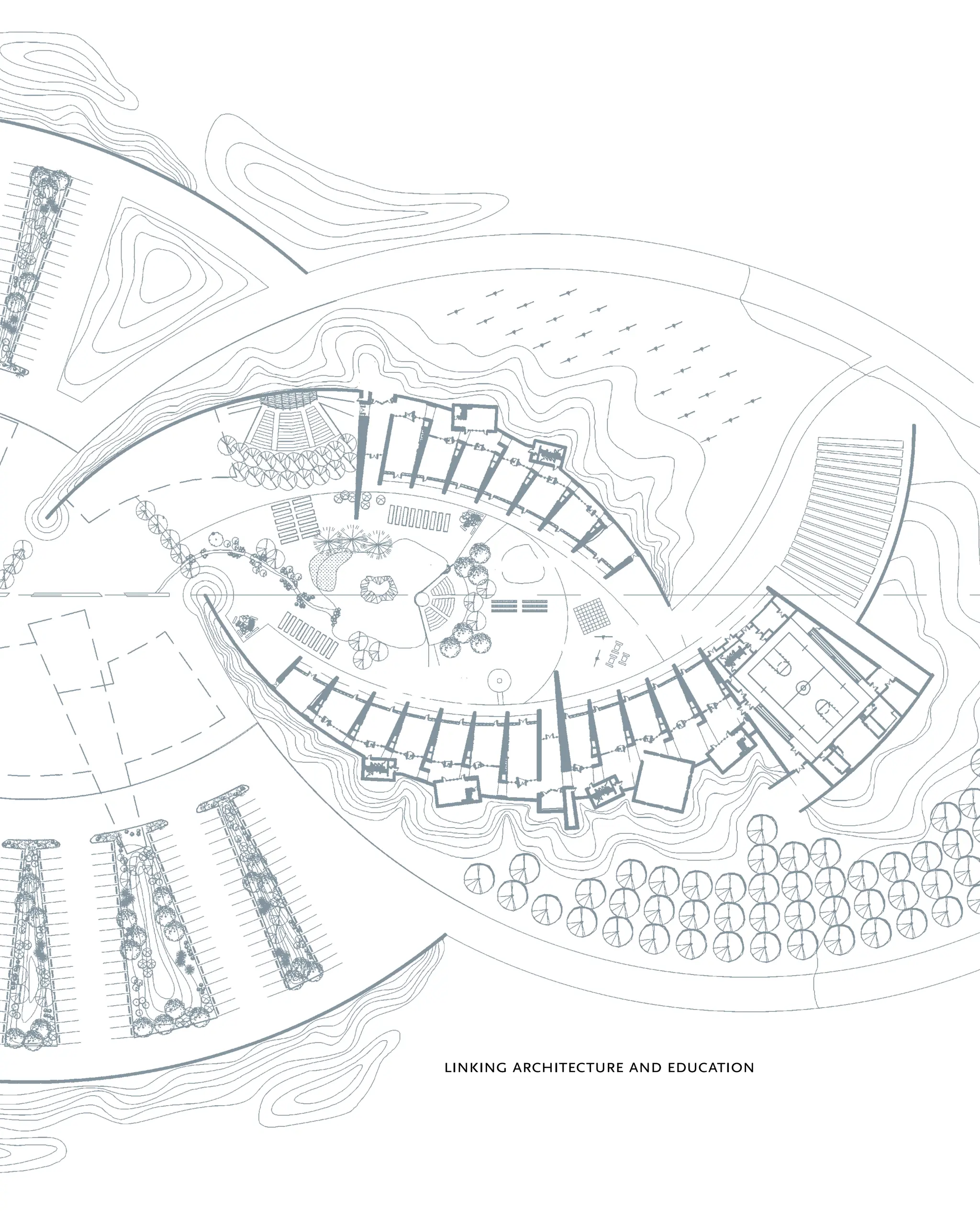
  • 9.
    © 2009 bythe University of New Mexico Press All rights reserved. Published 2009 Printed in China by Everbest Printing Company, Ltd. 14 13 12 11 10 09    1 2 3 4 5 6 Library of Congress Cataloging-in-Publication Data Taylor, Anne P. Linking architecture and education : sustainable design for learning environments / Anne Taylor with Katherine Enggass. p. cm. Includes bibliographical references and index. ISBN 978-0-8263-3407-7 (cloth : alk. paper) 1. School facilities—Design and construction. 2. School buildings—Design and construction. 3. Sustainable design. I. Enggass, Katherine. II. Title. LB3205.T39 2008 727—dc22 2008021837 Book and jacket design and type composition by Kathleen Sparkes. This book was designed and typeset using the Fontfont families Scala and Scala Sans otf. My design incorporates a Fibonacci relationship of text size, leading, grid, column size, and page size, in keeping with the philosophy of relationship, harmony, and rhythm discussed in the text.
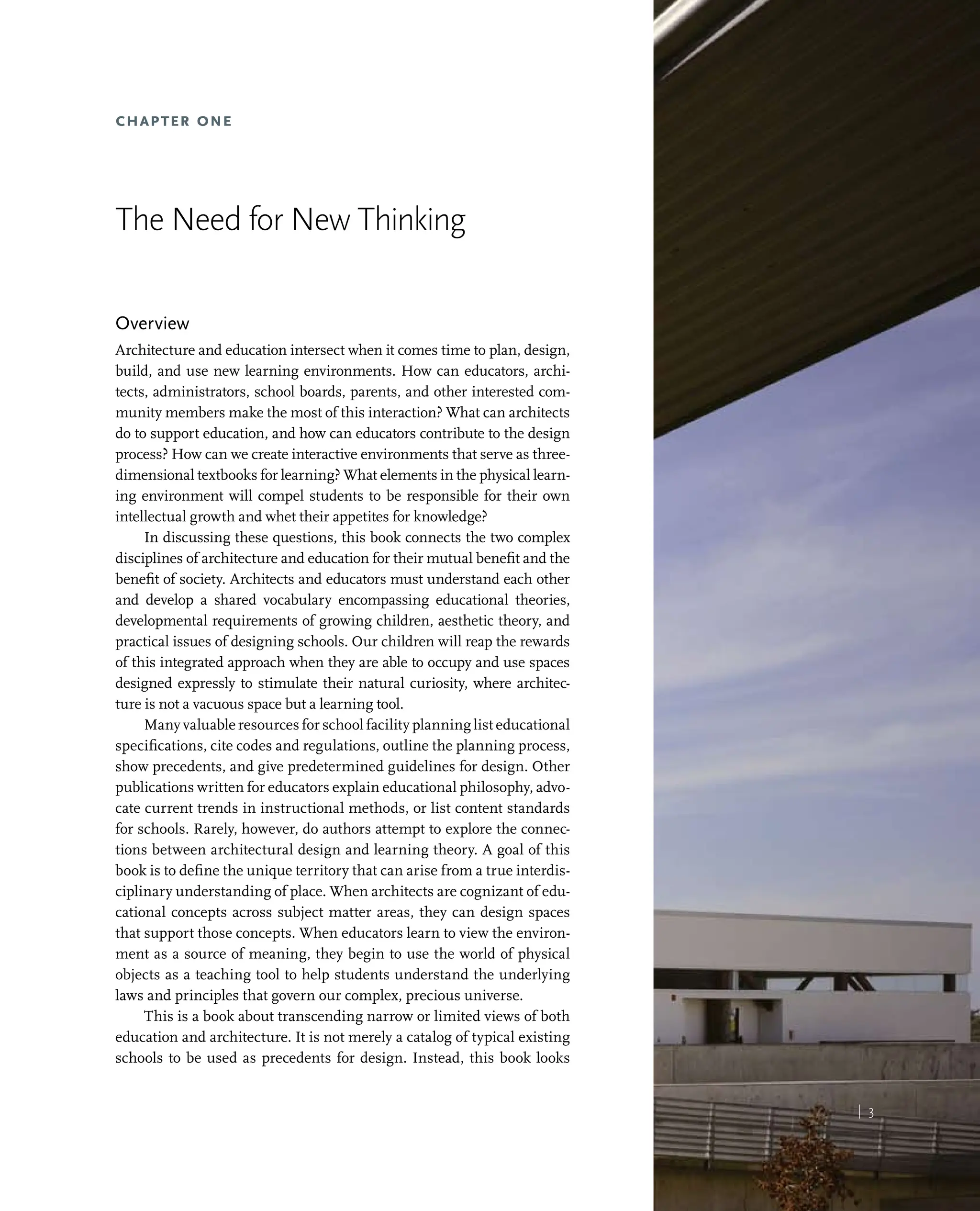
  • 10.
    To Marion Parker,my mother, who cultivated beauty and filled my childhood home with beautiful repas, flowers, aesthetic order, and love.
  • 12.
    | vii Contents Foreword byAndrew Pressman xiii Preface: The Knowing Eye xv A Note on the Book’s Structure: The Nonlinear Approach xix Part One: The Philosophical Framework behind the Knowing Eye Chapter One: The Need for New Thinking 3 Designer Perspective: Randall Fielding, Great Schools of the World: The Best of DesignShare 16 Chapter Two: The Learning Environment 21 Designer Perspective: Gilbert Choy, Preparing Children for the Challenges of Global Citizenship: 3e International Kindergarten 33 Chapter Three: Philosophy 101 39 Designer Perspective: Roger Lewis, Philosophy in Architecture 52 Chapter Four: Philosophy Applied to the Physical Learning Environment 55 Designer Perspective: Elliot Washor, The Met: Letting the Outside In and the Inside Out 70
  • 13.
    viii | Stewardship ForumOne: Philosophy and Aesthetics for the Learner Introduction 75 Eeva Reeder, Can’t Learn in Ugly 79 Janet Carpio, A Native American Head Start School: Isleta Pueblo, New Mexico 80 Richard Fleischman, Innovation in School Design: The Mosaic of Diversified Space 81 Kumi Tashiro, School and Learning Space Design in Japan 82 Howard Kaplan, The Time Is Now 85 Legorreta + Legorreta, Legorreta + Legorreta on Educational Facilities: A Personality of One’s Own 87 Part Two: Using an Organizing System: Planning for Educational Environments with the Knowing Eye Chapter Five: Using a Curricular Organizing System for School Facility Planning 91 Designer Perspective: Jeffery Lackney, A Case Study in Collaborative School Design: McWillie School, Jackson, Mississippi 111 Chapter Six: Habitability of Learning Environments 115 Designer Perspective: Wolfgang F. E. Preiser, The Triad of Programming, Post-occupancy Evaluation, and Universal Design: Toward Continuous Quality Improvement (Including the Seven Principles of Universal Design) 137 Designer Perspective: The Center for Universal Design, The Principles of Universal Design 142 Designer Perspective: Baker Morrow and Elizabeth Calhoon, Kids Outdoors in the New Century: Notes on Playground Design 145
  • 14.
    | ix Stewardship ForumTwo: Architectural Programming for the Learner Introduction 151 John Petronis, Facility Programming: Focused Decision Making 160 Dee Trout, A Learning Model in Practice: Keystone Early Learning Center, Montgomery, Alabama 162 Karen Marsh, Designing for Special Needs at the Nye Bilingual Early Childhood Center, Santa Fe, New Mexico 165 Gaylaird Christopher, School Design that Lasts: Harold G. Fearn Elementary School 168 Amy Yurko, The Middle School at High Desert: Excerpts from a Design Narrative 170 Eeva Reeder, Spaces Teachers Need to Be Effective 172 Stephen Wheeler, A Pedagogical Framework for Active Learning: Education and Sustainability 174 Robert Lurker, Joyce Downing, and Diane Wilson: The Technology Learning Center 176 Part Three: Reading the Three-Dimensional Textbook with the Knowing Eye Chapter Seven: Manifestations for Learning 181 Designer Perspective: Ron Jacobs, A Visual Explosion of Manifestations (Sketches) 216 Designer Perspective: Paul Tatter, The Meaning Is the Use: Characteristics of Environments for Thinking and Learning 220 Chapter Eight: Connecting Manifestations to Learning through Curriculum and Post-occupancy Evaluation 225 Designer Perspective: Terry Dunbar, The Schoolyard as Lesson Plan 242
  • 15.
    x | Stewardship ForumThree: Community and the Learner Introduction: School as Community, Community as School 247 Steven Bingler, Common Ground: Schools as Centers of Community 256 Atsuko Sakai, Key Exercises during the School Design Process: Bridging Students to Educators to Architects 259 Sherry Eagle, Designing Learning Environments: A Community Agenda 261 Gaylaird Christopher, Architecture for Education 264 Dale Lang, High School Reform: Opportunities for Improving Academic Outcomes through Small Learning Communities 266 Henry Sanoff, Methods of Community Participation 271 Jeffery Lackney, Involving Students in the Design of a Neighborhood Center within an Existing Large High School 273 Part Four: Seeing the Future of the Learning Environment with the Knowing Eye Chapter Nine: Beyond the Existing Classroom 279 Designer Perspective: Bruce Jilk, Contingency and Place Making for Learning 314 Designer Perspective: Bruce Jilk, Evolution of a Design for Change 319 Chapter Ten: Learning Landscapes 323 Designer Perspective: Janet Hawkes, Agriculture in the Classroom 348
  • 16.
    | xi Stewardship ForumFour: Ecologically Responsive Design and the Global Learner Introduction 355 Kuppaswamy Iyengar, Toward a True Ecohistoric Sense of Place 366 Sim Van der Ryn, Five Broad Principles of Ecological Design 368 Shannon Horst, The School District Farm and Areas of Management Concern 369 Robert Becker, Sixteen Building Blocks for High- Performance School Buildings 373 Stephen Dent, Daylighting and the Environmentally Responsive School 377 René Dierkx, Project Summary: Sierra Leone, Africa 381 John Crittenden and Stuart Smith, Making the Most of Site: Remodeling (and Rethinking) a Small Rural School 384 Thomas Vliet, Laguna Family Center: Pueblo of Laguna, Laguna, New Mexico 386 Conclusion 389 Afterword 395 Acknowledgments 401 Appendix A: Design Education Portfolio Rubric: Two- and Three- Dimensional Design Process and Product Evaluation 403 Appendix B: Ideas for Future Research 406 Appendix C: Sample User’s Manual from Edward Mazria 409 Glossary of Key Terms and Phrases 416 References and Resources 420 Index 441
  • 18.
    | xiii Foreword Anne Taylorhas produced the definitive guide to creating magical learning places. This book is the culmination of a lifetime of research, teaching, and design, elegantly packaged to inspire architects, teachers, school administra- tors, community members, and, most importantly, students of all ages. The book is not merely a design primer. It provides readers with a logical— almost inevitable—framework for an inclusive programming and design pro- cess that has a strong philosophical underpinning. Moreover, Taylor suggests ways to translate philosophy and curriculum to an architectural program and then to actual physical design. Herein lies the brilliance of the book: Ideas about learning are given life in the buildings, furniture, and landscape archi- tecture of school facilities. Substantive examples of innovative designs at a variety of scales are peppered throughout the volume. Challenging the status quo—not accepting “standards” at face value—is a continuous theme in the book to promote critical thinking. This is especially salient during the early phases of a school facility project when the program is developed. The program is the design problem, the foundation for design deci- sions, and the tool that empowers stakeholders in helping shape the design. Taylor underscores the value of a deep and thorough examination of the issues at this predesign stage in order to produce the most responsive architecture possible. This is quite a compelling—and essential—way to launch the pro- cess of building a great facility. Taylor identifies and describes the critical issues and features of what con- stitutes the best school facility design. All of these elements, including both the process and the final product, are viewed as learning opportunities for all participants. She reminds us to keep our minds open so we can actualize our full potential as contributors to the process. For seasoned school facility design- ers, this volume provides fresh insights and new tools. For those who are not design professionals, it provides ideas that would not have been imagined pre- viously. For all, it underscores the big picture, which is a mandate to create a direct linkage of the physical environment with learning and curriculum.
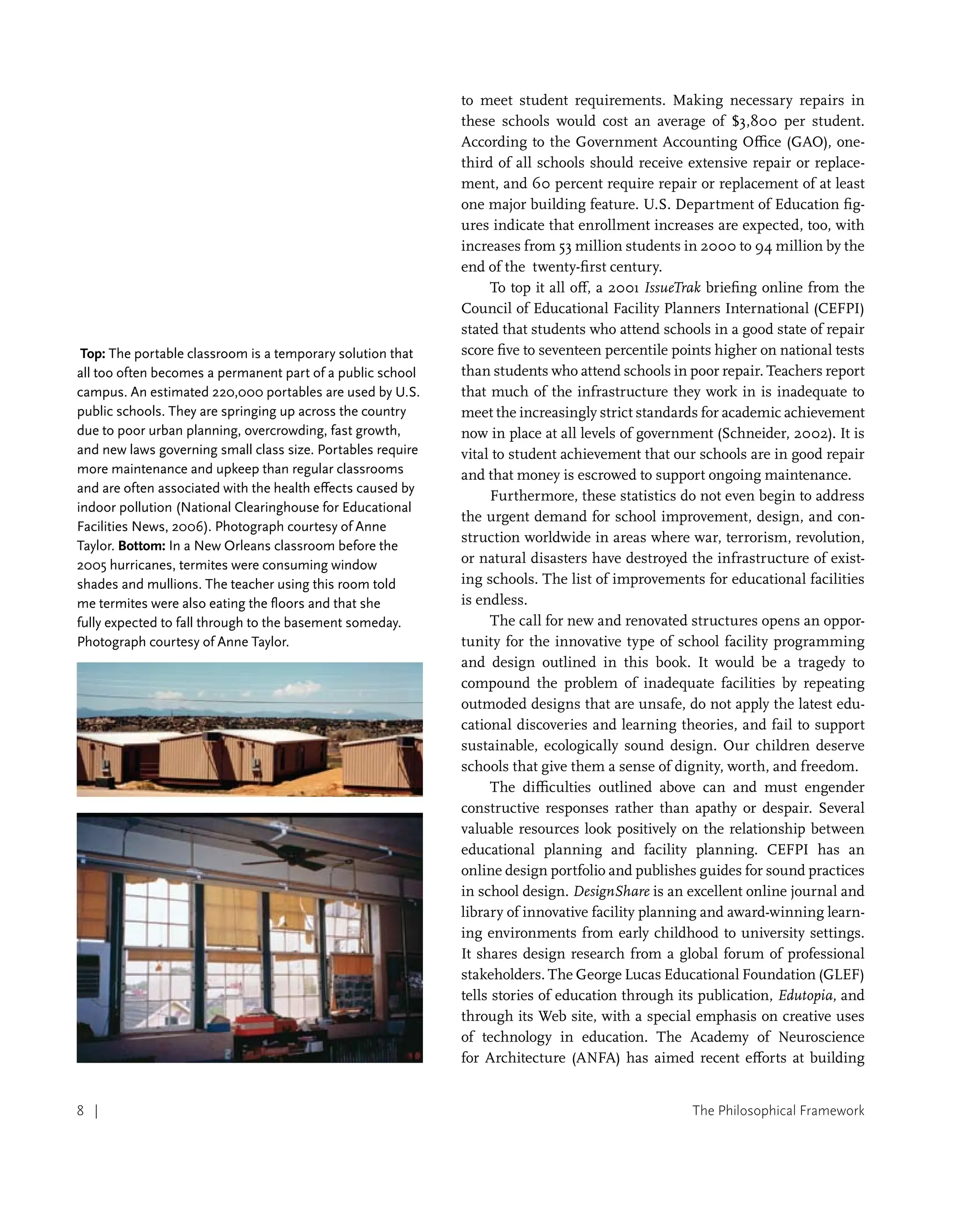
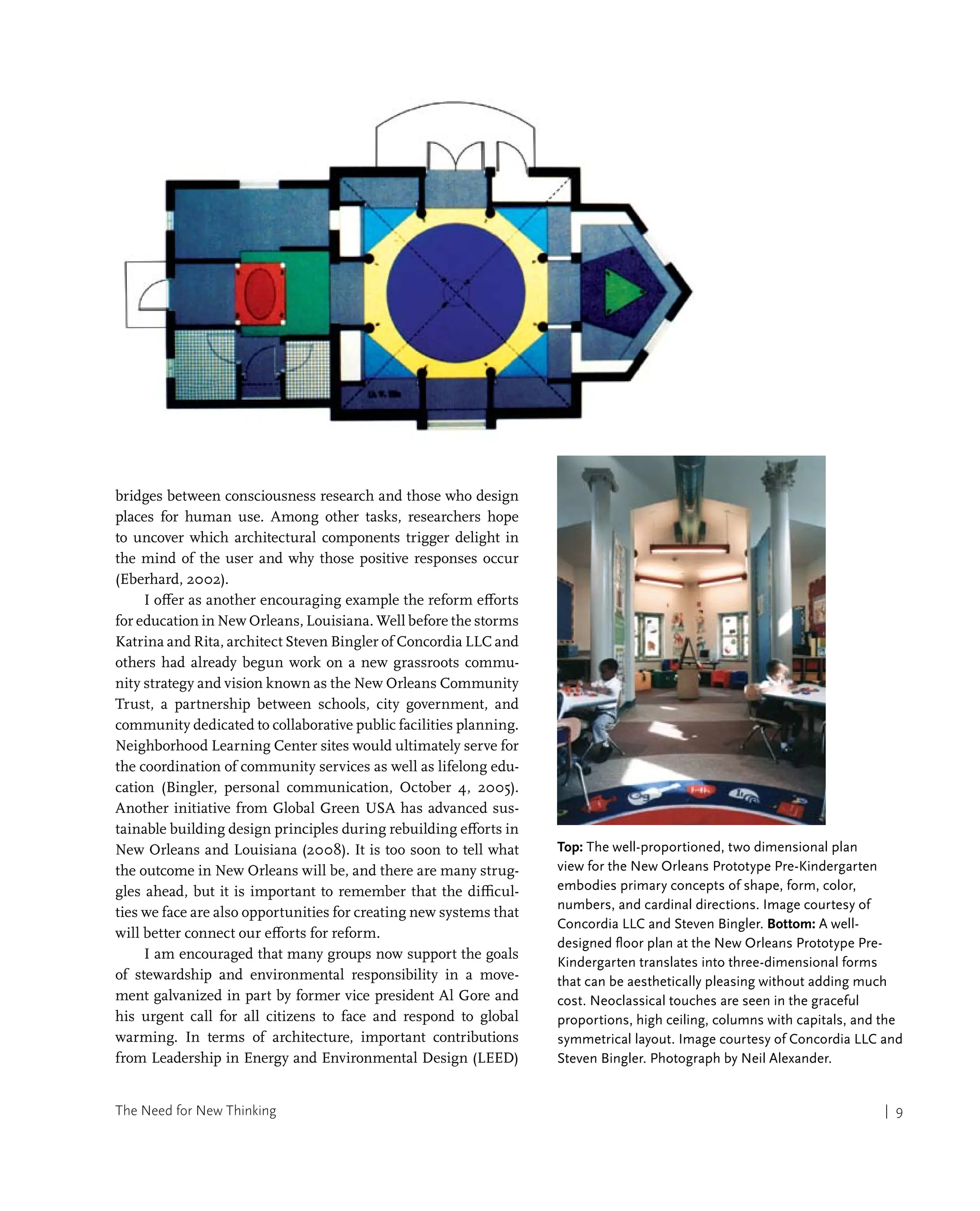
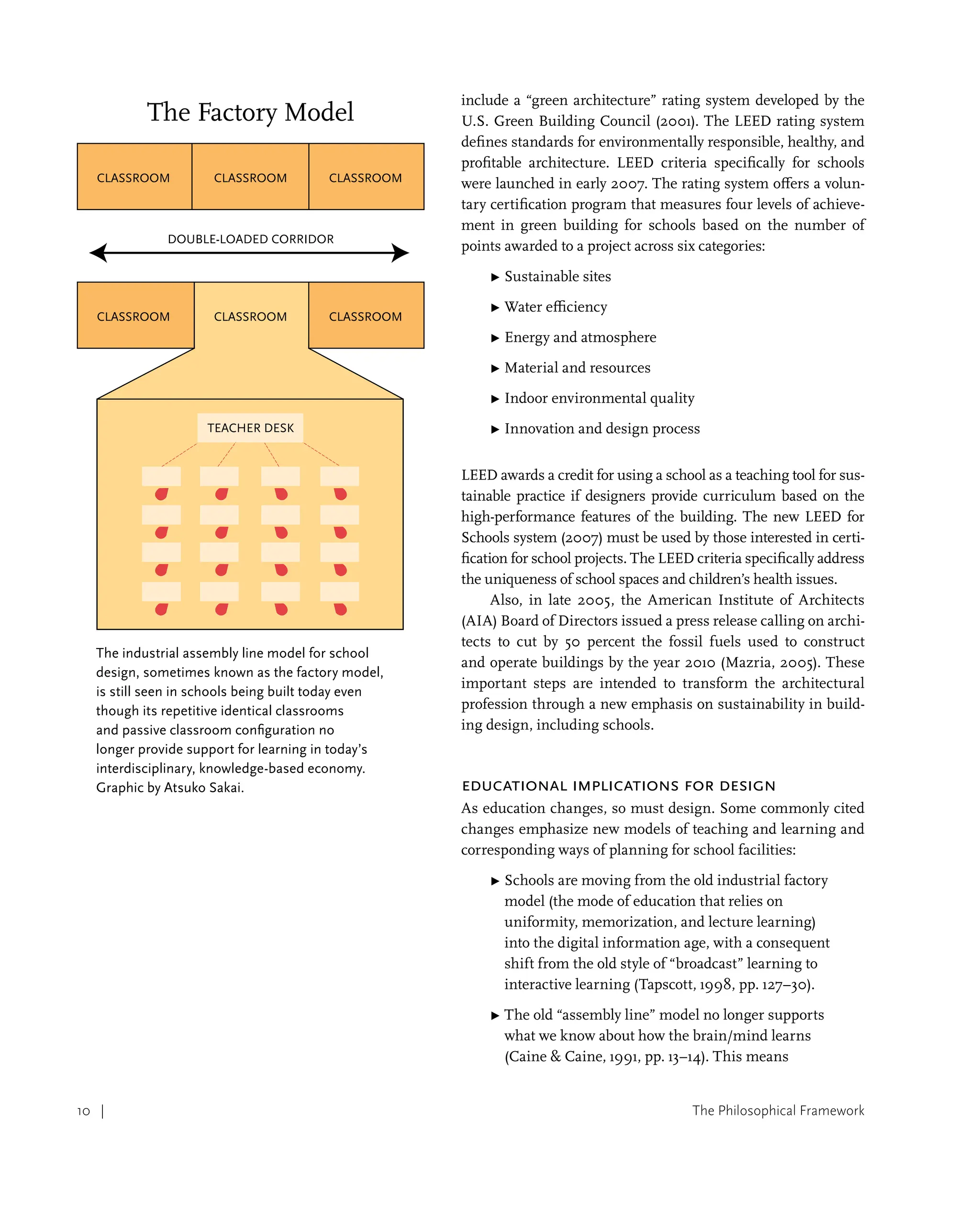
  • 19.
    Foreword xiv | The opportunityto be part of a team designing a school facility is a privi- lege. This book implores you to embrace a collaborative approach to produce the most responsive and highest-quality outcomes, especially in the context of aggressive schedules and limited budgets. In their landmark report on the future of architecture education and prac- tice, the late Ernest Boyer and Lee Mitgang of the Carnegie Foundation called for practitioners who are capable of creating beauty and who can communicate clearly and convincingly its value to the public. Boyer and Mitgang saw a need to elevate the importance of aesthetics in elementary and secondary educa- tion. Architects must become “more effective advocates for beauty in the struc- tures that touch so permanently the lives of everyone in society.” One of Anne Taylor’s primary directives has been to develop ways to enhance public con- sciousness so people can become active and competent participants in help- ing shape a responsive built environment of genuine aesthetic quality. Taylor’s concept of a building as a three-dimensional textbook speaks directly to facili- tating such an aesthetic education in addition to learning and integrating sub- ject matter across disciplines. This book is intended to be not only a prescriptive guide for everyone involved—even tangentially—in school facility design but also to cultivate a very special kind of inquiry and discovery. Thinking outside of the box or class- room is what makes this work such a significant contribution to the literature. Andrew Pressman, Fellow of the American Institute of Architects Washington DC
  • 20.
    | xv Preface The KnowingEye For the past forty years my mind has been on the topic of learning environ- ments and how schools, classrooms, playgrounds, homes, museums, and parks affect children and their learning. As I look back, I see that each year of experience is layered one upon the next, much as an architect uses trac- ing paper during early planning to explore iterations and suggest solutions to design problems. Similar to architects, those of us trying to build new ideas move from the first quick sketch of thought to increasingly careful renderings, finally fleshing out our ideas and giving them dimension through design of models and construction of the final product. The meaning of our work is in the process as well as in the end result. As a professor working in the University of New Mexico’s School of Architecture and Planning, I have had the unique opportunity to act as a pio- neer, merging the two disciplines of education and architecture in my daily thinking and experiences in the field. Architecture first impressed me as an applied learning and teaching tool through its studio design method and its interdisciplinary nature. Next, as I took students out into the world to develop their sense of perception and wonder, I saw how architecture and the physi- cal environment were in themselves teaching tools. This, in turn, suggested a new path for the architect, who can become an educator of aesthetics, and for the teacher, who becomes a designer of the mind. This is the personal cycle of pragmatic learning that informs my book. My colleagues and I have worked hard to link the disciplines of architec- ture and education through the investigation and development of architectural programming processes and the remediation of school design based on best educational practices. Our key contribution has been to help planners and their clients translate educational theory, academic goals, and developmental rights of children into architectural design criteria for schools. As a result of thought- ful and qualitative planning, educational concepts are built into the learning
  • 21.
    Preface xvi | Above: Thework of Santiago Calatrava fuses art, architecture, and engineering, linking the technical demands of structure with the freedom of transforming creation. These studies of the eye and eyelid are courtesy of the Santiago Calatrava Archive. © Santiago Calatrava. Right: Cuidad de las Artes y de las Ciencias (City of Arts and Sciences), Valencia, Spain. The design result of Calatrava’s thought processes is manifested in the form of the planetarium with its elliptical, eye-shaped plan and hemispheric dome with movable ribbed covering. Similarly, our educational goals must be embedded in our learning environment designs. Santiago Calatrava, architect and engineer. Photograph © Barbara Burg and Oliver Schuh, Palladium Photodesign, http://www.palladium.de/.
  • 22.
    | xvii environment. Theenvironment itself and the objects within it become a teach- ing tool or “three-dimensional textbook.” Architects must integrate many aspects of design to create a whole and wholesome learning environment by not addressing merely a numerical pro- gram, however important the size and cost, but also a deeper program respond- ing to the needs of the user, the community, and the Earth. Educators, in turn, must identify the current needs of the active, whole learner while expanding their own understanding of built, natural, and cultural environments as teach- ing and learning tools. Once we learn to “read” the environment, we become more aware. We open our eyes and minds to the wisdom and order in the uni- verse, thus cultivating what I have come to call the “knowing eye.” Architect Robert Peters describes the knowing eye as a type of visual liter- acy that enables architects and artists to see and critically analyze the physical world. The special training architects receive sharpens perception, increases discernment, and helps individuals form an aesthetic sense of the environ- ment. The knowing eye is not solely a sensory mechanism, but rather an organ of wisdom, a mind’s eye that allows us to read the environment with deep understanding. I believe we are all inherently wired to seek meaning and that the knowing eye does not have to remain the province of a select few. Developing the knowing eye means temporarily suspending the past, opening ourselves to new possibilities, and choosing creativity over destructive or nega- tive impulses. As we move beyond traditional images of schools so familiar to us that they have become essentially invisible to our critical judgment, we ulti- mately reach a thoughtful and deeply felt understanding of the harmonies, pat- terns, and underlying wholeness that could grace our learning environments. Over the years I have been on many trips to give speeches and workshops about school facility planning across the country and overseas—from Alaska to Native American reservations in New Mexico and Arizona to sites from Connecticut to California, and on to Japan, Finland, and more. During my travels, I have not only advocated best practices for programming and design of schools, but I have also tried to listen to what children want in their schools. My colleagues and I have developed, refined, and used an Architecture and Children curriculum as a tool to encourage children and teachers to commu- nicate their ideas effectively. Program participants express their ideas through the visual language of architecture and design during project-based studio workshops. In Stockton, California, students told us they wanted a farm and an environmental study center on the San Joaquin Delta, not just another ordi- nary high school. In Washington State, a fourth-grade student suggested that repetitive classrooms be converted to greenhouses, music and dance rooms, career centers, and art studios. At a summit of Native American Pueblo lead- ers, I learned that Pueblo communities deeply value children as the “caretakers of culture.” Preservation of the culture subsequently was the primary educa- tional goal that guided programming of spaces at the new Santa Fe Indian School (SFIS) in New Mexico. The deeper message behind these and many other stories is that children want us to make their learning real and relevant to their lives.
  • 23.
    Preface xviii | This bookis about progressive, breakthrough thinking. It is intended to stimulate new ideas in the minds of architects, administrators, educators, school boards, and community members who want to make a positive and informed difference in the lives of all children. It presents a new model of learning for stu- dents and for professional development of educators and architects, and it illus- trates how inspired design transforms and enriches our world. I am talking not only about constructing beautiful buildings for our children, but also setting those buildings in thoughtfully transformed playgrounds called “learning land- scapes.” Ultimately, our populations must understand, revere, and steward the environments in which they live, work, and play. As my father, an educator, once said, one can learn how to earn a living in a very short time, but it takes a lifetime to learn how to live. My goal is to empower children to be the leaders of the future, to respect each other and the Earth, and to become happy people who have truly learned how to live. I want to give all chil- dren—including my seven grandchildren—an education that optimizes their talents, exposes them to what is real and true, gives them a sense of ethics and aesthetics, lifts their spirits, and prepares them to preserve our democratic soci- ety. I want them to become active global citizens and representatives of a culture that supports a more loving ambience than we have today. I want children to love learning, love themselves, and love each other.
  • 24.
    | xix A Noteon the Book’s Structure The Nonlinear Approach Though it appears to meander randomly, a stream has a logical proportional flow based on topography and mathematics. The natural geometry of a mean- dering river is a response to volume and silt load resulting in alternating shal- lows, deep pools, and cleansing currents. Tampering with these graceful bends can result in more frequent and extreme flooding. My work has not taken a purely linear path, and I view my experiences as interconnected rather than isolated. It has been a challenge to convey this rich sense of fullness and complexity while providing an orderly narrative. I have opted for a multifaceted approach to impart my ideas and those of the many peo- ple who have enriched the journey. The “spine” of the book is composed of a core narrative in four parts with ten chapters, a distillation of the main themes I have uncovered and the thinking that has evolved over the years. The narrative unfolds along the lines of the archi- tectural planning and design process and concludes with a look to the future of learning environments. My work achieves continuity through the essential beliefs and thought processes in the core narrative. To me, though, this is not enough, so I have saved space “in the margins” to share related ideas from colleagues—quotes, questions, anecdotes, sidebars, photographs, illustrations, and charts (Tools for Thought)—all designed to stim- ulate thinking about learning environments and to encourage an open, diver- sified approach to the problems school planners and designers face today. The ideas in this running visual and verbal commentary are identified and separated graphically into color coded sections. A designer perspective section written by outside contributors appears at the end of each chapter. In addition, each major part of the book concludes with an open stewardship forum of case studies and commentary derived from many different contributors on selected topics vital to school planning. The idea of stewardship—the individual’s responsibility to manage and care for life and property with proper regard for the rights of others—is at the heart of my think- ing. The forum contributors provide examples of corroborating fieldwork for the ideas expressed in the book. Their writing is excerpted and consolidated from longer articles generously shared with me early in the book-writing process. I remain indebted to these contributors—colleagues, friends, and, of course, the children—who have been part of a collaborative life’s work. designer perspective stewardship forum tools for thought sidebar
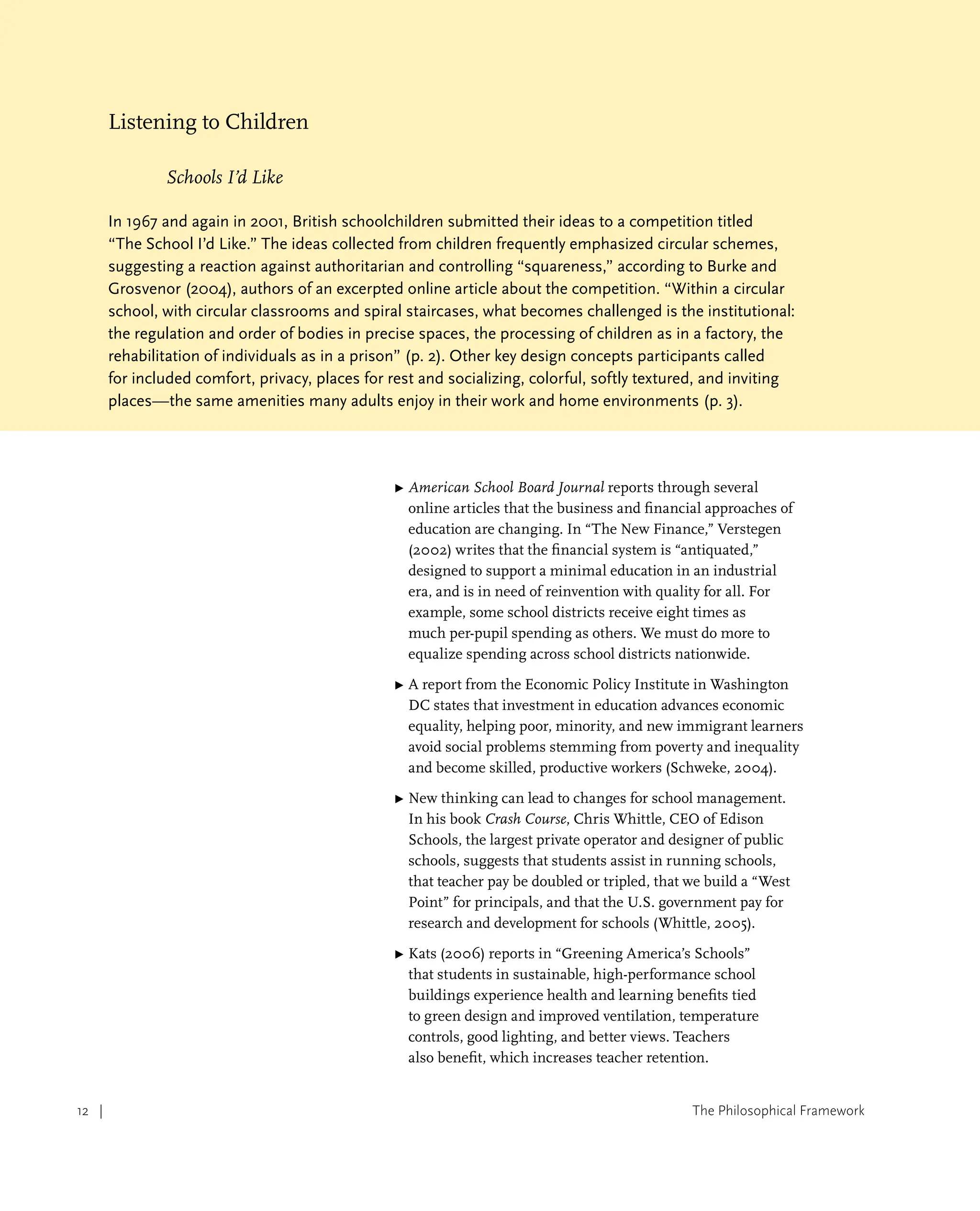
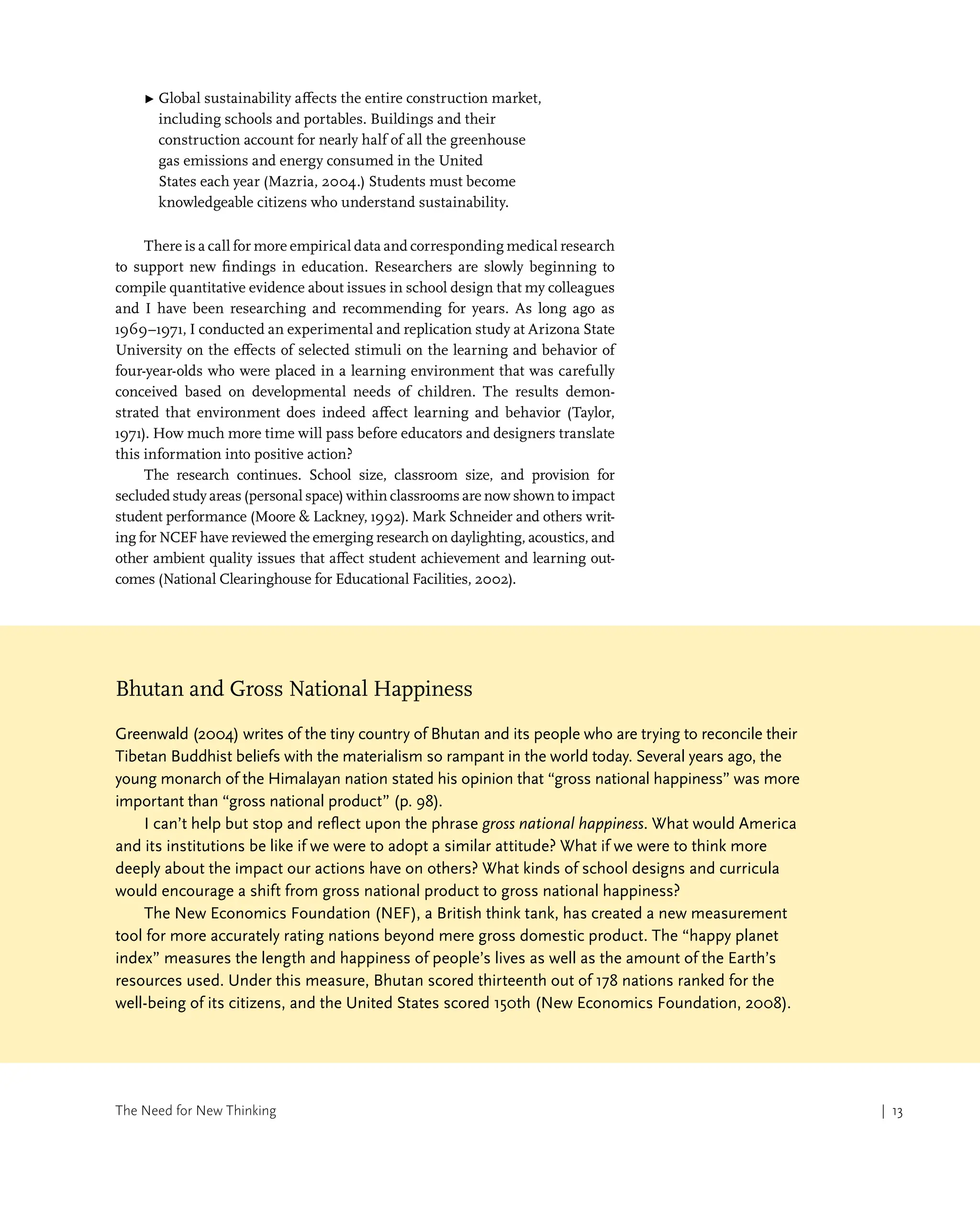
  • 26.
  • 27.
    Diamond Ranch HighSchool, Pomona, California. Thom Mayne, principal architect, Morphosis. Thomas Blurock Architects. Photograph © Kim Zwarts
  • 28.
    | 3 Chapter One TheNeed for New Thinking Overview Architecture and education intersect when it comes time to plan, design, build, and use new learning environments. How can educators, archi- tects, administrators, school boards, parents, and other interested com- munity members make the most of this interaction? What can architects do to support education, and how can educators contribute to the design process? How can we create interactive environments that serve as three- dimensional textbooks for learning? What elements in the physical learn- ing environment will compel students to be responsible for their own intellectual growth and whet their appetites for knowledge? In discussing these questions, this book connects the two complex disciplines of architecture and education for their mutual benefit and the benefit of society. Architects and educators must understand each other and develop a shared vocabulary encompassing educational theories, developmental requirements of growing children, aesthetic theory, and practical issues of designing schools. Our children will reap the rewards of this integrated approach when they are able to occupy and use spaces designed expressly to stimulate their natural curiosity, where architec- ture is not a vacuous space but a learning tool. Many valuable resources for school facility planning list educational specifications, cite codes and regulations, outline the planning process, show precedents, and give predetermined guidelines for design. Other publications written for educators explain educational philosophy, advo- cate current trends in instructional methods, or list content standards for schools. Rarely, however, do authors attempt to explore the connec- tions between architectural design and learning theory. A goal of this book is to define the unique territory that can arise from a true interdis- ciplinary understanding of place. When architects are cognizant of edu- cational concepts across subject matter areas, they can design spaces that support those concepts. When educators learn to view the environ- ment as a source of meaning, they begin to use the world of physical objects as a teaching tool to help students understand the underlying laws and principles that govern our complex, precious universe. This is a book about transcending narrow or limited views of both education and architecture. It is not merely a catalog of typical existing schools to be used as precedents for design. Instead, this book looks | 3
  • 29.
    The Philosophical Framework 4| forward and outward to design innovations that are not yet com- monly found in our schools. My aim is to present examples of informed design to help people everywhere develop the know- ing eye and attain a heightened state of awareness that allows them to see and “read” the interconnectedness of all things in the built, natural, and cultural environment. The book introduces new ways of thinking about design of school facilities and encourages a deep sense of responsibility toward the betterment of society reflected in the choices educa- tors, architects, parents, and other citizens make on behalf of children. Educators need to stop talking only to themselves and initiate a dialogue with the public about more successful ways to educate children and adults. The call for progressive leader- ship presents a special challenge to architects, too, not only to design effectively, but also to explicate the ideas that formulate their work. This is an idealistic book that asks architects, educators, and parents to aim high and set new priorities. It is a book about entertaining possibilities, suspending disbelief and cyni- cal thinking, and overcoming apathy and perceived barriers to high-quality educational environments. It is about choosing the path of creativity, generosity, and caring over that of distrust, fear, or destructiveness. An intelligently designed, attractive, ecologically responsive learning environment is not a waste of taxpayer money or an unrealistic dream, but rather a vital, con- crete endorsement of our better nature and our professed con- cern for children and the future of the world. Author Jonathan Kozol asserts that America can afford to pay for good schools for all children. Kozol’s The Shame of the Nation: The Restoration of Apartheid Schooling in America (2005) documents inequities in our public schools. During a recent book tour stop in Portland, Oregon, Kozol expressed his frustration with the frequently asked question, “Can you really solve this kind of problem by throwing money at it?” Why is it, he wonders, that we “allocate funds” to the Pentagon, but we “throw money” at schools? And why, if money is not important to education, do so many affluent families pay huge sums for private education for their children? In an interview taped for Alternative Radio in Boulder, Colorado, Kozol’s response to the question of money for schools was: throw it! “I don’t know a better way to put a new roof on a collapsing school. I don’t know a better way to stock one of these sparse and barren libraries with a wonderful, rich, super- beautiful collection of all those lovely books . . . I don’t know a better way than money to stock an inner city classroom with good computers and software. Strange as it seems, they actu- ally make you pay money for those things.” Top: Architect Steven Bingler acts as an educator as he prepares schematic drawings for discussion with stakeholders during the planning process. Photograph courtesy of Anne Taylor. Bottom: Van Sanders, an educator not formally schooled in architecture, acts as a designer as he presents his portfolio as part of teacher professional development for teaching architecture in public schools. Note that the presentation shows the entire visual thinking process, not just the end product. Photograph courtesy of Architecture and Children and Anne Taylor.
  • 30.
    The Need forNew Thinking | 5 | 5 Our Priorities ▶ In 2003, the U.S. public school average per-pupil spending for the year was $8,044. In 2008, the average education cost per child in New Mexico is $7,580, while the average U.S. cost is $8,701. New York spends $14,119 per pupil (Chan, 2008). ▶ In 2005 Kozol stated that New York City schools spent $11,700 per pupil, while in a mostly white suburb in Manhasset, expenditures per pupil were more than $22,000. ▶ The average cost of incarceration for one year in a federal prison was more than $25,000 per prisoner in 2003. According to a 2007 Albuquerque Tribune article, “New Mexico pays more for private prisons”—more than $70 per day per inmate ($25,550 per inmate per year) at the Guadalupe County Correctional Facility outside Santa Rosa (New Mexico Legislative Finance Committee, 2007). ▶ For the war in Iraq, the cost based on operations with some 138,000 soldiers deployed in Iraq works out to approximately $383,000 per soldier per year. A 2006 Houston Chronicle article stated that the cost of putting each soldier in the war zone neared $400,000 per service member (Hedges, 2006). Beginning with Excellence and High Aspirations Unfortunately, many architectural programs or plans for public school facilities begin with predetermined needs and minimal technical requirements such as square footage or standardized educational specifications. Programs can eas- ily bog down with budgets or value engineering before achieving higher-order values such as support of curriculum, enduring usefulness, beauty, or sus- tainability. How do we create excellence and optimize tax dollars? In my work as motivator, educator, and programming consultant, I begin the planning process for any learning environment with best practices in edu- cation so that every consequent design decision is informed by a vision of aca- demic excellence. Similarly, I also stress the best architecture has to offer so that educators and administrators can begin to appreciate the physical learning envi- ronment as a rich resource for learning. I try to provide stakeholders in the dif- ferent professions alternative thought processes that lead to new solutions about learning environments. I believe success is linked to how clearly and explicitly one can define ambitious academic and aesthetic goals early in the process. The economic bottom line is important, but it is just that: the bottom. When we look beyond the immediate finances for individual schools, the big picture shows us that more investment in education, from preschool to college, spurs economic development. Adequate and effective funding of
  • 31.
    The Philosophical Framework 6| education is the best way to achieve faster growth, more jobs, greater productiv- ity, and more widely shared prosperity, thus meeting the competitive demands of our knowledge-based economy (Schweke, 2004). Even so, tight constraints on budgets and time for school construction are commonly cited across the nation when planners try to break the “box store” mentality with high-quality design solutions for schools. A student of mine recently shared a report from a citizen school oversight committee submitted to Albuquerque Public Schools (Community Oversight Committee, 2004). The report stated that it was time to “rein in the designers” and start using proto- type designs for new schools, following the speedy and cost-effective methods of Wal-Mart, Costco, McDonald’s, and other economically viable institutions. The idea of a prototype has some merit, but the inspiration for that prototype reveals the poverty of our design understanding and our imaginations. This limited worldview can be frustrating for those trying to reform education and support that reform with innovative school designs and sustainable architec- ture. This is why it is so important that our designers share their expertise and enthusiasm with the general public. What are our priorities? Rather than begin with narrow adequacy stan- dards or school population ratios or projections (all important at later stages of programming), designers and planners might refer to the respective goals for excellence in the above chart. Developmental psychology gives us insight into the needs of learners across body, mind, and spirit. Vitruvius, a first-century Roman, offers us one of the enduring definitions of architecture. A parallel arises when we compare the two sets of goals. The child is not fully educated and the building is not complete unless all goals are met, including high levels of aesthetic satisfaction and psychological comfort. From these humble parallels of body/structure, mind/function, and spirit/beauty, we begin to see the types of questions we must ask before we design educational facilities. In terms of the body, which building systems (light- ing, ventilation) and spaces or forms (open, closed) will best support the physi- cal well-being and kinesthetic learning of children? What environmental factors make children feel safe? To develop the mind, how can designed spaces best sup- port learning about subject matter disciplines and related concepts? How does the design support the work of children of all ages and learning styles? How do spatial relationships affect instructional delivery systems or how teachers teach? And, finally, in light of spiritual learning, what is delight to a child? Holistic Goals of Educational Facility Design Goal of Education: Reaching the whole learner Goal of Architecture (Vitruvius): Designing the whole building Body (physical learning) Firmness (structure) Mind (cognitive learning) Commodity (function) Spirit (emotional learning) Delight (beauty) Children wonder why schools can’t be more like this. Students from nearby schools often visit Bart Prince’s home and revel in its futuristic spaceship design. Photograph courtesy of Bart Prince, architect.
  • 32.
    The Need forNew Thinking | 7 America, Wake Up! I admit I have a difficult time understanding our complacency as a nation when it comes to the current state of our public school facilities. Perhaps many adults are in denial about or feel powerless to change the conditions in our schools. If so, con- sider this book a wake-up call about our need to think differ- ently. Even in fairly wealthy suburban high schools—let alone the appalling state of many large inner-city schools—I have encountered armed police officers patrolling bleak and bar- ren hallways, prisonlike lockable gates, chain link fences, and surveillance cameras. Are we preparing students for a democ- racy or a police state? I have witnessed children sitting on the cold floor like refugees and gulping their fast food lunches, then stuffing half-eaten leftovers and wrappers into overflow- ing garbage cans without a thought for recycling. What does this “health illiteracy” say about nutritional habits and life- long wellness? I have seen children stuck in portables with no plumbing, a lack of storage and order, shades pulled against the natural light, students sitting at desks that are ergonomi- cally inappropriate, possessions and clothing piled everywhere, mouse droppings among the computers, and trash, weeds, and abandoned furniture on playgrounds. In a discussion with my granddaughter about school bathrooms, she disclosed that she only goes to the bathroom at home in the morning and later in the afternoon because her school bathrooms are dark, scary, and dirty. At age ten she was knowledgeable enough to sug- gest windows or skylights, smart lights, smart faucets, and self- flushing toilets. “Put that in your book, Grandma,” she said. The obvious question is: what messages are we sending to our children? The National Clearinghouse for Educational Facilities (NCEF) has compiled the world’s largest and most widely used database about school facilities and how to create, renovate, and maintain safe, healthy, high-performance schools. A quick trip to the NCEF Web site reveals the latest evidence that the need for new or modernized school facilities in the United States is great. Statistics gathered in preparation for this book include a 1999 report by the National Center for Education Statistics (NCES, June 2000), which stated that the average public school building was forty years old. NCES estimated that it would take more than $112 billion to update U.S. school facilities, while the National Education Association (2000) estimated the full nationwide cost of modernization including new construction at about $322 billion. The American Society of Civil Engineers’s 2005 report card on America’s infrastructure gave schools a grade of D, citing aging, outdated, and overcrowded facilities, and estimated that 75 percent of the buildings were inadequate Top: Hidden behind its chain link fence and isolated from the community, this school could be anywhere in the United States. Photograph courtesy of Anne Taylor. Bottom: Gates and fences are not only for keeping strangers out; they are for locking students in. In a California junior high school (not pictured), students lobbied to keep their school unfenced, even though it is in a busy area. The argument is that openness is not just about aesthetics, but also the belief that freedom promotes responsibility in students (National Clearinghouse for Educational Facilities News, 2006). Photograph courtesy of Anne Taylor.
  • 33.
    The Philosophical Framework 8| to meet student requirements. Making necessary repairs in these schools would cost an average of $3,800 per student. According to the Government Accounting Office (GAO), one- third of all schools should receive extensive repair or replace- ment, and 60 percent require repair or replacement of at least one major building feature. U.S. Department of Education fig- ures indicate that enrollment increases are expected, too, with increases from 53 million students in 2000 to 94 million by the end of the twenty-first century. To top it all off, a 2001 IssueTrak briefing online from the Council of Educational Facility Planners International (CEFPI) stated that students who attend schools in a good state of repair score five to seventeen percentile points higher on national tests than students who attend schools in poor repair. Teachers report that much of the infrastructure they work in is inadequate to meet the increasingly strict standards for academic achievement now in place at all levels of government (Schneider, 2002). It is vital to student achievement that our schools are in good repair and that money is escrowed to support ongoing maintenance. Furthermore, these statistics do not even begin to address the urgent demand for school improvement, design, and con- struction worldwide in areas where war, terrorism, revolution, or natural disasters have destroyed the infrastructure of exist- ing schools. The list of improvements for educational facilities is endless. The call for new and renovated structures opens an oppor- tunity for the innovative type of school facility programming and design outlined in this book. It would be a tragedy to compound the problem of inadequate facilities by repeating outmoded designs that are unsafe, do not apply the latest edu- cational discoveries and learning theories, and fail to support sustainable, ecologically sound design. Our children deserve schools that give them a sense of dignity, worth, and freedom. The difficulties outlined above can and must engender constructive responses rather than apathy or despair. Several valuable resources look positively on the relationship between educational planning and facility planning. CEFPI has an online design portfolio and publishes guides for sound practices in school design. DesignShare is an excellent online journal and library of innovative facility planning and award-winning learn- ing environments from early childhood to university settings. It shares design research from a global forum of professional stakeholders. The George Lucas Educational Foundation (GLEF) tells stories of education through its publication, Edutopia, and through its Web site, with a special emphasis on creative uses of technology in education. The Academy of Neuroscience for Architecture (ANFA) has aimed recent efforts at building Top: The portable classroom is a temporary solution that all too often becomes a permanent part of a public school campus. An estimated 220,000 portables are used by U.S. public schools. They are springing up across the country due to poor urban planning, overcrowding, fast growth, and new laws governing small class size. Portables require more maintenance and upkeep than regular classrooms and are often associated with the health effects caused by indoor pollution (National Clearinghouse for Educational Facilities News, 2006). Photograph courtesy of Anne Taylor. Bottom: In a New Orleans classroom before the 2005 hurricanes, termites were consuming window shades and mullions. The teacher using this room told me termites were also eating the floors and that she fully expected to fall through to the basement someday. Photograph courtesy of Anne Taylor.
  • 34.
    The Need forNew Thinking | 9 bridges between consciousness research and those who design places for human use. Among other tasks, researchers hope to uncover which architectural components trigger delight in the mind of the user and why those positive responses occur (Eberhard, 2002). I offer as another encouraging example the reform efforts for education in New Orleans, Louisiana. Well before the storms Katrina and Rita, architect Steven Bingler of Concordia LLC and others had already begun work on a new grassroots commu- nity strategy and vision known as the New Orleans Community Trust, a partnership between schools, city government, and community dedicated to collaborative public facilities planning. Neighborhood Learning Center sites would ultimately serve for the coordination of community services as well as lifelong edu- cation (Bingler, personal communication, October 4, 2005). Another initiative from Global Green USA has advanced sus- tainable building design principles during rebuilding efforts in New Orleans and Louisiana (2008). It is too soon to tell what the outcome in New Orleans will be, and there are many strug- gles ahead, but it is important to remember that the difficul- ties we face are also opportunities for creating new systems that will better connect our efforts for reform. I am encouraged that many groups now support the goals of stewardship and environmental responsibility in a move- ment galvanized in part by former vice president Al Gore and his urgent call for all citizens to face and respond to global warming. In terms of architecture, important contributions from Leadership in Energy and Environmental Design (LEED) Top: The well-proportioned, two dimensional plan view for the New Orleans Prototype Pre-Kindergarten embodies primary concepts of shape, form, color, numbers, and cardinal directions. Image courtesy of Concordia LLC and Steven Bingler. Bottom: A well- designed floor plan at the New Orleans Prototype Pre- Kindergarten translates into three-dimensional forms that can be aesthetically pleasing without adding much cost. Neoclassical touches are seen in the graceful proportions, high ceiling, columns with capitals, and the symmetrical layout. Image courtesy of Concordia LLC and Steven Bingler. Photograph by Neil Alexander.
  • 35.
    The Philosophical Framework 10| include a “green architecture” rating system developed by the U.S. Green Building Council (2001). The LEED rating system defines standards for environmentally responsible, healthy, and profitable architecture. LEED criteria specifically for schools were launched in early 2007. The rating system offers a volun- tary certification program that measures four levels of achieve- ment in green building for schools based on the number of points awarded to a project across six categories: ▶ Sustainable sites ▶ Water efficiency ▶ Energy and atmosphere ▶ Material and resources ▶ Indoor environmental quality ▶ Innovation and design process LEED awards a credit for using a school as a teaching tool for sus- tainable practice if designers provide curriculum based on the high-performance features of the building. The new LEED for Schools system (2007) must be used by those interested in certi- fication for school projects. The LEED criteria specifically address the uniqueness of school spaces and children’s health issues. Also, in late 2005, the American Institute of Architects (AIA) Board of Directors issued a press release calling on archi- tects to cut by 50 percent the fossil fuels used to construct and operate buildings by the year 2010 (Mazria, 2005). These important steps are intended to transform the architectural profession through a new emphasis on sustainability in build- ing design, including schools. Educational Implications for Design As education changes, so must design. Some commonly cited changes emphasize new models of teaching and learning and corresponding ways of planning for school facilities: ▶ Schools are moving from the old industrial factory model (the mode of education that relies on uniformity, memorization, and lecture learning) into the digital information age, with a consequent shift from the old style of “broadcast” learning to interactive learning (Tapscott, 1998, pp. 127–30). ▶ The old “assembly line” model no longer supports what we know about how the brain/mind learns (Caine Caine, 1991, pp. 13–14). This means The Factory Model CLASSROOM CLASSROOM CLASSROOM CLASSROOM CLASSROOM CLASSROOM DOUBLE-LOADED CORRIDOR TEACHER DESK The industrial assembly line model for school design, sometimes known as the factory model, is still seen in schools being built today even though its repetitive identical classrooms and passive classroom configuration no longer provide support for learning in today’s interdisciplinary, knowledge-based economy. Graphic by Atsuko Sakai.
  • 36.
    The Need forNew Thinking | 11 architects must provide different configurations for learning environments, more flexibility, adaptability, movable components, and future conversion to other uses (Locker Olson, 2004). ▶ The industrial/factory model must be replaced by a model based on the way the mind develops (a process), recognizing the variety of children’s developmental profiles (Greenspan, 1997, p. 314). ▶ Current educational best practices and learning theories indicate that environmentally based, project- based, hands-on, active, relevant, constructivist learning can close the achievement gap (Hoody Lieberman, 1998). Project-based learning often requires more learning space and architectural support for different space usage and for changing student/teacher/community relationships. ▶ Students become responsible for their own learning (Brooks Brooks, 1993, p. v), and teachers act as facilitators (Caine Caine, 1991, p. 22). ▶ Classrooms will become more like studio workplaces (Second National Invitational Conference on Architecture and Education Report, 1992, p. 3). ▶ Special programs and individualization of the curriculum are on the rise and require a variety of specialized spaces and universal access (Preiser, 2001). ▶ Schools must become more community oriented through shared facilities, multiple use, and community participation in the planning process (Brubaker, 1998). ▶ School design changes must be driven by new technology requirements (Myers Robertson, 2004). ▶ Budgeting must shift from short-term, up-front costs to include whole building life cycle costs and ongoing maintenance and operations (Perkins, 2001, pp. 89–90; Council of Educational Facility Planners International, 2004). ▶ Deferred maintenance harms our schools, resulting in health risks, increased cost of maintenance and replacement of equipment, and increased rates of deterioration of facilities (National Clearinghouse for Educational Statistics, 2000). Top: Kiva form, Ray and Maria Stata Center, Massachusetts Institute of Technology. Variegated facades of brick, painted aluminum, and stainless steel lend visual interest. Vivid sculptural pieces are scattered throughout the site. Frank Gehry, architect. Bottom: Walt Disney Concert Hall, Los Angeles. The work of well-known architects can provide an antidote to the industrial model found in many schools. Frank Gehry, architect. Photographs courtesy of Gehry Partners, LLP.
  • 37.
    The Philosophical Framework 12| Listening to Children Schools I’d Like In 1967 and again in 2001, British schoolchildren submitted their ideas to a competition titled “The School I’d Like.” The ideas collected from children frequently emphasized circular schemes, suggesting a reaction against authoritarian and controlling “squareness,” according to Burke and Grosvenor (2004), authors of an excerpted online article about the competition. “Within a circular school, with circular classrooms and spiral staircases, what becomes challenged is the institutional: the regulation and order of bodies in precise spaces, the processing of children as in a factory, the rehabilitation of individuals as in a prison” (p. 2). Other key design concepts participants called for included comfort, privacy, places for rest and socializing, colorful, softly textured, and inviting places—the same amenities many adults enjoy in their work and home environments (p. 3). ▶ American School Board Journal reports through several online articles that the business and financial approaches of education are changing. In “The New Finance,” Verstegen (2002) writes that the financial system is “antiquated,” designed to support a minimal education in an industrial era, and is in need of reinvention with quality for all. For example, some school districts receive eight times as much per-pupil spending as others. We must do more to equalize spending across school districts nationwide. ▶ A report from the Economic Policy Institute in Washington DC states that investment in education advances economic equality, helping poor, minority, and new immigrant learners avoid social problems stemming from poverty and inequality and become skilled, productive workers (Schweke, 2004). ▶ New thinking can lead to changes for school management. In his book Crash Course, Chris Whittle, CEO of Edison Schools, the largest private operator and designer of public schools, suggests that students assist in running schools, that teacher pay be doubled or tripled, that we build a “West Point” for principals, and that the U.S. government pay for research and development for schools (Whittle, 2005). ▶ Kats (2006) reports in “Greening America’s Schools” that students in sustainable, high-performance school buildings experience health and learning benefits tied to green design and improved ventilation, temperature controls, good lighting, and better views. Teachers also benefit, which increases teacher retention.
  • 38.
    The Need forNew Thinking | 13 ▶ Global sustainability affects the entire construction market, including schools and portables. Buildings and their construction account for nearly half of all the greenhouse gas emissions and energy consumed in the United States each year (Mazria, 2004.) Students must become knowledgeable citizens who understand sustainability. There is a call for more empirical data and corresponding medical research to support new findings in education. Researchers are slowly beginning to compile quantitative evidence about issues in school design that my colleagues and I have been researching and recommending for years. As long ago as 1969–1971, I conducted an experimental and replication study at Arizona State University on the effects of selected stimuli on the learning and behavior of four-year-olds who were placed in a learning environment that was carefully conceived based on developmental needs of children. The results demon- strated that environment does indeed affect learning and behavior (Taylor, 1971). How much more time will pass before educators and designers translate this information into positive action? The research continues. School size, classroom size, and provision for secluded study areas (personal space) within classrooms are now shown to impact student performance (Moore Lackney, 1992). Mark Schneider and others writ- ing for NCEF have reviewed the emerging research on daylighting, acoustics, and other ambient quality issues that affect student achievement and learning out- comes (National Clearinghouse for Educational Facilities, 2002). | 13 Bhutan and Gross National Happiness Greenwald (2004) writes of the tiny country of Bhutan and its people who are trying to reconcile their Tibetan Buddhist beliefs with the materialism so rampant in the world today. Several years ago, the young monarch of the Himalayan nation stated his opinion that “gross national happiness” was more important than “gross national product” (p. 98). I can’t help but stop and reflect upon the phrase gross national happiness. What would America and its institutions be like if we were to adopt a similar attitude? What if we were to think more deeply about the impact our actions have on others? What kinds of school designs and curricula would encourage a shift from gross national product to gross national happiness? The New Economics Foundation (NEF), a British think tank, has created a new measurement tool for more accurately rating nations beyond mere gross domestic product. The “happy planet index” measures the length and happiness of people’s lives as well as the amount of the Earth’s resources used. Under this measure, Bhutan scored thirteenth out of 178 nations ranked for the well-being of its citizens, and the United States scored 150th (New Economics Foundation, 2008).
  • 39.
    The Philosophical Framework 14| 14 | Diamond Ranch High School, Pomona, California. Top: The building and site are perceptually interchangeable, and there are no references to traditional typology. According to the architectural firm Morphosis, “The intention of the whole is to challenge the message sent by a society that routinely communicates its disregard for the young by educating them in cheap institutional boxes surrounded by impenetrable chain link fencing.” Thom Mayne, principal architect, Morphosis. Thomas Blurock Architects. Photograph © Kim Zwarts. Bottom: Canyon for student interaction. Organizational cues come from the natural topography of the steeply sloped site in the jagged terrain of the Los Angeles foothills. Two rows of fragmented, interlocking forms are set tightly on either side of a long central “canyon,” or street, which cuts through the face of the hillside as a geologic fault line might. Thom Mayne, principal architect, Morphosis. Thomas Blurock Architects. Photograph © Tim Hursley. Universityof VirginiaProfessorDanielL.Duke(1998),how- ever, frames the problem of research in a way that resonates with the themes of this book. In Does it Matter Where Our Children Learn? Duke says that even though more research is needed to understand the subtleties of how environment influ- ences learning, it is important to point out that research is not required to justify high-quality schools. “Where we choose to send our children for educational purposes ultimately is a mat- ter of ethics and morality. . . . Even if no links between learning and facilities could be demonstrated scientifically, our society still would have a moral obligation to assign young people to safe and well-designed schools” (Duke, 1998, p. 4). Five Key Points To summarize, this chapter identifies the need for new and ren- ovated school facilities that support what we now know about how children learn. The problem is clear, but how do we tackle it? Here are the five key points I make during the course of this book, phrased as an action plan for strengthening the connec- tion between architecture and education through school facil- ity planning and design. Point one: Begin with aesthetics and a philosophical frame of reference. Point two: Develop and use a curricular organizing system to govern the school facility planning and development process. Point three: Design and learn from the environment as a three-dimensional textbook. Point four: Aim for the future. Point five: Foster ecological stewardship by nurturing the individual, the community, and the Earth.
  • 40.
    | 15 Too l s fo r T h o u g h t The Needfor New Thinking The Three Qualities of an Effective School Facility Venustas Beauty, delight Utilitas Use, function, commodity Firmitas Strength, firmness ��������� Facility is a visionary, motivational, sustainable, healthy, high-performance teaching tool ����������� Facility is functionally flexible, functionally proximate, structurally adaptable, instructionally supportive �������� Facility is safe and secure, accessible, meets codes and regulations, minimum thermal, acoustic, and lighting requirements From Vitruvius to the modern school facility. Graphic courtesy of Jeffery Lackney. The Three Qualities of an Effective School Facility
  • 41.
    D e si g n e r P e r s p e c t i v e 16 | Design themes for the 2006 DesignShare awards included small learning communities, many layers of community, sustainability and constant renewal, learning outcomes focused on the future, radical flexibility, movement and collaboration, evolving building projects, and openness and transparency. Great Schools of the World The Best of DesignShare Randall Fielding, American Institute of Architects Founder and editorial director of DesignShare.com What do schools of the future look like? By analyzing DesignShare’s database of more than four hundred award-winning schools from around the world, we find many solutions already in place. Sharing these ideas is as important as inventing new ones—it is a philosophy that can sustain our planet. This essay includes an overview of key features of schools of the future, as well as summary case studies of three selected projects. Key Features of Great Schools Schools of the future foster personalized learning, recognizing that every student is different, learns at her own schedule, and follows her own interest. They provide nooks, niches, and small spaces for individuals who need “cave” time for reflection. Great schools organize into small learning communities, fostering collaboration, social interaction, and caring. More space is devoted to learning and less to nonacademic spaces. Corridors are often replaced with wider multiuse common areas. Common areas have flexible furnishings, allowing students and teachers to rearrange elements for different types of real- world, project-based learning. Great schools rely on daylighting and use electric lighting artfully. They use water from the roof and showers to water the grounds and photovoltaic panels for entry canopies. They draw on thermal mass for heating and cooling. Walls are not limited to right angles, reducing reverberation and improving sound quality. Great schools connect fluidly to the outside, recognizing nature and the city as exten- sions of the learning space. Schools of the future may involve less building but operate as larger entities because they are interdependent with community and business organizations and share facilities; this is an ecologically sustainable model at its broadest level, involving systems of relationships that expand the boundaries between living, learning, and working.
  • 42.
    | 17 C as e s t u d i e s The Need for New Thinking c a s e s t u d y The Learning Street Peel Education and Tertiary and Further Education Campus, Mandurah, Australia HASSELL and Jones Coulter Young, Architects in Association This project, built on the site of an existing Tertiary and Further Education (TAFE) campus, is unique because its master plan combines senior school students, TAFE, and university students on a single campus. The facility allows adult education and voca- tional training to occur within one facility, therefore helping boost student retention rates and promote the concept of lifelong learning. A “learning street” consolidates display, exhibition, gather- ing, and learning spaces within one large covered area, offering easy access to learning and specialist facilities. Group discus- sion rooms are scattered throughout the campus in an effort to limit the “ownership” of individual curriculum areas. A “ubiq- uitous technology” approach to general, flexible, and group learning areas is designed to address short- and long-term needs as well as the future sharing of facilities, which is likely to occur as a result of the evolving relationship between the dif- ferent educational providers. An indigenous center within the TAFE facilities promotes cross-cultural interaction. The grounds include tracts of natu- ral vegetation as part of an indigenous natural heritage zone within the horticultural studies area. Connection to the outside community is also part of the campus’s master plan. Zones are set aside for development by businesses that want to partner with the school and create ties to the vocational study and work- shop facilities. Peel Education and TAFE Campus, Mandurah, Australia. Learning Street. HASSELL and Jones Coulter Young, Architects in Association. Photograph by the Architects.
  • 43.
    18 | D es i g n e r P e r s p e c t i v e The Philosophical Framework Harbor City International School, Duluth, Minnesota. Plan view. Randall Fielding, design architect. Fielding Nair International with Scalzo Architects. c a s e s t u d y The Death of the Classroom Harbor City International School, Duluth, Minnesota Fielding Nair International and Scalzo Architects A handful of teachers with a passion for working with teen- agers launched this school from their living rooms. The two-hundred-student public charter school occupies the third floor of an 1860 industrial building in Duluth’s cen- tral business district. The school provides a small, learner- directed community that encourages investigative learning and global citizenship and nurtures a sense of belonging; its purpose is to graduate students who are knowledgeable, dis- cerning, passionate, creative, and reflective. The floor plan is notable in that there are no corridors and no conventional classrooms, yet it is a far cry from the warehouselike open classrooms of the 1970s. A wide vari- ety of spaces of different sizes with varied finishes and fur- nishings supports a rhythm of daily activities personalized for each student. Individual student workstations allow for reflective “cave” time, and clusters of couches support social interaction and collaboration. A wireless network allows stu- dents to work on laptops and access their personal portfolios anywhere in the school. A presentation forum supports both digital and oral faculty and student presentations. Harbor City has developed programming at a variety of local businesses and community partners, including a nearby broadcasting station, newspaper office, YMCA, library, and aquarium. A lead student with a cell phone takes groups of students to the lakefront for soccer. The prescriptive limits of classrooms—rectilinear spaces where twenty-five students learn the same thing at the same time—are irrelevant at Harbor city. The design reflects the death of classrooms and the rise of learner-centered schools that respond to the needs of each individual student.
  • 44.
    | 19 C as e s t u d i e s The Need for New Thinking c a s e s t u d y Earth Connections Kvernhuset Junior High School, Fredrikstad, Norway Pir II Arkitektkontor AS, Architect Nature and learning are in love at Kvernhuset Junior High. The organic, varied furniture arrangements in the “home base” learning wings remind one of leaves on a forest floor—orderly and random at the same time. Isn’t this how we live and learn? Inside and out, the rocky, forested site is expressed but never dominated. To approach the site, you cross a bridge over a pond. Three individual learning wings/houses are cut into the natural rock on the ground floor, and forty-ton granite blocks that were removed during excavation were later built back into the main hall. Holes drilled directly into the rock provide geothermal energy. Students helped remove the bark from trees harvested on the site for use as columns in the main hall to hold up a concrete roof covered with living green sod. The same trees are part of the facade, juxtaposed with concrete to appear modern and primitive at the same time, like a pagan dance on a twenty- first-century stage. Each of the learning houses has a different color and theme, all relating to the site: The yellow wing focuses on energy—active and passive use of solar energy, solar cells, and monitoring of energy use. The blue wing focuses on water, collecting water from the roof, water-saving utilities in toilets, and wash- basins. The green wing focuses on ecological cycles, including the growth and recycling of materials, vegetables, and plants inside and outside. The “home base” learning areas offer a wide variety of furniture configu- rations supported by movable walls and a flexible structure. Workbenches with sinks and informal large and small meeting places enhanced by light filtered through the surrounding forest permit individual, group, and project-based learning to occur fluidly.
  • 45.
    El Papalote Children’sMuseum, Mexico City. Legorreta + Legorreta Architects. Photograph by Lourdes Legorreta.
  • 46.
    | 21 | 21 ChapterTwo The Learning Environment The Order of the Universe It is hard not to view our world as chaotic and random, especially because we often find ourselves removed from natural settings, surrounded by material proliferation, and living in discord with other people and our deepest personal wishes. It should be possi- ble to establish a sense of harmony within ourselves and with the world, as there exists an order to the universe that we can capture and enjoy. Philosophers, mathematicians, physicists, ecologists, religious leaders, musicians, and Native people who have uncov- ered the interconnectedness of all things through their observations of natural phe- nomena have described this sense of pattern or underlying meaning in different ways. Perhaps architects, with their understanding of proportion and geometry, can help us discover our own interpretations of cosmic harmonies and balance. Many authors and designers have used their visual acuity and design ability to reveal formal relationships and connections in the world around us through text and illustration. Three such authors who demonstrate the principle of the knowing eye are Gyorgy Doczi, an architect; Michael S. Schneider, an educator and author inter- ested in nature’s numerical language and the designed environment; and Fritjof Capra, author and founder of the Center for Ecoliteracy in California. Doczi coined the word dinergy to describe the dynamic way in which all things grow or are made by a union of complementary opposites. Through a series of dia- grams in The Power of Limits, his book on proportional harmonies and logarithmic principles in nature and art, he illustrates commonalities in form and proportion across disciplines. Doczi begins his book with the example of a daisy’s center, which is formed by a pattern of spirals moving in opposite directions. The pattern is in turn analyzed and then related to the Fibonacci number series and the Golden Mean. The Golden Mean is a long-revered, aesthetically pleasing proportional relationship between two unequal parts of a whole. The small part stands in the same proportion to the large part as the large part stands to the whole. Similar proportions are found in musical harmonies, crafts, the physical proportions of species of all kinds, includ- ing humans, and—of course—in architecture (Doczi, 1981). Michael S. Schneider’s understanding of pattern and connection is equally intriguing. Schneider has authored several activity books and A Beginner’s Guide to Constructing the Universe: The Mathematical Archetypes of Nature, Art, and Science (1995). With the use of a geometer’s compass, straightedge, and pencil, Schneider takes the reader on an interdisciplinary journey of the numbers one through ten. He urges readers to create their own geometric constructions as they follow the text, to “construct the patterns that construct the universe” (p. xxxii). In his conclusion he suggests we have the opportunity to restructure education and teach children differently, “to expose them to harmony in all its forms, in nature, music, art, and
  • 47.
    The Philosophical Framework 22| mathematical beauty. Perhaps children steeped in harmony will become generations of adults who will strive to achieve harmony in the world” (p. 350). Fritjof Capra, physicist and systems theorist, is well known for his many lucid books translating a complex scientific under- standing of living systems into an accessible philosophy of deep ecology that encompasses social systems and has direct appli- cations to education. Capra identifies six principles of ecology, principles of organization common to all living systems: ▶ Networks ▶ Cycles ▶ Solar energy ▶ Partnership ▶ Diversity ▶ Dynamic balance (Capra, 2002, p. 231) Capra writes that we must understand these principles and experience them in nature in order to develop a true sense of place. Consider for a moment that every school playground, if not covered in asphalt, could be designed instead to high- light these principles. Capra’s Center for Ecoliteracy Web site describes the mental shift to systems thinking: from the parts to the whole, from objects to relationships, from quantity to quality, and from hierarchies to networks. This constitutes a movement from a linear to a nonlinear worldview, which could also be adopted for our designs of school spaces and their spa- tial relationships. For more insights, I urge everyone to read Capra’s The Web of Life, in which he summarizes emerging understandings of life tied to complexity theory and nonlinear dynamics. In short, Capra shows that in order to sustain life, the design principles underlying our social institutions must be consistent with the defining characteristics of life and the organizational patterns in nature. Capra further explores the implications of complexity in philosophical attempts to explain the mind/brain relationship. Although difficult to summarize in the space I have here, the Santiago Theory of Cognition Capra outlines in The Hidden Connections (2002) characterizes the mind not as a thing but as a process. The mind/process operates within the structure called the brain. Capra writes, “At all levels of life, beginning with the simplest cell, mind and matter, process and structure, are inseparably connected” (p. 38). I build on the work of Doczi, Schneider, Capra, and oth- ers who have described the magnificent order in the universe through careful observations derived from merging aesthetics Using a compass to construct the Golden Rectangle. A Golden Rectangle is one whose sides are in phi ratio. Phi (Φ) expresses not a number so much as a relationship: Whole = Large part = Φ (phi) Large part Small part The small, newly added rectangle is itself a Golden Rectangle. Adapted from Michael S. Schneider’s A Beginner’s Guide to Constructing the Universe (1995). Used by permission of the author.
  • 48.
    The Learning Environment| 23 and philosophy. These writings demonstrate the great potential of environmental teaching and learning. Why not build harmo- nious connections, patterns, and ideas into the very structure of our educational facilities? Why not use Capra’s principles of ecology as design criteria for the ambience of schools? The Soul and Spirit of Our Schools I remember the philosophy of a friend of mine, a Hopi jeweler. This magnificent artist would always inlay the inside of his rings with turquoise. I asked him why, because no one ever saw the inside of a ring, especially when someone was wearing it. He replied that his art is much like a person, with the beauty of the soul or spirit on the inside as well as the more visible external beauty. The jeweler’s aesthetic philosophy expresses my hope for our schools: carefully crafted architecture throughout, revealing an inner, as well as an outer, beauty. In my work in the Southwest I have often encountered and admired the belief systems and symbolism of Native American culture. It is not my intent to romanticize the experiences of ancient cultures—mere survival for these cultures has been difficult—but I do feel we have much to learn from people who are attuned to natural rhythms and a sense of the sacred in our world. We have lost a sense of awe, wonder, and connection to the Earth, which has caused many of us to lead impoverished lives. The story of the rings is about seeing holistically, and applied to education, it is about creating school designs that bring a multifaceted depth to the indoor and outdoor spaces in which we learn. The Holistic Worldview Shannon Horst of Holistic Management International writes that holism, a term coined by Jan Smuts in 1926, is the concept that all natural things, including humans, function in wholes and processes. There are no parts and the whole is not the same as the sum of its parts. As a simple example, there is nothing obvious in hydrogen or oxygen that, considered in parts, would lead you to know anything about a substance called water. Horst (2006) explains that in the latter part of the twenti- eth century, Allan Savory, a wildlife biologist, determined that the challenges facing the human species are all—except the ran- dom earthquake or tornado—a result of a linear worldview and the decision-making and actions that follow from that world- view. In essence, Horst writes, the cumulative effect of millions Creating a Golden Spiral from a Golden Rectangle. The coils of the Golden Spiral grow in a pattern often found in nature in seashells, rams’ horns, some plants, human ears and fists, whirlpools, and galaxies. Perhaps our schools can be designed to reflect these and other archetypical forms that resonate with deep historical, mathematical, and natural meanings. Adapted from Michael S. Schneider’s A Beginner’s Guide to Constructing the Universe (1995). Used by permission of the author.
  • 49.
    The Philosophical Framework 24| of decisions made without considering equally the social, financial, and biologi- cal ramifications is the destruction of the very “earth ship” that sustains human life. The same attitudes continue to affect how we plan and manage our educa- tional facilities. My own view of the environment begins with three basic principles tied to holistic thought: The first principle is that people are a part of, not apart from, the environ- ment. During our brief history on Earth, human beings have struggled to con- quer nature and dominate the globe through our inventions and technology. We Western thinkers in particular have evolved the mistaken view that we are apart from or superior to our environment. The attitudes expressed in this book are in direct contrast to this dominating view of the universe. We are a part of, not apart from, the built, natural, and cultural environment. We must be aware of the consequences of our actions and act responsibly. Our actions come full circle and affect each of us. The second principle is that the order of the universe is holistic and inter- disciplinary. Seeking to make sense of a complex world, early Western thinkers artificially divided the principles and laws of the universe into distinct, discrete subject matter disciplines that are usually taught independently and in isola- tion (i.e., math, sciences, language arts, philosophy, social studies, the arts, and physical education). However, the true content of the universe is holistic, or, in educational terms, integrated and interdisciplinary. The third principle is that the concept of a split in the body/mind/spirit con- tinuum is in contrast to our natural capacities as whole learners. The human mind naturally functions in a holistic, integrated way, which influences how we learn. Western thought has created a false dichotomy between body and mind that favors and elevates the intellect at the expense of emotional, prac- tical, or creative learning in schools. Instead, we learn as whole people across body, mind, and spirit. We learn in multiple ways through our bodily senses and movement, through the mind’s problem solving and idea formation abili- ties, and through our spiritual respect for cultural plurality, emotions, and self- expression. Psychologist and educational theorist Howard Gardner’s theory of multiple intelligences explores the many ways in which people process infor- mation. Gardner has identified eight intelligences or competencies ranging from verbal/linguistic to kinesthetic, musical, naturalistic, and more. (Please see chapter 5 and stewardship forum 2 for more on learning processes.) How can architecture support the three main principles that for me define environment? We look for an architecture that ▶ Establishes a sense of belonging versus isolation from the world ▶ Supports an instructional delivery system that connects disciplines in real-world, holistic contexts ▶ Engages the whole learner by reaching highest levels of satisfaction in the users of schools, across levels of health and safety (body), functionality (mind), and psychological comfort and aesthetic satisfaction (spirit) Linear Thinking N o n -Linear Think i n g
  • 50.
    The Learning Environment| 25 Defining the Learning Environment: A Silent Curriculum The environment consists of one’s physical surroundings—the natural, built, and cultural world and the objects within it. The learning environment tradi- tionally refers to school facilities and settings within schools. Unfortunately, the physical environment of the school has become nearly invisible to teach- ers and families in part because it is so familiar; basic school design has not changed in one hundred years (Brubaker, 1998). There is also that conve- nient myth that a good teacher can teach anywhere or a willing student can learn anywhere. We avoid dealing with problems in school facilities by mar- veling at how adaptable humans are and by making do with poor conditions, but as architect Gaylaird Christopher asks, why shouldn’t we design quality environments to enhance the performance of dedicated individuals? I add to Christopher’s question: why are we ignoring the powerful effect of the physi- cal learning environment on teaching? The environment is indeed a “silent curriculum” that can provide positive (or negative) learning experiences. The key is to view the physical environment and its ambient quality as active and indispensable parts of the learning process. This is done in part by responding to the human experience of school facility users. The objects and buildings we design are not merely things to own, but also represent human ideas, actions, and beliefs. Good designs serve people well. Remember that we human beings exist as a part of—and not apart from—the environment. Regardless of what we are doing, we are always operating in a physical context in space (Caine Caine, 1991, p. 40). Our natural ability to learn is directly linked to constant interaction with the environment. This integrated defini- tion of learning and environment is crucial to educational facilities design. We cannot help but interact with our environment. Thus, the quality of the envi- ronment affects the quality of learning. A general pattern emerges when we contrast architectural and educational views of environment. Architects are accustomed to assessing and evaluating physical spaces and gain considerable practice in spatial thinking. As design- ers, architects are well versed in the world of matter, of objects and things. They see and analyze the physical world and its relationships with the knowing eye. They know how to accurately translate percepts and concepts into functional objects and buildings that symbolize ideas and provide aesthetic ambiance. Many educators, however, have little training in space planning. Educators often refer to “environment” in abstract, behavioral, psychological, or conno- tative terms while neglecting the implications of the physical condition of the space, which may be cluttered or overcrowded. The prevalent focus in teacher professional development is on how to establish and manage the emotional qual- ity or mood of a place, rather than the actual physical form a space takes. Teacher textbooks provide advice on how to set an orderly tone through classroom man- agement techniques, or they define strategies that create an atmosphere con- ducive to learning, a supportive atmosphere that encourages risk-taking, for example. Training implies to teachers that their management skills can over- come deficiencies in the physical learning environment. It also places teachers at the center of learning as managers and directors, rather than empowering Apart From A Part Of ENVIRONMENT
  • 51.
    The Philosophical Framework 26| students to interact with the physical environment to create their own meanings. Educators and architects often operate as if in a vacuum, thereby failing to ensure that both the physical place and the interpretation of that place contribute to the creation of a com- plete learning environment. This is mirrored in many of the visual images I have collected over the years. I have beautiful photographs of children deeply engaged in project-based work, but often working in drab settings that are an impediment to their activities. I also have photographs gathered from archi- tects of beautiful facilities devoid of children. It is my intent to somehow merge these images into a new aesthetic for schools. There is a relationship between the individual learner and the physical environment that cannot be ignored when we think about how to design high-quality learning environments. In his classic book on urban design, The Image of the City, Kevin Lynch states that forming mental maps or images is the “strategic link” between the individual and his or her exterior environment. Although he is talking about cities, many of his observations apply naturally to schools and the learning process: Environmental images are the result of a two-way process between the observer and his environment. The environment suggests distinctions and relations, and the observer—with great adaptability and in the light of his own purposes—selects, organizes, and endows with meaning what he sees. The image so developed now limits and emphasizes what is seen, while the image itself is being tested against the filtered perceptual input in a constant interacting process (Lynch, 1993, p. 6). For Lynch, the key to his urban study is the “imageability” or “legibility” of the built environment—a physical clarity that inspires clear and useful images or representations in the viewer (p. 9). A muddled setting creates a weak or confused image. Lynch’s description of the constant interaction of the indi- vidual with his or her environment is strikingly similar to descriptions of learning in cognitive neuroscience, and how learning actually alters the structure of the brain, the engine of the mind. In The Growth of the Mind (1997), Stanley Greenspan laments the long-held dichotomy of reason and emotion in our educational system. He states that new research into infant development, neuroscience, and clinical work reveals links between affects and intellect, and that early experiences influ- ence the structure of the brain itself (p. 7). “In general, dur- ing the formative years there is a sensitive interaction between genetic proclivities and environmental experience. Experience Cluttered Classroom. Although we may be accustomed to the visual cacophony of the typical American classroom (alternately known as the supermarket effect), such images can be confusing to young learners. Embedded figure and figure ground discrimination are visual perceptual skills essential to learning how to read. The careful use of negative space to offset positive forms can bring clarity and focus to the learning space. Photograph courtesy of Anne Taylor.
  • 52.
    The Learning Environment| 27 appears to adapt the infant’s biology to his or her environment” (p. 8). How does it affect the development of a child’s mind to spend years in dull, impersonal, poorly designed environments that support passive learning? In Making Connections: Teaching and the Human Brain, Caine and Caine (1991) suggest that school reform be extrapo- lated from a growing scientific understanding of how the brain/ mind works. The authors offer a metaphor of the brain as a city, a complex and busy place with its many physical structures, simultaneous functions, interconnections, and dependencies (p. 26). Learning does not occur in a vacuum or by rote memo- rization, but through a process of immersion in complex, rich environments (p. 5). Caine and Caine report that brain-based education involves orchestrated immersion, relaxed alertness, and active processing. According to Caine and Caine, orchestrated immersion means providing rich opportunities for students to make con- nections between new material and what is already known. It is characterized by instructional methods such as theme teach- ing, reality-based project learning, multisensory learning, sto- rytelling, teamwork, and using the physical and perceptual context as “packaging” for learning (pp. 107–15). Relaxed alertness is the desired mental state for learning. Because children absorb the entire context when learning, if the atmosphere is intimidating, the brain/mind of the learner may downshift or basically shut down. The ideal learning state combines a sense of safety with student self-motivation and high challenge (pp. 126–33). The third component identified by Caine and Caine is active processing, or the work of learning. Some methods of active processing are reflection, analysis, contemplation, ques- tioning, using personal analogies, and performance assess- ment techniques (pp. 146–57). Caine and Caine and other authors mentioned here pro- vide a valuable description of the qualities of the optimal mental state and ideal academic situation for learning. Administrators and other educators may wish to refer to these same authors, or they may research, compile, and articulate their own approaches to education, which can then be translated into architectural forms during the process of planning educational facilities. In terms of architecture, how might we characterize qual- ities of legibility, the importance of the thinking and feeling individual interacting within a rich environment, and the func- tioning of the brain/mind? How can our environments reflect the order in the universe? How can we build these concepts into the very structure of our schools? Top: In contrast to the cluttered classroom, endless double-loaded corridors are often barren, dim, and prisonlike. Photograph courtesy of Anne Taylor. Bottom: Curators link architecture and kinesthetic learning in Japan through clear, well-designed signage. Children learn how to experience firsthand the forces at work in a truss structure. Image courtesy of the Architecture and Children Network in Japan.
  • 53.
    The Philosophical Framework 28| Children’s Museums as Models for Learning Environments Educational theorist Howard Gardner has suggested that a good design model to keep in mind for the learning environ- ment of the future is the children’s museum, where teach- ing and learning are based on the ideas of apprenticeship and learning by doing. In a children’s museum children are encour- aged to touch and explore interesting objects in a carefully arranged setting scaled to young people. It is a highly legible place that embodies the attributes provided by Caine and Caine and celebrates childhood developmental rights as advocated by Greenspan. Effective museums are no longer storehouses of artifacts in display cases, but rather places where active partici- pation abounds. The legibility of museum-quality display, with negative space around signage, increases clarity and supports perceptual skills essential for learning how to read. Professional-quality display offers an alternative to the visual cacophony so preva- lent in classrooms today—the “visual bombardment of images” Patricia Tarr (2001) described in her article about the aesthetics of the typical North American early childhood environment. Tarr accurately observes that the stereotypical and cartoonlike art, greeting card and crafts shop aesthetics, as well as skewed display and profusion of color talk down to young children. Teens also benefit from legible, authentic learning envi- ronments that encourage autonomy and offer choice. In many hands-on museums such as Albuquerque’s ¡explora!, which is featured later in this book, an open questioning strategy in museum signage and by docents facilitates learning without dictating answers. Perhaps museum exhibit curators and designers could offer their expertise as part of teacher professional development or as part of the architectural programming workshop process. Every school should have a museum for realia (objects used to relate learning to real life) based on curricular themes and design related to science, math, local industry, arts, and cul- ture. Older children can learn curatorial skills by designing set- tings with adequate display and storage. In any case, the larger goal is to encourage the development of learning environments with an overall aesthetic that respects and empowers children, is based on the real world, and reinforces the concept of hands- on problem solving.
  • 54.
    The Learning Environment| 29 El Papalote Children’s Museum, Mexico City. Top: Interior. Open floor space and interactive displays enable self-selection and can be translated to school environments. Photograph by Lourdes Legorreta. Center: Toddler area. Playful climbing structures, portholes, and mirrored environments support early learning. Photograph by Luis Mendez, courtesy of AD Mexico. Bottom: External learning spaces. Multisensory environments extend to the outdoor learning environment, which is also an effective tool for school design. The playful exterior makes use of traditional Mexican glazed tiles, basic geometric forms, stone, and water. Photograph by Lourdes Legorreta. All designs by Legorreta + Legorreta Architects. Anchorage Museum of History and Art. Top: Phantasmagoria Structure Gallery. Different capitals show the classical architectural orders, and signage is incorporated into the exhibit at the child’s scale. Tensile structures in the foreground are operable by children. Suspended Nerf balls give the spatial feel of basic architectural spaces, such as domed interiors, and teach geometry concepts. A point becomes a line, a line becomes a shape, and a shape becomes a three- dimensional architectural form. Bottom: Exhibit entry. A vaulted hallway teaches architectural elements while acting as a children’s art gallery in a major museum setting. You can teach anything to anybody if you bring it to the appropriate level of understanding. Anne Taylor, curator. George Vlastos, architect. Assistance from the Anchorage, Alaska, AIA chapter. Photographs © Paul Warchol.
  • 55.
    Another Random Documenton Scribd Without Any Related Topics
  • 56.
    THE QUIVER. THE EMPEROR'SVISIT TO THE HOLY LAND. By Our Special Commissioner at Berlin. Illustrated from Photographs. Few projects of Church extension have attracted so much attention as the forthcoming opening of the Lutheran church in Jerusalem: a movement which has been zealously pushed forward by his Imperial Majesty the Kaiser of Germany and King of Prussia, and will be happily consummated by an imposing ceremony, at which his Majesty and his illustrious consort will be the central figures, just about the time that this number reaches its thousands of subscribers. So important is the movement, and with such close attention has it been watched by the religious bodies of England, that a special representative was sent to Berlin, who was fortunate enough to be received by some most distinguished Personages and kindly furnished with many details of the scheme, and all the information that it was possible to give—so much in advance as the exigencies of a monthly periodical demand.
  • 57.
    A VIEW OFVENICE. (The Imperial Party's Place of Embarcation.) It will be as well to first speak of the requirements for a new Lutheran church in Jerusalem. For a great many years there has been a considerable German colony in the city, its members steadily augmenting year by year. In the time of Frederick William IV. of Prussia a joint Protestant bishopric (German and English) was established, the right of appointment to lie with each country alternately. The first Bishop was a converted German Jew holding orders in the English Church; two others succeeded him, and then in 1886 Prussia withdrew from the agreement.
  • 58.
    THE LATEST PORTRAIT-GROUPOF THE GERMAN ROYAL FAMILY. (Photo: J. Baruch, Berlin.) Nearly twenty years previous to this latter date the Sultan had presented to King William I. a disused building, which formerly was the property of the Knights of St. John, in order that a Protestant Lutheran church might be erected on the site. For some reason, the work was delayed for a considerable period, and the members of the German Evangelical Church have been worshipping in a small temporary chapel, by the side of which the handsome new church has been reared. The work has been carried on by a pastor and an assistant teacher, and there has also been a good school in
  • 59.
    conjunction with it.The foundation stone of the church was laid on October 31st, 1893, and it was thought the consecration would take place in 1897; but things were not in readiness, and so the event was fixed for October 31st of this year—the anniversary of the birth of the Evangelical Church, being the day on which Luther nailed his thesis to the church door in Wittenberg. The Kaiser and Kaiserin have long cherished a wish to visit the Holy City and tread the land which Christ trod when on earth; and no better opportunity could possibly occur than when a new Lutheran church was about to be consecrated. Both their Majesties have done much—not only by rightly using the immense influence which they possess, but also financially—to further Church work; and, apart from any other cause, the opening of this sacred building for the use of their countrymen in a foreign land could not fail to enlist their sympathetic interest. The undertaking is a pious and domestic, and not a political, one, spite of several assertions to the contrary; and all who have the cause of true religion at heart cannot but rejoice that there will be another pulpit from which the risen Saviour will be proclaimed to the residents of God's chosen land. Their Imperial Majesties will leave Berlin by special train for Venice, where a brief rest will be taken previous to the embarkation on the royal yacht Hohenzollern. The dignitaries of the Lutheran Church and invited personages will travel in another direction. Leaving Berlin by train, they embark on the Midnight Sun (an English vessel flying the English flag) at Trieste; thence they will proceed to Alexandria. Having explored that city, they will visit Cairo, and thence, returning to Alexandria, they will go on to Jaffa, and so through Palestine to Jerusalem, where they arrive about midday on October 25th. The next few days will be spent in viewing the city and neighbourhood, and on the 31st the entire party will be present at the formal opening of the Erlöser-Kirche in the presence of the Kaiser and Kaiserin.
  • 60.
    JAFFA (JOPPA) ATTHE PRESENT DAY. But I wish more particularly to draw your attention to the route taken by their Majesties, as this was particularly pointed out to me in Berlin. Venice—the principal port on the Adriatic—will naturally claim some share of the interest of the Imperial couple, and the Palace of the Doges, dating from the fourteenth century, with its many historical and awful associations; the famous cathedral of St. Mark— a venerable building of the eleventh century, rich in cupolas and mosaics, and marble columns to the number of five hundred—as well as other renowned places, will be visited. At Venice their Majesties will go on board for a voyage of four days down the Adriatic, and up in a northerly direction through the Dardanelles and Sea of Marmora, direct to Constantinople and the Golden Horn. Here the Sultan has made great preparations for their reception. Special buildings are being erected, old roads widened, and new roads made; moreover, all streets to be traversed by the Imperial party are being properly paved—not before it was requisite —thousands of gas-jets are being added to the meagre number which have hitherto done duty, and the Yildiz Palace has been completely overhauled and refitted. In short, Abdul Hamid is incurring tremendous expense in order to entertain his distinguished visitors right regally. The sojourn will extend over several days, and many places will be visited, including the royal palaces—which abound in Constantinople—the mosques, tombs, towers, and bazaars; and as their Majesties will be in the city on a Friday, the
  • 61.
    Selamlik, or Sultan'sprocession to the mosque, will be included in the programme. On leaving Constantinople, the Imperial yacht will steam round Asia Minor to the Syrian coast, passing many attractive places, amongst which may be mentioned the Plains of Troy and the Isle of Patmos. A run of about three days will bring them to Kaiffa, more generally known as Haifa. Here the Kaiser and Kaiserin will land about midday on October 25th, at the special new landing-stage which has lately been erected for the purpose. The first stone of this was laid amidst much ceremony by the Mutessarif of Acre, in the presence of the entire Consular body, the troops, and all the local notabilities. The ceremony was, of course, a Mohammedan one, a sheep being sacrificed upon the stone, and the blessing of Allah invoked upon the coming Imperial guests. A VIEW OF MODERN JERUSALEM. Once landed at Haifa, thenceforth the Imperial expedition will be entirely under the guidance of Messrs. Thomas Cook and Son, the well-known tourist agents, Mr. Cook himself personally conducting the party to Jerusalem. The Sultan had previously offered tents, horses and carriages for the journey, but these the Emperor at first
  • 62.
    declined, as hewas anxious to avoid giving any political significance to an expedition undertaken solely on religious grounds, and for the purpose of the formal opening of the Church of St. Saviour or the Redeemer. At the earnest solicitation of the Sultan, he, however, finally consented to use horses, mules, carriages, and wagons provided by the Turkish monarch. The journey will be performed in true Oriental style, everything else necessary being furnished by Thomas Cook and Son. HAIFA, AND THE BAY OF ACRE. (The Landing-Place of the Imperial Party.) The Kaiser will make the journey on horseback, the Kaiserin in an open carriage. The route is to be exactly the same as that followed by ordinary tourists, and the entire party will camp out at night in the usual way. The first day's journey will occupy nine or ten hours, and tents will be pitched for the night outside Cæsarea, in full view of the Mediterranean. Thence the party will ride to Jaffa, a journey of ten hours. The town is beautifully situated, and extensively
  • 63.
    planted with orangegroves. There is a good carriage road from it direct to Jerusalem, and a railway, which was opened some six years since. The Imperial party will spend the night under canvas outside the city, the view of which has an added interest, inasmuch as there is within its walls a considerable German colony. The remainder of the journey to Jerusalem will be carried out in the same manner over ground that is scripturally historical and highly picturesque, passing as it does over the Plains of Sharon, by Lydda and Emmaus —where Christ walked with His disciples after the Resurrection—and so on through the Valley of Ajalon, by Kirjath and Jesrun; arriving at Jerusalem on Saturday, October 29th, where tents will be pitched on ground acquired by the Evangelical Jerusalem Fund. THE JAFFA GATE AT JERUSALEM. (From here the Emperor and Empress go on foot to the Holy Sepulchre.)
  • 64.
    The actual entranceof the procession into the city will be imposing, but, once within the Jaffa Gate, the Kaiser and Kaiserin purpose going on foot to the Holy Sepulchre, with an entire absence of any State surroundings. The route from the gate to the Sepulchre has been entirely renovated for their Majesties by the Sultan. Needless to say, this block of buildings containing the Chapel of the Sepulchre is surrounded by much that is legendary, and has been the scene of many and fierce contentions. Now it is under the protection of the Sultan, and Moslem soldiers guard it, and are stationed within the vestibule to keep order amongst the various Christian pilgrims who visit it. Various chapels credited to various nations are within its portals, the Church of the Sepulchre being, of course, the chief place of interest. The rotunda of the sepulchre is the principal part of the building. In the centre of the adjoining vestibule, or Angel's Chapel, lies the stone which is said to be that which the angel rolled away from the mouth of the sepulchre; then by passing through a lower door you enter the Chapel of the Sepulchre; it is very small, only holding three or four persons at one time. Very much controversy has taken place regarding the correctness of the site of the Holy Sepulchre. It must of necessity be an uncertain matter, as the course of the city wall has not been clearly ascertained, and it seems an undoubted fact that in the fourth century the actual site of the tomb was completely lost sight of. Pilgrims who visited Jerusalem at that period centred their entire interest on the place of the Ascension of the Lord, worshipping and revering the living, and not the dead, Christ. It is perhaps hardly necessary here to point out the difference between ancient and modern Jerusalem. Many of the old landmarks are still in existence, some of which I shall have occasion to mention later. There is a large German colony now resident there, and during his Majesty's visit he will receive representatives of this colony at the German Consulate.
  • 65.
    CHURCH OF THEHOLY SEPULCHRE. Sunday will be a memorable day for the expedition, the first event being the attendance at morning service in the Church of the Nativity at Bethlehem, to be followed by the opening of an orphanage for Armenian children. In the afternoon certain sacred places on the Mount of Olives will be visited. The entire Mount is replete with interest, for there is no other place which was frequented so much by Christ when on earth. It is a significant fact that, so far as can be ascertained from the Scriptures, Jesus never spent one night within the precincts of Jerusalem, but was wont to spend them on the Mount of Olives. The Brook Kedron and the valley of Jehoshaphat are each near, and are amongst the places to be visited by the Kaiser and the Kaiserin on that special Sunday. But as interesting as any event of the day will be an open-air service to be held on the Mount, attended by their Majesties, the whole of the personages forming the expedition, and the German settlement in Jerusalem. The bands of the royal yacht and the escorting squadron, which will have journeyed up from Haifa for the purpose, will perform the musical part of the service.
  • 66.
    DR. BARKHAUSEN OF BERLIN. (Organiserof the Tour.) (Photo: Johannes Hülsen, Berlin.) The next day—Monday, the 31st—the consecration of the Church of the Redeemer in the Mâristân will take place; the ceremony will be somewhat imposing, as a large number of clergy and distinguished personages will be taking part in it. The list of representatives who will be present reads as follows:—The members of the Evangelical Church Council specially formed for the Jerusalem expedition; the representatives of the German Evangelical Ecclesiastical Governments; the invited Foreign Church Corporations; the Knights of the Order of St. John; the invited representatives of the missionary societies who are working in Palestine and Syria; the Gustave Adolf Society; the whole of the Evangelical Church in Jerusalem; their Imperial Majesties and suite. I may say that everyone present who has gone out from Germany will wear a decoration that has been specially designed, known as the Jerusalem cross; these, in fact, will be worn the whole route of the journey.
  • 67.
    The military elementwill be in the minority, consisting only of about sixteen men, eight of them belonging to the Imperial Body Gendarmerie, and eight to the Kaiserin's bodyguard; these, however, will not travel up with the Imperial party, having gone out from Berlin some little time beforehand to accustom themselves to the habits of the country. THE NEW LUTHERAN CHURCH, JERUSALEM. Immediately subsequent to the ceremony at the church the Kaiser and Kaiserin will start for a two or three days' visit to places of interest around Jerusalem, commencing by riding to Jericho, which will take about six hours. The Imperial party will halt there for the night, camping at the foot of Jebel Harantel. On the succeeding day visits will be paid to the Dead Sea and the Jordan, the latter one of the most wonderful rivers of the world, with a history running through the entire Bible. Various other places of much interest will be seen, and then their Majesties return to Jerusalem, going back to the coast by train, and taking ship again at Jaffa for Haifa. From here they will visit Nazareth—which is memorable as the home of Jesus. It is still a flourishing place, partly built on rocky ridges. There is a Latin chapel which is supposed to be built over the workshop of Joseph; also a small chapel known as the Table of
  • 68.
    Christ, which ismerely a vaulted chamber containing the table at which the Saviour and His disciples sat. Tiberias and the Sea of Galilee will be visited. Bethsaida, the birthplace of some of Christ's disciples, and other small places in the vicinity, will each come in for a share of attention. A PRESENT-DAY VIEW ON THE JORDAN. Proceeding northward, the expedition will view other places, but none, perhaps, so beautiful as one at which they will make a brief stay—Damascus, the oldest city in the world. It is situated on the western side of the great plain, at an elevation of two thousand two hundred and sixty feet above the level of the sea, and is beautiful beyond all description. On an elevated part of the Anti-Libanus, which rises to a height of nearly four thousand feet, there is erected a dome of victory, from which the best view of the city and the seven rivers can be obtained, as also of the white-streaked mountains, the chocolate plain, and the rich and varied colours of the foliage of the trees. Within the city stands a citadel and a palace. Damascus has seventy mosques, and about one hundred and fifty other places of worship in addition; and each of the principal
  • 69.
    religious communities occupydifferent parts of the city. In the same way different industries are carried on, each in their own quarters exclusively, having their own bazaars for the sale of goods. The place is highly prosperous, and its appearance is, as I have said, extremely beautiful. Thence the Kaiser and Kaiserin will journey on to Egypt, seeing Alexandria, Cairo, and going up the Nile; but here space forbids us following them. It is a visit which cannot fail to impress all; the Kaiser himself to no ordinary extent, considering his remarkable power of grasping the religious and romantic elements of ancient history and its famous scenes. What he will see will stir his heart to no ordinary degree, sensitive as is his mind to all such impressions. It must also sensibly appeal to the cultured members of every religious community, and all will watch this Imperial pilgrimage with unusual interest, and wish for it a happy and prosperous finale. I cannot close this without tendering my respectful thanks for the gracious kindness accorded me in Berlin, and for the valuable assistance rendered me by Dr. Barkhausen, the President of the Evangelical Church Council for the Jerusalem Expedition, this gentleman being chiefly responsible for the entire arrangements.
  • 70.
    PLEDGED By Katharine Tynan,Author of A Daughter of Erin, Etc.
  • 71.
    CHAPTER I. FATHER ANDDAUGHTER. Mr. Graydon and his daughter Pamela were jogging leisurely home from the little market town of Lettergort. There was no reason to hurry, and if there had been, Frisky, the little fat pony, whose frisky days were long over, would not have been aware of it. It was very hot, a morning of late summer; but Pamela's creamy cheeks were as cool as the firm petals of a lily. She bore as if accustomed to it the jog-trot of the pony and the frequent ruts into which their chariot bumped, flinging her from the seat as though she were the football in a hotly contested game. Mr. Graydon kept up a contented whistling when he was not commenting on the fields and the cattle as they passed. That had been a long, hot summer, and for once in a century people had begun to long for the patter of rain on the leaves. Woa, Frisky—woa, little lad! That's a nice colt of Whelan's down there by the sally-tree. Do you see, Pam? Now, I hope the poor fellow will get a handful of money for it. He'll need it this summer, Mr. Graydon would say. Or, again, it would be a farmer going their own way from Lettergort. Good-morning, John. Good-morning, your honour. How did the calves do wid your honour? I'm not complaining, John. Murray of Slievenahoola gave me thirty shillings apiece for them. It was as much as I hoped for.
  • 72.
    Aye, they worbut weanlin's. An' 'tis no use keepin' stock this summer. How did you do with the heifers, John? Didn't get the price of their feed, your honour. Wirra! 'tis a desperate summer. The hay wasn't worth cuttin', and the oats is pitiful. Again, it would be a labourer with a scythe on his shoulder whom Mr. Graydon would stop to ask after his household concerns. Everywhere they passed a smile followed Mr. Graydon's broad back in its faded homespuns. 'Tis a rale pleasant word he has in his mouth, God bless him! an' him a rale gentleman an' all, followed him from many a cottage- door. You've done your marketing, Pam, said her father, turning to her. I'd plenty of time, dad, while you chatted to your million acquaintances. And sold my calves, Pam. You might have sold a thousand in the time. Well, well, Pam, it is my little world, you see. I hope the perishable things won't be broken when we come to the rut by Murphy's gate. 'Tis a foot and a half deep at least. Johnny Maher ought really to mend this road. You ought to make him, dad. What's the good of being a magistrate? What indeed, Pam! Sure, I never get a job done for myself. There's old Inverbarry now, and he a lord, and he's getting the private road through his park mended at the public expense. And he as rich as Crœsus, the old sinner! Mr. Graydon rubbed his hands with benevolent amusement. His daughter glanced at him with a pucker between her white brows.
  • 73.
    The violet-blue eyesunder curling black lashes exactly reproduced her father's, though at this moment the expressions were widely different. You're too easy-going, dad. You should make Johnny Maher mend the road. Mr. Graydon dropped a rein to pull one of his daughter's silky black curls. You wouldn't be having me too hard on the poor fellow, and he with a sick wife and an old mother and a pack of children. Eh, little Pam? Pamela shook her head severely, and the red mouth, which had drooped at the corners when she was serious, parted over white teeth in a laugh fresh as a child's. How did the calves do wid your honour?
  • 74.
    You've no conscience,dad, any more than Lord Inverbarry or Johnny Maher. You're conniving at their wrongdoing, you see. Maybe I am, Pam—maybe I am. Only I don't suppose it seems wrongdoing to them—at least, not to Johnny Maher, poor fellow. Inverbarry ought to know better. They jogged along for a few minutes till there was another jolt. Simultaneously there was a crash at their feet, and Mr. Graydon pulled up with an exclamation. There goes some of your crockery, Pam. I hope it's not the lad's looking-glass. Never mind, said Pam, with a sigh of despair. Perhaps now you'll get Johnny Maher to see to the road. If it's his looking-glass, he'll have to shave as Mick St. Leger used, with the lid of a can for his looking-glass. Ah, poor Mick was used to our ways. He didn't mind. But this is a public-school man. We'll have to furbish up for him, little Pam, and put our best foot foremost, eh? It looks like it, said Pam, gazing down at the jumbled parcels at her feet. I'll tell you what it is, she said: it's the glass for his bedroom window. It is all in smithereens. He'll have to put up with the brown-paper panes, as Mick St. Leger did. Never mind, never mind. The lad's a gentleman, and he'll see we're gentlefolk, though we're as poor as church mice. He won't mind, you'll see, Pam; gentlemen never do mind these things. You're thinking of Mick still, dad. You forget that Gwynne man who wouldn't stay because he got nothing but potatoes for three days. As if we could help the roads being frozen and Frisky not being able to get to Lettergort! Do you remember Gwynne's face over the potato- cake the third day? Yet I'm sure Bridget had done her best. What with potatoes in their jackets, and mashed, and with butter, and without, and in a salad, and at last in a cake, I'm sure there was no sameness about the diet.
  • 75.
    Gwynne was a—well,of course, he was a gentleman, but as disagreeable as a gentleman can be. Besides, Pam, potatoes probably didn't agree with him; they don't with everyone, you know, and Gwynne was dyspeptic. I don't know what the lads are coming to. In my young days we didn't even know the word dyspepsia, much less the thing. Gwynne was hateful, said Pamela. He expected us to kill the chickens for him when every single chicken was a pet, and so tame, dear things! that they would walk into the drawing-room and perch on your knee. Perhaps that's why Gwynne wanted them killed, said Mr. Graydon. Nasty thing! said Pamela. I was glad when we saw his back. He couldn't bear the dear dogs lying on his bed either, though Mary told him it was a proof of their friendliness towards him. He fired his bootjack after Mark Antony, you remember, and though it's not easy to stir up Mark Antony, yet I'm glad he had the spirit to go for Gwynne's legs. Mark Antony had been burying bones under Gwynne's pillow, my dear. Only because it was a wet day, and he never liked to go out in the rain. I daresay if he'd had time he'd have removed the bones to the garden. However, I don't suppose this youth will be like Gwynne. What do you think, dad? His father was the best fellow ever stepped on shoe-leather. If the lad is like him, we shan't complain. What a handsome, dashing fellow he was! I can see him now in his scarlet and gold lace that night at Lady Westbury's ball, where I first met—— He broke off suddenly with a little sigh. That was another world, Pam. A world well lost—was it not?—dad. Aye, a world well lost, little girl.
  • 76.
    It was plainto see that a tender intimacy existed between this father and daughter. I daresay he'll find my ways rather old-fashioned, Pam. It was an odd thing that his father should have remembered me, and have wished the lad to come to me. It would have been odd if he hadn't, said Pam shortly. There are new ways and new methods in the world since I was at Oxford. I daresay the lad'll find me rather rusty in my knowledge. You'll teach over his head, as you always do, and you'll get great delight out of it. You'll forget all about your pupil, and you'll go mouthing Greek poetry till we think downstairs that the study chimney is on fire. And while you're growling and thundering the youth will be making caricatures of you under the table, or cutting his name deep in the oak of your precious study table. Is that my way, little Pam? That's your way, dad. There was never one of your pupils that could follow you, only little Sells, and he died young, poor boy! Ah, little Sells. I am proud of Sells. He died fighting the small-pox with all the heroic soul in his little body. He had the making of a fine scholar. Never mind, dad. None of us can do more than die heroically. And Sells would always have been a poor curate. They'd never have made him a bishop. I suppose not, poor lad! Scholarship doesn't count for much, Pam. Or you wouldn't be here, dad. I'd always be in the ruck, Pam; I'm afraid I'm a worthless old fellow. From what you say, Pam, I'm as much of a failure at the teaching as anything else. I'm really afraid it's true. Never mind, dad. As Mick St. Leger said, you taught them better things. It isn't your fault that you're over their heads.
  • 77.
    Did poor Micksay that, now? said Mr. Graydon, answering the first part of her sentence. Mick was a good boy; but no scholarship in him. A child could beat Mick at the Greek verbs. He was more at home with a rod or a gun, assented Pamela. Only for the noise he made you'd never know he was in the house. There was no fun he wasn't up to. Mr. Graydon's face suddenly became serious. You'll remember this lad's not Mick, Pam, he said; you and Sylvia, I mean, for, of course, Mary is always prudent. Don't behave with him as if you were all boys together. Now, that locking Mick in the hayloft, or going with him to Whiddy Fair, would never do with this boy. That was five years ago, dad, answered Pamela, looking with a demure smile at the hem of her pink cotton frock where it covered her shoes. We were wild little colts of girls, then, with our hair down our backs. Besides, we never meant to leave Mick in the hayloft; we only forgot he was there in the delight of finding a wild bees' nest; and we cried coming home from Whiddy Fair, we were so tired and so hungry. Till I overtook you with Frisky, and drove you home and comforted you. You should have spanked us, dad, and sent Mick to the right- about. So I should. If you'd been boys, I daresay I'd have known a better way with you. But what can one do with little girls? Then poor Mick. I knew it wasn't Mick's fault. You'd been leading him astray, as usual. But Frisky had pulled up suddenly at a rather dilapidated gate, with a post falling to pieces, and the two halves of the gate fastened together with a piece of string. Out of the lodge within poured a stream of blue-eyed and chubby children, who stood regarding Frisky and his freight with shy and friendly smiles.
  • 78.
    Halloa, you rascals,called out Mr. Graydon, run and call your mother, some of you. Gone with your father's dinner, is she? She seems to be always gone with your father's dinner. You can't get down to open the gate, Pam? No, I see you can't; you're built in with parcels round your feet. Here, take the reins, and I'll get down myself. Only don't let Frisky get his head, or he'll run off with the other post, as he did with that one. Frisky is not likely to do that, dad. He's got more sedate since those days. It was about the same time that Sylvia and I locked Mick in the hayloft. Five years ago, Pam? It can't be five years ago. I'd never have left that post unmended five years. Why, it was only the other day I was saying I'd have over the mason from Lettergort to mend it. He had now done fumbling with the tie of the gate, and Pamela drove into the overgrown avenue. While he was replacing the bit of string he kept up a running fire of jests with the small, shame-faced children, to which she listened with a half-smile. Dear old dad, she said to herself. He has been so long letting things go that he even forgets that he has let them go. And I'm his own daughter. She took up a breadth of her pink frock and looked at it. There was a rent of at least three inches in it. Pamela shook her head in mute self-reproach. It'll never do for 'Trevithick's lad,' as the dear dad calls him. I don't suppose he's used to young women with rents in their frocks. And I am a young woman, and so is Sylvia, though our own father has never found it out. As she sat waiting, a dreamy smile came to her lips and a softness to her eyes. It was like a prophecy of what Trevithick's lad was to bring—like the dawn of love, sweet and bitter, that was to bring Pam the hoyden into her woman's inheritance.
  • 79.
    Come along, dear,she said with a start, turning to her father: it seemed as if his head-pattings of the children would never come to an end. Frisky's getting uneasy, and will bolt with me and the crockery, if you don't hurry up. Her father jumped into the little cart with a laugh. I forgot that you were waiting, Pam, those infants have such pleasing ways. But as for Frisky running away with you, why, bless me! he's had time to get old since he ran away with the post; at least, so you say, though I should never have believed it—never! And now, said Pam, you're going to be turned out of house and home for the next few days. Unhappy man, you little know how you've carried soap and scrubbing brushes for your own destruction. Mr. Graydon gave a gasp of genuine alarm. Soap and scrubbing brushes! But what for, Pam? I am sure everything is very clean—except my books; and I won't have the books touched, mind that—I won't have my books touched. Indeed, then, and I'd advise you to say that to Bridget yourself, for I'm sure I won't. She's taken a fit of industry, and says she might as well be living among haythens, wid th' ould dust an' dirt the masther's for ever gatherin'. 'Them ould books of his,' she says, 'would be a dale better for a rub of a damp cloth, and then a polish up wid a duster.' Pam! cried the unhappy gentleman. She wouldn't dare put a damp cloth near my books. She'd dare most things, would Bridget. It's your vellum covers she's after chiefly. She says they're unnaturally dirty. She looked at the beloved face, which bore a look of genuine dismay over its genial ruddiness. Never mind, dad, she said. Bridget promises great things; but between you and me I believe the great clearing up will just end in
  • 80.
    what she herselfcalls a lick and a promise. I don't suppose she'll ever get so far as your possessions—I don't really believe she will. Don't let her, Pamela darling, will you? said her father entreatingly. Why, good gracious! my classics in vellum! A damp cloth! And Bridget's damp cloth! It would be enough to send me to an asylum. Come along, she said.
  • 81.
    CHAPTER II. PREPARATIONS. When Iwas at Lord Carrickmines's, began Bridget. Bother Lord Carrickmines! said Miss Sylvia Graydon. We know everything that happened at Lord Carrickmines', and that can't have been much, seeing you've lived in this house since before I was born. When I was at Lord Carrickmines's, went on Bridget with a kindling eye, the young ladies—and sweet young ladies they were, Miss Mabel and Miss Alice—would have scorned to sit on the kitchen table swingin' their feet an' givin' advice they worn't asked for when there was work to be done in the house. They were more likely to come an' help—— In their pink and blue silks, Bridget dear. You know they always wore pink and blue silks. Besides, I only advised you for your good. You're going the wrong way entirely about mending that chair. The first time Sir Anthony sits on it he'll go flat on the floor. Well, then, it won't be you'll go flat on the floor, Miss Sylvy, so you needn't be talkin' about it. There, bother the thing! The more nails I drives in it the more it splits, till the cracks in it is like the spokes of a wheel. I believe 'tis you sittin' there givin' me impudence, Miss Sylvy. Sure it's the contrary ould thing entirely. I wish I'd never bothered after it. Why did you, then? Why can't he sit on his trunk, as Mick used to do? I'm sure he can't be better than Mick. There's a deal o' differ, Miss Sylvy, between the rank of a 'Sir' an' the rank of a meleetia leftenant, though Mr. St. Leger was a real nice
  • 82.
    young gentleman, whennot led into mischief by you or Miss Pamela. You see, I learnt the differ when I was at Lord—— I'll tell you what, Bridget, said Miss Sylvia, jumping off the table, I'll go and pick currants in the garden. You were saying yesterday they were dropping off their stalks for want of picking. Aye, do, dearie. I'll be makin' jam as soon as I get this weary cleanin' done, an' you'll help me with the stirrin', Miss Sylvy, an' write the labels for me? That I will, Bridget, on condition you give me a pot for myself. Bridget looked fondly after the slender young figure as it went out in the sunlight, followed by a very fat bull-dog which had been basking before the fire. There, she said to herself, Miss Sylvy's real willin', if you only take her the right way. Sure, as I was sayin' to the master the other day, you'd never miss a young gentleman in the house as long as you'd Miss Sylvy. Miss Pamela's real pleasant, too, but give me Miss Sylvy, for all she's more like a boy nor a girl. But there, a household of females is apt to weigh on the spirits, as I say, so it's well we have Miss Sylvy, for the master's ever abroad or shut up wid his musty ould books. At this moment a lieutenant of Bridget's appeared on the scene. This was Mrs. Murphy, a stout village matron, who had been brought in to assist in the great cleaning up, preparatory to the arrival of the new pupil. The good woman was steaming like her suds, of which she carried a very dirty bucketful. Well, that job's done, she observed, an' the room ought to be clane enough to sarve him another twelvemonth. I don't know what the gentry wants wid all the clanin' at all. 'Tis meself wouldn't like ould buckets o' suds rowled round the flure o' my little room at home. They say washin' flures is the cause of a many coulds. How is the work wid ye, ma'am?
  • 83.
    I'm not progressin'much, ma'am. I was just tellin' Miss Sylvy that it was her sittin' and laughin' at me was puttin' out my hand. Sit down for a minute, ma'am, an' have a noggin o' buttermilk to cool ye. There's time enough to be pullin' up the master's ould carpet that hasn't been up in the memory o' man. He won't be home this hour yet. Gentlemen doesn't like clanin' times, Miss Flanagan, Mrs. Murphy observed, as she seated herself. Indeed, they're contrairy cratures, like all men. They like claneness, but they don't like to be claned. See how they're always moppin' themselves in could baths enough to give them their end, and yet water about their rooms is somethin' they can't endure. When I was at Lord Carrickmines's, the housekeeper put me, as it might be you, ma'am, to pelt an ould bucket o' water round his lordship's studio. He was a hasty man, an' he caught sight o' me enterin' the door— oh, bedad! he took the ould blunderbuss an' promised me the contints of it if I didn't quit. The master here's rale quiet, though. He won't be for murdherin' you, glory be to goodness! I daresay he'll raise a pillalew all the time, said Bridget philosophically, but 'tis no use mindin' him. Yez have great preparations anyway, an' people's comfort all out o' the windy. I suppose 'tis a rale grand young gentleman yez are gettin'? Well enough, well enough, said Bridget loftily. He's what ye call a baronite. Rowlin' in gould, I suppose? Well, then, ma'am, I was never curious enough to ax his fortin'. Undeterred by this glaring snub, Mrs. Murphy went on placidly: He'll be a fine match for wan o' the young ladies.
  • 84.
    He might be,assented Bridget, as if she had thought of it for the first time. Miss Sylvy now'll dazzle the eyes of him wid beauty. I wouldn't ask a greater beauty meself if I wor a young gentleman. Oh, the beauty's there, never fear. You wouldn't find a sweeter angel than Miss Sylvy sittin' up in church on Sunday, wid the feathery hat she made herself, poor lamb. The little face of her, and the big shiny eyes, an' the darlin' hair puffed out about her. Och, indeed, you'd go a long way to bate Miss Sylvia in beauty. So the young gentleman'll think, I'll be bound. Indeed, then, I hope he won't be wastin' his time, for if he was to come makin' love to Miss Sylvy, 'tis as like as not she'd make a face at him. Well, then, it'll be Miss Pamela. May be, may be. Anyhow, it won't be Miss Sylvy, for she's just an imp of mischief, for all she has the face of an angel. The master calls her 'Boy.' 'I was lookin' for a boy,' says he, 'an' 'twas herself that come. But sure, after all,' says he, 'I'm not sure 'twas any mistake at all, at all.' And now, Mrs. Murphy, said Bridget, with a sudden return to authority, I'd be obliged to you if it was your work you was gettin' about, an' not sittin' here idlin' all day. Stir your lazy bones, woman, an' be off to the master's studio, or 'tis never done 'twill be at all. Well, indeed, ma'am, said Mrs. Murphy, with a justly aggrieved air. Here I wouldn't be at all, exceptin' by your own invitation.
  • 85.
    Gentlemen doesn't like clanin'times, Miss Flanagan. Bridget hurried upstairs through the quiet house flooded with morning sunshine. Carrickmoyle stood on a plateau, and looked away over the bleached country and the summer-dark coppices. It was a square house, kindly of aspect, despite its ruinous condition, and around it lay a rich old garden, full of damask roses and such wealth of fruit as only come with years to a garden. An orchard, gnarled and overgrown, was down in the hollow. A delightful place it was to dream away a summer day, with no sound to break the stillness save only the moan of the wood-dove or the dropping of ripe fruit. As Bridget went upstairs she paused at a window. Below her, flitting here and there through the raspberry canes and currant bushes, she caught a glimpse of Sylvia's blue frock. There she is, the lamb, muttered the old woman, her face softening. There she is, wid that Mark Antony at her heels, helpin'
  • 86.
    himself to theraspberries, I'll be bound. An' she, pretty lamb! 'tis more she'll be atin' thin pickin', I'm thinkin'. But never mind, never mind, we can't be young but wance. In the room intended for the new pupil Mary Graydon, the eldest of the three girls, was sitting, puckering her forehead over a mass of muslin that overflowed her lap. What are you in trouble about, Miss Mary? asked Bridget. I don't know how to cut this into curtains for the window at all, Bridget dear, said the sweetest, most plaintive voice; it's so narrow and the window so wide. What have you got at all, child? 'Tisn't your poor mamma's muslin slips? It is indeed, Bridget. They were only going to pieces where they were, and we can't afford curtains, and I'm sure if mamma was alive she'd tell me to 'take them.' Indeed, then, I'm sure she would, Miss Mary, for she was like yourself; she'd give the clothes off her back to anyone she thought wanted them worse. Give me the scissors, jewel, an' I'll just cut them out for you. I once got a prize in Major Healy's lady's sewin'- class for cuttin'-out when I was a girl; though you'd never believe it, to see the botch I made of the chair I was tryin' to mend. It isn't quite the same thing, Bridget, you know. Oh! thank you, that is clever. How are you getting on downstairs? Pretty well, Miss Mary, but 'tis aisy does it wid that woman, Mrs. Murphy. She's a great ould gossip of a woman; 'tis no wonder Tim an' the childher are the shows of the place. I was hard put to it to shut her mouth—her tongue's longer thin my arm—an' get her to the master's studio before he came home. Oh, poor papa! You're surely not invading him, Bridget? Aye, am I. The woman's up to her shoulders in dirty soap-suds by this time, unless she's found someone more ready to listen to her
  • 87.
    Welcome to ourwebsite – the perfect destination for book lovers and knowledge seekers. We believe that every book holds a new world, offering opportunities for learning, discovery, and personal growth. That’s why we are dedicated to bringing you a diverse collection of books, ranging from classic literature and specialized publications to self-development guides and children's books. More than just a book-buying platform, we strive to be a bridge connecting you with timeless cultural and intellectual values. With an elegant, user-friendly interface and a smart search system, you can quickly find the books that best suit your interests. Additionally, our special promotions and home delivery services help you save time and fully enjoy the joy of reading. Join us on a journey of knowledge exploration, passion nurturing, and personal growth every day! ebookbell.com