From Drupal 7 to Drupal 8
Features vs. Configuration
Management
Andrea Pescetti
andrea@nuvole.org
Antonio De Marco
antonio@nuvole.org
0
Nuvole
a 100% Drupal company
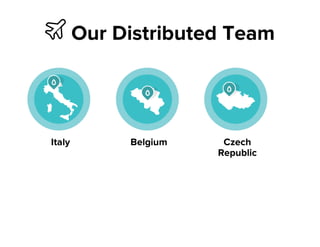
✈ Our Distributed Team
Italy Belgium Czech
Republic
ὄ Our Clients
Ὃ Our Projects
International organisations
Institutions
Fast delivery: several developers working simultaneously
on the same site
Frequent configuration changes: need for safe updates
 Challenges We Face
Remote collaboration on site development
Keeping track of all configuration changes during
development
Pushing upgrades to production sites
Chapter 1
ἱ ἴ ἳ ἲ ἱ
The Evolution of
Code-Driven Development
in Drupal 8
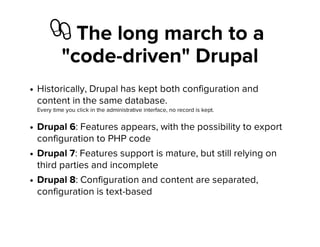
὆ The long march to a
"code-driven" Drupal
Historically, Drupal has kept both configuration and
content in the same database.
Every time you click in the administrative interface, no record is kept.
Drupal 6: Features appears, with the possibility to export
configuration to PHP code
Drupal 7: Features support is mature, but still relying on
third parties and incomplete
Drupal 8: Configuration and content are separated,
configuration is text-based
  
The database-driven
workflow disadvantages
Default in Drupal 6 and Drupal 7 (core)
Standard approach: you click, you save, Drupal saves to
database and forgets
Bad: Mixing configuration and content
Bad: Losing track of configuration changes
Theoretically still possible in Drupal 8!
 
The Features-driven
workflow disadvantages
A structural flaw: to package configuration into modules,
you need to make it exportable to "code"
Features is very good for packaging, not as good for
exporting; but there's no packaging without exporting
Not everything is exportable/traceable
You must "whitelist" elements to be tracked: you never
have the whole site under control
 
Code-driven is not just
Features
It’s a global technical choice
For example, it includes makefiles and profiles, still
applicable in D8
Keywords: text-based configuration, traceability,
repeatability, reuse
Ἲ
New in Drupal 8
Configuration Management
Ἲ
A guided example of
Configuration Management
Ἲ
Reference Use Case
Modify the configuration of a production site:
Keeping the site online all the time.
Developing/testing the new configuration on a
development copy.
Exporting the configuration changes from development
and importing them into production.
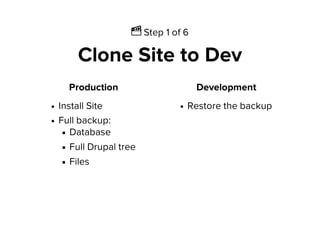
Ἲ Step 1 of 6
Clone Site to Dev
Production
Install Site
Full backup:
Database
Full Drupal tree
Files
Development
Restore the backup
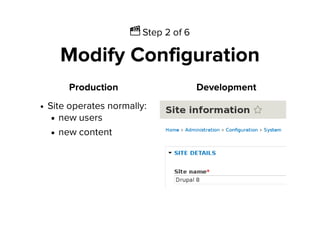
Ἲ Step 2 of 6
Modify Configuration
Production
Site operates normally:
new users
new content
Development
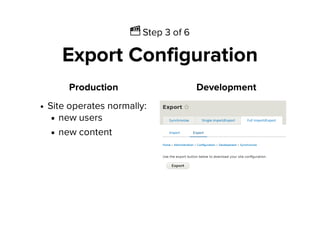
Ἲ Step 3 of 6
Export Configuration
Production
Site operates normally:
new users
new content
Development
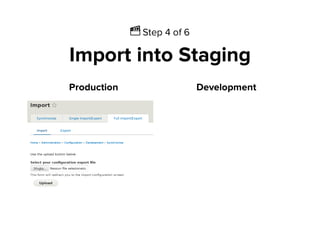
Ἲ Step 4 of 6
Import into Staging
Production Development
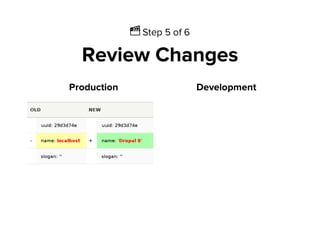
Ἲ Step 5 of 6
Review Changes
Production Development
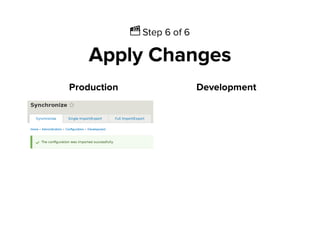
Ἲ Step 6 of 6
Apply Changes
Production Development
How this would have
worked in Drupal 7
Clone site to development environment
Create a feature exporting the site name variable
Development: update the feature
Transfer the feature to Production
Production: enable/revert the feature
drush
DRUpal SHell: everybody loves!
Drupal 8 ⇔ drush 7
Both not stable yet
A new installation method: composer
Ἲ Step 3 of 6 — Drush Style
Export Configuration
Development
$ drush config-export
The current contents of your export directory
(sites/default/files/config_H6raw/staging) will be deleted. (y/n): y
Configuration successfully exported to [success]
sites/default/files/config_H6raw/staging.
Ἲ Step 5 of 6 — Drush Style
Review Changes
Production
$ drush config-import --preview=diff
Configuration successfully exported to /tmp/drush_tmp_xy. [success]
diff -u /tmp/drush_tmp_xy/system.site.yml sites/.../staging/system.site.yml
--- /tmp/drush_tmp_xy/system.site.yml
+++ sites/default/files/config_H6raw/staging/system.site.yml
@@ -1,5 +1,5 @@
uuid: ca04efa4-51bf-4d12-8b00-e7b244b97aef
-name: 'Drupal 8'
+name: 'Amsterdam - alpha15'
mail: drupal@example.com
slogan: ''
page:
Import the listed configuration changes? (y/n):
Chapter 2

Inner workings of
Configuration Management
and Features
 Use case
Features
A collection of logically
related Drupal elements
Packaged into PHP code,
using hooks
Exportability is a
precondition to packaging
Configuration Management
Reference for the whole site
configuration, development to
production
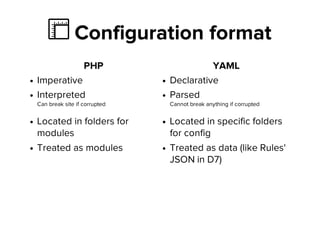
Ὄ Configuration format
PHP
Imperative
Interpreted
Can break site if corrupted
Located in folders for
modules
Treated as modules
YAML
Declarative
Parsed
Cannot break anything if corrupted
Located in specific folders
for config
Treated as data (like Rules'
JSON in D7)
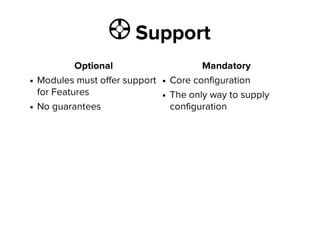
 Support
Optional
Modules must offer support
for Features
No guarantees
Mandatory
Core configuration
The only way to supply
configuration
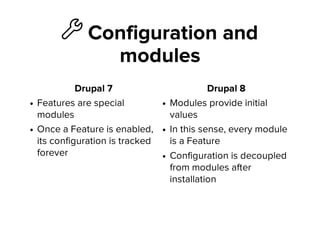
ὒ Configuration and
modules
Drupal 7
Features are special
modules
Once a Feature is enabled,
its configuration is tracked
forever
Drupal 8
Modules provide initial
values
In this sense, every module
is a Feature
Configuration is decoupled
from modules after
installation
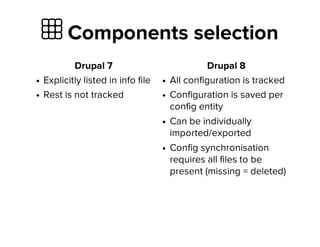
 Components selection
Drupal 7
Explicitly listed in info file
Rest is not tracked
Drupal 8
All configuration is tracked
Configuration is saved per
config entity
Can be individually
imported/exported
Config synchronisation
requires all files to be
present (missing = deleted)
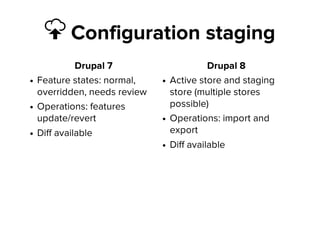
 Configuration staging
Drupal 7
Feature states: normal,
overridden, needs review
Operations: features
update/revert
Diff available
Drupal 8
Active store and staging
store (multiple stores
possible)
Operations: import and
export
Diff available

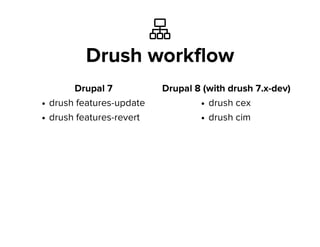
Drush workflow
Drupal 7
drush features-update
drush features-revert
Drupal 8 (with drush 7.x-dev)
drush cex
drush cim
Ἴ ⚽
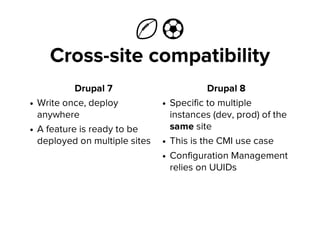
Cross-site compatibility
Drupal 7
Write once, deploy
anywhere
A feature is ready to be
deployed on multiple sites
Drupal 8
Specific to multiple
instances (dev, prod) of the
same site
This is the CMI use case
Configuration Management
relies on UUIDs
 Ὁ
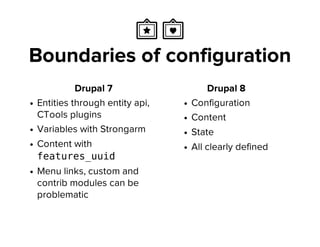
Boundaries of configuration
Drupal 7
Entities through entity api,
CTools plugins
Variables with Strongarm
Content with
features_uuid
Menu links, custom and
contrib modules can be
problematic
Drupal 8
Configuration
Content
State
All clearly defined
὎ ὎ ὎
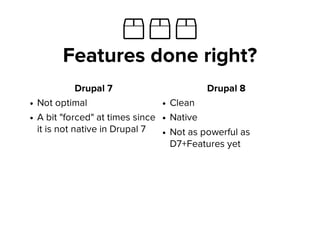
Features done right?
Drupal 7
Not optimal
A bit "forced" at times since
it is not native in Drupal 7
Drupal 8
Clean
Native
Not as powerful as
D7+Features yet
Chapter 3
 
How to build
Re-usable components

Contrib module:
Configuration development
1. Automated import of configuration files into the active
storage.
2. Automated export of configuration objects into files.
https://www.drupal.org/project/config_devel

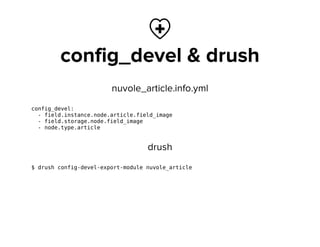
config_devel & drush
nuvole_article.info.yml
config_devel:
- field.instance.node.article.field_image
- field.storage.node.field_image
- node.type.article
drush
$ drush config-devel-export-module nuvole_article
 Features 8.x-3.x
Goes back to the core mission of Features: package
functionality for re-use.
No more project specific features!
Under development in sandbox
 Other considerations
config_devel can also “import” configuration, only
important during development of a re-usable feature
Room for another drush extension that re-installs the
default config.
Chapter 4
Ἱ
Configuration Management
For Developers
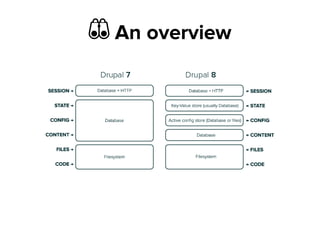
 An overview
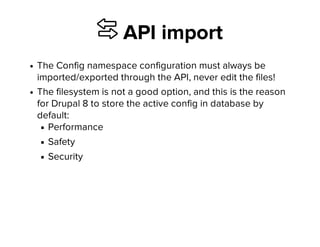
⇆ API import
The Config namespace configuration must always be
imported/exported through the API, never edit the files!
The filesystem is not a good option, and this is the reason
for Drupal 8 to store the active config in database by
default:
Performance
Safety
Security
⚙
Configurables in Drupal 8
ConfigEntityBaseclass
Two namespaces: one for config, one for content
⚙
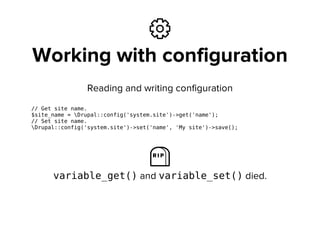
Working with configuration
Reading and writing configuration
// Get site name.
$site_name = Drupal::config('system.site')->get('name');
// Set site name.
Drupal::config('system.site')->set('name', 'My site')->save();
⛼
variable_get()and variable_set()died.
⚙
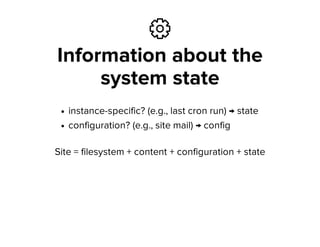
Information about the
system state
instance-specific? (e.g., last cron run) → state
configuration? (e.g., site mail) → config
Site = filesystem + content + configuration + state
⚙
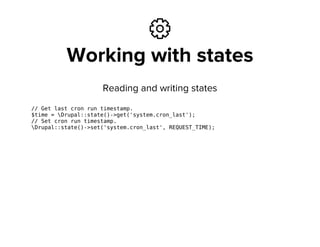
Working with states
Reading and writing states
// Get last cron run timestamp.
$time = Drupal::state()->get('system.cron_last');
// Set cron run timestamp.
Drupal::state()->set('system.cron_last', REQUEST_TIME);
⚙
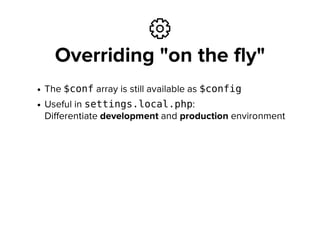
Overriding "on the fly"
The $confarray is still available as $config
Useful in settings.local.php:
Differentiate development and production environment
ὄ
Thank you!

DDAY2014 - Features per Drupal 8

  • 1.
    From Drupal 7to Drupal 8 Features vs. Configuration Management Andrea Pescetti andrea@nuvole.org Antonio De Marco antonio@nuvole.org 0
  • 2.
  • 3.
    ✈ Our DistributedTeam Italy Belgium Czech Republic
  • 4.
  • 5.
    Ὃ Our Projects Internationalorganisations Institutions Fast delivery: several developers working simultaneously on the same site Frequent configuration changes: need for safe updates
  • 6.
     Challenges WeFace Remote collaboration on site development Keeping track of all configuration changes during development Pushing upgrades to production sites
  • 7.
    Chapter 1 ἱ ἴἳ ἲ ἱ The Evolution of Code-Driven Development in Drupal 8
  • 8.
    ὆ The longmarch to a "code-driven" Drupal Historically, Drupal has kept both configuration and content in the same database. Every time you click in the administrative interface, no record is kept. Drupal 6: Features appears, with the possibility to export configuration to PHP code Drupal 7: Features support is mature, but still relying on third parties and incomplete Drupal 8: Configuration and content are separated, configuration is text-based
  • 9.
       Thedatabase-driven workflow disadvantages Default in Drupal 6 and Drupal 7 (core) Standard approach: you click, you save, Drupal saves to database and forgets Bad: Mixing configuration and content Bad: Losing track of configuration changes Theoretically still possible in Drupal 8!
  • 10.
      The Features-driven workflowdisadvantages A structural flaw: to package configuration into modules, you need to make it exportable to "code" Features is very good for packaging, not as good for exporting; but there's no packaging without exporting Not everything is exportable/traceable You must "whitelist" elements to be tracked: you never have the whole site under control
  • 11.
      Code-driven isnot just Features It’s a global technical choice For example, it includes makefiles and profiles, still applicable in D8 Keywords: text-based configuration, traceability, repeatability, reuse
  • 12.
    Ἲ New in Drupal8 Configuration Management
  • 13.
    Ἲ A guided exampleof Configuration Management
  • 14.
    Ἲ Reference Use Case Modifythe configuration of a production site: Keeping the site online all the time. Developing/testing the new configuration on a development copy. Exporting the configuration changes from development and importing them into production.
  • 15.
    Ἲ Step 1of 6 Clone Site to Dev Production Install Site Full backup: Database Full Drupal tree Files Development Restore the backup
  • 16.
    Ἲ Step 2of 6 Modify Configuration Production Site operates normally: new users new content Development
  • 17.
    Ἲ Step 3of 6 Export Configuration Production Site operates normally: new users new content Development
  • 18.
    Ἲ Step 4of 6 Import into Staging Production Development
  • 19.
    Ἲ Step 5of 6 Review Changes Production Development
  • 20.
    Ἲ Step 6of 6 Apply Changes Production Development
  • 21.
    How this wouldhave worked in Drupal 7 Clone site to development environment Create a feature exporting the site name variable Development: update the feature Transfer the feature to Production Production: enable/revert the feature
  • 22.
    drush DRUpal SHell: everybodyloves! Drupal 8 ⇔ drush 7 Both not stable yet A new installation method: composer
  • 23.
    Ἲ Step 3of 6 — Drush Style Export Configuration Development $ drush config-export The current contents of your export directory (sites/default/files/config_H6raw/staging) will be deleted. (y/n): y Configuration successfully exported to [success] sites/default/files/config_H6raw/staging.
  • 24.
    Ἲ Step 5of 6 — Drush Style Review Changes Production $ drush config-import --preview=diff Configuration successfully exported to /tmp/drush_tmp_xy. [success] diff -u /tmp/drush_tmp_xy/system.site.yml sites/.../staging/system.site.yml --- /tmp/drush_tmp_xy/system.site.yml +++ sites/default/files/config_H6raw/staging/system.site.yml @@ -1,5 +1,5 @@ uuid: ca04efa4-51bf-4d12-8b00-e7b244b97aef -name: 'Drupal 8' +name: 'Amsterdam - alpha15' mail: drupal@example.com slogan: '' page: Import the listed configuration changes? (y/n):
  • 25.
    Chapter 2  Inner workingsof Configuration Management and Features
  • 26.
     Use case Features Acollection of logically related Drupal elements Packaged into PHP code, using hooks Exportability is a precondition to packaging Configuration Management Reference for the whole site configuration, development to production
  • 27.
    Ὄ Configuration format PHP Imperative Interpreted Canbreak site if corrupted Located in folders for modules Treated as modules YAML Declarative Parsed Cannot break anything if corrupted Located in specific folders for config Treated as data (like Rules' JSON in D7)
  • 28.
     Support Optional Modules mustoffer support for Features No guarantees Mandatory Core configuration The only way to supply configuration
  • 29.
    ὒ Configuration and modules Drupal7 Features are special modules Once a Feature is enabled, its configuration is tracked forever Drupal 8 Modules provide initial values In this sense, every module is a Feature Configuration is decoupled from modules after installation
  • 30.
     Components selection Drupal7 Explicitly listed in info file Rest is not tracked Drupal 8 All configuration is tracked Configuration is saved per config entity Can be individually imported/exported Config synchronisation requires all files to be present (missing = deleted)
  • 31.
     Configuration staging Drupal7 Feature states: normal, overridden, needs review Operations: features update/revert Diff available Drupal 8 Active store and staging store (multiple stores possible) Operations: import and export Diff available
  • 32.
     Drush workflow Drupal 7 drushfeatures-update drush features-revert Drupal 8 (with drush 7.x-dev) drush cex drush cim
  • 33.
    Ἴ ⚽ Cross-site compatibility Drupal7 Write once, deploy anywhere A feature is ready to be deployed on multiple sites Drupal 8 Specific to multiple instances (dev, prod) of the same site This is the CMI use case Configuration Management relies on UUIDs
  • 34.
     Ὁ Boundaries ofconfiguration Drupal 7 Entities through entity api, CTools plugins Variables with Strongarm Content with features_uuid Menu links, custom and contrib modules can be problematic Drupal 8 Configuration Content State All clearly defined
  • 35.
    ὎ ὎ ὎ Featuresdone right? Drupal 7 Not optimal A bit "forced" at times since it is not native in Drupal 7 Drupal 8 Clean Native Not as powerful as D7+Features yet
  • 36.
    Chapter 3   Howto build Re-usable components
  • 37.
     Contrib module: Configuration development 1.Automated import of configuration files into the active storage. 2. Automated export of configuration objects into files. https://www.drupal.org/project/config_devel
  • 38.
     config_devel & drush nuvole_article.info.yml config_devel: -field.instance.node.article.field_image - field.storage.node.field_image - node.type.article drush $ drush config-devel-export-module nuvole_article
  • 39.
     Features 8.x-3.x Goesback to the core mission of Features: package functionality for re-use. No more project specific features! Under development in sandbox
  • 40.
     Other considerations config_develcan also “import” configuration, only important during development of a re-usable feature Room for another drush extension that re-installs the default config.
  • 41.
  • 42.
  • 43.
    ⇆ API import TheConfig namespace configuration must always be imported/exported through the API, never edit the files! The filesystem is not a good option, and this is the reason for Drupal 8 to store the active config in database by default: Performance Safety Security
  • 44.
    ⚙ Configurables in Drupal8 ConfigEntityBaseclass Two namespaces: one for config, one for content
  • 45.
    ⚙ Working with configuration Readingand writing configuration // Get site name. $site_name = Drupal::config('system.site')->get('name'); // Set site name. Drupal::config('system.site')->set('name', 'My site')->save(); ⛼ variable_get()and variable_set()died.
  • 46.
    ⚙ Information about the systemstate instance-specific? (e.g., last cron run) → state configuration? (e.g., site mail) → config Site = filesystem + content + configuration + state
  • 47.
    ⚙ Working with states Readingand writing states // Get last cron run timestamp. $time = Drupal::state()->get('system.cron_last'); // Set cron run timestamp. Drupal::state()->set('system.cron_last', REQUEST_TIME);
  • 48.
    ⚙ Overriding "on thefly" The $confarray is still available as $config Useful in settings.local.php: Differentiate development and production environment
  • 49.