Spain in the 19th
century
4st ESO
Maira Gil Camarón
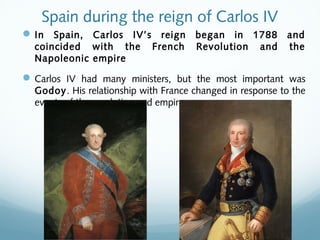
Spain during the reign of Carlos IV
In Spain, Carlos IV’s reign began in 1788 and
coincided with the French Revolution and the
Napoleonic empire
Carlos IV had many ministers, but the most important was
Godoy. His relationship with France changed in response to the
events of the revolution and empire
 1793: Spain joined the first coalition against France as a result of
Louis XVI’s execution, but France defeated the coalition
 1975: the French Revolution had moved in a more moderate
direction  Godoy allied with France against Great Britain:
Treaties of San Ildefonso (1796 and 1800): Spain promised helped
France in an invasion of Great Britain, but in 1805 the French and the
Spanish fleets were defeated by the British in the Battle of Trafalgar
 the end of Spanish naval power
Treaty of Fontainebleau (1807) allowed French troops to cross Spain
in order to occupy Portugal  Napoleon took advantage of the treaty to
occupy Spain too
 Godoy tried to move the Spanish royal family to Seville in order to
protect them, but this caused a popular revolt in March 1808 known
as the Mutiny of Aranjuez  this event forced Carlos IV to
dismiss Godoy and abdicate in favour of his son Fernando VII
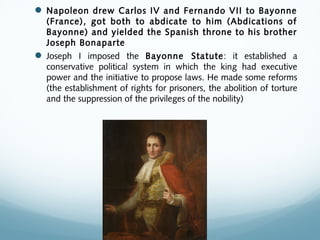
 Napoleon drew Carlos IV and Fernando VII to Bayonne
(France), got both to abdicate to him (Abdications of
Bayonne) and yielded the Spanish throne to his brother
Joseph Bonaparte
 Joseph I imposed the Bayonne Statute: it established a
conservative political system in which the king had executive
power and the initiative to propose laws. He made some reforms
(the establishment of rights for prisoners, the abolition of torture
and the suppression of the privileges of the nobility)
QUESTIONS
How did Spain react to Louis XVI’s execution?
What was the difference between the Treaties of San
Ildefonso and the Treaty of Fontainebleau?
What were the consequences of the Revolt of Aranjuez?
Draw a timeline in your notebook showing the main events of
Carlos IV’s reign
The Spanish War of Independence
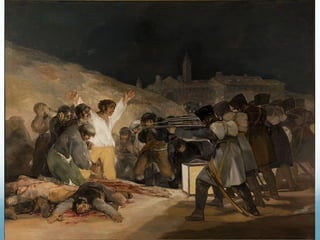
 In March 1808, French soldiers had occupied Madrid. This was very
unpopular, and on 2 May 1808 the people of Madrid rebelled
against the French army, killing many soldiers. The French responded
by executing anyone carrying a weapon
 The rebellion soon spread all over Spain. The people didn’t want
Joseph as their king and formed local and provincial councils, called
juntas, to govern the country. The juntas said that they were
governing in the name of Fernando VII
 These committees were governmental organisations whose members
were elected by the people: for the first time in Spain, people were
voting to choose their representatives. These committees were led by
the Central Council (Junta Suprema Central) that had both
executive and legislative power and represented the absent
Fernando VII
 6 June 1808, the juntas declared was on France. This was the
start of the Spanish War of Independence
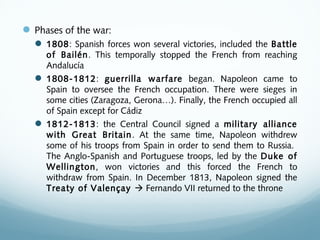
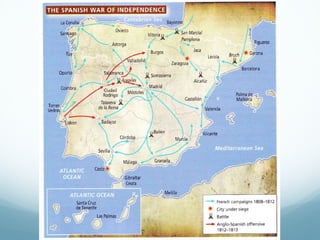
Phases of the war:
 1808: Spanish forces won several victories, included the Battle
of Bailén. This temporally stopped the French from reaching
Andalucía
 1808-1812: guerrilla warfare began. Napoleon came to
Spain to oversee the French occupation. There were sieges in
some cities (Zaragoza, Gerona…). Finally, the French occupied all
of Spain except for Cádiz
 1812-1813: the Central Council signed a military alliance
with Great Britain. At the same time, Napoleon withdrew
some of his troops from Spain in order to send them to Russia.
The Anglo-Spanish and Portuguese troops, led by the Duke of
Wellington, won victories and this forced the French to
withdraw from Spain. In December 1813, Napoleon signed the
Treaty of Valençay  Fernando VII returned to the throne
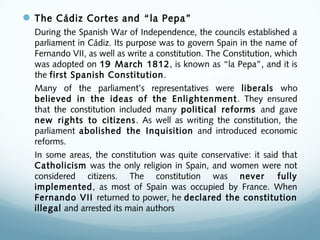
The Cádiz Cortes and “la Pepa”
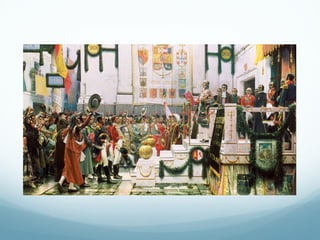
During the Spanish War of Independence, the councils established a
parliament in Cádiz. Its purpose was to govern Spain in the name of
Fernando VII, as well as write a constitution. The Constitution, which
was adopted on 19 March 1812, is known as “la Pepa”, and it is
the first Spanish Constitution.
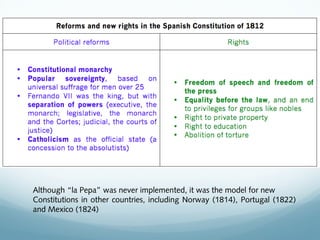
Many of the parliament’s representatives were liberals who
believed in the ideas of the Enlightenment. They ensured
that the constitution included many political reforms and gave
new rights to citizens. As well as writing the constitution, the
parliament abolished the Inquisition and introduced economic
reforms.
In some areas, the constitution was quite conservative: it said that
Catholicism was the only religion in Spain, and women were not
considered citizens. The constitution was never fully
implemented, as most of Spain was occupied by France. When
Fernando VII returned to power, he declared the constitution
illegal and arrested its main authors
Although “la Pepa” was never implemented, it was the model for new
Constitutions in other countries, including Norway (1814), Portugal (1822)
and Mexico (1824)
QUESTIONS
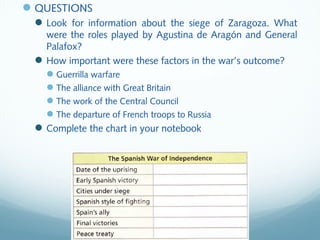
Look for information about the siege of Zaragoza. What
were the roles played by Agustina de Aragón and General
Palafox?
How important were these factors in the war’s outcome?
Guerrilla warfare
The alliance with Great Britain
The work of the Central Council
The departure of French troops to Russia
Complete the chart in your notebook
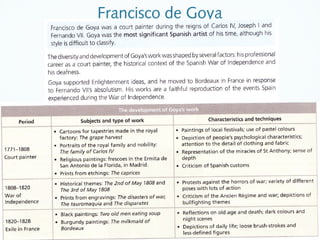
Francisco de Goya
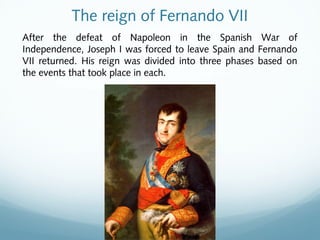
The reign of Fernando VII
After the defeat of Napoleon in the Spanish War of
Independence, Joseph I was forced to leave Spain and Fernando
VII returned. His reign was divided into three phases based on
the events that took place in each.
 ABSOLUTIST SEXENIUM (1814-1820). Absolutist phase. At the start,
Fernando VII enjoyed the support of the Spanish people, the Cádiz Cortes
and the absolutists. The Cádiz Cortes hoped he would uphold the
Constitution, while the absolutists wanted a return to the Ancient Regime,
as outlined in the Persian Manifesto. Fernando VII agreed with the
absolutists’ demands, so he dismissed the Cortes, abolished the Constitution
and re-established absolute monarchy
 LIBERAL TRIENIUM (1820-1823). Liberal phase. A period of political
instability followed, as some liberals organised military coups designed to
overthrow absolutism. In 1820, a coup led by Riego and Quiroga
succeeded. Fernando VII was forced to reinstate the Constitution of 1812
and to guarantee the freedoms that had been suppressed during the
previous phase
 OMINOUS DECADE (1823-1833). In 1833, Fernando VII asked the Holy
Alliance for assistance. They sent a French army, the 100,000 Sons of St
Louis, who defeated the liberals. Fernando VII re-established the absolute
monarchy and persecuted the liberals. There were more liberal revolts, but
non of them succeeded
Carlist Wars
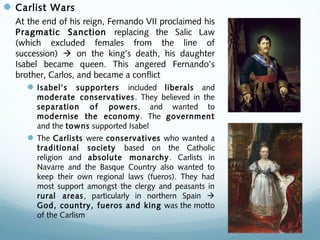
At the end of his reign, Fernando VII proclaimed his
Pragmatic Sanction replacing the Salic Law
(which excluded females from the line of
succession)  on the king’s death, his daughter
Isabel became queen. This angered Fernando’s
brother, Carlos, and became a conflict
Isabel’s supporters included liberals and
moderate conservatives. They believed in the
separation of powers, and wanted to
modernise the economy. The government
and the towns supported Isabel
The Carlists were conservatives who wanted a
traditional society based on the Catholic
religion and absolute monarchy. Carlists in
Navarre and the Basque Country also wanted to
keep their own regional laws (fueros). They had
most support amongst the clergy and peasants in
rural areas, particularly in northern Spain 
God, country, fueros and king was the motto
of the Carlism
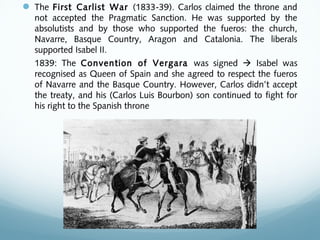
 The First Carlist War (1833-39). Carlos claimed the throne and
not accepted the Pragmatic Sanction. He was supported by the
absolutists and by those who supported the fueros: the church,
Navarre, Basque Country, Aragon and Catalonia. The liberals
supported Isabel II.
1839: The Convention of Vergara was signed  Isabel was
recognised as Queen of Spain and she agreed to respect the fueros
of Navarre and the Basque Country. However, Carlos didn’t accept
the treaty, and his (Carlos Luis Bourbon) son continued to fight for
his right to the Spanish throne
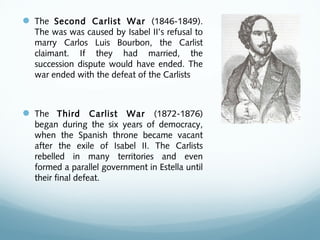
 The Second Carlist War (1846-1849).
The was was caused by Isabel II’s refusal to
marry Carlos Luis Bourbon, the Carlist
claimant. If they had married, the
succession dispute would have ended. The
war ended with the defeat of the Carlists
 The Third Carlist War (1872-1876)
began during the six years of democracy,
when the Spanish throne became vacant
after the exile of Isabel II. The Carlists
rebelled in many territories and even
formed a parallel government in Estella until
their final defeat.
Latin American Independence
In the last years of the reign of Fernando VII, the independence of the
Spanish colonies in America took place. The process was advanced by the
creoles, dissatisfied with their political marginalisation, the high taxes and
the social discrimination they faced compared to peninsular Spaniards. It was
driven by military aid from the USA and the UK. It was carried out in two
stages:
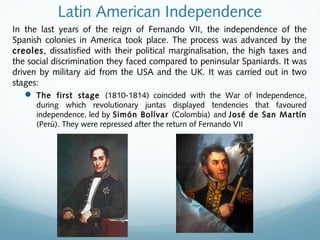
 The first stage (1810-1814) coincided with the War of Independence,
during which revolutionary juntas displayed tendencies that favoured
independence, led by Simón Bolívar (Colombia) and José de San Martín
(Perú). They were repressed after the return of Fernando VII
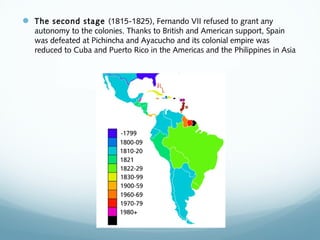
 The second stage (1815-1825), Fernando VII refused to grant any
autonomy to the colonies. Thanks to British and American support, Spain
was defeated at Pichincha and Ayacucho and its colonial empire was
reduced to Cuba and Puerto Rico in the Americas and the Philippines in Asia
The reign of Isabel II
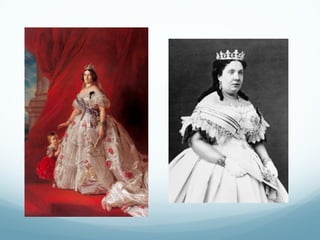
Absolutism ended in Spain with the reign of Isabel II. She
established a liberal constitutional monarchy, although it
had its own special features
The crown retained power, but this power was shared with the
Cortes, which the crown could call and dissolve. This was called shared
sovereignty
The queen was supported by the liberal political parties, the
Moderates and the Progressives. However, Isabel favoured the
Moderates, who governed for most of her reign
Various constitutions were approved, depending on which party
was in government
The military participated actively in politics, as heads of government
and ministers, and also leading military revolts to acquire more power
The regency period
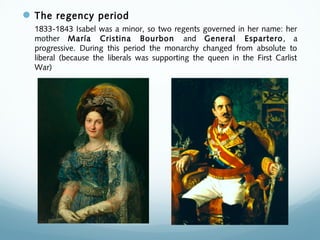
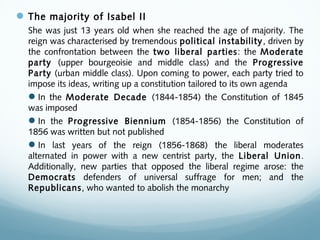
1833-1843 Isabel was a minor, so two regents governed in her name: her
mother María Cristina Bourbon and General Espartero, a
progressive. During this period the monarchy changed from absolute to
liberal (because the liberals was supporting the queen in the First Carlist
War)
The majority of Isabel II
She was just 13 years old when she reached the age of majority. The
reign was characterised by tremendous political instability, driven by
the confrontation between the two liberal parties: the Moderate
party (upper bourgeoisie and middle class) and the Progressive
Party (urban middle class). Upon coming to power, each party tried to
impose its ideas, writing up a constitution tailored to its own agenda
In the Moderate Decade (1844-1854) the Constitution of 1845
was imposed
In the Progressive Biennium (1854-1856) the Constitution of
1856 was written but not published
In last years of the reign (1856-1868) the liberal moderates
alternated in power with a new centrist party, the Liberal Union.
Additionally, new parties that opposed the liberal regime arose: the
Democrats defenders of universal suffrage for men; and the
Republicans, who wanted to abolish the monarchy
The Glorious Revolution
1868: a military revolt began in Cadiz, the Glorious Revolution, and the
queen was forced to exile. This period had three phases.
 A provisional government: Serrano (regent) and Prim (head of the
government) looked for a new king for Spain who wasn’t a Bourbon. They
also wrote a new constitution, the Constitution of 1869, the most democratic
of the century: universal manhood suffrage, freedom of religion, and
guaranteed a range of other rights and freedoms. It also established a
constitutional monarchy
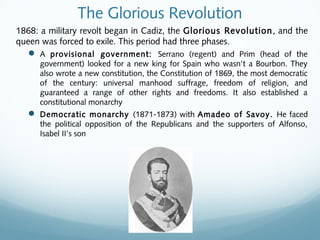
 Democratic monarchy (1871-1873) with Amadeo of Savoy. He faced
the political opposition of the Republicans and the supporters of Alfonso,
Isabel II’s son
 The First Republic (1877-1874). The Cortes proclaimed Spain a republic,
the first time that Spain was not ruled by a monarch.
The First Republic faced many problems: the third Carlist War, Alfonso’s
supporters rejected it, some revolts in Andalucia, Levante and Murcia that
demanded the creation of a federal republic…
The main problem was the division among the Republicans. They
disagreed on the type of republic they wanted:
A federal republic, divided into 17 federal states
A centralised, or unitary, republic, in which the central government
would control all the political and administrative institutions
1874 there was another military revolt which aimed to bring back the
Bourbons, and the First Republic ended

3. Spain in the 19th century

  • 1.
    Spain in the19th century 4st ESO Maira Gil Camarón
  • 2.
    Spain during thereign of Carlos IV In Spain, Carlos IV’s reign began in 1788 and coincided with the French Revolution and the Napoleonic empire Carlos IV had many ministers, but the most important was Godoy. His relationship with France changed in response to the events of the revolution and empire
  • 3.
     1793: Spainjoined the first coalition against France as a result of Louis XVI’s execution, but France defeated the coalition  1975: the French Revolution had moved in a more moderate direction  Godoy allied with France against Great Britain: Treaties of San Ildefonso (1796 and 1800): Spain promised helped France in an invasion of Great Britain, but in 1805 the French and the Spanish fleets were defeated by the British in the Battle of Trafalgar  the end of Spanish naval power Treaty of Fontainebleau (1807) allowed French troops to cross Spain in order to occupy Portugal  Napoleon took advantage of the treaty to occupy Spain too  Godoy tried to move the Spanish royal family to Seville in order to protect them, but this caused a popular revolt in March 1808 known as the Mutiny of Aranjuez  this event forced Carlos IV to dismiss Godoy and abdicate in favour of his son Fernando VII
  • 5.
     Napoleon drewCarlos IV and Fernando VII to Bayonne (France), got both to abdicate to him (Abdications of Bayonne) and yielded the Spanish throne to his brother Joseph Bonaparte  Joseph I imposed the Bayonne Statute: it established a conservative political system in which the king had executive power and the initiative to propose laws. He made some reforms (the establishment of rights for prisoners, the abolition of torture and the suppression of the privileges of the nobility)
  • 6.
    QUESTIONS How did Spainreact to Louis XVI’s execution? What was the difference between the Treaties of San Ildefonso and the Treaty of Fontainebleau? What were the consequences of the Revolt of Aranjuez? Draw a timeline in your notebook showing the main events of Carlos IV’s reign
  • 7.
    The Spanish Warof Independence  In March 1808, French soldiers had occupied Madrid. This was very unpopular, and on 2 May 1808 the people of Madrid rebelled against the French army, killing many soldiers. The French responded by executing anyone carrying a weapon  The rebellion soon spread all over Spain. The people didn’t want Joseph as their king and formed local and provincial councils, called juntas, to govern the country. The juntas said that they were governing in the name of Fernando VII  These committees were governmental organisations whose members were elected by the people: for the first time in Spain, people were voting to choose their representatives. These committees were led by the Central Council (Junta Suprema Central) that had both executive and legislative power and represented the absent Fernando VII  6 June 1808, the juntas declared was on France. This was the start of the Spanish War of Independence
  • 9.
    Phases of thewar:  1808: Spanish forces won several victories, included the Battle of Bailén. This temporally stopped the French from reaching Andalucía  1808-1812: guerrilla warfare began. Napoleon came to Spain to oversee the French occupation. There were sieges in some cities (Zaragoza, Gerona…). Finally, the French occupied all of Spain except for Cádiz  1812-1813: the Central Council signed a military alliance with Great Britain. At the same time, Napoleon withdrew some of his troops from Spain in order to send them to Russia. The Anglo-Spanish and Portuguese troops, led by the Duke of Wellington, won victories and this forced the French to withdraw from Spain. In December 1813, Napoleon signed the Treaty of Valençay  Fernando VII returned to the throne
  • 11.
    The Cádiz Cortesand “la Pepa” During the Spanish War of Independence, the councils established a parliament in Cádiz. Its purpose was to govern Spain in the name of Fernando VII, as well as write a constitution. The Constitution, which was adopted on 19 March 1812, is known as “la Pepa”, and it is the first Spanish Constitution. Many of the parliament’s representatives were liberals who believed in the ideas of the Enlightenment. They ensured that the constitution included many political reforms and gave new rights to citizens. As well as writing the constitution, the parliament abolished the Inquisition and introduced economic reforms. In some areas, the constitution was quite conservative: it said that Catholicism was the only religion in Spain, and women were not considered citizens. The constitution was never fully implemented, as most of Spain was occupied by France. When Fernando VII returned to power, he declared the constitution illegal and arrested its main authors
  • 12.
    Although “la Pepa”was never implemented, it was the model for new Constitutions in other countries, including Norway (1814), Portugal (1822) and Mexico (1824)
  • 14.
    QUESTIONS Look for informationabout the siege of Zaragoza. What were the roles played by Agustina de Aragón and General Palafox? How important were these factors in the war’s outcome? Guerrilla warfare The alliance with Great Britain The work of the Central Council The departure of French troops to Russia Complete the chart in your notebook
  • 15.
  • 16.
    The reign ofFernando VII After the defeat of Napoleon in the Spanish War of Independence, Joseph I was forced to leave Spain and Fernando VII returned. His reign was divided into three phases based on the events that took place in each.
  • 17.
     ABSOLUTIST SEXENIUM(1814-1820). Absolutist phase. At the start, Fernando VII enjoyed the support of the Spanish people, the Cádiz Cortes and the absolutists. The Cádiz Cortes hoped he would uphold the Constitution, while the absolutists wanted a return to the Ancient Regime, as outlined in the Persian Manifesto. Fernando VII agreed with the absolutists’ demands, so he dismissed the Cortes, abolished the Constitution and re-established absolute monarchy  LIBERAL TRIENIUM (1820-1823). Liberal phase. A period of political instability followed, as some liberals organised military coups designed to overthrow absolutism. In 1820, a coup led by Riego and Quiroga succeeded. Fernando VII was forced to reinstate the Constitution of 1812 and to guarantee the freedoms that had been suppressed during the previous phase  OMINOUS DECADE (1823-1833). In 1833, Fernando VII asked the Holy Alliance for assistance. They sent a French army, the 100,000 Sons of St Louis, who defeated the liberals. Fernando VII re-established the absolute monarchy and persecuted the liberals. There were more liberal revolts, but non of them succeeded
  • 18.
    Carlist Wars At theend of his reign, Fernando VII proclaimed his Pragmatic Sanction replacing the Salic Law (which excluded females from the line of succession)  on the king’s death, his daughter Isabel became queen. This angered Fernando’s brother, Carlos, and became a conflict Isabel’s supporters included liberals and moderate conservatives. They believed in the separation of powers, and wanted to modernise the economy. The government and the towns supported Isabel The Carlists were conservatives who wanted a traditional society based on the Catholic religion and absolute monarchy. Carlists in Navarre and the Basque Country also wanted to keep their own regional laws (fueros). They had most support amongst the clergy and peasants in rural areas, particularly in northern Spain  God, country, fueros and king was the motto of the Carlism
  • 19.
     The FirstCarlist War (1833-39). Carlos claimed the throne and not accepted the Pragmatic Sanction. He was supported by the absolutists and by those who supported the fueros: the church, Navarre, Basque Country, Aragon and Catalonia. The liberals supported Isabel II. 1839: The Convention of Vergara was signed  Isabel was recognised as Queen of Spain and she agreed to respect the fueros of Navarre and the Basque Country. However, Carlos didn’t accept the treaty, and his (Carlos Luis Bourbon) son continued to fight for his right to the Spanish throne
  • 20.
     The SecondCarlist War (1846-1849). The was was caused by Isabel II’s refusal to marry Carlos Luis Bourbon, the Carlist claimant. If they had married, the succession dispute would have ended. The war ended with the defeat of the Carlists  The Third Carlist War (1872-1876) began during the six years of democracy, when the Spanish throne became vacant after the exile of Isabel II. The Carlists rebelled in many territories and even formed a parallel government in Estella until their final defeat.
  • 21.
    Latin American Independence Inthe last years of the reign of Fernando VII, the independence of the Spanish colonies in America took place. The process was advanced by the creoles, dissatisfied with their political marginalisation, the high taxes and the social discrimination they faced compared to peninsular Spaniards. It was driven by military aid from the USA and the UK. It was carried out in two stages:  The first stage (1810-1814) coincided with the War of Independence, during which revolutionary juntas displayed tendencies that favoured independence, led by Simón Bolívar (Colombia) and José de San Martín (Perú). They were repressed after the return of Fernando VII
  • 22.
     The secondstage (1815-1825), Fernando VII refused to grant any autonomy to the colonies. Thanks to British and American support, Spain was defeated at Pichincha and Ayacucho and its colonial empire was reduced to Cuba and Puerto Rico in the Americas and the Philippines in Asia
  • 23.
    The reign ofIsabel II Absolutism ended in Spain with the reign of Isabel II. She established a liberal constitutional monarchy, although it had its own special features The crown retained power, but this power was shared with the Cortes, which the crown could call and dissolve. This was called shared sovereignty The queen was supported by the liberal political parties, the Moderates and the Progressives. However, Isabel favoured the Moderates, who governed for most of her reign Various constitutions were approved, depending on which party was in government The military participated actively in politics, as heads of government and ministers, and also leading military revolts to acquire more power
  • 25.
    The regency period 1833-1843Isabel was a minor, so two regents governed in her name: her mother María Cristina Bourbon and General Espartero, a progressive. During this period the monarchy changed from absolute to liberal (because the liberals was supporting the queen in the First Carlist War)
  • 26.
    The majority ofIsabel II She was just 13 years old when she reached the age of majority. The reign was characterised by tremendous political instability, driven by the confrontation between the two liberal parties: the Moderate party (upper bourgeoisie and middle class) and the Progressive Party (urban middle class). Upon coming to power, each party tried to impose its ideas, writing up a constitution tailored to its own agenda In the Moderate Decade (1844-1854) the Constitution of 1845 was imposed In the Progressive Biennium (1854-1856) the Constitution of 1856 was written but not published In last years of the reign (1856-1868) the liberal moderates alternated in power with a new centrist party, the Liberal Union. Additionally, new parties that opposed the liberal regime arose: the Democrats defenders of universal suffrage for men; and the Republicans, who wanted to abolish the monarchy
  • 27.
    The Glorious Revolution 1868:a military revolt began in Cadiz, the Glorious Revolution, and the queen was forced to exile. This period had three phases.  A provisional government: Serrano (regent) and Prim (head of the government) looked for a new king for Spain who wasn’t a Bourbon. They also wrote a new constitution, the Constitution of 1869, the most democratic of the century: universal manhood suffrage, freedom of religion, and guaranteed a range of other rights and freedoms. It also established a constitutional monarchy  Democratic monarchy (1871-1873) with Amadeo of Savoy. He faced the political opposition of the Republicans and the supporters of Alfonso, Isabel II’s son
  • 28.
     The FirstRepublic (1877-1874). The Cortes proclaimed Spain a republic, the first time that Spain was not ruled by a monarch. The First Republic faced many problems: the third Carlist War, Alfonso’s supporters rejected it, some revolts in Andalucia, Levante and Murcia that demanded the creation of a federal republic… The main problem was the division among the Republicans. They disagreed on the type of republic they wanted: A federal republic, divided into 17 federal states A centralised, or unitary, republic, in which the central government would control all the political and administrative institutions 1874 there was another military revolt which aimed to bring back the Bourbons, and the First Republic ended