Ancie
 nt
India
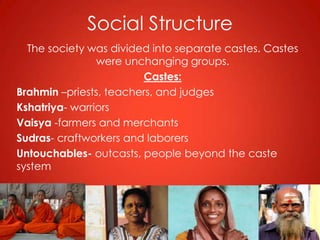
Social Structure
  The society was divided into separate castes. Castes
                were unchanging groups.
                        Castes:
Brahmin –priests, teachers, and judges
Kshatriya- warriors
Vaisya -farmers and merchants
Sudras- craftworkers and laborers
Untouchables- outcasts, people beyond the caste
system
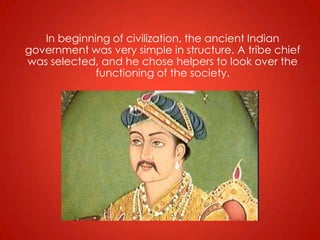
In beginning of civilization, the ancient Indian
government was very simple in structure. A tribe chief
was selected, and he chose helpers to look over the
             functioning of the society.
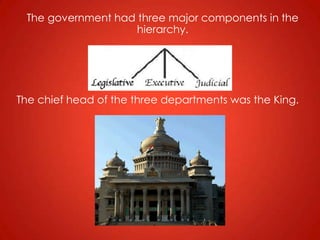
The government had three major components in the
                    hierarchy.


The chief head of the three departments was the King.
The government kept
tabs on what people
thought of the
administration by
having a secret group
of spies. The spies
roamed around in the
kingdom in disguise.
There were regular
updates of
population, birth rate,
death rate, etc.
Despite a huge
empire, administration
was controlled and
highly effective in
ancient India.
The caste system restricted
people from changing
their occupation and
aspiring for an upper
caste's lifestyle.

In towns and urban
centers trade took place
with coins but in villages
barter was the main
system of economic
activities.

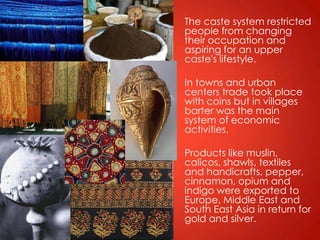
Products like muslin,
calicos, shawls, textiles
and handicrafts, pepper,
cinnamon, opium and
indigo were exported to
Europe, Middle East and
South East Asia in return for
gold and silver.
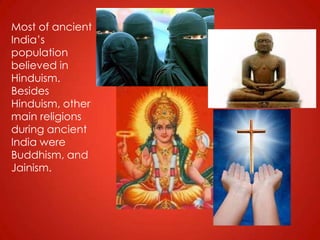
Most of ancient
India’s
population
believed in
Hinduism.
Besides
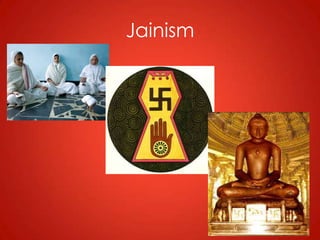
Hinduism, other
main religions
during ancient
India were
Buddhism, and
Jainism.
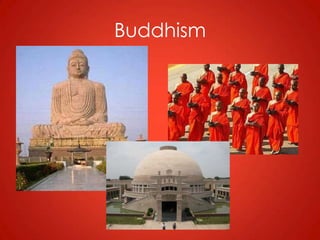
Buddhism
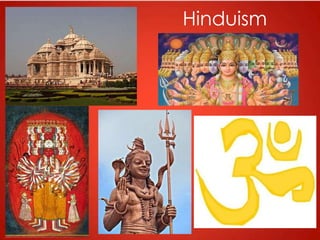
Hinduism
Jainism
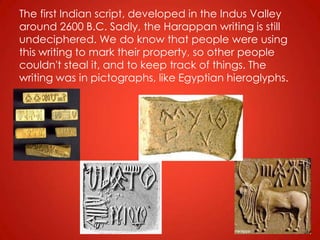
The first Indian script, developed in the Indus Valley
around 2600 B.C. Sadly, the Harappan writing is still
undeciphered. We do know that people were using
this writing to mark their property, so other people
couldn't steal it, and to keep track of things. The
writing was in pictographs, like Egyptian hieroglyphs.
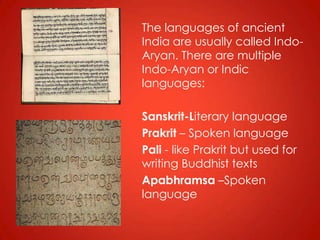
The languages of ancient
India are usually called Indo-
Aryan. There are multiple
Indo-Aryan or Indic
languages:

Sanskrit-Literary language
Prakrit – Spoken language
Pali - like Prakrit but used for
writing Buddhist texts
Apabhramsa –Spoken
language
Ancient india presentation

Ancient india presentation

  • 1.
  • 2.
    Social Structure The society was divided into separate castes. Castes were unchanging groups. Castes: Brahmin –priests, teachers, and judges Kshatriya- warriors Vaisya -farmers and merchants Sudras- craftworkers and laborers Untouchables- outcasts, people beyond the caste system
  • 3.
    In beginning ofcivilization, the ancient Indian government was very simple in structure. A tribe chief was selected, and he chose helpers to look over the functioning of the society.
  • 4.
    The government hadthree major components in the hierarchy. The chief head of the three departments was the King.
  • 6.
    The government kept tabson what people thought of the administration by having a secret group of spies. The spies roamed around in the kingdom in disguise. There were regular updates of population, birth rate, death rate, etc. Despite a huge empire, administration was controlled and highly effective in ancient India.
  • 7.
    The caste systemrestricted people from changing their occupation and aspiring for an upper caste's lifestyle. In towns and urban centers trade took place with coins but in villages barter was the main system of economic activities. Products like muslin, calicos, shawls, textiles and handicrafts, pepper, cinnamon, opium and indigo were exported to Europe, Middle East and South East Asia in return for gold and silver.
  • 8.
    Most of ancient India’s population believedin Hinduism. Besides Hinduism, other main religions during ancient India were Buddhism, and Jainism.
  • 9.
  • 10.
  • 12.
  • 14.
    The first Indianscript, developed in the Indus Valley around 2600 B.C. Sadly, the Harappan writing is still undeciphered. We do know that people were using this writing to mark their property, so other people couldn't steal it, and to keep track of things. The writing was in pictographs, like Egyptian hieroglyphs.
  • 15.
    The languages ofancient India are usually called Indo- Aryan. There are multiple Indo-Aryan or Indic languages: Sanskrit-Literary language Prakrit – Spoken language Pali - like Prakrit but used for writing Buddhist texts Apabhramsa –Spoken language