The Albert Einstein’s presents…
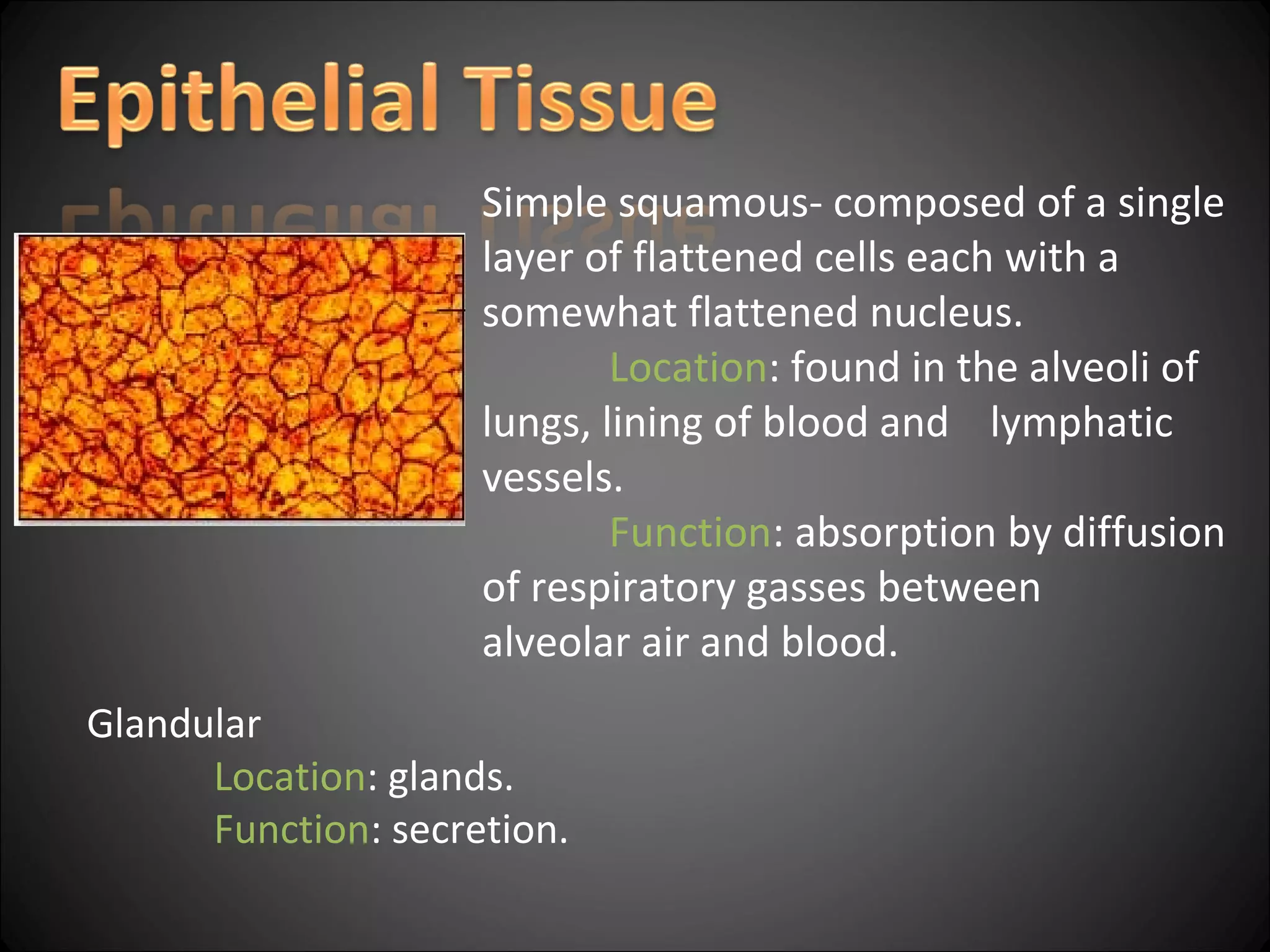
Simple squamous- composed of a single
                     layer of flattened cells each with a
                     somewhat flattened nucleus.
                             Location: found in the alveoli of
                     lungs, lining of blood and lymphatic
                     vessels.
                             Function: absorption by diffusion
                     of respiratory gasses between
                     alveolar air and blood.
Glandular
      Location: glands.
      Function: secretion.
Cont.


Stratified squamous- consists of multiple layers
of cells with the surface cells flattened and the
deeper cells cuboidal.
        Location: surface of mucus membrane
        lining mouth, esophagus, and vagina,
        surface of skin.
        Function: absorption by diffusion of
        respiratory gasses between alveolar air
        and blood.
Cont.


                         Transitional- consists of two or more layers
                         of cells with the basal cells being mostly
                         cuboidal and surface cells varying size.
                                 Location: surface of mucus
                         membrane lining the urinary          bladder
                         and ureters.
                                 Function: permits stretching.
Simple columnar- composed of a single
layer of tall, thin cells.
       Location: surface layer of mucus
       lining of stomach, intestines, and
       part of the respiratory tract.
       Function: protection; secretion;
       absorption; moving of mucus.
Cont.


Stratified columnar- consists of two or more
layers of cells, typically with columnar surface
cells resting upon cuboidal basal cells.
         Location: lining of portions of the male
         urethra; mucous membrane near anus.
         Function: protection.
                      Pseudostratified- frequently contain goblet cells
                      and cilia. Appears stratified because the nuclei are
                      staggered and appear at many levels.
                              Location: surface of mucous membrane
                              lining the trachea, large bronchi, nasal
                              mucosa, & large parts of the male
                      reproductive tract; lines large ducts of      some
                      glands.
                              Function: protection.
Cont.


                      Simple cuboidal- consists of a single layer of
                      cells squarish in profile.
                              Location: ducts and tubes of many
                      organs, including exocrine glands and
                      kidneys.
                              Function: secretion; absorption.

Stratified cuboidal- consist of two or more
layers of cuboidal cells.
        Location: ducts of sweat glands;
lining of pharynx; covering portion of
epiglottis.
        Function: protection.
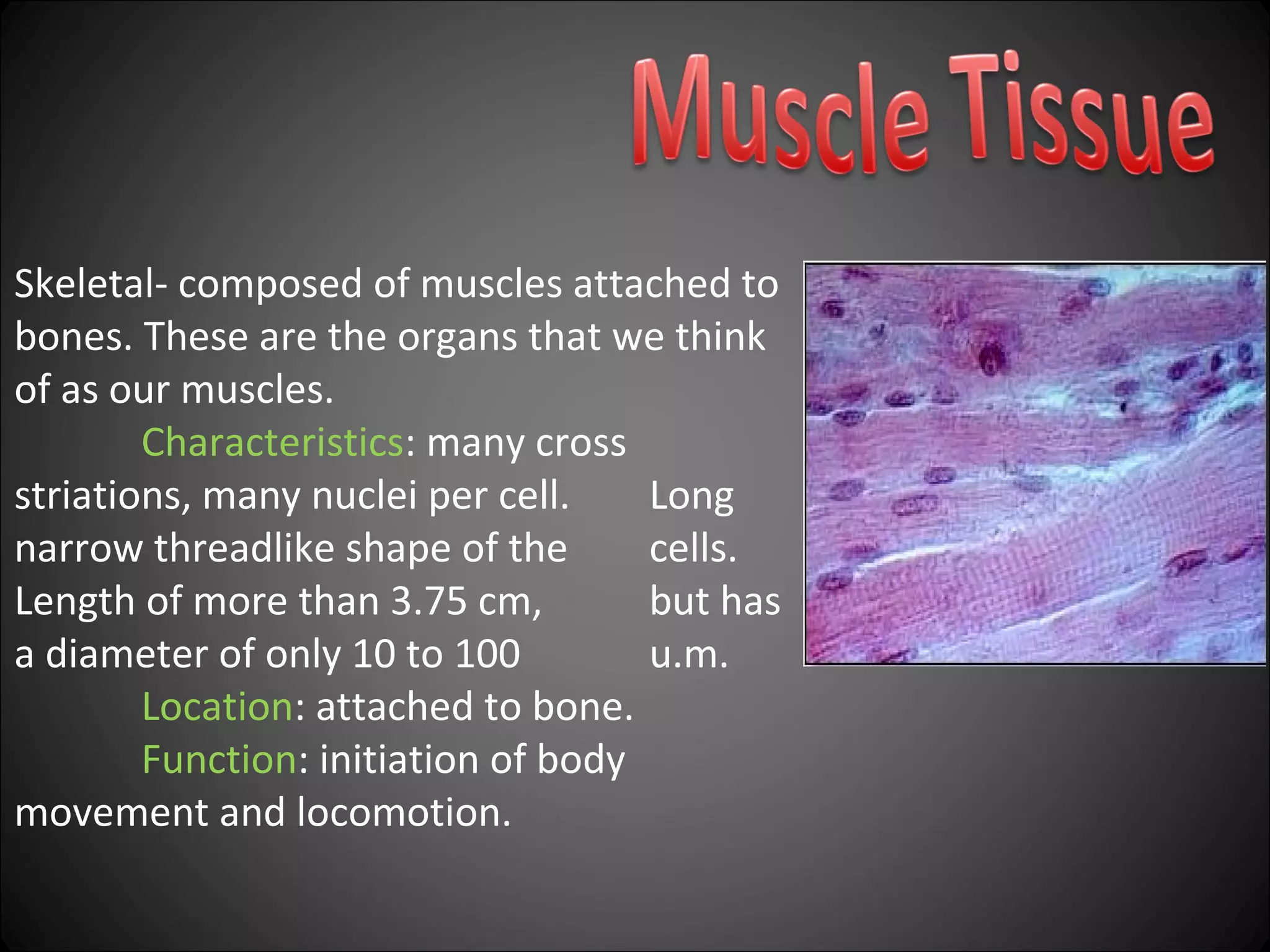
Skeletal- composed of muscles attached to
bones. These are the organs that we think
of as our muscles.
        Characteristics: many cross
striations, many nuclei per cell.    Long
narrow threadlike shape of the       cells.
Length of more than 3.75 cm,         but has
a diameter of only 10 to 100         u.m.
        Location: attached to bone.
        Function: initiation of body
movement and locomotion.
Cont.


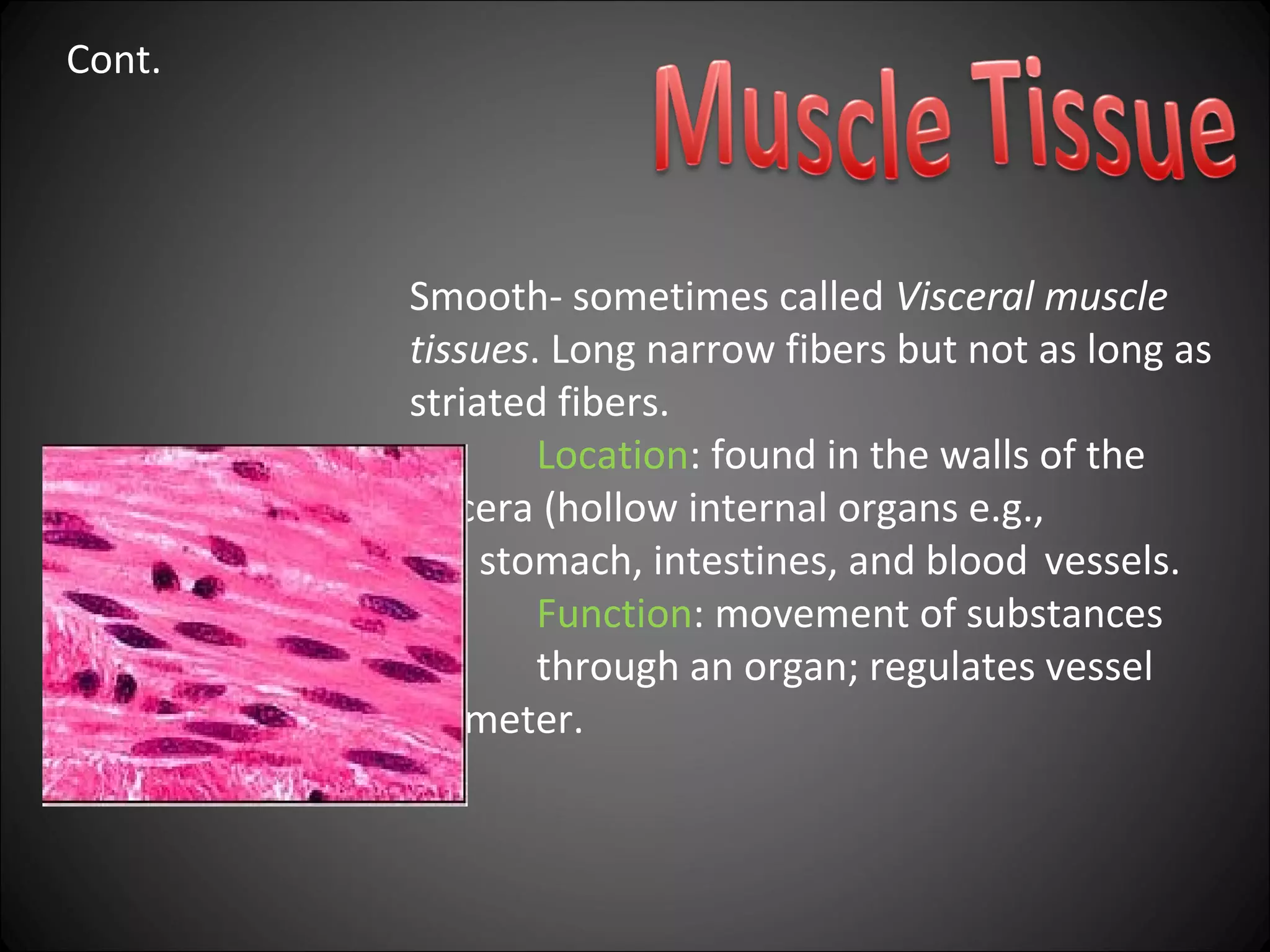
        Smooth- sometimes called Visceral muscle
        tissues. Long narrow fibers but not as long as
        striated fibers.
                Location: found in the walls of the
        viscera (hollow internal organs e.g.,
        the stomach, intestines, and blood vessels.
                Function: movement of substances
                through an organ; regulates vessel
        diameter.
Cont.


Cardiac- also called striated voluntary
muscle; makes up the wall of the heart.
Cardiac tissue consists of cross striations
and unique dark bands. The cells are
shorter, branched, and each cell has one
nucleus that is centrally located and are
joined end to end by junctions called
intercalated discs.
       Location: heart.
       Function: contraction of heart.
Consists of neurons (nerve cells) and
neuroglial cells. Neurons are
specialized to transmit electrical
signals and contain 3 principal parts:
the soma, dendrites, and one axon
(or nerve fiber).
        Location: brain, spinal cord,
and peripheral nerves.
        Function: detect stimuli,
respond, and transmit
information to other cells.
Reticular- consists of branching fibers and
fibroblasts.
       Location: stroma of spleen, liver,
lymph nodes, and thymus
       Function: support


                         Dense Regular- consists of closely packed
                         parallel collagen fibers and fibroblasts
                         interspersed between the fibers.
                                Location: tendons; ligaments.
                                Function: strong support.
Cont.


                      Dense Irregular- similar to dense regular
                      except that the collagen fibers do not
                      exhibit a consistent pattern.
                             Location: dermis; sheaths around
                             bones, nerves and cartilages.
                             Function: strong support.
Adipose- consists of adipocytes, which store
fat droplets.
       Location: subcutaneous region, bone
       marrow, and mesenteries
       Function: lipid storage;
thermoregulation; protection.
Cont.


 Hyaline Cartilage- contains chondrocytes in
 lacunae and a matrix of fine collagen fibers
 that are not visible.
        Location: fetal skeleton; covering of
        bones at joints; end of ribs
        Function: flexible support

                       Elastic Cartilage- contains chondrocytes in
                       lacunae and a matrix of collagen fibers with
                       elastic fibers randomly oriented.
                               Location: outer ear; epiglottis;
                       Eustachian tube
                               Function: flexible support
Cont.


                       Fibrocartilage- consists of parallel fibers
                       of collagen fibers with chondrocytes in
                       lacunae interspersed.
                               Location: intervertebral discs;
                               pubic symphysis
                               Function: firm support


 Compact bone- dense calcified tissue with
 no spaces visible to the naked eye.
        Location: outer surface and shaft of
        bone.
        Function: support.
Cont.


                       Blood- liquid connective tissue that travels
                       through vessels. Consists of a liquid matrix
                       called plasma, cells, and cell fragments
                       referred to as formed elements.
                               Location: within blood vessels, bone
                       marrow, blood sinuses.
                               Function: transportation, immunity.


    Loose Fibrous
            Location: beneath skin, between
    muscles, beneath epithelial tissues
            Function: binds organs together,
    holds tissue fluids

Anatomy body tissues

  • 1.
  • 2.
    Simple squamous- composedof a single layer of flattened cells each with a somewhat flattened nucleus. Location: found in the alveoli of lungs, lining of blood and lymphatic vessels. Function: absorption by diffusion of respiratory gasses between alveolar air and blood. Glandular Location: glands. Function: secretion.
  • 3.
    Cont. Stratified squamous- consistsof multiple layers of cells with the surface cells flattened and the deeper cells cuboidal. Location: surface of mucus membrane lining mouth, esophagus, and vagina, surface of skin. Function: absorption by diffusion of respiratory gasses between alveolar air and blood.
  • 4.
    Cont. Transitional- consists of two or more layers of cells with the basal cells being mostly cuboidal and surface cells varying size. Location: surface of mucus membrane lining the urinary bladder and ureters. Function: permits stretching. Simple columnar- composed of a single layer of tall, thin cells. Location: surface layer of mucus lining of stomach, intestines, and part of the respiratory tract. Function: protection; secretion; absorption; moving of mucus.
  • 5.
    Cont. Stratified columnar- consistsof two or more layers of cells, typically with columnar surface cells resting upon cuboidal basal cells. Location: lining of portions of the male urethra; mucous membrane near anus. Function: protection. Pseudostratified- frequently contain goblet cells and cilia. Appears stratified because the nuclei are staggered and appear at many levels. Location: surface of mucous membrane lining the trachea, large bronchi, nasal mucosa, & large parts of the male reproductive tract; lines large ducts of some glands. Function: protection.
  • 6.
    Cont. Simple cuboidal- consists of a single layer of cells squarish in profile. Location: ducts and tubes of many organs, including exocrine glands and kidneys. Function: secretion; absorption. Stratified cuboidal- consist of two or more layers of cuboidal cells. Location: ducts of sweat glands; lining of pharynx; covering portion of epiglottis. Function: protection.
  • 7.
    Skeletal- composed ofmuscles attached to bones. These are the organs that we think of as our muscles. Characteristics: many cross striations, many nuclei per cell. Long narrow threadlike shape of the cells. Length of more than 3.75 cm, but has a diameter of only 10 to 100 u.m. Location: attached to bone. Function: initiation of body movement and locomotion.
  • 8.
    Cont. Smooth- sometimes called Visceral muscle tissues. Long narrow fibers but not as long as striated fibers. Location: found in the walls of the viscera (hollow internal organs e.g., the stomach, intestines, and blood vessels. Function: movement of substances through an organ; regulates vessel diameter.
  • 9.
    Cont. Cardiac- also calledstriated voluntary muscle; makes up the wall of the heart. Cardiac tissue consists of cross striations and unique dark bands. The cells are shorter, branched, and each cell has one nucleus that is centrally located and are joined end to end by junctions called intercalated discs. Location: heart. Function: contraction of heart.
  • 10.
    Consists of neurons(nerve cells) and neuroglial cells. Neurons are specialized to transmit electrical signals and contain 3 principal parts: the soma, dendrites, and one axon (or nerve fiber). Location: brain, spinal cord, and peripheral nerves. Function: detect stimuli, respond, and transmit information to other cells.
  • 11.
    Reticular- consists ofbranching fibers and fibroblasts. Location: stroma of spleen, liver, lymph nodes, and thymus Function: support Dense Regular- consists of closely packed parallel collagen fibers and fibroblasts interspersed between the fibers. Location: tendons; ligaments. Function: strong support.
  • 12.
    Cont. Dense Irregular- similar to dense regular except that the collagen fibers do not exhibit a consistent pattern. Location: dermis; sheaths around bones, nerves and cartilages. Function: strong support. Adipose- consists of adipocytes, which store fat droplets. Location: subcutaneous region, bone marrow, and mesenteries Function: lipid storage; thermoregulation; protection.
  • 13.
    Cont. Hyaline Cartilage-contains chondrocytes in lacunae and a matrix of fine collagen fibers that are not visible. Location: fetal skeleton; covering of bones at joints; end of ribs Function: flexible support Elastic Cartilage- contains chondrocytes in lacunae and a matrix of collagen fibers with elastic fibers randomly oriented. Location: outer ear; epiglottis; Eustachian tube Function: flexible support
  • 14.
    Cont. Fibrocartilage- consists of parallel fibers of collagen fibers with chondrocytes in lacunae interspersed. Location: intervertebral discs; pubic symphysis Function: firm support Compact bone- dense calcified tissue with no spaces visible to the naked eye. Location: outer surface and shaft of bone. Function: support.
  • 15.
    Cont. Blood- liquid connective tissue that travels through vessels. Consists of a liquid matrix called plasma, cells, and cell fragments referred to as formed elements. Location: within blood vessels, bone marrow, blood sinuses. Function: transportation, immunity. Loose Fibrous Location: beneath skin, between muscles, beneath epithelial tissues Function: binds organs together, holds tissue fluids