


Access and Analytics to the UK Web Archive Lewis Crawford, Web Archive Technical Lead The British Library
Introduction This talk will cover: Background of the UK Web Archive Traditional access methods to Web Archives Full text search for resource discovery Problems of scale – needles and haystacks
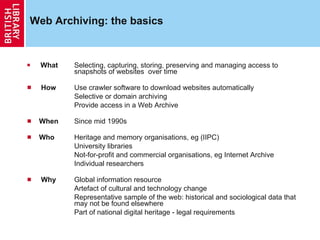
Web Archiving: the basics What Selecting, capturing, storing, preserving and managing access to  snapshots of websites  over time How Use crawler software to download websites automatically Selective or domain archiving  Provide access in a Web Archive When Since mid 1990s  Who Heritage and memory organisations, eg (IIPC) University libraries  Not-for-profit and commercial organisations, eg Internet Archive Individual researchers Why   Global information resource Artefact of cultural and technology change Representative sample of the web: historical and sociological data that  may not be found elsewhere Part of national digital heritage - legal requirements
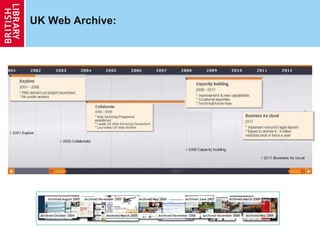
UK Web Archive:
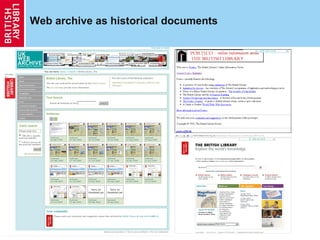
Web archive as historical documents
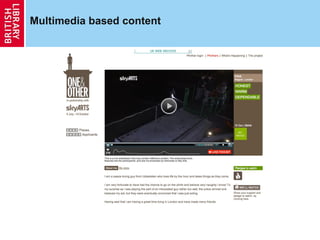
Multimedia based content
3D visualisation wall
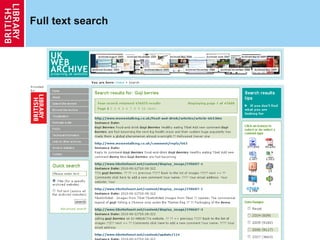
Full text search
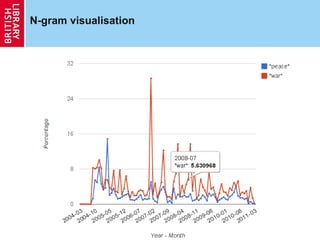
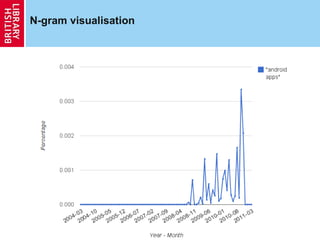
N-gram visualisation
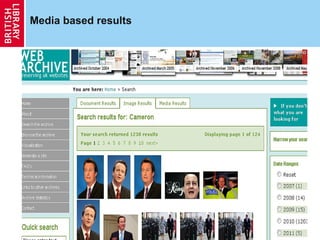
Media based results
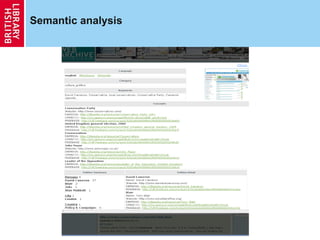
Semantic analysis
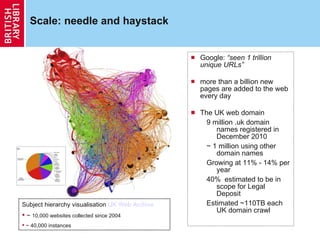
Scale: needle and haystack   Google:  “seen 1 trillion unique URLs” more than a billion new pages are added to the web every day  The UK web domain 9 million .uk domain names registered in December 2010 ~ 1 million using other domain names Growing at 11% - 14% per year 40%  estimated to be in scope for Legal Deposit Estimated ~110TB each UK domain crawl Subject hierarchy visualisation  UK Web Archive ~  10,000 websites collected since 2004 ~ 40,000 instances
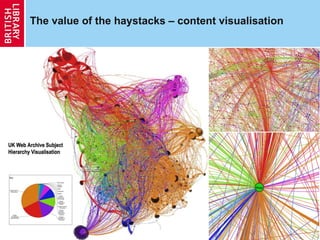
The value of the haystacks – content visualisation
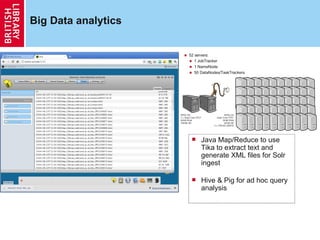
Big Data analytics Java Map/Reduce to use Tika to extract text and generate XML files for Solr ingest Hive & Pig for ad hoc query analysis
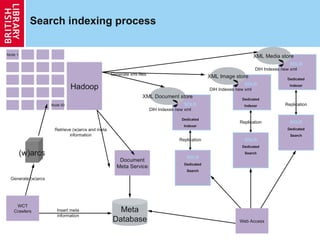
Search indexing process SOLR Dedicated Indexer SOLR Dedicated Search Hadoop Node 1 Node 50 (w)arcs Document Meta Service Meta Database XML Document store Web Access Replication WCT Crawlers Generate (w)arcs Insert meta information Retrieve (w)arcs and meta information Generate xml files DIH Indexes new xml SOLR Dedicated Indexer XML Image store DIH Indexes new xml SOLR Dedicated Indexer XML Media store DIH Indexes new xml SOLR Dedicated Search SOLR Dedicated Search Replication Replication
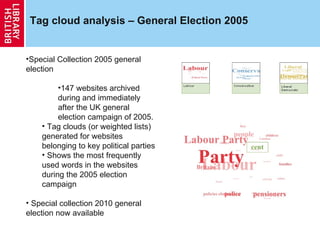
Tag cloud analysis – General Election 2005 Special Collection 2005 general election  147 websites archived during and immediately after the UK general election campaign of 2005.  Tag clouds (or weighted lists) generated for websites belonging to key political parties Shows the most frequently used words in the websites during the 2005 election campaign Special collection 2010 general election now available
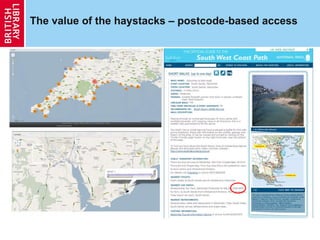
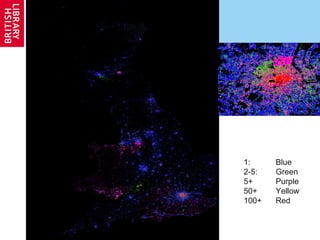
The value of the haystacks – postcode-based access
1: Blue 2-5: Green 5+ Purple 50+ Yellow 100+ Red
Questions? Thank you. http://www.webarchive.org.uk [email_address] @relephantdata

Analytics and Access to the UK web archive

  • 1.
    Access and Analyticsto the UK Web Archive Lewis Crawford, Web Archive Technical Lead The British Library
  • 2.
    Introduction This talkwill cover: Background of the UK Web Archive Traditional access methods to Web Archives Full text search for resource discovery Problems of scale – needles and haystacks
  • 3.
    Web Archiving: thebasics What Selecting, capturing, storing, preserving and managing access to snapshots of websites over time How Use crawler software to download websites automatically Selective or domain archiving Provide access in a Web Archive When Since mid 1990s Who Heritage and memory organisations, eg (IIPC) University libraries Not-for-profit and commercial organisations, eg Internet Archive Individual researchers Why Global information resource Artefact of cultural and technology change Representative sample of the web: historical and sociological data that may not be found elsewhere Part of national digital heritage - legal requirements
  • 4.
  • 5.
    Web archive ashistorical documents
  • 6.
  • 7.
  • 8.
  • 9.
  • 10.
  • 11.
  • 12.
  • 13.
    Scale: needle andhaystack Google: “seen 1 trillion unique URLs” more than a billion new pages are added to the web every day The UK web domain 9 million .uk domain names registered in December 2010 ~ 1 million using other domain names Growing at 11% - 14% per year 40% estimated to be in scope for Legal Deposit Estimated ~110TB each UK domain crawl Subject hierarchy visualisation UK Web Archive ~ 10,000 websites collected since 2004 ~ 40,000 instances
  • 14.
    The value ofthe haystacks – content visualisation
  • 15.
    Big Data analyticsJava Map/Reduce to use Tika to extract text and generate XML files for Solr ingest Hive & Pig for ad hoc query analysis
  • 16.
    Search indexing processSOLR Dedicated Indexer SOLR Dedicated Search Hadoop Node 1 Node 50 (w)arcs Document Meta Service Meta Database XML Document store Web Access Replication WCT Crawlers Generate (w)arcs Insert meta information Retrieve (w)arcs and meta information Generate xml files DIH Indexes new xml SOLR Dedicated Indexer XML Image store DIH Indexes new xml SOLR Dedicated Indexer XML Media store DIH Indexes new xml SOLR Dedicated Search SOLR Dedicated Search Replication Replication
  • 17.
    Tag cloud analysis– General Election 2005 Special Collection 2005 general election 147 websites archived during and immediately after the UK general election campaign of 2005. Tag clouds (or weighted lists) generated for websites belonging to key political parties Shows the most frequently used words in the websites during the 2005 election campaign Special collection 2010 general election now available
  • 18.
    The value ofthe haystacks – postcode-based access
  • 19.
    1: Blue 2-5:Green 5+ Purple 50+ Yellow 100+ Red
  • 20.
    Questions? Thank you.http://www.webarchive.org.uk [email_address] @relephantdata

Editor's Notes

  • #2 Header text here... Footer text here... Page Footer text here...
  • #5 Header text here... Footer text here... Page Footer text here...
  • #6 Header text here... Footer text here... Page
  • #7 Header text here... Footer text here... Page
  • #8 Header text here... Footer text here... Page Footer text here...
  • #9 Header text here... Footer text here... Page
  • #10 Header text here... Footer text here... Page Footer text here...
  • #11 Header text here... Footer text here... Page Footer text here...
  • #12 Header text here... Footer text here... Page
  • #13 Header text here... Footer text here... Page
  • #16 Header text here... Footer text here... Page
  • #18 Header text here... Footer text here... Page Footer text here...
  • #19 Header text here... Footer text here... Page
  • #20 Header text here... Footer text here... Page