GROUP 1 CLASS B
Challenges involved in development of an IPC Protocol
MEMBERS NAMES REGISTRATION NUMBERS SIGNITURES
TUMURAMYE EDGAR 2020-08-00233
YIGA GODFREY 2020-08-00234
NAMATOVU HARRIET 2020-08-00237
LOWUDE DANIEL 2020-08-00243
KANYI REHEMA SOWALI 2020-08-00247
NANZALA LILLIAN 2020-08-00255
OPAKASI OBED ORENA 2020-08-00265
WASAGALI LINDA ESELI 2020-08-00266
MWANJE STEVEN 2020-08-00270
MUBIRU KEN DOUGLUS 2020-08-00272
OGWANG ROBINSON 2020-08-00273
KAINERUGABA TRAVIS EFRAIM 2020-08-00271
introduction
• infection prevention and control (IPC) is a practical evidence-based
approach of preventing patients and health workers from being harmed by
avoidable infections.it aims at minimizing the spread and transmission of
infectious disease agents within the health facility and the community.
• To achieve this, guidelines, procedures or protocols are established at
healthcare facility level, district levels, national level (by ministry of health)
and worldwide by the World Health Organization.
• therefore, Infection prevention and control protocols are approved policies,
procedures, guidelines and plans put in place to safeguard the healthcare
providers and the public from exposures to infectious disease agents. This
protocol is needed in case there is none in existence there is a change in
clinical practice, facilities or a new disease.
Stapes in development of IPC protocol
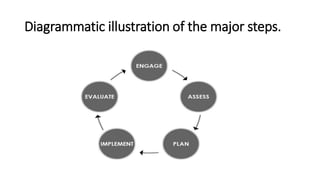
• Engage stakeholders
• Assess the situation
• plan IPC efforts
• implementation
• evaluation of progress
Diagrammatic illustration of the major steps.
Engaging stakeholders
• The project of developing an IPC protocol begins with engaging
stakeholders for example the healthcare facility administration,
management and the staff leadership, Pluss the healthcare facility
staff like nurses, laboratory technicians, surgeons, cleaners etc. The
expected outcomes of the project should then be agreed upon
together by the relevant authorities.
Possible challenges
Failure to coordinate and cooperate with the stakeholders since their
primary role in this project is to ensure that the objective is achieved
by contributing their experience and perspective to the project of
formulation of the IPC protocol.
Lack of support both financially and infrastructure necessary to
perform the project which in turn hinders surveillance, staff
education and staff training which requires quite a lot of money.
Limited devotion from health care facility staff towards the project,
this in turn create gaps in-between the project initiators and the rest
of the staff
Assessment of IPC practice
• An initial assessment of IPC practice and healthcare associated
infections serves both to identify the areas for improvement and also
supply baseline information against which to compare findings from
later evaluation.
• Already existing protocol is reviewed and any element that’s no
longer applicable is removed or not based on evidence. New
elements are then added based on existing evidence
Possible challenges
Irregular data review and failure to take necessary measures to
correct the loopholes in already existing protocol
Lack of evidence-based data
The type of the assessment depends on the resources available and
the scope of the programme or intended interventions, therefore
limited resources hinders the progress of the formulation project.
Lack of proper information about mode of transmission of the
targeted infectious agents
Planning of IPC efforts
• The multi-stakeholder committee then plans to implement the core
components of infection prevention and control and determines
which interventions to use in the process to form a sustainable effort.
Possible challenges when choosing tools and
study strategies.
• Inadequate local data to base on especially on existing cultural structures of the
healthcare facilities especially IPC protocols that are nationwide sometimes
become difficult to implement since not all healthcare facilities have similar
structures.
• Inadequate study of the targeted population on factors like population size,
religious denominations and age brackets. Some protocols face challenges during
implementation due to this factor for example the use of alcohol-based sanitizers
in mosques was a challenge during COVID-19 crisis
• limited resources available to conduct education outreach visits, interactive
educational meetings and printed educational materials. Insufficient funds and
poor infrastructure make it difficult to reach out the targeted population
• long duration taken to approve the IPC protocol proposal since thorough cross-
checking are made before the proposal is approved for implementation which is
likely to affect planning in emergency cases like pandemic outbreak e.g. covid19
Implementation
• in this stage, the protocol is put into use interventions are piloted to test the effectiveness
and necessary adjustment are made to the new protocol
possible challenges
• lack of proper sensitization of the public which reduces adherence to the formulated
protocols especially limited taskforce, inaccessibility to media by the rural communities
• existence of gaps between what is expected and what is actually done, this is because in real
life there are unseen problems that can arise. This can easily be seen during emergency cases
where health workers forget to use PPEs
• insufficient personal protective equipments used during implementation which exposes the
taskforce to risk of contracting infections. This is very common in public health centers where
patients are asked to provide some of the PPEs like gloves.
• lack of proper communications to those involved either directly or indirectly especially
through media. this makes implementation difficult since the message is likely not to reach
the targeted group.
• poor risk assessment that can result into failure to recognize inherent risks that might occur
during implementation. for example the recent Ebola virus disease in mubende and kassanda
has ended up claiming lives of healthcare workers including our own KIU masters student
DR.Muhammed Ali (RIP)
evaluation of progress
monitoring and evaluation provides an insight into the impact of the
program and can identify aspects that might need improvement
possible challenges
• poor data collection methods for example taking samples to represent a
large study group at times gives inaccurate results
• improper analysis and interpretation of data collected from the community
during the investigations
• Failure to communicate the results and provide feedback to collaborating
partners or stakeholders especially the hospital management or the
government ministry of health partners like USAID
Bibliography
• World Health Organisation.Infection prevention and control course
series; https//openwho.org/channels/IPC
• internal society for infectious diseases-ISID; guide to infection control
in health care setting. Https//isid.org/guide/
• World Health Organization, Resource consideration for improvement
in health care facilities.
• https//www.who.int/publications-detail-redirect/9789240025882.
(2021)

IPC protocol.pptx

  • 1.
    GROUP 1 CLASSB Challenges involved in development of an IPC Protocol
  • 2.
    MEMBERS NAMES REGISTRATIONNUMBERS SIGNITURES TUMURAMYE EDGAR 2020-08-00233 YIGA GODFREY 2020-08-00234 NAMATOVU HARRIET 2020-08-00237 LOWUDE DANIEL 2020-08-00243 KANYI REHEMA SOWALI 2020-08-00247 NANZALA LILLIAN 2020-08-00255 OPAKASI OBED ORENA 2020-08-00265 WASAGALI LINDA ESELI 2020-08-00266 MWANJE STEVEN 2020-08-00270 MUBIRU KEN DOUGLUS 2020-08-00272 OGWANG ROBINSON 2020-08-00273 KAINERUGABA TRAVIS EFRAIM 2020-08-00271
  • 3.
    introduction • infection preventionand control (IPC) is a practical evidence-based approach of preventing patients and health workers from being harmed by avoidable infections.it aims at minimizing the spread and transmission of infectious disease agents within the health facility and the community. • To achieve this, guidelines, procedures or protocols are established at healthcare facility level, district levels, national level (by ministry of health) and worldwide by the World Health Organization. • therefore, Infection prevention and control protocols are approved policies, procedures, guidelines and plans put in place to safeguard the healthcare providers and the public from exposures to infectious disease agents. This protocol is needed in case there is none in existence there is a change in clinical practice, facilities or a new disease.
  • 4.
    Stapes in developmentof IPC protocol • Engage stakeholders • Assess the situation • plan IPC efforts • implementation • evaluation of progress
  • 5.
  • 6.
    Engaging stakeholders • Theproject of developing an IPC protocol begins with engaging stakeholders for example the healthcare facility administration, management and the staff leadership, Pluss the healthcare facility staff like nurses, laboratory technicians, surgeons, cleaners etc. The expected outcomes of the project should then be agreed upon together by the relevant authorities.
  • 7.
    Possible challenges Failure tocoordinate and cooperate with the stakeholders since their primary role in this project is to ensure that the objective is achieved by contributing their experience and perspective to the project of formulation of the IPC protocol. Lack of support both financially and infrastructure necessary to perform the project which in turn hinders surveillance, staff education and staff training which requires quite a lot of money. Limited devotion from health care facility staff towards the project, this in turn create gaps in-between the project initiators and the rest of the staff
  • 8.
    Assessment of IPCpractice • An initial assessment of IPC practice and healthcare associated infections serves both to identify the areas for improvement and also supply baseline information against which to compare findings from later evaluation. • Already existing protocol is reviewed and any element that’s no longer applicable is removed or not based on evidence. New elements are then added based on existing evidence
  • 9.
    Possible challenges Irregular datareview and failure to take necessary measures to correct the loopholes in already existing protocol Lack of evidence-based data The type of the assessment depends on the resources available and the scope of the programme or intended interventions, therefore limited resources hinders the progress of the formulation project. Lack of proper information about mode of transmission of the targeted infectious agents
  • 10.
    Planning of IPCefforts • The multi-stakeholder committee then plans to implement the core components of infection prevention and control and determines which interventions to use in the process to form a sustainable effort.
  • 11.
    Possible challenges whenchoosing tools and study strategies. • Inadequate local data to base on especially on existing cultural structures of the healthcare facilities especially IPC protocols that are nationwide sometimes become difficult to implement since not all healthcare facilities have similar structures. • Inadequate study of the targeted population on factors like population size, religious denominations and age brackets. Some protocols face challenges during implementation due to this factor for example the use of alcohol-based sanitizers in mosques was a challenge during COVID-19 crisis • limited resources available to conduct education outreach visits, interactive educational meetings and printed educational materials. Insufficient funds and poor infrastructure make it difficult to reach out the targeted population • long duration taken to approve the IPC protocol proposal since thorough cross- checking are made before the proposal is approved for implementation which is likely to affect planning in emergency cases like pandemic outbreak e.g. covid19
  • 12.
    Implementation • in thisstage, the protocol is put into use interventions are piloted to test the effectiveness and necessary adjustment are made to the new protocol possible challenges • lack of proper sensitization of the public which reduces adherence to the formulated protocols especially limited taskforce, inaccessibility to media by the rural communities • existence of gaps between what is expected and what is actually done, this is because in real life there are unseen problems that can arise. This can easily be seen during emergency cases where health workers forget to use PPEs • insufficient personal protective equipments used during implementation which exposes the taskforce to risk of contracting infections. This is very common in public health centers where patients are asked to provide some of the PPEs like gloves. • lack of proper communications to those involved either directly or indirectly especially through media. this makes implementation difficult since the message is likely not to reach the targeted group. • poor risk assessment that can result into failure to recognize inherent risks that might occur during implementation. for example the recent Ebola virus disease in mubende and kassanda has ended up claiming lives of healthcare workers including our own KIU masters student DR.Muhammed Ali (RIP)
  • 13.
    evaluation of progress monitoringand evaluation provides an insight into the impact of the program and can identify aspects that might need improvement possible challenges • poor data collection methods for example taking samples to represent a large study group at times gives inaccurate results • improper analysis and interpretation of data collected from the community during the investigations • Failure to communicate the results and provide feedback to collaborating partners or stakeholders especially the hospital management or the government ministry of health partners like USAID
  • 14.
    Bibliography • World HealthOrganisation.Infection prevention and control course series; https//openwho.org/channels/IPC • internal society for infectious diseases-ISID; guide to infection control in health care setting. Https//isid.org/guide/ • World Health Organization, Resource consideration for improvement in health care facilities. • https//www.who.int/publications-detail-redirect/9789240025882. (2021)