Rami Sayar - @ramisayar
Technical Evangelist
Microsoft Canada
@RAMISAYAR
@RAMISAYAR
• Introduction to React & the Ecosystem
• What is Flux
• What is Redux
• What is Relay (and other Reactive Databases/APIs)
• What is React Native
• Useful React Dev Tools
@RAMISAYAR
@RAMISAYAR
Level: Intermediate.
Assumption: Beginner React Developer
@RAMISAYAR
@RAMISAYAR
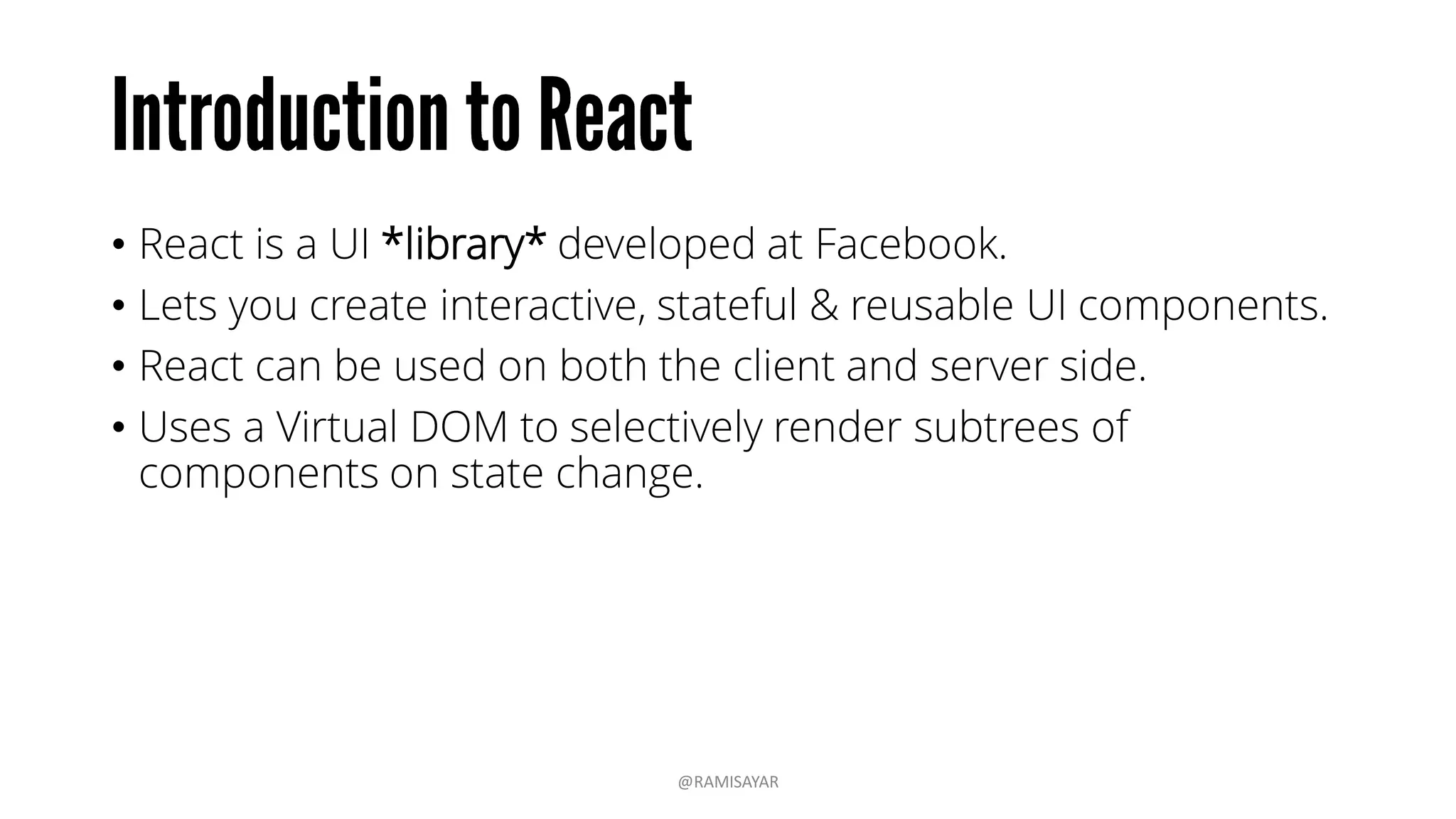
• React is a UI *library* developed at Facebook.
• Lets you create interactive, stateful & reusable UI components.
• React can be used on both the client and server side.
• Uses a Virtual DOM to selectively render subtrees of
components on state change.
@RAMISAYAR
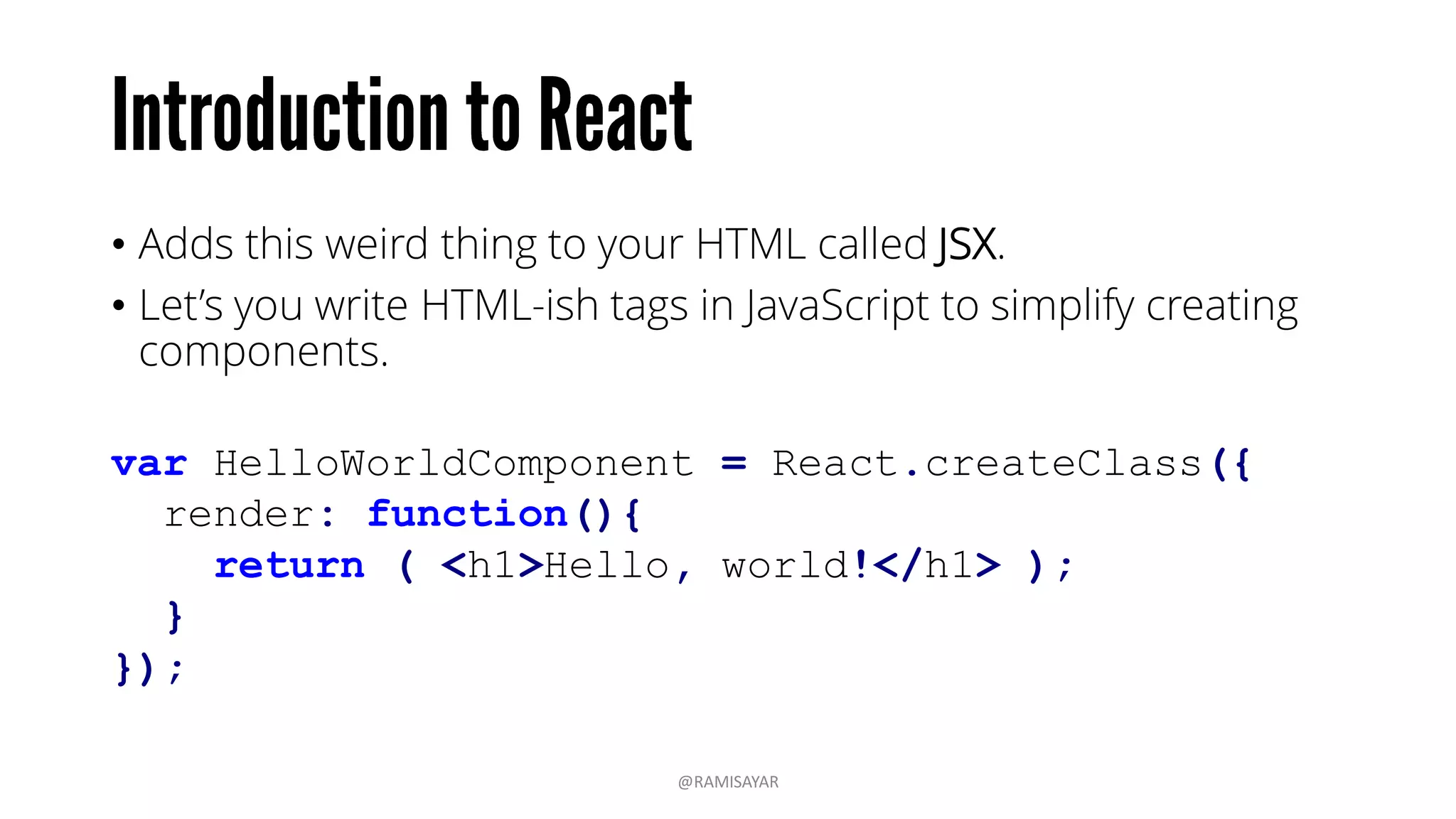
• Adds this weird thing to your HTML called JSX.
• Let’s you write HTML-ish tags in JavaScript to simplify creating
components.
var HelloWorldComponent = React.createClass({
render: function(){
return ( <h1>Hello, world!</h1> );
}
});
@RAMISAYAR
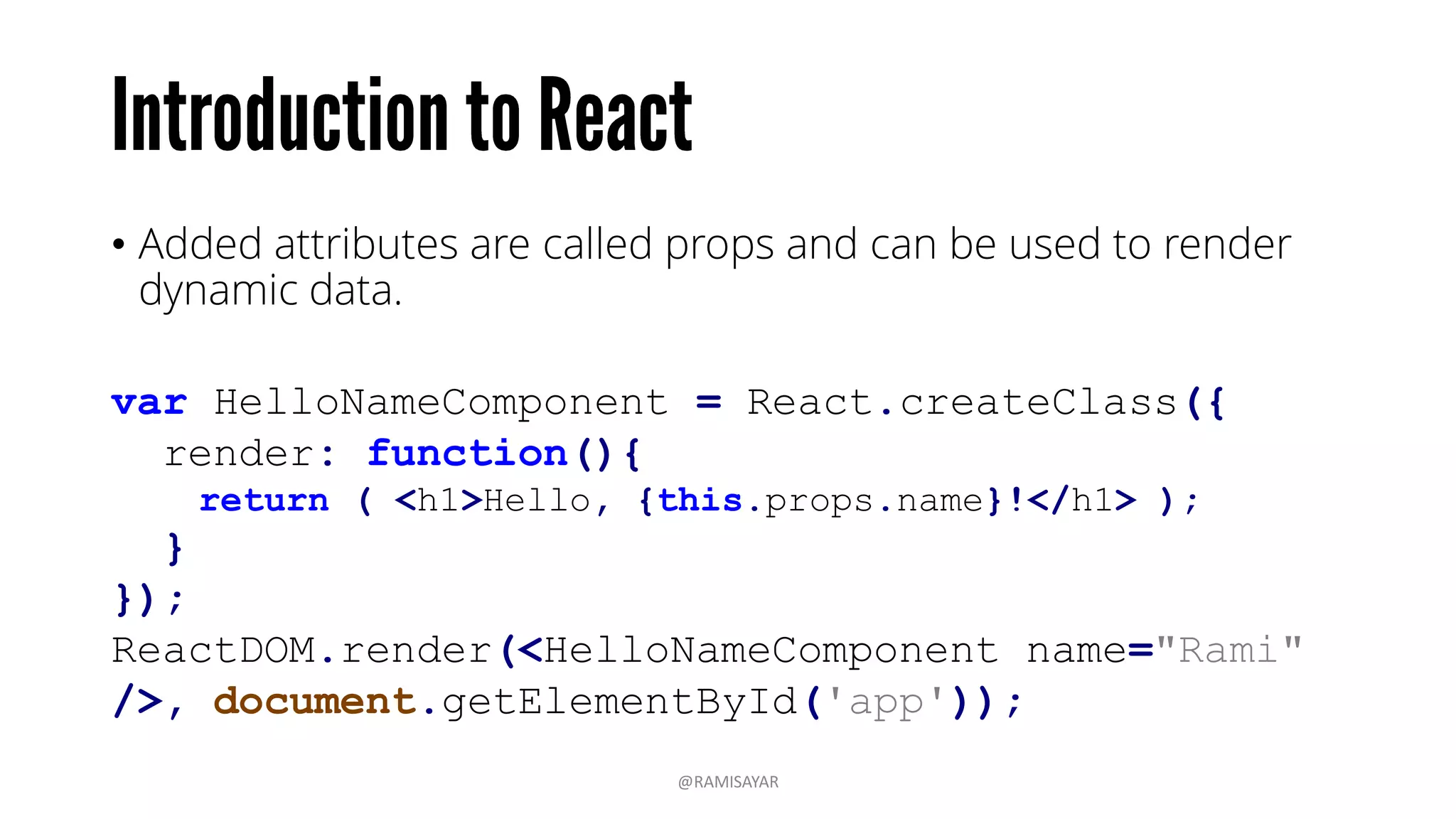
• Added attributes are called props and can be used to render
dynamic data.
var HelloNameComponent = React.createClass({
render: function(){
return ( <h1>Hello, {this.props.name}!</h1> );
}
});
ReactDOM.render(<HelloNameComponent name="Rami"
/>, document.getElementById('app'));
@RAMISAYAR
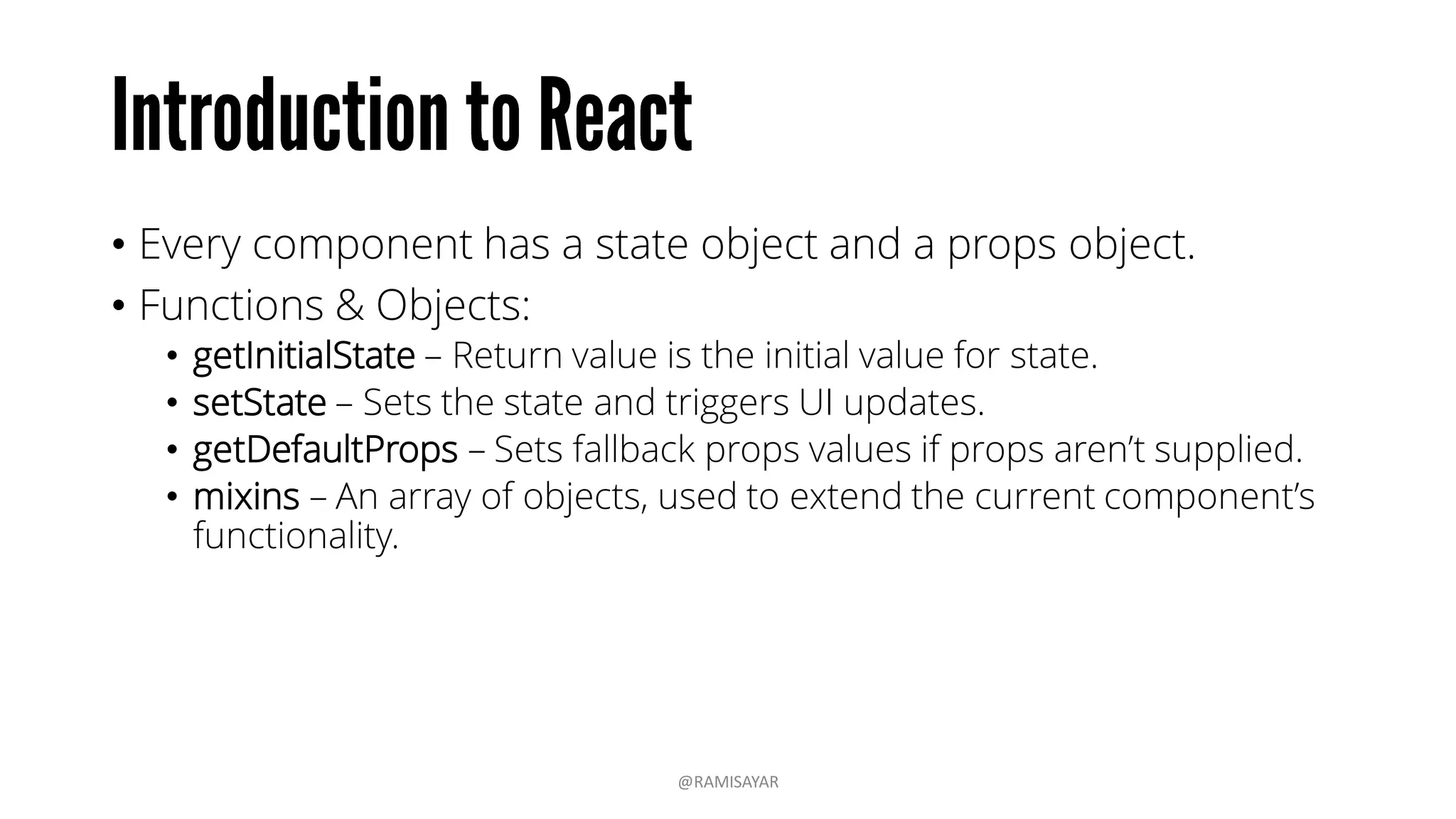
• Every component has a state object and a props object.
• Functions & Objects:
• getInitialState – Return value is the initial value for state.
• setState – Sets the state and triggers UI updates.
• getDefaultProps – Sets fallback props values if props aren’t supplied.
• mixins – An array of objects, used to extend the current component’s
functionality.
@RAMISAYAR
• React events are attached as properties and can trigger
methods.
• Data flows unidirectionally via the state and props objects.
• React seams to rerender the whole app on every data change
but really it only ends up rerendering the parts that changed.
• To assign CSS classes you have to use className.
• You can use ES6 Classes instead of the createClass function.
@RAMISAYAR
@RAMISAYAR
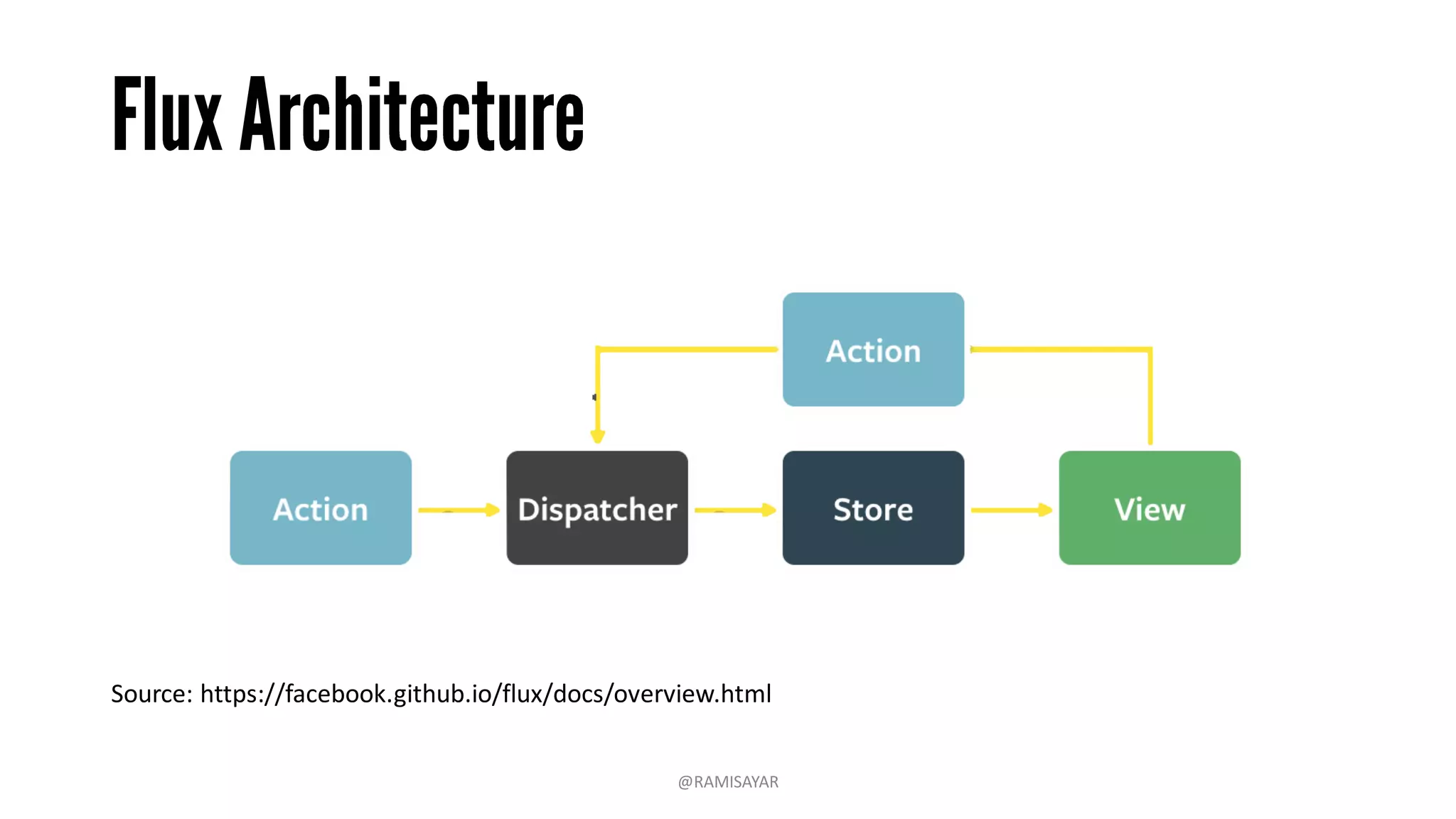
• Flux is the architecture that Facebook uses for building client-
side web apps.
• More of a pattern rather than a framework.
• Flux doesn’t follow MVC in favor of a unidirectional data flow.
• Flux architecture is composed of four major parts: Dispatchers,
Stores, Views and Actions.
@RAMISAYAR
• Dispatchers are the central hubs that manage data flow.
• Essentially registry of callbacks into Stores.
• When Actions passed into the central Dispatcher, they are
redistributed to the Stores.
• Dispatchers manage dependencies between Stores.
• Stores contain the application state and logic (sort of like the
Model in MVC)
• Stores register themselves with the Dispatcher to receive Actions via a
callback.
• Actions describe state changes in the Store.
• Stores broadcast an event saying they have changed so Views can
update.
@RAMISAYAR
• Views are the React Components.
• React Components are composable and are typically nested in a tree
hierarchy.
• A special “App View” behaves like a controller-view and provides glue
code to propagate states down the chain.
• Events cause Views to request the State from a Store to setState() so
that render() will be executed.
• Actions describe a change and include a payload of data.
@RAMISAYAR
@RAMISAYAR
Source: https://facebook.github.io/flux/docs/overview.html
• Several Different Implementations of Flux:
• Flux by Facebook
• Redux by Dan Abramov
• Alt by Josh Perez
• Reflux by Mikael Brassman
• Fluxxor by Michelle Tilley
@RAMISAYAR
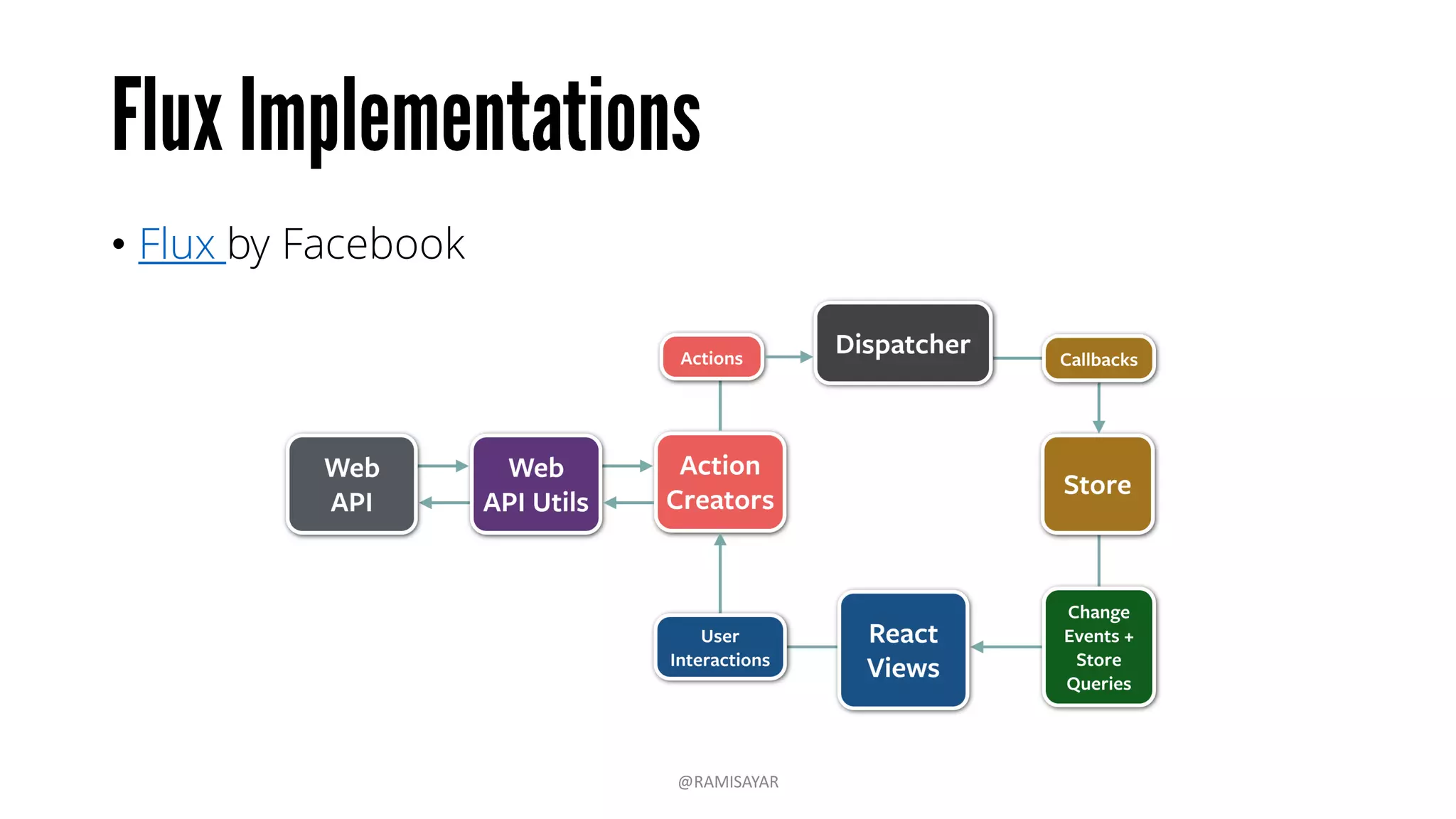
• Flux by Facebook
@RAMISAYAR
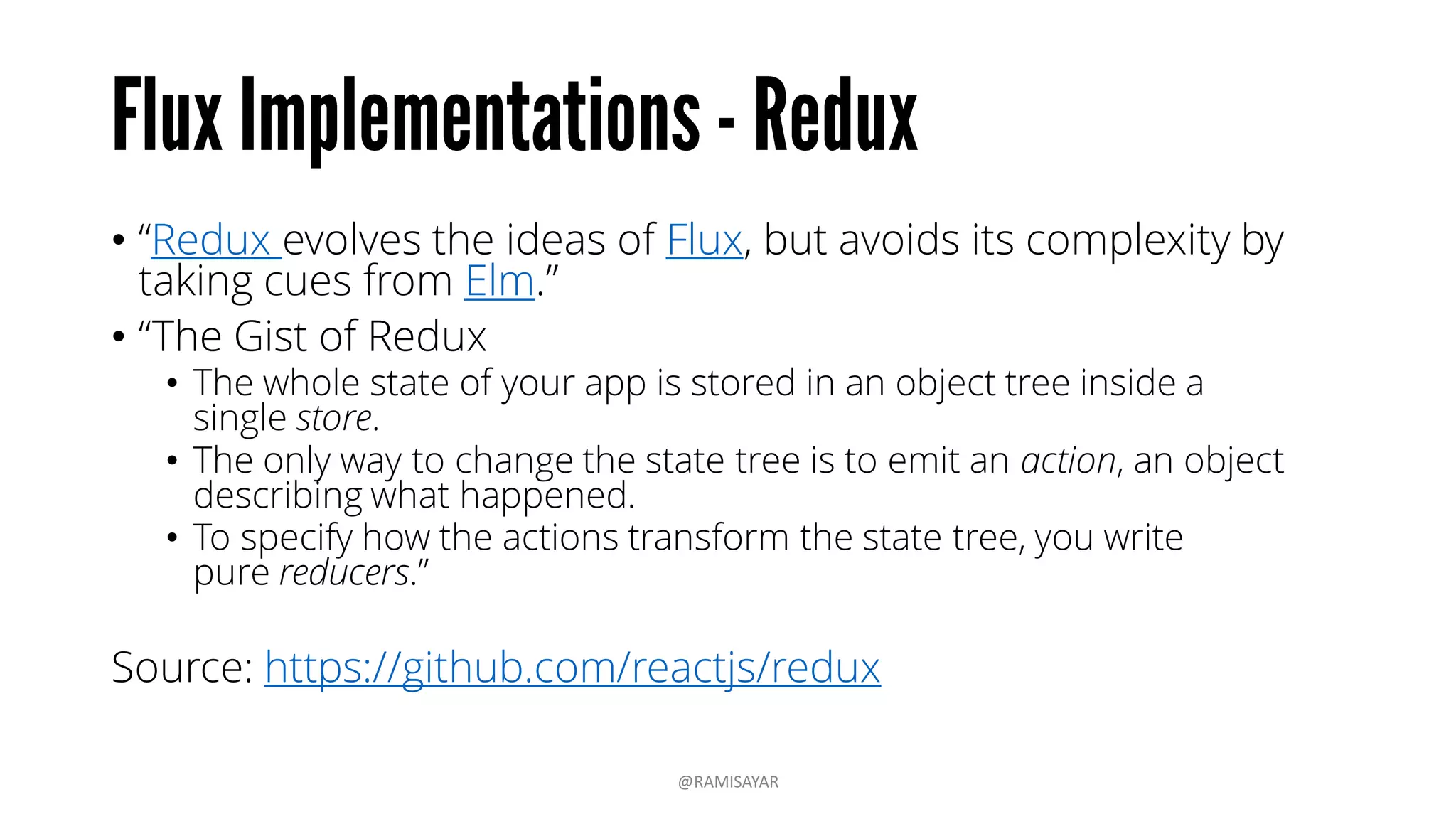
• “Redux evolves the ideas of Flux, but avoids its complexity by
taking cues from Elm.”
• “The Gist of Redux
• The whole state of your app is stored in an object tree inside a
single store.
• The only way to change the state tree is to emit an action, an object
describing what happened.
• To specify how the actions transform the state tree, you write
pure reducers.”
Source: https://github.com/reactjs/redux
@RAMISAYAR
@RAMISAYAR
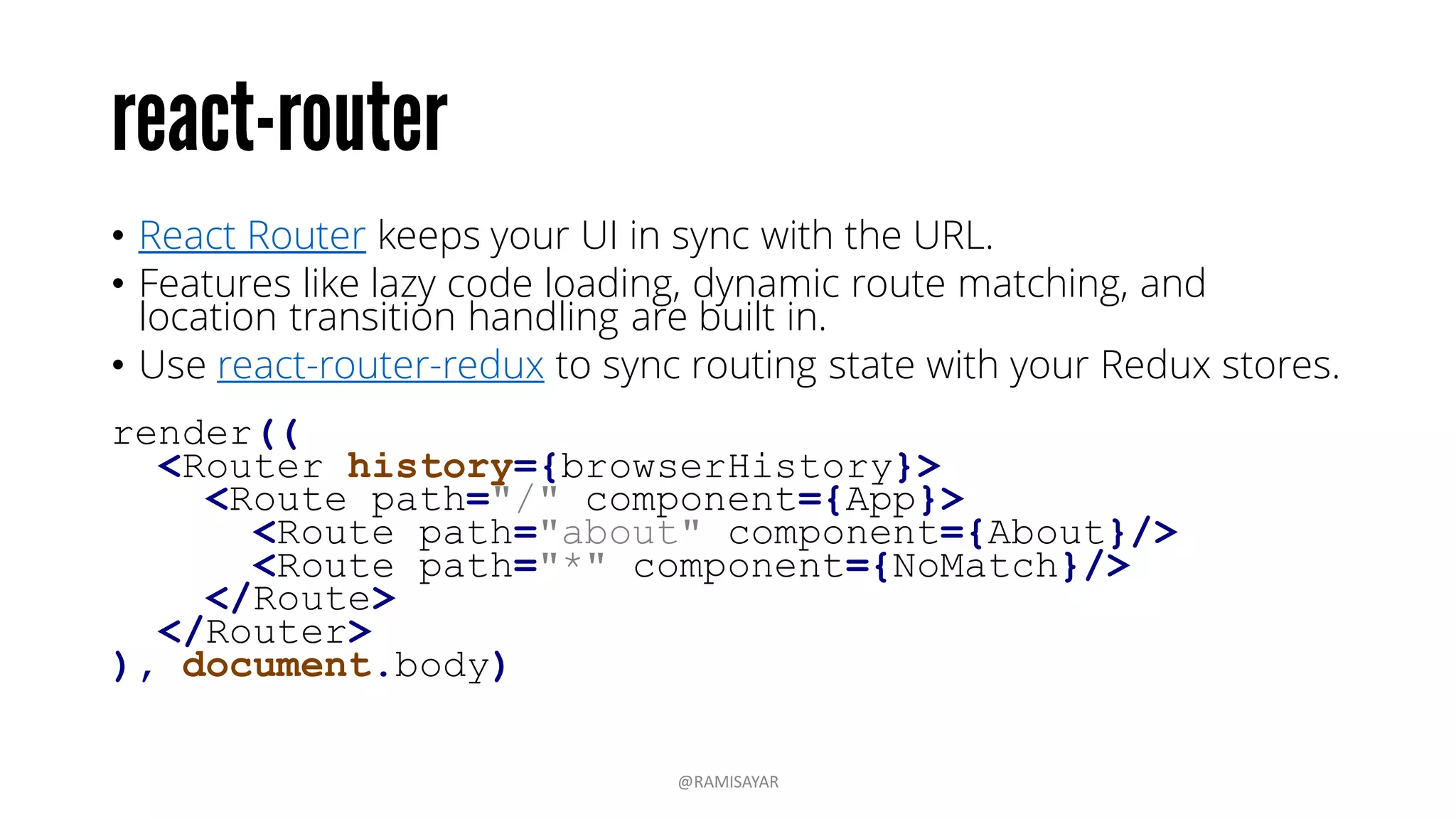
• React Router keeps your UI in sync with the URL.
• Features like lazy code loading, dynamic route matching, and
location transition handling are built in.
• Use react-router-redux to sync routing state with your Redux stores.
render((
<Router history={browserHistory}>
<Route path="/" component={App}>
<Route path="about" component={About}/>
<Route path="*" component={NoMatch}/>
</Route>
</Router>
), document.body)
@RAMISAYAR
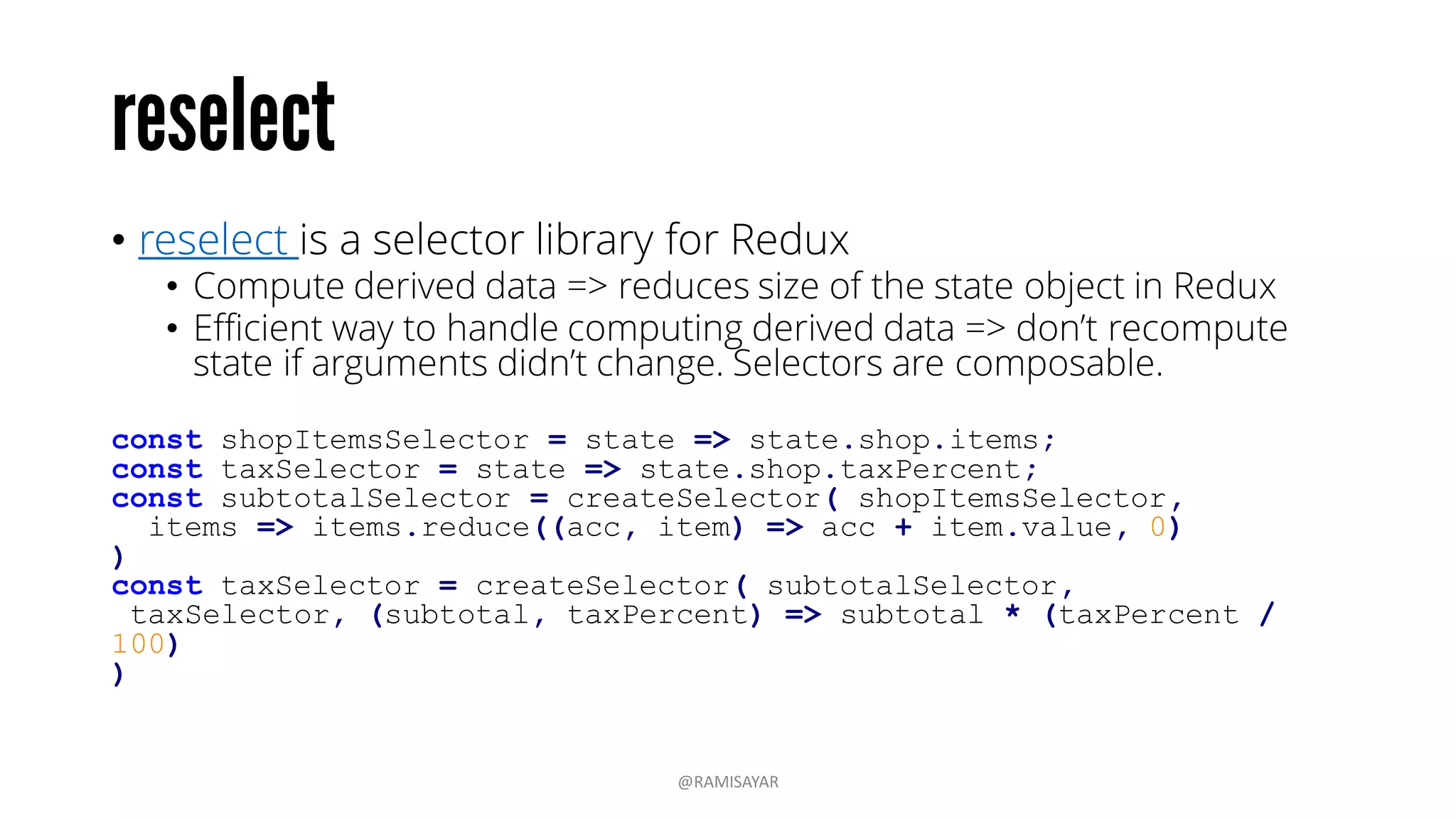
• reselect is a selector library for Redux
• Compute derived data => reduces size of the state object in Redux
• Efficient way to handle computing derived data => don’t recompute
state if arguments didn’t change. Selectors are composable.
const shopItemsSelector = state => state.shop.items;
const taxSelector = state => state.shop.taxPercent;
const subtotalSelector = createSelector( shopItemsSelector,
items => items.reduce((acc, item) => acc + item.value, 0)
)
const taxSelector = createSelector( subtotalSelector,
taxSelector, (subtotal, taxPercent) => subtotal * (taxPercent /
100)
)
@RAMISAYAR
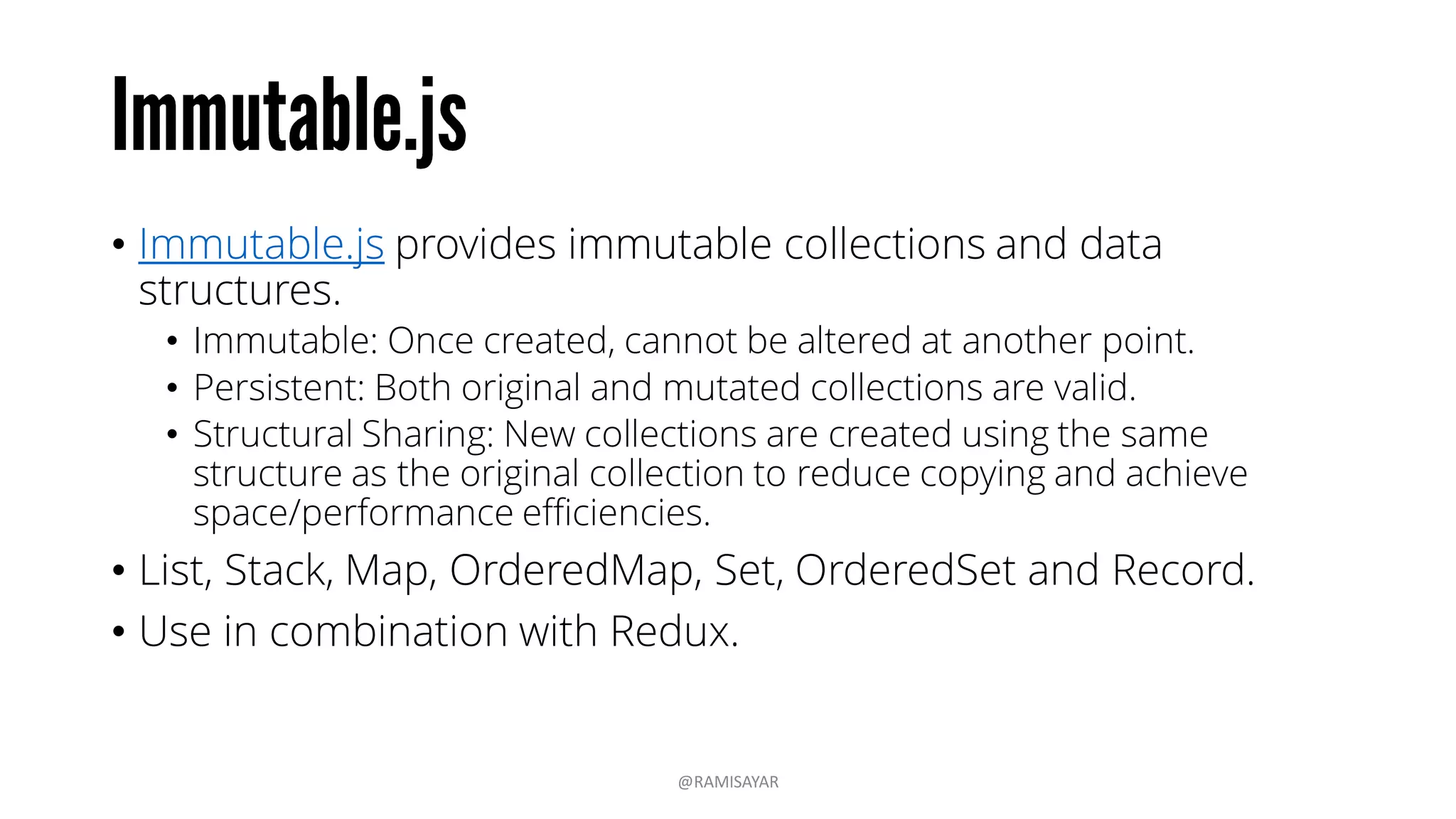
• Immutable.js provides immutable collections and data
structures.
• Immutable: Once created, cannot be altered at another point.
• Persistent: Both original and mutated collections are valid.
• Structural Sharing: New collections are created using the same
structure as the original collection to reduce copying and achieve
space/performance efficiencies.
• List, Stack, Map, OrderedMap, Set, OrderedSet and Record.
• Use in combination with Redux.
@RAMISAYAR
• Flux Standard Action is a human-friendly standard for Flux
action objects.
• Action objects must be plain JavaScript objects and have a type
property.
• They can also have an error, payload and a meta property.
• Use with:
• redux-actions - a set of helpers for creating and handling FSA actions
in Redux.
• redux-promise - Redux promise middleware that supports FSA actions.
@RAMISAYAR
@RAMISAYAR
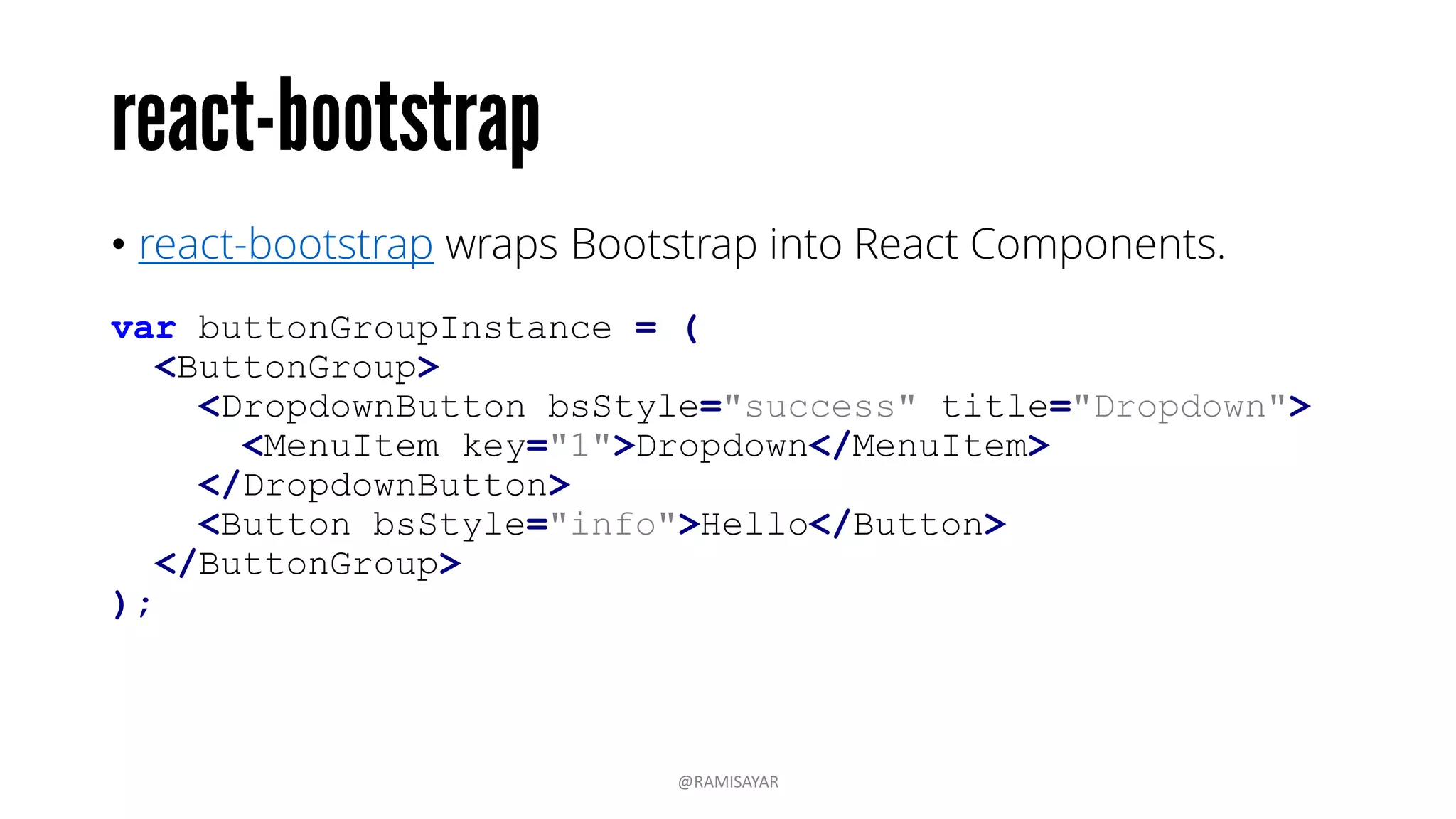
• react-bootstrap wraps Bootstrap into React Components.
var buttonGroupInstance = (
<ButtonGroup>
<DropdownButton bsStyle="success" title="Dropdown">
<MenuItem key="1">Dropdown</MenuItem>
</DropdownButton>
<Button bsStyle="info">Hello</Button>
</ButtonGroup>
);
@RAMISAYAR
“Foundation Apps is a new framework for building web
apps. It has awesome new features like flexbox based
grid, motion-ui, and several core components for
building web apps.” https://github.com/akiran/react-
foundation-apps
@RAMISAYAR
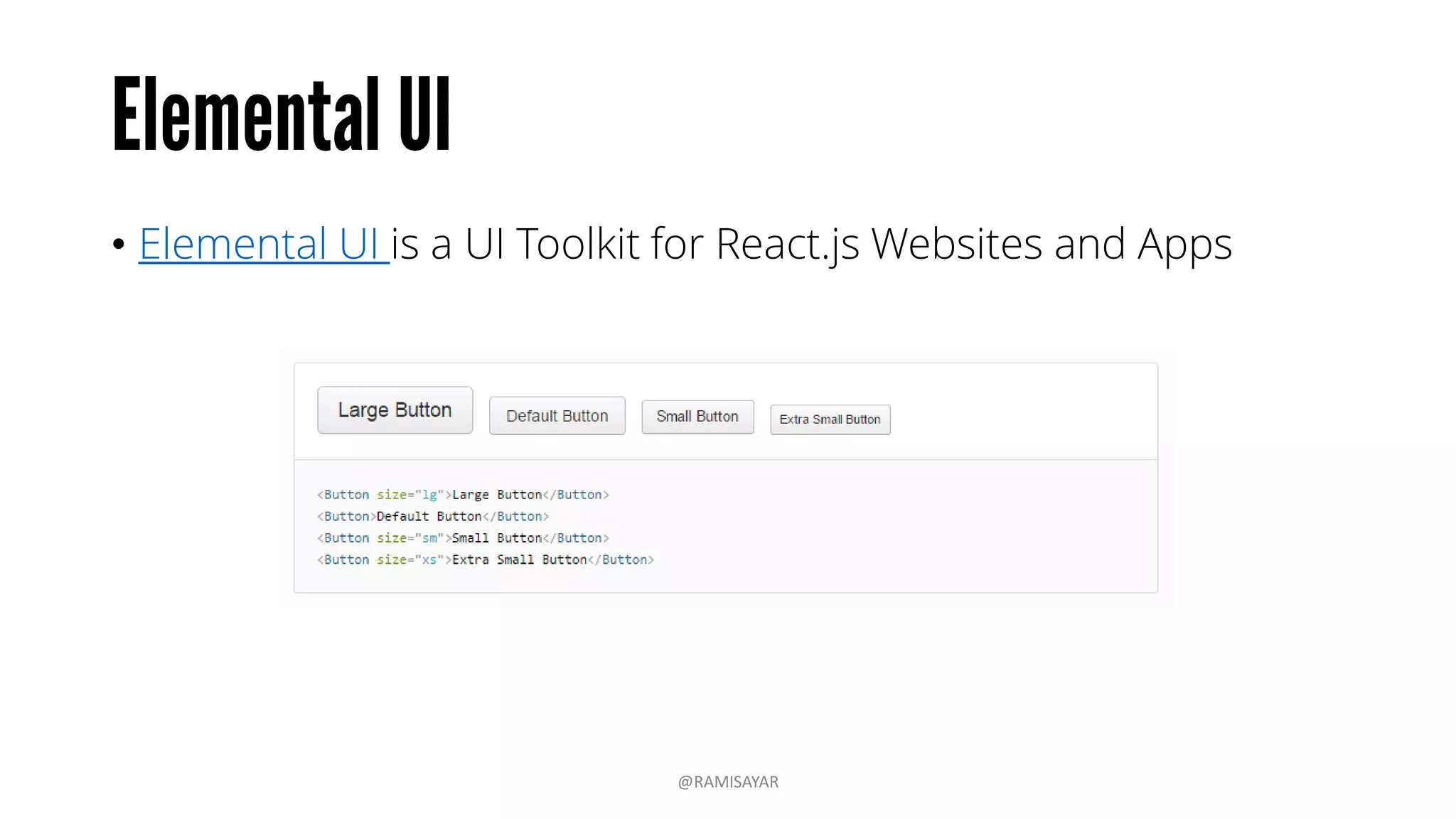
• Elemental UI is a UI Toolkit for React.js Websites and Apps
@RAMISAYAR
“This is a collection of some of the most
reusable React components built at Khan Academy. […]
We're trying to make it just as easy to jumpstart React
applications with a well-tested, thoughtful, and beautiful
library of components.” http://khan.github.io/react-
components/
@RAMISAYAR
@RAMISAYAR
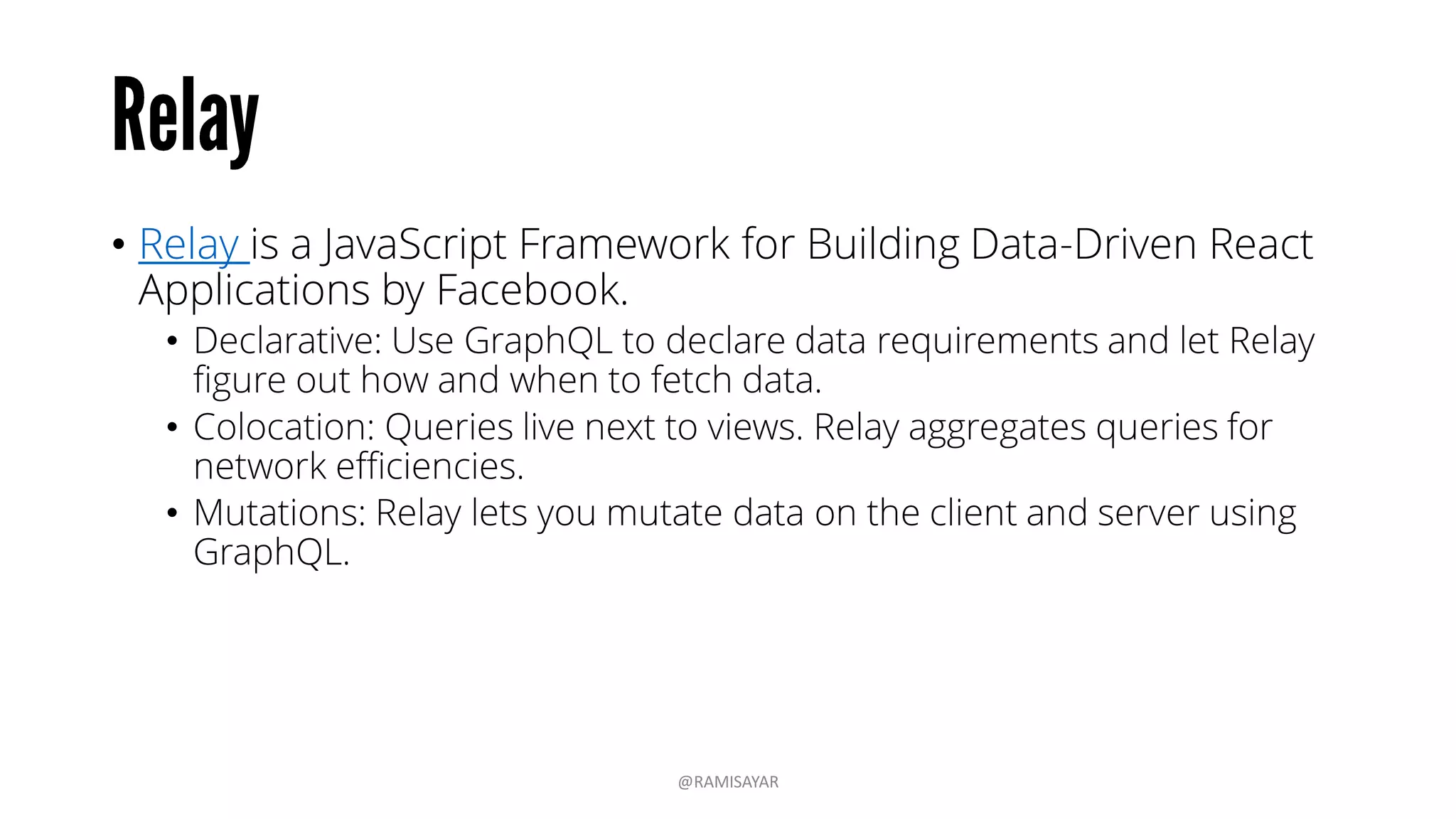
• Relay is a JavaScript Framework for Building Data-Driven React
Applications by Facebook.
• Declarative: Use GraphQL to declare data requirements and let Relay
figure out how and when to fetch data.
• Colocation: Queries live next to views. Relay aggregates queries for
network efficiencies.
• Mutations: Relay lets you mutate data on the client and server using
GraphQL.
@RAMISAYAR
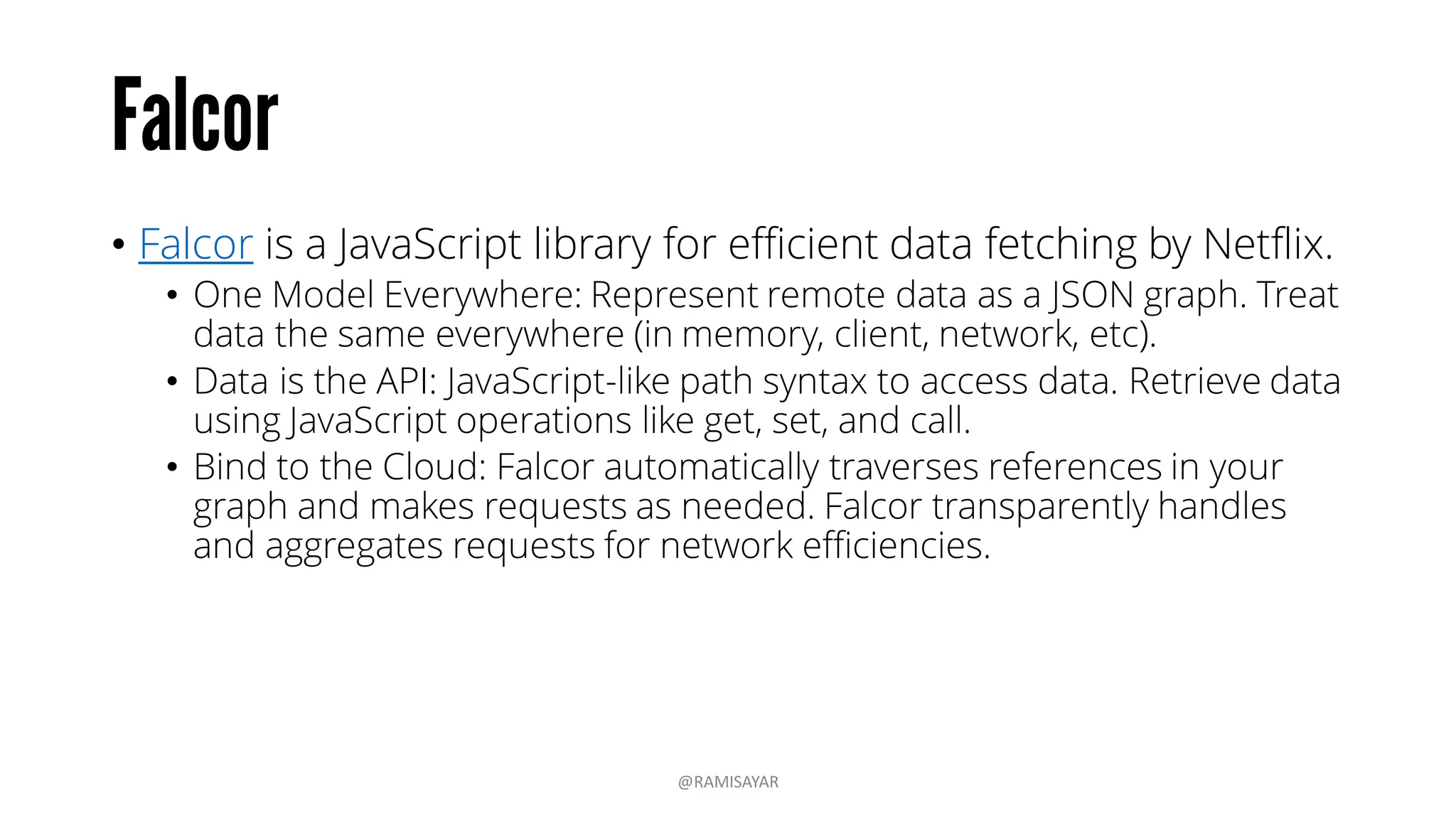
• Falcor is a JavaScript library for efficient data fetching by Netflix.
• One Model Everywhere: Represent remote data as a JSON graph. Treat
data the same everywhere (in memory, client, network, etc).
• Data is the API: JavaScript-like path syntax to access data. Retrieve data
using JavaScript operations like get, set, and call.
• Bind to the Cloud: Falcor automatically traverses references in your
graph and makes requests as needed. Falcor transparently handles
and aggregates requests for network efficiencies.
@RAMISAYAR
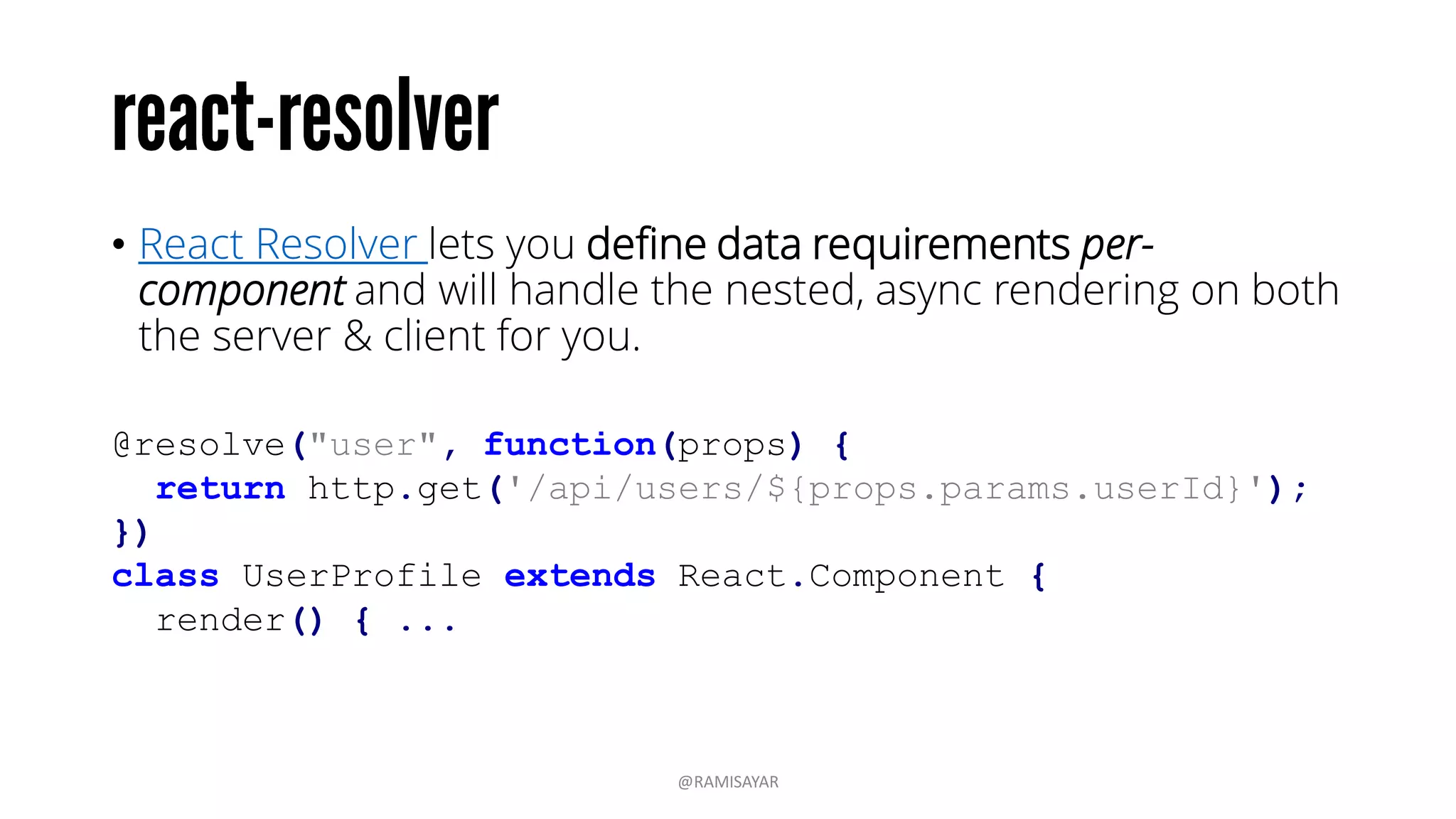
• React Resolver lets you define data requirements per-
component and will handle the nested, async rendering on both
the server & client for you.
@resolve("user", function(props) {
return http.get('/api/users/${props.params.userId}');
})
class UserProfile extends React.Component {
render() { ...
@RAMISAYAR
@RAMISAYAR
• React Native by Facebook enables you to build on native
platforms using JavaScript and React.
• React Native focuses on developer efficiency — learn once,
write anywhere.
• Supports iOS and Android.
@RAMISAYAR
• Use standard platform components such as UITabBar on iOS
and Drawer on Android.
• Apps have a consistent look and feel with the rest of the
platform ecosystem and have native performance.
• Operations between JavaScript and the native platform are
performed asynchronously.
• Communication is fully serializable, allows you to debug the
JavaScript while running the complete app, either in the
simulator or on a physical device.
@RAMISAYAR
@RAMISAYAR
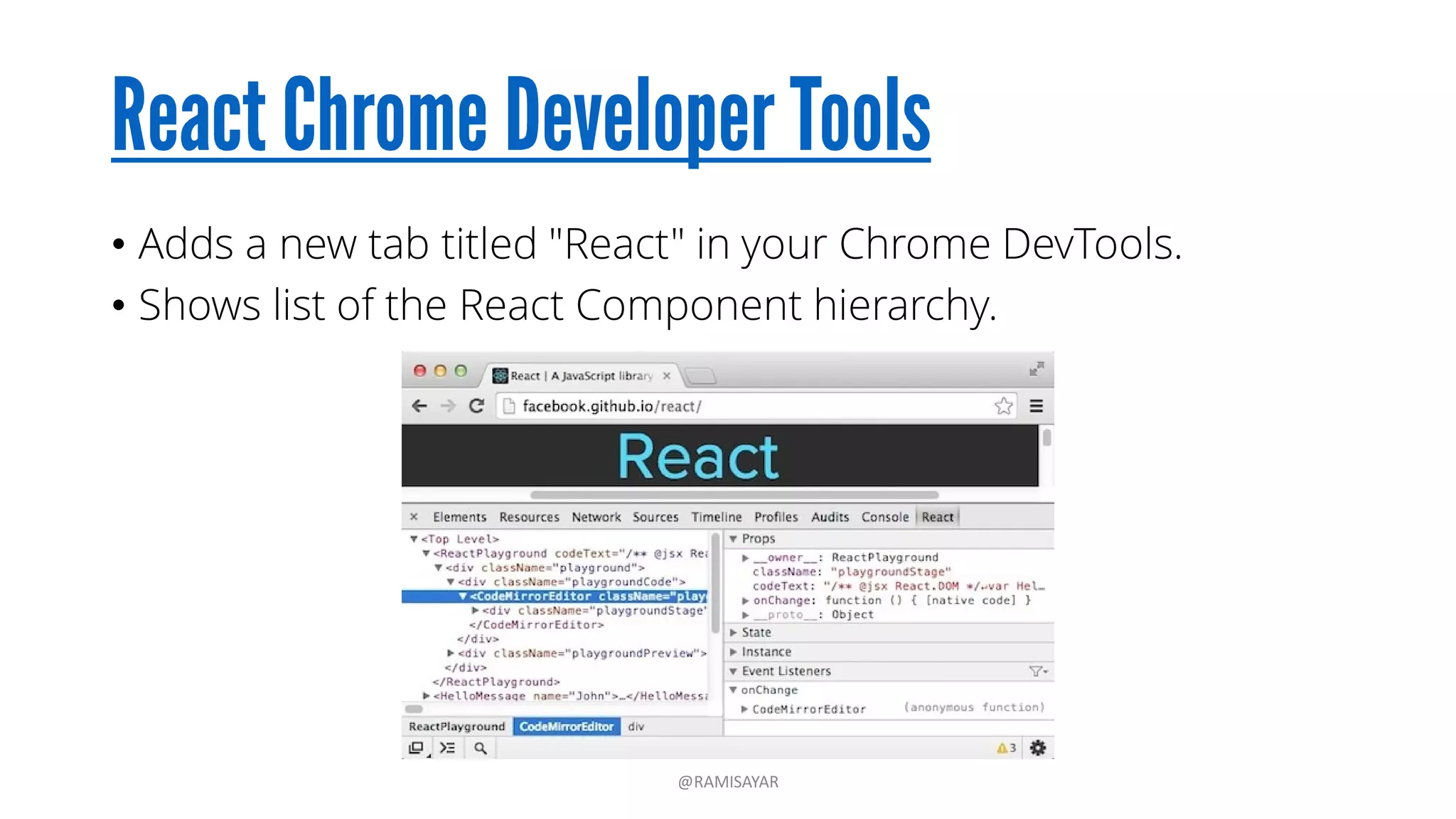
• Adds a new tab titled "React" in your Chrome DevTools.
• Shows list of the React Component hierarchy.
@RAMISAYAR
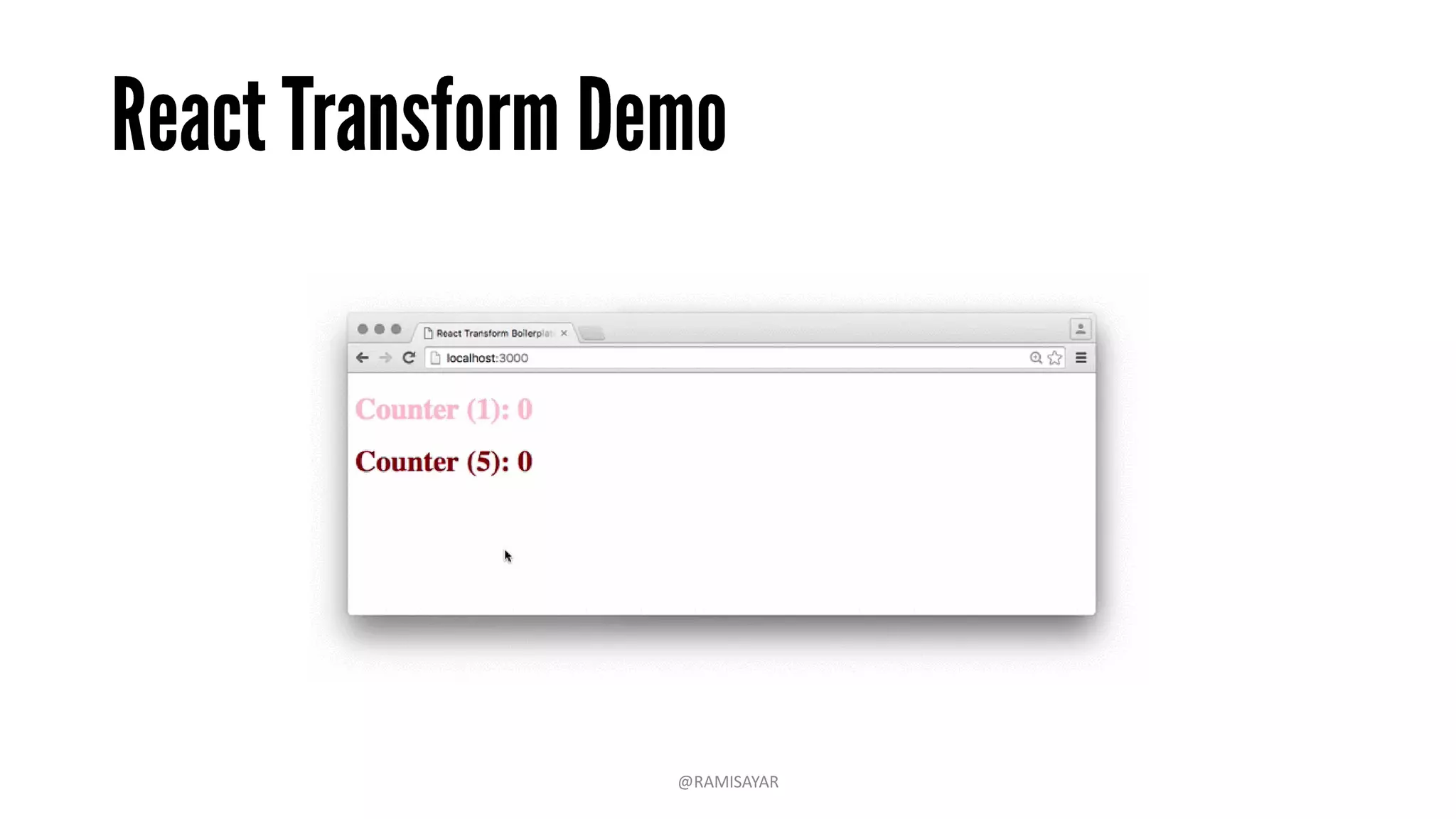
• babel-plugin-react-transform wraps React components with
arbitrary transforms. In other words, it allows you to instrument
React components in any way—limited only by your
imagination.
• react-transform-hmr - enables hot reloading using HMR API
• react-transform-catch-errors - catches errors inside render()
• react-transform-debug-inspector - renders an inline prop inspector
• react-transform-render-visualizer - highlight components when
updated
@RAMISAYAR
@RAMISAYAR
@RAMISAYAR
• A cloud service that enables Cordova and React Native
developers to deploy mobile app updates directly to their
users’ devices.
• Manage alpha, beta and production apps.
• Cordova and React Native ready.
• http://codepush.tools
@RAMISAYAR
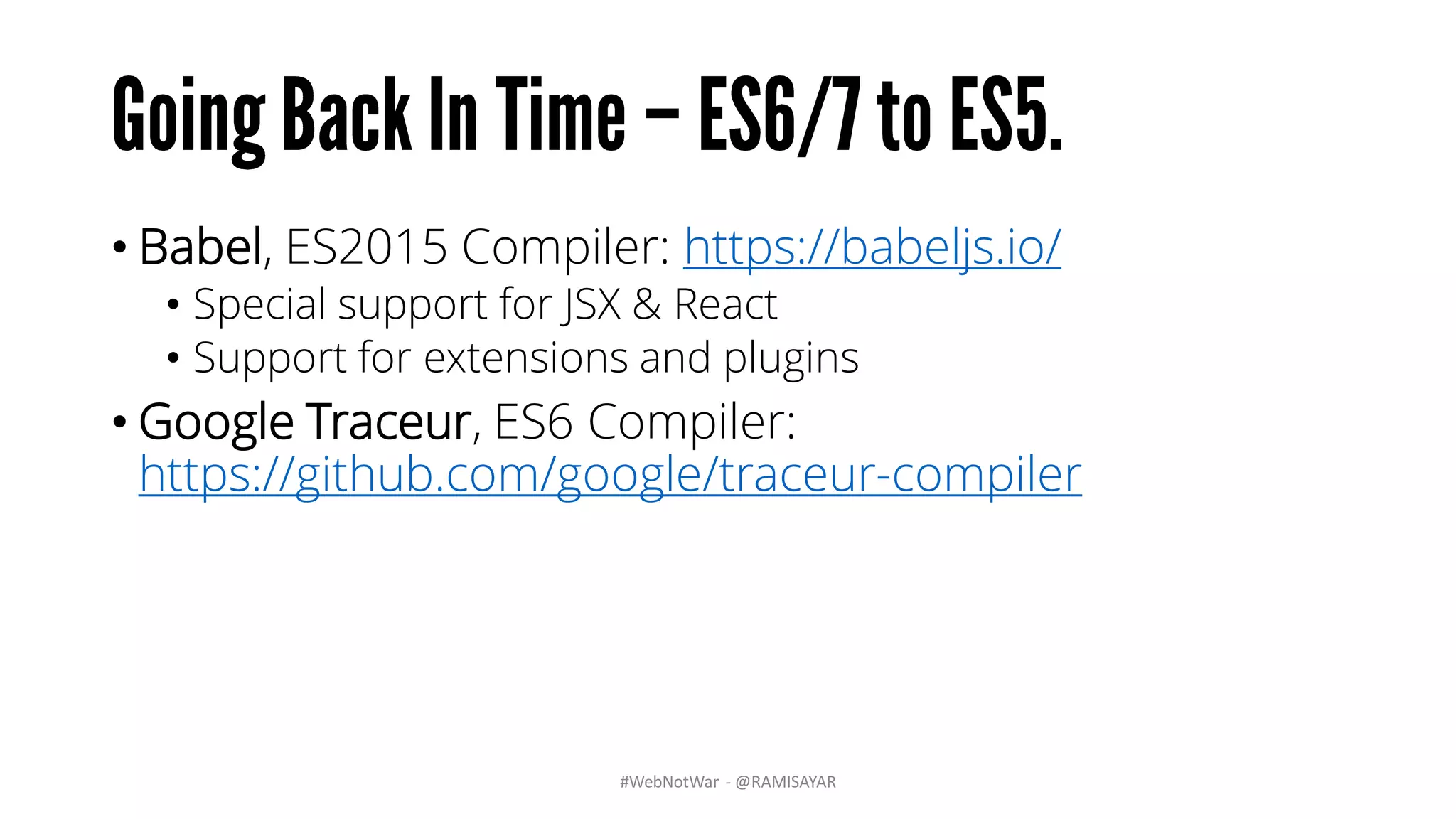
• Babel, ES2015 Compiler: https://babeljs.io/
• Special support for JSX & React
• Support for extensions and plugins
• Google Traceur, ES6 Compiler:
https://github.com/google/traceur-compiler
#WebNotWar - @RAMISAYAR
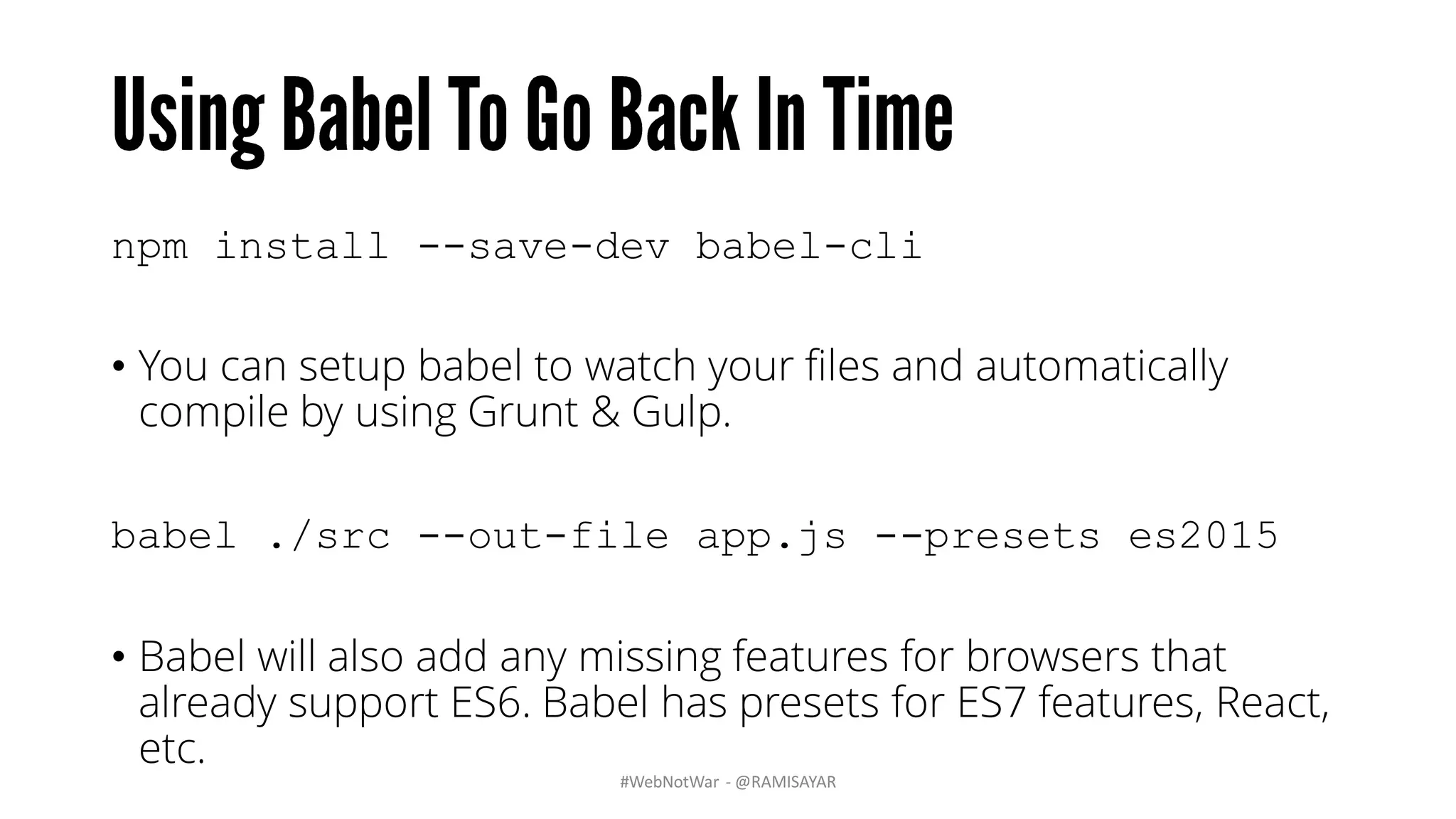
npm install --save-dev babel-cli
• You can setup babel to watch your files and automatically
compile by using Grunt & Gulp.
babel ./src --out-file app.js --presets es2015
• Babel will also add any missing features for browsers that
already support ES6. Babel has presets for ES7 features, React,
etc.
#WebNotWar - @RAMISAYAR
@RAMISAYAR
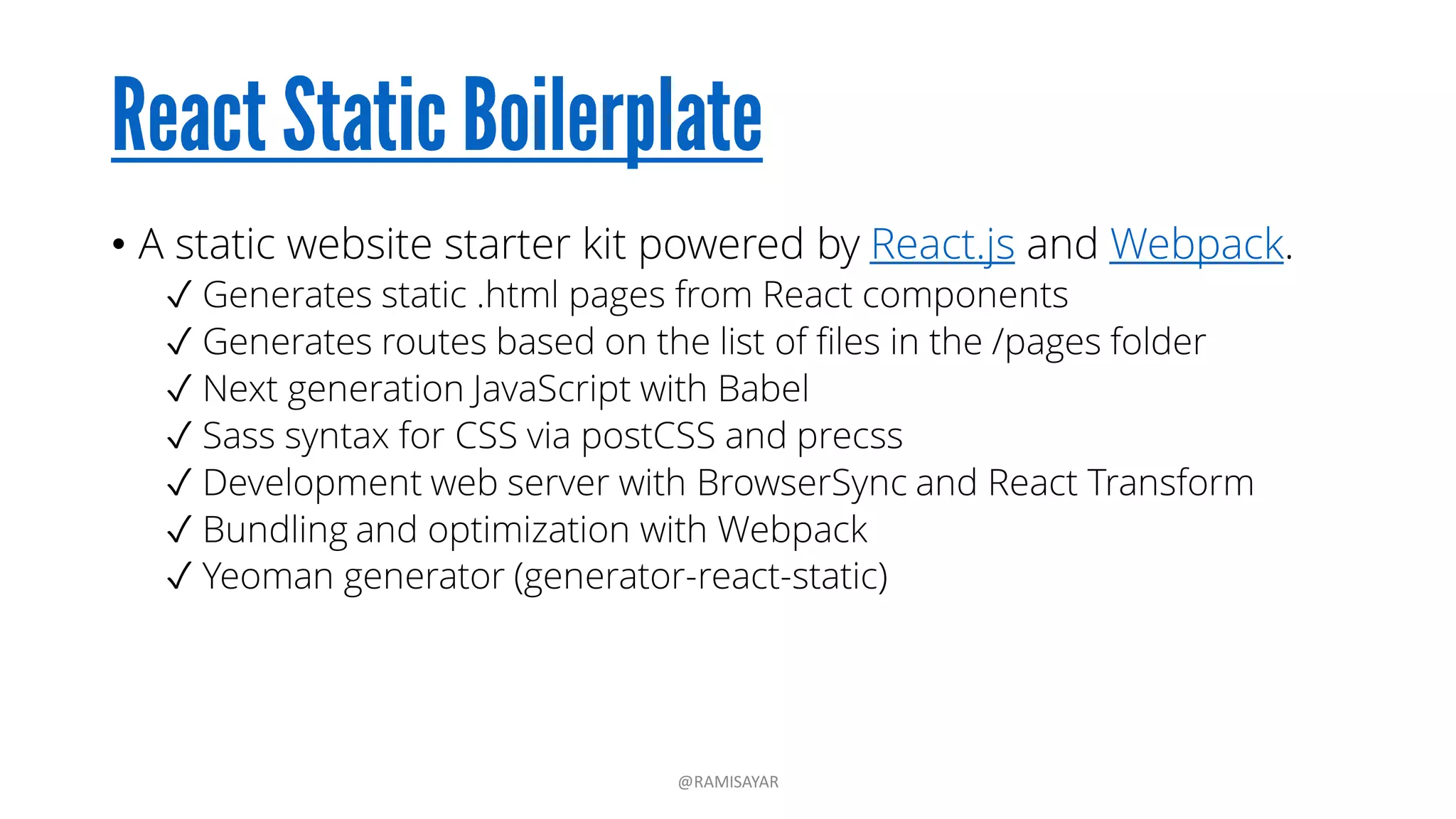
• A static website starter kit powered by React.js and Webpack.
✓ Generates static .html pages from React components
✓ Generates routes based on the list of files in the /pages folder
✓ Next generation JavaScript with Babel
✓ Sass syntax for CSS via postCSS and precss
✓ Development web server with BrowserSync and React Transform
✓ Bundling and optimization with Webpack
✓ Yeoman generator (generator-react-static)
@RAMISAYAR
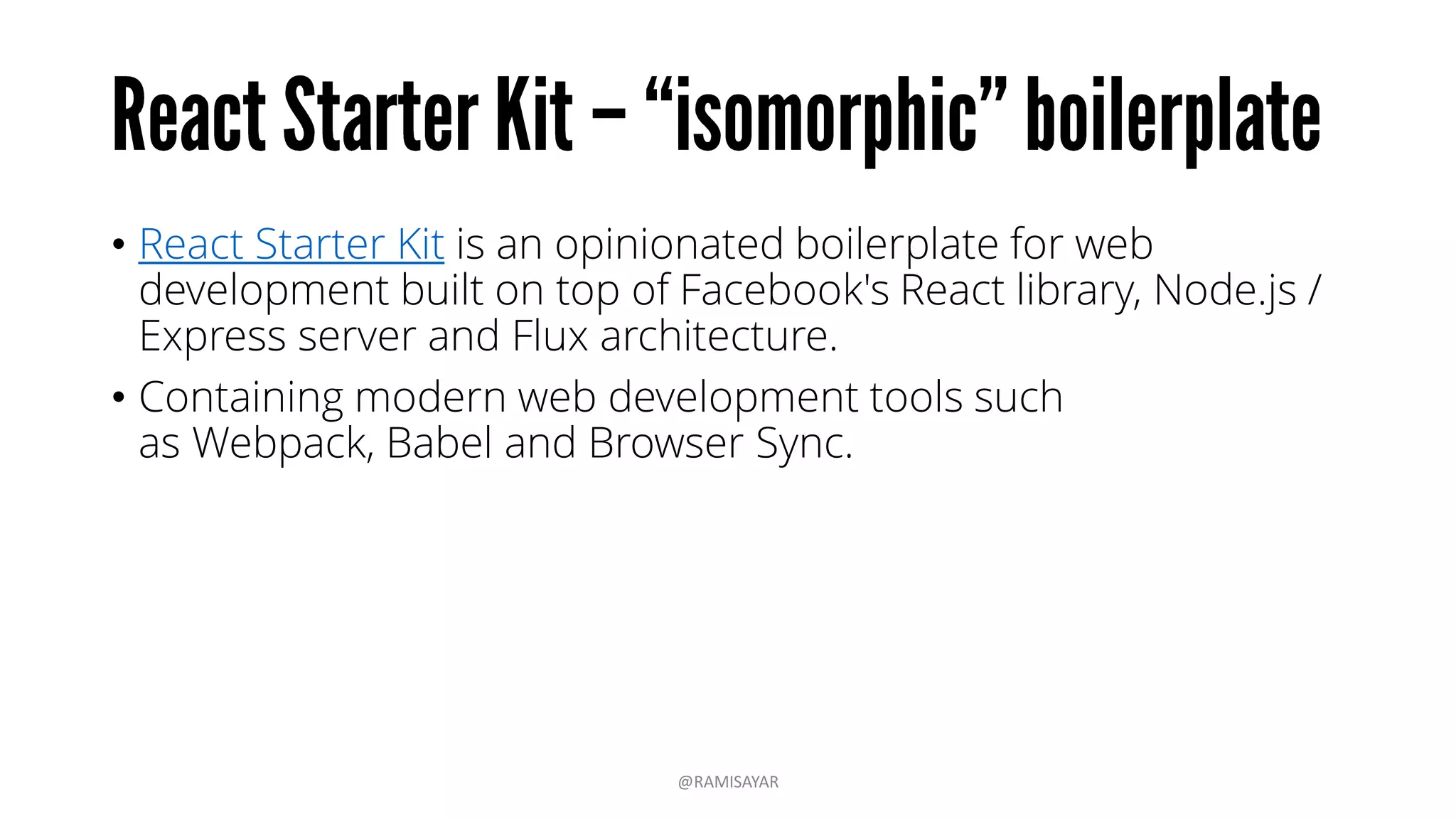
• React Starter Kit is an opinionated boilerplate for web
development built on top of Facebook's React library, Node.js /
Express server and Flux architecture.
• Containing modern web development tools such
as Webpack, Babel and Browser Sync.
@RAMISAYAR
• MERN is the easiest way to build isomorphic JavaScript apps
using React and Redux.
• MERN is a scaffolding tool which makes it easy to build
isomorphic apps using Mongo, Express, React and NodeJS.
@RAMISAYAR
@RAMISAYAR
• Introduced React & the Ecosystem
• What is Flux Architecture
• Flux, Redux, Alt.js, etc.
• Introduced React Libraries and UI Component Libraries
• Introduced Relay, Falcor & React Resolver
• Introduced React Native
• Useful React Dev Tools
@RAMISAYAR
tw: @ramisayar | gh: @sayar
@RAMISAYAR
• https://www.toptal.com/react/navigating-the-react-ecosystem
• https://github.com/enaqx/awesome-react
• https://github.com/facebook/react/wiki/Complementary-Tools
• http://slides.com/cguedes/a-tour-on-react-ecosystem
@RAMISAYAR
©2013 Microsoft Corporation. All rights reserved. Microsoft, Windows, Office, Azure, System Center, Dynamics and other product names are or may be registered trademarks and/or trademarks in the
U.S. and/or other countries. The information herein is for informational purposes only and represents the current view of Microsoft Corporation as of the date of this presentation. Because Microsoft
must respond to changing market conditions, it should not be interpreted to be a commitment on the part of Microsoft, and Microsoft cannot guarantee the accuracy of any information provided after
the date of this presentation. MICROSOFT MAKES NO WARRANTIES, EXPRESS, IMPLIED OR STATUTORY, AS TO THE INFORMATION IN THIS PRESENTATION.

An Overview of the React Ecosystem

  • 1.
    Rami Sayar -@ramisayar Technical Evangelist Microsoft Canada @RAMISAYAR
  • 2.
  • 3.
    • Introduction toReact & the Ecosystem • What is Flux • What is Redux • What is Relay (and other Reactive Databases/APIs) • What is React Native • Useful React Dev Tools @RAMISAYAR
  • 4.
  • 5.
  • 6.
  • 7.
    • React isa UI *library* developed at Facebook. • Lets you create interactive, stateful & reusable UI components. • React can be used on both the client and server side. • Uses a Virtual DOM to selectively render subtrees of components on state change. @RAMISAYAR
  • 8.
    • Adds thisweird thing to your HTML called JSX. • Let’s you write HTML-ish tags in JavaScript to simplify creating components. var HelloWorldComponent = React.createClass({ render: function(){ return ( <h1>Hello, world!</h1> ); } }); @RAMISAYAR
  • 9.
    • Added attributesare called props and can be used to render dynamic data. var HelloNameComponent = React.createClass({ render: function(){ return ( <h1>Hello, {this.props.name}!</h1> ); } }); ReactDOM.render(<HelloNameComponent name="Rami" />, document.getElementById('app')); @RAMISAYAR
  • 10.
    • Every componenthas a state object and a props object. • Functions & Objects: • getInitialState – Return value is the initial value for state. • setState – Sets the state and triggers UI updates. • getDefaultProps – Sets fallback props values if props aren’t supplied. • mixins – An array of objects, used to extend the current component’s functionality. @RAMISAYAR
  • 11.
    • React eventsare attached as properties and can trigger methods. • Data flows unidirectionally via the state and props objects. • React seams to rerender the whole app on every data change but really it only ends up rerendering the parts that changed. • To assign CSS classes you have to use className. • You can use ES6 Classes instead of the createClass function. @RAMISAYAR
  • 12.
  • 13.
    • Flux isthe architecture that Facebook uses for building client- side web apps. • More of a pattern rather than a framework. • Flux doesn’t follow MVC in favor of a unidirectional data flow. • Flux architecture is composed of four major parts: Dispatchers, Stores, Views and Actions. @RAMISAYAR
  • 14.
    • Dispatchers arethe central hubs that manage data flow. • Essentially registry of callbacks into Stores. • When Actions passed into the central Dispatcher, they are redistributed to the Stores. • Dispatchers manage dependencies between Stores. • Stores contain the application state and logic (sort of like the Model in MVC) • Stores register themselves with the Dispatcher to receive Actions via a callback. • Actions describe state changes in the Store. • Stores broadcast an event saying they have changed so Views can update. @RAMISAYAR
  • 15.
    • Views arethe React Components. • React Components are composable and are typically nested in a tree hierarchy. • A special “App View” behaves like a controller-view and provides glue code to propagate states down the chain. • Events cause Views to request the State from a Store to setState() so that render() will be executed. • Actions describe a change and include a payload of data. @RAMISAYAR
  • 16.
  • 17.
    • Several DifferentImplementations of Flux: • Flux by Facebook • Redux by Dan Abramov • Alt by Josh Perez • Reflux by Mikael Brassman • Fluxxor by Michelle Tilley @RAMISAYAR
  • 18.
    • Flux byFacebook @RAMISAYAR
  • 19.
    • “Redux evolvesthe ideas of Flux, but avoids its complexity by taking cues from Elm.” • “The Gist of Redux • The whole state of your app is stored in an object tree inside a single store. • The only way to change the state tree is to emit an action, an object describing what happened. • To specify how the actions transform the state tree, you write pure reducers.” Source: https://github.com/reactjs/redux @RAMISAYAR
  • 20.
  • 21.
    • React Routerkeeps your UI in sync with the URL. • Features like lazy code loading, dynamic route matching, and location transition handling are built in. • Use react-router-redux to sync routing state with your Redux stores. render(( <Router history={browserHistory}> <Route path="/" component={App}> <Route path="about" component={About}/> <Route path="*" component={NoMatch}/> </Route> </Router> ), document.body) @RAMISAYAR
  • 22.
    • reselect isa selector library for Redux • Compute derived data => reduces size of the state object in Redux • Efficient way to handle computing derived data => don’t recompute state if arguments didn’t change. Selectors are composable. const shopItemsSelector = state => state.shop.items; const taxSelector = state => state.shop.taxPercent; const subtotalSelector = createSelector( shopItemsSelector, items => items.reduce((acc, item) => acc + item.value, 0) ) const taxSelector = createSelector( subtotalSelector, taxSelector, (subtotal, taxPercent) => subtotal * (taxPercent / 100) ) @RAMISAYAR
  • 23.
    • Immutable.js providesimmutable collections and data structures. • Immutable: Once created, cannot be altered at another point. • Persistent: Both original and mutated collections are valid. • Structural Sharing: New collections are created using the same structure as the original collection to reduce copying and achieve space/performance efficiencies. • List, Stack, Map, OrderedMap, Set, OrderedSet and Record. • Use in combination with Redux. @RAMISAYAR
  • 24.
    • Flux StandardAction is a human-friendly standard for Flux action objects. • Action objects must be plain JavaScript objects and have a type property. • They can also have an error, payload and a meta property. • Use with: • redux-actions - a set of helpers for creating and handling FSA actions in Redux. • redux-promise - Redux promise middleware that supports FSA actions. @RAMISAYAR
  • 25.
  • 26.
    • react-bootstrap wrapsBootstrap into React Components. var buttonGroupInstance = ( <ButtonGroup> <DropdownButton bsStyle="success" title="Dropdown"> <MenuItem key="1">Dropdown</MenuItem> </DropdownButton> <Button bsStyle="info">Hello</Button> </ButtonGroup> ); @RAMISAYAR
  • 27.
    “Foundation Apps isa new framework for building web apps. It has awesome new features like flexbox based grid, motion-ui, and several core components for building web apps.” https://github.com/akiran/react- foundation-apps @RAMISAYAR
  • 28.
    • Elemental UIis a UI Toolkit for React.js Websites and Apps @RAMISAYAR
  • 29.
    “This is acollection of some of the most reusable React components built at Khan Academy. […] We're trying to make it just as easy to jumpstart React applications with a well-tested, thoughtful, and beautiful library of components.” http://khan.github.io/react- components/ @RAMISAYAR
  • 30.
  • 31.
    • Relay isa JavaScript Framework for Building Data-Driven React Applications by Facebook. • Declarative: Use GraphQL to declare data requirements and let Relay figure out how and when to fetch data. • Colocation: Queries live next to views. Relay aggregates queries for network efficiencies. • Mutations: Relay lets you mutate data on the client and server using GraphQL. @RAMISAYAR
  • 32.
    • Falcor isa JavaScript library for efficient data fetching by Netflix. • One Model Everywhere: Represent remote data as a JSON graph. Treat data the same everywhere (in memory, client, network, etc). • Data is the API: JavaScript-like path syntax to access data. Retrieve data using JavaScript operations like get, set, and call. • Bind to the Cloud: Falcor automatically traverses references in your graph and makes requests as needed. Falcor transparently handles and aggregates requests for network efficiencies. @RAMISAYAR
  • 33.
    • React Resolverlets you define data requirements per- component and will handle the nested, async rendering on both the server & client for you. @resolve("user", function(props) { return http.get('/api/users/${props.params.userId}'); }) class UserProfile extends React.Component { render() { ... @RAMISAYAR
  • 34.
  • 35.
    • React Nativeby Facebook enables you to build on native platforms using JavaScript and React. • React Native focuses on developer efficiency — learn once, write anywhere. • Supports iOS and Android. @RAMISAYAR
  • 36.
    • Use standardplatform components such as UITabBar on iOS and Drawer on Android. • Apps have a consistent look and feel with the rest of the platform ecosystem and have native performance. • Operations between JavaScript and the native platform are performed asynchronously. • Communication is fully serializable, allows you to debug the JavaScript while running the complete app, either in the simulator or on a physical device. @RAMISAYAR
  • 37.
  • 38.
    • Adds anew tab titled "React" in your Chrome DevTools. • Shows list of the React Component hierarchy. @RAMISAYAR
  • 39.
    • babel-plugin-react-transform wrapsReact components with arbitrary transforms. In other words, it allows you to instrument React components in any way—limited only by your imagination. • react-transform-hmr - enables hot reloading using HMR API • react-transform-catch-errors - catches errors inside render() • react-transform-debug-inspector - renders an inline prop inspector • react-transform-render-visualizer - highlight components when updated @RAMISAYAR
  • 40.
  • 41.
  • 42.
    • A cloudservice that enables Cordova and React Native developers to deploy mobile app updates directly to their users’ devices. • Manage alpha, beta and production apps. • Cordova and React Native ready. • http://codepush.tools @RAMISAYAR
  • 43.
    • Babel, ES2015Compiler: https://babeljs.io/ • Special support for JSX & React • Support for extensions and plugins • Google Traceur, ES6 Compiler: https://github.com/google/traceur-compiler #WebNotWar - @RAMISAYAR
  • 44.
    npm install --save-devbabel-cli • You can setup babel to watch your files and automatically compile by using Grunt & Gulp. babel ./src --out-file app.js --presets es2015 • Babel will also add any missing features for browsers that already support ES6. Babel has presets for ES7 features, React, etc. #WebNotWar - @RAMISAYAR
  • 45.
  • 46.
    • A staticwebsite starter kit powered by React.js and Webpack. ✓ Generates static .html pages from React components ✓ Generates routes based on the list of files in the /pages folder ✓ Next generation JavaScript with Babel ✓ Sass syntax for CSS via postCSS and precss ✓ Development web server with BrowserSync and React Transform ✓ Bundling and optimization with Webpack ✓ Yeoman generator (generator-react-static) @RAMISAYAR
  • 47.
    • React StarterKit is an opinionated boilerplate for web development built on top of Facebook's React library, Node.js / Express server and Flux architecture. • Containing modern web development tools such as Webpack, Babel and Browser Sync. @RAMISAYAR
  • 48.
    • MERN isthe easiest way to build isomorphic JavaScript apps using React and Redux. • MERN is a scaffolding tool which makes it easy to build isomorphic apps using Mongo, Express, React and NodeJS. @RAMISAYAR
  • 49.
  • 50.
    • Introduced React& the Ecosystem • What is Flux Architecture • Flux, Redux, Alt.js, etc. • Introduced React Libraries and UI Component Libraries • Introduced Relay, Falcor & React Resolver • Introduced React Native • Useful React Dev Tools @RAMISAYAR
  • 51.
    tw: @ramisayar |gh: @sayar @RAMISAYAR
  • 52.
    • https://www.toptal.com/react/navigating-the-react-ecosystem • https://github.com/enaqx/awesome-react •https://github.com/facebook/react/wiki/Complementary-Tools • http://slides.com/cguedes/a-tour-on-react-ecosystem @RAMISAYAR
  • 53.
    ©2013 Microsoft Corporation.All rights reserved. Microsoft, Windows, Office, Azure, System Center, Dynamics and other product names are or may be registered trademarks and/or trademarks in the U.S. and/or other countries. The information herein is for informational purposes only and represents the current view of Microsoft Corporation as of the date of this presentation. Because Microsoft must respond to changing market conditions, it should not be interpreted to be a commitment on the part of Microsoft, and Microsoft cannot guarantee the accuracy of any information provided after the date of this presentation. MICROSOFT MAKES NO WARRANTIES, EXPRESS, IMPLIED OR STATUTORY, AS TO THE INFORMATION IN THIS PRESENTATION.