Content-Driven Apps with React
Corsin Decurtins, Netcetera
2016-10-17
/Bern
BärnerJS
Notes
Content-Driven Apps with React
This talk is a story about a family of projects or apps
Actually not just individual apps, but app platforms
Same team, same technology (roughly)
Multiple projects, multiple apps, multiple customers
But the same kind of app or actually app platform
Mobile app, heavily content driven
Customers are publishers, users are readers
It all started with a proof-of-concept…
Notes
Proof of Concept
Customer had a hybrid mobile app, Cordova and Angular (1)
It was too slow for them, which resulted in a bad UX
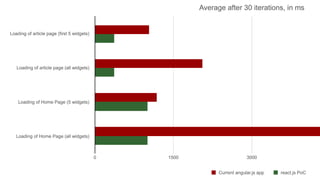
PoC done with React to see if we can improve the performance
In particular the performance of the home page / start screen
PoC showed, that we can
Goal was a 50% improvement, he had up to 80% improvement
This talk is about the app architecture that started with this PoC
But it will be about anything but performance
Disclaimer
Notes
Disclaimers
I’m just the person giving the talk; other people did the
actual work
If something is wrong or does not make sense, it’s probably
me who messed it up
I’m familiar with the architecture, design and technologies
If you have very detailed questions about the
implementation, I will refer you to my colleagues
Ognen Ivanovski, Netcetera
Principal Architect
Andon Sikavica, Netcetera
Senior Software Engineer
Notes
Who are you?
Who is already familiar with…
… React
… React Native
… Redux
… Immutable Data, ImmutableJS
… Pure Functions, Functional Programming
React
React Native
Redux
Functional Programming
Pure Functions
Immutable Data
immutable.js
Notes
Setting the Scene
Web-Based
Hybrid Mobile Apps
Notes
Web-Based Hybrid Mobile Apps
Mobile apps for smartphones and tablets
Hybrid, i.e. one code base for all the platforms
Based on web technologies, i.e. HTML, Javascript, CSS and
JSON
Based on web tooling (debuggers, CSS, NPM, gulp,
ECMAScript, …)
Cordova is the most common runtime platform for creating
packaged apps that can be delivered to the app store
Web-Based*
Hybrid Mobile** Apps***
Notes
Web-Based Hybrid Mobile Apps
Web based can be interpreted loosely
Instead of HTML, other markup is possible, including
markup for native components
Also not restricted to mobile apps, you can build other apps
as well
Not even restricted to apps, can be used for “websites”
Content-Driven Apps
Notes
Content-Driven Apps
Mobile apps that are mostly used to consume and browse
through content
News apps for example
Get content from a server
Content from the server determines the screens, the
interaction and the navigation
The browser is probably the ultimate example
Notes
Content-Driven Apps
We started out with news apps for publishers
But there are a lot of other examples
Notes
High-Level Architecture
App
Cordova
app.js
Libraries
CMS
DAM
Ads
IAM
Entitlement
Platform
SkinningConfig
API
Cache
Widgets
Metrics
Analytics
Notes
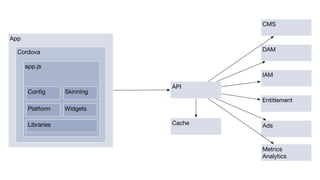
Architecture
Client App, JS, packaged with Cordova
Libraries, Widgets, Generic Platform Code
These are part of the platform and the same for all the apps of
the platform
App-specific configuration and skinning
Content is retrieved from the server-side through an API
Abstracts various backend systems such as the CMS, DAM, …
API might have a server-side cache
Notes
Challenges
App Platform vs. just an app
Reuse of code, platform, configuration, customising,
skinning
API Evolution
Apps are deployed, no instant updates
Performance, User Experience (UX)
Time-To-Market and Price
Notes
Design, Patterns, Concepts,
Technologies, …
React
Notes
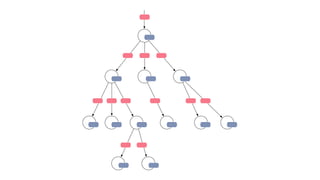
React Components
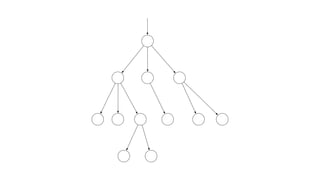
Tree of React Components
JS objects, can be as simple as one function
Every component has a render() function
Can be static (children are hard-coded in the parent) or
dynamic (children are added based on data of the parent-
components)
Notes
State
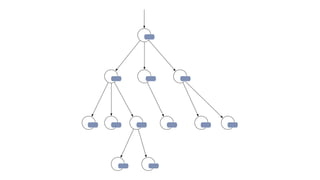
Every React component can have an inner state
State is optional
State must only be manipulated through an defined interface
Gives React a chance to know when the state has changed
and the component needs to be re-rendered
Notes
Attributes
In addition to the internal state, React components can also
receive data from parent components through attributes
Can be used for rendering
Can be used for initialising state
const CommentForm = React.createClass({
getInitialState: () => {
return {author: '', text: ''};
},
handleAuthorChange: (e) => {
this.setState({author: e.target.value});
},
handleTextChange: (e) => {
this.setState({text: e.target.value});
},
handleSubmit: (e) => {
e.preventDefault();
// do something
},
...
});
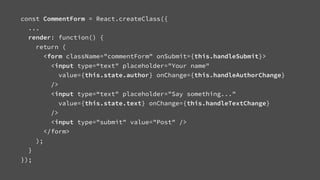
const CommentForm = React.createClass({
...
render: function() {
return (
<form className="commentForm" onSubmit={this.handleSubmit}>
<input type=“text" placeholder="Your name"
value={this.state.author} onChange={this.handleAuthorChange}
/>
<input type=“text" placeholder="Say something..."
value={this.state.text} onChange={this.handleTextChange}
/>
<input type="submit" value="Post" />
</form>
);
}
});
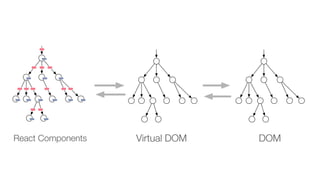
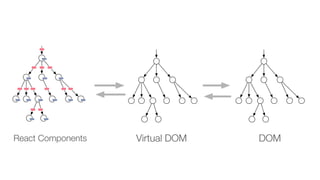
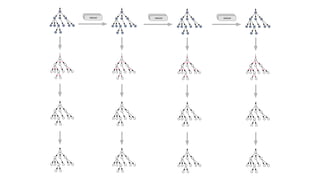
React Components Virtual DOM DOM
Notes
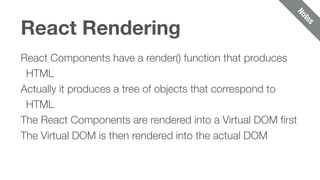
React Rendering
React Components have a render() function that produces
HTML
Actually it produces a tree of objects that correspond to
HTML
The React Components are rendered into a Virtual DOM first
The Virtual DOM is then rendered into the actual DOM
Notes
React Rendering
Pure Functions for the transformations (aka rendering)
Events flow in reverse to the transformation flow
React Optimisations
Propagate diffs rather than new trees
Lots and lots of checks for changes for trees and subtrees
Modify data (state or attributes) only through well-defined
interfaces
Immutable Data
React Components Virtual DOM DOM
Notes
Immutable Data
Data cannot be changed
Every change results in a new copy of a data structure
Optimisation: Data structure can contain references to data of
other data structures (since they can never change)
Equality check with immutable data becomes very efficient
Check if the reference is the same
React change check (shouldComponentUpdate) can be
implemented very efficiently
Redux
Dan Abramov
Hot Reloading with Time Travel
https://youtu.be/xsSnOQynTHs
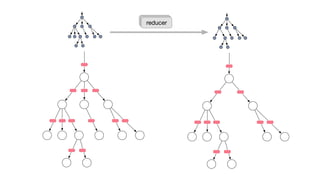
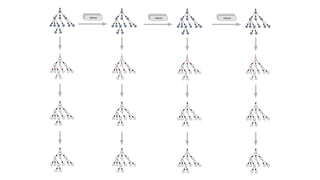
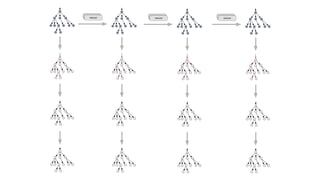
reducerreducerreducerreducer
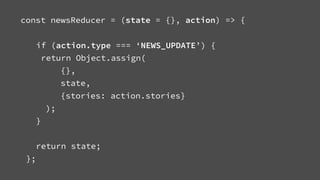
const newsReducer = (state = {}, action) => {


if (action.type === ‘NEWS_UPDATE’) {

return Object.assign(
{},
state,
{stories: action.stories}
);

}


return state;

};
Notes
Redux
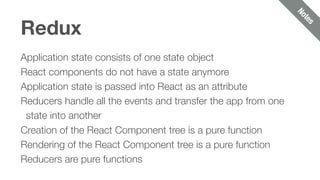
Application state consists of one state object
React components do not have a state anymore
Application state is passed into React as an attribute
Reducers handle all the events and transfer the app from one
state into another
Creation of the React Component tree is a pure function
Rendering of the React Component tree is a pure function
Reducers are pure functions
reducerreducerreducerreducer reducerreducerreducerreducer
reducerreducerreducerreducer
Notes
Loading Content
from the Server
(or from a local cache)
Content API
{
"kind": ["image", "diagram"],
"imageUrl": “http://example.com/diagram.png"
"caption": “Super Cool Diagram"
}
Notes
Content API
Objects in the content tree are called elements
Kind describes the (hierarchical) type of an element
Additional type-specific attributes are part of the element
Above example is the element description for an image
Can for example be a nice diagram
Customer wants to add support for an interactive diagram (zoom and
pan, play around with values, …)
Create a new element, support on the CMS and in the app
Create the new element as an extension/refinement of the old one
Content API
{
"kind": [“image”, “diagram”, “interactive”],
“dataUrl”: “https://example.com/data/diagram.json”,
"imageUrl": “https://example.com/diagram.png"
"caption": “Super Cool Diagram"
}
Notes
Content API
New sub-type ‘interactive’
Data URL for loading the data for the diagram
But the component is also an [‘image’, ‘diagram’] with
‘imageUrl’ and ‘caption’
If a client does not support ‘interactive’ yet, the component
can also just be rendered as an image/diagram
reducerreducerreducerreducer reducerreducerreducerreducer
reducerreducerreducerreducer
Notes
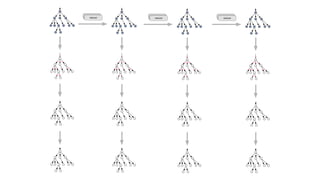
Loading Content (Simplified)
Reducer triggers a request for loading content
Technically, this is a side-effect and the reducer is not a pure function
anymore
Side-Effect is on an external system, asynchronous handling
When the data arrives, that triggers a new event for the reducers
Data passes through a series of transformers (“pure” functions) that
transform the received data into data that can be incorporated into the
application state … as well as side-effect events for loading additional
data
Notes
React / Redux / Immutable
Pure functions everywhere
Logically, everything is immutable and pure functions
Physically, React makes optimisations
Notes
Interesting Properties
Serialisable application state
Testing
Time-Machine
Performance
Code Quality
Code Reuse
Notes
Excursions
Web Applications
Notes
Web Applications
Nothing mentioned above is specific to mobile apps
You can also use the architecture for “normal” web
applications
Desktop web applications, mobile apps, responsive apps, …
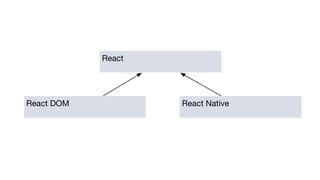
React Native
React
React DOM React Native
Notes
React Native
Relatively recent extension of the React Framework
Everything remains the same, React Components and if you
use it Redux, …
Instead of rendering HTML objects (using ReactDOM and
JSX), you render markup for Native Components
Native Runtime, Native Apps, Javascript as Scripting Engine
Native Performance, but still Hybrid
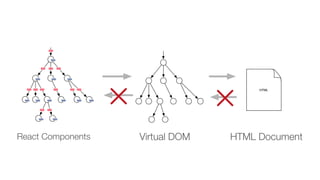
Server-Side Rendering
React Components Virtual DOM HTML Document
HTML
Notes
Server-Side Rendering
React Components can be rendered into a string
HTML code only
HTML code is dead, i.e. it does not contain any active parts
(Javascript)
Can be used for pre-rendering on the server-side
Make content available for search engine and other non-browser
clients
Testing
Notes
Summary
Technologies and Concepts
reducerreducerreducerreducer reducerreducerreducerreducer
reducerreducerreducerreducer
Notes
Technologies and Concepts
Technology choices have a big impact on design and fundamental
concepts
React, Redux and other members of this family have a clear heritage of
functional programming
This has a learning curve
It takes some time until you “get it”
And then it takes some more time until you really “get it”
Concepts are very different from what our developers were used too
There was a learning curve until it really clicks
Notes
Technologies and Concepts
Some things seem unnecessarily complicated and limiting
Most of the time, they are actually not
They seem complicated, because they are unfamiliar and you have
not started to think in a React/Redux/Functional way
Code Base in the end is much more fragmented
More small granular components than with other core technologies
Complexity is still smaller though, because the small components
follow very clear, simple and orthogonal concepts
Notes
Technologies and Concepts
Concepts (and technologies) allow for really cool and helpful
things
Testing, Time-Machine, React DevTools
Clean, simple, well-abstracted and clean code
Reusable and extensible code
Content API allows for very powerful customisation and
extension … of existing apps and use cases
Girders Elements
https://github.com/netceteragroup/girders-elements
Notes
Girders Elements
We had the chance to go through multiple iterations with the described
architecture
Both with React DOM and React Native
One of the current customers gave us the chance to extract the core
framework of the architecture and open-source it
This is called Girders Elements
It is currently being developed … in parallel with the platform and some
apps for the mentioned customer
Not production-ready yet
Notes
Girders Elements
React, React DOM or React Native, Redux and other core
libraries
Framework, Wiring, Configuration, UI Widgets
(Customisable, Skinnable)
Notes
Girders Elements
If you are very familiar with the concepts and libraries that I
mentioned -> use it and contribute to it
If you are not familiar with the concepts and libraries yet ->
wait for a few months
Girders Elements is still under development
Documentation is not there yet
But we will get there eventually
Corsin Decurtins, Netcetera
Chief Technology Officer
corsin.decurtins@netcetera.com
@corsin
reducerreducerreducerreducer reducerreducerreducerreducer
reducerreducerreducerreducer
Content-Driven Apps with React
Corsin Decurtins, Netcetera
2016-10-17
/Bern
BärnerJS

Content-Driven Apps with React

  • 1.
    Content-Driven Apps withReact Corsin Decurtins, Netcetera 2016-10-17 /Bern BärnerJS
  • 2.
    Notes Content-Driven Apps withReact This talk is a story about a family of projects or apps Actually not just individual apps, but app platforms Same team, same technology (roughly) Multiple projects, multiple apps, multiple customers But the same kind of app or actually app platform Mobile app, heavily content driven Customers are publishers, users are readers It all started with a proof-of-concept…
  • 4.
    Notes Proof of Concept Customerhad a hybrid mobile app, Cordova and Angular (1) It was too slow for them, which resulted in a bad UX PoC done with React to see if we can improve the performance In particular the performance of the home page / start screen PoC showed, that we can Goal was a 50% improvement, he had up to 80% improvement This talk is about the app architecture that started with this PoC But it will be about anything but performance
  • 5.
  • 6.
    Notes Disclaimers I’m just theperson giving the talk; other people did the actual work If something is wrong or does not make sense, it’s probably me who messed it up I’m familiar with the architecture, design and technologies If you have very detailed questions about the implementation, I will refer you to my colleagues
  • 7.
    Ognen Ivanovski, Netcetera PrincipalArchitect Andon Sikavica, Netcetera Senior Software Engineer
  • 8.
    Notes Who are you? Whois already familiar with… … React … React Native … Redux … Immutable Data, ImmutableJS … Pure Functions, Functional Programming
  • 9.
  • 10.
  • 11.
  • 12.
  • 13.
  • 14.
  • 15.
  • 16.
    Notes Web-Based Hybrid MobileApps Mobile apps for smartphones and tablets Hybrid, i.e. one code base for all the platforms Based on web technologies, i.e. HTML, Javascript, CSS and JSON Based on web tooling (debuggers, CSS, NPM, gulp, ECMAScript, …) Cordova is the most common runtime platform for creating packaged apps that can be delivered to the app store
  • 17.
  • 18.
    Notes Web-Based Hybrid MobileApps Web based can be interpreted loosely Instead of HTML, other markup is possible, including markup for native components Also not restricted to mobile apps, you can build other apps as well Not even restricted to apps, can be used for “websites”
  • 19.
  • 20.
    Notes Content-Driven Apps Mobile appsthat are mostly used to consume and browse through content News apps for example Get content from a server Content from the server determines the screens, the interaction and the navigation The browser is probably the ultimate example
  • 21.
    Notes Content-Driven Apps We startedout with news apps for publishers But there are a lot of other examples
  • 22.
  • 23.
  • 24.
    Notes Architecture Client App, JS,packaged with Cordova Libraries, Widgets, Generic Platform Code These are part of the platform and the same for all the apps of the platform App-specific configuration and skinning Content is retrieved from the server-side through an API Abstracts various backend systems such as the CMS, DAM, … API might have a server-side cache
  • 25.
    Notes Challenges App Platform vs.just an app Reuse of code, platform, configuration, customising, skinning API Evolution Apps are deployed, no instant updates Performance, User Experience (UX) Time-To-Market and Price
  • 26.
  • 27.
  • 29.
    Notes React Components Tree ofReact Components JS objects, can be as simple as one function Every component has a render() function Can be static (children are hard-coded in the parent) or dynamic (children are added based on data of the parent- components)
  • 31.
    Notes State Every React componentcan have an inner state State is optional State must only be manipulated through an defined interface Gives React a chance to know when the state has changed and the component needs to be re-rendered
  • 33.
    Notes Attributes In addition tothe internal state, React components can also receive data from parent components through attributes Can be used for rendering Can be used for initialising state
  • 34.
    const CommentForm =React.createClass({ getInitialState: () => { return {author: '', text: ''}; }, handleAuthorChange: (e) => { this.setState({author: e.target.value}); }, handleTextChange: (e) => { this.setState({text: e.target.value}); }, handleSubmit: (e) => { e.preventDefault(); // do something }, ... });
  • 35.
    const CommentForm =React.createClass({ ... render: function() { return ( <form className="commentForm" onSubmit={this.handleSubmit}> <input type=“text" placeholder="Your name" value={this.state.author} onChange={this.handleAuthorChange} /> <input type=“text" placeholder="Say something..." value={this.state.text} onChange={this.handleTextChange} /> <input type="submit" value="Post" /> </form> ); } });
  • 36.
  • 37.
    Notes React Rendering React Componentshave a render() function that produces HTML Actually it produces a tree of objects that correspond to HTML The React Components are rendered into a Virtual DOM first The Virtual DOM is then rendered into the actual DOM
  • 38.
    Notes React Rendering Pure Functionsfor the transformations (aka rendering) Events flow in reverse to the transformation flow React Optimisations Propagate diffs rather than new trees Lots and lots of checks for changes for trees and subtrees Modify data (state or attributes) only through well-defined interfaces
  • 39.
  • 40.
  • 41.
    Notes Immutable Data Data cannotbe changed Every change results in a new copy of a data structure Optimisation: Data structure can contain references to data of other data structures (since they can never change) Equality check with immutable data becomes very efficient Check if the reference is the same React change check (shouldComponentUpdate) can be implemented very efficiently
  • 42.
  • 43.
    Dan Abramov Hot Reloadingwith Time Travel https://youtu.be/xsSnOQynTHs
  • 44.
  • 45.
    const newsReducer =(state = {}, action) => {
 
 if (action.type === ‘NEWS_UPDATE’) {
 return Object.assign( {}, state, {stories: action.stories} );
 }
 
 return state;
 };
  • 46.
    Notes Redux Application state consistsof one state object React components do not have a state anymore Application state is passed into React as an attribute Reducers handle all the events and transfer the app from one state into another Creation of the React Component tree is a pure function Rendering of the React Component tree is a pure function Reducers are pure functions
  • 47.
  • 48.
    Notes Loading Content from theServer (or from a local cache)
  • 49.
    Content API { "kind": ["image","diagram"], "imageUrl": “http://example.com/diagram.png" "caption": “Super Cool Diagram" }
  • 50.
    Notes Content API Objects inthe content tree are called elements Kind describes the (hierarchical) type of an element Additional type-specific attributes are part of the element Above example is the element description for an image Can for example be a nice diagram Customer wants to add support for an interactive diagram (zoom and pan, play around with values, …) Create a new element, support on the CMS and in the app Create the new element as an extension/refinement of the old one
  • 51.
    Content API { "kind": [“image”,“diagram”, “interactive”], “dataUrl”: “https://example.com/data/diagram.json”, "imageUrl": “https://example.com/diagram.png" "caption": “Super Cool Diagram" }
  • 52.
    Notes Content API New sub-type‘interactive’ Data URL for loading the data for the diagram But the component is also an [‘image’, ‘diagram’] with ‘imageUrl’ and ‘caption’ If a client does not support ‘interactive’ yet, the component can also just be rendered as an image/diagram
  • 53.
  • 54.
    Notes Loading Content (Simplified) Reducertriggers a request for loading content Technically, this is a side-effect and the reducer is not a pure function anymore Side-Effect is on an external system, asynchronous handling When the data arrives, that triggers a new event for the reducers Data passes through a series of transformers (“pure” functions) that transform the received data into data that can be incorporated into the application state … as well as side-effect events for loading additional data
  • 55.
    Notes React / Redux/ Immutable Pure functions everywhere Logically, everything is immutable and pure functions Physically, React makes optimisations
  • 56.
    Notes Interesting Properties Serialisable applicationstate Testing Time-Machine Performance Code Quality Code Reuse
  • 57.
  • 58.
  • 59.
    Notes Web Applications Nothing mentionedabove is specific to mobile apps You can also use the architecture for “normal” web applications Desktop web applications, mobile apps, responsive apps, …
  • 60.
  • 61.
  • 62.
    Notes React Native Relatively recentextension of the React Framework Everything remains the same, React Components and if you use it Redux, … Instead of rendering HTML objects (using ReactDOM and JSX), you render markup for Native Components Native Runtime, Native Apps, Javascript as Scripting Engine Native Performance, but still Hybrid
  • 63.
  • 64.
    React Components VirtualDOM HTML Document HTML
  • 65.
    Notes Server-Side Rendering React Componentscan be rendered into a string HTML code only HTML code is dead, i.e. it does not contain any active parts (Javascript) Can be used for pre-rendering on the server-side Make content available for search engine and other non-browser clients Testing
  • 66.
  • 67.
  • 68.
  • 69.
    Notes Technologies and Concepts Technologychoices have a big impact on design and fundamental concepts React, Redux and other members of this family have a clear heritage of functional programming This has a learning curve It takes some time until you “get it” And then it takes some more time until you really “get it” Concepts are very different from what our developers were used too There was a learning curve until it really clicks
  • 70.
    Notes Technologies and Concepts Somethings seem unnecessarily complicated and limiting Most of the time, they are actually not They seem complicated, because they are unfamiliar and you have not started to think in a React/Redux/Functional way Code Base in the end is much more fragmented More small granular components than with other core technologies Complexity is still smaller though, because the small components follow very clear, simple and orthogonal concepts
  • 71.
    Notes Technologies and Concepts Concepts(and technologies) allow for really cool and helpful things Testing, Time-Machine, React DevTools Clean, simple, well-abstracted and clean code Reusable and extensible code Content API allows for very powerful customisation and extension … of existing apps and use cases
  • 72.
  • 73.
    Notes Girders Elements We hadthe chance to go through multiple iterations with the described architecture Both with React DOM and React Native One of the current customers gave us the chance to extract the core framework of the architecture and open-source it This is called Girders Elements It is currently being developed … in parallel with the platform and some apps for the mentioned customer Not production-ready yet
  • 74.
    Notes Girders Elements React, ReactDOM or React Native, Redux and other core libraries Framework, Wiring, Configuration, UI Widgets (Customisable, Skinnable)
  • 75.
    Notes Girders Elements If youare very familiar with the concepts and libraries that I mentioned -> use it and contribute to it If you are not familiar with the concepts and libraries yet -> wait for a few months Girders Elements is still under development Documentation is not there yet But we will get there eventually
  • 76.
    Corsin Decurtins, Netcetera ChiefTechnology Officer corsin.decurtins@netcetera.com @corsin
  • 77.
  • 78.
    Content-Driven Apps withReact Corsin Decurtins, Netcetera 2016-10-17 /Bern BärnerJS