React+Redux
Workshops
Marcin Grzywaczewski (@Killavus)
Arkency
What
• An app for managing conferences
• Planning conferences
• Scheduling conference days
• Accepting events from CFP (call for papers)
• Scheduling events within conference days
How
• React.js and Redux will be used to create an
interface
• HTML Mockups are prepared so you can base on
it (I’ll be happy if you experiment with your own
solutions, though)
• Project with an API and all needed libraries is
provided
• One view = one React.js+Redux application
React.js
• Responsible for rendering HTML.
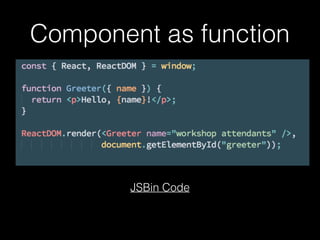
• A function which takes properties and returns HTML.
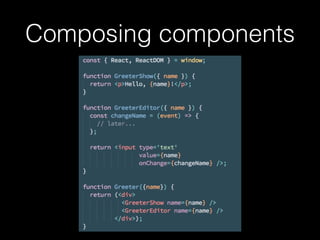
• You create components which are small pieces of your
interface and you compose them together.
• React.js uses JSX syntax, which is very similar to
HTML.
• There is a concept of state, but thanks to Redux it is
unnecessary.
Component as function
JSBin Code
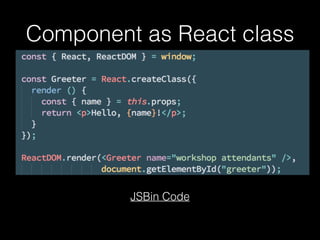
Component as React class
JSBin Code
Composing components
How to make it dynamic?
• You can’t change props!
• You can call ReactDOM.render again. It is fast,
thanks to React.js internal algorithms.
• There is a concept of state, but we won’t use it
beacuse you don’t need it.
Dynamic component?
JSBin Code
What if…
• You can have some piece of data needed to
render a component.
• Every time a piece of data changes you re-
render your component. Your component is
notified somehow about the change.
• This is what Redux will provide to us.
Redux
• Manages the data flow in your application.
• You emit actions which are like parameters for Rails
update endpoint (but named!). Actions are created by
action creators.
• Actions modify state.
• State is stored within a store.
• How an action modifies state is determined by a
reducer.
Greeter with React+Redux
• A function is called an app when contains:
• React components
• Redux building blocks
• Let’s create a GreeterApp, step by step.
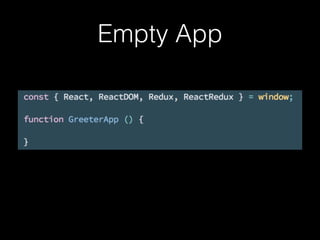
Empty App
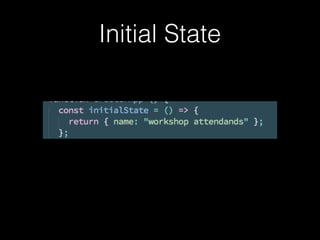
Initial State
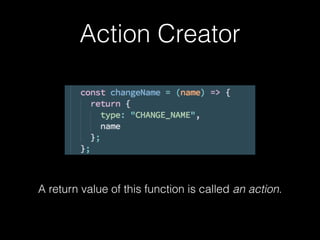
Action Creator
A return value of this function is called an action.
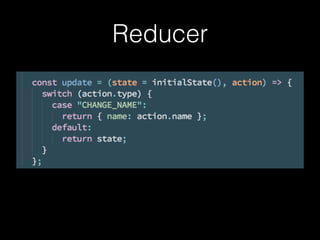
Reducer
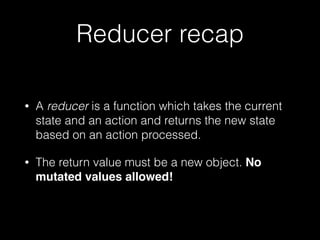
Reducer recap
• A reducer is a function which takes the current
state and an action and returns the new state
based on an action processed.
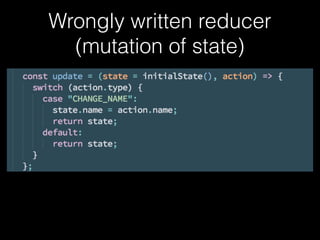
• The return value must be a new object. No
mutated values allowed!
Wrongly written reducer
(mutation of state)
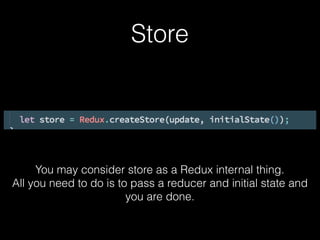
Store
You may consider store as a Redux internal thing.
All you need to do is to pass a reducer and initial state and
you are done.
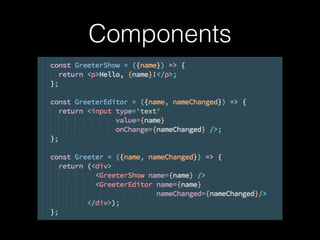
Components
Components recap
• The new property will be passed -
nameChanged which is a function passed to
onChange of GreeterEdit.
• Components are blissfully unaware of being
managed by Redux ;).
• But how to connect React + Redux together?
Connecting React & Redux
• To connect React.js components with Redux stores
you need create a connector.
• Connector is a pair of state mapper and dispatch
mapper.
• State mapper takes your state and produces an object
which will be merged to component’s properties.
• Dispatch mapper exposes dispatch function which
passes actions to a store. It returns an object which
will get merged to component’s properties too.
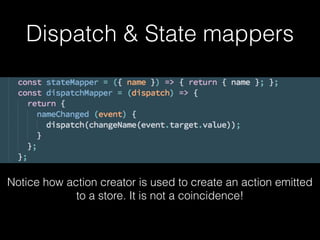
Dispatch & State mappers
Notice how action creator is used to create an action emitted
to a store. It is not a coincidence!
connect function
• connect function takes your state mapper and
dispatch mapper and creates a connector. It is a
function.
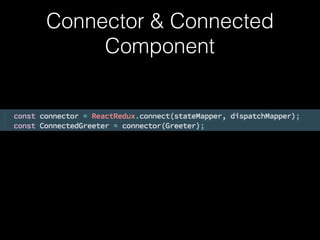
• To make your component connected you just
pass a component as an argument to a
connector.
Connector & Connected
Component
Provider
• We know how to map state to properties and
we’re exposing functions for dispatching
actions. But we don’t know where to dispatch
our actions!
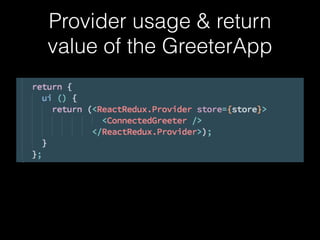
• There is a Provider component. You wrap your
connected component with it. It takes store as a
property.
Provider usage & return
value of the GreeterApp
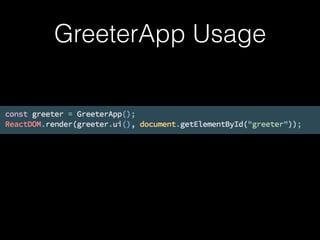
GreeterApp Usage
GreeterApp Code
JSBin Code
Summary
• React.js is great for defining your user interface in
the declarative way.
• Redux is great for managing the data flow in a
simple way.
• You can connect the two together, removing the
problem of updating React components.
• Component’s built-in state is not needed. It is the
most troubling part of React components!
Good luck!

React.js+Redux Workshops

  • 1.
  • 2.
    What • An appfor managing conferences • Planning conferences • Scheduling conference days • Accepting events from CFP (call for papers) • Scheduling events within conference days
  • 3.
    How • React.js andRedux will be used to create an interface • HTML Mockups are prepared so you can base on it (I’ll be happy if you experiment with your own solutions, though) • Project with an API and all needed libraries is provided • One view = one React.js+Redux application
  • 4.
    React.js • Responsible forrendering HTML. • A function which takes properties and returns HTML. • You create components which are small pieces of your interface and you compose them together. • React.js uses JSX syntax, which is very similar to HTML. • There is a concept of state, but thanks to Redux it is unnecessary.
  • 5.
  • 6.
    Component as Reactclass JSBin Code
  • 7.
  • 8.
    How to makeit dynamic? • You can’t change props! • You can call ReactDOM.render again. It is fast, thanks to React.js internal algorithms. • There is a concept of state, but we won’t use it beacuse you don’t need it.
  • 9.
  • 10.
    What if… • Youcan have some piece of data needed to render a component. • Every time a piece of data changes you re- render your component. Your component is notified somehow about the change. • This is what Redux will provide to us.
  • 11.
    Redux • Manages thedata flow in your application. • You emit actions which are like parameters for Rails update endpoint (but named!). Actions are created by action creators. • Actions modify state. • State is stored within a store. • How an action modifies state is determined by a reducer.
  • 12.
    Greeter with React+Redux •A function is called an app when contains: • React components • Redux building blocks • Let’s create a GreeterApp, step by step.
  • 13.
  • 14.
  • 15.
    Action Creator A returnvalue of this function is called an action.
  • 16.
  • 17.
    Reducer recap • Areducer is a function which takes the current state and an action and returns the new state based on an action processed. • The return value must be a new object. No mutated values allowed!
  • 18.
  • 19.
    Store You may considerstore as a Redux internal thing. All you need to do is to pass a reducer and initial state and you are done.
  • 20.
  • 21.
    Components recap • Thenew property will be passed - nameChanged which is a function passed to onChange of GreeterEdit. • Components are blissfully unaware of being managed by Redux ;). • But how to connect React + Redux together?
  • 22.
    Connecting React &Redux • To connect React.js components with Redux stores you need create a connector. • Connector is a pair of state mapper and dispatch mapper. • State mapper takes your state and produces an object which will be merged to component’s properties. • Dispatch mapper exposes dispatch function which passes actions to a store. It returns an object which will get merged to component’s properties too.
  • 23.
    Dispatch & Statemappers Notice how action creator is used to create an action emitted to a store. It is not a coincidence!
  • 24.
    connect function • connectfunction takes your state mapper and dispatch mapper and creates a connector. It is a function. • To make your component connected you just pass a component as an argument to a connector.
  • 25.
  • 26.
    Provider • We knowhow to map state to properties and we’re exposing functions for dispatching actions. But we don’t know where to dispatch our actions! • There is a Provider component. You wrap your connected component with it. It takes store as a property.
  • 27.
    Provider usage &return value of the GreeterApp
  • 28.
  • 29.
  • 30.
    Summary • React.js isgreat for defining your user interface in the declarative way. • Redux is great for managing the data flow in a simple way. • You can connect the two together, removing the problem of updating React components. • Component’s built-in state is not needed. It is the most troubling part of React components!
  • 31.