REACT & FLUX WORKSHOP

BY CHRISTIAN LILLEY
ABOUT.ME/XML — @XMLILLEY
OUR PLAN
REACT
1. Light Intro to React Concepts
2. Demos: Building with React
3. React Details/Summary
(SHORT) BREAK
FLUX
4. Light Intro to Flux Concepts
5. Demos: Building with Flux
6. Flux Details/Summary
CODE
REPOS AT GITHUB.COM/XMLILLEY
github.com/xmlilley/jschannel-react-demos
github.com/xmlilley/jschannel-flux-demos
“WORKSHOP” VS. “HANDS-ON”
NORMS ON QUESTIONS
WATCH FOR: THE BIG PICTURE
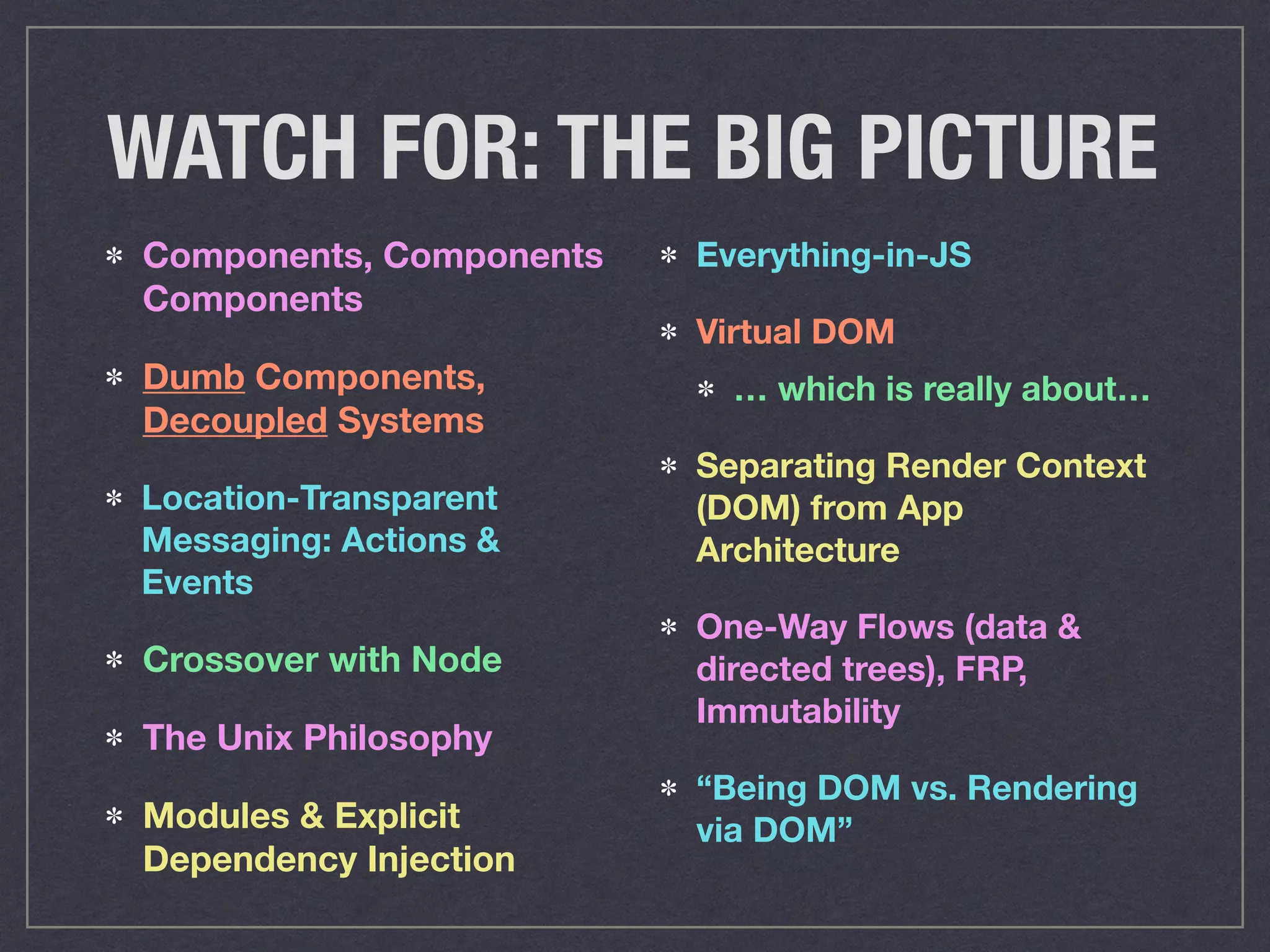
Components, Components
Components
Dumb Components,
Decoupled Systems
Location-Transparent
Messaging: Actions &
Events
Crossover with Node
The Unix Philosophy
Modules & Explicit
Dependency Injection
Everything-in-JS
Virtual DOM
… which is really about…
Separating Render Context
(DOM) from App
Architecture
One-Way Flows (data &
directed trees), FRP,
Immutability
“Being DOM vs. Rendering
via DOM”
WATCH FOR: THE BIG PICTURE
DOM —> JAVASCRIPT?
JAVASCRIPT —> DOM
or:
WATCH FOR: THE BIG PICTURE
$WATCH & UPDATE?
RE-RENDER
or:
WATCH FOR: THE BIG PICTURE
WHAT IS ?
‘Library’, not a ‘Framework’
If you start from MVC, React is only the V
(But forget MVC. It’s kind of… over)
Components for interfaces: Make complex
components from simpler components
Not a tiny library, but a small API: only for rendering
components, not building whole apps
Use basic JS for most things, not API calls
Browser Support: IE 8+ (Needs shims/shams for ES5)
The whole interface is a tree of React components,
which mirrors… is mirrored by… the DOM tree
For every DOM element, there’s a component
No templates at runtime: only Javascript *
Data flows only in one direction: down the tree
Conceptually, this means we never ‘update’ or
‘mutate’ the DOM. We simply re-render it.
WHAT IS ?
* YMMV
LET’S SEE A COMPONENT…
COMPONENT STRUCTURE
A component is a React ‘class’ instance (but isn’t built
with `new` in ES5: it’s functional construction until ES6)
Components have default ‘lifecycle’ methods: hooks for
actions at various points in time
has ‘Props’ & ‘State’: props are immutable and inherited,
state is mutable and changes trigger re-render
JSX is how you compose the view, combine child
elements
Extend with your own methods, or augment existing ones
COMPONENT MIXINS
Mixins are handy bundles of reusable methods that
you can apply to multiple component types
Great for ‘glue’ functions/boilerplate: service
interaction, event listeners, dispatching Actions, etc.
Big problem: they’re going away in ES6
Smaller problem: multiple mixins can clash
Good Solution to both: ‘Higher-Order
Components’ (functional generators that compose
new components by augmenting existing ones)
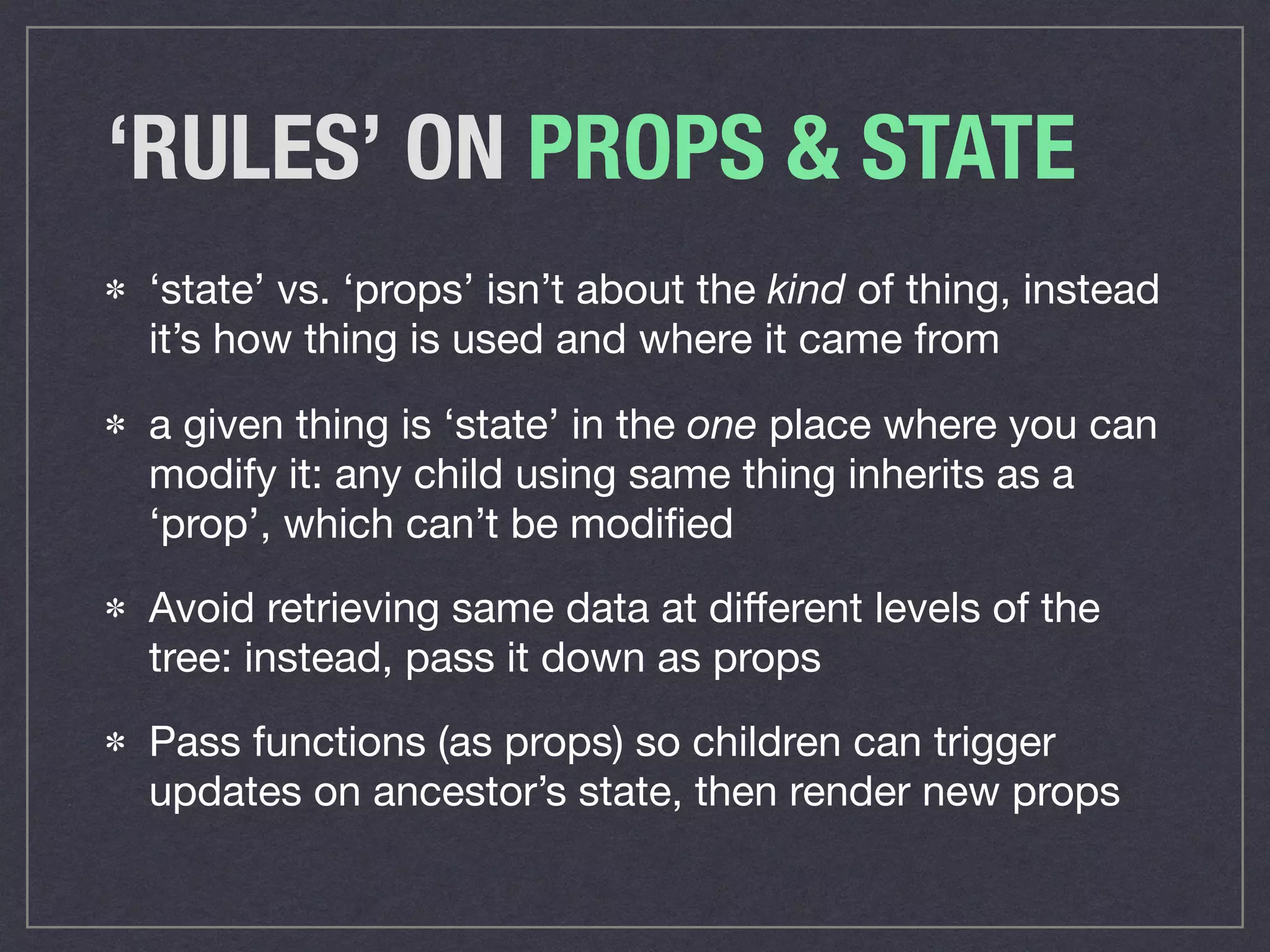
‘RULES’ ON PROPS & STATE
‘state’ vs. ‘props’ isn’t about the kind of thing, instead
it’s how thing is used and where it came from

a given thing is ‘state’ in the one place where you can
modify it: any child using same thing inherits as a
‘prop’, which can’t be modified

Avoid retrieving same data at different levels of the
tree: instead, pass it down as props

Pass functions (as props) so children can trigger
updates on ancestor’s state, then render new props
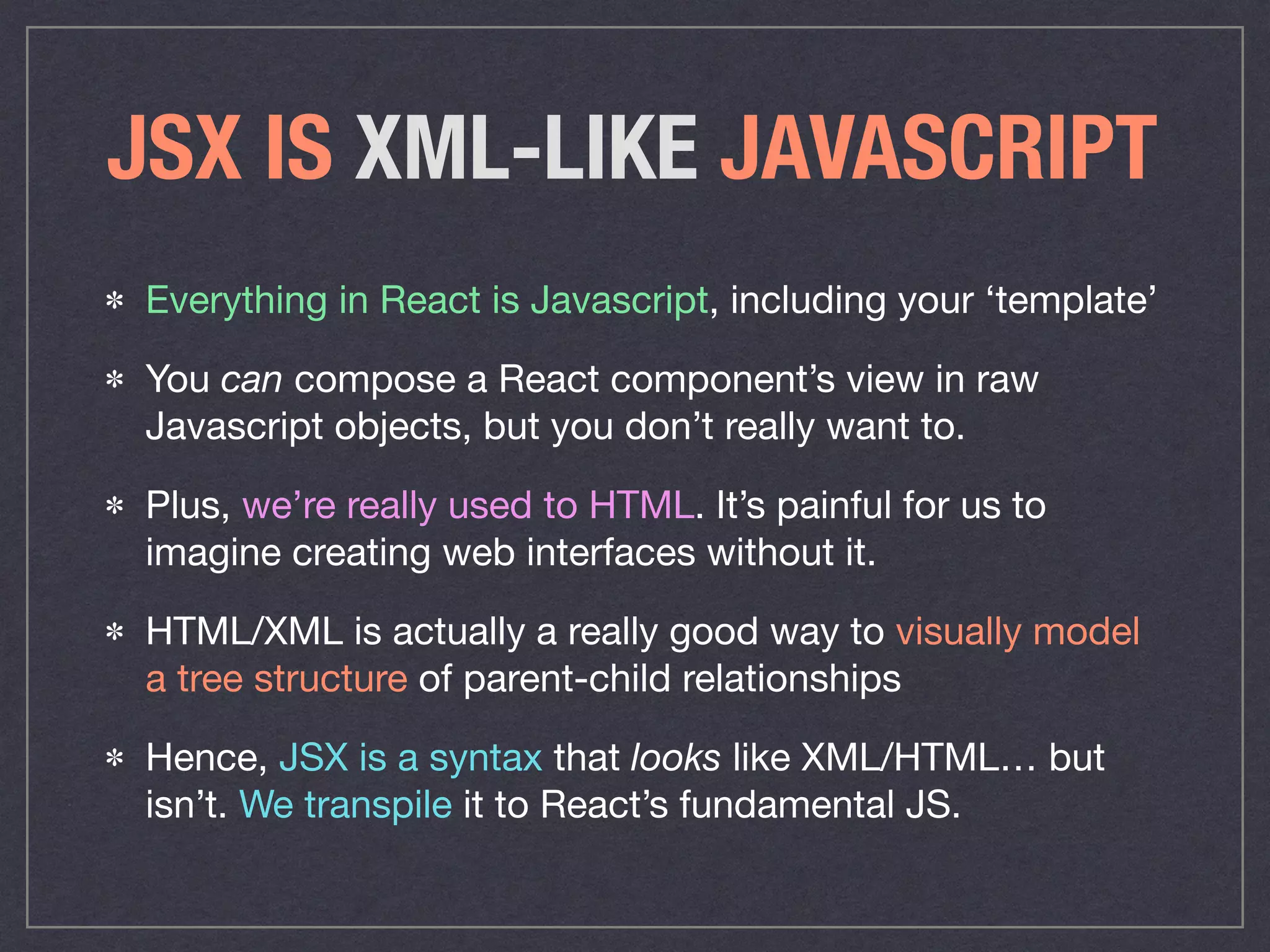
JSX IS XML-LIKE JAVASCRIPT
Everything in React is Javascript, including your ‘template’

You can compose a React component’s view in raw
Javascript objects, but you don’t really want to. 

Plus, we’re really used to HTML. It’s painful for us to
imagine creating web interfaces without it. 

HTML/XML is actually a really good way to visually model
a tree structure of parent-child relationships

Hence, JSX is a syntax that looks like XML/HTML… but
isn’t. We transpile it to React’s fundamental JS.
JSX IS XML-LIKE JAVASCRIPT
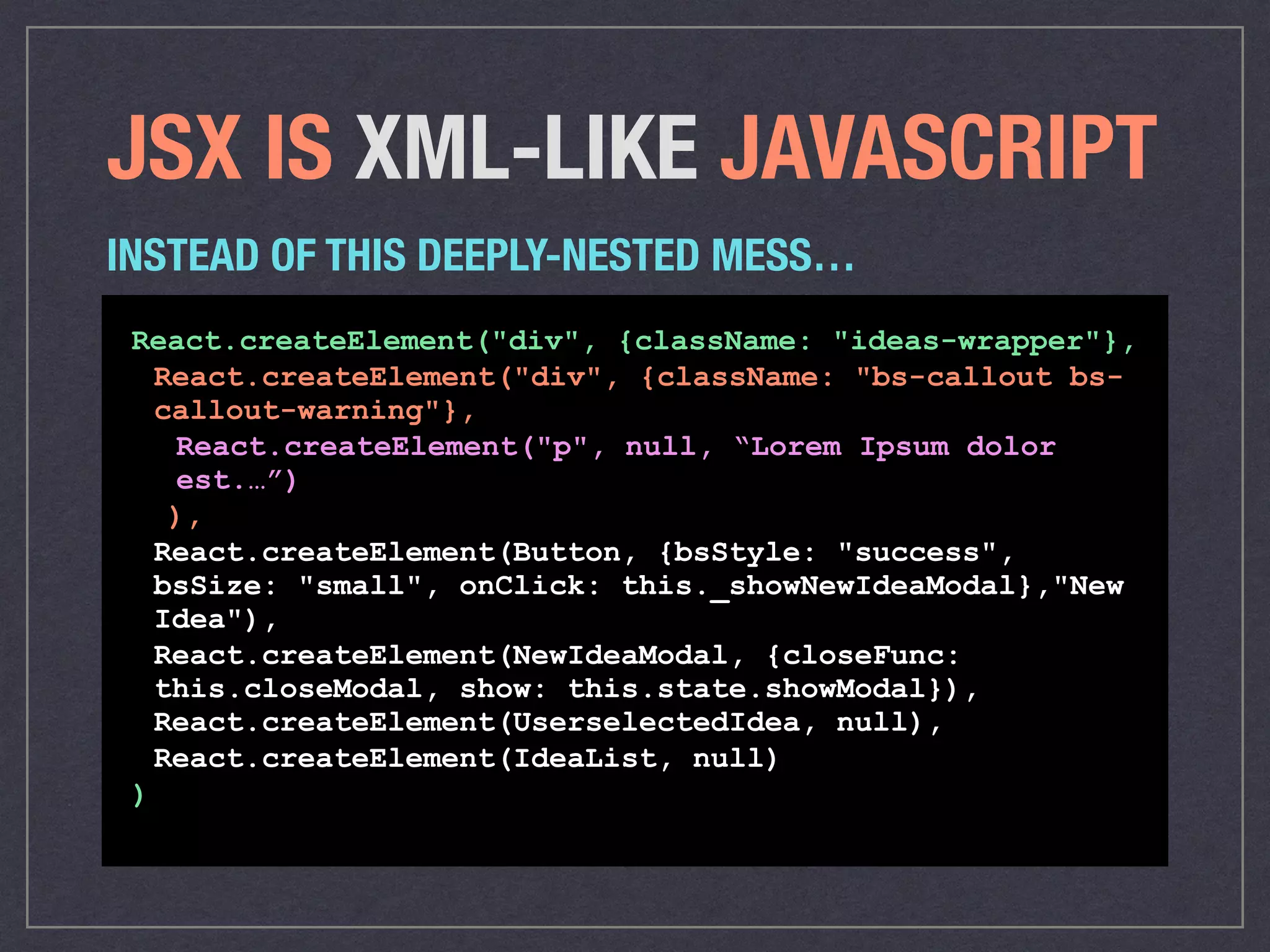
React.createElement("div", {className: "ideas-wrapper"},
React.createElement("div", {className: "bs-callout bs-
callout-warning"},
React.createElement("p", null, “Lorem Ipsum dolor
est.…”)
),
React.createElement(Button, {bsStyle: "success",
bsSize: "small", onClick: this._showNewIdeaModal},"New
Idea"),
React.createElement(NewIdeaModal, {closeFunc:
this.closeModal, show: this.state.showModal}),
React.createElement(UserselectedIdea, null),
React.createElement(IdeaList, null)
)
INSTEAD OF THIS DEEPLY-NESTED MESS…
JSX IS XML-LIKE JAVASCRIPT
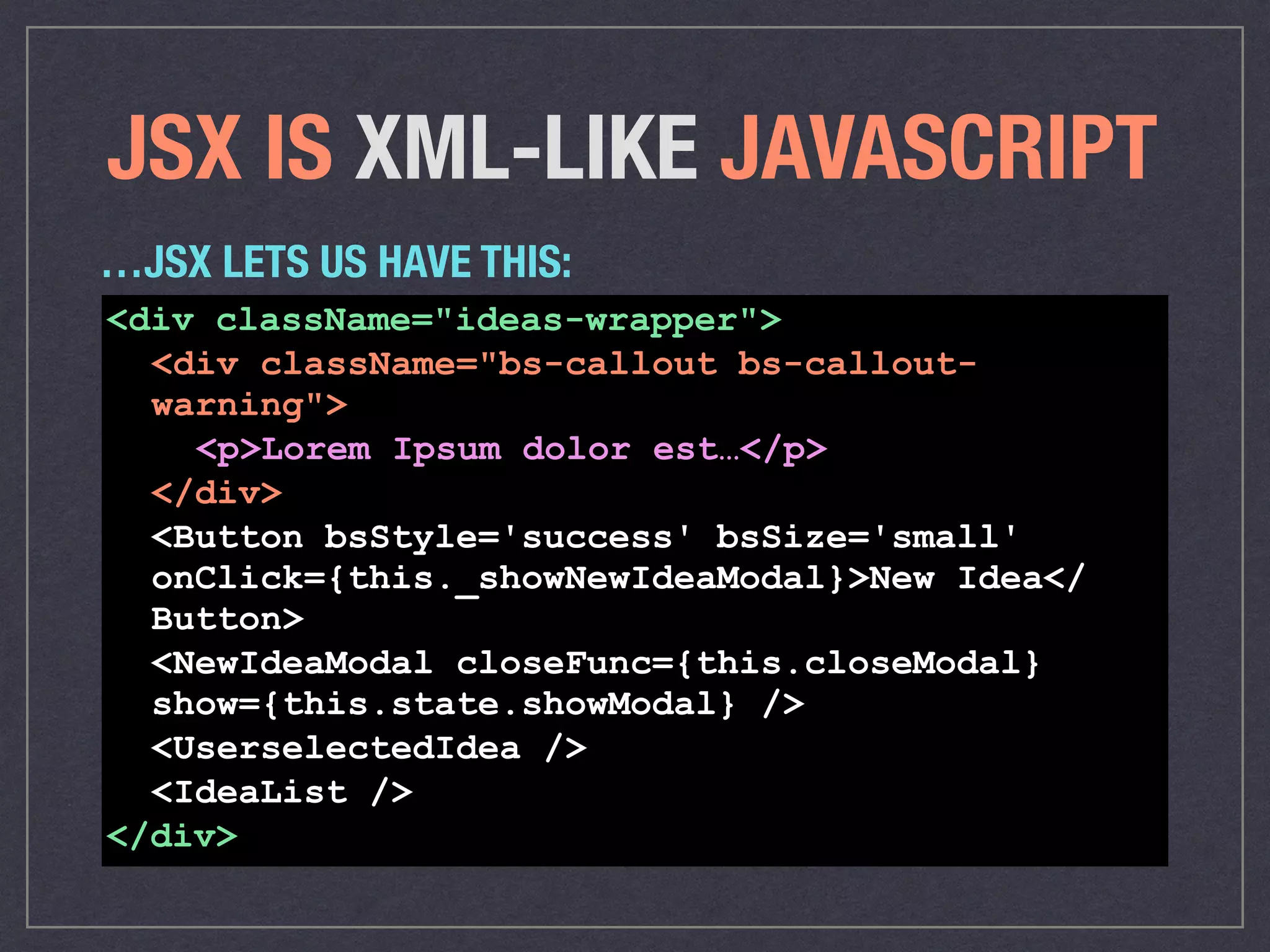
<div className="ideas-wrapper">
<div className="bs-callout bs-callout-
warning">
<p>Lorem Ipsum dolor est…</p>
</div>
<Button bsStyle='success' bsSize='small'
onClick={this._showNewIdeaModal}>New Idea</
Button>
<NewIdeaModal closeFunc={this.closeModal}
show={this.state.showModal} />
<UserselectedIdea />
<IdeaList />
</div>
…JSX LETS US HAVE THIS:
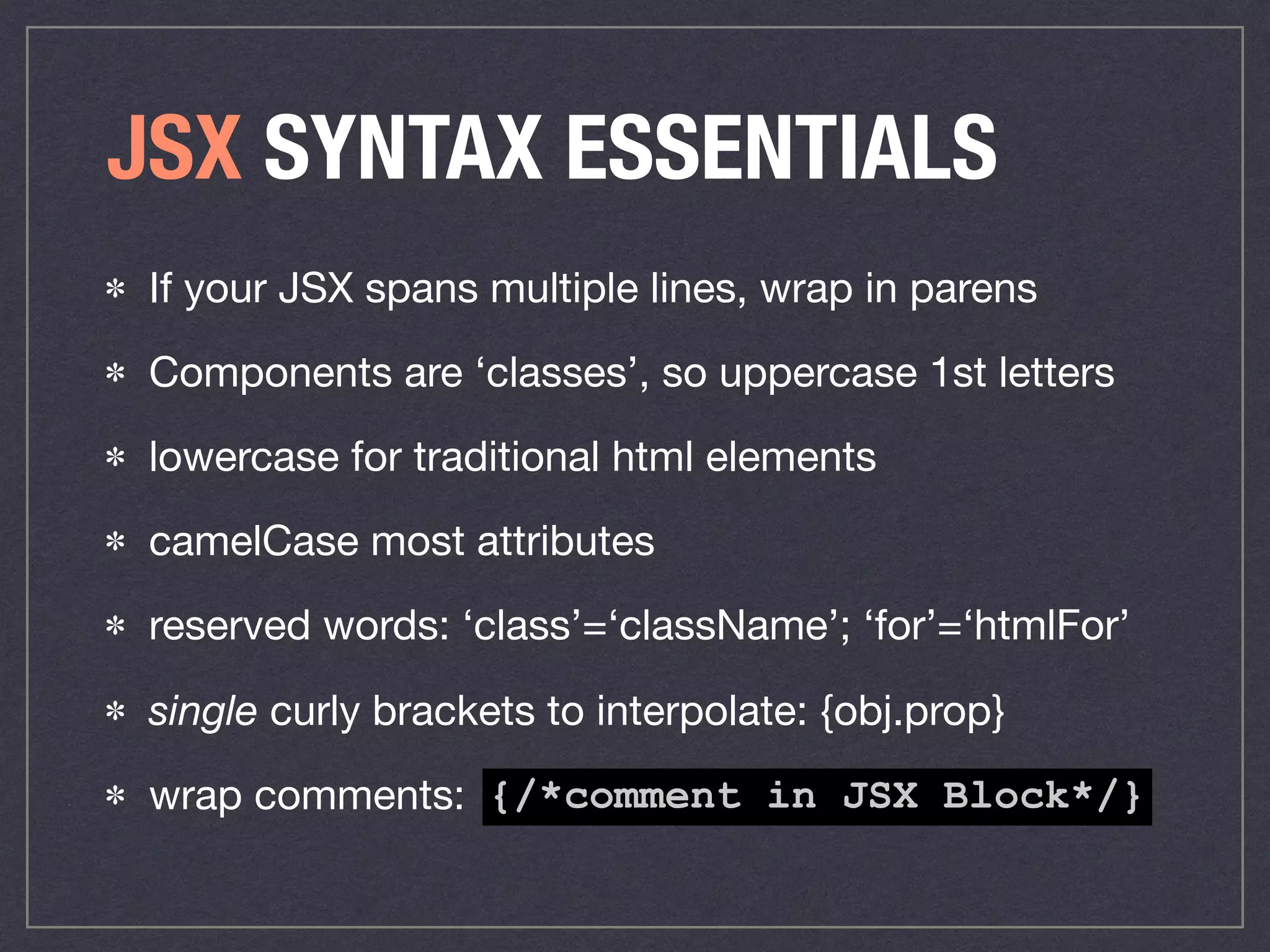
JSX SYNTAX ESSENTIALS
If your JSX spans multiple lines, wrap in parens

Components are ‘classes’, so uppercase 1st letters

lowercase for traditional html elements

camelCase most attributes

reserved words: ‘class’=‘className’; ‘for’=‘htmlFor’

single curly brackets to interpolate: {obj.prop}

wrap comments: {/*comment in JSX Block*/}
JSX SYNTAX ESSENTIALS
Remember: even <div> is just a default React
component, called ‘div’, which has a render method
that outputs some specific HTML
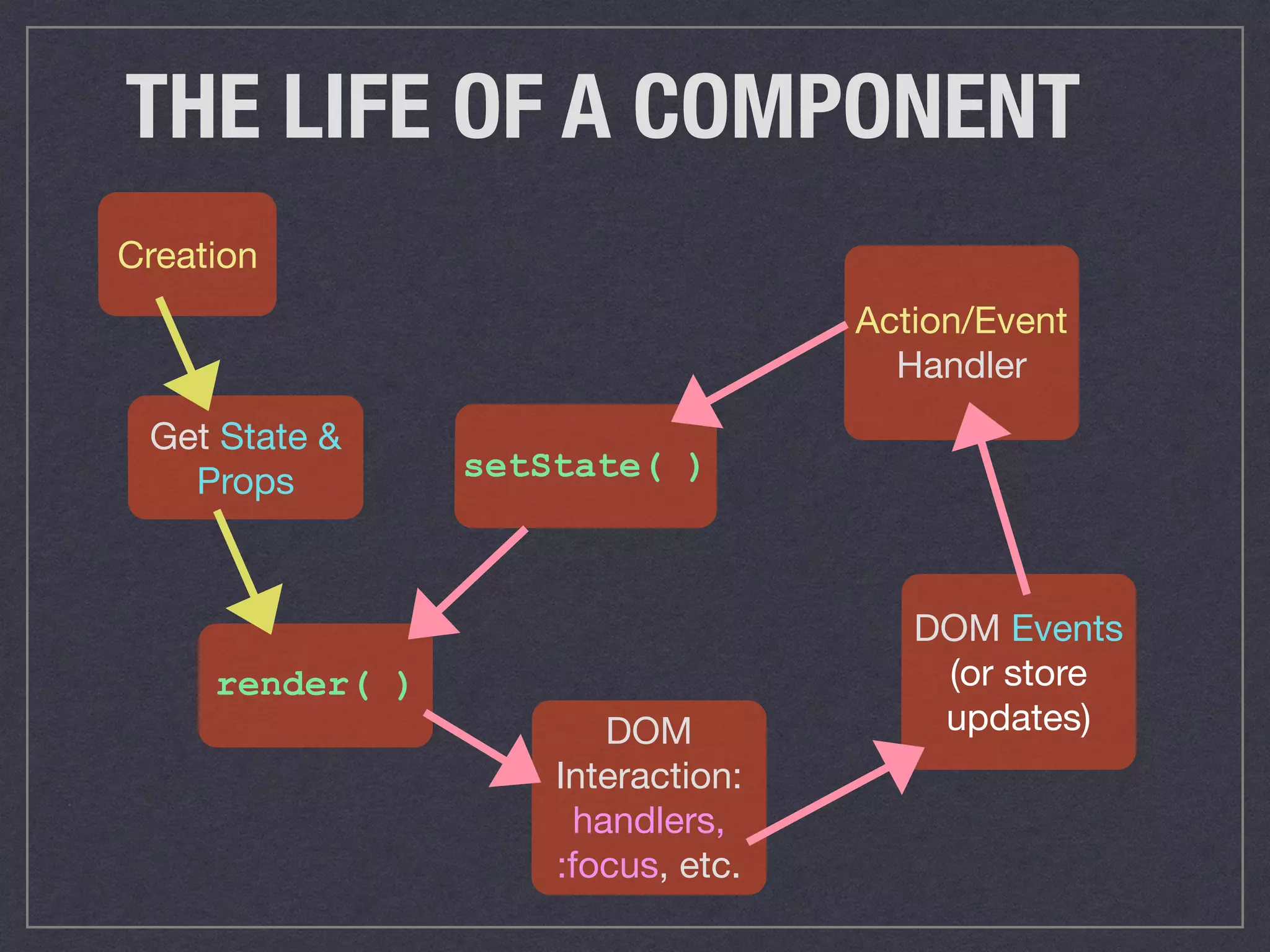
THE LIFE OF A COMPONENT
Creation
Get State &
Props
render( )
DOM
Interaction:
handlers, 

:focus, etc.
DOM Events
(or store
updates)
Action/Event

Handler
setState( )
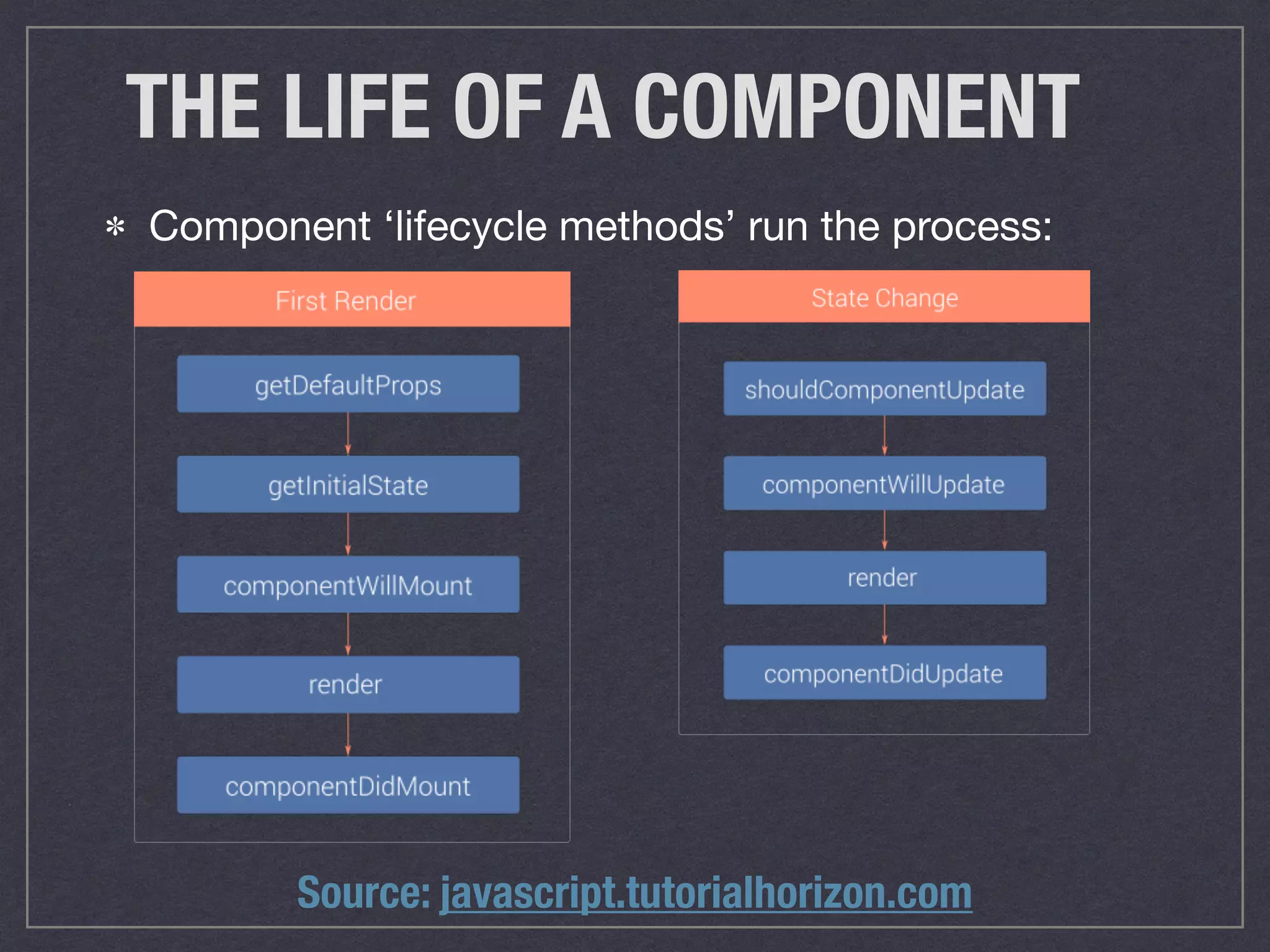
THE LIFE OF A COMPONENT
Component ‘lifecycle methods’ run the process:
Source: javascript.tutorialhorizon.com
THE LIFE OF A COMPONENT
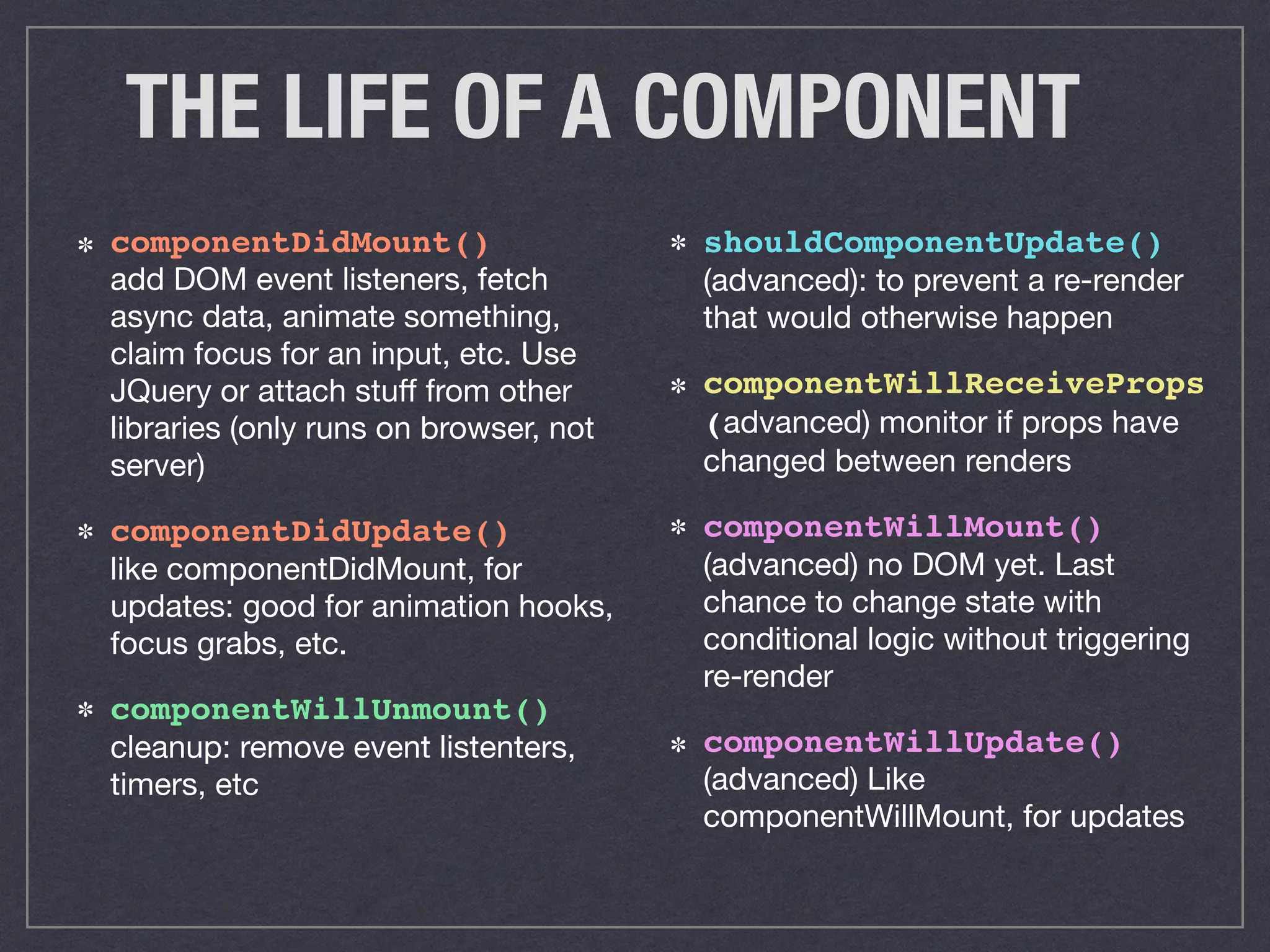
componentDidMount()

add DOM event listeners, fetch
async data, animate something,
claim focus for an input, etc. Use
JQuery or attach stuff from other
libraries (only runs on browser, not
server)

componentDidUpdate()
like componentDidMount, for
updates: good for animation hooks,
focus grabs, etc.

componentWillUnmount()
cleanup: remove event listenters,
timers, etc

shouldComponentUpdate()
(advanced): to prevent a re-render
that would otherwise happen

componentWillReceiveProps
(advanced) monitor if props have
changed between renders

componentWillMount()
(advanced) no DOM yet. Last
chance to change state with
conditional logic without triggering
re-render 

componentWillUpdate()
(advanced) Like
componentWillMount, for updates
RE-RENDERING COMPONENTS
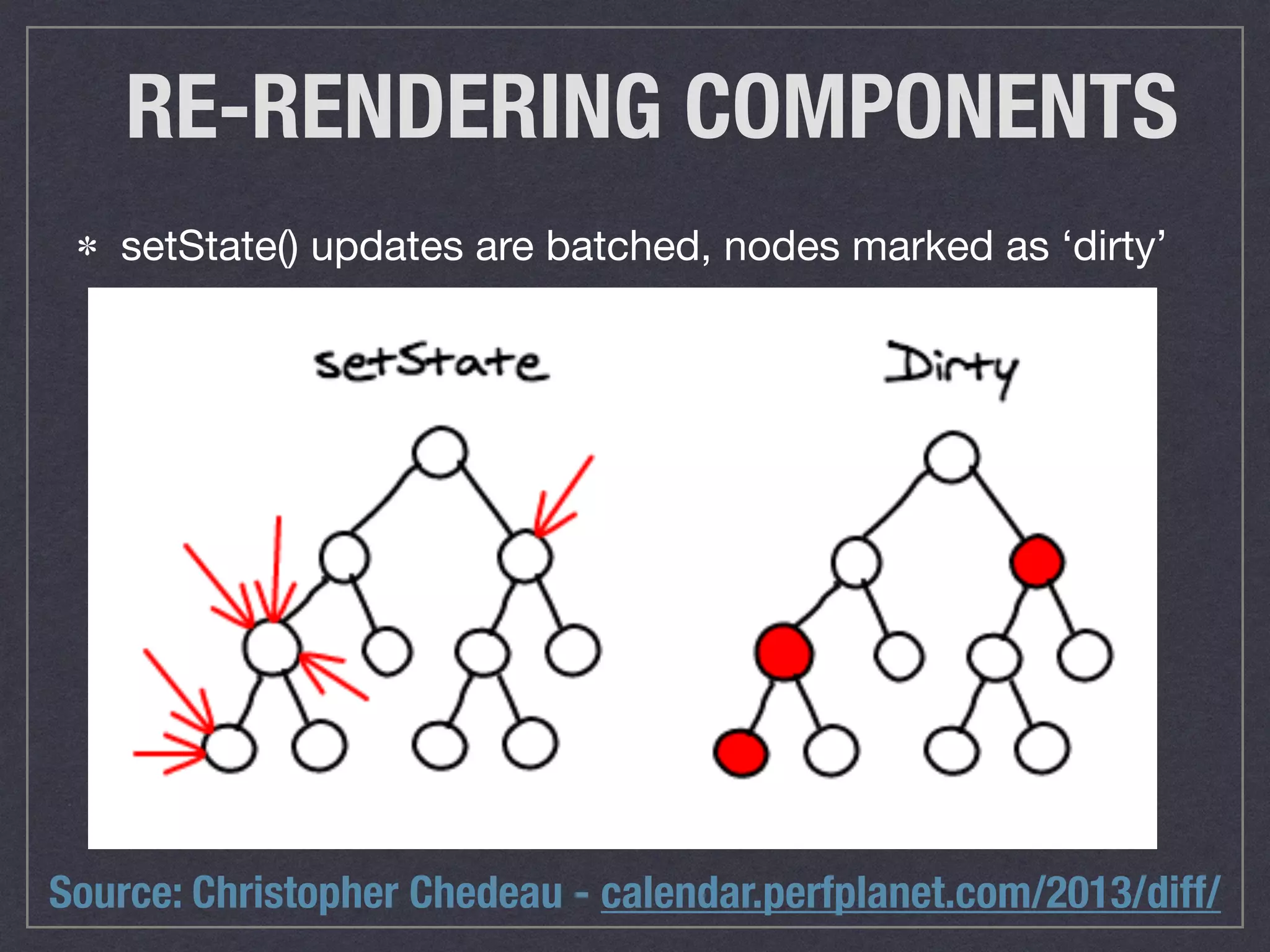
setState() updates are batched, nodes marked as ‘dirty’
Source: Christopher Chedeau - calendar.perfplanet.com/2013/diff/
RE-RENDERING COMPONENTS
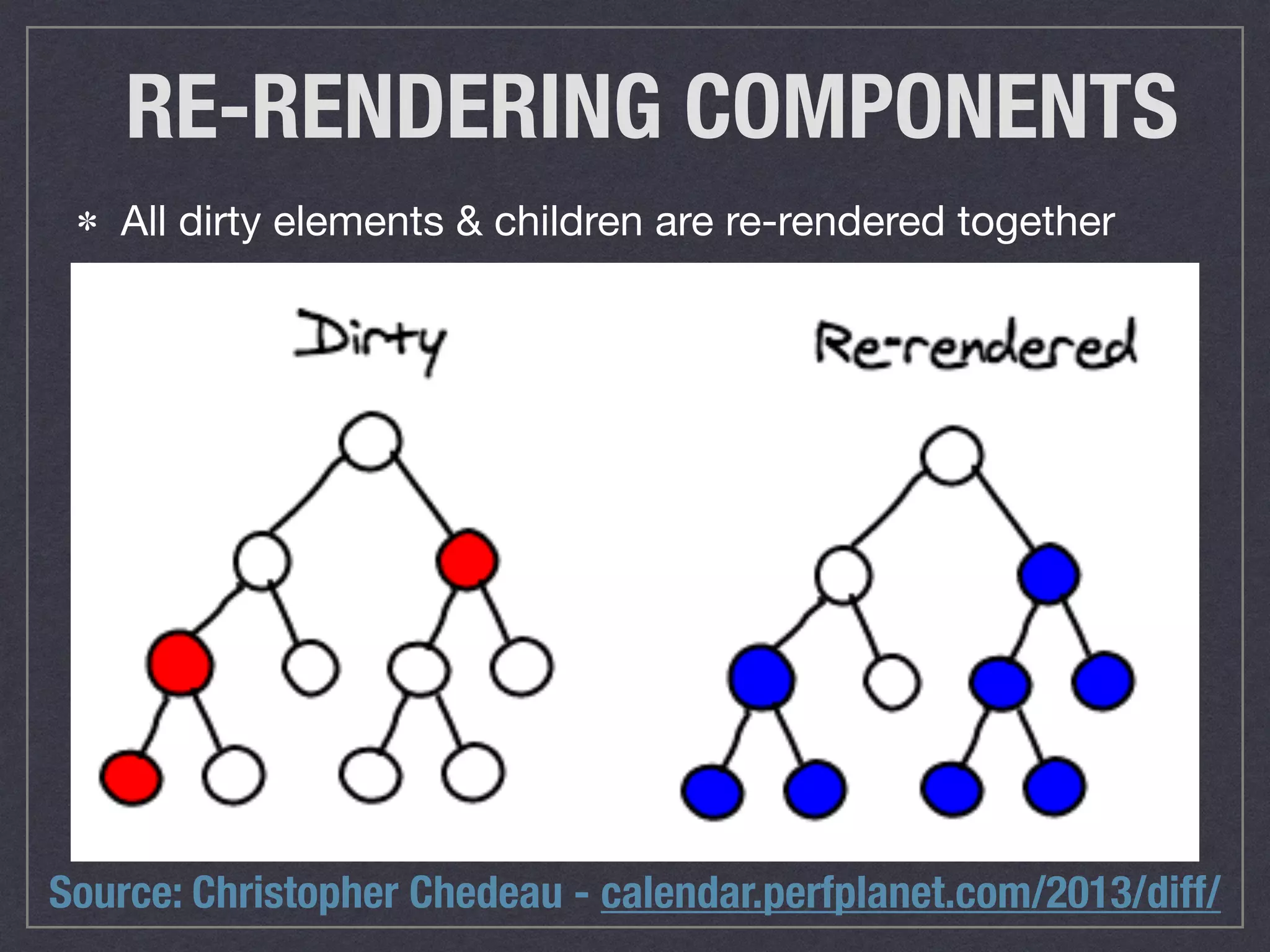
All dirty elements & children are re-rendered together
Source: Christopher Chedeau - calendar.perfplanet.com/2013/diff/
RE-RENDERING COMPONENTS
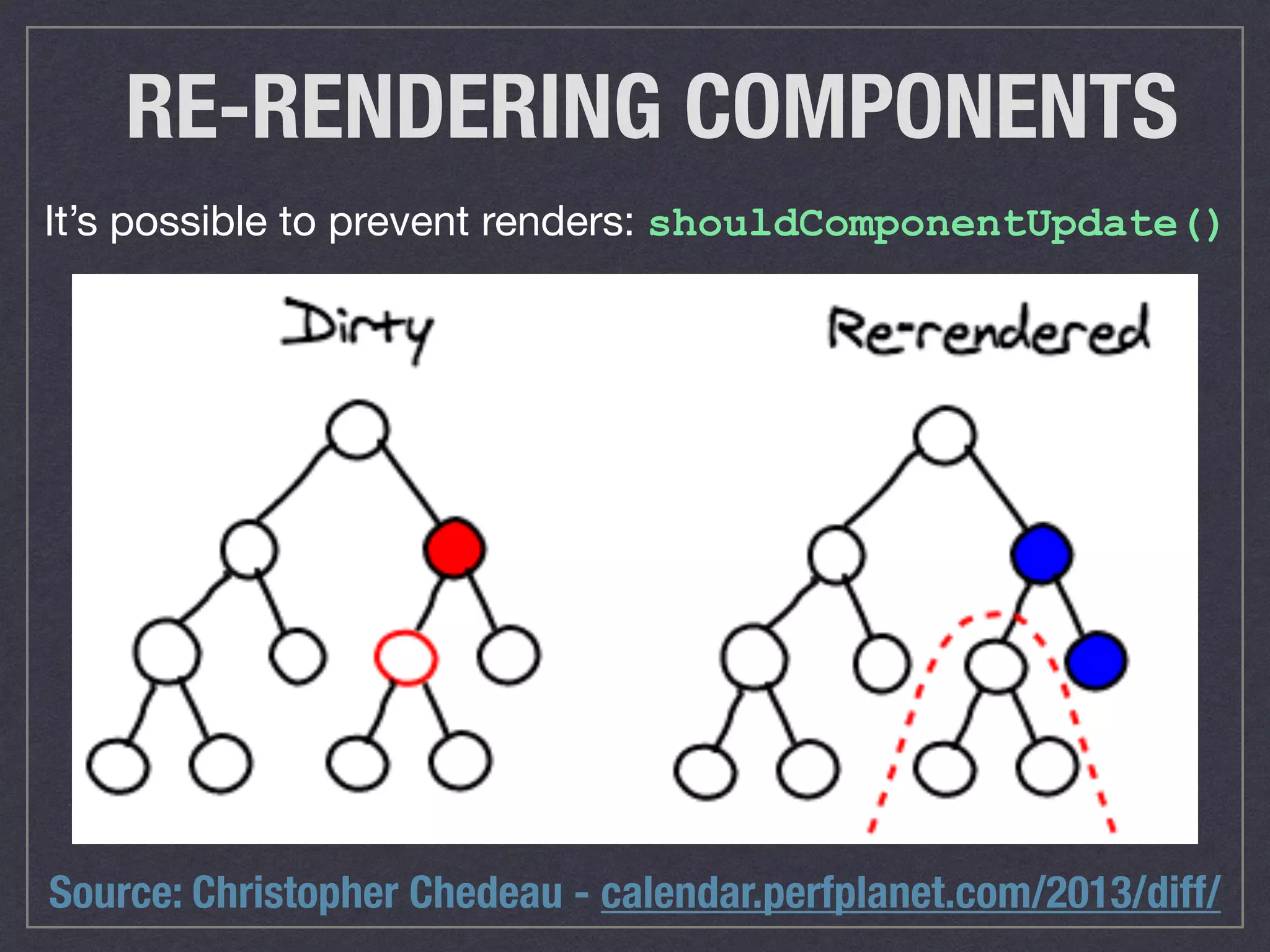
It’s possible to prevent renders: shouldComponentUpdate()
Source: Christopher Chedeau - calendar.perfplanet.com/2013/diff/
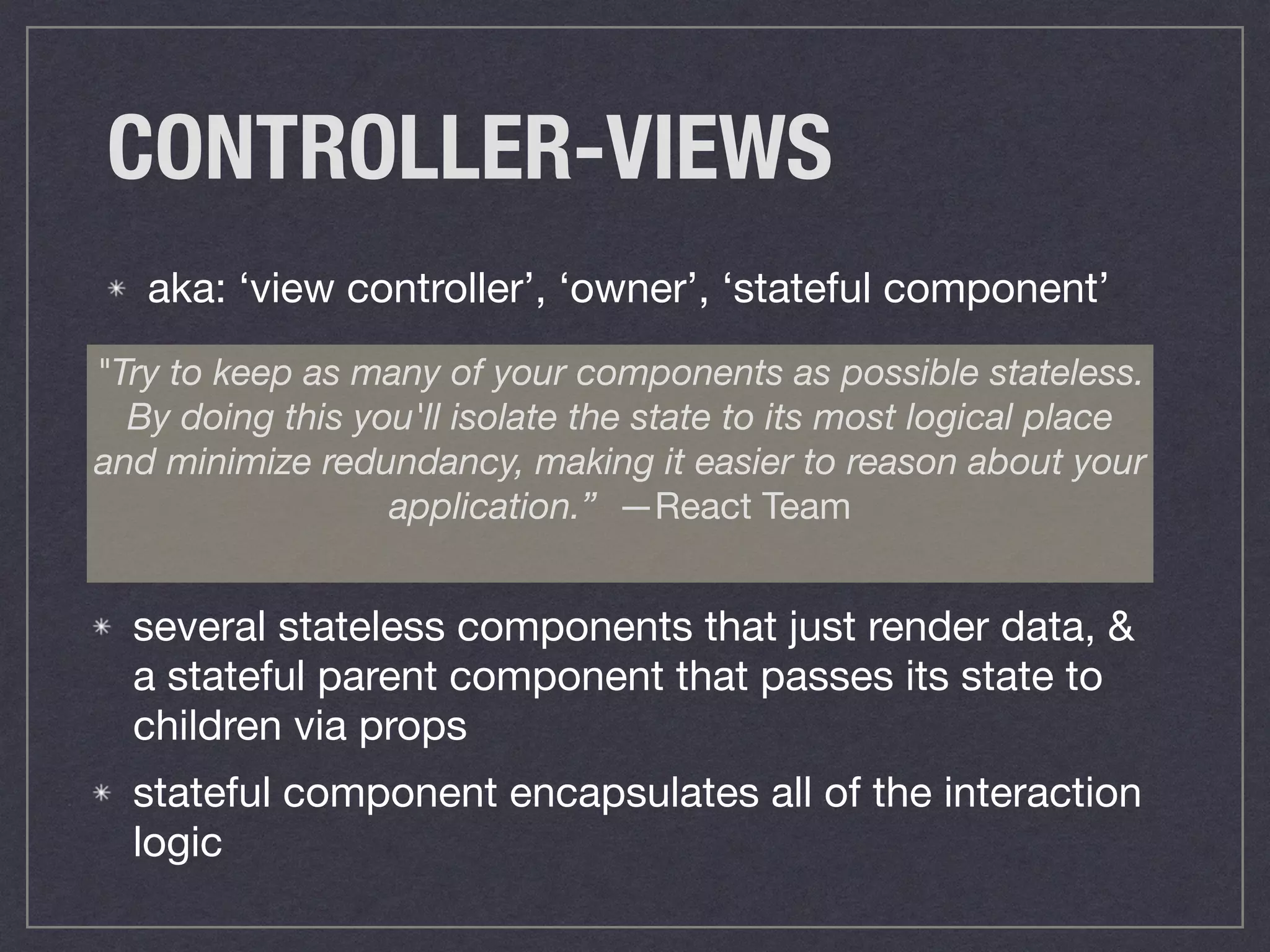
CONTROLLER-VIEWS
aka: ‘view controller’, ‘owner’, ‘stateful component’
"Try to keep as many of your components as possible stateless.
By doing this you'll isolate the state to its most logical place
and minimize redundancy, making it easier to reason about your
application.” —React Team
several stateless components that just render data, &
a stateful parent component that passes its state to
children via props

stateful component encapsulates all of the interaction
logic
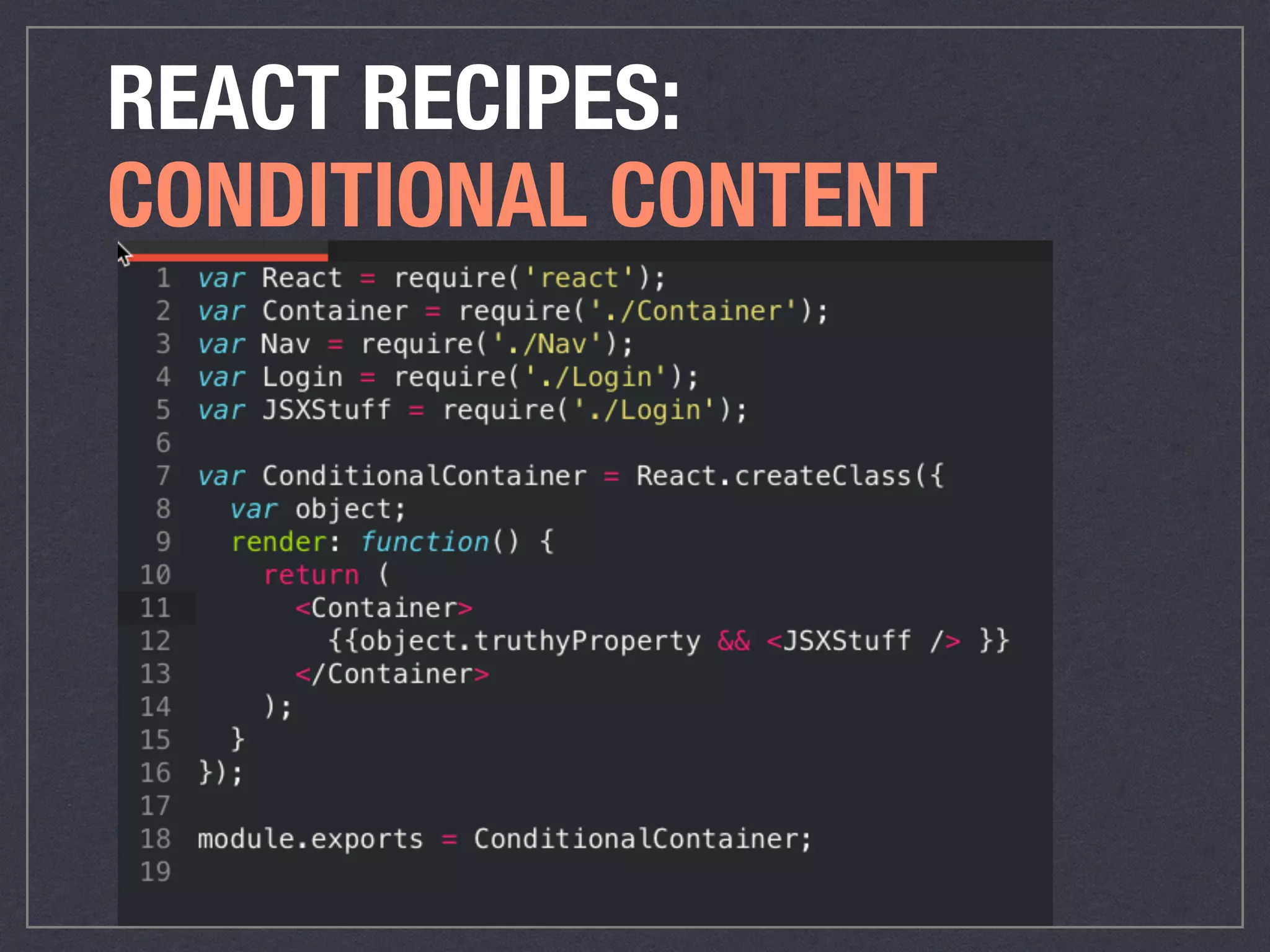
REACT RECIPES:
CONDITIONAL CONTENT
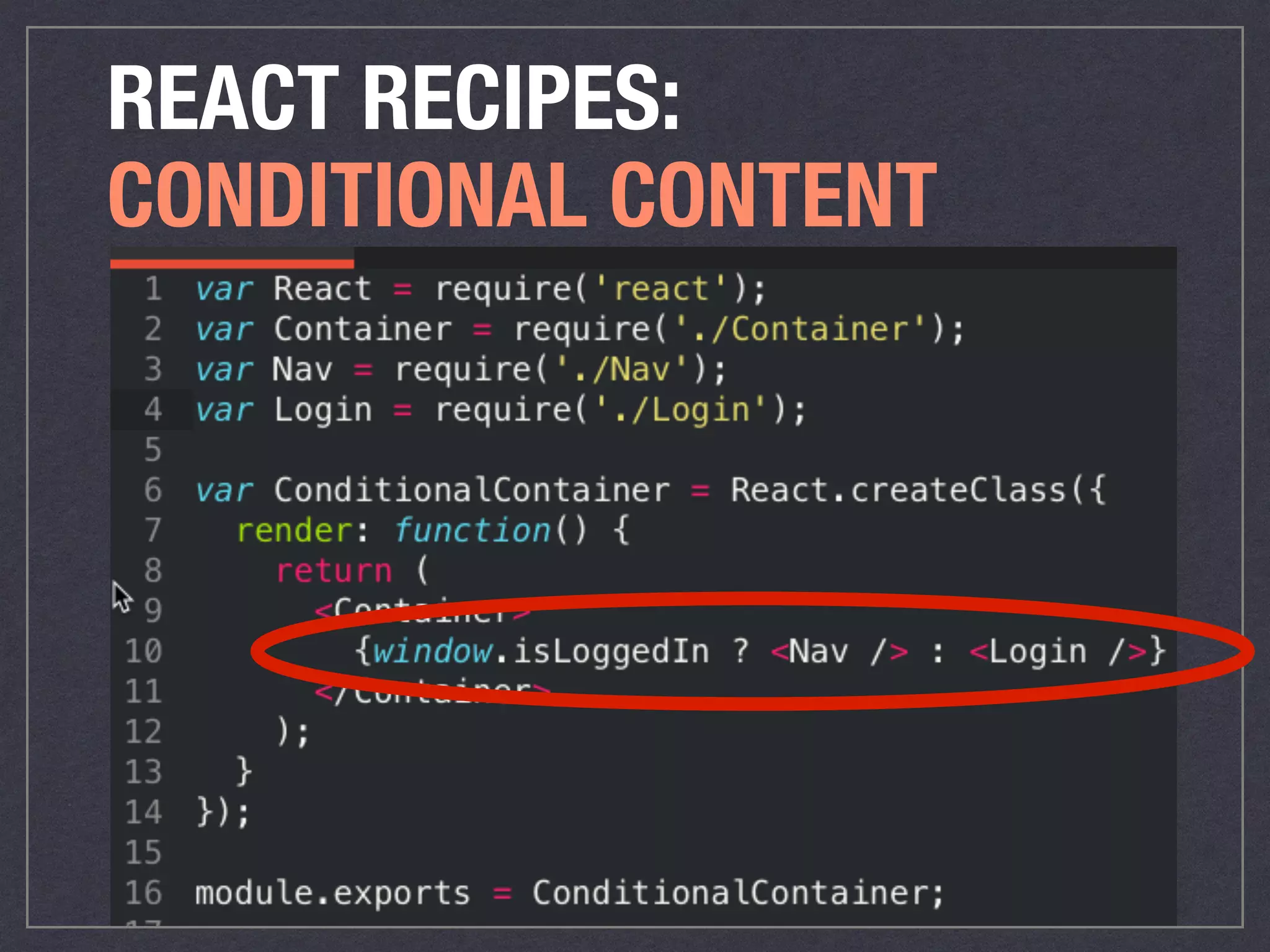
REACT RECIPES:
CONDITIONAL CONTENT
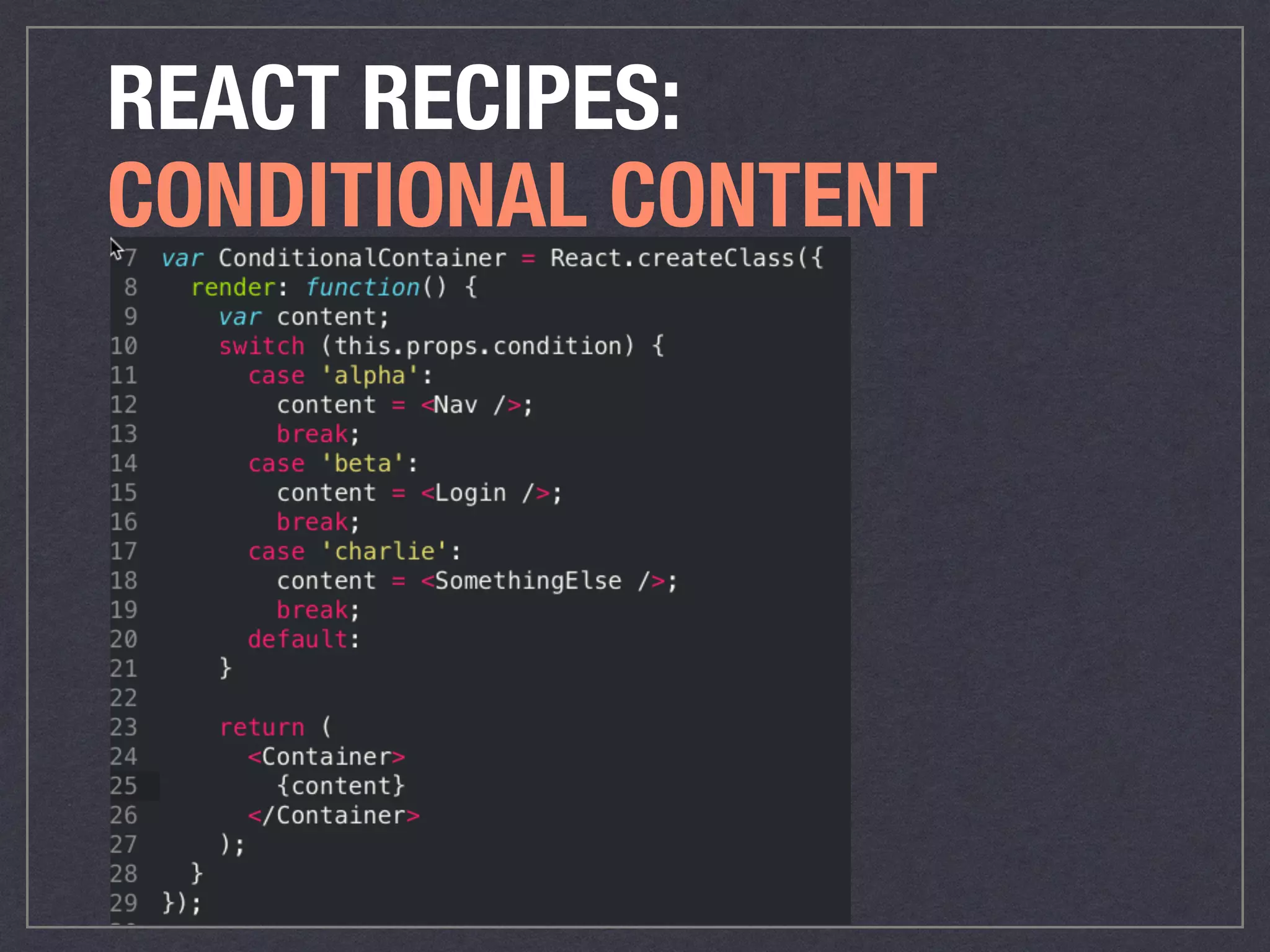
REACT RECIPES:
CONDITIONAL CONTENT
REACT RECIPES:
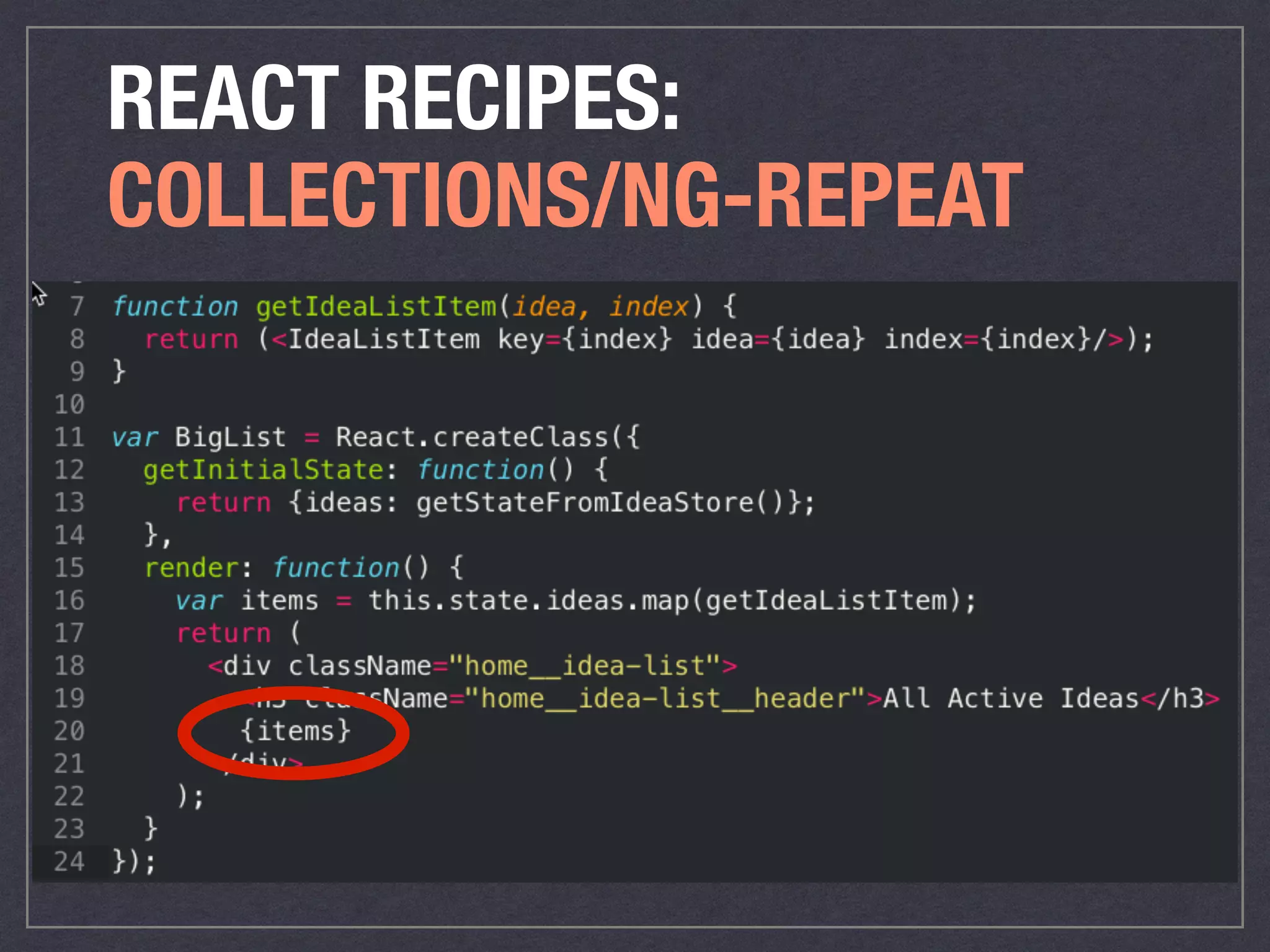
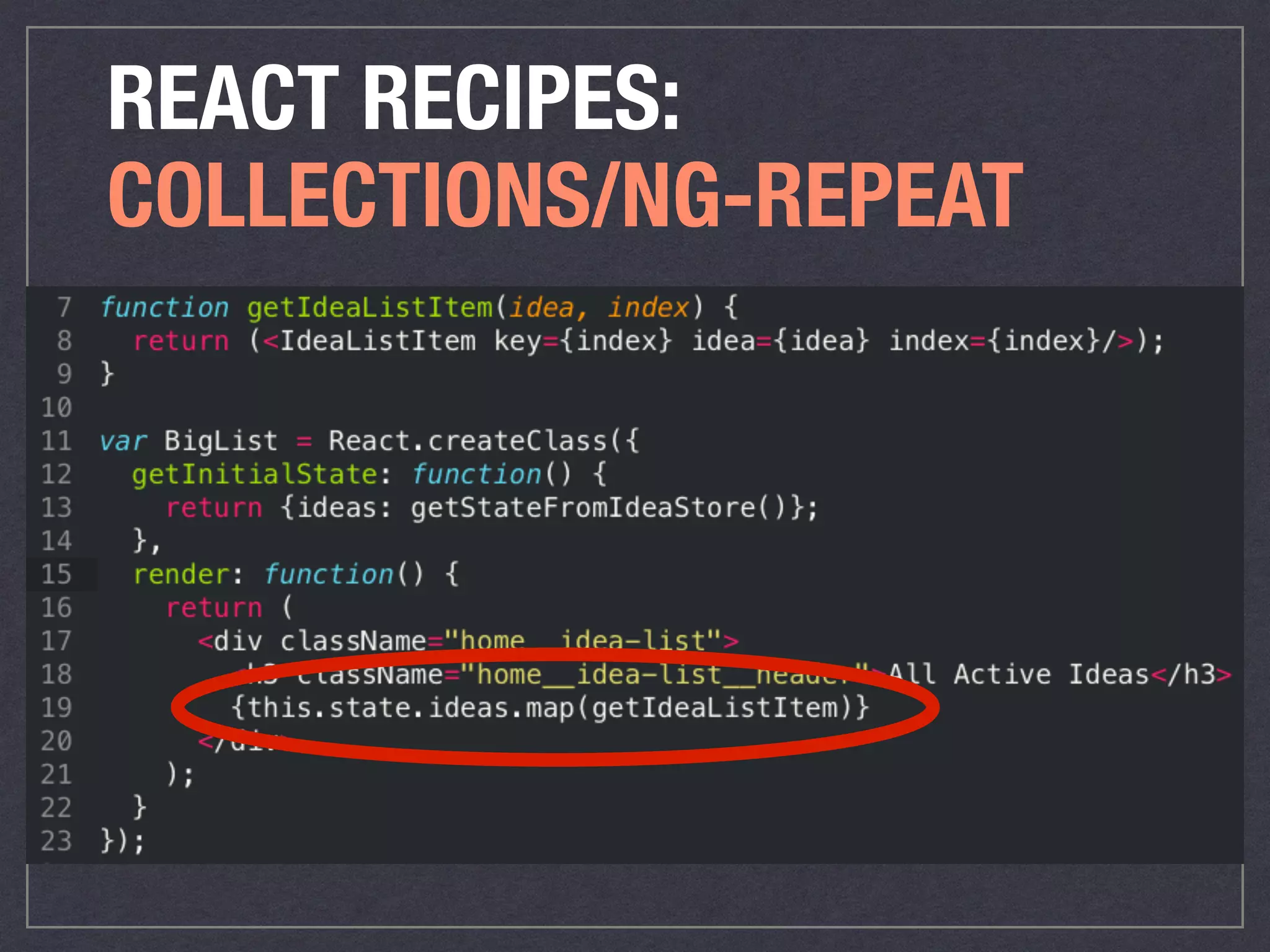
COLLECTIONS/NG-REPEAT
REACT RECIPES:
COLLECTIONS/NG-REPEAT
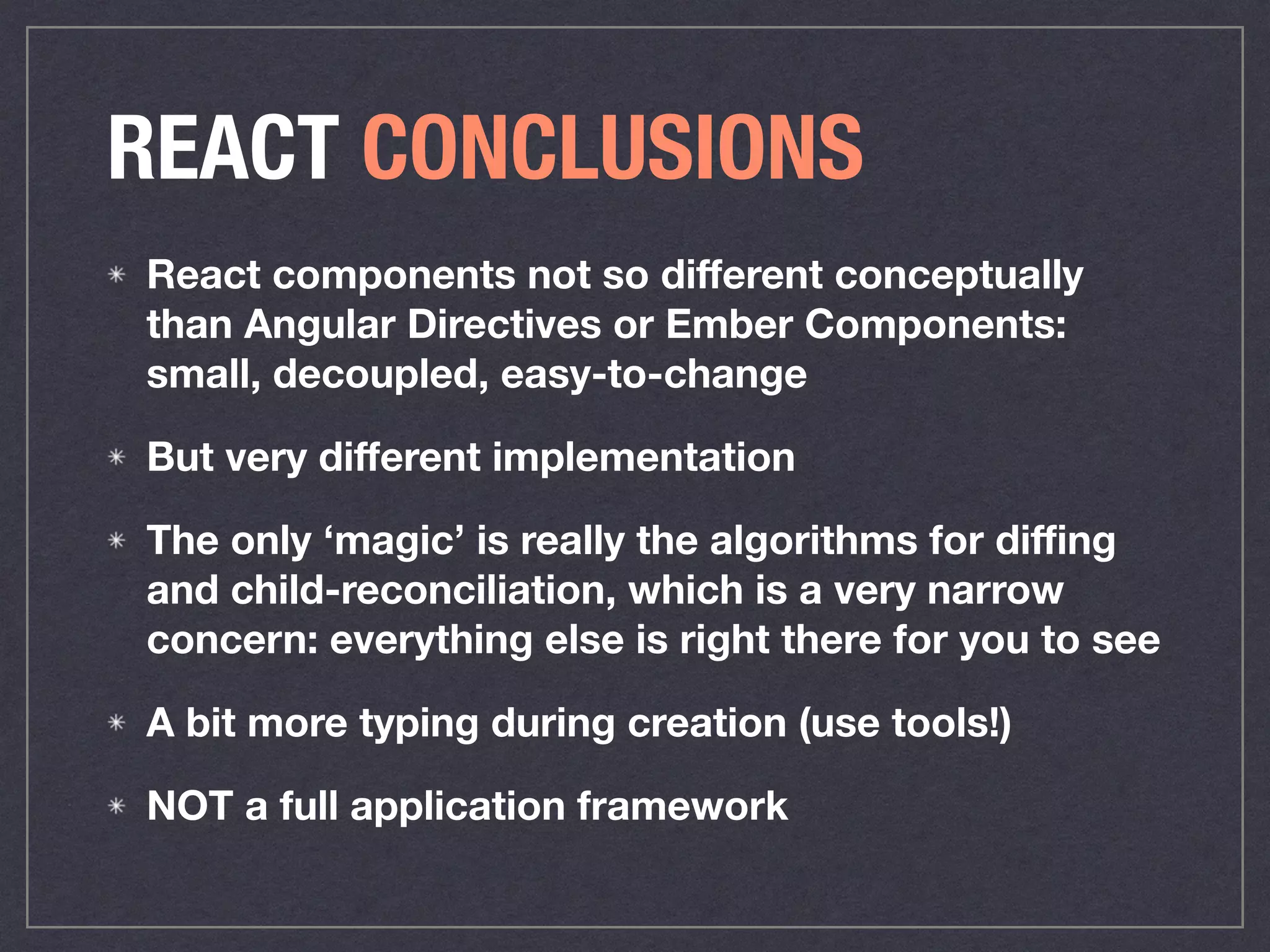
REACT CONCLUSIONS
React components not so different conceptually
than Angular Directives or Ember Components:
small, decoupled, easy-to-change
But very different implementation
The only ‘magic’ is really the algorithms for diffing
and child-reconciliation, which is a very narrow
concern: everything else is right there for you to see
A bit more typing during creation (use tools!)
NOT a full application framework
STRETCH!
WHAT IS ?
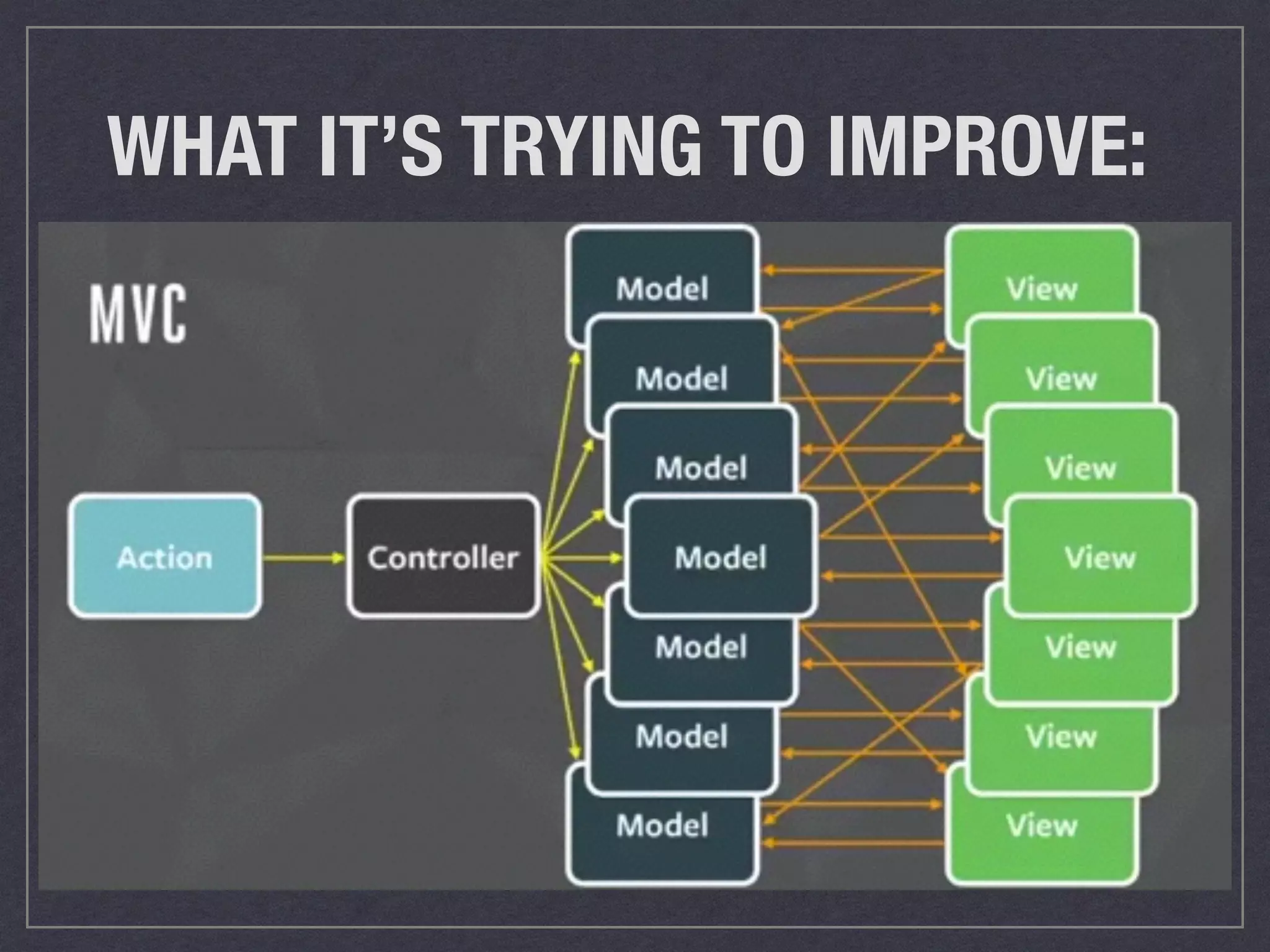
WHAT IT’S TRYING TO IMPROVE:
WHAT IS ?
"It's more of a pattern rather than a formal 

framework.” —Facebook
“It is simply a new kind of architecture that 

complements React and the concept of 

Unidirectional Data Flow.” — Scotch.io
“The glue for communicating between your dumb
React components” — XML
Very little of ‘Flux’ is a set library or API: most of it
you create yourself, or BYO tools
WHAT IS ?
Doesn’t even include everything you need: there’s
no router, for instance
Basic Javascript conventions wherever possible
Tendency toward the Node/NPM world
Fragmented/Evolving
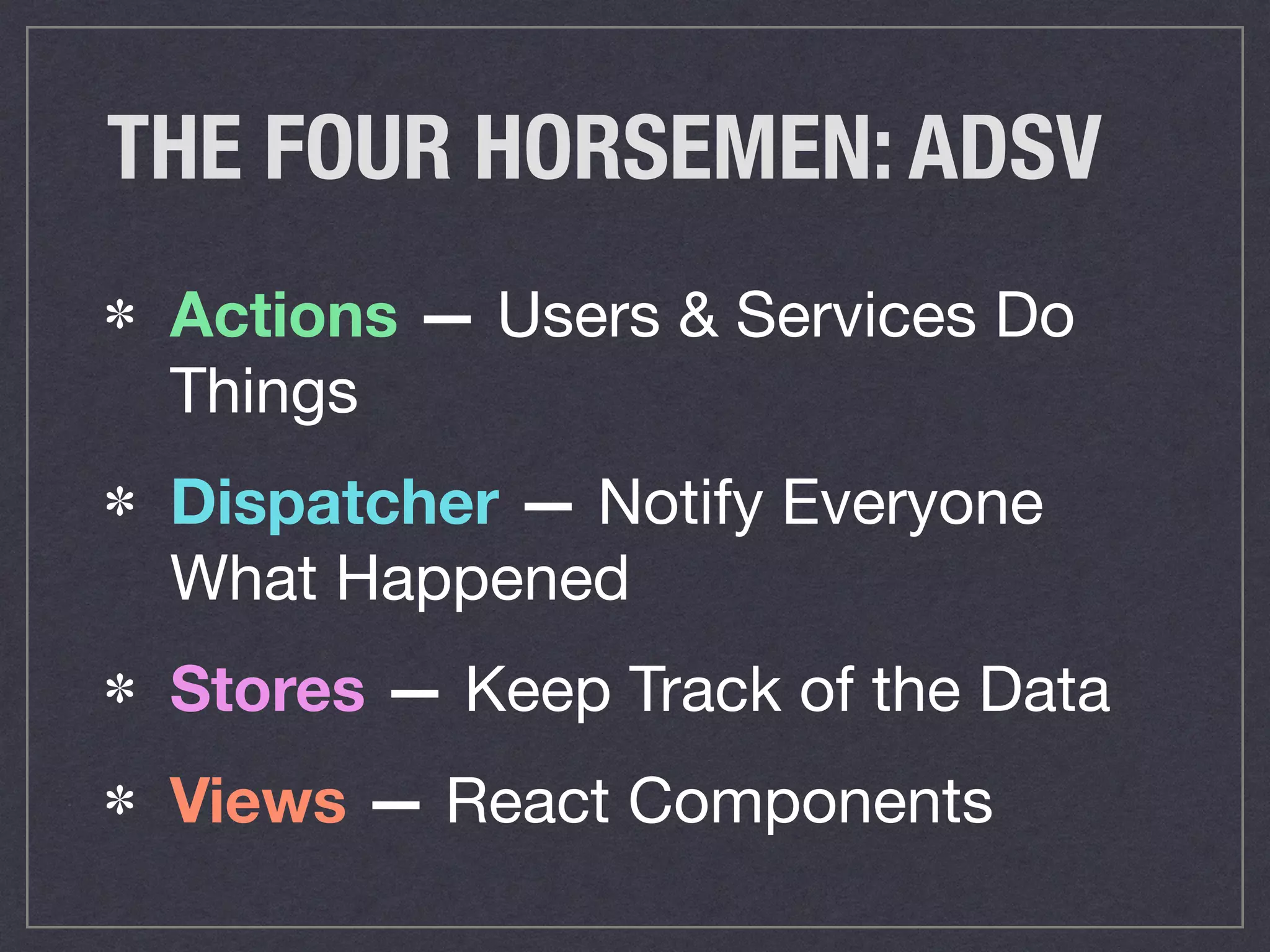
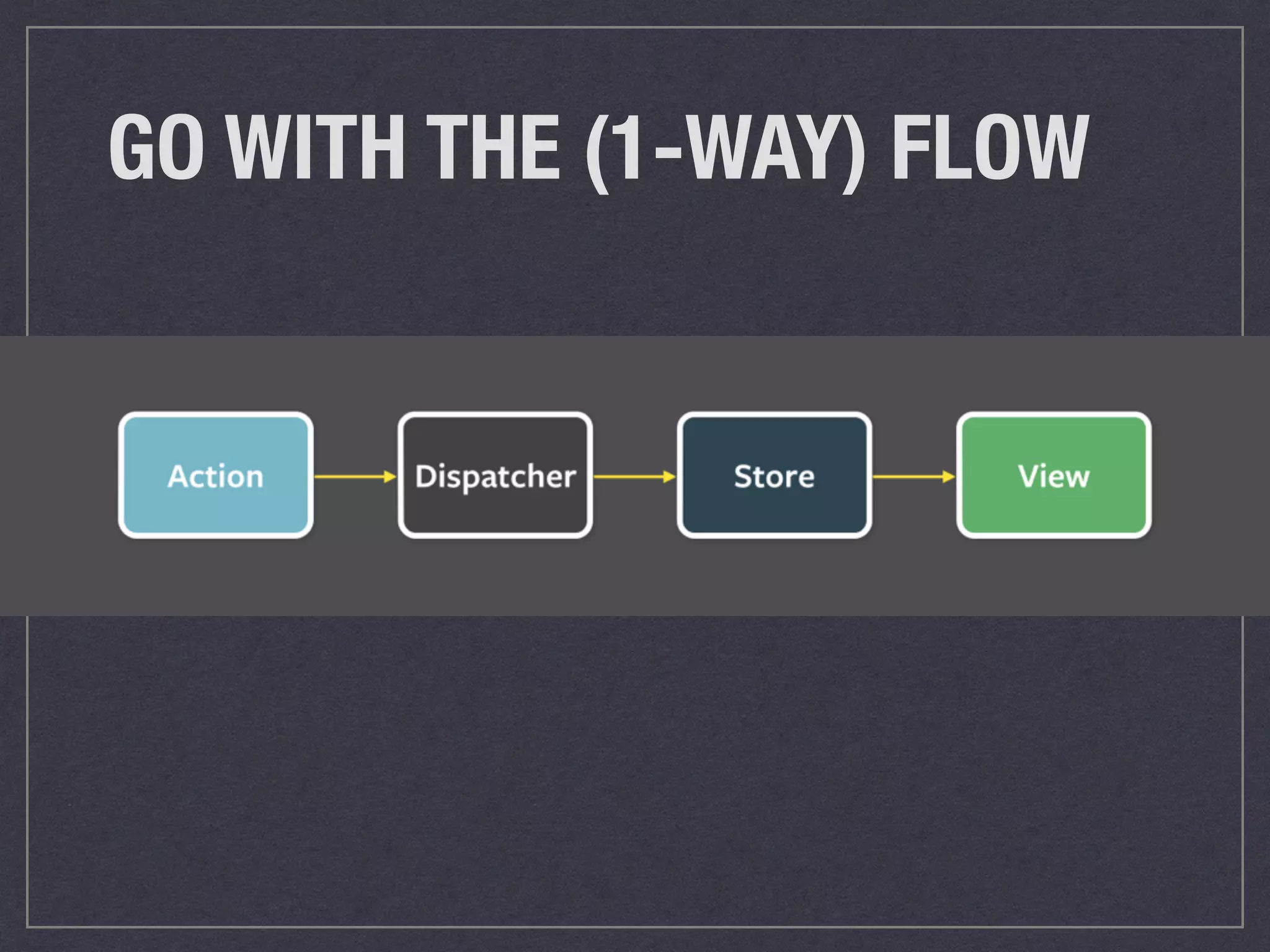
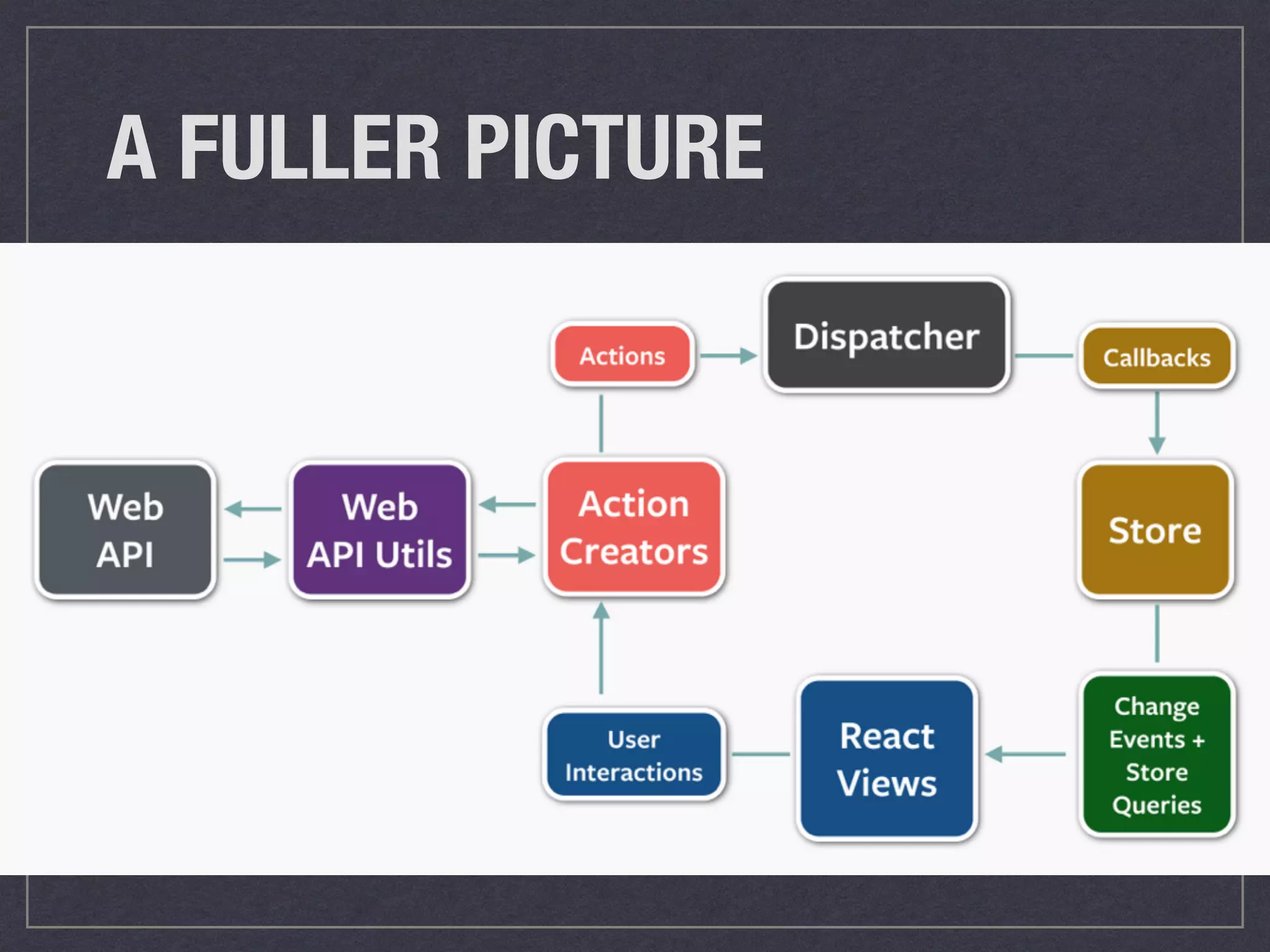
THE FOUR HORSEMEN: ADSV
Actions — Users & Services Do
Things

Dispatcher — Notify Everyone
What Happened
Stores — Keep Track of the Data

Views — React Components
GO WITH THE (1-WAY) FLOW
A FULLER PICTURE
ENOUGH TALKY-TALK.

SHOW CODE!!!
FLUX: ACTIONS
Discrete, atomic bits of app logic: “When X happens,
Do Y and Z to data/app state”
As close as it gets to the MVC ‘Controller’
“Fire and Forget”: use events, not callbacks
Usually where server calls are triggered
Then, tell everyone the outcome, via the Dispatcher
Best-practices: separate action types, use ‘action-
constants’
FLUX: DISPATCHER
Only one instance per app
Just a dumb pipe: the internet, not the nodes
All subscribers receive all events it dispatches
Only clever trick: waitFor()
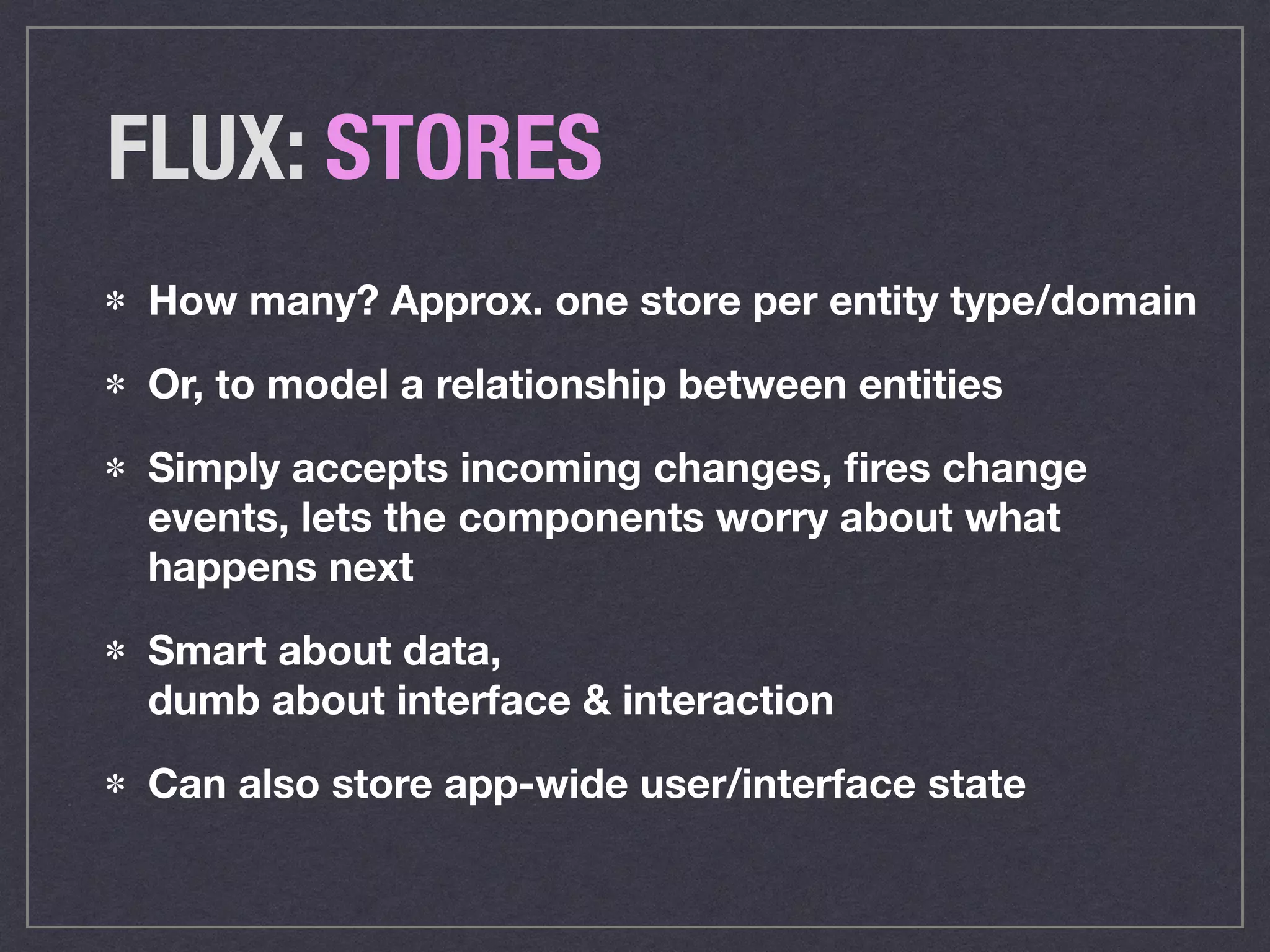
FLUX: STORES
How many? Approx. one store per entity type/domain
Or, to model a relationship between entities
Simply accepts incoming changes, fires change
events, lets the components worry about what
happens next
Smart about data, 

dumb about interface & interaction
Can also store app-wide user/interface state
FLUX: STORES
Flux is completely unopinionated about models:
POJOs seem most common
Consider Immutable data-structures
REACT/FLUX RECIPES:
TWO-WAY BINDINGS
Do we really use this all that often? :-)
Simple concept:
One component updates state from input
Another component listens for state changes
Can do yourself, or use ‘LinkedStateMixin’
(Only saves a few lines of code…)
FLUX/REACT CONCLUSIONS
Powerful patterns make it harder to mingle
concerns, create interdependency
Less ‘magic’
Community/docs still growing… quickly
Everything is user-replaceable, many options
Maintainability vs. Creation Speed
Lots of Developer Freedom (too much for some?)
FLUX/REACT CONCLUSIONS
Not everyone is ready to give up HTML templating
… yet
Mass-adoption might require a ‘framework’
around it
A sponsor is helpful, too: Facebook?
Clearly the direction our craft is moving… but
they’re not the only ones moving that way, nor is it
the only way to get there
REACT & VIRTUAL DOM
If you do your whole interface in HTML, what is
that? It’s a virtual DOM.
So, we’ve always been doing that. That’s not the
magic here.
More powerful ideas:
Immutable DOM
Optional (Decoupled) DOM
ABOUT PERFORMANCE:
The React team talks in frames per second when
describing their lightning fast rendering. Examples such
as this one show lists of 1500 rows taking 1.35 seconds
with AngularJS versus 310ms with ReactJs. This begs
questions such as:
• should you ever render 1500 rows (can the user
process this much on screen) and
• is trimming fractions of a second off of load times on
reasonably designed pages a premature optimization
in most applications?
Source: http://www.funnyant.com/reactjs-what-is-it/
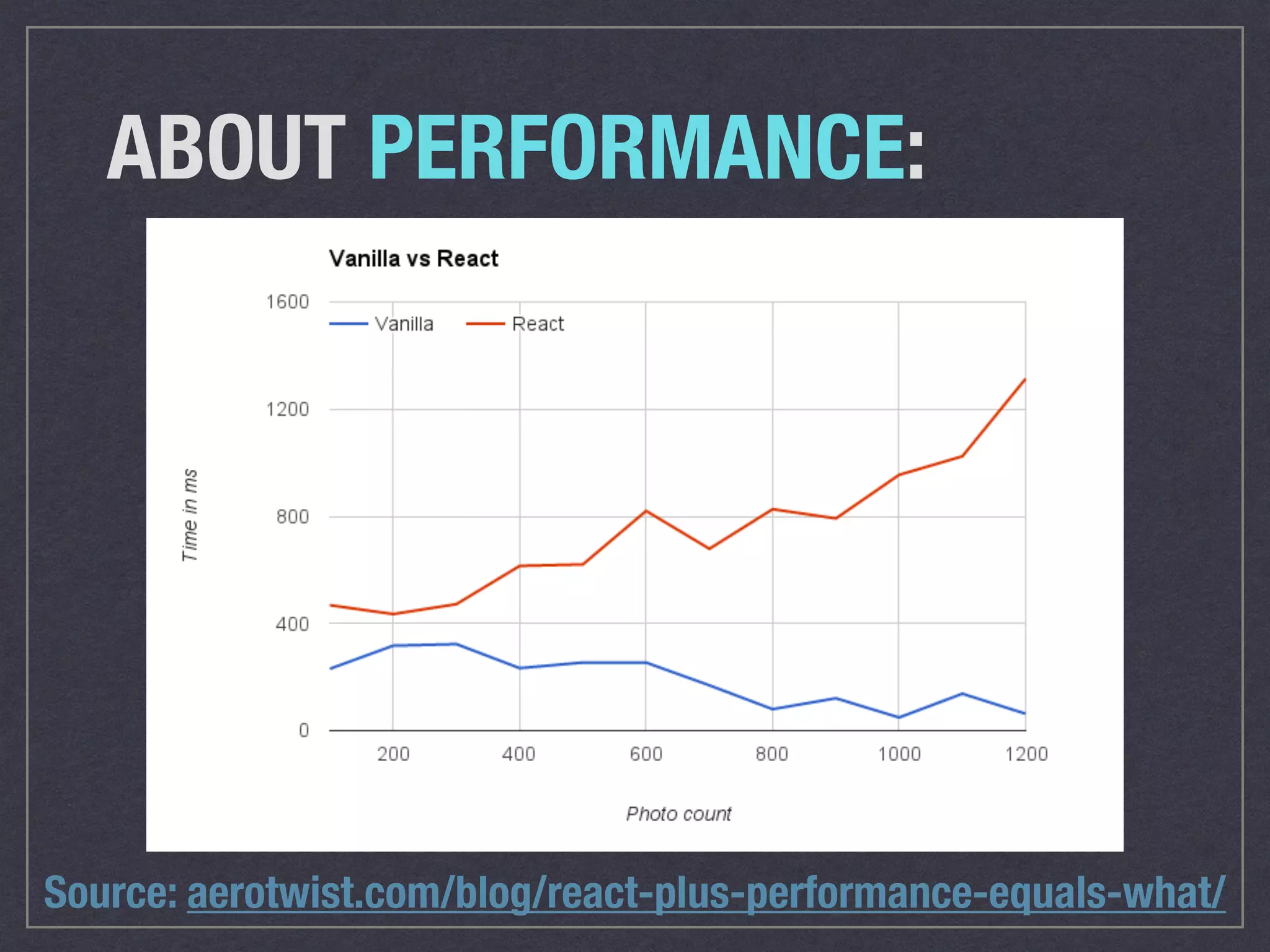
ABOUT PERFORMANCE:
Source: aerotwist.com/blog/react-plus-performance-equals-what/
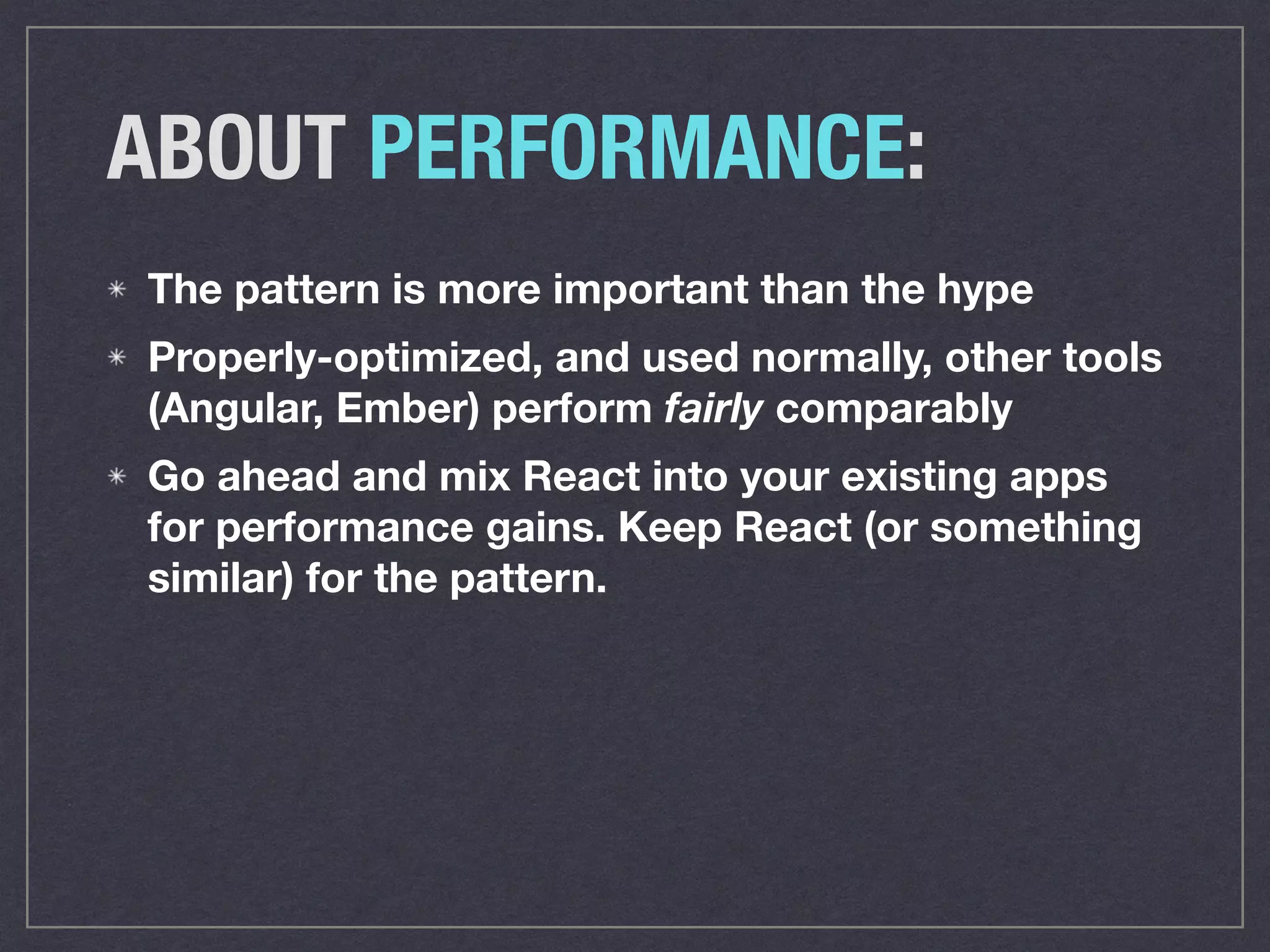
ABOUT PERFORMANCE:
The pattern is more important than the hype
Properly-optimized, and used normally, other tools
(Angular, Ember) perform fairly comparably
Go ahead and mix React into your existing apps
for performance gains. Keep React (or something
similar) for the pattern.
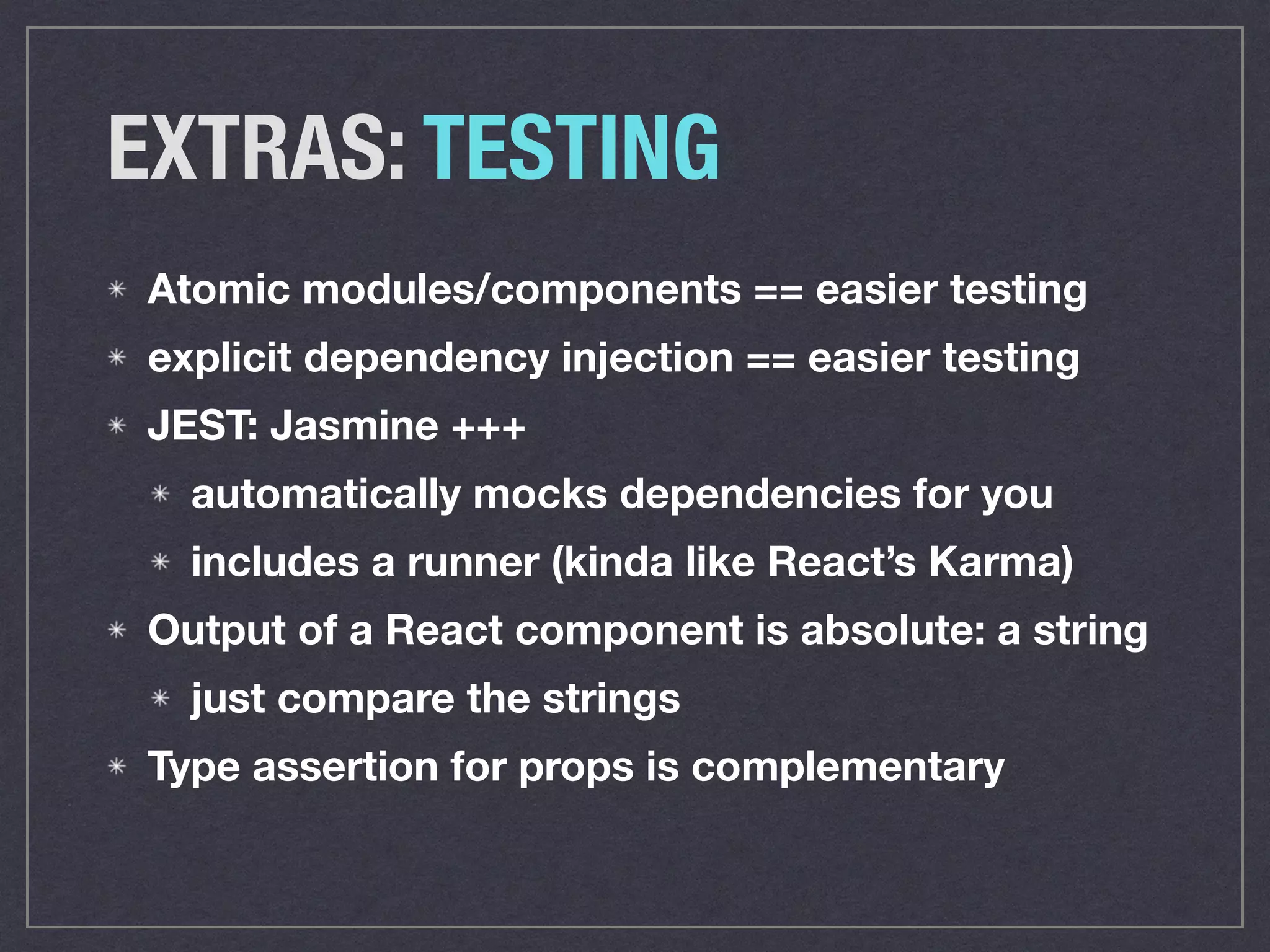
EXTRAS: TESTING
Atomic modules/components == easier testing
explicit dependency injection == easier testing
JEST: Jasmine +++
automatically mocks dependencies for you
includes a runner (kinda like React’s Karma)
Output of a React component is absolute: a string
just compare the strings
Type assertion for props is complementary
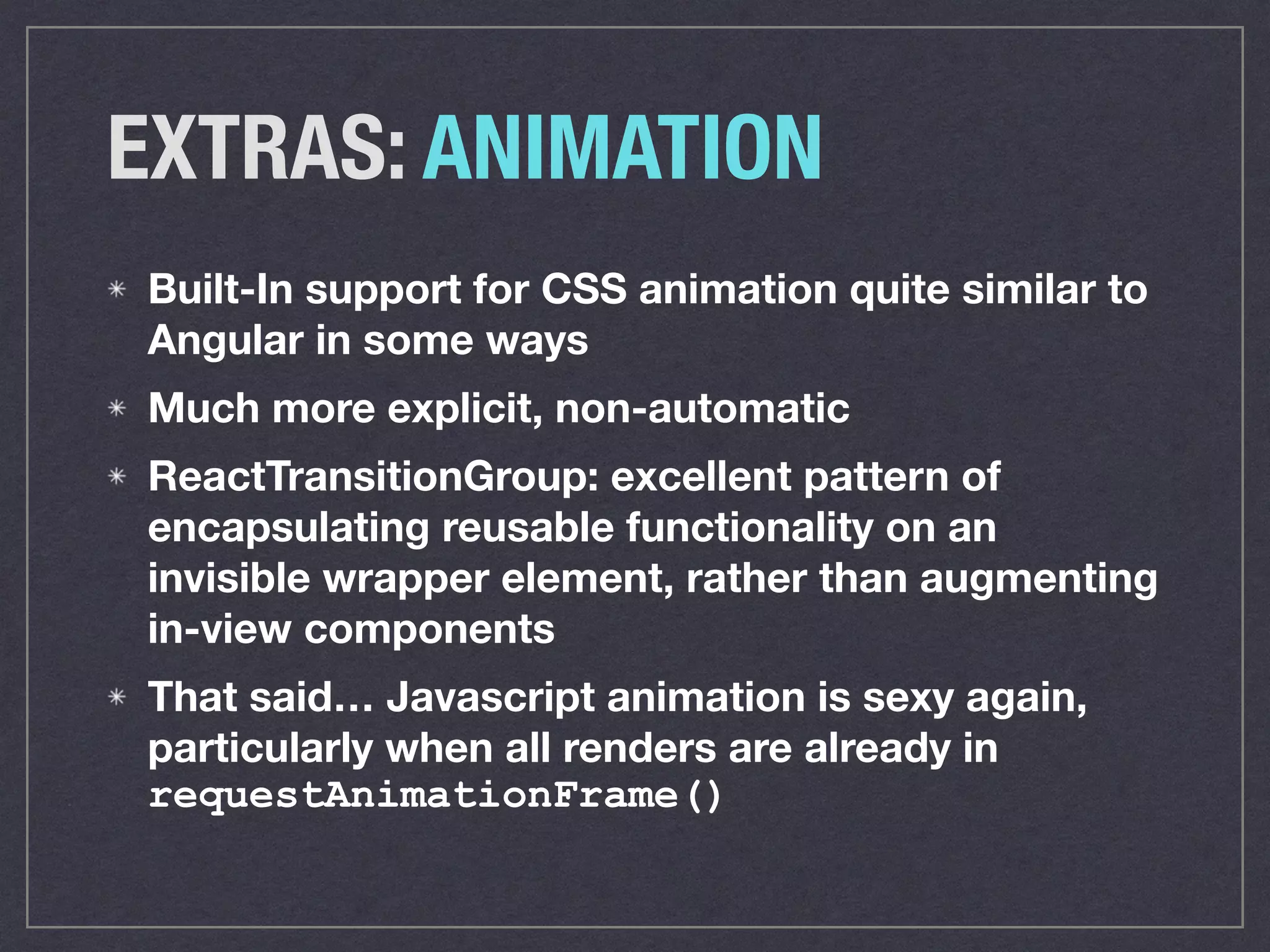
EXTRAS: ANIMATION
Built-In support for CSS animation quite similar to
Angular in some ways
Much more explicit, non-automatic
ReactTransitionGroup: excellent pattern of
encapsulating reusable functionality on an
invisible wrapper element, rather than augmenting
in-view components
That said… Javascript animation is sexy again,
particularly when all renders are already in
requestAnimationFrame()
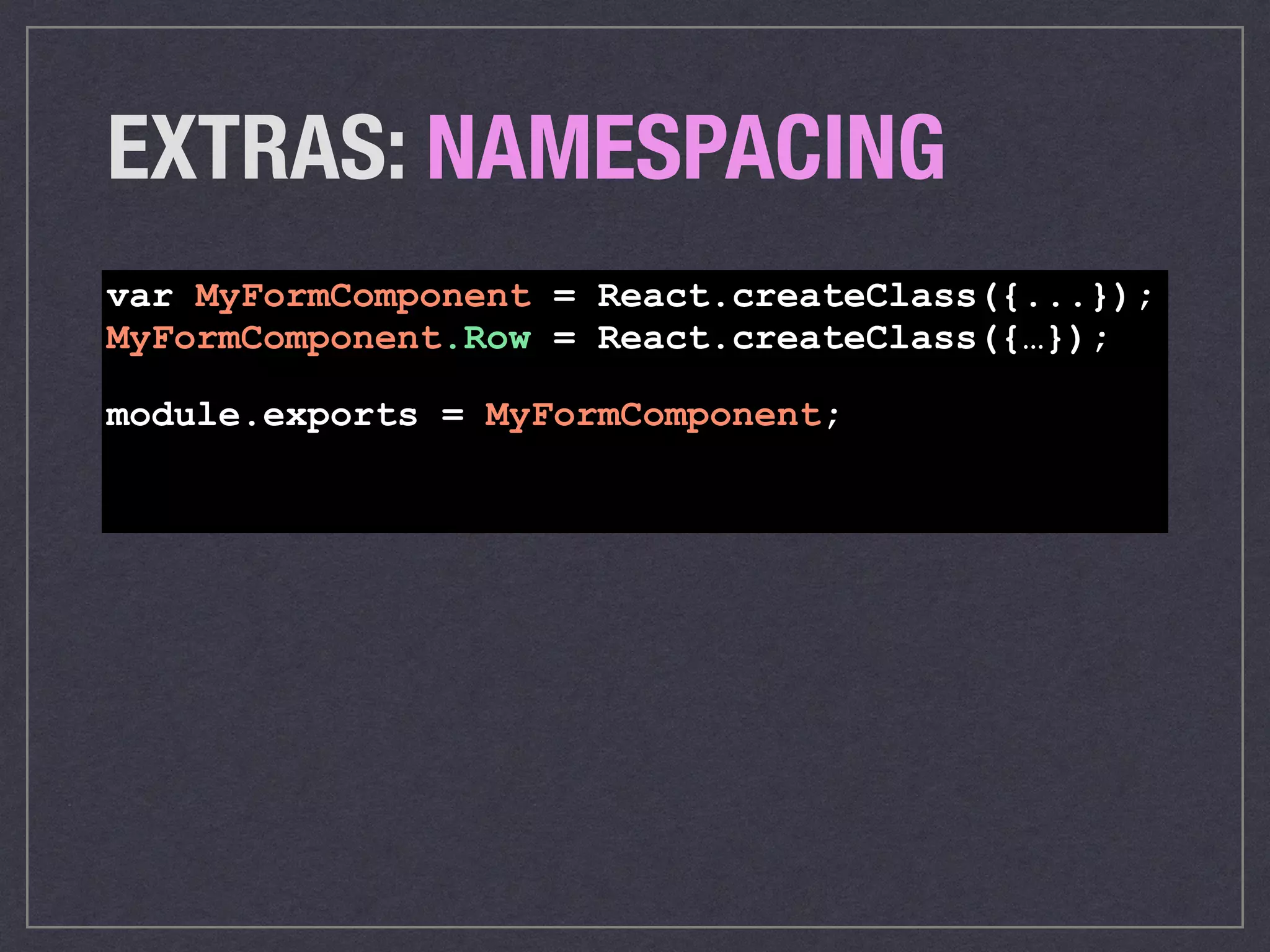
EXTRAS: NAMESPACING
var MyFormComponent = React.createClass({...});
MyFormComponent.Row = React.createClass({…});
module.exports = MyFormComponent;
EXTRAS: CSS
Why are inline styles ‘bad’? Not maintainable.

Goals for CSS are narrower scoping, avoiding cascade
collisions. (See BEM, OOCSS) 

This is very hard with global styles: either single-element
classes, or single-rule classes. Neither is convenient. 

JS can do anything a CSS preprocessor can do, and more.
In JS. No pre-processing.

Not inherently superior, but very attractive.
EXTRAS: TOOLS, RESOURCES
github.com/facebook/react/wiki/Complementary-Tools
React Bootstrap already exists, of course

Redux, Reflux, Alt are hottest Flux replacements

Axios for networking ($http)

React-Router
React-Mount, if you really like DOM —> Javascript
React-Style: CSS-in-JS
BY CHRISTIAN LILLEY
ABOUT.ME/XML — @XMLILLEY
THANK YOU!!!!
-XML

React & Flux Workshop

  • 1.
    REACT & FLUXWORKSHOP BY CHRISTIAN LILLEY ABOUT.ME/XML — @XMLILLEY
  • 2.
    OUR PLAN REACT 1. LightIntro to React Concepts 2. Demos: Building with React 3. React Details/Summary (SHORT) BREAK FLUX 4. Light Intro to Flux Concepts 5. Demos: Building with Flux 6. Flux Details/Summary
  • 3.
  • 7.
    WATCH FOR: THEBIG PICTURE Components, Components Components Dumb Components, Decoupled Systems Location-Transparent Messaging: Actions & Events Crossover with Node The Unix Philosophy Modules & Explicit Dependency Injection Everything-in-JS Virtual DOM … which is really about… Separating Render Context (DOM) from App Architecture One-Way Flows (data & directed trees), FRP, Immutability “Being DOM vs. Rendering via DOM”
  • 8.
    WATCH FOR: THEBIG PICTURE DOM —> JAVASCRIPT? JAVASCRIPT —> DOM or:
  • 9.
    WATCH FOR: THEBIG PICTURE $WATCH & UPDATE? RE-RENDER or:
  • 10.
    WATCH FOR: THEBIG PICTURE
  • 11.
    WHAT IS ? ‘Library’,not a ‘Framework’ If you start from MVC, React is only the V (But forget MVC. It’s kind of… over) Components for interfaces: Make complex components from simpler components Not a tiny library, but a small API: only for rendering components, not building whole apps Use basic JS for most things, not API calls
  • 12.
    Browser Support: IE8+ (Needs shims/shams for ES5) The whole interface is a tree of React components, which mirrors… is mirrored by… the DOM tree For every DOM element, there’s a component No templates at runtime: only Javascript * Data flows only in one direction: down the tree Conceptually, this means we never ‘update’ or ‘mutate’ the DOM. We simply re-render it. WHAT IS ? * YMMV
  • 13.
    LET’S SEE ACOMPONENT…
  • 14.
    COMPONENT STRUCTURE A componentis a React ‘class’ instance (but isn’t built with `new` in ES5: it’s functional construction until ES6) Components have default ‘lifecycle’ methods: hooks for actions at various points in time has ‘Props’ & ‘State’: props are immutable and inherited, state is mutable and changes trigger re-render JSX is how you compose the view, combine child elements Extend with your own methods, or augment existing ones
  • 15.
    COMPONENT MIXINS Mixins arehandy bundles of reusable methods that you can apply to multiple component types Great for ‘glue’ functions/boilerplate: service interaction, event listeners, dispatching Actions, etc. Big problem: they’re going away in ES6 Smaller problem: multiple mixins can clash Good Solution to both: ‘Higher-Order Components’ (functional generators that compose new components by augmenting existing ones)
  • 16.
    ‘RULES’ ON PROPS& STATE ‘state’ vs. ‘props’ isn’t about the kind of thing, instead it’s how thing is used and where it came from a given thing is ‘state’ in the one place where you can modify it: any child using same thing inherits as a ‘prop’, which can’t be modified Avoid retrieving same data at different levels of the tree: instead, pass it down as props Pass functions (as props) so children can trigger updates on ancestor’s state, then render new props
  • 17.
    JSX IS XML-LIKEJAVASCRIPT Everything in React is Javascript, including your ‘template’ You can compose a React component’s view in raw Javascript objects, but you don’t really want to. Plus, we’re really used to HTML. It’s painful for us to imagine creating web interfaces without it. HTML/XML is actually a really good way to visually model a tree structure of parent-child relationships Hence, JSX is a syntax that looks like XML/HTML… but isn’t. We transpile it to React’s fundamental JS.
  • 18.
    JSX IS XML-LIKEJAVASCRIPT React.createElement("div", {className: "ideas-wrapper"}, React.createElement("div", {className: "bs-callout bs- callout-warning"}, React.createElement("p", null, “Lorem Ipsum dolor est.…”) ), React.createElement(Button, {bsStyle: "success", bsSize: "small", onClick: this._showNewIdeaModal},"New Idea"), React.createElement(NewIdeaModal, {closeFunc: this.closeModal, show: this.state.showModal}), React.createElement(UserselectedIdea, null), React.createElement(IdeaList, null) ) INSTEAD OF THIS DEEPLY-NESTED MESS…
  • 19.
    JSX IS XML-LIKEJAVASCRIPT <div className="ideas-wrapper"> <div className="bs-callout bs-callout- warning"> <p>Lorem Ipsum dolor est…</p> </div> <Button bsStyle='success' bsSize='small' onClick={this._showNewIdeaModal}>New Idea</ Button> <NewIdeaModal closeFunc={this.closeModal} show={this.state.showModal} /> <UserselectedIdea /> <IdeaList /> </div> …JSX LETS US HAVE THIS:
  • 20.
    JSX SYNTAX ESSENTIALS Ifyour JSX spans multiple lines, wrap in parens Components are ‘classes’, so uppercase 1st letters lowercase for traditional html elements camelCase most attributes reserved words: ‘class’=‘className’; ‘for’=‘htmlFor’ single curly brackets to interpolate: {obj.prop} wrap comments: {/*comment in JSX Block*/}
  • 21.
    JSX SYNTAX ESSENTIALS Remember:even <div> is just a default React component, called ‘div’, which has a render method that outputs some specific HTML
  • 22.
    THE LIFE OFA COMPONENT Creation Get State & Props render( ) DOM Interaction: handlers, 
 :focus, etc. DOM Events (or store updates) Action/Event Handler setState( )
  • 23.
    THE LIFE OFA COMPONENT Component ‘lifecycle methods’ run the process: Source: javascript.tutorialhorizon.com
  • 24.
    THE LIFE OFA COMPONENT componentDidMount()
 add DOM event listeners, fetch async data, animate something, claim focus for an input, etc. Use JQuery or attach stuff from other libraries (only runs on browser, not server) componentDidUpdate() like componentDidMount, for updates: good for animation hooks, focus grabs, etc. componentWillUnmount() cleanup: remove event listenters, timers, etc
 shouldComponentUpdate() (advanced): to prevent a re-render that would otherwise happen componentWillReceiveProps (advanced) monitor if props have changed between renders componentWillMount() (advanced) no DOM yet. Last chance to change state with conditional logic without triggering re-render componentWillUpdate() (advanced) Like componentWillMount, for updates
  • 25.
    RE-RENDERING COMPONENTS setState() updatesare batched, nodes marked as ‘dirty’ Source: Christopher Chedeau - calendar.perfplanet.com/2013/diff/
  • 26.
    RE-RENDERING COMPONENTS All dirtyelements & children are re-rendered together Source: Christopher Chedeau - calendar.perfplanet.com/2013/diff/
  • 27.
    RE-RENDERING COMPONENTS It’s possibleto prevent renders: shouldComponentUpdate() Source: Christopher Chedeau - calendar.perfplanet.com/2013/diff/
  • 28.
    CONTROLLER-VIEWS aka: ‘view controller’,‘owner’, ‘stateful component’ "Try to keep as many of your components as possible stateless. By doing this you'll isolate the state to its most logical place and minimize redundancy, making it easier to reason about your application.” —React Team several stateless components that just render data, & a stateful parent component that passes its state to children via props stateful component encapsulates all of the interaction logic
  • 29.
  • 30.
  • 31.
  • 32.
  • 33.
  • 34.
    REACT CONCLUSIONS React componentsnot so different conceptually than Angular Directives or Ember Components: small, decoupled, easy-to-change But very different implementation The only ‘magic’ is really the algorithms for diffing and child-reconciliation, which is a very narrow concern: everything else is right there for you to see A bit more typing during creation (use tools!) NOT a full application framework
  • 35.
  • 36.
  • 37.
    WHAT IT’S TRYINGTO IMPROVE:
  • 38.
    WHAT IS ? "It's more of a pattern rather than a formal 
 framework.”—Facebook “It is simply a new kind of architecture that 
 complements React and the concept of 
 Unidirectional Data Flow.” — Scotch.io “The glue for communicating between your dumb React components” — XML Very little of ‘Flux’ is a set library or API: most of it you create yourself, or BYO tools
  • 39.
    WHAT IS ? Doesn’teven include everything you need: there’s no router, for instance Basic Javascript conventions wherever possible Tendency toward the Node/NPM world Fragmented/Evolving
  • 40.
    THE FOUR HORSEMEN:ADSV Actions — Users & Services Do Things Dispatcher — Notify Everyone What Happened Stores — Keep Track of the Data Views — React Components
  • 41.
    GO WITH THE(1-WAY) FLOW
  • 42.
  • 43.
  • 45.
    FLUX: ACTIONS Discrete, atomicbits of app logic: “When X happens, Do Y and Z to data/app state” As close as it gets to the MVC ‘Controller’ “Fire and Forget”: use events, not callbacks Usually where server calls are triggered Then, tell everyone the outcome, via the Dispatcher Best-practices: separate action types, use ‘action- constants’
  • 46.
    FLUX: DISPATCHER Only oneinstance per app Just a dumb pipe: the internet, not the nodes All subscribers receive all events it dispatches Only clever trick: waitFor()
  • 47.
    FLUX: STORES How many?Approx. one store per entity type/domain Or, to model a relationship between entities Simply accepts incoming changes, fires change events, lets the components worry about what happens next Smart about data, 
 dumb about interface & interaction Can also store app-wide user/interface state
  • 48.
    FLUX: STORES Flux iscompletely unopinionated about models: POJOs seem most common Consider Immutable data-structures
  • 49.
    REACT/FLUX RECIPES: TWO-WAY BINDINGS Dowe really use this all that often? :-) Simple concept: One component updates state from input Another component listens for state changes Can do yourself, or use ‘LinkedStateMixin’ (Only saves a few lines of code…)
  • 50.
    FLUX/REACT CONCLUSIONS Powerful patternsmake it harder to mingle concerns, create interdependency Less ‘magic’ Community/docs still growing… quickly Everything is user-replaceable, many options Maintainability vs. Creation Speed Lots of Developer Freedom (too much for some?)
  • 51.
    FLUX/REACT CONCLUSIONS Not everyoneis ready to give up HTML templating … yet Mass-adoption might require a ‘framework’ around it A sponsor is helpful, too: Facebook? Clearly the direction our craft is moving… but they’re not the only ones moving that way, nor is it the only way to get there
  • 52.
    REACT & VIRTUALDOM If you do your whole interface in HTML, what is that? It’s a virtual DOM. So, we’ve always been doing that. That’s not the magic here. More powerful ideas: Immutable DOM Optional (Decoupled) DOM
  • 53.
    ABOUT PERFORMANCE: The Reactteam talks in frames per second when describing their lightning fast rendering. Examples such as this one show lists of 1500 rows taking 1.35 seconds with AngularJS versus 310ms with ReactJs. This begs questions such as: • should you ever render 1500 rows (can the user process this much on screen) and • is trimming fractions of a second off of load times on reasonably designed pages a premature optimization in most applications? Source: http://www.funnyant.com/reactjs-what-is-it/
  • 54.
  • 55.
    ABOUT PERFORMANCE: The patternis more important than the hype Properly-optimized, and used normally, other tools (Angular, Ember) perform fairly comparably Go ahead and mix React into your existing apps for performance gains. Keep React (or something similar) for the pattern.
  • 56.
    EXTRAS: TESTING Atomic modules/components== easier testing explicit dependency injection == easier testing JEST: Jasmine +++ automatically mocks dependencies for you includes a runner (kinda like React’s Karma) Output of a React component is absolute: a string just compare the strings Type assertion for props is complementary
  • 57.
    EXTRAS: ANIMATION Built-In supportfor CSS animation quite similar to Angular in some ways Much more explicit, non-automatic ReactTransitionGroup: excellent pattern of encapsulating reusable functionality on an invisible wrapper element, rather than augmenting in-view components That said… Javascript animation is sexy again, particularly when all renders are already in requestAnimationFrame()
  • 58.
    EXTRAS: NAMESPACING var MyFormComponent= React.createClass({...}); MyFormComponent.Row = React.createClass({…}); module.exports = MyFormComponent;
  • 59.
    EXTRAS: CSS Why areinline styles ‘bad’? Not maintainable. Goals for CSS are narrower scoping, avoiding cascade collisions. (See BEM, OOCSS) This is very hard with global styles: either single-element classes, or single-rule classes. Neither is convenient. JS can do anything a CSS preprocessor can do, and more. In JS. No pre-processing. Not inherently superior, but very attractive.
  • 60.
    EXTRAS: TOOLS, RESOURCES github.com/facebook/react/wiki/Complementary-Tools ReactBootstrap already exists, of course Redux, Reflux, Alt are hottest Flux replacements Axios for networking ($http) React-Router React-Mount, if you really like DOM —> Javascript React-Style: CSS-in-JS
  • 61.
    BY CHRISTIAN LILLEY ABOUT.ME/XML— @XMLILLEY THANK YOU!!!! -XML