www.principalityconsulting.com
An Introduction to the Lean
Business Model
www.principalityconsulting.com
Overview
• Lean Model
• What is Lean?
• Lean Business Journey, Timing & Themes
– Standardisation & Reducing Variation
– Identifying & Eliminating Waste
– Inventory Management
– Stuck in First Gear
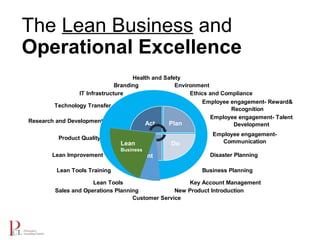
Health and Safety
Environment
Ethics and Compliance
Employee engagement- Reward&
Recognition
Employee engagement- Talent
Development
Employee engagement-
Communication
Disaster Planning
Business Planning
Key Account Management
New Product Introduction
Customer Service
Sales and Operations Planning
Lean Tools
Lean Tools Training
Lean Improvement
Product Quality
Research and Development
Technology Transfer
IT Infrastructure
Branding
Act Plan
DoCheck
The Lean Business and
Operational Excellence
Order
Fulfilment
Lean
Business
What is lean?
A quick reminder…
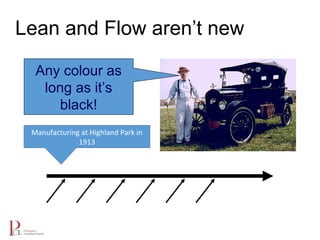
Lean and Flow aren’t new
Any colour as
long as it’s
black!
Manufacturing at Highland Park in
1913
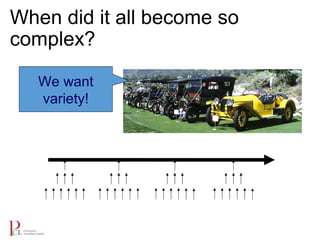
When did it all become so
complex?
We want
variety!
Variety means...
•Colour changes
•Body and shape changes
Which, in turn, means...
• Increased skill requirement
• More parts and part numbers
Which, in turn, means…
•Process islands
•More complex scheduling
Which, in turn, means…
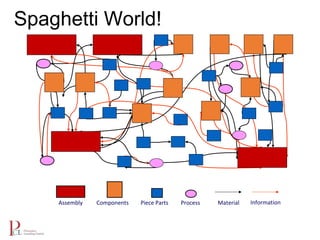
Spaghetti World!
Assembly Components Piece Parts Process Material Information
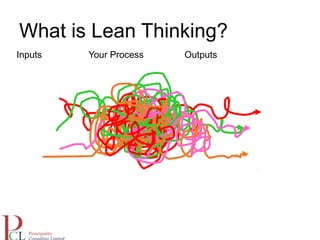
What is Lean Thinking?
Inputs Your Process Outputs
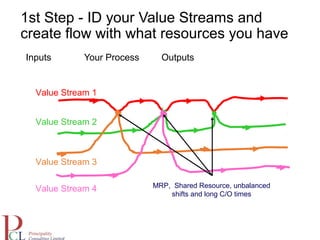
1st Step - ID your Value Streams and
create flow with what resources you have
Inputs Your Process Outputs
MRP, Shared Resource, unbalanced
shifts and long C/O times
Value Stream 1
Value Stream 3
Value Stream 2
Value Stream 4
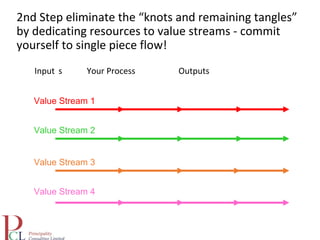
2nd Step eliminate the “knots and remaining tangles”
by dedicating resources to value streams - commit
yourself to single piece flow!
Input s Your Process Outputs
Value Stream 1
Value Stream 2
Value Stream 3
Value Stream 4
Lean Business Model
•Focussed on maximising profitability and
generating cash
•Links seamlessly with OE deployment and
Sales and operations planning
•Supports a plant-specific roadmap
•Drives local involvement and competition
•Combines all current best practice
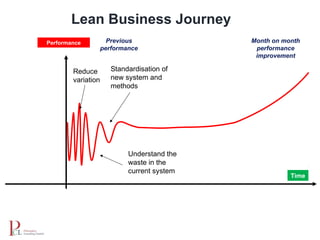
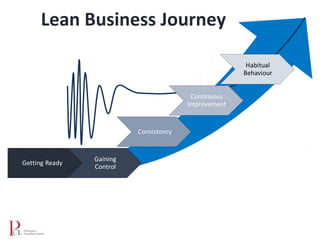
Lean Business Journey
Time
Performance
Standardisation of
new system and
methods
Understand the
waste in the
current system
Reduce
variation
Previous
performance
Month on month
performance
improvement
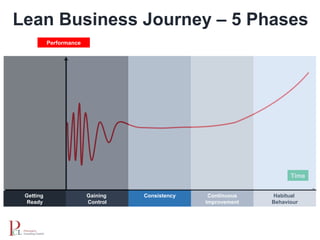
Lean Business Journey – 5 Phases
Time
Consistency Continuous
Improvement
Habitual
Behaviour
Performance
Gaining
Control
Getting
Ready
Lean Business Journey
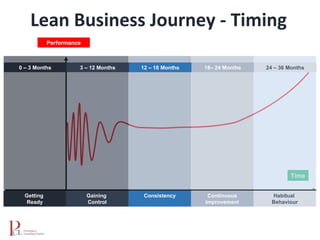
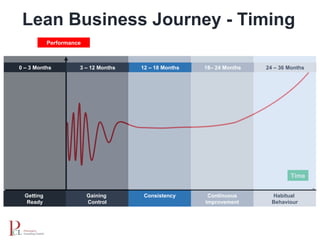
Lean Business Journey - Timing
Time
Consistency Continuous
Improvement
Habitual
Behaviour
Performance
Gaining
Control
Getting
Ready
12 – 18 Months 18– 24 Months 24 – 36 Months3 – 12 Months0 – 3 Months
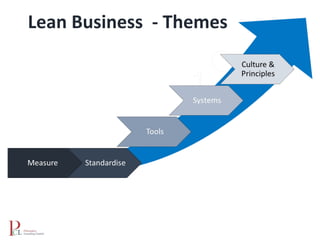
Lean Business - Themes
1
Getting Ready
Gaining
Control
Consistency
Continuous
Improvement
Habitual
Behaviour
1
Getting Ready
Gaining
Control
Consistency
Continuous
Improvement
Habitual
Behaviour
Standardisation and
Reducing Variation
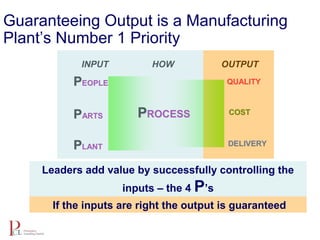
Guaranteeing Output is a Manufacturing
Plant’s Number 1 Priority
QUALITYQUALITYPPEOPLEEOPLE
PPARTSARTS
PPLANTLANT
COSTCOSTPPROCESSROCESS
HOWINPUT OUTPUT
DELIVERYDELIVERY
QUALITYQUALITYPPEOPLEEOPLE
PPARTSARTS
PPLANTLANT
COSTCOSTPPROCESSROCESS
HOWINPUT OUTPUT
DELIVERYDELIVERY
Leaders add value by successfully controlling the
inputs – the 4 P’s
If the inputs are right the output is guaranteed
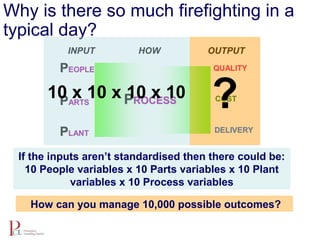
Why is there so much firefighting in a
typical day?
QUALITYQUALITYPPEOPLEEOPLE
PPARTSARTS
PPLANTLANT
COSTCOSTPPROCESSROCESS
HOWINPUT OUTPUT
DELIVERYDELIVERY
QUALITYQUALITYPPEOPLEEOPLE
PPARTSARTS
PPLANTLANT
COSTCOSTPPROCESSROCESS
HOWINPUT OUTPUT
DELIVERYDELIVERY
If the inputs aren’t standardised then there could be:
10 People variables x 10 Parts variables x 10 Plant
variables x 10 Process variables
10 x 10 x 10 x 10
How can you manage 10,000 possible outcomes?
?
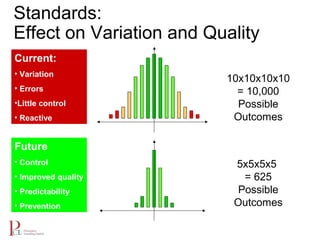
Standards:
Effect on Variation and Quality
10x10x10x10
= 10,000
Possible
Outcomes
5x5x5x5
= 625
Possible
Outcomes
Current:
• Variation
• Errors
•Little control
• Reactive
Future
• Control
• Improved quality
• Predictability
• Prevention
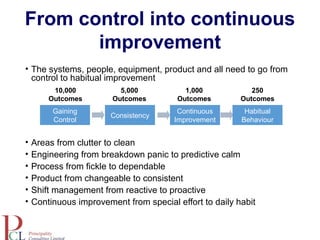
From control into continuous
improvement
• The systems, people, equipment, product and all need to go from
control to habitual improvement
• Areas from clutter to clean
• Engineering from breakdown panic to predictive calm
• Process from fickle to dependable
• Product from changeable to consistent
• Shift management from reactive to proactive
• Continuous improvement from special effort to daily habit
10,000
Outcomes
5,000
Outcomes
1,000
Outcomes
250
Outcomes
Control Consistency Continuous
Improvement
Chaos
10,000
Outcomes
5,000
Outcomes
1,000
Outcomes
250
Outcomes
Control Consistency Continuous
Improvement
ChaosGaining
Control
Consistency
Continuous
Improvement
Habitual
Behaviour
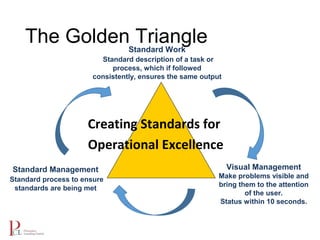
The Golden Triangle
Creating Standards for
Operational Excellence
Standard Work
Standard description of a task or
process, which if followed
consistently, ensures the same output
Standard Management
Standard process to ensure
standards are being met
Visual Management
Make problems visible and
bring them to the attention
of the user.
Status within 10 seconds.
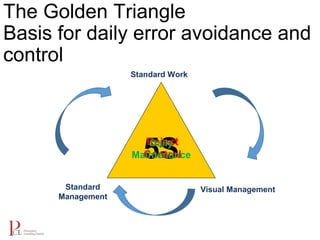
The Golden Triangle
Basis for daily error avoidance and
control
Standard Work
Visual ManagementStandard
Management
5SReject
Control
Daily
Maintenance
Identifying and
Eliminating Waste
In Manufacturing there are 7
Traditional Types of NVA or Waste
•Waste of T ransport
•Waste of I nventory
•Waste of M ovement
•Waste of W aiting
•Waste of O verprocessing
•Waste of O verproduction
•Waste of D efects and Rework
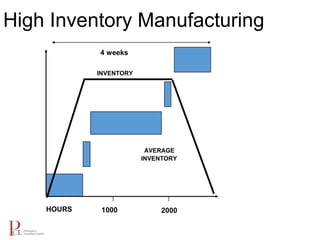
4 weeks
HOURS 1000 2000
AVERAGE
INVENTORY
INVENTORY
High Inventory Manufacturing
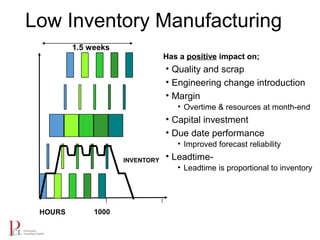
HOURS 1000
1.5 weeks
INVENTORY
Low Inventory Manufacturing
Has a positive impact on;
• Quality and scrap
• Engineering change introduction
• Margin
• Overtime & resources at month-end
• Capital investment
• Due date performance
• Improved forecast reliability
• Leadtime-
• Leadtime is proportional to inventory
1
Getting Ready
Gaining
Control
Consistency
Continuous
Improvement
Habitual
Behaviour
1
Getting Ready
Gaining
Control
Consistency
Continuous
Improvement
Habitual
Behaviour
1
Getting Ready
Gaining
Control
Consistency
Continuous
Improvement
Habitual
Behaviour
Lean Business Journey - Timing
Time
Consistency Continuous
Improvement
Habitual
Behaviour
Performance
Gaining
Control
Getting
Ready
12 – 18 Months 18– 24 Months 24 – 36 Months3 – 12 Months0 – 3 Months
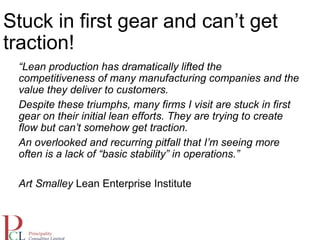
Stuck in first gear and can’t get
traction!
“Lean production has dramatically lifted the
competitiveness of many manufacturing companies and the
value they deliver to customers.
Despite these triumphs, many firms I visit are stuck in first
gear on their initial lean efforts. They are trying to create
flow but can’t somehow get traction.
An overlooked and recurring pitfall that I’m seeing more
often is a lack of “basic stability” in operations.”
Art Smalley Lean Enterprise Institute
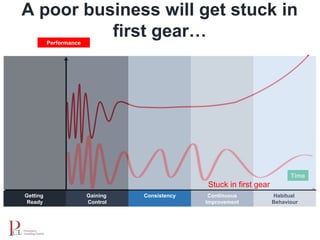
A poor business will get stuck in
first gear…
Time
Consistency Continuous
Improvement
Habitual
Behaviour
Performance
Gaining
Control
Getting
Ready
Stuck in first gear
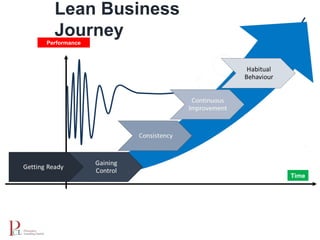
Lean Business
Journey
Time
Performance
www.principalityconsulting.com
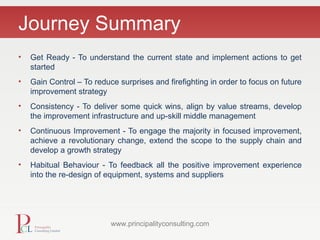
Journey Summary
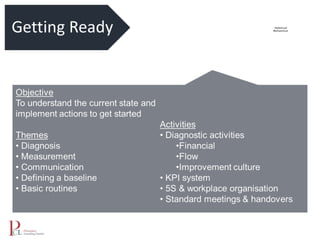
• Get Ready - To understand the current state and implement actions to get
started
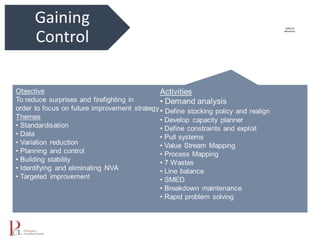
• Gain Control – To reduce surprises and firefighting in order to focus on future
improvement strategy
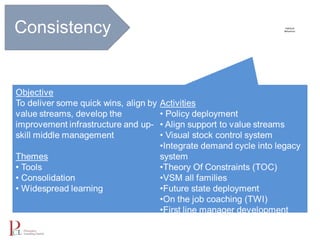
• Consistency - To deliver some quick wins, align by value streams, develop
the improvement infrastructure and up-skill middle management
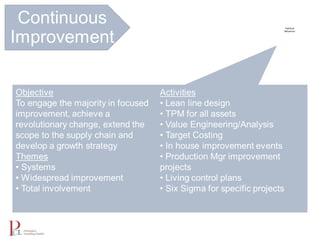
• Continuous Improvement - To engage the majority in focused improvement,
achieve a revolutionary change, extend the scope to the supply chain and
develop a growth strategy
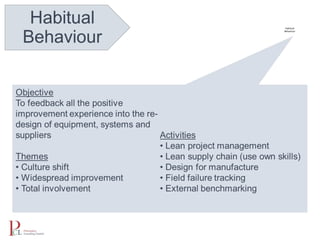
• Habitual Behaviour - To feedback all the positive improvement experience
into the re-design of equipment, systems and suppliers
www.principalityconsulting.com

An Introduction to the Lean Business Model

  • 1.
  • 2.
    www.principalityconsulting.com Overview • Lean Model •What is Lean? • Lean Business Journey, Timing & Themes – Standardisation & Reducing Variation – Identifying & Eliminating Waste – Inventory Management – Stuck in First Gear
  • 3.
    Health and Safety Environment Ethicsand Compliance Employee engagement- Reward& Recognition Employee engagement- Talent Development Employee engagement- Communication Disaster Planning Business Planning Key Account Management New Product Introduction Customer Service Sales and Operations Planning Lean Tools Lean Tools Training Lean Improvement Product Quality Research and Development Technology Transfer IT Infrastructure Branding Act Plan DoCheck The Lean Business and Operational Excellence Order Fulfilment Lean Business
  • 4.
    What is lean? Aquick reminder…
  • 5.
    Lean and Flowaren’t new Any colour as long as it’s black! Manufacturing at Highland Park in 1913
  • 6.
    When did itall become so complex? We want variety!
  • 7.
    Variety means... •Colour changes •Bodyand shape changes Which, in turn, means... • Increased skill requirement • More parts and part numbers
  • 8.
    Which, in turn,means… •Process islands •More complex scheduling Which, in turn, means…
  • 9.
    Spaghetti World! Assembly ComponentsPiece Parts Process Material Information
  • 10.
    What is LeanThinking? Inputs Your Process Outputs
  • 11.
    1st Step -ID your Value Streams and create flow with what resources you have Inputs Your Process Outputs MRP, Shared Resource, unbalanced shifts and long C/O times Value Stream 1 Value Stream 3 Value Stream 2 Value Stream 4
  • 12.
    2nd Step eliminatethe “knots and remaining tangles” by dedicating resources to value streams - commit yourself to single piece flow! Input s Your Process Outputs Value Stream 1 Value Stream 2 Value Stream 3 Value Stream 4
  • 13.
    Lean Business Model •Focussedon maximising profitability and generating cash •Links seamlessly with OE deployment and Sales and operations planning •Supports a plant-specific roadmap •Drives local involvement and competition •Combines all current best practice
  • 14.
    Lean Business Journey Time Performance Standardisationof new system and methods Understand the waste in the current system Reduce variation Previous performance Month on month performance improvement
  • 15.
    Lean Business Journey– 5 Phases Time Consistency Continuous Improvement Habitual Behaviour Performance Gaining Control Getting Ready
  • 16.
  • 17.
    Lean Business Journey- Timing Time Consistency Continuous Improvement Habitual Behaviour Performance Gaining Control Getting Ready 12 – 18 Months 18– 24 Months 24 – 36 Months3 – 12 Months0 – 3 Months
  • 18.
  • 19.
  • 20.
  • 21.
  • 22.
    Guaranteeing Output isa Manufacturing Plant’s Number 1 Priority QUALITYQUALITYPPEOPLEEOPLE PPARTSARTS PPLANTLANT COSTCOSTPPROCESSROCESS HOWINPUT OUTPUT DELIVERYDELIVERY QUALITYQUALITYPPEOPLEEOPLE PPARTSARTS PPLANTLANT COSTCOSTPPROCESSROCESS HOWINPUT OUTPUT DELIVERYDELIVERY Leaders add value by successfully controlling the inputs – the 4 P’s If the inputs are right the output is guaranteed
  • 23.
    Why is thereso much firefighting in a typical day? QUALITYQUALITYPPEOPLEEOPLE PPARTSARTS PPLANTLANT COSTCOSTPPROCESSROCESS HOWINPUT OUTPUT DELIVERYDELIVERY QUALITYQUALITYPPEOPLEEOPLE PPARTSARTS PPLANTLANT COSTCOSTPPROCESSROCESS HOWINPUT OUTPUT DELIVERYDELIVERY If the inputs aren’t standardised then there could be: 10 People variables x 10 Parts variables x 10 Plant variables x 10 Process variables 10 x 10 x 10 x 10 How can you manage 10,000 possible outcomes? ?
  • 24.
    Standards: Effect on Variationand Quality 10x10x10x10 = 10,000 Possible Outcomes 5x5x5x5 = 625 Possible Outcomes Current: • Variation • Errors •Little control • Reactive Future • Control • Improved quality • Predictability • Prevention
  • 25.
    From control intocontinuous improvement • The systems, people, equipment, product and all need to go from control to habitual improvement • Areas from clutter to clean • Engineering from breakdown panic to predictive calm • Process from fickle to dependable • Product from changeable to consistent • Shift management from reactive to proactive • Continuous improvement from special effort to daily habit 10,000 Outcomes 5,000 Outcomes 1,000 Outcomes 250 Outcomes Control Consistency Continuous Improvement Chaos 10,000 Outcomes 5,000 Outcomes 1,000 Outcomes 250 Outcomes Control Consistency Continuous Improvement ChaosGaining Control Consistency Continuous Improvement Habitual Behaviour
  • 26.
    The Golden Triangle CreatingStandards for Operational Excellence Standard Work Standard description of a task or process, which if followed consistently, ensures the same output Standard Management Standard process to ensure standards are being met Visual Management Make problems visible and bring them to the attention of the user. Status within 10 seconds.
  • 27.
    The Golden Triangle Basisfor daily error avoidance and control Standard Work Visual ManagementStandard Management 5SReject Control Daily Maintenance
  • 28.
  • 29.
    In Manufacturing thereare 7 Traditional Types of NVA or Waste •Waste of T ransport •Waste of I nventory •Waste of M ovement •Waste of W aiting •Waste of O verprocessing •Waste of O verproduction •Waste of D efects and Rework
  • 30.
    4 weeks HOURS 10002000 AVERAGE INVENTORY INVENTORY High Inventory Manufacturing
  • 31.
    HOURS 1000 1.5 weeks INVENTORY LowInventory Manufacturing Has a positive impact on; • Quality and scrap • Engineering change introduction • Margin • Overtime & resources at month-end • Capital investment • Due date performance • Improved forecast reliability • Leadtime- • Leadtime is proportional to inventory
  • 32.
  • 33.
  • 34.
  • 35.
    Lean Business Journey- Timing Time Consistency Continuous Improvement Habitual Behaviour Performance Gaining Control Getting Ready 12 – 18 Months 18– 24 Months 24 – 36 Months3 – 12 Months0 – 3 Months
  • 36.
    Stuck in firstgear and can’t get traction! “Lean production has dramatically lifted the competitiveness of many manufacturing companies and the value they deliver to customers. Despite these triumphs, many firms I visit are stuck in first gear on their initial lean efforts. They are trying to create flow but can’t somehow get traction. An overlooked and recurring pitfall that I’m seeing more often is a lack of “basic stability” in operations.” Art Smalley Lean Enterprise Institute
  • 37.
    A poor businesswill get stuck in first gear… Time Consistency Continuous Improvement Habitual Behaviour Performance Gaining Control Getting Ready Stuck in first gear
  • 38.
  • 39.
    www.principalityconsulting.com Journey Summary • GetReady - To understand the current state and implement actions to get started • Gain Control – To reduce surprises and firefighting in order to focus on future improvement strategy • Consistency - To deliver some quick wins, align by value streams, develop the improvement infrastructure and up-skill middle management • Continuous Improvement - To engage the majority in focused improvement, achieve a revolutionary change, extend the scope to the supply chain and develop a growth strategy • Habitual Behaviour - To feedback all the positive improvement experience into the re-design of equipment, systems and suppliers
  • 40.