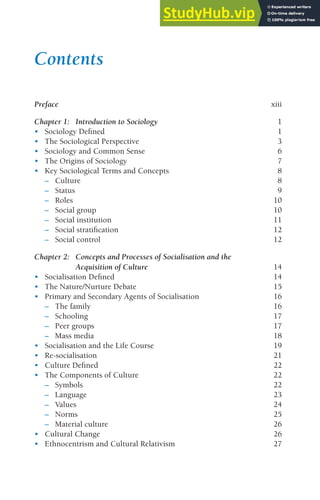
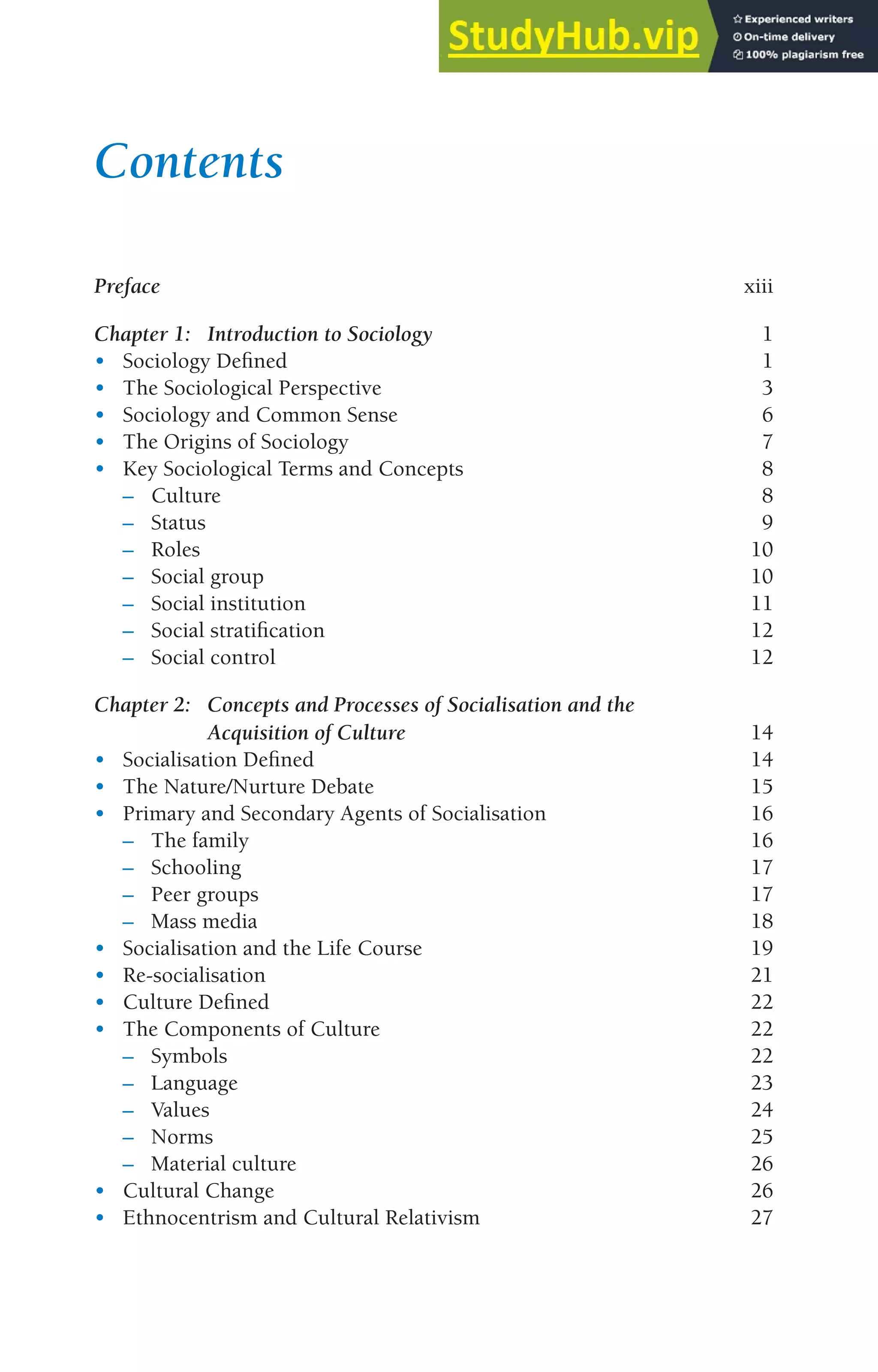
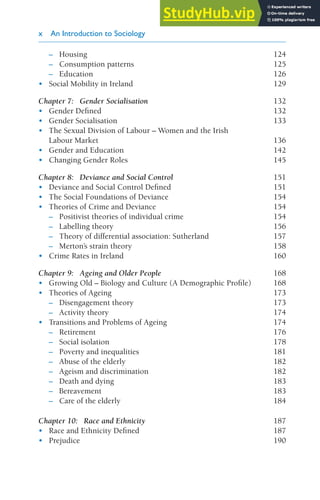
Contents
Preface xiii
Chapter 1: Introduction to Sociology 1
• Sociology Defined 1
• The Sociological Perspective 3
• Sociology and Common Sense 6
• The Origins of Sociology 7
• Key Sociological Terms and Concepts 8
– Culture 8
– Status 9
– Roles 10
– Social group 10
– Social institution 11
– Social stratification 12
– Social control 12
Chapter 2: Concepts and Processes of Socialisation and the
Acquisition of Culture 14
• Socialisation Defined 14
• The Nature/Nurture Debate 15
• Primary and Secondary Agents of Socialisation 16
– The family 16
– Schooling 17
– Peer groups 17
– Mass media 18
• Socialisation and the Life Course 19
• Re-socialisation 21
• Culture Defined 22
• The Components of Culture 22
– Symbols 22
– Language 23
– Values 24
– Norms 25
– Material culture 26
• Cultural Change 26
• Ethnocentrism and Cultural Relativism 27
Introduction to Sociology 10 Feb.indd 7 20/02/2014 11:15
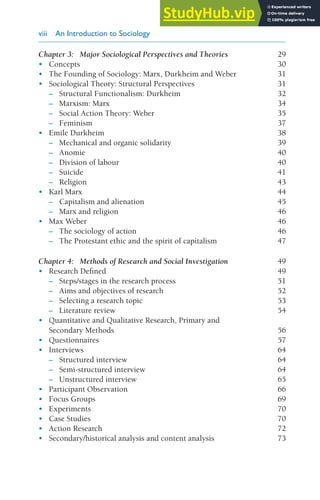
viii An Introduction to Sociology
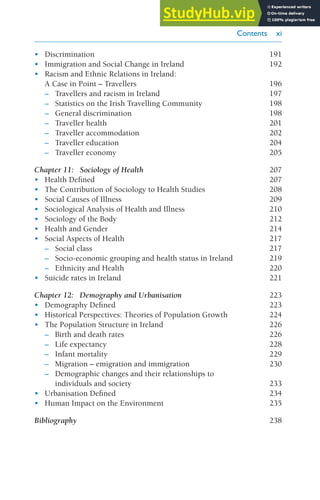
Chapter 3: Major Sociological Perspectives and Theories 29
• Concepts 30
• The Founding of Sociology: Marx, Durkheim and Weber 31
• Sociological Theory: Structural Perspectives 31
– Structural Functionalism: Durkheim 32
– Marxism: Marx 34
– Social Action Theory: Weber 35
– Feminism 37
• Emile Durkheim 38
– Mechanical and organic solidarity 39
– Anomie 40
– Division of labour 40
– Suicide 41
– Religion 43
• Karl Marx 44
– Capitalism and alienation 45
– Marx and religion 46
• Max Weber 46
– The sociology of action 46
– The Protestant ethic and the spirit of capitalism 47
Chapter 4: Methods of Research and Social Investigation 49
• Research Defined 49
– Steps/stages in the research process 51
– Aims and objectives of research 52
– Selecting a research topic 53
– Literature review 54
• Quantitative and Qualitative Research, Primary and
Secondary Methods 56
• Questionnaires 57
• Interviews 64
– Structured interview 64
– Semi-structured interview 64
– Unstructured interview 65
• Participant Observation 66
• Focus Groups 69
• Experiments 70
• Case Studies 70
• Action Research 72
• Secondary/historical analysis and content analysis 73
Introduction to Sociology 10 Feb.indd 8 20/02/2014 11:15
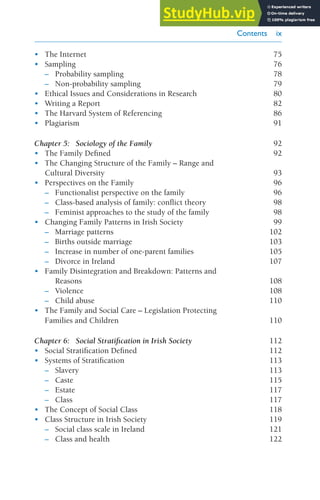
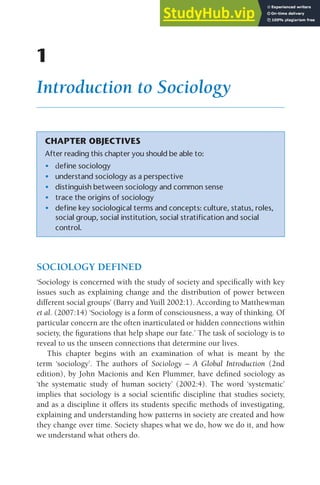
Contents ix
• The Internet 75
• Sampling 76
– Probability sampling 78
– Non-probability sampling 79
• Ethical Issues and Considerations in Research 80
• Writing a Report 82
• The Harvard System of Referencing 86
• Plagiarism 91
Chapter 5: Sociology of the Family 92
• The Family Defined 92
• The Changing Structure of the Family – Range and
Cultural Diversity 93
• Perspectives on the Family 96
– Functionalist perspective on the family 96
– Class-based analysis of family: conflict theory 98
– Feminist approaches to the study of the family 98
• Changing Family Patterns in Irish Society 99
– Marriage patterns 102
– Births outside marriage 103
– Increase in number of one-parent families 105
– Divorce in Ireland 107
• Family Disintegration and Breakdown: Patterns and
Reasons 108
– Violence 108
– Child abuse 110
• The Family and Social Care – Legislation Protecting
Families and Children 110
Chapter 6: Social Stratification in Irish Society 112
• Social Stratification Defined 112
• Systems of Stratification 113
– Slavery 113
– Caste 115
– Estate 117
– Class 117
• The Concept of Social Class 118
• Class Structure in Irish Society 119
– Social class scale in Ireland 121
– Class and health 122
Introduction to Sociology 10 Feb.indd 9 20/02/2014 11:15
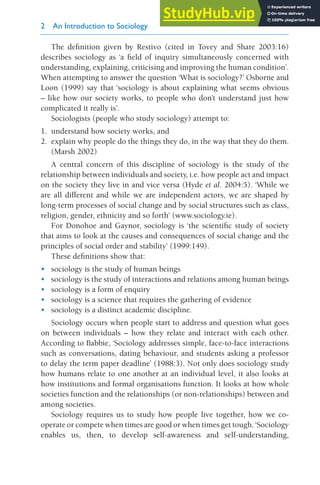
x An Introduction to Sociology
– Housing 124
– Consumption patterns 125
– Education 126
• Social Mobility in Ireland 129
Chapter 7: Gender Socialisation 132
• Gender Defined 132
• Gender Socialisation 133
• The Sexual Division of Labour – Women and the Irish
Labour Market 136
• Gender and Education 142
• Changing Gender Roles 145
Chapter 8: Deviance and Social Control 151
• Deviance and Social Control Defined 151
• The Social Foundations of Deviance 154
• Theories of Crime and Deviance 154
– Positivist theories of individual crime 154
– Labelling theory 156
– Theory of differential association: Sutherland 157
– Merton’s strain theory 158
• Crime Rates in Ireland 160
Chapter 9: Ageing and Older People 168
• Growing Old – Biology and Culture (A Demographic Profile) 168
• Theories of Ageing 173
– Disengagement theory 173
– Activity theory 174
• Transitions and Problems of Ageing 174
– Retirement 176
– Social isolation 178
– Poverty and inequalities 181
– Abuse of the elderly 182
– Ageism and discrimination 182
– Death and dying 183
– Bereavement 183
– Care of the elderly 184
Chapter 10: Race and Ethnicity 187
• Race and Ethnicity Defined 187
• Prejudice 190
Introduction to Sociology 10 Feb.indd 10 20/02/2014 11:15
Contents xi
• Discrimination 191
• Immigration and Social Change in Ireland 192
• Racism and Ethnic Relations in Ireland:
A Case in Point – Travellers 196
– Travellers and racism in Ireland 197
– Statistics on the Irish Travelling Community 198
– General discrimination 198
– Traveller health 201
– Traveller accommodation 202
– Traveller education 204
– Traveller economy 205
Chapter 11: Sociology of Health 207
• Health Defined 207
• The Contribution of Sociology to Health Studies 208
• Social Causes of Illness 209
• Sociological Analysis of Health and Illness 210
• Sociology of the Body 212
• Health and Gender 214
• Social Aspects of Health 217
– Social class 217
– Socio-economic grouping and health status in Ireland 219
– Ethnicity and Health 220
• Suicide rates in Ireland 221
Chapter 12: Demography and Urbanisation 223
• Demography Defined 223
• Historical Perspectives: Theories of Population Growth 224
• The Population Structure in Ireland 226
– Birth and death rates 226
– Life expectancy 228
– Infant mortality 229
– Migration – emigration and immigration 230
– Demographic changes and their relationships to
individuals and society 233
• Urbanisation Defined 234
• Human Impact on the Environment 235
Bibliography 238
Introduction to Sociology 10 Feb.indd 11 20/02/2014 11:15
1
Introduction to Sociology
CHAPTER OBJECTIVES
After reading this chapter you should be able to:
• define sociology
• understand sociology as a perspective
• distinguish between sociology and common sense
• trace the origins of sociology
• define key sociological terms and concepts: culture, status, roles,
social group, social institution, social stratification and social
control.
SOCIOLOGY DEFINED
‘Sociology is concerned with the study of society and specifically with key
issues such as explaining change and the distribution of power between
different social groups’ (Barry and Yuill 2002:1). According to Matthewman
et al. (2007:14) ‘Sociology is a form of consciousness, a way of thinking. Of
particular concern are the often inarticulated or hidden connections within
society, the figurations that help shape our fate.’ The task of sociology is to
reveal to us the unseen connections that determine our lives.
This chapter begins with an examination of what is meant by the
term ‘sociology’. The authors of Sociology – A Global Introduction (2nd
edition), by John Macionis and Ken Plummer, have defined sociology as
‘the systematic study of human society’ (2002:4). The word ‘systematic’
implies that sociology is a social scientific discipline that studies society,
and as a discipline it offers its students specific methods of investigating,
explaining and understanding how patterns in society are created and how
they change over time. Society shapes what we do, how we do it, and how
we understand what others do.
2 An Introduction to Sociology
The definition given by Restivo (cited in Tovey and Share 2003:16)
describes sociology as ‘a field of inquiry simultaneously concerned with
understanding, explaining, criticising and improving the human condition’.
When attempting to answer the question ‘What is sociology?’ Osborne and
Loon (1999) say that ‘sociology is about explaining what seems obvious
– like how our society works, to people who don’t understand just how
complicated it really is’.
Sociologists (people who study sociology) attempt to:
1. understand how society works, and
2. explain why people do the things they do, in the way that they do them.
(Marsh 2002)
A central concern of this discipline of sociology is the study of the
relationship between individuals and society, i.e. how people act and impact
on the society they live in and vice versa (Hyde et al. 2004:5). ‘While we
are all different and while we are independent actors, we are shaped by
long-term processes of social change and by social structures such as class,
religion, gender, ethnicity and so forth’ (www.sociology.ie).
For Donohoe and Gaynor, sociology is ‘the scientific study of society
that aims to look at the causes and consequences of social change and the
principles of social order and stability’ (1999:149).
These definitions show that:
• sociology is the study of human beings
• sociology is the study of interactions and relations among human beings
• sociology is a form of enquiry
• sociology is a science that requires the gathering of evidence
• sociology is a distinct academic discipline.
Sociology occurs when people start to address and question what goes
on between individuals – how they relate and interact with each other.
According to Babbie, ‘Sociology addresses simple, face-to-face interactions
such as conversations, dating behaviour, and students asking a professor
to delay the term paper deadline’ (1988:3). Not only does sociology study
how humans relate to one another at an individual level, it also looks at
how institutions and formal organisations function. It looks at how whole
societies function and the relationships (or non-relationships) between and
among societies.
Sociology requires us to study how people live together, how we co-
operate or compete when times are good or when times get tough. ‘Sociology
enables us, then, to develop self-awareness and self-understanding,
Introduction to Sociology 3
facilitating an increased recognition of what enables and constrains our,
and others’ actions’ (McIntosh and Punch 2005:10). Because human needs
and wants sometimes result in situations that put humans in conflict with
each other, there is a need to create rules. The creation of rules is an attempt
to help humans live together, an attempt to help establish some order in a
world that would otherwise be chaotic.
Babbie in his 1988 work The Sociological Spirit also states that ‘sociology
is also the study of how rules are organised and perpetuated’ (1988:4).
While it is important to examine the rules that govern how people live
together, we need to examine how they arise and how they change over
time. For Babbie, sociology is also the study of how we break rules and why
at times this is not always a bad thing. ‘A sociological understanding of the
world . . . enables us to consider how our lives are intertwined with others.
This enhances our ability to see the world from other viewpoints and to
engage with people from different backgrounds. It encourages us to become
more tolerant and sensitive to cultural differences’ (McIntosh and Punch
2005:10). Sociology as a subject appeals to those who wish to challenge
their assumptions and to go beyond common-sense explanations. Those
interested in sociology are being asked to look at the familiar with fresh
eyes, ‘to question accepted understandings of the world and to critically
evaluate widely held ideas that might otherwise go unquestioned’ (www.
sociology.ie).
While the above section outlines briefly what sociology is, the next
touches on the approach we must take if we are to develop a sociological
perspective.
THE SOCIOLOGICAL PERSPECTIVE
‘Each discipline within the social sciences has its own unique viewpoint’
(Curry et al. 2005:4). The sociological perspective offers us a way to view,
understand and affect the world we live in. It requires sociologists to take
a broad view, to stand back and start to question all that we have taken for
granted. To ‘do’ sociology, we need to think outside our own experiences and
to start looking at what seems ordinary or ‘mundane’ to us in a new light.
For Macionis and Plummer, ‘using the sociological perspective amounts
to seeing the strange in the familiar’ (2002:4). According to Peter Berger
(1967) ‘The fascination of sociology lies in the fact that its perspective
makes us see in a new light the very world in which we have lived all our
lives (cited in Marsh 2000:8).
4 An Introduction to Sociology
Sociology is not just about human societies, it is also a way of thinking
about human societies (Hyde et al. 2004:6). The American sociologist
C. Wright Mills emphasised the importance of developing ‘the sociological
imagination’ and of using it within sociology. Failure to use this sociological
imagination would mean that the discipline would lack a critical and
questioning edge and sociology would be reduced to a discipline that
lacked any ‘real purpose other than to describe, to provide background
detail and a social context’ (Barry and Yuill 2002:9). Most simply put, ‘the
sociological imagination requires us, above all, to “think ourselves away”
from the familiar routines of our daily lives in order to look at them anew’
(Giddens 2001:2).
To really be a proponent of this perspective we must give up the idea that
the way humans behave is simply a result of their deciding to behave that
way and accepting instead the notion that society guides our thoughts and
actions. Many sociologists today believe that we must combine the study of
major changes in society and individual lives and by doing so, sociologists
can develop their understanding of social life (Haralambos and Holborn
2004:xxv). While this may initially seem strange and difficult to do, it is a
skill we need to master in order to view the world sociologically.
Thinking sociologically requires us to see society as much more than
a collection of human beings. Failure to do so and to recognise the power
of social institutions that outlive humans means we will be unable to
deal with important problems and opportunities in our lives and in the
world. An understanding of the power that society has on influencing our
thoughts and actions can empower us to deal with the problems of the
world. Mills’ work on ‘the sociological imagination’ showed the ability to
study the structure of society at the same time as individuals’ lives. Mills
‘held up sociology as an escape from the “traps” of our lives because it can
show us that society – not our own foibles or failings – is responsible for
many of our problems’ (Macionis and Plummer 2005:10). He argued that
the sociological imagination allowed people to understand their ‘private
troubles’ in terms of ‘public issues’ (Haralambos and Holborn 2004:xxv).
An example of this can be seen when we look at problems such as marital
breakdown, unemployment and war. Although these are problems that are
all experienced by people, due maybe to problems in their own personal
lives, individuals need to react to them differently and the way they do so
impacts on society as a whole. However, Mills argues that these issues need
to be examined and can only be fully understood in the context of wider
social forces. ‘For example, very specific circumstances might lead to one
Introduction to Sociology 5
person becoming unemployed, but when unemployment rates in society
as a whole rise, it becomes a public issue that needs to be explained’ (Ibid.:
xxv). Mills maintains that sociology transforms personal problems into
public and political issues. His work describes ‘both the power of society
to shape our individual lives, and the importance of connecting our lives
(biographies) to history and society’ (Macionis and Plummer 2005:10).
Grasping the sociological perspective requires us to grasp the idea that
‘who we are’ is a function of the society we live in. By doing so, we will see
how it can help us deal with the constraints of society. This can set us on a
quest for answers that may prove invaluable.
Developing a sociological perspective will enable us to:
1. develop a new way of thinking; one that questions our familiar way of
understanding ourselves
2. critically assess commonly held truths and allow us to see opportunities
or constraints that affect our lives
3. empower us to become active participants in our society
4. recognise human differences and suffering that may influence our
decisions to confront problems of living in a diverse world. (Macionis
and Plummer 2002:9)
Where there are clear benefits (mentioned briefly above), there are
certain pitfalls and problems associated with the perspective that we
must try to avoid. Because we are part of a rapidly changing world, it
sometimes becomes difficult to study society as it too changes. Becoming
aware of this will enable us to question research findings and statistics
that might have been reflective of a particular society at a particular time
but that may be out-of-date or invalid today. Because we are part of the
world we study, it is important that we try to maintain some distance
from it and not develop a view that holds our society’s practices or our
cultural views superior or inferior to another’s. We must also be aware
that the information we produce as sociologists, and the findings we
present, become part of a society’s knowledge and that too can shape the
working of that society. Overall what is being highlighted is the impact
of sociology on society. To help us understand the perspective, it is
necessary to examine it at the time and in the context it first emerged. To
do so, a historical account of the development of the subject is necessary.
However, prior to discussing the origins of sociology as an academic
discipline, it is important to highlight the differences between sociology
and a commonsense approach to society.
6 An Introduction to Sociology
SOCIOLOGY AND COMMON SENSE
Some may argue that since sociology focuses on issues, problems or
challenges we encounter in our everyday lives, it is difficult to distinguish
it from commonsense theories of everyday life. Sociology is concerned with
studying many things most people already know something about. Everyone
will have some form of knowledge, information and understanding on areas
such as family life, work, the education system and the health system. ‘This
leads many people to assume that the topics studied by sociologists and
the explanations sociologists produce are really just common sense: what
“everyone knows”’ (Browne 2005). This is a very mistaken assumption.
Sociology does not see society as operating on commonsense lines
because ‘In the world of common sense there is also little requirement to
be “scientific”’ (McIntosh and Punch 2005:27). Sociology sees society as
consisting of ‘often complex social patterns which needed to be uncovered
and analysed, just as a physical scientist would study a chemical compound
or the laws of motion. If evidence was gathered through rigorous empirical
ways then theories could be seen as true and valid’ (Scott, cited in Marsh
2002:9). Research carried out by sociologists has shown many widely held
common-sense ideas and explanations to be false. According to Browne
(2005), ‘Ideas such as that the poor and unemployed are inadequate and lazy,
that everyone has equal chances in life, that men are “naturally” superior to
women . . . these have all been questioned by sociological research. Much
of the concern of sociology lies in re-examination of such common-sense
views.’
Sociological explanations of the social world differ to commonsense
explanations in the following ways:
1. Sociology, like other social sciences such as psychology, uses methods of
research to obtain information and knowledge about the social world.
2. ‘Sociological studies seek to move beyond individual subjective
understanding in order to ask how others might understand the same
processes differently’ (Hyde et al. 2004:6). Sociologists are required to
adopt a sceptical attitude and as a result depart from limited observations
of the commonsense explanations of the social world.
3. Sociology teaches us to critically assess and evaluate commonly held
assumptions by gathering evidence as a result of rigorous research. On
the basis of such evidence we should construct logical arguments and
then ‘attempt to relate what we have learned to a wider social context’
(McIntosh and Punch 2005:29).
Introduction to Sociology 7
Sociologists look at and examine evidence on issues before making up
their minds. ‘The explanations and conclusions of sociologists are based
on precise evidence which has been collected through painstaking research
using established research procedures’ (Browne 2005:2).
THE ORIGINS OF SOCIOLOGY
‘The discipline of sociology is fundamentally a “modern” one, bound up
with attempts to explain, anticipate and alter a rapidly changing world’
(Barry and Yuill 2002:7).
Sociology, the science of social life, is a discipline of relatively recent
origin. It was so named by the French writer Auguste Comte in 1838,
making it a product of the early nineteenth century (Tovey and Share
2003). When Comte first used the term less than 200 years ago, he was
interested in developing a new way of looking at the world. Unlike the
great thinkers such as Aristotle (384–322 BC) and Plato (427–347 BC),
who tended to focus their thinking on imagining the ideal society, Comte
wanted to go a step further. For him, this involved analysing society as
it really was and he believed that it was only by doing so that you could
understand or try to understand how society actually operated. ‘Comte
was influenced by Enlightenment thinking as a new way of understanding
the natural and social worlds. The new intelligentsia of the Enlightenment
sought explanations for patterns in the natural and social worlds by rejecting
religious (or supernatural) and metaphysical (or natural) explanations in
favour of the development of scientific and rational explanations’ (Hyde et
al. 2004:3).
Unlike his predecessors and their approach to society, Comte’s new
approach was to be characterised by a buzzword – ‘critical thinking’.
Assertions about society must make sense, correspond to facts. Comte
believed that in order to truly understand how a society actually operates
there was a need to develop a scientific approach. Comte therefore was a
proponent of ‘Positivism’ and saw it as ‘the search for order and progress
in the social world’ (Marsh 2000:15). ‘Positivism holds that science should
be concerned only with observable entities that are known directly to
experience’ (Giddens 2001:8). To put it more simply, Positivism refers to
using research methods of the natural sciences to carry out social enquiry
and as a result produce a ‘social science’.
Comte believed that when we were equipped with knowledge about
how society operated, then people would be able to build themselves a
8 An Introduction to Sociology
better life and a better future. But why did this discipline emerge in that
historical period? What was happening around Comte that resulted in his
seeing a need for a new science?
By the time of the birth of sociology in the early nineteenth century,
huge changes were taking place across Europe and North America that
were having profound effects on the people of that time. These changes
were a result of the industrial and democratic revolutions that occurred
at the end of the eighteenth and beginning of the nineteenth centuries.
These changes were rearranging society and changing the way people lived.
Comte himself was one of those being affected by these social changes. He
was born at the end of the democratic revolution in his own native France
and grew up in the early years of the industrial revolution that first hit
Britain before spreading to other areas of Europe. Society, as people knew it
at that time, was undergoing massive transformations. The introduction of
technology and the new economic processes associated with the industrial
revolution were altering forever the organisation of societies. The democratic
revolutions were raising issues about the proper relationship between the
individual and society while debating human nature and authority. ‘The
changes occurring in society at this time provoked questions about how
societies could or should be organised and how emerging forms of society
affected relations between groups of individuals in society’ (Hyde et al.
2004:4).
Social change was happening at a rate that had not been seen before
and as a result people like Comte saw a need to identify these changes
associated with modernity and to chart its likely path. By understanding
what was happening one could build oneself a better future. Hence the
emergence of the discipline of sociology (from the Greek and Latin words
meaning the study of society) which Comte divided into two parts:
1. social statics, which looks at how society is held together, and
2. social dynamics, which looks at how society changes. (Macionis and
Plummer 2002:12)
KEY SOCIOLOGICAL TERMS AND CONCEPTS
Culture
‘Culture refers to the ways of life of the members of a society, or of groups
within a society. It includes how they dress, their marriage customs and
family life, their patterns of work, religious ceremonies and leisure pursuits’
Introduction to Sociology 9
(Giddens 2001:22). When people behave in a particular way, it is believed
that their behaviour is determined by the culture they live in. Just as
different individuals have different personalities, different societies have
different cultures. For example, Irish culture is very different to Chinese
culture.
Culture in its broadest sense is all the ways of behaving, interacting,
thinking and communicating that are handed down from one generation
to the next through language and all other modes of communicating
which, according to Osborne and Loon, include ‘gesture, painting, writing,
architecture, music, fashion, food and so on’ (1999:142). Although human
culture is very recent, it is said to be the force that separates us from
primitive ways of living. A society’s culture is their way of behaving that
allows them to make sense of the world. At the same time it makes sure
everyone else knows what they are supposed to be doing. Cultures vary the
world over, but despite huge differences they are found to be built on five
major components:
1. symbols
2. language
3. values/beliefs
4. norms
5. material culture
Status
‘Contrary to what people may believe, their social interactions are not always
a matter of conscious choice. Each of us is linked to society, and whether we
realise it or not, these linkages can determine how we interact with others.
One of the most important linkages is status’ (Curry et al. 2005:128). Status
refers to the social positions a person can occupy within a society or within
a small social grouping (Babbie 1988). For example, in society a person can
occupy the status of mother, sister, student, doctor etc. Each of us in real
life occupies numerous statuses and we act accordingly, because each status
we occupy has certain kinds of behaviour associated with it. When you
occupy the status of doctor there are certain kinds of behaviour expected of
you that would not be expected of a disc jockey. Each status we occupy acts
like a mask that we hold up when we interact with others, that determines
our behaviour and the expected behaviour of another.
Throughout our lives we continue to learn the statuses we occupy, the
behaviour expectations associated with those statuses and our relationships
10 An Introduction to Sociology
with people occupying other statuses. It is a process that continues right
through our life cycle because during this time the statuses we occupy in
society change. Our status as student ends when we finish study and enter
the arena of work.
Sociologists distinguish between two types of statuses: ascribed and
achieved. An ascribed status, such as race and sex, cannot be changed by
individual effort whether we want to or not. An achieved status on the other
hand is one that can be obtained through individual effort. For example,
our occupational status can be achieved by our ability, how hard we work
and an element of luck (Curry et al. 2005:129).
Roles
‘Each status in society is accompanied by a number of norms that define
how an individual occupying a particular status is expected to act. This
group of norms is known as a role’ (Haralambos and Holborn 2004:x).
When we occupy a certain status in society we have functions to serve or
roles to play. Social roles help us to organise and to regulate our behaviour.
Teacher, dentist, waitress are all examples of occupational roles, while
grandfather, aunt, daughter provide examples of family roles (Donohoe
and Gaynor 1999). When we interact with other individuals in terms of
their roles, we know what to do and how to do it. Knowing our role in
society helps us to take part (in most cases) in ‘pleasant and productive
social interactions’. However, times or situations can arise that can result in
role conflict – ‘the incompatibility of the different roles played by a single
person’ (Turner 1990 cited in Curry et al. 2005:131). If we diverge too far
from the social role we are expected to play in society, we can expect to be
criticised or to experience some other form of social punishment.
Social group
Social gatherings of people such as an audience or a crowd do not constitute
a sociologist’s definition of a group. To be part of a group, members must
agree on a number of characteristics springing from shared common interest
or interaction with one another, and the group must have a sense of identity
and some degree of structure.
Two types of groups have been distinguished by sociologists: primary
groups and secondary groups (Marsh 2000:30). Primary groups are made
up of people connected to one another through primary relationships;
relationships we have with people closest to us, such as our family members
Introduction to Sociology 11
or partner. On the other hand, the relationships we have within secondary
groups are based on the statuses we occupy and the roles we expect of such
statuses, such as that between a teacher and their student.
Sociologists are interested in how groups
1. contribute to our sense of identity, and
2. influence who people think we are.
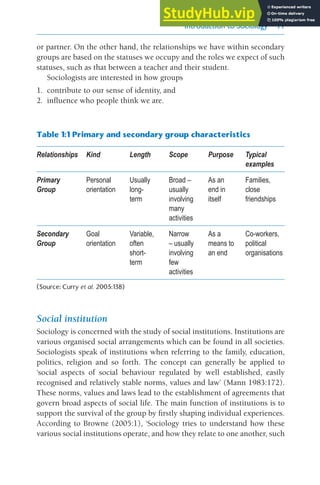
Table 1:1 Primary and secondary group characteristics
Relationships Kind Length Scope Purpose Typical
examples
Primary
Group
Personal
orientation
Usually
long-
term
Broad –
usually
involving
many
activities
As an
end in
itself
Families,
close
friendships
Secondary
Group
Goal
orientation
Variable,
often
short-
term
Narrow
– usually
involving
few
activities
As a
means to
an end
Co-workers,
political
organisations
(Source: Curry et al. 2005:138)
Social institution
Sociology is concerned with the study of social institutions. Institutions are
various organised social arrangements which can be found in all societies.
Sociologists speak of institutions when referring to the family, education,
politics, religion and so forth. The concept can generally be applied to
‘social aspects of social behaviour regulated by well established, easily
recognised and relatively stable norms, values and law’ (Mann 1983:172).
These norms, values and laws lead to the establishment of agreements that
govern broad aspects of social life. The main function of institutions is to
support the survival of the group by firstly shaping individual experiences.
According to Browne (2005:1), ‘Sociology tries to understand how these
various social institutions operate, and how they relate to one another, such
12 An Introduction to Sociology
as the influence the family might have on how well children perform in the
education system’.
Institutional change does occur and is most likely to occur when the
beliefs and values of one institution come into conflict with another. Change
can also be a result of conflict within the same institution.
Social stratification
Social stratification refers to ‘a system by which a society ranks categories
of people in a hierarchy’ (Macionis and Plummer 2002:178). Most societies
the world over have some form of stratification that results in some groups
of people being in superior positions. Such positioning in a ‘hierarchy’
allows certain groups to enjoy considerably more power, prestige or access
to resources such as health, education etc. than others.
While every society (except the most technologically primitive) stratifies
in some ways, four main systems of stratification have been identified by
sociologists. These are slavery, estate, caste and class. Each of these systems
is made up of its own strata or layers. Your life chances or opportunities are
very much determined by the position you occupy on these social strata.
Some of these stratification systems are open and some are closed. In
other words, when we speak of an open system of stratification we are
referring to a system that allows people to change their position on the
hierarchical structure throughout their life course. The class system that
operates in Ireland is considered an open system. A closed system does not
afford a person the same opportunity, and as a result a person’s position in
life is solely determined by the family group they are born into. The caste
system that operates in parts of India provides a good example of a closed
system of stratification.
Social control
‘The processes of socialisation and social control are fundamental to
the equilibrium of the social system and therefore to order in society’
(Haralambos and Holborn 2004:940).
When people do not abide by the rules or behaviour expectations of
a certain society they are disciplined. Social control aims to create social
order. It can take many different forms but falls into two broad categories:
informal and formal.
Informal social control can be expressed in disapproving looks by
another if something is said or done out of context. In contrast more serious
Introduction to Sociology 13
acts such as murder, theft or child abuse are disciplined by formal social
control which is backed by the law, the Gardaí, the courts and the prison
system. Other means of social control could possibly include psychiatrists
and social workers.
The following chapters will deal with each of these concepts in greater
detail, especially in relation to Irish society.

An Introduction To Sociology 3Rd Ed - Look Inside Sample

  • 1.
    Contents Preface xiii Chapter 1:Introduction to Sociology 1 • Sociology Defined 1 • The Sociological Perspective 3 • Sociology and Common Sense 6 • The Origins of Sociology 7 • Key Sociological Terms and Concepts 8 – Culture 8 – Status 9 – Roles 10 – Social group 10 – Social institution 11 – Social stratification 12 – Social control 12 Chapter 2: Concepts and Processes of Socialisation and the Acquisition of Culture 14 • Socialisation Defined 14 • The Nature/Nurture Debate 15 • Primary and Secondary Agents of Socialisation 16 – The family 16 – Schooling 17 – Peer groups 17 – Mass media 18 • Socialisation and the Life Course 19 • Re-socialisation 21 • Culture Defined 22 • The Components of Culture 22 – Symbols 22 – Language 23 – Values 24 – Norms 25 – Material culture 26 • Cultural Change 26 • Ethnocentrism and Cultural Relativism 27 Introduction to Sociology 10 Feb.indd 7 20/02/2014 11:15
  • 2.
    viii An Introductionto Sociology Chapter 3: Major Sociological Perspectives and Theories 29 • Concepts 30 • The Founding of Sociology: Marx, Durkheim and Weber 31 • Sociological Theory: Structural Perspectives 31 – Structural Functionalism: Durkheim 32 – Marxism: Marx 34 – Social Action Theory: Weber 35 – Feminism 37 • Emile Durkheim 38 – Mechanical and organic solidarity 39 – Anomie 40 – Division of labour 40 – Suicide 41 – Religion 43 • Karl Marx 44 – Capitalism and alienation 45 – Marx and religion 46 • Max Weber 46 – The sociology of action 46 – The Protestant ethic and the spirit of capitalism 47 Chapter 4: Methods of Research and Social Investigation 49 • Research Defined 49 – Steps/stages in the research process 51 – Aims and objectives of research 52 – Selecting a research topic 53 – Literature review 54 • Quantitative and Qualitative Research, Primary and Secondary Methods 56 • Questionnaires 57 • Interviews 64 – Structured interview 64 – Semi-structured interview 64 – Unstructured interview 65 • Participant Observation 66 • Focus Groups 69 • Experiments 70 • Case Studies 70 • Action Research 72 • Secondary/historical analysis and content analysis 73 Introduction to Sociology 10 Feb.indd 8 20/02/2014 11:15
  • 3.
    Contents ix • TheInternet 75 • Sampling 76 – Probability sampling 78 – Non-probability sampling 79 • Ethical Issues and Considerations in Research 80 • Writing a Report 82 • The Harvard System of Referencing 86 • Plagiarism 91 Chapter 5: Sociology of the Family 92 • The Family Defined 92 • The Changing Structure of the Family – Range and Cultural Diversity 93 • Perspectives on the Family 96 – Functionalist perspective on the family 96 – Class-based analysis of family: conflict theory 98 – Feminist approaches to the study of the family 98 • Changing Family Patterns in Irish Society 99 – Marriage patterns 102 – Births outside marriage 103 – Increase in number of one-parent families 105 – Divorce in Ireland 107 • Family Disintegration and Breakdown: Patterns and Reasons 108 – Violence 108 – Child abuse 110 • The Family and Social Care – Legislation Protecting Families and Children 110 Chapter 6: Social Stratification in Irish Society 112 • Social Stratification Defined 112 • Systems of Stratification 113 – Slavery 113 – Caste 115 – Estate 117 – Class 117 • The Concept of Social Class 118 • Class Structure in Irish Society 119 – Social class scale in Ireland 121 – Class and health 122 Introduction to Sociology 10 Feb.indd 9 20/02/2014 11:15
  • 4.
    x An Introductionto Sociology – Housing 124 – Consumption patterns 125 – Education 126 • Social Mobility in Ireland 129 Chapter 7: Gender Socialisation 132 • Gender Defined 132 • Gender Socialisation 133 • The Sexual Division of Labour – Women and the Irish Labour Market 136 • Gender and Education 142 • Changing Gender Roles 145 Chapter 8: Deviance and Social Control 151 • Deviance and Social Control Defined 151 • The Social Foundations of Deviance 154 • Theories of Crime and Deviance 154 – Positivist theories of individual crime 154 – Labelling theory 156 – Theory of differential association: Sutherland 157 – Merton’s strain theory 158 • Crime Rates in Ireland 160 Chapter 9: Ageing and Older People 168 • Growing Old – Biology and Culture (A Demographic Profile) 168 • Theories of Ageing 173 – Disengagement theory 173 – Activity theory 174 • Transitions and Problems of Ageing 174 – Retirement 176 – Social isolation 178 – Poverty and inequalities 181 – Abuse of the elderly 182 – Ageism and discrimination 182 – Death and dying 183 – Bereavement 183 – Care of the elderly 184 Chapter 10: Race and Ethnicity 187 • Race and Ethnicity Defined 187 • Prejudice 190 Introduction to Sociology 10 Feb.indd 10 20/02/2014 11:15
  • 5.
    Contents xi • Discrimination191 • Immigration and Social Change in Ireland 192 • Racism and Ethnic Relations in Ireland: A Case in Point – Travellers 196 – Travellers and racism in Ireland 197 – Statistics on the Irish Travelling Community 198 – General discrimination 198 – Traveller health 201 – Traveller accommodation 202 – Traveller education 204 – Traveller economy 205 Chapter 11: Sociology of Health 207 • Health Defined 207 • The Contribution of Sociology to Health Studies 208 • Social Causes of Illness 209 • Sociological Analysis of Health and Illness 210 • Sociology of the Body 212 • Health and Gender 214 • Social Aspects of Health 217 – Social class 217 – Socio-economic grouping and health status in Ireland 219 – Ethnicity and Health 220 • Suicide rates in Ireland 221 Chapter 12: Demography and Urbanisation 223 • Demography Defined 223 • Historical Perspectives: Theories of Population Growth 224 • The Population Structure in Ireland 226 – Birth and death rates 226 – Life expectancy 228 – Infant mortality 229 – Migration – emigration and immigration 230 – Demographic changes and their relationships to individuals and society 233 • Urbanisation Defined 234 • Human Impact on the Environment 235 Bibliography 238 Introduction to Sociology 10 Feb.indd 11 20/02/2014 11:15
  • 6.
    1 Introduction to Sociology CHAPTEROBJECTIVES After reading this chapter you should be able to: • define sociology • understand sociology as a perspective • distinguish between sociology and common sense • trace the origins of sociology • define key sociological terms and concepts: culture, status, roles, social group, social institution, social stratification and social control. SOCIOLOGY DEFINED ‘Sociology is concerned with the study of society and specifically with key issues such as explaining change and the distribution of power between different social groups’ (Barry and Yuill 2002:1). According to Matthewman et al. (2007:14) ‘Sociology is a form of consciousness, a way of thinking. Of particular concern are the often inarticulated or hidden connections within society, the figurations that help shape our fate.’ The task of sociology is to reveal to us the unseen connections that determine our lives. This chapter begins with an examination of what is meant by the term ‘sociology’. The authors of Sociology – A Global Introduction (2nd edition), by John Macionis and Ken Plummer, have defined sociology as ‘the systematic study of human society’ (2002:4). The word ‘systematic’ implies that sociology is a social scientific discipline that studies society, and as a discipline it offers its students specific methods of investigating, explaining and understanding how patterns in society are created and how they change over time. Society shapes what we do, how we do it, and how we understand what others do.
  • 7.
    2 An Introductionto Sociology The definition given by Restivo (cited in Tovey and Share 2003:16) describes sociology as ‘a field of inquiry simultaneously concerned with understanding, explaining, criticising and improving the human condition’. When attempting to answer the question ‘What is sociology?’ Osborne and Loon (1999) say that ‘sociology is about explaining what seems obvious – like how our society works, to people who don’t understand just how complicated it really is’. Sociologists (people who study sociology) attempt to: 1. understand how society works, and 2. explain why people do the things they do, in the way that they do them. (Marsh 2002) A central concern of this discipline of sociology is the study of the relationship between individuals and society, i.e. how people act and impact on the society they live in and vice versa (Hyde et al. 2004:5). ‘While we are all different and while we are independent actors, we are shaped by long-term processes of social change and by social structures such as class, religion, gender, ethnicity and so forth’ (www.sociology.ie). For Donohoe and Gaynor, sociology is ‘the scientific study of society that aims to look at the causes and consequences of social change and the principles of social order and stability’ (1999:149). These definitions show that: • sociology is the study of human beings • sociology is the study of interactions and relations among human beings • sociology is a form of enquiry • sociology is a science that requires the gathering of evidence • sociology is a distinct academic discipline. Sociology occurs when people start to address and question what goes on between individuals – how they relate and interact with each other. According to Babbie, ‘Sociology addresses simple, face-to-face interactions such as conversations, dating behaviour, and students asking a professor to delay the term paper deadline’ (1988:3). Not only does sociology study how humans relate to one another at an individual level, it also looks at how institutions and formal organisations function. It looks at how whole societies function and the relationships (or non-relationships) between and among societies. Sociology requires us to study how people live together, how we co- operate or compete when times are good or when times get tough. ‘Sociology enables us, then, to develop self-awareness and self-understanding,
  • 8.
    Introduction to Sociology3 facilitating an increased recognition of what enables and constrains our, and others’ actions’ (McIntosh and Punch 2005:10). Because human needs and wants sometimes result in situations that put humans in conflict with each other, there is a need to create rules. The creation of rules is an attempt to help humans live together, an attempt to help establish some order in a world that would otherwise be chaotic. Babbie in his 1988 work The Sociological Spirit also states that ‘sociology is also the study of how rules are organised and perpetuated’ (1988:4). While it is important to examine the rules that govern how people live together, we need to examine how they arise and how they change over time. For Babbie, sociology is also the study of how we break rules and why at times this is not always a bad thing. ‘A sociological understanding of the world . . . enables us to consider how our lives are intertwined with others. This enhances our ability to see the world from other viewpoints and to engage with people from different backgrounds. It encourages us to become more tolerant and sensitive to cultural differences’ (McIntosh and Punch 2005:10). Sociology as a subject appeals to those who wish to challenge their assumptions and to go beyond common-sense explanations. Those interested in sociology are being asked to look at the familiar with fresh eyes, ‘to question accepted understandings of the world and to critically evaluate widely held ideas that might otherwise go unquestioned’ (www. sociology.ie). While the above section outlines briefly what sociology is, the next touches on the approach we must take if we are to develop a sociological perspective. THE SOCIOLOGICAL PERSPECTIVE ‘Each discipline within the social sciences has its own unique viewpoint’ (Curry et al. 2005:4). The sociological perspective offers us a way to view, understand and affect the world we live in. It requires sociologists to take a broad view, to stand back and start to question all that we have taken for granted. To ‘do’ sociology, we need to think outside our own experiences and to start looking at what seems ordinary or ‘mundane’ to us in a new light. For Macionis and Plummer, ‘using the sociological perspective amounts to seeing the strange in the familiar’ (2002:4). According to Peter Berger (1967) ‘The fascination of sociology lies in the fact that its perspective makes us see in a new light the very world in which we have lived all our lives (cited in Marsh 2000:8).
  • 9.
    4 An Introductionto Sociology Sociology is not just about human societies, it is also a way of thinking about human societies (Hyde et al. 2004:6). The American sociologist C. Wright Mills emphasised the importance of developing ‘the sociological imagination’ and of using it within sociology. Failure to use this sociological imagination would mean that the discipline would lack a critical and questioning edge and sociology would be reduced to a discipline that lacked any ‘real purpose other than to describe, to provide background detail and a social context’ (Barry and Yuill 2002:9). Most simply put, ‘the sociological imagination requires us, above all, to “think ourselves away” from the familiar routines of our daily lives in order to look at them anew’ (Giddens 2001:2). To really be a proponent of this perspective we must give up the idea that the way humans behave is simply a result of their deciding to behave that way and accepting instead the notion that society guides our thoughts and actions. Many sociologists today believe that we must combine the study of major changes in society and individual lives and by doing so, sociologists can develop their understanding of social life (Haralambos and Holborn 2004:xxv). While this may initially seem strange and difficult to do, it is a skill we need to master in order to view the world sociologically. Thinking sociologically requires us to see society as much more than a collection of human beings. Failure to do so and to recognise the power of social institutions that outlive humans means we will be unable to deal with important problems and opportunities in our lives and in the world. An understanding of the power that society has on influencing our thoughts and actions can empower us to deal with the problems of the world. Mills’ work on ‘the sociological imagination’ showed the ability to study the structure of society at the same time as individuals’ lives. Mills ‘held up sociology as an escape from the “traps” of our lives because it can show us that society – not our own foibles or failings – is responsible for many of our problems’ (Macionis and Plummer 2005:10). He argued that the sociological imagination allowed people to understand their ‘private troubles’ in terms of ‘public issues’ (Haralambos and Holborn 2004:xxv). An example of this can be seen when we look at problems such as marital breakdown, unemployment and war. Although these are problems that are all experienced by people, due maybe to problems in their own personal lives, individuals need to react to them differently and the way they do so impacts on society as a whole. However, Mills argues that these issues need to be examined and can only be fully understood in the context of wider social forces. ‘For example, very specific circumstances might lead to one
  • 10.
    Introduction to Sociology5 person becoming unemployed, but when unemployment rates in society as a whole rise, it becomes a public issue that needs to be explained’ (Ibid.: xxv). Mills maintains that sociology transforms personal problems into public and political issues. His work describes ‘both the power of society to shape our individual lives, and the importance of connecting our lives (biographies) to history and society’ (Macionis and Plummer 2005:10). Grasping the sociological perspective requires us to grasp the idea that ‘who we are’ is a function of the society we live in. By doing so, we will see how it can help us deal with the constraints of society. This can set us on a quest for answers that may prove invaluable. Developing a sociological perspective will enable us to: 1. develop a new way of thinking; one that questions our familiar way of understanding ourselves 2. critically assess commonly held truths and allow us to see opportunities or constraints that affect our lives 3. empower us to become active participants in our society 4. recognise human differences and suffering that may influence our decisions to confront problems of living in a diverse world. (Macionis and Plummer 2002:9) Where there are clear benefits (mentioned briefly above), there are certain pitfalls and problems associated with the perspective that we must try to avoid. Because we are part of a rapidly changing world, it sometimes becomes difficult to study society as it too changes. Becoming aware of this will enable us to question research findings and statistics that might have been reflective of a particular society at a particular time but that may be out-of-date or invalid today. Because we are part of the world we study, it is important that we try to maintain some distance from it and not develop a view that holds our society’s practices or our cultural views superior or inferior to another’s. We must also be aware that the information we produce as sociologists, and the findings we present, become part of a society’s knowledge and that too can shape the working of that society. Overall what is being highlighted is the impact of sociology on society. To help us understand the perspective, it is necessary to examine it at the time and in the context it first emerged. To do so, a historical account of the development of the subject is necessary. However, prior to discussing the origins of sociology as an academic discipline, it is important to highlight the differences between sociology and a commonsense approach to society.
  • 11.
    6 An Introductionto Sociology SOCIOLOGY AND COMMON SENSE Some may argue that since sociology focuses on issues, problems or challenges we encounter in our everyday lives, it is difficult to distinguish it from commonsense theories of everyday life. Sociology is concerned with studying many things most people already know something about. Everyone will have some form of knowledge, information and understanding on areas such as family life, work, the education system and the health system. ‘This leads many people to assume that the topics studied by sociologists and the explanations sociologists produce are really just common sense: what “everyone knows”’ (Browne 2005). This is a very mistaken assumption. Sociology does not see society as operating on commonsense lines because ‘In the world of common sense there is also little requirement to be “scientific”’ (McIntosh and Punch 2005:27). Sociology sees society as consisting of ‘often complex social patterns which needed to be uncovered and analysed, just as a physical scientist would study a chemical compound or the laws of motion. If evidence was gathered through rigorous empirical ways then theories could be seen as true and valid’ (Scott, cited in Marsh 2002:9). Research carried out by sociologists has shown many widely held common-sense ideas and explanations to be false. According to Browne (2005), ‘Ideas such as that the poor and unemployed are inadequate and lazy, that everyone has equal chances in life, that men are “naturally” superior to women . . . these have all been questioned by sociological research. Much of the concern of sociology lies in re-examination of such common-sense views.’ Sociological explanations of the social world differ to commonsense explanations in the following ways: 1. Sociology, like other social sciences such as psychology, uses methods of research to obtain information and knowledge about the social world. 2. ‘Sociological studies seek to move beyond individual subjective understanding in order to ask how others might understand the same processes differently’ (Hyde et al. 2004:6). Sociologists are required to adopt a sceptical attitude and as a result depart from limited observations of the commonsense explanations of the social world. 3. Sociology teaches us to critically assess and evaluate commonly held assumptions by gathering evidence as a result of rigorous research. On the basis of such evidence we should construct logical arguments and then ‘attempt to relate what we have learned to a wider social context’ (McIntosh and Punch 2005:29).
  • 12.
    Introduction to Sociology7 Sociologists look at and examine evidence on issues before making up their minds. ‘The explanations and conclusions of sociologists are based on precise evidence which has been collected through painstaking research using established research procedures’ (Browne 2005:2). THE ORIGINS OF SOCIOLOGY ‘The discipline of sociology is fundamentally a “modern” one, bound up with attempts to explain, anticipate and alter a rapidly changing world’ (Barry and Yuill 2002:7). Sociology, the science of social life, is a discipline of relatively recent origin. It was so named by the French writer Auguste Comte in 1838, making it a product of the early nineteenth century (Tovey and Share 2003). When Comte first used the term less than 200 years ago, he was interested in developing a new way of looking at the world. Unlike the great thinkers such as Aristotle (384–322 BC) and Plato (427–347 BC), who tended to focus their thinking on imagining the ideal society, Comte wanted to go a step further. For him, this involved analysing society as it really was and he believed that it was only by doing so that you could understand or try to understand how society actually operated. ‘Comte was influenced by Enlightenment thinking as a new way of understanding the natural and social worlds. The new intelligentsia of the Enlightenment sought explanations for patterns in the natural and social worlds by rejecting religious (or supernatural) and metaphysical (or natural) explanations in favour of the development of scientific and rational explanations’ (Hyde et al. 2004:3). Unlike his predecessors and their approach to society, Comte’s new approach was to be characterised by a buzzword – ‘critical thinking’. Assertions about society must make sense, correspond to facts. Comte believed that in order to truly understand how a society actually operates there was a need to develop a scientific approach. Comte therefore was a proponent of ‘Positivism’ and saw it as ‘the search for order and progress in the social world’ (Marsh 2000:15). ‘Positivism holds that science should be concerned only with observable entities that are known directly to experience’ (Giddens 2001:8). To put it more simply, Positivism refers to using research methods of the natural sciences to carry out social enquiry and as a result produce a ‘social science’. Comte believed that when we were equipped with knowledge about how society operated, then people would be able to build themselves a
  • 13.
    8 An Introductionto Sociology better life and a better future. But why did this discipline emerge in that historical period? What was happening around Comte that resulted in his seeing a need for a new science? By the time of the birth of sociology in the early nineteenth century, huge changes were taking place across Europe and North America that were having profound effects on the people of that time. These changes were a result of the industrial and democratic revolutions that occurred at the end of the eighteenth and beginning of the nineteenth centuries. These changes were rearranging society and changing the way people lived. Comte himself was one of those being affected by these social changes. He was born at the end of the democratic revolution in his own native France and grew up in the early years of the industrial revolution that first hit Britain before spreading to other areas of Europe. Society, as people knew it at that time, was undergoing massive transformations. The introduction of technology and the new economic processes associated with the industrial revolution were altering forever the organisation of societies. The democratic revolutions were raising issues about the proper relationship between the individual and society while debating human nature and authority. ‘The changes occurring in society at this time provoked questions about how societies could or should be organised and how emerging forms of society affected relations between groups of individuals in society’ (Hyde et al. 2004:4). Social change was happening at a rate that had not been seen before and as a result people like Comte saw a need to identify these changes associated with modernity and to chart its likely path. By understanding what was happening one could build oneself a better future. Hence the emergence of the discipline of sociology (from the Greek and Latin words meaning the study of society) which Comte divided into two parts: 1. social statics, which looks at how society is held together, and 2. social dynamics, which looks at how society changes. (Macionis and Plummer 2002:12) KEY SOCIOLOGICAL TERMS AND CONCEPTS Culture ‘Culture refers to the ways of life of the members of a society, or of groups within a society. It includes how they dress, their marriage customs and family life, their patterns of work, religious ceremonies and leisure pursuits’
  • 14.
    Introduction to Sociology9 (Giddens 2001:22). When people behave in a particular way, it is believed that their behaviour is determined by the culture they live in. Just as different individuals have different personalities, different societies have different cultures. For example, Irish culture is very different to Chinese culture. Culture in its broadest sense is all the ways of behaving, interacting, thinking and communicating that are handed down from one generation to the next through language and all other modes of communicating which, according to Osborne and Loon, include ‘gesture, painting, writing, architecture, music, fashion, food and so on’ (1999:142). Although human culture is very recent, it is said to be the force that separates us from primitive ways of living. A society’s culture is their way of behaving that allows them to make sense of the world. At the same time it makes sure everyone else knows what they are supposed to be doing. Cultures vary the world over, but despite huge differences they are found to be built on five major components: 1. symbols 2. language 3. values/beliefs 4. norms 5. material culture Status ‘Contrary to what people may believe, their social interactions are not always a matter of conscious choice. Each of us is linked to society, and whether we realise it or not, these linkages can determine how we interact with others. One of the most important linkages is status’ (Curry et al. 2005:128). Status refers to the social positions a person can occupy within a society or within a small social grouping (Babbie 1988). For example, in society a person can occupy the status of mother, sister, student, doctor etc. Each of us in real life occupies numerous statuses and we act accordingly, because each status we occupy has certain kinds of behaviour associated with it. When you occupy the status of doctor there are certain kinds of behaviour expected of you that would not be expected of a disc jockey. Each status we occupy acts like a mask that we hold up when we interact with others, that determines our behaviour and the expected behaviour of another. Throughout our lives we continue to learn the statuses we occupy, the behaviour expectations associated with those statuses and our relationships
  • 15.
    10 An Introductionto Sociology with people occupying other statuses. It is a process that continues right through our life cycle because during this time the statuses we occupy in society change. Our status as student ends when we finish study and enter the arena of work. Sociologists distinguish between two types of statuses: ascribed and achieved. An ascribed status, such as race and sex, cannot be changed by individual effort whether we want to or not. An achieved status on the other hand is one that can be obtained through individual effort. For example, our occupational status can be achieved by our ability, how hard we work and an element of luck (Curry et al. 2005:129). Roles ‘Each status in society is accompanied by a number of norms that define how an individual occupying a particular status is expected to act. This group of norms is known as a role’ (Haralambos and Holborn 2004:x). When we occupy a certain status in society we have functions to serve or roles to play. Social roles help us to organise and to regulate our behaviour. Teacher, dentist, waitress are all examples of occupational roles, while grandfather, aunt, daughter provide examples of family roles (Donohoe and Gaynor 1999). When we interact with other individuals in terms of their roles, we know what to do and how to do it. Knowing our role in society helps us to take part (in most cases) in ‘pleasant and productive social interactions’. However, times or situations can arise that can result in role conflict – ‘the incompatibility of the different roles played by a single person’ (Turner 1990 cited in Curry et al. 2005:131). If we diverge too far from the social role we are expected to play in society, we can expect to be criticised or to experience some other form of social punishment. Social group Social gatherings of people such as an audience or a crowd do not constitute a sociologist’s definition of a group. To be part of a group, members must agree on a number of characteristics springing from shared common interest or interaction with one another, and the group must have a sense of identity and some degree of structure. Two types of groups have been distinguished by sociologists: primary groups and secondary groups (Marsh 2000:30). Primary groups are made up of people connected to one another through primary relationships; relationships we have with people closest to us, such as our family members
  • 16.
    Introduction to Sociology11 or partner. On the other hand, the relationships we have within secondary groups are based on the statuses we occupy and the roles we expect of such statuses, such as that between a teacher and their student. Sociologists are interested in how groups 1. contribute to our sense of identity, and 2. influence who people think we are. Table 1:1 Primary and secondary group characteristics Relationships Kind Length Scope Purpose Typical examples Primary Group Personal orientation Usually long- term Broad – usually involving many activities As an end in itself Families, close friendships Secondary Group Goal orientation Variable, often short- term Narrow – usually involving few activities As a means to an end Co-workers, political organisations (Source: Curry et al. 2005:138) Social institution Sociology is concerned with the study of social institutions. Institutions are various organised social arrangements which can be found in all societies. Sociologists speak of institutions when referring to the family, education, politics, religion and so forth. The concept can generally be applied to ‘social aspects of social behaviour regulated by well established, easily recognised and relatively stable norms, values and law’ (Mann 1983:172). These norms, values and laws lead to the establishment of agreements that govern broad aspects of social life. The main function of institutions is to support the survival of the group by firstly shaping individual experiences. According to Browne (2005:1), ‘Sociology tries to understand how these various social institutions operate, and how they relate to one another, such
  • 17.
    12 An Introductionto Sociology as the influence the family might have on how well children perform in the education system’. Institutional change does occur and is most likely to occur when the beliefs and values of one institution come into conflict with another. Change can also be a result of conflict within the same institution. Social stratification Social stratification refers to ‘a system by which a society ranks categories of people in a hierarchy’ (Macionis and Plummer 2002:178). Most societies the world over have some form of stratification that results in some groups of people being in superior positions. Such positioning in a ‘hierarchy’ allows certain groups to enjoy considerably more power, prestige or access to resources such as health, education etc. than others. While every society (except the most technologically primitive) stratifies in some ways, four main systems of stratification have been identified by sociologists. These are slavery, estate, caste and class. Each of these systems is made up of its own strata or layers. Your life chances or opportunities are very much determined by the position you occupy on these social strata. Some of these stratification systems are open and some are closed. In other words, when we speak of an open system of stratification we are referring to a system that allows people to change their position on the hierarchical structure throughout their life course. The class system that operates in Ireland is considered an open system. A closed system does not afford a person the same opportunity, and as a result a person’s position in life is solely determined by the family group they are born into. The caste system that operates in parts of India provides a good example of a closed system of stratification. Social control ‘The processes of socialisation and social control are fundamental to the equilibrium of the social system and therefore to order in society’ (Haralambos and Holborn 2004:940). When people do not abide by the rules or behaviour expectations of a certain society they are disciplined. Social control aims to create social order. It can take many different forms but falls into two broad categories: informal and formal. Informal social control can be expressed in disapproving looks by another if something is said or done out of context. In contrast more serious
  • 18.
    Introduction to Sociology13 acts such as murder, theft or child abuse are disciplined by formal social control which is backed by the law, the Gardaí, the courts and the prison system. Other means of social control could possibly include psychiatrists and social workers. The following chapters will deal with each of these concepts in greater detail, especially in relation to Irish society.