Title: Passive Immunity
Name: Sadia Liaquat
Arid No: 23-Arid-1912
Rechecked By: Mamoona Liaquat
Arid No: 23-Arid-1903
Passive Immunity
 In passive immunity, antibodies from one individual are passed into
another individual.
 They give immediate protection, unlike active immunity which takes a
few days or weeks to build up.
 However, it only provides protection for a few weeks, as antibodies
are broken down by the body’s natural processes.
 Their number slowly falls, and protection is lost — therefore,
immunity is temporary.
Natural Passive Immunity (Introduction)
 Passive immunity may be gained naturally.
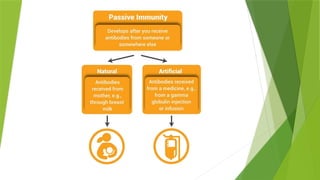
For example, antibodies from a mother can cross the placenta and enter
her foetus. In this way, they provide protection for the baby until its own
immune system becomes fully functional.
Natural Passive Immunity (Continued)
 Passive immunity may also be provided by colostrum, the first
secretion of the mammary glands.
 The baby absorbs the antibodies through its gut.
 These antibodies mainly include IgA (Immunoglobulin A).
Artificial Passive Immunity (Introduction)
 In artificial passive immunity, antibodies formed in one individual are
extracted and then injected into another individual.
 The recipient may or may not belong to the same species.
 This method provides immediate protection if a person has been, or is
likely to be, exposed to a particular disease.
Artificial Passive Immunity (Examples)
 Specific antibodies used for combating tetanus and diphtheria were
once cultured in horses and injected into humans.
 Now, only antibodies of human origin are used.
 Antibodies against rabies and some snake venoms are also available.
 Additionally, antibodies against the human Rhesus blood group antigen
are used for protection.
Thank You!

An introduction to Passive Immunity Presentation.pptx

  • 1.
    Title: Passive Immunity Name:Sadia Liaquat Arid No: 23-Arid-1912 Rechecked By: Mamoona Liaquat Arid No: 23-Arid-1903
  • 3.
    Passive Immunity  Inpassive immunity, antibodies from one individual are passed into another individual.  They give immediate protection, unlike active immunity which takes a few days or weeks to build up.  However, it only provides protection for a few weeks, as antibodies are broken down by the body’s natural processes.  Their number slowly falls, and protection is lost — therefore, immunity is temporary.
  • 4.
    Natural Passive Immunity(Introduction)  Passive immunity may be gained naturally. For example, antibodies from a mother can cross the placenta and enter her foetus. In this way, they provide protection for the baby until its own immune system becomes fully functional.
  • 5.
    Natural Passive Immunity(Continued)  Passive immunity may also be provided by colostrum, the first secretion of the mammary glands.  The baby absorbs the antibodies through its gut.  These antibodies mainly include IgA (Immunoglobulin A).
  • 6.
    Artificial Passive Immunity(Introduction)  In artificial passive immunity, antibodies formed in one individual are extracted and then injected into another individual.  The recipient may or may not belong to the same species.  This method provides immediate protection if a person has been, or is likely to be, exposed to a particular disease.
  • 7.
    Artificial Passive Immunity(Examples)  Specific antibodies used for combating tetanus and diphtheria were once cultured in horses and injected into humans.  Now, only antibodies of human origin are used.  Antibodies against rabies and some snake venoms are also available.  Additionally, antibodies against the human Rhesus blood group antigen are used for protection.
  • 8.