A Gentle Introduction to
Computer Vision (CV)
Muhammad Haroon
Lecturer, University of Gujrat Lahore Sub Campus, Lahore, Pakistan.
Muhammad Haroon (Lecturer, UOG Lahore Sub Campus)
OVERVIEW
Desire for Computers to See
What Is Computer Vision
Challenge of Computer Vision
Tasks in Computer Vision
Muhammad Haroon (Lecturer, UOG Lahore Sub Campus)
Desire for Computers to See
 The internet is comprised of text and images. It is
relatively straightforward to index and search text, but in
order to index and search images, algorithms need to
know what the images contain.
 To get the most out of image data, we need computers
to “see” an image and understand the content.
Muhammad Haroon (Lecturer, UOG Lahore Sub Campus)
 This is a trivial problem for a human, even young
children.
A person can describe the content of a photograph they
have seen once.
A person can summarize a video that they have only seen
once.
A person can recognize a face that they have only seen
once before.
 We require at least the same capabilities from
computers in order to unlock our images and videos.
Muhammad Haroon (Lecturer, UOG Lahore Sub Campus)
WHAT IS COMPUTER VISION (CV)?
Computer Vision, often abbreviated as CV, is
defined as a field of study that seeks to develop
techniques to help computers “see” and
understand the content of digital images such
as photographs and videos.
Muhammad Haroon (Lecturer, UOG Lahore Sub Campus)
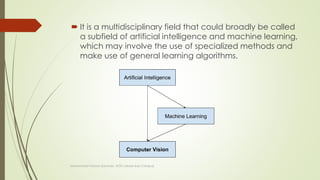
 It is a multidisciplinary field that could broadly be called
a subfield of artificial intelligence and machine learning,
which may involve the use of specialized methods and
make use of general learning algorithms.
Muhammad Haroon (Lecturer, UOG Lahore Sub Campus)
Challenge of Computer Vision
 Computer vision seems easy, perhaps because it is so
effortless for humans.
 Initially, it was believed to be a trivially simple problem
that could be solved by a student connecting a camera
to a computer. After decades of research, “computer
vision” remains unsolved, at least in terms of meeting the
capabilities of human vision.
Muhammad Haroon (Lecturer, UOG Lahore Sub Campus)
 Another reason why it is such a challenging problem is
because of the complexity inherent in the visual world.
 A given object may be seen from any orientation, in any
lighting conditions, with any type of occlusion from other
objects, and so on. A true vision system must be able to
“see” in any of an infinite number of scenes and still
extract something meaningful.
 Computers work well for tightly constrained problems,
not open unbounded problems like visual perception.
Muhammad Haroon (Lecturer, UOG Lahore Sub Campus)
Tasks in Computer Vision (Applications)
 Nevertheless, there has been progress in the field,
especially in recent years with commodity systems for
optical character recognition and face detection in
cameras and smartphones.
 Optical character recognition (OCR)
 Retail (e.g. automated checkouts)
 3D model building (photogrammetry)
 Medical imaging
 Surveillance
 Fingerprint recognition and biometrics
Muhammad Haroon (Lecturer, UOG Lahore Sub Campus)

An introduction to computer vision

  • 1.
    A Gentle Introductionto Computer Vision (CV) Muhammad Haroon Lecturer, University of Gujrat Lahore Sub Campus, Lahore, Pakistan. Muhammad Haroon (Lecturer, UOG Lahore Sub Campus)
  • 2.
    OVERVIEW Desire for Computersto See What Is Computer Vision Challenge of Computer Vision Tasks in Computer Vision Muhammad Haroon (Lecturer, UOG Lahore Sub Campus)
  • 3.
    Desire for Computersto See  The internet is comprised of text and images. It is relatively straightforward to index and search text, but in order to index and search images, algorithms need to know what the images contain.  To get the most out of image data, we need computers to “see” an image and understand the content. Muhammad Haroon (Lecturer, UOG Lahore Sub Campus)
  • 4.
     This isa trivial problem for a human, even young children. A person can describe the content of a photograph they have seen once. A person can summarize a video that they have only seen once. A person can recognize a face that they have only seen once before.  We require at least the same capabilities from computers in order to unlock our images and videos. Muhammad Haroon (Lecturer, UOG Lahore Sub Campus)
  • 5.
    WHAT IS COMPUTERVISION (CV)? Computer Vision, often abbreviated as CV, is defined as a field of study that seeks to develop techniques to help computers “see” and understand the content of digital images such as photographs and videos. Muhammad Haroon (Lecturer, UOG Lahore Sub Campus)
  • 6.
     It isa multidisciplinary field that could broadly be called a subfield of artificial intelligence and machine learning, which may involve the use of specialized methods and make use of general learning algorithms. Muhammad Haroon (Lecturer, UOG Lahore Sub Campus)
  • 7.
    Challenge of ComputerVision  Computer vision seems easy, perhaps because it is so effortless for humans.  Initially, it was believed to be a trivially simple problem that could be solved by a student connecting a camera to a computer. After decades of research, “computer vision” remains unsolved, at least in terms of meeting the capabilities of human vision. Muhammad Haroon (Lecturer, UOG Lahore Sub Campus)
  • 8.
     Another reasonwhy it is such a challenging problem is because of the complexity inherent in the visual world.  A given object may be seen from any orientation, in any lighting conditions, with any type of occlusion from other objects, and so on. A true vision system must be able to “see” in any of an infinite number of scenes and still extract something meaningful.  Computers work well for tightly constrained problems, not open unbounded problems like visual perception. Muhammad Haroon (Lecturer, UOG Lahore Sub Campus)
  • 9.
    Tasks in ComputerVision (Applications)  Nevertheless, there has been progress in the field, especially in recent years with commodity systems for optical character recognition and face detection in cameras and smartphones.  Optical character recognition (OCR)  Retail (e.g. automated checkouts)  3D model building (photogrammetry)  Medical imaging  Surveillance  Fingerprint recognition and biometrics Muhammad Haroon (Lecturer, UOG Lahore Sub Campus)