Copyright Crash Coursebuilding on others’ creative expression
The Public Domain and Orphan WorksDeveloping better tools to identify those works that actually are in the public domain.Free those works that are in the public domain but not identified as such.Orphan works by definition often lack sufficient information to identify their owners.
Using materials from the InternetCopyright protection is automatic: Neither a publication nor a notice of any kind is required to protect works today.By posting an author impliedly grants a limited license for the use of the work.Commercial use it’s not part of an implied license.Implied licenses are vague.
Fair use of copyrighted materialsFair use is better described as a shadowy territory whose boundaries are disputed.Any work published on or before Dec. 31, 1922 is now in the public domain.Works published between Jan. 1, 1923 to Dec. 31, 1978 are protected 95 yrs. after published date.After 1978 works are protected after 70 years from the date the author dies.
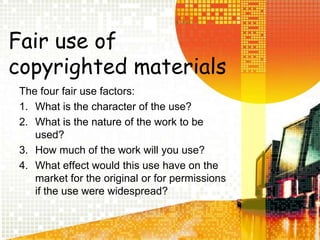
Fair use of copyrighted materialsThe four fair use factors:What is the character of the use?What is the nature of the work to be used?How much of the work will you use?What effect would this use have on the market for the original or for permissions if the use were widespread?
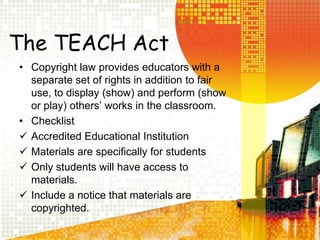
The TEACH ActCopyright law provides educators with a separate set of rights in addition to fair use, to display (show) and perform (show or play) others’ works in the classroom.Checklist Accredited Educational Institution
Materials are specifically for students
Only students will have access to materials.

Copyright crash course saul m

  • 1.
    Copyright Crash Coursebuildingon others’ creative expression
  • 2.
    The Public Domainand Orphan WorksDeveloping better tools to identify those works that actually are in the public domain.Free those works that are in the public domain but not identified as such.Orphan works by definition often lack sufficient information to identify their owners.
  • 3.
    Using materials fromthe InternetCopyright protection is automatic: Neither a publication nor a notice of any kind is required to protect works today.By posting an author impliedly grants a limited license for the use of the work.Commercial use it’s not part of an implied license.Implied licenses are vague.
  • 4.
    Fair use ofcopyrighted materialsFair use is better described as a shadowy territory whose boundaries are disputed.Any work published on or before Dec. 31, 1922 is now in the public domain.Works published between Jan. 1, 1923 to Dec. 31, 1978 are protected 95 yrs. after published date.After 1978 works are protected after 70 years from the date the author dies.
  • 5.
    Fair use ofcopyrighted materialsThe four fair use factors:What is the character of the use?What is the nature of the work to be used?How much of the work will you use?What effect would this use have on the market for the original or for permissions if the use were widespread?
  • 6.
    The TEACH ActCopyrightlaw provides educators with a separate set of rights in addition to fair use, to display (show) and perform (show or play) others’ works in the classroom.Checklist Accredited Educational Institution
  • 7.
  • 8.
    Only students willhave access to materials.