An Intervention Study: The Role of Book Club in ELL Reading Motivation Kevin Wong Education 110 April 25, 2008
Background Eddie is a Hispanic male in the third grade.  Eddie is an English Language Learner (ELL) who struggles with reading motivation. Quarterly assessments suggest Eddie has the work ethic and capacity to produce work that is at or above grade level, Eddie would also greatly benefit from a boost in his motivation to read.
Literature Review ELL Students: Assimilation “ It generally takes ELL two to three years to be on grade level for conversational English.” “ It takes approximately five to seven years for ELLs to reach grade level proficiency in using academic language.” Cummins (1981; 1996; 1999)
Literature Review ELL Students: Extrinsic Motivation While first language learning is largely motivated by a child’s intrinsic desire to socialize, second-language learning often needs more extrinsic motivation Mohr & Mohr (2003)
Literature Review Book Club Intervention Varying cultures met every two weeks over 9 months R eading interest surveys Different genres Increase in student-initiated reading for pleasure   Raphael & McMahon (1994)
Literature Review Book Club Intervention (con’t) Reading motivation increased after a Book Club intervention since “students remembered and could talk about at least 9 of the 16 books they had read the pervious year.”    Raphael & McMahon (1994)
Specific Aims This study aims to apply the effective intervention strategy of book club, which offers an external source for student reading motivation, to this specific population of ELL students who, according to research, seek an external source for reading motivation.
Rese ar ch Design Before and after the book club, students completed the ERAS Ben and Me  was the teacher-chosen book for the book club 3 members chosen for this book club The roles of each book club member rotated with each week A researcher observation log was completed after each session
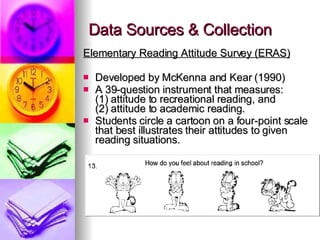
Data Sources & Collection Elementary Reading Attitude Survey (ERAS) Developed by McKenna and Kear (1990) A 39-question instrument that measures:  (1) attitude to recreational reading, and  (2) attitude to academic reading.  Students circle a cartoon on a four-point scale that best illustrates their attitudes to given reading situations.
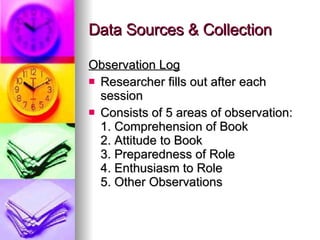
Data Sources & Collection Observation Log Researcher fills out after each session Consists of 5 areas of observation: 1. Comprehension of Book 2. Attitude to Book 3. Preparedness of Role 4. Enthusiasm to Role 5. Other Observations
Data Sources & Collection Book Club Roles Literacy Luminary “ You show what is interesting about your book. Your job is to pick several outstanding passages from the reading and plan for them to be shared in the group.” Impressive Illustrator “ You create artwork to show main ideas. Your job is to draw a picture that shows the most important part of the plot, or what is happening. Try to find one scene in the section you just read that really changes the direction of the story, and make some artwork that depicts, or shows, that scene.” Language Lover “ You make reading easier by helping everyone understand what the author is saying. Your job is to be on the lookout for new, interesting, powerful, puzzling, or unfamiliar words.” Discussion Director “ You choose several questions about the book you are reading for your group to discuss the next time you meet as a book club. Your questions should have lots of possible answers, not just “yes” or “no.””
Data Sources & Collection End-of-Quarter Reflection: Reading After each academic quarter, students are given assessments to reflect and evaluate their attitudes and achievements across subject areas of Reading, Writing and Math. Reflection consists of 5 questions that recount: the child’s favorite book, reading improvements, and goals for the next quarter.
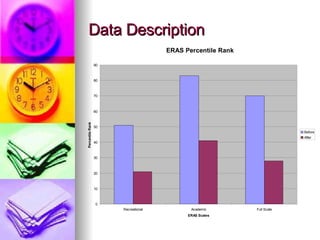
Data Description
Data Description
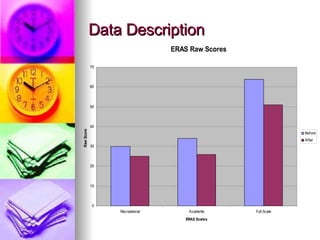
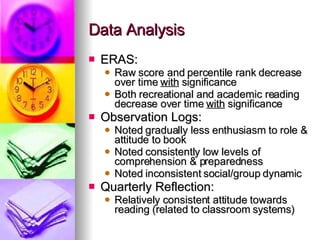
Data Analysis ERAS: Raw score and percentile rank decrease over time  with  significance Both recreational and academic reading decrease over time  with  significance Observation Logs: Noted gradually less enthusiasm to role & attitude to book Noted consistently low levels of comprehension & preparedness Noted inconsistent social/group dynamic Quarterly Reflection: Relatively consistent attitude towards reading (related to classroom systems)
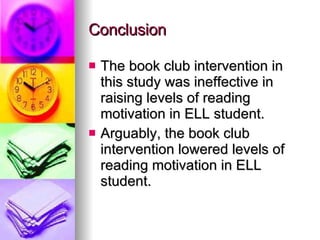
Conclusion The book club intervention in this study was ineffective in raising levels of reading motivation in ELL student. Arguably, the book club intervention lowered levels of reading motivation in ELL student.
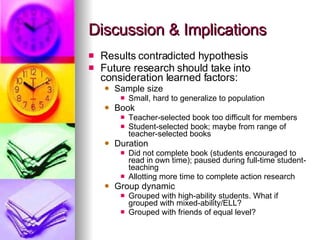
Discussion & Implications Results contradicted hypothesis Future research should take into consideration learned factors: Sample size Small, hard to generalize to population Book Teacher-selected book too difficult for members Student-selected book; maybe from range of teacher-selected books Duration Did not complete book (students encouraged to read in own time); paused during full-time student-teaching Allotting more time to complete action research Group dynamic Grouped with high-ability students. What if grouped with mixed-ability/ELL? Grouped with friends of equal level?

An Intervention Study

  • 1.
    An Intervention Study:The Role of Book Club in ELL Reading Motivation Kevin Wong Education 110 April 25, 2008
  • 2.
    Background Eddie isa Hispanic male in the third grade. Eddie is an English Language Learner (ELL) who struggles with reading motivation. Quarterly assessments suggest Eddie has the work ethic and capacity to produce work that is at or above grade level, Eddie would also greatly benefit from a boost in his motivation to read.
  • 3.
    Literature Review ELLStudents: Assimilation “ It generally takes ELL two to three years to be on grade level for conversational English.” “ It takes approximately five to seven years for ELLs to reach grade level proficiency in using academic language.” Cummins (1981; 1996; 1999)
  • 4.
    Literature Review ELLStudents: Extrinsic Motivation While first language learning is largely motivated by a child’s intrinsic desire to socialize, second-language learning often needs more extrinsic motivation Mohr & Mohr (2003)
  • 5.
    Literature Review BookClub Intervention Varying cultures met every two weeks over 9 months R eading interest surveys Different genres Increase in student-initiated reading for pleasure Raphael & McMahon (1994)
  • 6.
    Literature Review BookClub Intervention (con’t) Reading motivation increased after a Book Club intervention since “students remembered and could talk about at least 9 of the 16 books they had read the pervious year.” Raphael & McMahon (1994)
  • 7.
    Specific Aims Thisstudy aims to apply the effective intervention strategy of book club, which offers an external source for student reading motivation, to this specific population of ELL students who, according to research, seek an external source for reading motivation.
  • 8.
    Rese ar chDesign Before and after the book club, students completed the ERAS Ben and Me was the teacher-chosen book for the book club 3 members chosen for this book club The roles of each book club member rotated with each week A researcher observation log was completed after each session
  • 9.
    Data Sources &Collection Elementary Reading Attitude Survey (ERAS) Developed by McKenna and Kear (1990) A 39-question instrument that measures: (1) attitude to recreational reading, and (2) attitude to academic reading. Students circle a cartoon on a four-point scale that best illustrates their attitudes to given reading situations.
  • 10.
    Data Sources &Collection Observation Log Researcher fills out after each session Consists of 5 areas of observation: 1. Comprehension of Book 2. Attitude to Book 3. Preparedness of Role 4. Enthusiasm to Role 5. Other Observations
  • 11.
    Data Sources &Collection Book Club Roles Literacy Luminary “ You show what is interesting about your book. Your job is to pick several outstanding passages from the reading and plan for them to be shared in the group.” Impressive Illustrator “ You create artwork to show main ideas. Your job is to draw a picture that shows the most important part of the plot, or what is happening. Try to find one scene in the section you just read that really changes the direction of the story, and make some artwork that depicts, or shows, that scene.” Language Lover “ You make reading easier by helping everyone understand what the author is saying. Your job is to be on the lookout for new, interesting, powerful, puzzling, or unfamiliar words.” Discussion Director “ You choose several questions about the book you are reading for your group to discuss the next time you meet as a book club. Your questions should have lots of possible answers, not just “yes” or “no.””
  • 12.
    Data Sources &Collection End-of-Quarter Reflection: Reading After each academic quarter, students are given assessments to reflect and evaluate their attitudes and achievements across subject areas of Reading, Writing and Math. Reflection consists of 5 questions that recount: the child’s favorite book, reading improvements, and goals for the next quarter.
  • 13.
  • 14.
  • 15.
    Data Analysis ERAS:Raw score and percentile rank decrease over time with significance Both recreational and academic reading decrease over time with significance Observation Logs: Noted gradually less enthusiasm to role & attitude to book Noted consistently low levels of comprehension & preparedness Noted inconsistent social/group dynamic Quarterly Reflection: Relatively consistent attitude towards reading (related to classroom systems)
  • 16.
    Conclusion The bookclub intervention in this study was ineffective in raising levels of reading motivation in ELL student. Arguably, the book club intervention lowered levels of reading motivation in ELL student.
  • 17.
    Discussion & ImplicationsResults contradicted hypothesis Future research should take into consideration learned factors: Sample size Small, hard to generalize to population Book Teacher-selected book too difficult for members Student-selected book; maybe from range of teacher-selected books Duration Did not complete book (students encouraged to read in own time); paused during full-time student-teaching Allotting more time to complete action research Group dynamic Grouped with high-ability students. What if grouped with mixed-ability/ELL? Grouped with friends of equal level?