An Intelligent Architectural
Framework for Fog Computing
Supported IoT Applications
F. Mohamed shakir
Department of Information Technology
Thiagarajar College of Engineering
MOTIVATION
 In healthcare, the patient monitoring is one of the pivotal application
as it deals with human life.
 The patient physiological parameters like Heart rate, Pulse rate,
Temperature, Blood pressure are monitored to know the condition
of the patient.
 The criticality are occurred only if these parameters are not known
to the physician.
PROBLEM STATMENT
 To detect emergencies and inform medical personnel about the
status of the patient. Physician has to frequently visit the patient
and asses the parameter like Temperature ,Blood pressure , Pulse
and Heart rate to know the current status of the patient.
 To avoid this problem, data are gathered from patient and
transmitted to fog layer for quick processing rather than sending
huge data to the cloud.
FOG COMPUTING
 Fog computing is the computing paradigm, which extends cloud nearer to
the devices. The primary aim of fog is to solve the problems faced by the
cloud computing during the data processing.
 The characteristics of fog computing are
◦ Edge location
◦ Mobility support
◦ Real time interaction
◦ Large number of nodes
 The advantage of fog computing are
◦ Low latency
◦ Quick decision making
◦ Store confidential data on local servers
LITERATURE SURVEY
Title of the paper
Fog Assisted-IoT Enabled Patient Health
Monitoring in Smart Homes
Year of Publication 2018
Author Names Prabal Verma and Sandeep K. Sood
Source IEEE Internet of Things Volume:5
Extract of the paper
In this paper they used fog computing at the gateway.
Event triggering based data transmission methodology is
used to process real time patient’s data. For the patient
classification they used Bayesian Belief Network.
Findings
The issue in this paper is, Information that is to be
delivered to the responder from the cloud layer is
challenging. Issues in sensor can make difficulty in
capturing the data
CONT..
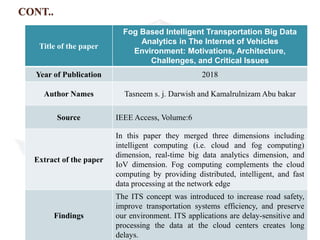
Title of the paper
Fog Based Intelligent Transportation Big Data
Analytics in The Internet of Vehicles
Environment: Motivations, Architecture,
Challenges, and Critical Issues
Year of Publication 2018
Author Names Tasneem s. j. Darwish and Kamalrulnizam Abu bakar
Source IEEE Access, Volume:6
Extract of the paper
In this paper they merged three dimensions including
intelligent computing (i.e. cloud and fog computing)
dimension, real-time big data analytics dimension, and
IoV dimension. Fog computing complements the cloud
computing by providing distributed, intelligent, and fast
data processing at the network edge
Findings
The ITS concept was introduced to increase road safety,
improve transportation systems efficiency, and preserve
our environment. ITS applications are delay-sensitive and
processing the data at the cloud centers creates long
delays.
CONT..
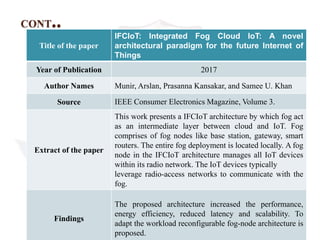
Title of the paper
IFCIoT: Integrated Fog Cloud IoT: A novel
architectural paradigm for the future Internet of
Things
Year of Publication 2017
Author Names Munir, Arslan, Prasanna Kansakar, and Samee U. Khan
Source IEEE Consumer Electronics Magazine, Volume 3.
Extract of the paper
This work presents a IFCIoT architecture by which fog act
as an intermediate layer between cloud and IoT. Fog
comprises of fog nodes like base station, gateway, smart
routers. The entire fog deployment is located locally. A fog
node in the IFCIoT architecture manages all IoT devices
within its radio network. The IoT devices typically
leverage radio-access networks to communicate with the
fog.
Findings
The proposed architecture increased the performance,
energy efficiency, reduced latency and scalability. To
adapt the workload reconfigurable fog-node architecture is
proposed.
CONT..
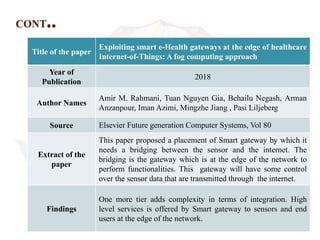
Title of the paper
Exploiting smart e-Health gateways at the edge of healthcare
Internet-of-Things: A fog computing approach
Year of
Publication
2018
Author Names
Amir M. Rahmani, Tuan Nguyen Gia, Behailu Negash, Arman
Anzanpour, Iman Azimi, Mingzhe Jiang , Pasi Liljeberg
Source Elsevier Future generation Computer Systems, Vol 80
Extract of the
paper
This paper proposed a placement of Smart gateway by which it
needs a bridging between the sensor and the internet. The
bridging is the gateway which is at the edge of the network to
perform functionalities. This gateway will have some control
over the sensor data that are transmitted through the internet.
Findings
One more tier adds complexity in terms of integration. High
level services is offered by Smart gateway to sensors and end
users at the edge of the network.
CONT..
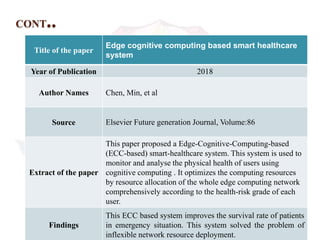
Title of the paper
Edge cognitive computing based smart healthcare
system
Year of Publication 2018
Author Names Chen, Min, et al
Source Elsevier Future generation Journal, Volume:86
Extract of the paper
This paper proposed a Edge-Cognitive-Computing-based
(ECC-based) smart-healthcare system. This system is used to
monitor and analyse the physical health of users using
cognitive computing . It optimizes the computing resources
by resource allocation of the whole edge computing network
comprehensively according to the health-risk grade of each
user.
Findings
This ECC based system improves the survival rate of patients
in emergency situation. This system solved the problem of
inflexible network resource deployment.
FINDINGS
 Damage in sensors leads to difficulty in capturing the data
 Any damage in fog node leads to interruption of communication
between the layers
 The data communication between Application layer and cloud takes
more response time
 The framework is very useful for senior citizens and disabled people
PROPOSED SYSTEM
 The objective is to capturing the data from Application layer
and send to the fog layer which consists of fog nodes.
 The fog nodes can be Wi-Fi routers, gateway devices, base
stations etc.
 The Machine learning algorithms and decision-making system
are deployed on those fog nodes based on its capability.
 Based on the results of processing, the alert or notification
kind of output is delivered through actuators to physician or
care taker and data for long term and periodical analysis is
sent to the cloud layer which is the top most layer
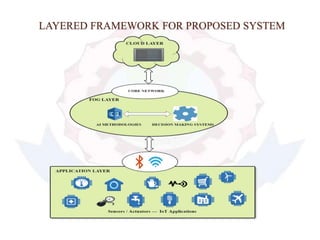
LAYERED FRAMEWORK FOR PROPOSED SYSTEM
APPLICATION LAYER
 The role of application layer is to capture all the
real time data for various applications.
 This can be done by placing various kinds of
sensors.
 Then the collected data are transmitted through
Bluetooth or Wi-Fi to the intermediate layer called
fog layer.
FOG LAYER
 The fog layer consists of various fog nodes.
 Each fog node takes responsibility to process the data.
 In our proposed framework, AI methodologies and
decision making systems are deployed on fog nodes.
 Based on the results, alert or notification kind of output
are delivered through the actuators to the cloud layer.
CLOUD LAYER
 This is the top most layer in our proposed framework.
 The cloud layer comprises of centralized data centers.
 The data of various applications are stored in the
servers.
 The authority person can fetch the data from the cloud
for further processing.
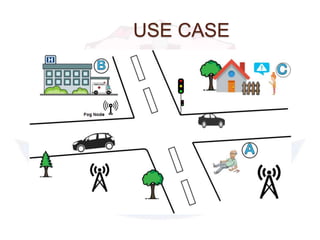
USE CASE
OBJECTIVES
 To have assessment of important physiological variables of
elderly patients, disabled patients or patient with chronic
disease during critical periods of their biological functions. It
is necessary to know their actual value or trend of change.
 In critical cases, Artificial Intelligence (AI) techniques can be
applied to manage the patient data.
CONCLUSION
We proposed an intelligent architectural framework for fog
computing that can adapt according to the application requirements. The
main motive is to overcome the drawback of cloud which takes more
response time. The health monitoring is the critical application when
compared to other application, so fog layer is added as the intermediate
layer for the quick processing.
FUTURE WORK
The proposed work can be extended by incorporating
machine learning algorithm in the fog layer for decision making
during emergency situation and further notification to the care
takers as well as the physicians.
REFERENCES
[1].Munir, Arslan, Prasanna Kansakar, and Samee U. Khan. "IFCIoT: Integrated Fog Cloud IoT: A
novel architectural paradigm for the future Internet of Things." IEEE Consumer Electronics
Magazine 6, no. 3 (2017): 74-82.
[2].OpenFog Consortium. (2017, Apr.). OpenFog. [Online]. Available:
http://www.openfogconsortium.org/
[3].S. Yi, Z. Hao, Z. Qin, and Q. Li, “Fog computing: Platform and applications,” in Proc. IEEE
Workshop on Hot Topics in Web Systems and Technologies (HotWeb), Nov. 2015, pp. 73–78
[4].M. Aazam and E.-N. Huh, “Fog computing: The cloud-IoT/IoE middleware paradigm,” IEEE
Potentials, vol. 35, no. 3, pp. 40–44, May 2016.
[5].Chen, Min, et al. "Edge cognitive computing based smart healthcare system." Future Generation
Computer Systems (2018).
REFERENCES
[6] .Lu, Jingyang, Lun Li, Genshe Chen, Dan Shen, Khanh Pham, and Erik Blasch. "Machine
learning based Intelligent cognitive network using fog computing." In Sensors and Systems for Space
Applications X, vol. 10196, p. 101960G. International Society for Optics and Photonics, 2017
[7].Shi, Weisong, Jie Cao, Quan Zhang, Youhuizi Li, and Lanyu Xu. "Edge computing: Vision and
challenges." IEEE Internet of Things Journal 3, no. 5 (2016): 637-646.
[8].Wen, Zhenyu, Renyu Yang, Peter Garraghan, Tao Lin, Jie Xu, and Michael Rovatsos. "Fog
orchestration for internet of things services." IEEE Internet Computing 21, no. 2 (2017): 16-24.
[9].Darwish, Tasneem SJ, and Kamalrulnizam Abu Bakar. "Fog Based Intelligent Transportation Big
Data Analytics in The Internet of Vehicles Environment: Motivations, Architecture, Challenges, and
Critical Issues." IEEE Access 6 (2018): 15679-15701.
[10].Verma, Prabal, and Sandeep K. Sood. "Fog Assisted-IoT Enabled Patient Health Monitoring in
Smart Homes." IEEE Internet of Things Journal (2018).
[11].G. Eysenbach. What is e-health? J. Med. Internet Res. Vol.3 no. 2,
2001.doi:10.2196/jmir.3.2.e20
Thank You

An Intelligent Architectural Framework for Fog Computing Supported IoT Applications.

  • 1.
    An Intelligent Architectural Frameworkfor Fog Computing Supported IoT Applications F. Mohamed shakir Department of Information Technology Thiagarajar College of Engineering
  • 2.
    MOTIVATION  In healthcare,the patient monitoring is one of the pivotal application as it deals with human life.  The patient physiological parameters like Heart rate, Pulse rate, Temperature, Blood pressure are monitored to know the condition of the patient.  The criticality are occurred only if these parameters are not known to the physician.
  • 3.
    PROBLEM STATMENT  Todetect emergencies and inform medical personnel about the status of the patient. Physician has to frequently visit the patient and asses the parameter like Temperature ,Blood pressure , Pulse and Heart rate to know the current status of the patient.  To avoid this problem, data are gathered from patient and transmitted to fog layer for quick processing rather than sending huge data to the cloud.
  • 4.
    FOG COMPUTING  Fogcomputing is the computing paradigm, which extends cloud nearer to the devices. The primary aim of fog is to solve the problems faced by the cloud computing during the data processing.  The characteristics of fog computing are ◦ Edge location ◦ Mobility support ◦ Real time interaction ◦ Large number of nodes  The advantage of fog computing are ◦ Low latency ◦ Quick decision making ◦ Store confidential data on local servers
  • 5.
    LITERATURE SURVEY Title ofthe paper Fog Assisted-IoT Enabled Patient Health Monitoring in Smart Homes Year of Publication 2018 Author Names Prabal Verma and Sandeep K. Sood Source IEEE Internet of Things Volume:5 Extract of the paper In this paper they used fog computing at the gateway. Event triggering based data transmission methodology is used to process real time patient’s data. For the patient classification they used Bayesian Belief Network. Findings The issue in this paper is, Information that is to be delivered to the responder from the cloud layer is challenging. Issues in sensor can make difficulty in capturing the data
  • 6.
    CONT.. Title of thepaper Fog Based Intelligent Transportation Big Data Analytics in The Internet of Vehicles Environment: Motivations, Architecture, Challenges, and Critical Issues Year of Publication 2018 Author Names Tasneem s. j. Darwish and Kamalrulnizam Abu bakar Source IEEE Access, Volume:6 Extract of the paper In this paper they merged three dimensions including intelligent computing (i.e. cloud and fog computing) dimension, real-time big data analytics dimension, and IoV dimension. Fog computing complements the cloud computing by providing distributed, intelligent, and fast data processing at the network edge Findings The ITS concept was introduced to increase road safety, improve transportation systems efficiency, and preserve our environment. ITS applications are delay-sensitive and processing the data at the cloud centers creates long delays.
  • 7.
    CONT.. Title of thepaper IFCIoT: Integrated Fog Cloud IoT: A novel architectural paradigm for the future Internet of Things Year of Publication 2017 Author Names Munir, Arslan, Prasanna Kansakar, and Samee U. Khan Source IEEE Consumer Electronics Magazine, Volume 3. Extract of the paper This work presents a IFCIoT architecture by which fog act as an intermediate layer between cloud and IoT. Fog comprises of fog nodes like base station, gateway, smart routers. The entire fog deployment is located locally. A fog node in the IFCIoT architecture manages all IoT devices within its radio network. The IoT devices typically leverage radio-access networks to communicate with the fog. Findings The proposed architecture increased the performance, energy efficiency, reduced latency and scalability. To adapt the workload reconfigurable fog-node architecture is proposed.
  • 8.
    CONT.. Title of thepaper Exploiting smart e-Health gateways at the edge of healthcare Internet-of-Things: A fog computing approach Year of Publication 2018 Author Names Amir M. Rahmani, Tuan Nguyen Gia, Behailu Negash, Arman Anzanpour, Iman Azimi, Mingzhe Jiang , Pasi Liljeberg Source Elsevier Future generation Computer Systems, Vol 80 Extract of the paper This paper proposed a placement of Smart gateway by which it needs a bridging between the sensor and the internet. The bridging is the gateway which is at the edge of the network to perform functionalities. This gateway will have some control over the sensor data that are transmitted through the internet. Findings One more tier adds complexity in terms of integration. High level services is offered by Smart gateway to sensors and end users at the edge of the network.
  • 9.
    CONT.. Title of thepaper Edge cognitive computing based smart healthcare system Year of Publication 2018 Author Names Chen, Min, et al Source Elsevier Future generation Journal, Volume:86 Extract of the paper This paper proposed a Edge-Cognitive-Computing-based (ECC-based) smart-healthcare system. This system is used to monitor and analyse the physical health of users using cognitive computing . It optimizes the computing resources by resource allocation of the whole edge computing network comprehensively according to the health-risk grade of each user. Findings This ECC based system improves the survival rate of patients in emergency situation. This system solved the problem of inflexible network resource deployment.
  • 10.
    FINDINGS  Damage insensors leads to difficulty in capturing the data  Any damage in fog node leads to interruption of communication between the layers  The data communication between Application layer and cloud takes more response time  The framework is very useful for senior citizens and disabled people
  • 11.
    PROPOSED SYSTEM  Theobjective is to capturing the data from Application layer and send to the fog layer which consists of fog nodes.  The fog nodes can be Wi-Fi routers, gateway devices, base stations etc.  The Machine learning algorithms and decision-making system are deployed on those fog nodes based on its capability.  Based on the results of processing, the alert or notification kind of output is delivered through actuators to physician or care taker and data for long term and periodical analysis is sent to the cloud layer which is the top most layer
  • 12.
    LAYERED FRAMEWORK FORPROPOSED SYSTEM
  • 13.
    APPLICATION LAYER  Therole of application layer is to capture all the real time data for various applications.  This can be done by placing various kinds of sensors.  Then the collected data are transmitted through Bluetooth or Wi-Fi to the intermediate layer called fog layer.
  • 14.
    FOG LAYER  Thefog layer consists of various fog nodes.  Each fog node takes responsibility to process the data.  In our proposed framework, AI methodologies and decision making systems are deployed on fog nodes.  Based on the results, alert or notification kind of output are delivered through the actuators to the cloud layer.
  • 15.
    CLOUD LAYER  Thisis the top most layer in our proposed framework.  The cloud layer comprises of centralized data centers.  The data of various applications are stored in the servers.  The authority person can fetch the data from the cloud for further processing.
  • 16.
  • 17.
    OBJECTIVES  To haveassessment of important physiological variables of elderly patients, disabled patients or patient with chronic disease during critical periods of their biological functions. It is necessary to know their actual value or trend of change.  In critical cases, Artificial Intelligence (AI) techniques can be applied to manage the patient data.
  • 18.
    CONCLUSION We proposed anintelligent architectural framework for fog computing that can adapt according to the application requirements. The main motive is to overcome the drawback of cloud which takes more response time. The health monitoring is the critical application when compared to other application, so fog layer is added as the intermediate layer for the quick processing.
  • 19.
    FUTURE WORK The proposedwork can be extended by incorporating machine learning algorithm in the fog layer for decision making during emergency situation and further notification to the care takers as well as the physicians.
  • 20.
    REFERENCES [1].Munir, Arslan, PrasannaKansakar, and Samee U. Khan. "IFCIoT: Integrated Fog Cloud IoT: A novel architectural paradigm for the future Internet of Things." IEEE Consumer Electronics Magazine 6, no. 3 (2017): 74-82. [2].OpenFog Consortium. (2017, Apr.). OpenFog. [Online]. Available: http://www.openfogconsortium.org/ [3].S. Yi, Z. Hao, Z. Qin, and Q. Li, “Fog computing: Platform and applications,” in Proc. IEEE Workshop on Hot Topics in Web Systems and Technologies (HotWeb), Nov. 2015, pp. 73–78 [4].M. Aazam and E.-N. Huh, “Fog computing: The cloud-IoT/IoE middleware paradigm,” IEEE Potentials, vol. 35, no. 3, pp. 40–44, May 2016. [5].Chen, Min, et al. "Edge cognitive computing based smart healthcare system." Future Generation Computer Systems (2018).
  • 21.
    REFERENCES [6] .Lu, Jingyang,Lun Li, Genshe Chen, Dan Shen, Khanh Pham, and Erik Blasch. "Machine learning based Intelligent cognitive network using fog computing." In Sensors and Systems for Space Applications X, vol. 10196, p. 101960G. International Society for Optics and Photonics, 2017 [7].Shi, Weisong, Jie Cao, Quan Zhang, Youhuizi Li, and Lanyu Xu. "Edge computing: Vision and challenges." IEEE Internet of Things Journal 3, no. 5 (2016): 637-646. [8].Wen, Zhenyu, Renyu Yang, Peter Garraghan, Tao Lin, Jie Xu, and Michael Rovatsos. "Fog orchestration for internet of things services." IEEE Internet Computing 21, no. 2 (2017): 16-24. [9].Darwish, Tasneem SJ, and Kamalrulnizam Abu Bakar. "Fog Based Intelligent Transportation Big Data Analytics in The Internet of Vehicles Environment: Motivations, Architecture, Challenges, and Critical Issues." IEEE Access 6 (2018): 15679-15701. [10].Verma, Prabal, and Sandeep K. Sood. "Fog Assisted-IoT Enabled Patient Health Monitoring in Smart Homes." IEEE Internet of Things Journal (2018). [11].G. Eysenbach. What is e-health? J. Med. Internet Res. Vol.3 no. 2, 2001.doi:10.2196/jmir.3.2.e20
  • 22.