International Journal of Computer Applications (0975 – 8887)
                                                                                                 Volume 34– No.5, November 2011


     An Efficient Approach to Forecast Indian Stock Market
              Price and their Performance Analysis
                      K.K.Sureshkumar                                                       Dr.N.M.Elango
          Assistant Professor, Department of MCA                             Professor and Head, Department of MCA
               Kongu Arts and Science College                                          RMK Engineering College
                       Bharathiar University                                       Anna University of Technology
                         Tamil Nadu, India                                                    Chennai, India


ABSTRACT                                                                fundamental analysis and technical analysis. Section 5 explains
Forecasting accuracy is the most important factor in selecting          the methodology of using Weka tool to predict the stock prices
any forecasting methods. Research efforts in improving the              and calculating performance measures. Section 6 draws the
accuracy of forecasting models are increasing since the last            conclusion of the paper.
decade. The appropriate stock selections those are suitable for         2. LITERATURE REVIEW
investment is a difficult task. The key factor for each investor is     Prediction of stock price variation is a difficult task and the price
to earn maximum profits on their investments. Numerous                  movement behaves more like a random walk and varies with
techniques used to predict stocks in which fundamental and              time. Since the last decade, stockbrokers and future traders have
technical analysis are one among them. In this paper, prediction        relied upon various types of intelligent systems to make trading
algorithms and functions are used to predict future share prices        decisions. Recently, artificial neural networks (ANNs) have
and their performance will be compared. The results from                been applied to predict and model stock prices [3, 12, 13]. These
analysis shows that isotonic regression function offers the ability     models, however, have their limitations owing to the tremendous
to predict the stock prices more accurately than the other              noise and complex dimensionality of stock price data and
existing techniques. The results will be used to analyze the stock      besides, the quantity of data itself and the input variables may
prices and their prediction in depth in future research efforts.        also interfere with each other [7].
                                                                        Generally, there are two analytical models to predict the stock
General Terms                                                           market. They are fundamental analysis and technical analysis.
Soft Computing and Artificial Neural Network                            Fundamental analysis includes economic analysis, industry
                                                                        analysis and company analysis. Technical analysis is a method
Keywords                                                                for predicting future price based on the past market data [8].
Artificial Neural Network, National Stock Exchange, Stock               Prediction is made by exploiting implications hidden in past
Prediction, Performance Measures.                                       trading activities and by analyzing patterns and trends shown in
                                                                        price and volume charts (Smirlock and Starks, 1985; Brush
1. INTRODUCTION                                                         1986). Using neural networks to predict financial markets has
Generally, stock market across the globe replicates the
                                                                        been an active research area in both analysis, since the late
fluctuation of the market’s economy, and attracts the attention of
                                                                        1980's (White, 1988; Fishman, Barr and Loick, 1991; Shih,
millions of investors. The stock market is characterized by high
                                                                        1991; Stein, 1991; Utans and Moody, 1991; Katz, 1992; Kean,
risk and high yield; hence investors are concerned about the
                                                                        1992; Swales and Yoon, 1992; [21] Wong, 1992; Azoff,1994;
analysis of the stock market and are trying to forecast the trend
                                                                        Rogers and Vemuri, 1994; Ruggerio, 1994; Baestaens, Van Den
of the stock market. To accurately predict stock market, various
                                                                        Breg and Vaudrey, 1995; Ward and Sherald, 1995; Gately,
prediction algorithms and models have been proposed in the
                                                                        1996; Refenes [18], Abu-Mostafa and Moody, 1996; Murphy,
literature. Forecasting is a process that produces a set of output
                                                                        1999; Qi, 1999; Virili and Reisleben, 2000; Yao and Tan, 2001;
with a set of variables [4]. The variables are normally past data
                                                                        Pan, 2003a; Pan 2003b) [17]. Most of these published works are
of the market prices. Basically, forecasting assumes that future
                                                                        targeted at US stock markets and other international financial
values are based, at least in part on these past data. Past
                                                                        markets. Very little is known or done on predicting the Chinese
relationships can be derived through the study and observation.
                                                                        or Asian stock markets.
Neural networks have been used to perform such task .The ideas
of forecasting using neural network is to find an approximation         3. OBJECTIVES OF THE STUDY
of mapping between the input and output data through training.          The main objective of this paper is to use Weka 3.6.3 tool to
Later to predict the future stock value trained neural network can      obtain more accurate stock prediction price and to compare them
be used [1].                                                            with weka classifier functions such as Gaussian processes,
The rest of the paper is organized as follows. Section 2 reviews        isotonic regression, least mean square, linear regression,
the literature in predicting the stock market price through             multilayer perceptron, pace regression, simple linear regression
Artificial Neural network. Section 3 focuses on the objectives of       and SMO regression. This study can be used to reduce the error
the research. Section 4 discusses about the National Stock              proportion in predicting the future stock prices. It increases the
Exchange (NSE), stock market, stock classification,


                                                                                                                                    44
International Journal of Computer Applications (0975 – 8887)
                                                                                                   Volume 34– No.5, November 2011

chances for the investors to predict the prices more accurately by    Midcap50, CNX Realty (10) and CNX Infra (25). The sectoral
reduced error percentage and hence benefited in share markets.        distribution of NSE are Financial services or banks, Energy,
                                                                      Information Technology, Metals, Automobile, FMCG,
4. NATIONAL STOCK EXCHANGE OF                                         Construction, Media & Entertainment, Pharma, Industrial
INDIA (NSE)                                                           Manufacturing, Cement, Fertilizers & Pesticides, Textiles,
NSE was incorporated in November 1992, and received                   Power and Telecom [11].Two ways of analyzing stock prices
recognition as a stock exchange under the Securities Contracts        namely fundamental analysis and technical analysis are
(Regulation) Act, 1956 in April 1993. Since its inception in          described in the next section.
1992, NSE of India has been at the vanguard of change in the
Indian securities market. This period has seen remarkable             4.3 Fundamental Analysis
changes in markets, from how capital is raised and traded, to         Fundamental analysis involves analysis of a company’s
how transactions are cleared and settled. The market has grown        performance and profitability to determine its share price. By
in scope and scale in a way that could not have been imagined at      studying the overall economic conditions, the company’s
that time. Average daily trading volumes have jumped from             competition, and other factors, it is possible to determine
Rs. 17 crore in 1994-95 when NSE started its Cash Market              expected returns and the intrinsic value of shares [14]. This type
segment to Rs.16,959 crore in 2009-10. Similarly, market              of analysis assumes that a share’s current (and future) price
capitalization of listed companies went up from Rs.363,350            depends on its intrinsic value and anticipated return on
crore at the end of March 1995 to Rs.36,834,930 crore at end          investment. As new information is released pertaining to the
March 2011. Indian equity markets are today among the most            company’s status, the expected return on the company’s shares
deep and vibrant markets in the world. NSE offers a wide range        will change, which affects the stock price. So the advantages of
of products for multiple markets, including equity shares,            fundamental analysis are its ability to predict changes before
Exchange Traded Funds (ETF), Mutual Funds, Debt                       they show up on the charts. Growth prospects are related to the
instruments, Index futures and options, Stock futures and             current economic environment.
options, Currency futures and Interest rate futures. Our
Exchange has more than 1,400 companies listed in the Capital
                                                                      4.4 Technical Analysis
Market and more than 92% of these companies are actively              Technical analysis is a method of evaluating securities by
traded. The debt market has 4,140 securities available for            analyzing the statistics generated by market activity, such as past
trading. Index futures and options trade on four different indices    prices and volume. To predict the future movement and identify
and on 223 stocks in stock futures and options as on 31st March,      patterns of a stock, technical analysts use tools and charts
2010. Currency futures contracts are traded in four currency          ignoring the fundamental value [20]. Few analysts rely on chart
pairs. Interest Rate Futures (IRF) contracts based on 10 year 7%      patterns and while others use technical indicators like moving
Notional GOI Bond is also available for trading. The role of          average (MA), relative strength index (RSI), on balance volume
trading members at NSE is to the extent of providing only             (OBV) and moving average convergence-divergence (MACD)
trading services to the investors; the Exchange involves trading      as their benchmark. In any case, technical analyst’s exclusive
members in the process of consultation and participation in vital     use of historical price and volume data is what separates them
inputs towards decision making [11].                                  from their fundamental counterparts. Unlike fundamental
                                                                      analysts, technical analysts don't care whether a stock is
4.1 Stock Market                                                      undervalued - the only thing that matters is a security's past
A stock market index is a method of measuring a stock market          trading data and what information this data can provide about
as a whole. The most important type of market index is the            where the security might move in the future. Technical analysis
broad-market index, consisting of the large, liquid stocks of the     really just studies supply and demand in a market in an attempt
country. In most countries, a single major index dominates            to determine what direction, or trend, will continue in the future.
benchmarking, index funds, index derivatives and research             Technical analysis studies the historical data relevant to price
applications. In addition, more specialized indices often find        and volume movements of the stock by using charts as a primary
interesting applications. In India, we have seen situations where     tool to forecast possible price movements. According to early
a dedicated industry fund uses an industry index as a                 research, future and past stock prices were deemed as irrelevant.
benchmark. In India, where clear categories of ownership groups       As a result, it was believed that using past data to predict the
exist, it becomes interesting to examine the performance of           future stock price was impossible, and that it would only have
classes of companies sorted by ownership group.                       abnormal profits. However, recent findings have proven that
                                                                      there was, indeed, a relationship between the past and future
4.2 Stock Classification                                              return rates. Furthermore, arguments have been made that by
Stocks are often classified based on the type of company it is,       using past return rates, future return rates could also be
the company’s value, or in some cases the level of return that is     forecasted. There are various kinds of technical indicators used
expected from the company. Below is a list of classifications         in futures market as well [5]. There are 26 technical indicators
which are generally known to us Growth Stocks, Value Stocks,          which can be primarily used to analyze the stock prices. Based
Large Cap Stocks, Mid Cap Stocks, and Small Cap Stocks.               upon the analysis, stock trend either up or down can be predicted
Stocks are usually classified according to their characteristics.     by the investor. For more detailed references, see [2, 9, 15, 16].
Some are classified according to their growth potential in the
long run and the others as per their current valuations. Similarly,   5. RESEARCH METHODOLOGY
stocks can also be classified according to their market               Artificial Neural networks are potentially useful for studying the
capitalization. S&P CNX NIFTY has NIFTY (50), Junior                  complex relationships between the input and output variables in
NIFTY (50), CNX IT (20), Bank NIFTY (12), NIFTY                       the system. The stock exchange operations can greatly benefit


                                                                                                                                      45
International Journal of Computer Applications (0975 – 8887)
                                                                                                    Volume 34– No.5, November 2011

from efficient forecast techniques. In this paper, to predict the      the table 2 and table 3 lies within the minimum and maximum
stock price of Infosys technologies a number of different
prediction approaches have been applied such as Gaussian                             Statistical Value of Infosys Technologies
processes, isotonic regression, least mean square, linear             Attrib                                            Std                     Unique
regression, multilayer perceptron, pace regression, simple linear                 Min.        Max.        Mean                     Distinct
                                                                       utes                                             Dev                       %
regression and SMO regression.
                                                                      Prev        1102.3     3481.45      2200.52      652.03      993.00         0.99
5.1 Prediction                                                        Close
The actual problem discussed in this paper is to forecast the                     1103.0     3480.00      2200.04      650.77      854.00         0.74
                                                                      Open
stock price of National Stock Exchange in India. For this
purpose we have used available daily stock data of Infosys
                                                                      High        1119.6     3499.00      2232.04      650.27      894.00         0.80
Technologies (i.e., bhavcopy) from the National Stock Exchange
beginning from 01-October-2007 to 12-October-2011 [10].
                                                                      Low         1040.0     3457.00      2168.27      653.36      940.00         0.89
5.2 Data and Methodology
We choose consecutive 1000 day’s of NSE stock data of Infosys          value of Infosys technologies stock.
Technologies Company. The stock data of a company cannot be                     Table 1. Statistical values of Infosys Technologies
predicted only from the stock price itself. The data employed in
this study consists of previous close, open price, high price and
low price of Infosys Technologies. The data set encompassed
                                                                         Table 2. Data Classification of Previous Close, Open Price
the trading days from 01-October-2007 to 12-October-2011. The
data is collected from the historical data available on the website
of National Stock Exchange.                                             Prev Close (1102.3 - 3481.45)          Open Price (1103 -3480)

     The task is to predict the stock price of Infosys                                                                        Lies Between the
Technologies will be up or down from today to tomorrow by                Data      Lies Between the Price      Data
                                                                                                                                    Price
using the past values of the company stock. In this research,
Waikato Environment for Knowledge Analysis version 3.6.3                 113          1102.30 -1340.21           111            1103 -1340.70
(Weka 3.6.3) tool is applied to preprocess the stock previous            113          1340.21-1578.13            117          1340.70 -1578.40
close price, open price, high price and low price data. As far as        155          1578.13 - 1816.04          154          1578.40 -1816.10
the computing equipment it is an Intel Core 2 Duo processor
                                                                          78          1816.04 -2053.96           75           1816.10 -2053.80
with 2 GB RAM and 500 GB HDD.
                                                                          61          2053.96 -2291.87           66           2053.80 -2291.50
     To derive effective input factors, Weka 3.6.3 tool is used
                                                                          85          2291.87 -2529.79           84           2291.50 -2529.20
throughout the process, this study choose 4 important attributes
including previous close, open price, high price and low price.          127          2529.79 -2767.70           129          2529.20 -2766.90
The performance of the neural network largely depends on the             140          2767.70 -3005.62           136          2766.90 - 3004.60
model of the neural network. Issues critical to the neural                97          3005.62 -3243.53           100          3004.60 - 3242.30
network modeling like selection of input variables, data
                                                                          31          3243.53 -3481.45           28             3242.30 - 3480
preprocessing technique, network architecture design and
performance measuring statistics should be considered carefully.
                                                                              Table 3. Data Classification of High Price, Low Price
5.3 Data Preprocessing
In data preprocessing, we have consider 1000 days of Infosys
technologies daily data. From this, minimum price, maximum              High Price (1119.6 - 3499)            Low Price (1040 - 3153.2)
price, mean, standard deviation, distinct and unique percentage
has been found. The details are given in the table 1.                                Lies Between the                      Lies Between the
                                                                         Data                                 Data
                                                                                           Price                                 Price
From the table 1, we found the Minimum, Maximum, Mean and
                                                                          103         1119.60 -1357.54         86             1040 - 1259.72
Standard deviation for the four attributes. In view of the data, we
find out in-between values for the stock prices. In each table we         103        1357.54 - 1595.48         95          1259.72 - 1479.45
have ten classifications in the table and in the graphs each in           166        1595.48 - 1833.42         142         1479.45 - 1699.18
four categories namely previous close, open price, high price             84         1833.42 - 2071.36         112         1699.18 - 1918.90
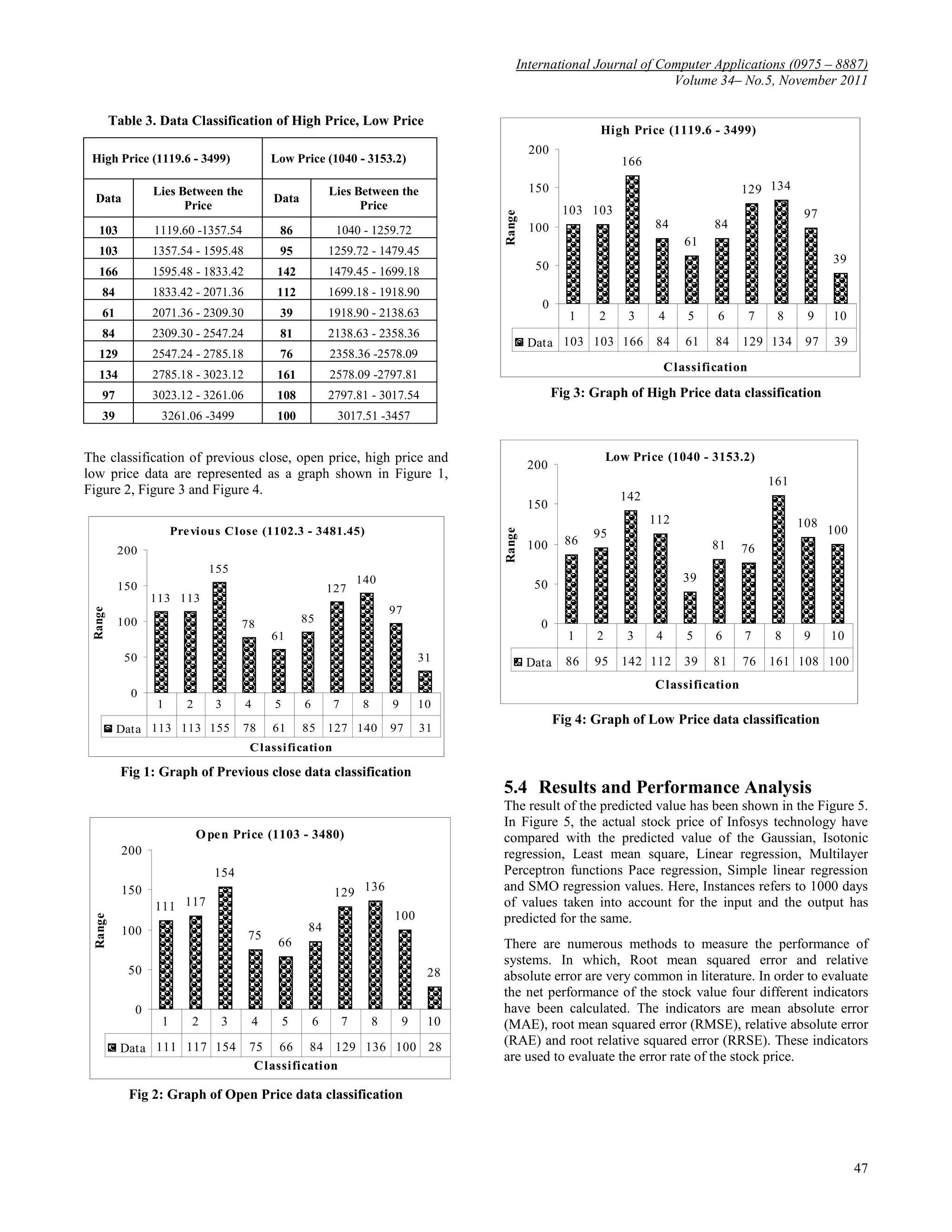
and low price. If we add up the data it will have 1001 instances.
                                                                          61         2071.36 - 2309.30         39          1918.90 - 2138.63
For example, consider the Table 2 prev close column containing            84         2309.30 - 2547.24         81          2138.63 - 2358.36
the attribute data as 113 which means 113 days of data indicates
stock price range lies between 1102.3 and 1340.21. Similarly for          129        2547.24 - 2785.18         76          2358.36 -2578.09
data 113, 155, 78, 61, 85, 127, 140, 97 and 31. The last data 31          134        2785.18 - 3023.12         161         2578.09 -2797.81
which denotes 31 days of Infosys Technology stock price range             97         3023.12 - 3261.06         108         2797.81 - 3017.54
lies between 3243.53 and 3481.45. Totally 1000 previous close
                                                                          39             3261.06 -3499         100              3017.51 -3457
data, open price, high price and low price data are represented in


                                                                                                                                                   46
International Journal of Computer Applications (0975 – 8887)
                                                                                                                             Volume 34– No.5, November 2011

         Table 3. Data Classification of High Price, Low Price
                                                                                                                     High Price (1119.6 - 3499)
                                                                                                      200
 High Price (1119.6 - 3499)                   Low Price (1040 - 3153.2)                                                   166

                 Lies Between the                             Lies Between the                        150                                         129 134
  Data                                        Data
                       Price                                        Price                                     103 103                                            97


                                                                                              Range
   103           1119.60 -1357.54              86              1040 - 1259.72                         100                       84           84
                                                                                                                                        61
   103           1357.54 - 1595.48             95             1259.72 - 1479.45
                                                                                                                                                                      39
   166           1595.48 - 1833.42             142            1479.45 - 1699.18                        50

    84           1833.42 - 2071.36             112            1699.18 - 1918.90
                                                                                                        0
    61           2071.36 - 2309.30             39             1918.90 - 2138.63                                1    2      3     4       5    6       7    8     9    10
    84           2309.30 - 2547.24             81             2138.63 - 2358.36
                                                                                                      Data 103 103 166           84     61   84   129 134        97    39
   129           2547.24 - 2785.18             76             2358.36 -2578.09
                                                                                                                                     Classification
   134           2785.18 - 3023.12             161            2578.09 -2797.81
    97           3023.12 - 3261.06             108            2797.81 - 3017.54                             Fig 3: Graph of High Price data classification
    39            3261.06 -3499                100             3017.51 -3457


The classification of previous close, open price, high price and                                                        Low Price (1040 - 3153.2)
                                                                                                      200
low price data are represented as a graph shown in Figure 1,
                                                                                                                                                          161
Figure 2, Figure 3 and Figure 4.                                                                                          142
                                                                                                      150
                                                                                                                                112                             108
                      Pre vious C lose (1102.3 - 3481.45)                                                           95                                                100
                                                                                              Range

                                                                                                      100      86                            81
          200                                                                                                                                     76
                               155
                                                                       140                                                              39
          150                                                 127                                      50
                 113 113
                                                                                97
Range


          100                         78              85                                                0
                                              61                                                               1    2      3     4      5    6    7        8     9    10
           50                                                                           31            Data     86   95    142 112       39   81   76      161 108 100
                                                                                                                                Classification
            0
                 1       2      3     4       5       6        7        8       9       10
                                                                                                             Fig 4: Graph of Low Price data classification
          Data 113 113 155            78      61      85      127 140           97      31
                                       C lassification

           Fig 1: Graph of Previous close data classification
                                                                                              5.4 Results and Performance Analysis
                                                                                              The result of the predicted value has been shown in the Figure 5.
                                                                                              In Figure 5, the actual stock price of Infosys technology have
                             O pe n Price (1103 - 3480)                                       compared with the predicted value of the Gaussian, Isotonic
           200                                                                                regression, Least mean square, Linear regression, Multilayer
                                154                                                           Perceptron functions Pace regression, Simple linear regression
           150                                                 129 136                        and SMO regression values. Here, Instances refers to 1000 days
                 111 117                                                                      of values taken into account for the input and the output has
                                                                                100           predicted for the same.
 Range


           100                                         84
                                      75
                                               66                                             There are numerous methods to measure the performance of
                                                                                              systems. In which, Root mean squared error and relative
            50                                                                           28   absolute error are very common in literature. In order to evaluate
                                                                                              the net performance of the stock value four different indicators
             0                                                                                have been calculated. The indicators are mean absolute error
                  1       2      3        4       5       6        7        8       9    10   (MAE), root mean squared error (RMSE), relative absolute error
                                                                                              (RAE) and root relative squared error (RRSE). These indicators
           Data 111 117 154            75 66 84 129 136 100 28
                                                                                              are used to evaluate the error rate of the stock price.
                                        Classification

            Fig 2: Graph of Open Price data classification


                                                                                                                                                                            47
International Journal of Computer Applications (0975 – 8887)
                                                                                                                               Volume 34– No.5, November 2011

                                                              Table 4. Comparison of Performance Measures


                                                                                                                        Root
                                                                           Mean          Root mean       Relative                  Time Taken         Total
                                                       Correlation                                                    relative
                             Functions                                    absolute        squared        absolute                    to Build       Number of
                                                       coefficient                                                    squared
                                                                           error           error          error                     Model (S)       Instances
                                                                                                                       error

                      Gaussian Processes                  0.9976          24.5165          44.95          4.19%        6.90%           7.97             1000

                      Isotonic Regression                 0.9985          15.1073         36.0041         2.58%        5.52%           0.52             1000

                      Least Mean Square                   0.9982          16.6091         38.9525         2.84%        5.98%           1.84             1000

                      Linear Regression                   0.9982          16.7118         38.8333         2.85%        5.96%           0.02             1000

                     Multilayer Perceptron                0.9982           24.535         42.5518         4.19%        6.53%           0.50             1000

                       Pace Regression                    0.9982          16.7935         38.8104         2.87%        5.96%           0.03             1000

                 Simple Linear Regression                 0.9982          16.7118         38.8333         2.85%        5.96%           0.02             1000

                       SMO Regression                     0.9982          16.7087         38.8682         2.85%        5.96%           0.83             1000


                                Comparison of Actual Vs Predicted Price                        modeled or estimated [19]. RAE is very similar to the relative
                                                                                               squared error in the sense that it is also relative to a simple
   3600
                                                                                               predictor, which is just the average of the actual values. In this
   3400
                                                                                               case, though, the error is just the total absolute error instead of
   3200
                                                                                               the total squared error. Thus, the relative absolute error takes the
   3000
   2800
                                                                                               total absolute error and normalizes it by dividing by the total
                                                                                               absolute error of the simple predictor. The relative squared error
   2600
                                                                                               takes the total squared error and normalizes it by dividing by the
   2400
   2200
                                                                                               total squared error of the simple predictor. By taking the square
                                                                                               root of the relative squared error one reduces the error to the
   2000
                                                                                               same dimensions as the quantity being predicted [6].
   1800
   1600                                                                                        The sample data has been tested on Windows XP operating
   1400                                                                                        system. We have used Weka 3.6.3 tool for preprocessing and
   1200                                                                                        evaluation of the stock. From this analysis, it is found that the
   1000                                                                                        percentage of correct prediction results has shown in the above
                 1      83     165 247 329 411 493 575 657 739 821 903 985                     table 4. We acquire eight functions for this analysis to predict
 Price (Range)


                                        Instances (1000 Days)                                  values and evaluate them. By comparing the results of the
                             Actual Price                     Gaussian                         correlation coefficient values and error percentage the isotonic
                             Isotonic                         Least Mean Square                regression is the best suited method for predicting the stock
                             Linear Regression                Multilayer Perceptron            prices.
                             Pace Regression                  Simple Linear Regression
                             SMO Regression
                                                                                               6. CONCLUSIONS
                 Fig 5: Comparison of Infosys Technology stock                                 In this paper, we examined and applied different neural classifier
                                                                                               functions by using the Weka tool. By using correlation
                                   Actual Vs Predicted Price                                   coefficient we compared various prediction functions, and found
                                                                                               that Isotonic regression function offer the ability to predict the
In this paper, the error percentage of the stock was evaluated by                              stock price of NSE more accurately than the other functions
calculating MAE, RMSE, RAE and RRSE for each of the                                            such as Gaussian processes, least mean square, linear regression,
outputs for testing [22]. MAE is a quantity used to measure how                                multilayer perceptron, pace regression, simple linear regression
close forecasts or predictions are to the eventual outcomes. Root                              and SMO regression. This analysis can be used to reduce the
mean squared error is widely used method to evaluate the                                       error percentage in predicting the future stock prices. It increases
performance of any system. RMSE is a frequently used measure                                   the chances for the investors to predict the prices more
of the differences between values predicted by a model or an                                   accurately by reduced error percentage and hence increased
estimator and the values actually observed from the thing being                                profit in share markets.


                                                                                                                                                                48
International Journal of Computer Applications (0975 – 8887)
                                                                                                   Volume 34– No.5, November 2011

In a highly volatile like Indian stock market, the performance        [11].National      Stock       Exchange         of      India,
levels of this various functions reported in the paper will be very        http://www.nseindia.com/content/us/fact2011_sec1.pdf
useful. Especially, the prediction of the market direction with
fairly high accuracy will guide the investors and the regulators.     [12].Kimoto, T., and K. Asakawa Stock market prediction
We believe that this tool gives a promising direction to the study         system with modular neural network. IEEE International
of market predictions and their performance measures.                      Joint Conference on Neural Network, (1990).1-6.
                                                                      [13].Lee, J. W. Stock Price Prediction Using Reinforcement
7. REFERENCES                                                              Learning. IEEE International Joint Conference on Neural
[1]. Abhyankar, A., Copeland, L. S., & Wong, W. (1997).                    Networks, (2001). 690-695.
     “Uncovering nonlinear structure in real-time stock-market
     indexes: The S&P 500, the DAX, the Nikkei 225, and the           [14].Mizuno, H., Kosaka, M., Yajima, H. and Komoda N.,
     FTSE-100”. Journal of Business & Economic Statistics, 15,             “Application of Neural Network to Technical Analysis of
     1–14.                                                                 Stock Market Prediction”, Studies in Informatic and
                                                                           Control, 1998, Vol.7, No.3, pp.111-120.
[2]. Achelis, S.B., Technical analysis from A to Z, IL: Probus
     Publishing, Chicago, 1995.                                       [15].Murphy, J.J. Technical analysis of the Futures Markets: A
                                                                           Comprehensive Guide to Trading Methods and
[3]. Aiken, M. and M. Bsat. “Forecasting Market Trends with                Applications, Prentice-Hall, New York, 1986.
     Neural Networks.” Information Systems Management 16
     (4), 1999, 42-48.                                                [16].Murphy, J.J. Technical analysis of the financial markets,
                                                                           Prentice-Hall, New York, 1999.
[4]. Atiya, A. F, E1-Shoura, S. M, Shaheen, S. I and El-Sherif,
     M. S. “A comparison between neural network forecasting           [17].Pan, H.P. “A joint review of technical and quantitative
     techniques case study: river flow forecasting,” in IEEE               analysis of the financial markets towards a unified science
     Transaction Neural Networks pp. 402-409, 10-2, 1999.                  of intelligent finance”. Proc. 2003 Hawaii International
                                                                           Conference on Statistics and Related Fields, June 5-9,
[5]. Brock,.W, Lakonishok.,J, and Lebaron,B, “Simple technical             Hawaii, USA, 2003.
     trading rules and the stochastic properties of stock returns”,
     Journal of Finance, vol. 47, 1992, pp. 1731-1764.                [18].Refenes, AN, Burgess, N and Bentz, Y. “Neural Networks
                                                                           in Financial Engineering: A study in methodology,” in
[6]. Carlson, W. L., Thorne, B., “Applied statistical methods”,            IEEE Trans on Neural Networks, pp. 1222-1267, 8(6),
     published by Prentice Hall, Inc., 1997.                               1997.
[7]. Chang, P.C., Wang, Y. W. and W. N. Yang. “An                     [19].Refenes, Zapranis, and Francis, (1994) Journal of Neural
     Investigation of the Hybrid Forecasting Models for Stock              Networks, “Stock Performance Modeling Using Neural
     Price Variation in Taiwan.” Journal of the Chinese Institute          Networks: A Comparative Study with Regression Models,”
     of Industrial Engineering, 21(4), 2004, pp.358-368.                   Vol. 7, No. 2, 375-388.
[8]. Chi, S. C., H. P. Chen, and C. H. Cheng. A Forecasting           [20]. Steven B. Achelis “Technical Analysis from A-To-Z,” 1st
     Approach for Stock Index Future Using Grey Theory and                 Ed. Vision Books, NewDelhi, 2006.
     Neural Networks. IEEE International Joint Conference on
     Neural Networks, (1999), 3850-3855.                              [21].Swales, G.S. and Yoon, Y.: “Applying artificial neural
                                                                           networks to investment analysis”. Financial Analysts
[9]. Colby, R.W., (2003). The Encyclopedia of Technical                    Journal, 1992, 48(5).
     Market Indicators. New York: McGraw-Hill.
                                                                      [22].Voelker.D, Orton.P, Adams.S, “Statistics”, Published by
[10].http://www.nseindia.com/content/equities/scripvol/datafiles           Wiley, 2001.
     /01-01-2007-TO-12-10-2011INFYALLN.csv accessed on
     12/10/2011.


                                                                                                                                   49

An efficient approach to forecast indian stock market price & their performance analysis

  • 1.
    International Journal ofComputer Applications (0975 – 8887) Volume 34– No.5, November 2011 An Efficient Approach to Forecast Indian Stock Market Price and their Performance Analysis K.K.Sureshkumar Dr.N.M.Elango Assistant Professor, Department of MCA Professor and Head, Department of MCA Kongu Arts and Science College RMK Engineering College Bharathiar University Anna University of Technology Tamil Nadu, India Chennai, India ABSTRACT fundamental analysis and technical analysis. Section 5 explains Forecasting accuracy is the most important factor in selecting the methodology of using Weka tool to predict the stock prices any forecasting methods. Research efforts in improving the and calculating performance measures. Section 6 draws the accuracy of forecasting models are increasing since the last conclusion of the paper. decade. The appropriate stock selections those are suitable for 2. LITERATURE REVIEW investment is a difficult task. The key factor for each investor is Prediction of stock price variation is a difficult task and the price to earn maximum profits on their investments. Numerous movement behaves more like a random walk and varies with techniques used to predict stocks in which fundamental and time. Since the last decade, stockbrokers and future traders have technical analysis are one among them. In this paper, prediction relied upon various types of intelligent systems to make trading algorithms and functions are used to predict future share prices decisions. Recently, artificial neural networks (ANNs) have and their performance will be compared. The results from been applied to predict and model stock prices [3, 12, 13]. These analysis shows that isotonic regression function offers the ability models, however, have their limitations owing to the tremendous to predict the stock prices more accurately than the other noise and complex dimensionality of stock price data and existing techniques. The results will be used to analyze the stock besides, the quantity of data itself and the input variables may prices and their prediction in depth in future research efforts. also interfere with each other [7]. Generally, there are two analytical models to predict the stock General Terms market. They are fundamental analysis and technical analysis. Soft Computing and Artificial Neural Network Fundamental analysis includes economic analysis, industry analysis and company analysis. Technical analysis is a method Keywords for predicting future price based on the past market data [8]. Artificial Neural Network, National Stock Exchange, Stock Prediction is made by exploiting implications hidden in past Prediction, Performance Measures. trading activities and by analyzing patterns and trends shown in price and volume charts (Smirlock and Starks, 1985; Brush 1. INTRODUCTION 1986). Using neural networks to predict financial markets has Generally, stock market across the globe replicates the been an active research area in both analysis, since the late fluctuation of the market’s economy, and attracts the attention of 1980's (White, 1988; Fishman, Barr and Loick, 1991; Shih, millions of investors. The stock market is characterized by high 1991; Stein, 1991; Utans and Moody, 1991; Katz, 1992; Kean, risk and high yield; hence investors are concerned about the 1992; Swales and Yoon, 1992; [21] Wong, 1992; Azoff,1994; analysis of the stock market and are trying to forecast the trend Rogers and Vemuri, 1994; Ruggerio, 1994; Baestaens, Van Den of the stock market. To accurately predict stock market, various Breg and Vaudrey, 1995; Ward and Sherald, 1995; Gately, prediction algorithms and models have been proposed in the 1996; Refenes [18], Abu-Mostafa and Moody, 1996; Murphy, literature. Forecasting is a process that produces a set of output 1999; Qi, 1999; Virili and Reisleben, 2000; Yao and Tan, 2001; with a set of variables [4]. The variables are normally past data Pan, 2003a; Pan 2003b) [17]. Most of these published works are of the market prices. Basically, forecasting assumes that future targeted at US stock markets and other international financial values are based, at least in part on these past data. Past markets. Very little is known or done on predicting the Chinese relationships can be derived through the study and observation. or Asian stock markets. Neural networks have been used to perform such task .The ideas of forecasting using neural network is to find an approximation 3. OBJECTIVES OF THE STUDY of mapping between the input and output data through training. The main objective of this paper is to use Weka 3.6.3 tool to Later to predict the future stock value trained neural network can obtain more accurate stock prediction price and to compare them be used [1]. with weka classifier functions such as Gaussian processes, The rest of the paper is organized as follows. Section 2 reviews isotonic regression, least mean square, linear regression, the literature in predicting the stock market price through multilayer perceptron, pace regression, simple linear regression Artificial Neural network. Section 3 focuses on the objectives of and SMO regression. This study can be used to reduce the error the research. Section 4 discusses about the National Stock proportion in predicting the future stock prices. It increases the Exchange (NSE), stock market, stock classification, 44
  • 2.
    International Journal ofComputer Applications (0975 – 8887) Volume 34– No.5, November 2011 chances for the investors to predict the prices more accurately by Midcap50, CNX Realty (10) and CNX Infra (25). The sectoral reduced error percentage and hence benefited in share markets. distribution of NSE are Financial services or banks, Energy, Information Technology, Metals, Automobile, FMCG, 4. NATIONAL STOCK EXCHANGE OF Construction, Media & Entertainment, Pharma, Industrial INDIA (NSE) Manufacturing, Cement, Fertilizers & Pesticides, Textiles, NSE was incorporated in November 1992, and received Power and Telecom [11].Two ways of analyzing stock prices recognition as a stock exchange under the Securities Contracts namely fundamental analysis and technical analysis are (Regulation) Act, 1956 in April 1993. Since its inception in described in the next section. 1992, NSE of India has been at the vanguard of change in the Indian securities market. This period has seen remarkable 4.3 Fundamental Analysis changes in markets, from how capital is raised and traded, to Fundamental analysis involves analysis of a company’s how transactions are cleared and settled. The market has grown performance and profitability to determine its share price. By in scope and scale in a way that could not have been imagined at studying the overall economic conditions, the company’s that time. Average daily trading volumes have jumped from competition, and other factors, it is possible to determine Rs. 17 crore in 1994-95 when NSE started its Cash Market expected returns and the intrinsic value of shares [14]. This type segment to Rs.16,959 crore in 2009-10. Similarly, market of analysis assumes that a share’s current (and future) price capitalization of listed companies went up from Rs.363,350 depends on its intrinsic value and anticipated return on crore at the end of March 1995 to Rs.36,834,930 crore at end investment. As new information is released pertaining to the March 2011. Indian equity markets are today among the most company’s status, the expected return on the company’s shares deep and vibrant markets in the world. NSE offers a wide range will change, which affects the stock price. So the advantages of of products for multiple markets, including equity shares, fundamental analysis are its ability to predict changes before Exchange Traded Funds (ETF), Mutual Funds, Debt they show up on the charts. Growth prospects are related to the instruments, Index futures and options, Stock futures and current economic environment. options, Currency futures and Interest rate futures. Our Exchange has more than 1,400 companies listed in the Capital 4.4 Technical Analysis Market and more than 92% of these companies are actively Technical analysis is a method of evaluating securities by traded. The debt market has 4,140 securities available for analyzing the statistics generated by market activity, such as past trading. Index futures and options trade on four different indices prices and volume. To predict the future movement and identify and on 223 stocks in stock futures and options as on 31st March, patterns of a stock, technical analysts use tools and charts 2010. Currency futures contracts are traded in four currency ignoring the fundamental value [20]. Few analysts rely on chart pairs. Interest Rate Futures (IRF) contracts based on 10 year 7% patterns and while others use technical indicators like moving Notional GOI Bond is also available for trading. The role of average (MA), relative strength index (RSI), on balance volume trading members at NSE is to the extent of providing only (OBV) and moving average convergence-divergence (MACD) trading services to the investors; the Exchange involves trading as their benchmark. In any case, technical analyst’s exclusive members in the process of consultation and participation in vital use of historical price and volume data is what separates them inputs towards decision making [11]. from their fundamental counterparts. Unlike fundamental analysts, technical analysts don't care whether a stock is 4.1 Stock Market undervalued - the only thing that matters is a security's past A stock market index is a method of measuring a stock market trading data and what information this data can provide about as a whole. The most important type of market index is the where the security might move in the future. Technical analysis broad-market index, consisting of the large, liquid stocks of the really just studies supply and demand in a market in an attempt country. In most countries, a single major index dominates to determine what direction, or trend, will continue in the future. benchmarking, index funds, index derivatives and research Technical analysis studies the historical data relevant to price applications. In addition, more specialized indices often find and volume movements of the stock by using charts as a primary interesting applications. In India, we have seen situations where tool to forecast possible price movements. According to early a dedicated industry fund uses an industry index as a research, future and past stock prices were deemed as irrelevant. benchmark. In India, where clear categories of ownership groups As a result, it was believed that using past data to predict the exist, it becomes interesting to examine the performance of future stock price was impossible, and that it would only have classes of companies sorted by ownership group. abnormal profits. However, recent findings have proven that there was, indeed, a relationship between the past and future 4.2 Stock Classification return rates. Furthermore, arguments have been made that by Stocks are often classified based on the type of company it is, using past return rates, future return rates could also be the company’s value, or in some cases the level of return that is forecasted. There are various kinds of technical indicators used expected from the company. Below is a list of classifications in futures market as well [5]. There are 26 technical indicators which are generally known to us Growth Stocks, Value Stocks, which can be primarily used to analyze the stock prices. Based Large Cap Stocks, Mid Cap Stocks, and Small Cap Stocks. upon the analysis, stock trend either up or down can be predicted Stocks are usually classified according to their characteristics. by the investor. For more detailed references, see [2, 9, 15, 16]. Some are classified according to their growth potential in the long run and the others as per their current valuations. Similarly, 5. RESEARCH METHODOLOGY stocks can also be classified according to their market Artificial Neural networks are potentially useful for studying the capitalization. S&P CNX NIFTY has NIFTY (50), Junior complex relationships between the input and output variables in NIFTY (50), CNX IT (20), Bank NIFTY (12), NIFTY the system. The stock exchange operations can greatly benefit 45
  • 3.
    International Journal ofComputer Applications (0975 – 8887) Volume 34– No.5, November 2011 from efficient forecast techniques. In this paper, to predict the the table 2 and table 3 lies within the minimum and maximum stock price of Infosys technologies a number of different prediction approaches have been applied such as Gaussian Statistical Value of Infosys Technologies processes, isotonic regression, least mean square, linear Attrib Std Unique regression, multilayer perceptron, pace regression, simple linear Min. Max. Mean Distinct utes Dev % regression and SMO regression. Prev 1102.3 3481.45 2200.52 652.03 993.00 0.99 5.1 Prediction Close The actual problem discussed in this paper is to forecast the 1103.0 3480.00 2200.04 650.77 854.00 0.74 Open stock price of National Stock Exchange in India. For this purpose we have used available daily stock data of Infosys High 1119.6 3499.00 2232.04 650.27 894.00 0.80 Technologies (i.e., bhavcopy) from the National Stock Exchange beginning from 01-October-2007 to 12-October-2011 [10]. Low 1040.0 3457.00 2168.27 653.36 940.00 0.89 5.2 Data and Methodology We choose consecutive 1000 day’s of NSE stock data of Infosys value of Infosys technologies stock. Technologies Company. The stock data of a company cannot be Table 1. Statistical values of Infosys Technologies predicted only from the stock price itself. The data employed in this study consists of previous close, open price, high price and low price of Infosys Technologies. The data set encompassed Table 2. Data Classification of Previous Close, Open Price the trading days from 01-October-2007 to 12-October-2011. The data is collected from the historical data available on the website of National Stock Exchange. Prev Close (1102.3 - 3481.45) Open Price (1103 -3480) The task is to predict the stock price of Infosys Lies Between the Technologies will be up or down from today to tomorrow by Data Lies Between the Price Data Price using the past values of the company stock. In this research, Waikato Environment for Knowledge Analysis version 3.6.3 113 1102.30 -1340.21 111 1103 -1340.70 (Weka 3.6.3) tool is applied to preprocess the stock previous 113 1340.21-1578.13 117 1340.70 -1578.40 close price, open price, high price and low price data. As far as 155 1578.13 - 1816.04 154 1578.40 -1816.10 the computing equipment it is an Intel Core 2 Duo processor 78 1816.04 -2053.96 75 1816.10 -2053.80 with 2 GB RAM and 500 GB HDD. 61 2053.96 -2291.87 66 2053.80 -2291.50 To derive effective input factors, Weka 3.6.3 tool is used 85 2291.87 -2529.79 84 2291.50 -2529.20 throughout the process, this study choose 4 important attributes including previous close, open price, high price and low price. 127 2529.79 -2767.70 129 2529.20 -2766.90 The performance of the neural network largely depends on the 140 2767.70 -3005.62 136 2766.90 - 3004.60 model of the neural network. Issues critical to the neural 97 3005.62 -3243.53 100 3004.60 - 3242.30 network modeling like selection of input variables, data 31 3243.53 -3481.45 28 3242.30 - 3480 preprocessing technique, network architecture design and performance measuring statistics should be considered carefully. Table 3. Data Classification of High Price, Low Price 5.3 Data Preprocessing In data preprocessing, we have consider 1000 days of Infosys technologies daily data. From this, minimum price, maximum High Price (1119.6 - 3499) Low Price (1040 - 3153.2) price, mean, standard deviation, distinct and unique percentage has been found. The details are given in the table 1. Lies Between the Lies Between the Data Data Price Price From the table 1, we found the Minimum, Maximum, Mean and 103 1119.60 -1357.54 86 1040 - 1259.72 Standard deviation for the four attributes. In view of the data, we find out in-between values for the stock prices. In each table we 103 1357.54 - 1595.48 95 1259.72 - 1479.45 have ten classifications in the table and in the graphs each in 166 1595.48 - 1833.42 142 1479.45 - 1699.18 four categories namely previous close, open price, high price 84 1833.42 - 2071.36 112 1699.18 - 1918.90 and low price. If we add up the data it will have 1001 instances. 61 2071.36 - 2309.30 39 1918.90 - 2138.63 For example, consider the Table 2 prev close column containing 84 2309.30 - 2547.24 81 2138.63 - 2358.36 the attribute data as 113 which means 113 days of data indicates stock price range lies between 1102.3 and 1340.21. Similarly for 129 2547.24 - 2785.18 76 2358.36 -2578.09 data 113, 155, 78, 61, 85, 127, 140, 97 and 31. The last data 31 134 2785.18 - 3023.12 161 2578.09 -2797.81 which denotes 31 days of Infosys Technology stock price range 97 3023.12 - 3261.06 108 2797.81 - 3017.54 lies between 3243.53 and 3481.45. Totally 1000 previous close 39 3261.06 -3499 100 3017.51 -3457 data, open price, high price and low price data are represented in 46
  • 4.
    International Journal ofComputer Applications (0975 – 8887) Volume 34– No.5, November 2011 Table 3. Data Classification of High Price, Low Price High Price (1119.6 - 3499) 200 High Price (1119.6 - 3499) Low Price (1040 - 3153.2) 166 Lies Between the Lies Between the 150 129 134 Data Data Price Price 103 103 97 Range 103 1119.60 -1357.54 86 1040 - 1259.72 100 84 84 61 103 1357.54 - 1595.48 95 1259.72 - 1479.45 39 166 1595.48 - 1833.42 142 1479.45 - 1699.18 50 84 1833.42 - 2071.36 112 1699.18 - 1918.90 0 61 2071.36 - 2309.30 39 1918.90 - 2138.63 1 2 3 4 5 6 7 8 9 10 84 2309.30 - 2547.24 81 2138.63 - 2358.36 Data 103 103 166 84 61 84 129 134 97 39 129 2547.24 - 2785.18 76 2358.36 -2578.09 Classification 134 2785.18 - 3023.12 161 2578.09 -2797.81 97 3023.12 - 3261.06 108 2797.81 - 3017.54 Fig 3: Graph of High Price data classification 39 3261.06 -3499 100 3017.51 -3457 The classification of previous close, open price, high price and Low Price (1040 - 3153.2) 200 low price data are represented as a graph shown in Figure 1, 161 Figure 2, Figure 3 and Figure 4. 142 150 112 108 Pre vious C lose (1102.3 - 3481.45) 95 100 Range 100 86 81 200 76 155 140 39 150 127 50 113 113 97 Range 100 78 85 0 61 1 2 3 4 5 6 7 8 9 10 50 31 Data 86 95 142 112 39 81 76 161 108 100 Classification 0 1 2 3 4 5 6 7 8 9 10 Fig 4: Graph of Low Price data classification Data 113 113 155 78 61 85 127 140 97 31 C lassification Fig 1: Graph of Previous close data classification 5.4 Results and Performance Analysis The result of the predicted value has been shown in the Figure 5. In Figure 5, the actual stock price of Infosys technology have O pe n Price (1103 - 3480) compared with the predicted value of the Gaussian, Isotonic 200 regression, Least mean square, Linear regression, Multilayer 154 Perceptron functions Pace regression, Simple linear regression 150 129 136 and SMO regression values. Here, Instances refers to 1000 days 111 117 of values taken into account for the input and the output has 100 predicted for the same. Range 100 84 75 66 There are numerous methods to measure the performance of systems. In which, Root mean squared error and relative 50 28 absolute error are very common in literature. In order to evaluate the net performance of the stock value four different indicators 0 have been calculated. The indicators are mean absolute error 1 2 3 4 5 6 7 8 9 10 (MAE), root mean squared error (RMSE), relative absolute error (RAE) and root relative squared error (RRSE). These indicators Data 111 117 154 75 66 84 129 136 100 28 are used to evaluate the error rate of the stock price. Classification Fig 2: Graph of Open Price data classification 47
  • 5.
    International Journal ofComputer Applications (0975 – 8887) Volume 34– No.5, November 2011 Table 4. Comparison of Performance Measures Root Mean Root mean Relative Time Taken Total Correlation relative Functions absolute squared absolute to Build Number of coefficient squared error error error Model (S) Instances error Gaussian Processes 0.9976 24.5165 44.95 4.19% 6.90% 7.97 1000 Isotonic Regression 0.9985 15.1073 36.0041 2.58% 5.52% 0.52 1000 Least Mean Square 0.9982 16.6091 38.9525 2.84% 5.98% 1.84 1000 Linear Regression 0.9982 16.7118 38.8333 2.85% 5.96% 0.02 1000 Multilayer Perceptron 0.9982 24.535 42.5518 4.19% 6.53% 0.50 1000 Pace Regression 0.9982 16.7935 38.8104 2.87% 5.96% 0.03 1000 Simple Linear Regression 0.9982 16.7118 38.8333 2.85% 5.96% 0.02 1000 SMO Regression 0.9982 16.7087 38.8682 2.85% 5.96% 0.83 1000 Comparison of Actual Vs Predicted Price modeled or estimated [19]. RAE is very similar to the relative squared error in the sense that it is also relative to a simple 3600 predictor, which is just the average of the actual values. In this 3400 case, though, the error is just the total absolute error instead of 3200 the total squared error. Thus, the relative absolute error takes the 3000 2800 total absolute error and normalizes it by dividing by the total absolute error of the simple predictor. The relative squared error 2600 takes the total squared error and normalizes it by dividing by the 2400 2200 total squared error of the simple predictor. By taking the square root of the relative squared error one reduces the error to the 2000 same dimensions as the quantity being predicted [6]. 1800 1600 The sample data has been tested on Windows XP operating 1400 system. We have used Weka 3.6.3 tool for preprocessing and 1200 evaluation of the stock. From this analysis, it is found that the 1000 percentage of correct prediction results has shown in the above 1 83 165 247 329 411 493 575 657 739 821 903 985 table 4. We acquire eight functions for this analysis to predict Price (Range) Instances (1000 Days) values and evaluate them. By comparing the results of the Actual Price Gaussian correlation coefficient values and error percentage the isotonic Isotonic Least Mean Square regression is the best suited method for predicting the stock Linear Regression Multilayer Perceptron prices. Pace Regression Simple Linear Regression SMO Regression 6. CONCLUSIONS Fig 5: Comparison of Infosys Technology stock In this paper, we examined and applied different neural classifier functions by using the Weka tool. By using correlation Actual Vs Predicted Price coefficient we compared various prediction functions, and found that Isotonic regression function offer the ability to predict the In this paper, the error percentage of the stock was evaluated by stock price of NSE more accurately than the other functions calculating MAE, RMSE, RAE and RRSE for each of the such as Gaussian processes, least mean square, linear regression, outputs for testing [22]. MAE is a quantity used to measure how multilayer perceptron, pace regression, simple linear regression close forecasts or predictions are to the eventual outcomes. Root and SMO regression. This analysis can be used to reduce the mean squared error is widely used method to evaluate the error percentage in predicting the future stock prices. It increases performance of any system. RMSE is a frequently used measure the chances for the investors to predict the prices more of the differences between values predicted by a model or an accurately by reduced error percentage and hence increased estimator and the values actually observed from the thing being profit in share markets. 48
  • 6.
    International Journal ofComputer Applications (0975 – 8887) Volume 34– No.5, November 2011 In a highly volatile like Indian stock market, the performance [11].National Stock Exchange of India, levels of this various functions reported in the paper will be very http://www.nseindia.com/content/us/fact2011_sec1.pdf useful. Especially, the prediction of the market direction with fairly high accuracy will guide the investors and the regulators. [12].Kimoto, T., and K. Asakawa Stock market prediction We believe that this tool gives a promising direction to the study system with modular neural network. IEEE International of market predictions and their performance measures. Joint Conference on Neural Network, (1990).1-6. [13].Lee, J. W. Stock Price Prediction Using Reinforcement 7. REFERENCES Learning. IEEE International Joint Conference on Neural [1]. Abhyankar, A., Copeland, L. S., & Wong, W. (1997). Networks, (2001). 690-695. “Uncovering nonlinear structure in real-time stock-market indexes: The S&P 500, the DAX, the Nikkei 225, and the [14].Mizuno, H., Kosaka, M., Yajima, H. and Komoda N., FTSE-100”. Journal of Business & Economic Statistics, 15, “Application of Neural Network to Technical Analysis of 1–14. Stock Market Prediction”, Studies in Informatic and Control, 1998, Vol.7, No.3, pp.111-120. [2]. Achelis, S.B., Technical analysis from A to Z, IL: Probus Publishing, Chicago, 1995. [15].Murphy, J.J. Technical analysis of the Futures Markets: A Comprehensive Guide to Trading Methods and [3]. Aiken, M. and M. Bsat. “Forecasting Market Trends with Applications, Prentice-Hall, New York, 1986. Neural Networks.” Information Systems Management 16 (4), 1999, 42-48. [16].Murphy, J.J. Technical analysis of the financial markets, Prentice-Hall, New York, 1999. [4]. Atiya, A. F, E1-Shoura, S. M, Shaheen, S. I and El-Sherif, M. S. “A comparison between neural network forecasting [17].Pan, H.P. “A joint review of technical and quantitative techniques case study: river flow forecasting,” in IEEE analysis of the financial markets towards a unified science Transaction Neural Networks pp. 402-409, 10-2, 1999. of intelligent finance”. Proc. 2003 Hawaii International Conference on Statistics and Related Fields, June 5-9, [5]. Brock,.W, Lakonishok.,J, and Lebaron,B, “Simple technical Hawaii, USA, 2003. trading rules and the stochastic properties of stock returns”, Journal of Finance, vol. 47, 1992, pp. 1731-1764. [18].Refenes, AN, Burgess, N and Bentz, Y. “Neural Networks in Financial Engineering: A study in methodology,” in [6]. Carlson, W. L., Thorne, B., “Applied statistical methods”, IEEE Trans on Neural Networks, pp. 1222-1267, 8(6), published by Prentice Hall, Inc., 1997. 1997. [7]. Chang, P.C., Wang, Y. W. and W. N. Yang. “An [19].Refenes, Zapranis, and Francis, (1994) Journal of Neural Investigation of the Hybrid Forecasting Models for Stock Networks, “Stock Performance Modeling Using Neural Price Variation in Taiwan.” Journal of the Chinese Institute Networks: A Comparative Study with Regression Models,” of Industrial Engineering, 21(4), 2004, pp.358-368. Vol. 7, No. 2, 375-388. [8]. Chi, S. C., H. P. Chen, and C. H. Cheng. A Forecasting [20]. Steven B. Achelis “Technical Analysis from A-To-Z,” 1st Approach for Stock Index Future Using Grey Theory and Ed. Vision Books, NewDelhi, 2006. Neural Networks. IEEE International Joint Conference on Neural Networks, (1999), 3850-3855. [21].Swales, G.S. and Yoon, Y.: “Applying artificial neural networks to investment analysis”. Financial Analysts [9]. Colby, R.W., (2003). The Encyclopedia of Technical Journal, 1992, 48(5). Market Indicators. New York: McGraw-Hill. [22].Voelker.D, Orton.P, Adams.S, “Statistics”, Published by [10].http://www.nseindia.com/content/equities/scripvol/datafiles Wiley, 2001. /01-01-2007-TO-12-10-2011INFYALLN.csv accessed on 12/10/2011. 49