

PRESENTED BY:
AVINASH KUMAR DUBEY
ROLL NO:AUR1224030
Introduction to the Turbo Jet Engine :-
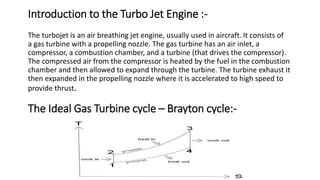
The turbojet is an air breathing jet engine, usually used in aircraft. It consists of
a gas turbine with a propelling nozzle. The gas turbine has an air inlet, a
compressor, a combustion chamber, and a turbine (that drives the compressor).
The compressed air from the compressor is heated by the fuel in the combustion
chamber and then allowed to expand through the turbine. The turbine exhaust it
then expanded in the propelling nozzle where it is accelerated to high speed to
provide thrust.
The Ideal Gas Turbine cycle – Brayton cycle:-
Design & Analysis of Turbo jet H.P.T rotor blade: -
Problem Statement
Evolution of turbojet engines to the technology level of today
• New concepts or technological breakthroughs are rare
• Advancements are rather due to evolutionary improvements of the design
10C4/60C50 turbine blade model
• Choosing a good material between Inconel 718 and Titanium T6
To achieve good performances, parallel research and development Effort
were undertaken in areas such as in optimisation of blade profile, selection
of materials, weight reduction and obtaining minimum frictional losses.
Design And Analysis
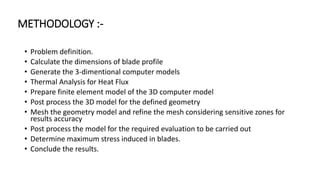
METHODOLOGY :-
• Problem definition.
• Calculate the dimensions of blade profile
• Generate the 3-dimentional computer models
• Thermal Analysis for Heat Flux
• Prepare finite element model of the 3D computer model
• Post process the 3D model for the defined geometry
• Mesh the geometry model and refine the mesh considering sensitive zones for
results accuracy
• Post process the model for the required evaluation to be carried out
• Determine maximum stress induced in blades.
• Conclude the results.
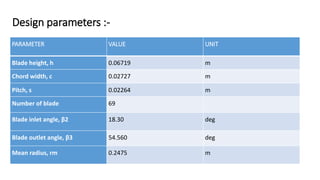
PARAMETER VALUE UNIT
Blade height, h 0.06719 m
Chord width, c 0.02727 m
Pitch, s 0.02264 m
Number of blade 69
Blade inlet angle, β2 18.30 deg
Blade outlet angle, β3 54.560 deg
Mean radius, rm 0.2475 m
Design parameters :-
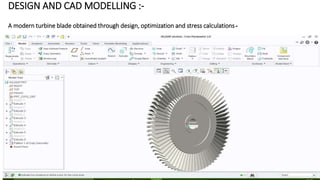
DESIGN AND CAD MODELLING :-
A modern turbine blade obtained through design, optimization and stress calculations-
Fig: 2.8 Cad Model of turbo jet engine, HPT rotor blade
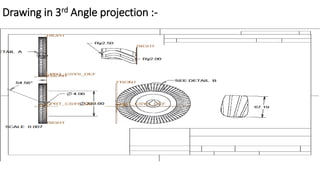
Drawing in 3rd Angle projection :-
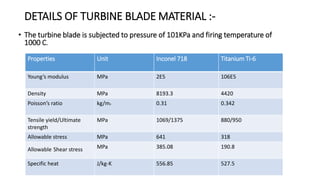
DETAILS OF TURBINE BLADE MATERIAL :-
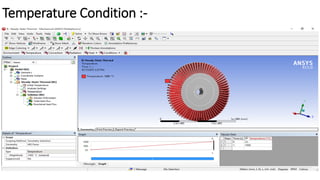
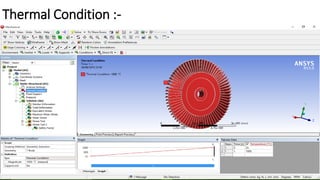
• The turbine blade is subjected to pressure of 101KPa and firing temperature of
1000 C.
Properties Unit Inconel 718 Titanium Ti-6
Young’s modulus MPa 2E5 106E5
Density MPa 8193.3 4420
Poisson’s ratio kg/m3 0.31 0.342
Tensile yield/Ultimate
strength
MPa 1069/1375 880/950
Allowable stress MPa 641 318
Allowable Shear stress MPa 385.08 190.8
Specific heat J/kg-K 556.85 527.5
Thermal Analysis Setting
Temperature Condition :-
Result Of Thermal Analysis
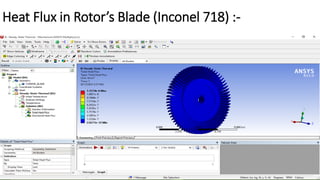
Heat Flux in Rotor’s Blade (Inconel 718) :-
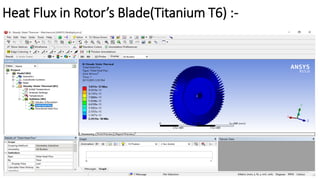
Heat Flux in Rotor’s Blade(Titanium T6) :-
FE Analysis Setting
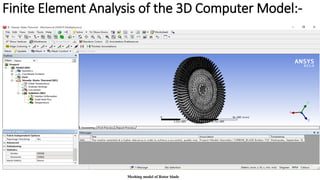
Finite Element Analysis of the 3D Computer Model:-
Meshing model of Rotor blade
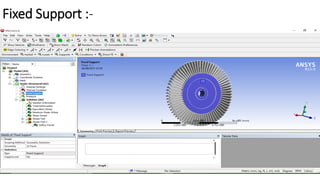
Fixed Support :-
Thermal Condition :-
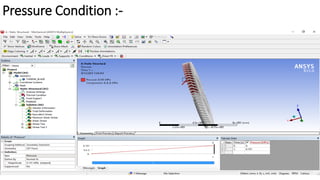
Pressure Condition :-
Result Of FE Analysis
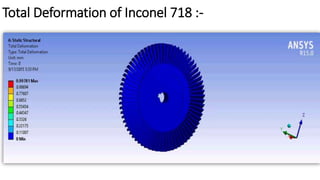
Total Deformation of Inconel 718 :-
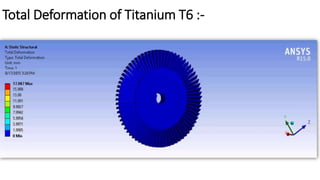
Total Deformation of Titanium T6 :-
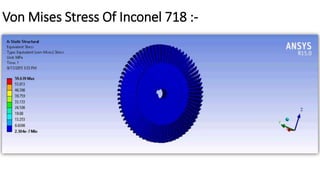
Von Mises Stress Of Inconel 718 :-
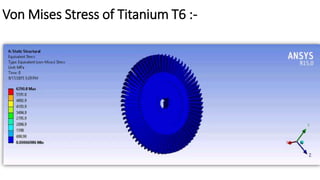
Von Mises Stress of Titanium T6 :-
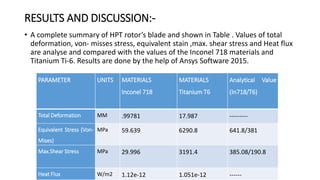
RESULTS AND DISCUSSION:-
• A complete summary of HPT rotor’s blade and shown in Table . Values of total
deformation, von- misses stress, equivalent stain ,max. shear stress and Heat flux
are analyse and compared with the values of the Inconel 718 materials and
Titanium Ti-6. Results are done by the help of Ansys Software 2015.
PARAMETER UNITS MATERIALS
Inconel 718
MATERIALS
Titanium T6
Analytical Value
(In718/T6)
Total Deformation MM .99781 17.987 ---------
Equivalent Stress (Von-
Mises)
MPa 59.639 6290.8 641.8/381
Max.Shear Stress MPa 29.996 3191.4 385.08/190.8
Heat Flux W/m2 1.12e-12 1.051e-12 ------
CONCLUSION :-
• It is seen from above results of both the materials are giving the considerable
results; finally the conclusion can be done on the basis of the total deformation ,
Von Mises stress and Heat flux.
• It is also seen Inconel 718 have good material properties but it have higher
thermal conductivity than Titanium T6 and the heat flux of Inconel 718 is higher
in comparison of Titanium T6 so cooling is easy in Titanium T6.
• So we can conclude from above result and observation that structure of is safe for
given loading condition and also, Inconel 718 is better material as compare to
that of Titanium T6 in economically as well as strength at higher temperatures.
AMITY UNIVERSITY

AMITY UNIVERSITY

  • 1.
    PRESENTED BY: AVINASH KUMARDUBEY ROLL NO:AUR1224030
  • 2.
    Introduction to theTurbo Jet Engine :- The turbojet is an air breathing jet engine, usually used in aircraft. It consists of a gas turbine with a propelling nozzle. The gas turbine has an air inlet, a compressor, a combustion chamber, and a turbine (that drives the compressor). The compressed air from the compressor is heated by the fuel in the combustion chamber and then allowed to expand through the turbine. The turbine exhaust it then expanded in the propelling nozzle where it is accelerated to high speed to provide thrust. The Ideal Gas Turbine cycle – Brayton cycle:-
  • 3.
    Design & Analysisof Turbo jet H.P.T rotor blade: - Problem Statement Evolution of turbojet engines to the technology level of today • New concepts or technological breakthroughs are rare • Advancements are rather due to evolutionary improvements of the design 10C4/60C50 turbine blade model • Choosing a good material between Inconel 718 and Titanium T6 To achieve good performances, parallel research and development Effort were undertaken in areas such as in optimisation of blade profile, selection of materials, weight reduction and obtaining minimum frictional losses.
  • 4.
  • 5.
    METHODOLOGY :- • Problemdefinition. • Calculate the dimensions of blade profile • Generate the 3-dimentional computer models • Thermal Analysis for Heat Flux • Prepare finite element model of the 3D computer model • Post process the 3D model for the defined geometry • Mesh the geometry model and refine the mesh considering sensitive zones for results accuracy • Post process the model for the required evaluation to be carried out • Determine maximum stress induced in blades. • Conclude the results.
  • 6.
    PARAMETER VALUE UNIT Bladeheight, h 0.06719 m Chord width, c 0.02727 m Pitch, s 0.02264 m Number of blade 69 Blade inlet angle, β2 18.30 deg Blade outlet angle, β3 54.560 deg Mean radius, rm 0.2475 m Design parameters :-
  • 7.
    DESIGN AND CADMODELLING :- A modern turbine blade obtained through design, optimization and stress calculations- Fig: 2.8 Cad Model of turbo jet engine, HPT rotor blade
  • 8.
    Drawing in 3rdAngle projection :-
  • 9.
    DETAILS OF TURBINEBLADE MATERIAL :- • The turbine blade is subjected to pressure of 101KPa and firing temperature of 1000 C. Properties Unit Inconel 718 Titanium Ti-6 Young’s modulus MPa 2E5 106E5 Density MPa 8193.3 4420 Poisson’s ratio kg/m3 0.31 0.342 Tensile yield/Ultimate strength MPa 1069/1375 880/950 Allowable stress MPa 641 318 Allowable Shear stress MPa 385.08 190.8 Specific heat J/kg-K 556.85 527.5
  • 10.
  • 11.
  • 12.
  • 13.
    Heat Flux inRotor’s Blade (Inconel 718) :-
  • 14.
    Heat Flux inRotor’s Blade(Titanium T6) :-
  • 15.
  • 16.
    Finite Element Analysisof the 3D Computer Model:- Meshing model of Rotor blade
  • 17.
  • 18.
  • 19.
  • 20.
    Result Of FEAnalysis
  • 21.
    Total Deformation ofInconel 718 :-
  • 22.
    Total Deformation ofTitanium T6 :-
  • 23.
    Von Mises StressOf Inconel 718 :-
  • 24.
    Von Mises Stressof Titanium T6 :-
  • 25.
    RESULTS AND DISCUSSION:- •A complete summary of HPT rotor’s blade and shown in Table . Values of total deformation, von- misses stress, equivalent stain ,max. shear stress and Heat flux are analyse and compared with the values of the Inconel 718 materials and Titanium Ti-6. Results are done by the help of Ansys Software 2015. PARAMETER UNITS MATERIALS Inconel 718 MATERIALS Titanium T6 Analytical Value (In718/T6) Total Deformation MM .99781 17.987 --------- Equivalent Stress (Von- Mises) MPa 59.639 6290.8 641.8/381 Max.Shear Stress MPa 29.996 3191.4 385.08/190.8 Heat Flux W/m2 1.12e-12 1.051e-12 ------
  • 26.
    CONCLUSION :- • Itis seen from above results of both the materials are giving the considerable results; finally the conclusion can be done on the basis of the total deformation , Von Mises stress and Heat flux. • It is also seen Inconel 718 have good material properties but it have higher thermal conductivity than Titanium T6 and the heat flux of Inconel 718 is higher in comparison of Titanium T6 so cooling is easy in Titanium T6. • So we can conclude from above result and observation that structure of is safe for given loading condition and also, Inconel 718 is better material as compare to that of Titanium T6 in economically as well as strength at higher temperatures.