Aminoglycoside induced
Nephrotoxicity
Aminoglycoside induced
Nephrotoxicity
• Introduction
• Risk factors
• Mechanism of Nephrotoxicity
• Clinical implications for prevention
• Conclusion
Introduction
• AKI – relatively common complication of aminoglycosides
• Incidence- 10 to 15%
• Cationic structure plays an important role in the toxicity
In spite of undesirable side effects AGs are still used because of
their
• Chemical stability
• Fast bactericidal effect,
• Synergy with beta lactams
• Little resistance
• Low cost
Risk factors
Mechanism of AG induced nephrotoxicity
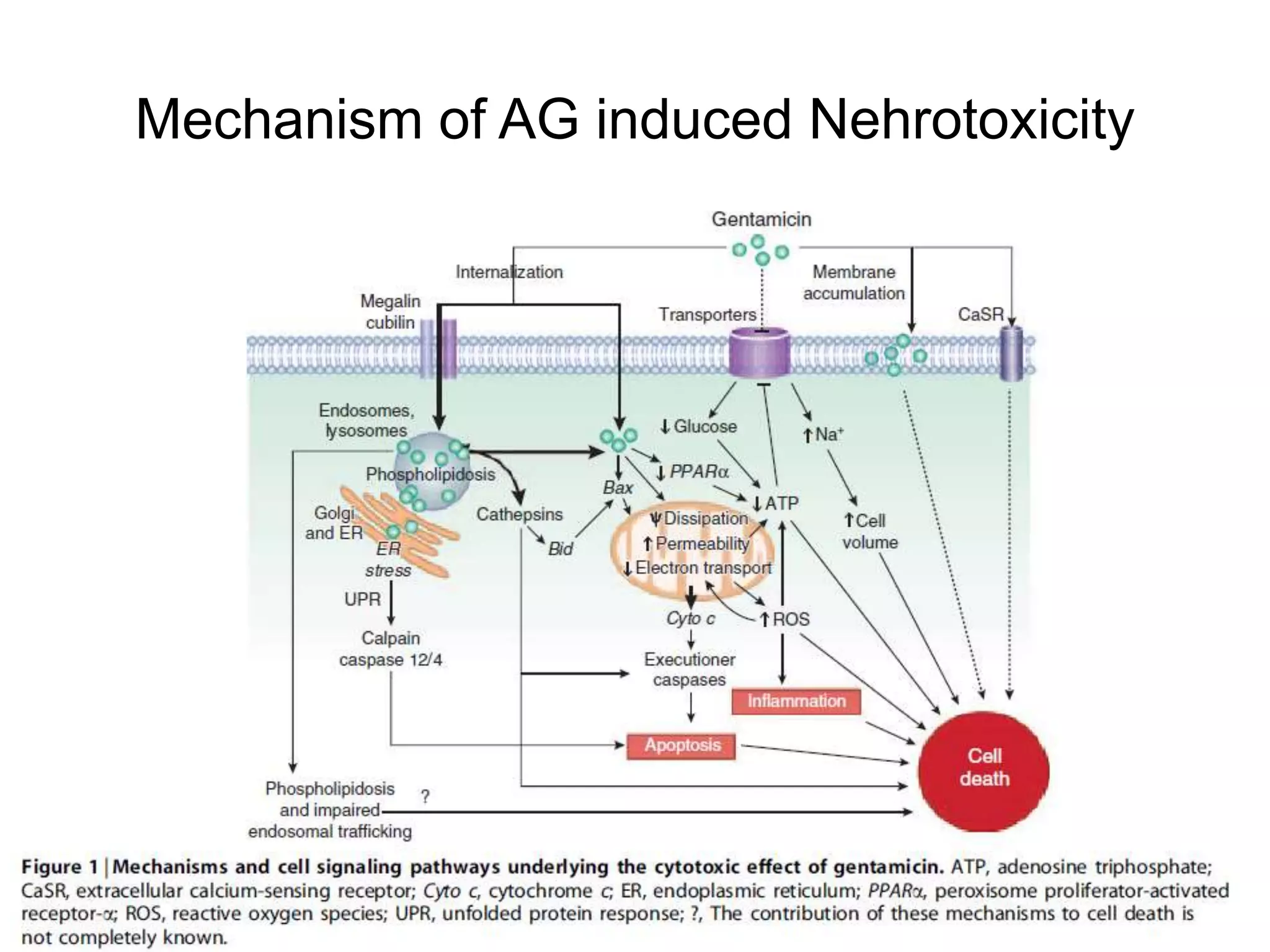
Mechanism of AG induced Nehrotoxicity
Glomerular effects of AG induced
nephrotoxicity
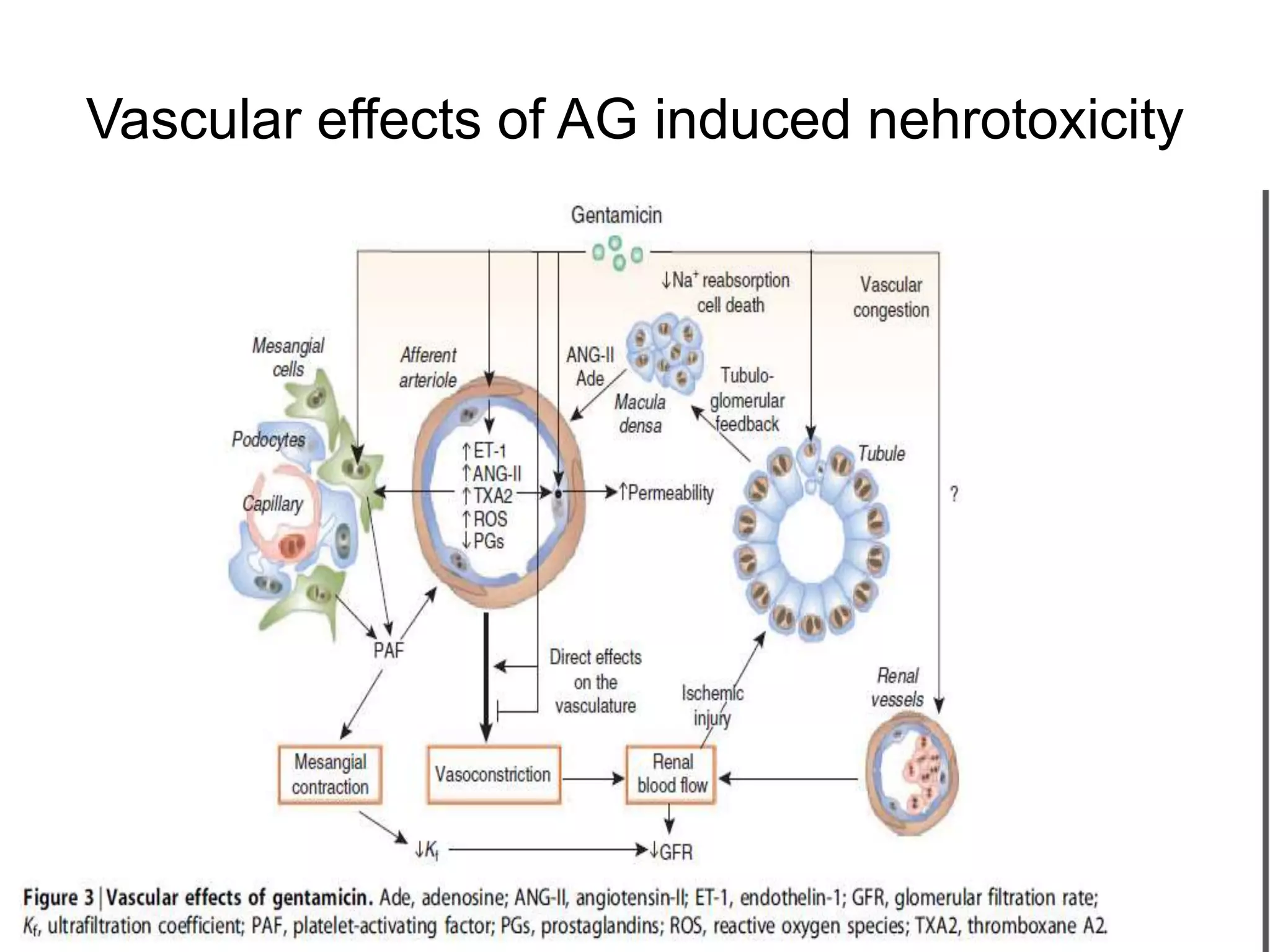
Vascular effects of AG induced nehrotoxicity
Clinical features
Non oliguric AKI
• AKI due to AGs occur 5 to 7 days after treatment
• Non-oliguric AKI due to loss of concentrating ability
due to distal tubular damage
• ATN due to AG unlikely to be severe , usually mild
• It can cause severe AKI requiring HD in patients with
CKD
Clinical features
Distal tubular dysfunction
• Polyuria- because of loss of concentrating capacity
• Hypomagnesemia – because of increased losses
Electrolyte abnormalities
• Hypomagnesemia, Hypokalemia, Hypocalcemia,
Hypophosphatemia
• Fanconi like syndrome- glycosuria, aminoaciduria,
phosphaturia, uricosuria
Clinical course
• Plasma creatinine resolves within 21 days after
cessation of the drug
• However resolution of acute episode may be delayed in
septic, hypovolemic and catabolic conditions
• Irreversible kidney damage- uncommon in acute AG
induced nephrotoxicity
• However it can occur in prolonged therapy, even in low
doses
Evolution of AKI in AG Induced Nehrotoxicity
Role of inflammation
Prevention
• Selection of least toxic AGs
• Correcting hypokalemia and hypomagnesemia prior to
AG
• Avoiding AG in patients with reduced effective arterial
volume or optimizing volume status prior to
administration of AG
• Adjusting dose for renal function
• Limiting duration of therapy
• Minimize concomitant nephrotoxic medications
• Using once daily regimen
Agents tried to prevent AG induced
nephrotoxicity
• PAAs(Polyaminoacids)
Polyaspartic acid and Polyglutamic acid
• Other compounds
Antioxidants such as desferrioxamine , methimazole,
vitamin C and E , Selenium
Superoxide , lipoic acid, DMSO,NAC and melatonin also
has utility in AG induced nephrotoxicity prevention
Conclusion
• There are many factors that determine the nephrotoxicity
due to AGs
• Its very important for clinicians to know all the factors
contributing so as to reduce AG induced nephrotoxicity
• Although pattern of AKI in AG induced nephrotoxicity
occurs 5 to 7 days after AG exposure, it can be difficult to
differentiate from other causes, as it occurs in the setting
of significant comorbid conditions , sepsis and
nephrotoxin exposure
• Hence essential step in diagnosis of AG induced
nephrotoxicity is attention to other potentially reversible
etiologies
• In addition review of all imaging procedures for contrast
exposure and concomitant nephrotoxin use is imperative
• Though many agents have emerged as potential
compounds to prevent AG induced nephrotoxicity, none
has been adopted clinically

Aminoglycoside induced nephrotoxicity

  • 1.
  • 2.
    Aminoglycoside induced Nephrotoxicity • Introduction •Risk factors • Mechanism of Nephrotoxicity • Clinical implications for prevention • Conclusion
  • 3.
    Introduction • AKI –relatively common complication of aminoglycosides • Incidence- 10 to 15% • Cationic structure plays an important role in the toxicity In spite of undesirable side effects AGs are still used because of their • Chemical stability • Fast bactericidal effect, • Synergy with beta lactams • Little resistance • Low cost
  • 4.
  • 5.
    Mechanism of AGinduced nephrotoxicity
  • 6.
    Mechanism of AGinduced Nehrotoxicity
  • 7.
    Glomerular effects ofAG induced nephrotoxicity
  • 8.
    Vascular effects ofAG induced nehrotoxicity
  • 9.
    Clinical features Non oliguricAKI • AKI due to AGs occur 5 to 7 days after treatment • Non-oliguric AKI due to loss of concentrating ability due to distal tubular damage • ATN due to AG unlikely to be severe , usually mild • It can cause severe AKI requiring HD in patients with CKD
  • 10.
    Clinical features Distal tubulardysfunction • Polyuria- because of loss of concentrating capacity • Hypomagnesemia – because of increased losses Electrolyte abnormalities • Hypomagnesemia, Hypokalemia, Hypocalcemia, Hypophosphatemia • Fanconi like syndrome- glycosuria, aminoaciduria, phosphaturia, uricosuria
  • 11.
    Clinical course • Plasmacreatinine resolves within 21 days after cessation of the drug • However resolution of acute episode may be delayed in septic, hypovolemic and catabolic conditions • Irreversible kidney damage- uncommon in acute AG induced nephrotoxicity • However it can occur in prolonged therapy, even in low doses
  • 12.
    Evolution of AKIin AG Induced Nehrotoxicity
  • 13.
  • 14.
    Prevention • Selection ofleast toxic AGs • Correcting hypokalemia and hypomagnesemia prior to AG • Avoiding AG in patients with reduced effective arterial volume or optimizing volume status prior to administration of AG • Adjusting dose for renal function • Limiting duration of therapy • Minimize concomitant nephrotoxic medications • Using once daily regimen
  • 15.
    Agents tried toprevent AG induced nephrotoxicity • PAAs(Polyaminoacids) Polyaspartic acid and Polyglutamic acid • Other compounds Antioxidants such as desferrioxamine , methimazole, vitamin C and E , Selenium Superoxide , lipoic acid, DMSO,NAC and melatonin also has utility in AG induced nephrotoxicity prevention
  • 16.
    Conclusion • There aremany factors that determine the nephrotoxicity due to AGs • Its very important for clinicians to know all the factors contributing so as to reduce AG induced nephrotoxicity • Although pattern of AKI in AG induced nephrotoxicity occurs 5 to 7 days after AG exposure, it can be difficult to differentiate from other causes, as it occurs in the setting of significant comorbid conditions , sepsis and nephrotoxin exposure
  • 17.
    • Hence essentialstep in diagnosis of AG induced nephrotoxicity is attention to other potentially reversible etiologies • In addition review of all imaging procedures for contrast exposure and concomitant nephrotoxin use is imperative • Though many agents have emerged as potential compounds to prevent AG induced nephrotoxicity, none has been adopted clinically