PREPARED BY-
BRAJESH
RANJAN(201BARC030)
TITIR BAUG(2014BARC037)
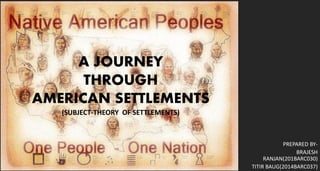
A JOURNEY
THROUGH
AMERICAN SETTLEMENTS
(SUBJECT-THEORY OF SETTLEMENTS)
STRUCTURE
• REGIONAL/PHYSIOGRAPHIC
• POWER AND ADMINSTRATION
• MAN, SOCIETY AND CULTURE
• SOCIO-ECONOMIC SITUATIONS
• POLARITY AND PRIMACY
• POSTPRIMACY
REGIONAL/PHYSIOGRAPHIC
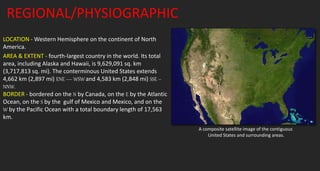
LOCATION - Western Hemisphere on the continent of North
America.
AREA & EXTENT - fourth-largest country in the world. Its total
area, including Alaska and Hawaii, is 9,629,091 sq. km
(3,717,813 sq. mi). The conterminous United States extends
4,662 km (2,897 mi) ENE — WSW and 4,583 km (2,848 mi) SSE –
NNW.
BORDER - bordered on the N by Canada, on the E by the Atlantic
Ocean, on the S by the gulf of Mexico and Mexico, and on the
W by the Pacific Ocean with a total boundary length of 17,563
km.
A composite satellite image of the contiguous
United States and surrounding areas.
REGIONAL/PHYSIOGRAPHIC
TOPOGRAPHY
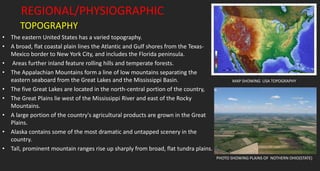
• The eastern United States has a varied topography.
• A broad, flat coastal plain lines the Atlantic and Gulf shores from the Texas-
Mexico border to New York City, and includes the Florida peninsula.
• Areas further inland feature rolling hills and temperate forests.
• The Appalachian Mountains form a line of low mountains separating the
eastern seaboard from the Great Lakes and the Mississippi Basin.
• The five Great Lakes are located in the north-central portion of the country,
• The Great Plains lie west of the Mississippi River and east of the Rocky
Mountains.
• A large portion of the country's agricultural products are grown in the Great
Plains.
• Alaska contains some of the most dramatic and untapped scenery in the
country.
• Tall, prominent mountain ranges rise up sharply from broad, flat tundra plains.
REGIONAL/PHYSIOGRAPHIC
MAP SHOWING USA TOPOGRAPHY
PHOTO SHOWING PLAINS OF NOTHERN OHIO(STATE)
POWER AND ADMINSTRATION
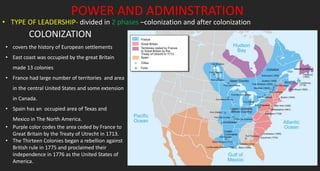
• TYPE OF LEADERSHIP- divided in 2 phases –colonization and after colonization
• covers the history of European settlements
• East coast was occupied by the great Britain
made 13 colonies
• France had large number of territories and area
in the central United States and some extension
in Canada.
• Spain has an occupied area of Texas and
Mexico in The North America.
• Purple color codes the area ceded by France to
Great Britain by the Treaty of Utrecht in 1713.
• The Thirteen Colonies began a rebellion against
British rule in 1775 and proclaimed their
independence in 1776 as the United States of
America.
COLONIZATION
AFTER COLONIZATION
• They made 2-party system.
• It featured two national parties competing for control of the
presidency, Congress, and the states.
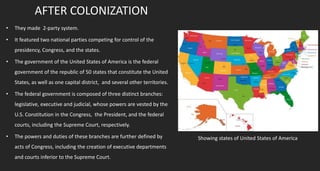
• The government of the United States of America is the federal
government of the republic of 50 states that constitute the United
States, as well as one capital district, and several other territories.
• The federal government is composed of three distinct branches:
legislative, executive and judicial, whose powers are vested by the
U.S. Constitution in the Congress, the President, and the federal
courts, including the Supreme Court, respectively.
• The powers and duties of these branches are further defined by
acts of Congress, including the creation of executive departments
and courts inferior to the Supreme Court.
Showing states of United States of America
RELIGIOUS LEADERSHIP IN USA
• The religious history of the United States began with the first Pilgrim settlers who came on the in the year 1620.
• Their Protestant faith motivated their movement as a community to the New World from Europe where they could
practice in peace.
• Christianity was in the era of the American Revolution.
MAN, SOCIETY AND CULTURE
Origin and Influence
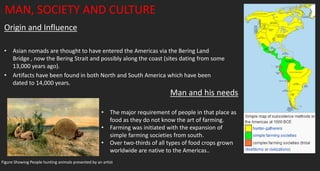
• Asian nomads are thought to have entered the Americas via the Bering Land
Bridge , now the Bering Strait and possibly along the coast (sites dating from some
13,000 years ago).
• Artifacts have been found in both North and South America which have been
dated to 14,000 years.
Man and his needs
• The major requirement of people in that place as
food as they do not know the art of farming.
• Farming was initiated with the expansion of
simple farming societies from south.
• Over two-thirds of all types of food crops grown
worldwide are native to the Americas..
Figure Showing People hunting animals presented by an artist
Shelter
MAN, SOCIETY AND CULTURE
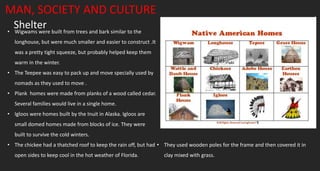
• Wigwams were built from trees and bark similar to the
longhouse, but were much smaller and easier to construct .It
was a pretty tight squeeze, but probably helped keep them
warm in the winter.
• The Teepee was easy to pack up and move specially used by
nomads as they used to move .
• Plank homes were made from planks of a wood called cedar.
Several families would live in a single home.
• Igloos were homes built by the Inuit in Alaska. Igloos are
small domed homes made from blocks of ice. They were
built to survive the cold winters.
• The chickee had a thatched roof to keep the rain off, but had
open sides to keep cool in the hot weather of Florida.
• They used wooden poles for the frame and then covered it in
clay mixed with grass.
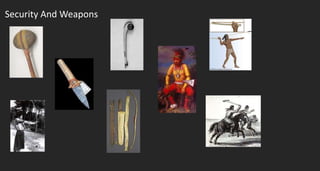
Security And Weapons
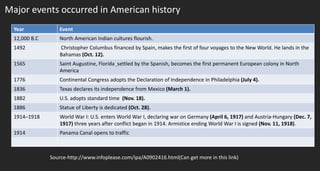
Major events occurred in American history
Year Event
12,000 B.C North American Indian cultures flourish.
1492 Christopher Columbus financed by Spain, makes the first of four voyages to the New World. He lands in the
Bahamas (Oct. 12).
1565 Saint Augustine, Florida settled by the Spanish, becomes the first permanent European colony in North
America
1776 Continental Congress adopts the Declaration of Independence in Philadelphia (July 4).
1836 Texas declares its independence from Mexico (March 1).
1882 U.S. adopts standard time (Nov. 18).
1886 Statue of Liberty is dedicated (Oct. 28).
1914–1918 World War I: U.S. enters World War I, declaring war on Germany (April 6, 1917) and Austria-Hungary (Dec. 7,
1917) three years after conflict began in 1914. Armistice ending World War I is signed (Nov. 11, 1918).
1914 Panama Canal opens to traffic
Source-http://www.infoplease.com/ipa/A0902416.html(Can get more in this link)
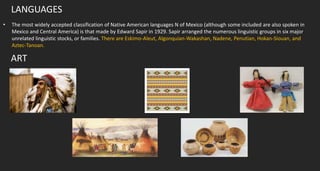
LANGUAGES
• The most widely accepted classification of Native American languages N of Mexico (although some included are also spoken in
Mexico and Central America) is that made by Edward Sapir in 1929. Sapir arranged the numerous linguistic groups in six major
unrelated linguistic stocks, or families. There are Eskimo-Aleut, Algonquian-Wakashan, Nadene, Penutian, Hokan-Siouan, and
Aztec-Tanoan.
ART
Social Structure
king
hunters villagers traders
MAN, SOCIETY AND CULTURE
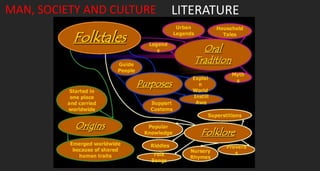
LITERATUREMAN, SOCIETY AND CULTURE
SOCIO-ECONOMIC SITUATIONS

Native america

  • 1.
    PREPARED BY- BRAJESH RANJAN(201BARC030) TITIR BAUG(2014BARC037) AJOURNEY THROUGH AMERICAN SETTLEMENTS (SUBJECT-THEORY OF SETTLEMENTS)
  • 2.
    STRUCTURE • REGIONAL/PHYSIOGRAPHIC • POWERAND ADMINSTRATION • MAN, SOCIETY AND CULTURE • SOCIO-ECONOMIC SITUATIONS • POLARITY AND PRIMACY • POSTPRIMACY
  • 3.
    REGIONAL/PHYSIOGRAPHIC LOCATION - WesternHemisphere on the continent of North America. AREA & EXTENT - fourth-largest country in the world. Its total area, including Alaska and Hawaii, is 9,629,091 sq. km (3,717,813 sq. mi). The conterminous United States extends 4,662 km (2,897 mi) ENE — WSW and 4,583 km (2,848 mi) SSE – NNW. BORDER - bordered on the N by Canada, on the E by the Atlantic Ocean, on the S by the gulf of Mexico and Mexico, and on the W by the Pacific Ocean with a total boundary length of 17,563 km. A composite satellite image of the contiguous United States and surrounding areas.
  • 4.
  • 5.
    TOPOGRAPHY • The easternUnited States has a varied topography. • A broad, flat coastal plain lines the Atlantic and Gulf shores from the Texas- Mexico border to New York City, and includes the Florida peninsula. • Areas further inland feature rolling hills and temperate forests. • The Appalachian Mountains form a line of low mountains separating the eastern seaboard from the Great Lakes and the Mississippi Basin. • The five Great Lakes are located in the north-central portion of the country, • The Great Plains lie west of the Mississippi River and east of the Rocky Mountains. • A large portion of the country's agricultural products are grown in the Great Plains. • Alaska contains some of the most dramatic and untapped scenery in the country. • Tall, prominent mountain ranges rise up sharply from broad, flat tundra plains. REGIONAL/PHYSIOGRAPHIC MAP SHOWING USA TOPOGRAPHY PHOTO SHOWING PLAINS OF NOTHERN OHIO(STATE)
  • 6.
    POWER AND ADMINSTRATION •TYPE OF LEADERSHIP- divided in 2 phases –colonization and after colonization • covers the history of European settlements • East coast was occupied by the great Britain made 13 colonies • France had large number of territories and area in the central United States and some extension in Canada. • Spain has an occupied area of Texas and Mexico in The North America. • Purple color codes the area ceded by France to Great Britain by the Treaty of Utrecht in 1713. • The Thirteen Colonies began a rebellion against British rule in 1775 and proclaimed their independence in 1776 as the United States of America. COLONIZATION
  • 7.
    AFTER COLONIZATION • Theymade 2-party system. • It featured two national parties competing for control of the presidency, Congress, and the states. • The government of the United States of America is the federal government of the republic of 50 states that constitute the United States, as well as one capital district, and several other territories. • The federal government is composed of three distinct branches: legislative, executive and judicial, whose powers are vested by the U.S. Constitution in the Congress, the President, and the federal courts, including the Supreme Court, respectively. • The powers and duties of these branches are further defined by acts of Congress, including the creation of executive departments and courts inferior to the Supreme Court. Showing states of United States of America
  • 8.
    RELIGIOUS LEADERSHIP INUSA • The religious history of the United States began with the first Pilgrim settlers who came on the in the year 1620. • Their Protestant faith motivated their movement as a community to the New World from Europe where they could practice in peace. • Christianity was in the era of the American Revolution.
  • 9.
    MAN, SOCIETY ANDCULTURE Origin and Influence • Asian nomads are thought to have entered the Americas via the Bering Land Bridge , now the Bering Strait and possibly along the coast (sites dating from some 13,000 years ago). • Artifacts have been found in both North and South America which have been dated to 14,000 years. Man and his needs • The major requirement of people in that place as food as they do not know the art of farming. • Farming was initiated with the expansion of simple farming societies from south. • Over two-thirds of all types of food crops grown worldwide are native to the Americas.. Figure Showing People hunting animals presented by an artist
  • 10.
    Shelter MAN, SOCIETY ANDCULTURE • Wigwams were built from trees and bark similar to the longhouse, but were much smaller and easier to construct .It was a pretty tight squeeze, but probably helped keep them warm in the winter. • The Teepee was easy to pack up and move specially used by nomads as they used to move . • Plank homes were made from planks of a wood called cedar. Several families would live in a single home. • Igloos were homes built by the Inuit in Alaska. Igloos are small domed homes made from blocks of ice. They were built to survive the cold winters. • The chickee had a thatched roof to keep the rain off, but had open sides to keep cool in the hot weather of Florida. • They used wooden poles for the frame and then covered it in clay mixed with grass.
  • 11.
  • 12.
    Major events occurredin American history Year Event 12,000 B.C North American Indian cultures flourish. 1492 Christopher Columbus financed by Spain, makes the first of four voyages to the New World. He lands in the Bahamas (Oct. 12). 1565 Saint Augustine, Florida settled by the Spanish, becomes the first permanent European colony in North America 1776 Continental Congress adopts the Declaration of Independence in Philadelphia (July 4). 1836 Texas declares its independence from Mexico (March 1). 1882 U.S. adopts standard time (Nov. 18). 1886 Statue of Liberty is dedicated (Oct. 28). 1914–1918 World War I: U.S. enters World War I, declaring war on Germany (April 6, 1917) and Austria-Hungary (Dec. 7, 1917) three years after conflict began in 1914. Armistice ending World War I is signed (Nov. 11, 1918). 1914 Panama Canal opens to traffic Source-http://www.infoplease.com/ipa/A0902416.html(Can get more in this link)
  • 13.
    LANGUAGES • The mostwidely accepted classification of Native American languages N of Mexico (although some included are also spoken in Mexico and Central America) is that made by Edward Sapir in 1929. Sapir arranged the numerous linguistic groups in six major unrelated linguistic stocks, or families. There are Eskimo-Aleut, Algonquian-Wakashan, Nadene, Penutian, Hokan-Siouan, and Aztec-Tanoan. ART
  • 14.
    Social Structure king hunters villagerstraders MAN, SOCIETY AND CULTURE
  • 15.
  • 16.