Music Exposure: Influence in Different Stages of Human Life
Alejandra de Jesús-Soto Math Department/RISE Program University of Puerto Rico-Cayey, Cayey,
P.R.

Abstract:
Music can cause a positive influence on human. There are scientific investigations
during fetal stage and at different stages of human development that point to this. This review
paper includes scientific research in the following stages: prenatal and neonatal, infancy,
childhood, adolescence, adulthood and old age. General information is reviewed, such as: the
setting and context of studies, research findings and explanatory variables. Also,
methodological issues are mentioned. Each methodology is adapted to the purpose of each
investigation. The exposure to music was beneficial from the fetal stage to adolescence, and
also in older people. At all stages of human life music has an implication on development,
behavior and learning.The earlier the exposure to music the greater the impact on cognition and
human skills (social and physical).In addition, since increasing age is accompanied by
perceptual and cognitive disorders, such as: hearing loss,research shows that music helps to
manage allof these conditions.The real effects of music in long-term learning have not been
fully studied.Further studies must be made to develop ways to use music to benefit humans.
Introduction:
Music is defined as the tones or
sounds employed, occurring in single line
(melody) or multiple lines (harmony) and
sounded or to be sounded by one or more
voices and or instruments (Collins English
Dictionary, 2009). Music has been a
fundamental part of human evolution.Music
Archaeology studies the sounds and the
musical cultures of the past. The large
amount of existing archaeological materials
that are similar to musical instruments, such
as flute and drums, demonstrates the
significant presence of music in past cultures.
In his book The Descent of Man (1859),
Charles Darwin mentioned that human beings
express their feelings through music. Music
has been included in cultures around the
world.

Therefore, it is a universal experience. This
paper summarizes several scientific studies
related to music exposure and their
implications in the subjects studied. It
explains the influence of music in different
stages of human development.In general, the
human developmental stages are: pre-natal,
infancy, childhood, adolescence, youth,
adulthood and old age. The studies expand on
how music affects cognitive areas, learning
development, physical skills, and other
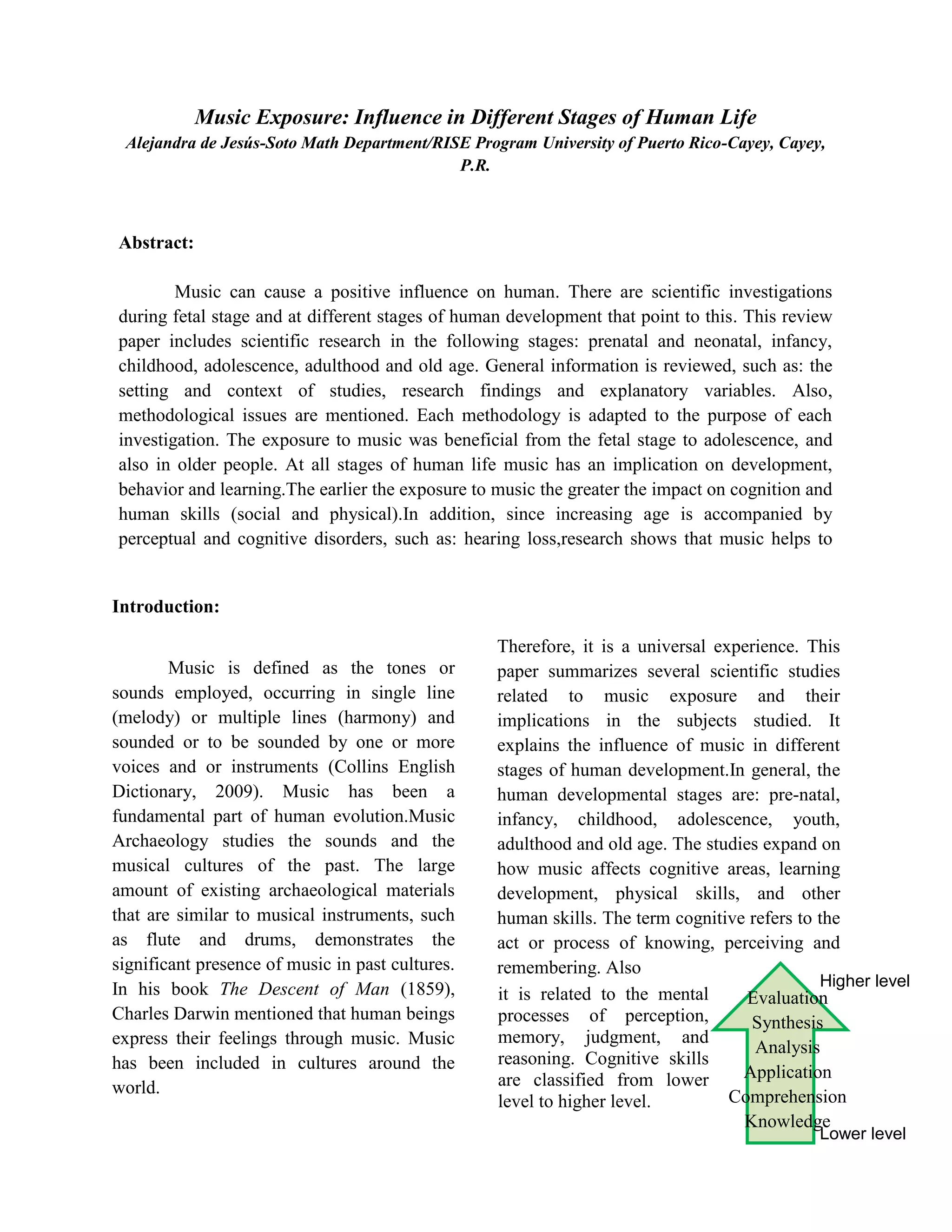
human skills. The term cognitive refers to the
act or process of knowing, perceiving and
remembering. Also
Higher level
it is related to the mental
Evaluation
processes of perception,
Synthesis
memory, judgment, and
Analysis
reasoning. Cognitive skills
Application
are classified from lower
Comprehension
level to higher level.
Knowledge
Lower level
Below, we discuss the effect of musical
exposure in humans.It is important to note
that each study reviewed used a particular
type of music.
Pre-natal stage and music:
Humans can be influenced by music
from as early as the fetal stage. There is
scientific evidence that points to the skills the
fetus possesses. The fetus has the capacity to
respond to external stimuli and has the ability
to listen. A study conducted in
DeenDayalUpadhyay, India (Arya et al.
2012), proved that amother’sexposure to
music during pregnancy positivelyaffects
neonatal behavior. This study was conducted
in 339 primigravidamothers. This was a
single-center,
open-label,
randomized
controlled trial at a teaching hospital.
Randomly, half of the participants were
exposed to 173 hours of music. This was the
experimental group. The other participants
were not exposed to this stimulus, they were
the control group. Researchers used the
Brazelton Neonatal Behavioral Assessment
Scale (BNBAS) to assess participants.
First,the
fetus
was
exposedto
a
GarbhSanskar’s cassette during the first half
of pregnancy. Then, two days after the baby’s
birth, he was evaluatedusing the scale. This
scale is based on the baby's ability to
communicate through body movements,
facial gestures, types of crying and social
cues. Therefore, this was a qualitative
research. During the investigation, tests were
performed to measure seven BNBAS
clusters: habituation, orientation, motor
performance, range of state, regulation of
state,
autonomic
stability
and
reflexes.BNBAS consists of 27 behavioral
items, each scored on a 9 point scale, and 20
elicited responses, each scored on a 3 point
scale. The results showed that newbornsthat
were exposed to music performed better on
tests. They scored significantly higher on 5 of
the 7 BNBAS clusters: habituation,

orientation, range of state, regulation of state,
and autonomic stability. The greatest effect
found was in the orientation of the child, a
factor which should make his birth less
traumatic. Orientation items test the infants’
response to animate and inanimate, auditory,
and visual stimuli presented separately or
together.On the other hand, the result in
reflex test was the same for both the
experimental and control groups. It is
possible to carry out further research using
the results of this study because the evidence
on the behavior of the newborn in relation to
intrauterine and perinatal events experience
may influence the organization of the
newborn’s Central Nervous System.This is
because this system captures external stimuli,
such as music.
Infancy and music:
At the stage of infancy,the
complexityofthe
environment
resultsconfusing to humans. Therefore, it is
believed that the teaching methods used for
infants should be simplified. The child should
be taught using some amounts of information
so they learn in a better way, by what is
called simplified input. This is because this
way cognitive abilitywill allow them to
process information more effectively.
However, in some situations the child learns
through complex input. There are two ways
in which the complex stimulus facilitates
learning in the infant: by providing additional
redundant cues and by supporting the infant's
attention. Therefore, the child shouldbe able
to learn in the same manner as the adult:
using complex stimuli. In this method, there
are relationships that facilitate the learning
process. These are known as bidirectional
relationships that relate two complementary
concepts. For example, consider the
relationship between the melody and lyrics in
music. The melody has repetitive signals that
facilitate the learning of lyrics. However, just
as the melody facilitates lyric learning, lyric
facilitates melody learning. Precisely for that
reason,it is called a bidirectional relationship.
It was found that the melodic structure
facilitates lyric learning in the adult.
However, infants are limited cognitively in
relation to adults. These limitations prevent
the child from fully benefiting from these
relationships between aspects of complex
stimuli. In two experiments, infants listened
to music in which melodic and lyrical
structure predicted each other (Thiessen and
Saffran 2009). In addition, they heard
melodies or lyrics presented alone. The
samples for both experiments wereforty and
thirty infants between the ages of 6.5 to 8.0
months. The results of the first experiment
reflected that infants learned better the lyrics
when they were paired with the melody than
when they were presented alone. In the same
way, in the second experiment infants learned
better the melody when it was paired with
lyrics.
Childhood and music:
Atthe elementary school level, many
teachers use music as a learning method.
Teaching through songs and auditory stimuli
helps the student during the learning process.
Even commercially, different educational tools
based on music are sold. Among these are the
alphabet and multiplication tableswith melodies.
Educators such as Maria Montessori and Jean
Piaget regarded music as an important tool in
education. Children who are music listeners at the
elementary
level
have
shown
better
performancein cognitive, mental and physical
skills. They can retain more information,

listen more closely and improve their
concentration. Early ages (4 to 6 years) are
essential to musical growth. Children have great
sensitivity; they can differentiate between bass
and treble.In 2013, Mattar conducted an
experimental study to investigate the impact of
the Mozart Effect. This study shows the impact of

music in social, cognitive and physical activities
of kindergarten students. The study sample
consisted of 42 Jordanian kindergarten children
(5-6 years) divided into two groups: the
experimental group was exposed to Mozart’s
music, while the control group was not exposed
to any kind of music. Both groups had the same
curriculum. To demonstrate the impact of music
they used "The preschool and kindergarten
children's performance scale”. This scale was
established and developed by Al-Batch (2001) in
Jordan. The scale consists of fifty behavioral
aspects, which cover ten sub-areas, within three
main domains of growth; cognitive, physical and
social. The experimental group showed higher
capacity than the control group. The results
showed that Mozart’s music included in the
school curriculum of kindergarten children
directly affected theirs social, cognitive and
physical development. Music helped children to
relax (reduce impulsiveness), invigorate, focus
student attention or to ease transitions. It also
allows children to listen to others, communicate
more effectively, understand their emotions and
express their feelings, leading to the improvement
of social skills.Music has physiological effects on
the body. Listening to music has been shown to
slow the listener's heart rate and activate higherorder thinking. This study confirms importance of
music in learning methods.According to the
study, it creates a positive, relaxed and receptive
state of mind that is ideal for learning.As one can
see, music is an important tool in education
because itreduces stress and facilitates the
development of the child.
Adolescence and music:
In young adolescents, there is a
relationship between musical education and
academic performance. In a study conducted at a
secondary school in the providence of Quebec at
Canada (Cabanac 2013), this relationship was
studied. Also, this study confirmed that music is
related to cognitive skills. Music helps us to
overcome stress due to cognitive dissonance.
Thus, it is possible to accumulate more
knowledge and facilitate learning. Cognitive
dissonance refers to the feeling of discomfort that
results in presence of incongruent relations
among cognitions. The subjects of the study were
a group of students from a high school in Canada.
Students were from three different school years,
corresponding to the second year (196 students),
the third (184 students) and the senior class of the
secondary school(180 students).All of them
belonged to the Honor’s Program and were
between the ages of 14 and 17. Investigators
evaluated the academic achievement of the
subjects taking music courses and those students
who chose another elective. Results confirm that
students taking music courses achieved better
academic grades in all subjects.These results
demonstrate that learning of students taking
courses in music is better. Music has played a key
role in the evolution of man. Philosophers like
Aristotle wondered why sounds had a greater
impact on human psyche or conscience. This
studydemonstrates the role of music in learning
and the accumulation of knowledge.

Adulthood and music:
Physical and mental conditions arise
during human aging. One of them is the hearing
loss. This is a condition that difficult
understanding speech in noise.Parbery-Clark
(2011) analyzed the implications of cognitive
abilities and hearing speech in noise in North
Western University at Illinois in United States.
Auditory-perceptual and cognitive measures
reveal that musicians showed greater competition
than non-musicians. The sample included thirtyseven subjects, mostly between the ages of 45 to
65 years of age. All subjects had normal hearing,
were native English speakers and did not have
neurological or learning disorders. Nineteen of
them were musicians, whereas eighteen were not.
Compared to non-musicians, the musicians
developed more the cognitive skillsof verbal

memory and the auditory-perceptual skill of
paying attention while listening in noise. This
was demonstrated after exposing the subjects to
different tests that measured the auditory working
memory, as well as word and speech perception
in noise. Therefore, it is necessary to continue to
investigate the impact of musical training in the
aging processes. Also, researchers expressed that
musical training during developmental years can
reduce the impact of hearing loss related with
age. The relationship between music and its
effects on the maintenance and development of
human skills is an important finding.
Conclusion:

At all stages of human life music has
an implication on development, behavior and
learning. From the womb, music can
influence the live and futures of the child. It
is known that the effects of music exposure
to primigravite mothers can be beneficial,
significant and favorable. This exposure
positively influences neonatal behavior.Once
the child is an infant, music facilitates the
learning of lyrics and vice versa. The infant
learning is enhanced by sound. Children
show greater development when they hear
Mozart’s music at the beginning of the school
years. We can see how the social, physical
and cognitive areas of the learner are
improved. They can retain more information,
listen more closely and improve their
concentration.
In
adolescents,
the
experiments indicate that students who
remain in music classes have better academic
achievement in their other subjects. These
young people feel less stress and achieve
better social integration. Increasing age is
accompanied by an increase in perceptual
and cognitive disorders. It has been found
that older adults with musical training are
better equipped to handle auditory perceptual
needs in real-world situations. It was
demonstrated that music positively influences
speech-in-noise perception and related
cognitive function are enhanced in older
musicians in comparison with non-musicians.
Also, the results show that musical training
may reduce the impact of age-related
auditory decline. The results of this paper
review illustrated the benefits of musical
exposure in humans. Music has been part of
human evolution and must continue to be
used it on their advantage. Therefore, it is
important to conduct further studies about
music and its effects.
References:
Arya
R,
Chansoria
M,
Konanki
R,&TiwariDK. 2012. Maternal music
exposureduring
pregnancy
influences
neonatal behavior: an open-label randomized
controlled trial. International Journal
OfPediatrics. 2012: 901812. [cited on 2013
October
2].
Available
from:
http://web.ebscohost.com.uprcdb.cayey
.upr.edu:2048/ehost/pdfviewer/pdfviewer?sid
=457a8ec4-6ca7-4f7f-81d32446ce1d8781%4
0sessionmgr111&vid=10&hid=114
Cabanac A, Perlovsky L, BonniotCabanac MC, Cabanac M. 2013. Musicand
academic
performance.BehavioralBrain
Research.256: 257-260. [cited on2013
October
2].
Available
from:http://www.sciencedirect.com.uprcdb.c
ayey.pr.edu:2048/science/article/pii/S016643
281005093?np=y
Collins English Dictionary [Internet].[2009].
10th Edition. HarperCollins Publishers; [cited
on 2013 November 1]. Available from:
http://dictionary.reference.com/browse/MUSI
C
Mattar J. 2013. The effect of
Mozart’smusic on child development in
a
Jordanian

Kindergarten.Education.133(3): 370377. [cited on 2013 September 30].
Available from:
http://web.ebscohost.com.uprcdb.cayey.
upr.edu:2048/ehost/pdfviewer
/pdfviewer?sid=457a8ec4-6ca7-4
f7f-81d3-2446ce1d8781%40session
mgr111&vid=6&hid=28
Parbery-Clark A, Strait DL, Anderson
S, Hittner E, Kraus N. 2011. Musical
Experience and the Aging Auditory System:
Implications for Cognitive Abilities and
Hearing Speech in Noise.Plos one.6(5):
e180182. [cited on 2013 September 30].
Available from:
http://web.ebscohost.com.uprcdb.cayey.upr.
edu:2048/ehost/pdfviewer/pdfviewer?sid=45
7a8ec4-6ca7-4f7f-81d32446ce1d8781%40sessionmgr111&vid=8&
hid=28
Thiessen ED, Saffran JR. 2009. How the
melody facilitates the message and vice versa
in infant learning and memory. Annals of the
New York Academy of Sciences.1169: 225233. [cited on 2013 October 2]. Available
from:
http://web.ebscohost.com.uprcdb.cayey.upr.e
du:2048/ehost/pdfviewer/pdfviewer?sid=a7f1
233c-6cbf-48c0-81269329d79ccc05%40sessionmgr112&vid=6&hi
d=113

AMDS_RP

  • 1.
    Music Exposure: Influencein Different Stages of Human Life Alejandra de Jesús-Soto Math Department/RISE Program University of Puerto Rico-Cayey, Cayey, P.R. Abstract: Music can cause a positive influence on human. There are scientific investigations during fetal stage and at different stages of human development that point to this. This review paper includes scientific research in the following stages: prenatal and neonatal, infancy, childhood, adolescence, adulthood and old age. General information is reviewed, such as: the setting and context of studies, research findings and explanatory variables. Also, methodological issues are mentioned. Each methodology is adapted to the purpose of each investigation. The exposure to music was beneficial from the fetal stage to adolescence, and also in older people. At all stages of human life music has an implication on development, behavior and learning.The earlier the exposure to music the greater the impact on cognition and human skills (social and physical).In addition, since increasing age is accompanied by perceptual and cognitive disorders, such as: hearing loss,research shows that music helps to manage allof these conditions.The real effects of music in long-term learning have not been fully studied.Further studies must be made to develop ways to use music to benefit humans. Introduction: Music is defined as the tones or sounds employed, occurring in single line (melody) or multiple lines (harmony) and sounded or to be sounded by one or more voices and or instruments (Collins English Dictionary, 2009). Music has been a fundamental part of human evolution.Music Archaeology studies the sounds and the musical cultures of the past. The large amount of existing archaeological materials that are similar to musical instruments, such as flute and drums, demonstrates the significant presence of music in past cultures. In his book The Descent of Man (1859), Charles Darwin mentioned that human beings express their feelings through music. Music has been included in cultures around the world. Therefore, it is a universal experience. This paper summarizes several scientific studies related to music exposure and their implications in the subjects studied. It explains the influence of music in different stages of human development.In general, the human developmental stages are: pre-natal, infancy, childhood, adolescence, youth, adulthood and old age. The studies expand on how music affects cognitive areas, learning development, physical skills, and other human skills. The term cognitive refers to the act or process of knowing, perceiving and remembering. Also Higher level it is related to the mental Evaluation processes of perception, Synthesis memory, judgment, and Analysis reasoning. Cognitive skills Application are classified from lower Comprehension level to higher level. Knowledge Lower level
  • 2.
    Below, we discussthe effect of musical exposure in humans.It is important to note that each study reviewed used a particular type of music. Pre-natal stage and music: Humans can be influenced by music from as early as the fetal stage. There is scientific evidence that points to the skills the fetus possesses. The fetus has the capacity to respond to external stimuli and has the ability to listen. A study conducted in DeenDayalUpadhyay, India (Arya et al. 2012), proved that amother’sexposure to music during pregnancy positivelyaffects neonatal behavior. This study was conducted in 339 primigravidamothers. This was a single-center, open-label, randomized controlled trial at a teaching hospital. Randomly, half of the participants were exposed to 173 hours of music. This was the experimental group. The other participants were not exposed to this stimulus, they were the control group. Researchers used the Brazelton Neonatal Behavioral Assessment Scale (BNBAS) to assess participants. First,the fetus was exposedto a GarbhSanskar’s cassette during the first half of pregnancy. Then, two days after the baby’s birth, he was evaluatedusing the scale. This scale is based on the baby's ability to communicate through body movements, facial gestures, types of crying and social cues. Therefore, this was a qualitative research. During the investigation, tests were performed to measure seven BNBAS clusters: habituation, orientation, motor performance, range of state, regulation of state, autonomic stability and reflexes.BNBAS consists of 27 behavioral items, each scored on a 9 point scale, and 20 elicited responses, each scored on a 3 point scale. The results showed that newbornsthat were exposed to music performed better on tests. They scored significantly higher on 5 of the 7 BNBAS clusters: habituation, orientation, range of state, regulation of state, and autonomic stability. The greatest effect found was in the orientation of the child, a factor which should make his birth less traumatic. Orientation items test the infants’ response to animate and inanimate, auditory, and visual stimuli presented separately or together.On the other hand, the result in reflex test was the same for both the experimental and control groups. It is possible to carry out further research using the results of this study because the evidence on the behavior of the newborn in relation to intrauterine and perinatal events experience may influence the organization of the newborn’s Central Nervous System.This is because this system captures external stimuli, such as music. Infancy and music: At the stage of infancy,the complexityofthe environment resultsconfusing to humans. Therefore, it is believed that the teaching methods used for infants should be simplified. The child should be taught using some amounts of information so they learn in a better way, by what is called simplified input. This is because this way cognitive abilitywill allow them to process information more effectively. However, in some situations the child learns through complex input. There are two ways in which the complex stimulus facilitates learning in the infant: by providing additional redundant cues and by supporting the infant's attention. Therefore, the child shouldbe able to learn in the same manner as the adult: using complex stimuli. In this method, there are relationships that facilitate the learning process. These are known as bidirectional relationships that relate two complementary concepts. For example, consider the relationship between the melody and lyrics in music. The melody has repetitive signals that facilitate the learning of lyrics. However, just as the melody facilitates lyric learning, lyric
  • 3.
    facilitates melody learning.Precisely for that reason,it is called a bidirectional relationship. It was found that the melodic structure facilitates lyric learning in the adult. However, infants are limited cognitively in relation to adults. These limitations prevent the child from fully benefiting from these relationships between aspects of complex stimuli. In two experiments, infants listened to music in which melodic and lyrical structure predicted each other (Thiessen and Saffran 2009). In addition, they heard melodies or lyrics presented alone. The samples for both experiments wereforty and thirty infants between the ages of 6.5 to 8.0 months. The results of the first experiment reflected that infants learned better the lyrics when they were paired with the melody than when they were presented alone. In the same way, in the second experiment infants learned better the melody when it was paired with lyrics. Childhood and music: Atthe elementary school level, many teachers use music as a learning method. Teaching through songs and auditory stimuli helps the student during the learning process. Even commercially, different educational tools based on music are sold. Among these are the alphabet and multiplication tableswith melodies. Educators such as Maria Montessori and Jean Piaget regarded music as an important tool in education. Children who are music listeners at the elementary level have shown better performancein cognitive, mental and physical skills. They can retain more information, listen more closely and improve their concentration. Early ages (4 to 6 years) are essential to musical growth. Children have great sensitivity; they can differentiate between bass and treble.In 2013, Mattar conducted an experimental study to investigate the impact of the Mozart Effect. This study shows the impact of music in social, cognitive and physical activities of kindergarten students. The study sample consisted of 42 Jordanian kindergarten children (5-6 years) divided into two groups: the experimental group was exposed to Mozart’s music, while the control group was not exposed to any kind of music. Both groups had the same curriculum. To demonstrate the impact of music they used "The preschool and kindergarten children's performance scale”. This scale was established and developed by Al-Batch (2001) in Jordan. The scale consists of fifty behavioral aspects, which cover ten sub-areas, within three main domains of growth; cognitive, physical and social. The experimental group showed higher capacity than the control group. The results showed that Mozart’s music included in the school curriculum of kindergarten children directly affected theirs social, cognitive and physical development. Music helped children to relax (reduce impulsiveness), invigorate, focus student attention or to ease transitions. It also allows children to listen to others, communicate more effectively, understand their emotions and express their feelings, leading to the improvement of social skills.Music has physiological effects on the body. Listening to music has been shown to slow the listener's heart rate and activate higherorder thinking. This study confirms importance of music in learning methods.According to the study, it creates a positive, relaxed and receptive state of mind that is ideal for learning.As one can see, music is an important tool in education because itreduces stress and facilitates the development of the child. Adolescence and music: In young adolescents, there is a relationship between musical education and academic performance. In a study conducted at a secondary school in the providence of Quebec at Canada (Cabanac 2013), this relationship was studied. Also, this study confirmed that music is related to cognitive skills. Music helps us to
  • 4.
    overcome stress dueto cognitive dissonance. Thus, it is possible to accumulate more knowledge and facilitate learning. Cognitive dissonance refers to the feeling of discomfort that results in presence of incongruent relations among cognitions. The subjects of the study were a group of students from a high school in Canada. Students were from three different school years, corresponding to the second year (196 students), the third (184 students) and the senior class of the secondary school(180 students).All of them belonged to the Honor’s Program and were between the ages of 14 and 17. Investigators evaluated the academic achievement of the subjects taking music courses and those students who chose another elective. Results confirm that students taking music courses achieved better academic grades in all subjects.These results demonstrate that learning of students taking courses in music is better. Music has played a key role in the evolution of man. Philosophers like Aristotle wondered why sounds had a greater impact on human psyche or conscience. This studydemonstrates the role of music in learning and the accumulation of knowledge. Adulthood and music: Physical and mental conditions arise during human aging. One of them is the hearing loss. This is a condition that difficult understanding speech in noise.Parbery-Clark (2011) analyzed the implications of cognitive abilities and hearing speech in noise in North Western University at Illinois in United States. Auditory-perceptual and cognitive measures reveal that musicians showed greater competition than non-musicians. The sample included thirtyseven subjects, mostly between the ages of 45 to 65 years of age. All subjects had normal hearing, were native English speakers and did not have neurological or learning disorders. Nineteen of them were musicians, whereas eighteen were not. Compared to non-musicians, the musicians developed more the cognitive skillsof verbal memory and the auditory-perceptual skill of paying attention while listening in noise. This was demonstrated after exposing the subjects to different tests that measured the auditory working memory, as well as word and speech perception in noise. Therefore, it is necessary to continue to investigate the impact of musical training in the aging processes. Also, researchers expressed that musical training during developmental years can reduce the impact of hearing loss related with age. The relationship between music and its effects on the maintenance and development of human skills is an important finding. Conclusion: At all stages of human life music has an implication on development, behavior and learning. From the womb, music can influence the live and futures of the child. It is known that the effects of music exposure to primigravite mothers can be beneficial, significant and favorable. This exposure positively influences neonatal behavior.Once the child is an infant, music facilitates the learning of lyrics and vice versa. The infant learning is enhanced by sound. Children show greater development when they hear Mozart’s music at the beginning of the school years. We can see how the social, physical and cognitive areas of the learner are improved. They can retain more information, listen more closely and improve their concentration. In adolescents, the experiments indicate that students who remain in music classes have better academic achievement in their other subjects. These young people feel less stress and achieve better social integration. Increasing age is accompanied by an increase in perceptual and cognitive disorders. It has been found that older adults with musical training are better equipped to handle auditory perceptual needs in real-world situations. It was demonstrated that music positively influences speech-in-noise perception and related
  • 5.
    cognitive function areenhanced in older musicians in comparison with non-musicians. Also, the results show that musical training may reduce the impact of age-related auditory decline. The results of this paper review illustrated the benefits of musical exposure in humans. Music has been part of human evolution and must continue to be used it on their advantage. Therefore, it is important to conduct further studies about music and its effects. References: Arya R, Chansoria M, Konanki R,&TiwariDK. 2012. Maternal music exposureduring pregnancy influences neonatal behavior: an open-label randomized controlled trial. International Journal OfPediatrics. 2012: 901812. [cited on 2013 October 2]. Available from: http://web.ebscohost.com.uprcdb.cayey .upr.edu:2048/ehost/pdfviewer/pdfviewer?sid =457a8ec4-6ca7-4f7f-81d32446ce1d8781%4 0sessionmgr111&vid=10&hid=114 Cabanac A, Perlovsky L, BonniotCabanac MC, Cabanac M. 2013. Musicand academic performance.BehavioralBrain Research.256: 257-260. [cited on2013 October 2]. Available from:http://www.sciencedirect.com.uprcdb.c ayey.pr.edu:2048/science/article/pii/S016643 281005093?np=y Collins English Dictionary [Internet].[2009]. 10th Edition. HarperCollins Publishers; [cited on 2013 November 1]. Available from: http://dictionary.reference.com/browse/MUSI C Mattar J. 2013. The effect of Mozart’smusic on child development in a Jordanian Kindergarten.Education.133(3): 370377. [cited on 2013 September 30]. Available from: http://web.ebscohost.com.uprcdb.cayey. upr.edu:2048/ehost/pdfviewer /pdfviewer?sid=457a8ec4-6ca7-4 f7f-81d3-2446ce1d8781%40session mgr111&vid=6&hid=28 Parbery-Clark A, Strait DL, Anderson S, Hittner E, Kraus N. 2011. Musical Experience and the Aging Auditory System: Implications for Cognitive Abilities and Hearing Speech in Noise.Plos one.6(5): e180182. [cited on 2013 September 30]. Available from: http://web.ebscohost.com.uprcdb.cayey.upr. edu:2048/ehost/pdfviewer/pdfviewer?sid=45 7a8ec4-6ca7-4f7f-81d32446ce1d8781%40sessionmgr111&vid=8& hid=28 Thiessen ED, Saffran JR. 2009. How the melody facilitates the message and vice versa in infant learning and memory. Annals of the New York Academy of Sciences.1169: 225233. [cited on 2013 October 2]. Available from: http://web.ebscohost.com.uprcdb.cayey.upr.e du:2048/ehost/pdfviewer/pdfviewer?sid=a7f1 233c-6cbf-48c0-81269329d79ccc05%40sessionmgr112&vid=6&hi d=113