1
Amazon EC2 Container Service
Deep dive
Ryosuke Iwanaga
Solutions Architect, Amazon Web Services Japan
2
Agenda
• ContainerとDevOps
• Case studies
– Sony: Batch jobs
• Summary
3
ContainerとDevOps
4
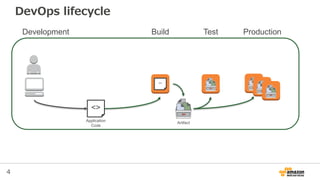
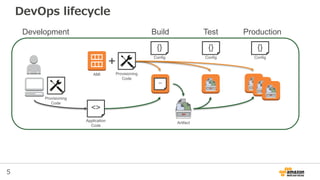
DevOps lifecycle
Build Test ProductionDevelopment
<>
<>
Application
Code
Artifact
5
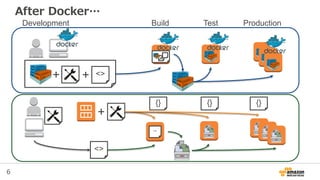
DevOps lifecycle
Build Test ProductionDevelopment
<>
<>
+
AMI Provisioning
Code
Application
Code
Artifact
Provisioning
Code
{}
Config
{}
Config
{}
Config
6
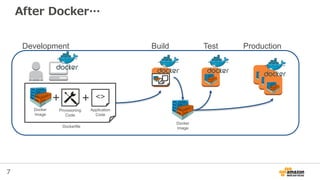
After Docker…
+ <>+
Build Test ProductionDevelopment
<>
<>
+
{} {} {}
7
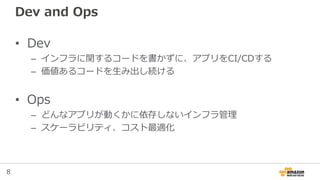
After Docker…
+
Provisioning
Code
<>
Application
Code
Docker
Image
+
Dockerfile
Docker
Image
Build Test ProductionDevelopment
8
Dev and Ops
• Dev
– インフラに関するコードを書かずに、アプリをCI/CDする
– 価値あるコードを生み出し続ける
• Ops
– どんなアプリが動くかに依存しないインフラ管理
– スケーラビリティ、コスト最適化
9
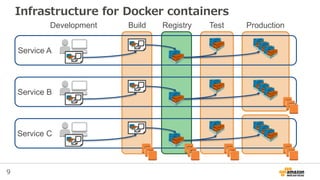
Infrastructure for Docker containers
Build Test ProductionDevelopment Registry
Service A
Service B
Service C
10
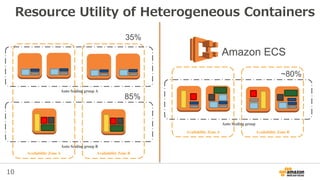
Resource Utility of Heterogeneous Containers
35%
85%
~80%
Amazon ECS
11
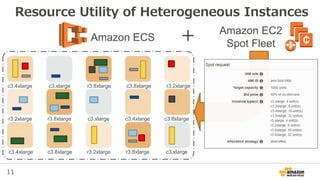
Resource Utility of Heterogeneous Instances
Amazon ECS
Amazon EC2
Spot Fleet
+
c3.xlarge
c3.xlarge
c3.xlarge
r3.8xlarge
r3.8xlarge
r3.8xlarge
c3.8xlarge
c3.8xlarge
c3.8xlarge
c3.4xlarge
c3.4xlarge
c3.4xlarge
r3.2xlarge
r3.2xlarge
r3.2xlarge
12
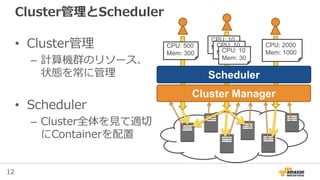
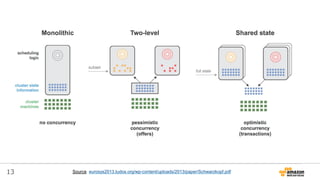
Cluster管理とScheduler
• Cluster管理
– 計算機群のリソース、
状態を常に管理
• Scheduler
– Cluster全体を見て適切
にContainerを配置
CPU: 500
Mem: 300
CPU: 10
Mem: 30 CPU: 2000
Mem: 1000
CPU: 10
Mem: 30CPU: 10
Mem: 30
Scheduler
Cluster Manager
13 Source: eurosys2013.tudos.org/wp-content/uploads/2013/paper/Schwarzkopf.pdf
14
Docker
Task
Container Instance
Amazon
ECS
Container
ECS Agent
ELB
Internet
ELB
User / Scheduler
API
Cluster Management Engine
Task
Container
Docker
Task
Container Instance
Container
ECS Agent
Task
Container
Docker
Task
Container Instance
Container
ECS Agent
Task
Container
AZ 1 AZ 2
Key/Value Store
Agent Communication Service
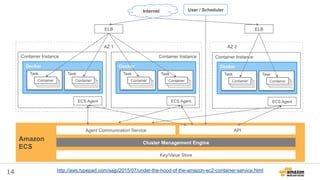
http://aws.typepad.com/sajp/2015/07/under-the-hood-of-the-amazon-ec2-container-service.html
15
Amazon ECS: Task Definition
16
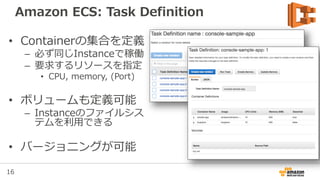
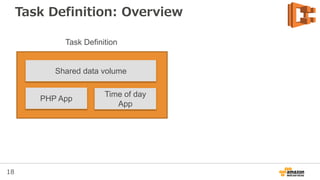
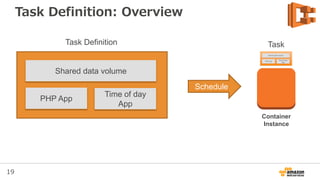
Amazon ECS: Task Definition
• Containerの集合を定義
– 必ず同じInstanceで稼働
– 要求するリソースを指定
• CPU, memory, (Port)
• ボリュームも定義可能
– Instanceのファイルシス
テムを利用できる
• バージョニングが可能
17
Task Definition: Container Definition
{
"name": "simple-demo",
"image": "foo/my-demo",
"cpu": 10,
"memory": 500,
"portMappings": [
{
"containerPort": 80,
"hostPort": 80
}
],
"mountPoints": [
{
"sourceVolume": "my-vol",
"containerPath": "/var/www/my-vol"
}
],
"entryPoint": [
"/usr/sbin/apache2",
"-D",
"FOREGROUND"
],
"essential": true
},
{
"name": "busybox",
"image": "busybox",
"cpu": 10,
"memory": 500,
"volumesFrom": [
{
"sourceContainer": "simple-demo"
}
],
"entryPoint": [
"sh",
"-c"
],
"command": [
"while true; do /bin/date > /var/www/my-vol/date; sleep 1; done"
],
"essential": false
}
18
Task Definition: Overview
Shared data volume
PHP App
Time of day
App
Task Definition
19
Task Definition: Overview
Container
Instance
Schedule
Shared data volume
PHP App
Time of day
App
Task Definition Task
20
Amazon ECS: Service
21
Amazon ECS: Service
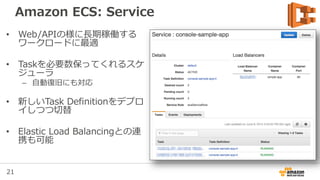
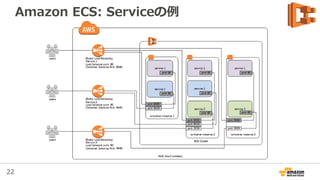
• Web/APIの様に長期稼働する
ワークロードに最適
• Taskを必要数保ってくれるスケ
ジューラ
– 自動復旧にも対応
• 新しいTask Definitionをデプロ
イしつつ切替
• Elastic Load Balancingとの連
携も可能
22
Amazon ECS: Serviceの例
23
Amazon ECS: ServiceのUpdate
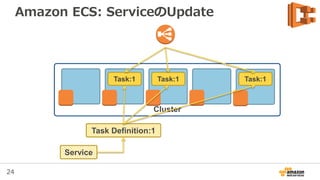
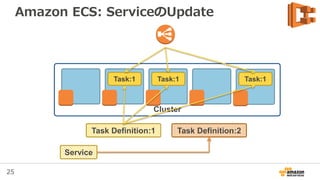
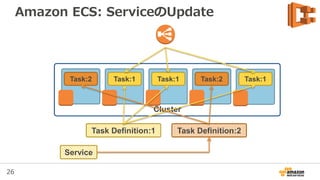
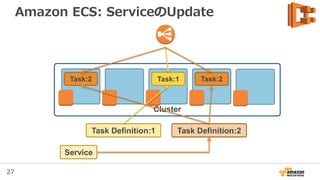
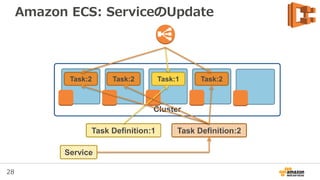
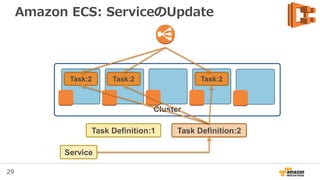
• Serviceが使うTask DefinitionをUpdateすると、
新しいTaskをデプロイできる
• 空いているリソースで新しいTaskを起動しなが
ら、徐々に古いTaskを止めていく
– Blue-Green deployment
– 中間では、新旧のTaskが混在する
24
Cluster
Amazon ECS: ServiceのUpdate
Service
Task Definition:1
Task:1Task:1 Task:1
25
Cluster
Amazon ECS: ServiceのUpdate
Service
Task Definition:1 Task Definition:2
Task:1Task:1 Task:1
26
Cluster
Amazon ECS: ServiceのUpdate
Service
Task Definition:1 Task Definition:2
Task:1Task:1 Task:1Task:2 Task:2
27
Cluster
Amazon ECS: ServiceのUpdate
Service
Task Definition:1 Task Definition:2
Task:1Task:2 Task:2
28
Cluster
Amazon ECS: ServiceのUpdate
Service
Task Definition:1 Task Definition:2
Task:1Task:2 Task:2Task:2
29
Cluster
Amazon ECS: ServiceのUpdate
Service
Task Definition:1 Task Definition:2
Task:2 Task:2Task:2
30
Case: Sony (Batch jobs)
© 2015, Amazon Web Services, Inc. or its Affiliates. All rights reserved.
Konstantin Wilms, Enterprise Solutions Architect, AWS
Ben Masek, CTO, Solutions Engineering Group, Sony PSA
October 2015
CMP405
Containerizing Video
Creating the Next Generation Video Transcoding Pipeline
1秒1秒が大事
なぜ?
スピードがコストに跳ね返る
変化
なぜ?
動画エンコードのライフサイクルは速い
ソフトウェアは捨てられる
なぜ?
しばしば高いエンジニアリングコストで
v1.0 v2.0 v3.0
AWSがどう役立ったか?
どのようにして?
エンコードの課題を解決するために
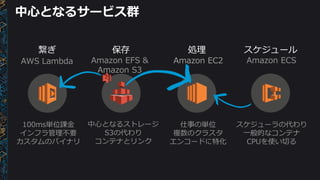
Amazon ECS
スケジュール
Amazon EC2
処理
中心となるサービス群
保存
AWS Lambda
繋ぎ
Amazon EFS &
Amazon S3
100ms単位課金
インフラ管理不要
カスタムのバイナリ
中心となるストレージ
S3の代わり
コンテナとリンク
仕事の単位
複数のクラスタ
エンコードに特化
スケジューラの代わり
一般的なコンテナ
CPUを使い切る
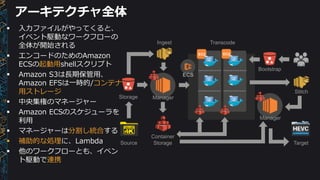
アーキテクチャ全体
Source
Storage
Ingest
Container
Storage
EC2
Bootstrap
Transcode
ECS
EC2
Manager
Target
Stitch
Manager
 入力ファイルがやってくると、
イベント駆動なワークフローの
全体が開始される
 エンコードのためのAmazon
ECSの起動用shellスクリプト
 Amazon S3は長期保管用、
Amazon EFSは一時的/コンテナ
用ストレージ
 中央集権のマネージャー
 Amazon ECSのスケジューラを
利用
 マネージャーは分割し統合する
 補助的な処理に、Lambda
 他のワークフローとも、イベン
ト駆動で連携
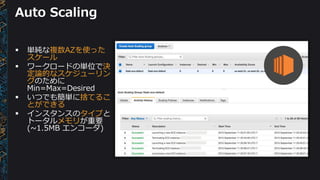
Auto Scaling
 単純な複数AZを使った
スケール
 ワークロードの単位で決
定論的なスケジューリン
グのために
Min=Max=Desired
 いつでも簡単に捨てるこ
とができる
 インスタンスのタイプと
トータルメモリが重要
(~1.5MB エンコーダ)
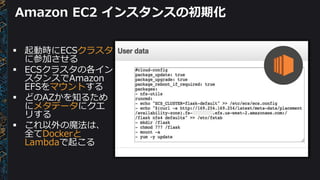
Amazon EC2 インスタンスの初期化
 起動時にECSクラスタ
に参加させる
 ECSクラスタの各イン
スタンスでAmazon
EFSをマウントする
 どのAZかを知るため
にメタデータにクエ
リする
 これ以外の魔法は、
全てDockerと
Lambdaで起こる
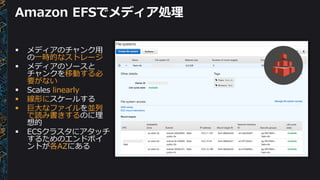
Amazon EFSでメディア処理
 メディアのチャンク用
の一時的なストレージ
 メディアのソースと
チャンクを移動する必
要がない
 Scales linearly
 線形にスケールする
 巨大なファイルを並列
で読み書きするのに理
想的
 ECSクラスタにアタッチ
するためのエンドポイ
ントが各AZにある
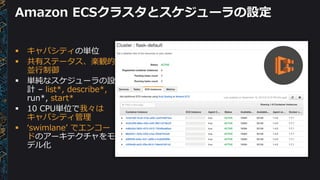
Amazon ECSクラスタとスケジューラの設定
 キャパシティの単位
 共有ステータス、楽観的
並行制御
 単純なスケジューラの設
計 – list*, describe*,
run*, start*
 10 CPU単位で我々は
キャパシティ管理
 ‘swimlane’ でエンコー
ドのアーキテクチャをモ
デル化
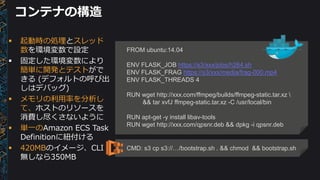
コンテナの構造
FROM ubuntu:14.04
ENV FLASK_JOB https://s3/xxx/jobs/h264.sh
ENV FLASK_FRAG https://s3/xxx/media/frag-000.mp4
ENV FLASK_THREADS 4
RUN wget http://xxx.com/ffmpeg/builds/ffmpeg-static.tar.xz 
&& tar xvfJ ffmpeg-static.tar.xz -C /usr/local/bin
RUN apt-get -y install libav-tools
RUN wget http://xxx.com/qpsnr.deb && dpkg -i qpsnr.deb
 起動時の処理とスレッド
数を環境変数で設定
 固定した環境変数により
簡単に開発とテストがで
きる (デフォルトの呼び出
しはデバッグ)
 メモリの利用率を分析し
て、ホストのリソースを
消費し尽くさないように
 単一のAmazon ECS Task
Definitionに紐付ける
 420MBのイメージ、CLI
無しなら350MB
CMD: s3 cp s3://…/bootstrap.sh . && chmod && bootstrap.sh
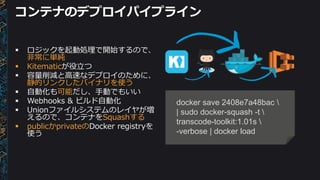
コンテナのデプロイパイプライン
docker save 2408e7a48bac 
| sudo docker-squash -t 
transcode-toolkit:1.01s 
-verbose | docker load
 ロジックを起動処理で開始するので、
非常に単純
 Kitematicが役立つ
 容量削減と高速なデプロイのために、
静的リンクしたバイナリを使う
 自動化も可能だし、手動でもいい
 Webhooks & ビルド自動化
 Unionファイルシステムのレイヤが増
えるので、コンテナをSquashする
 publicかprivateのDocker registryを
使う
44
まとめ
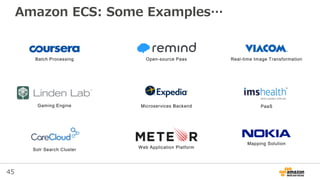
45
Batch Processing Open-source Paas Real-time Image Transformation
Solr Search Cluster
PaaSGaming Engine
Web Application Platform
Microservices Backend
Mapping Solution
Amazon ECS: Some Examples…
46 https://aws.amazon.com/docker/
AWS Container Partners
47
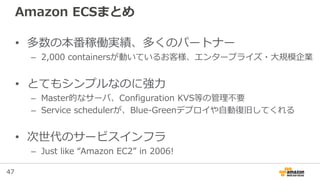
Amazon ECSまとめ
• 多数の本番稼働実績、多くのパートナー
– 2,000 containersが動いているお客様、エンタープライズ・大規模企業
• とてもシンプルなのに強力
– Master的なサーバ、Configuration KVS等の管理不要
– Service schedulerが、Blue-Greenデプロイや自動復旧してくれる
• 次世代のサービスインフラ
– Just like “Amazon EC2” in 2006!
48
Appendix
49
Case: Remind
© 2015, Amazon Web Services, Inc. or its Affiliates. All rights reserved.
Eric Holmes & Michael Barrett, Remind
October 2015
DVO308
Docker & ECS in Production
How We Migrated Our Infrastructure from Heroku to AWS
Remind
• A messaging platform for teachers.
• Chat/announcements/files
• Over 30 million users
• Used actively in ~50% of U.S. public schools
• Over 2 billion messages delivered
• ~50 employees. ~30 engineers.
Heroku was great, but…
• Every app on Heroku is publicly accessible
• Databases need to be exposed to Internet traffic
• Limited visibility and control
What we want from a PaaS
• AWS
• Flexibility
• Shared patterns for deployment
• Easy service operation
• Containers/Docker
Building an Empire
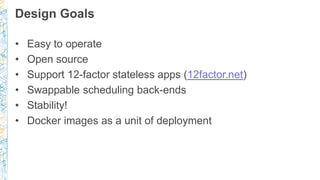
Design Goals
• Easy to operate
• Open source
• Support 12-factor stateless apps (12factor.net)
• Swappable scheduling back-ends
• Stability!
• Docker images as a unit of deployment
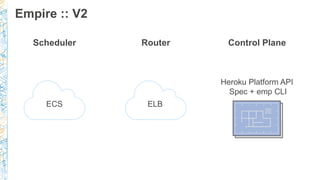
Empire :: V2
Scheduler Router Control Plane
ECS ELB
Heroku Platform API
Spec + emp CLI
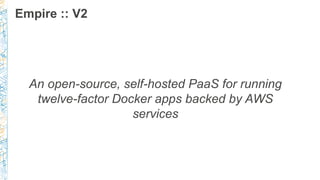
Empire :: V2
An open-source, self-hosted PaaS for running
twelve-factor Docker apps backed by AWS
services
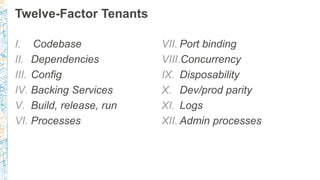
Twelve-Factor Tenants
I. Codebase
II. Dependencies
III. Config
IV. Backing Services
V. Build, release, run
VI. Processes
VII. Port binding
VIII.Concurrency
IX. Disposability
X. Dev/prod parity
XI. Logs
XII. Admin processes
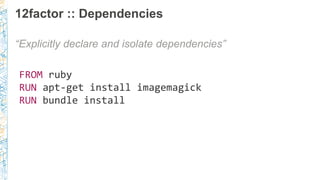
12factor :: Dependencies
“Explicitly declare and isolate dependencies”
FROM ruby
RUN apt-get install imagemagick
RUN bundle install
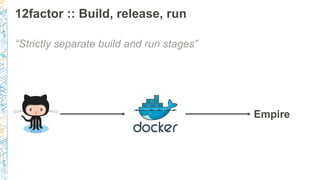
12factor :: Build, release, run
“Strictly separate build and run stages”
Empire
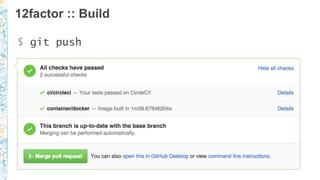
12factor :: Build
$ git push
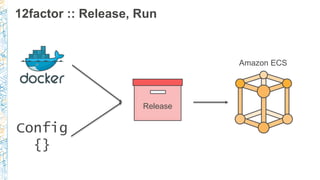
12factor :: Release, Run
Config
{}
Release
Amazon ECS
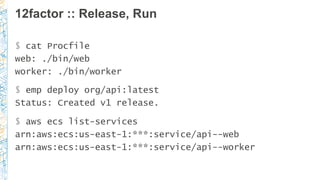
12factor :: Release, Run
$ cat Procfile
web: ./bin/web
worker: ./bin/worker
$ aws ecs list-services
arn:aws:ecs:us-east-1:***:service/api--web
arn:aws:ecs:us-east-1:***:service/api--worker
$ emp deploy org/api:latest
Status: Created v1 release.
Service Discovery
$ aws ecs describe-services --service api--web
"loadBalancers": [{
"containerName": "web”,
"containerPort": 9001,
"loadBalancerName”: "2888...a31d4c”
}]
$ curl http://api
Ok
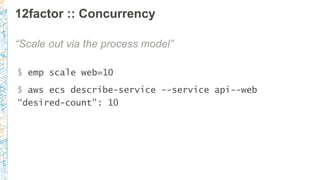
12factor :: Concurrency
“Scale out via the process model”
$ emp scale web=10
$ aws ecs describe-service --service api--web
“desired-count”: 10
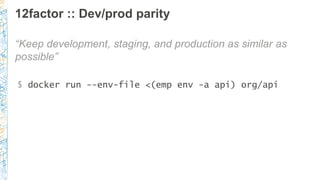
12factor :: Dev/prod parity
“Keep development, staging, and production as similar as
possible”
$ docker run --env-file <(emp env -a api) org/api
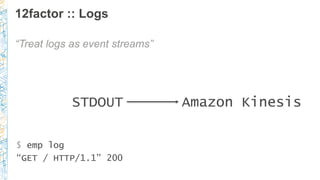
12factor :: Logs
“Treat logs as event streams”
$ emp log
“GET / HTTP/1.1” 200
STDOUT Amazon Kinesis
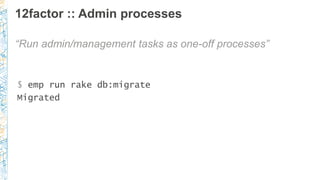
12factor :: Admin processes
“Run admin/management tasks as one-off processes”
$ emp run rake db:migrate
Migrated
69
Case: Coursera
© 2015, Amazon Web Services, Inc. or its Affiliates. All rights reserved.
Frank Chen, Coursera
Brennan Saeta, Coursera
October 2015
CMP406
Amazon ECS at Coursera
Powering a general-purpose near-line execution
microservice, while defending against untrusted code
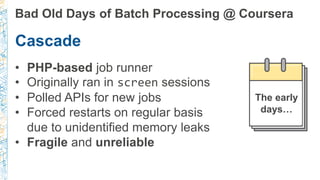
Bad Old Days of Batch Processing @ Coursera
Cascade
• PHP-based job runner
• Originally ran in screen sessions
• Polled APIs for new jobs
• Forced restarts on regular basis
due to unidentified memory leaks
• Fragile and unreliable
The early
days…
Bad Old Days of Batch Processing @ Coursera
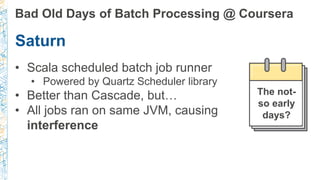
Saturn
• Scala scheduled batch job runner
• Powered by Quartz Scheduler library
• Better than Cascade, but…
• All jobs ran on same JVM, causing
interference
The not-
so early
days?
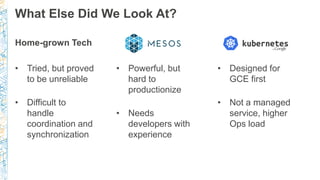
What Else Did We Look At?
Home-grown Tech
• Tried, but proved
to be unreliable
• Difficult to
handle
coordination and
synchronization
• Powerful, but
hard to
productionize
• Needs
developers with
experience
• Designed for
GCE first
• Not a managed
service, higher
Ops load
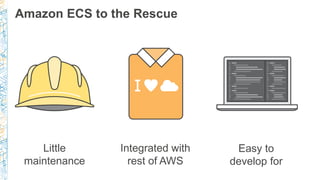
Amazon ECS to the Rescue
Little
maintenance
Integrated with
rest of AWS
Easy to
develop for
However…
Amazon ECS is a great building block,
but we still need to build tools around it
for our purposes.
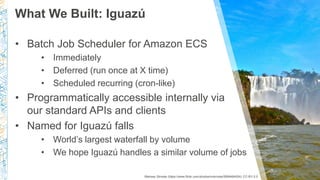
What We Built: Iguazú
Marissa Strniste (https://www.flickr.com/photos/mstrniste/5999464924) CC-BY-2.0
• Batch Job Scheduler for Amazon ECS
• Immediately
• Deferred (run once at X time)
• Scheduled recurring (cron-like)
• Programmatically accessible internally via
our standard APIs and clients
• Named for Iguazú falls
• World’s largest waterfall by volume
• We hope Iguazú handles a similar volume of jobs
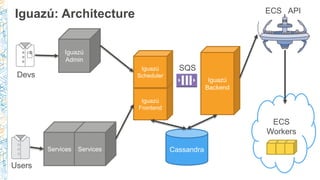
Iguazú
Frontend
Iguazú
Scheduler
Iguazú
Backend
Iguazú: Architecture
CassandraServices Services
Iguazú
Admin
ECS
Workers
SQS
ECS API
Devs
Users
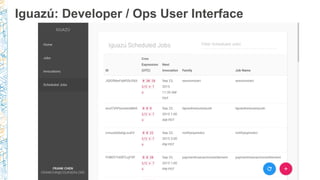
Iguazú: Developer / Ops User Interface
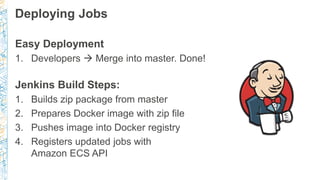
Deploying Jobs
Easy Deployment
1. Developers  Merge into master. Done!
Jenkins Build Steps:
1. Builds zip package from master
2. Prepares Docker image with zip file
3. Pushes image into Docker registry
4. Registers updated jobs with
Amazon ECS API
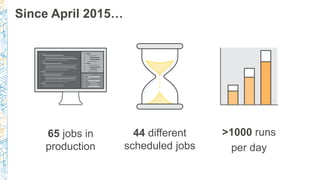
Since April 2015…
65 jobs in
production
>1000 runs
per day
44 different
scheduled jobs
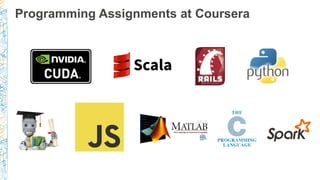
Programming Assignments at Coursera
The Security Challenge
Compiling and running untrusted, arbitrary code in
Amazon EC2
Would you like to compile and run C code from random
people on the Internet on your servers?
What We Built: GrID
Patrick Hoesly (https://www.flickr.com/photos/zooboing/5665221326/) CC-BY-2.0
• Service + architecture for grading
programming assignments
• Builds on Amazon ECS and Iguazú
• Named for Tron’s “digital frontier”
• Backronym: Grading Inside Docker
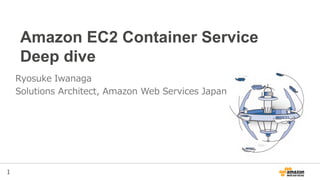
High-level GrID Architecture
Learners
GrID
Iguazú
S3 Bucket
ECS API
Grading
Machines
VPC
Firewalls
Production Acct GrID Grading Account

Amazon EC2 Container Service Deep dive