INDIANHEAD HOLSTEINS
                                                                                               BARRON, WISCONSIN

 Straight Vegetable Oil—
 On-site energy self-sufficiency


        “80% of diesel engines in Europe are burning straight vegetable oil because of the
                  simplicity of production...I think there is a real future in it.”
                               Bob Schauf - Indianhead Holsteins


  SUMMARY                                                    HISTORY AND BACKGROUND
  Indianhead Holsteins is located between Barron and         Robert and Karyn Schauf have operated Indianhead
  Cumberland, in rural northwest Wisconsin. It is owned      Holsteins since 1981. The 100 milking cows produce
  by Robert and Karyn Schauf and has 100 milking cows.       30,000 pounds of milk a day. During the summer of
  The farm deals in the sale of registered Holsteins and     2006, due primarily to increasing fuel prices, they first
  Holstein embryos and sells wood shavings for bedding.      decided to look into how the farm could implement a
  In addition, the farm also grows alfalfa, canning beans,   bioenergy technology to reduce the farm’s dependence
  corn, and wheat. In 2007, it started purchasing canola     on fossil fuels while not negatively impacting profits.
  seeds and pressing them to make straight vegetable oil     Initial discussion steered them towards bio-diesel. How-
  (SVO) for on-site fuel; and using the meal as a dietary    ever, after discussions with a German counterpart, it
  supplement for the cows. As a result, the farm is in the   was decided to focus on straight vegetable oil. They
  process of becoming energy self-sufficient. The Schaufs    decided to look at vegetable oil, as opposed to bio-
  are currently working cooperatively with partners in       diesel, for several reasons. For one, vegetable oil is a
  Germany to create an even more efficient and effective     less intensive operation, which limits the need for addi-
  on-site energy system.                                     tional staff and for additional chemicals.


          PREPARED BY ERIC ANDERSON, WEST CENTRAL WISCONSIN REGIONAL PLANNING COMMISSION, AND
               ANDREW DANE, BARRON & CHIPPEWA COUNTY UNIVERSITY OF WISCONSIN-EXTENSION.
      FUNDING WAS PROVIDED, IN PART, BY THE AGRICULTURAL MARKETING RESOURCE CENTER (WWW.AGMRC.ORG).
OPERATION                                                      also allow for a winter wheat                           CATEGORY
    The farm has had a press to make canola oil and the by-        planting after the canola has                         Vegetable Oil
    product canola meal since January 2007. Canola was             been harvested.                              PROJECT START DATE
    chosen as a feedstock due to its flash point of five de-                                                                   2007
    grees Fahrenheit and the quality of the meal by-product        Before processing, the canola
    that is produced during the press process. Additionally,       seeds are stored in a steel bin.      CO2 AND N20 REDUCTIONS
    canola contains approximately 40 percent to 50 percent         They are transported inside by                   Not available
    of its weight in oil. This compares to only 20 percent         a flex auger to a loft where the             FINANCIAL SAVINGS
    for soybeans and less for corn. Furthermore, canola has        seeds are pre-heated. The heat-        Over $2/gal. of fuel (based
    a low percent of saturated fat (seven percent), which          ing of the seeds increases yield
                                                                                                            on $4.50/gal. for diesel)
    makes it a good choice to run vehicles on.                     five to six percent when the
                                                                   seeds are pressed. The seeds                 INITIAL INVESTMENTS
    The meal that is produced on the farm consists of 38-42        are then dropped down into the                Storage bin = $20,000
    percent protein and 12-14 percent energy. It also has          press.                                              Press = $28,000
    high levels of beta carotene and protein. Currently, the                                                     Additional = $50,000
    cows receive three pounds of canola meal a day. The            The press is 10 horsepower
    farm has noticed increased milk production                     and has a three phase, variable          POSSIBLE ADJACENCIES
    (approximately three additional pounds a day) since the        speed motor. The press grinds         Cow feed, alternating crops
    introduction of the canola meal into the cows’ diet.           the seeds, producing both ca-                    PROJECT FUNDING
                                                                   nola oil and canola meal. The                        Self financing
                                                                   oil is transported via short pip-
Positives of using canola include a                                ing to four 250 gallon tanks                       PROJECT STATUS
                                                                   located in the adjacent room. A                          Ongoing
low flashpoint, a high quality meal,
                                                                   5,000 gallon tank is used to                         CONTACT
and a short growing season.                                        store the vegetable oil after the                Robert Schauf
                                                                   filtration process which occurs
                                                                                                         bob@indianheadfarms.com
    Another positive aspect of canola is its short growing         as the oil passes from the
    season, which runs from April to July. The shorter sea-        smaller tanks into the 5,000
    son reduces risk when compared with planting a more            gallon tank.
    traditional summer crop with a longer growing season.
    These risks include weather, insects, and other vari-          One ton of seed is currently producing around 80 gal-
    ables. At Indianhead Holsteins, planting canola will           lons of oil. The operation is pressing a ton and half of
                                                                   seeds per day yielding approximately 125 gallons of oil.


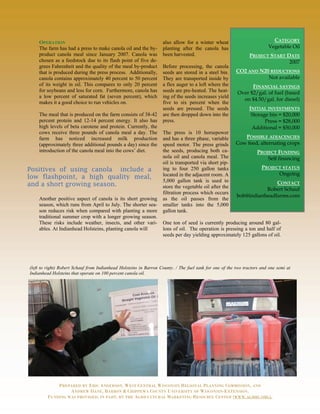
(left to right) Robert Schauf from Indianhead Holsteins in Barron County. / The fuel tank for one of the two tractors and one semi at
Indianhead Holsteins that operate on 100 percent canola oil.


             PREPARED BY ERIC ANDERSON, WEST CENTRAL WISCONSIN REGIONAL PLANNING COMMISSION, AND
                  ANDREW DANE, BARRON & CHIPPEWA COUNTY UNIVERSITY OF WISCONSIN-EXTENSION.
         FUNDING WAS PROVIDED, IN PART, BY THE AGRICULTURAL MARKETING RESOURCE CENTER (WWW.AGMRC.ORG).
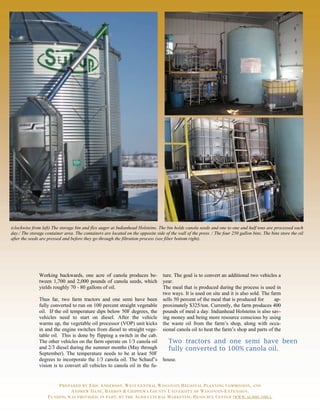
(clockwise from left) The storage bin and flex auger at Indianhead Holsteins. The bin holds canola seeds and one to one and half tons are processed each
day./ The storage container area. The containers are located on the opposite side of the wall of the press. / The four 250 gallon bins. The bins store the oil
after the seeds are pressed and before they go through the filtration process (see filter bottom right).


               Working backwards, one acre of canola produces be-                 ture. The goal is to convert an additional two vehicles a
               tween 1,700 and 2,000 pounds of canola seeds, which                year.
               yields roughly 70 - 80 gallons of oil.                             The meal that is produced during the process is used in
                                                                                  two ways. It is used on site and it is also sold. The farm
               Thus far, two farm tractors and one semi have been                 sells 50 percent of the meal that is produced for       ap-
               fully converted to run on 100 percent straight vegetable           proximately $325/ton. Currently, the farm produces 400
               oil. If the oil temperature dips below 50F degrees, the            pounds of meal a day. Indianhead Holsteins is also sav-
               vehicles need to start on diesel. After the vehicle                ing money and being more resource conscious by using
               warms up, the vegetable oil processor (VOP) unit kicks             the waste oil from the farm’s shop, along with occa-
               in and the engine switches from diesel to straight vege-           sional canola oil to heat the farm’s shop and parts of the
               table oil. This is done by flipping a switch in the cab.
               The other vehicles on the farm operate on 1/3 canola oil              Two tractors and one semi have been
               and 2/3 diesel during the summer months (May through                  fully converted to 100% canola oil.
               September). The temperature needs to be at least 50F
               degrees to incorporate the 1/3 canola oil. The Schauf’s            house.
               vision is to convert all vehicles to canola oil in the fu-


                       PREPARED BY ERIC ANDERSON, WEST CENTRAL WISCONSIN REGIONAL PLANNING COMMISSION, AND
                            ANDREW DANE, BARRON & CHIPPEWA COUNTY UNIVERSITY OF WISCONSIN-EXTENSION.
                   FUNDING WAS PROVIDED, IN PART, BY THE AGRICULTURAL MARKETING RESOURCE CENTER (WWW.AGMRC.ORG).
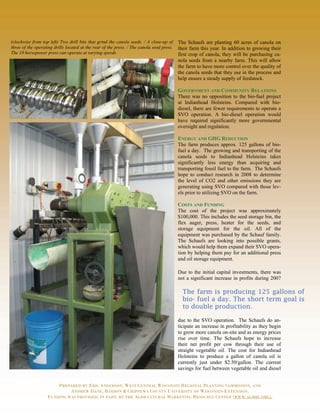
(clockwise from top left) Two drill bits that grind the canola seeds. / A close-up of      The Schaufs are planting 60 acres of canola on
three of the operating drills located at the rear of the press. / The canola seed press.   their farm this year. In addition to growing their
The 10 horsepower press can operate at varying speeds.                                     first crop of canola, they will be purchasing ca-
                                                                                           nola seeds from a nearby farm. This will allow
                                                                                           the farm to have more control over the quality of
                                                                                           the canola seeds that they use in the process and
                                                                                           help ensure a steady supply of feedstock.

                                                                                           GOVERNMENT AND COMMUNITY RELATIONS
                                                                                           There was no opposition to the bio-fuel project
                                                                                           at Indianhead Holsteins. Compared with bio-
                                                                                           diesel, there are fewer requirements to operate a
                                                                                           SVO operation. A bio-diesel operation would
                                                                                           have required significantly more governmental
                                                                                           oversight and regulation.

                                                                                           ENERGY AND GHG REDUCTION
                                                                                           The farm produces approx. 125 gallons of bio-
                                                                                           fuel a day. The growing and transporting of the
                                                                                           canola seeds to Indianhead Holsteins takes
                                                                                           significantly less energy than acquiring and
                                                                                           transporting fossil fuel to the farm. The Schaufs
                                                                                           hope to conduct research in 2008 to determine
                                                                                           the level of CO2 and other emissions they are
                                                                                           generating using SVO compared with those lev-
                                                                                           els prior to utilizing SVO on the farm.

                                                                                           COSTS AND FUNDING
                                                                                           The cost of the project was approximately
                                                                                           $100,000. This includes the seed storage bin, the
                                                                                           flex auger, press, heater for the seeds, and
                                                                                           storage equipment for the oil. All of the
                                                                                           equipment was purchased by the Schauf family.
                                                                                           The Schaufs are looking into possible grants,
                                                                                           which would help them expand their SVO opera-
                                                                                           tion by helping them pay for an additional press
                                                                                           and oil storage equipment.

                                                                                           Due to the initial capital investments, there was
                                                                                           not a significant increase in profits during 2007

                                                                                             The farm is producing 125 gallons of
                                                                                             bio- fuel a day. The short term goal is
                                                                                             to double production.

                                                                                           due to the SVO operation. The Schaufs do an-
                                                                                           ticipate an increase in profitability as they begin
                                                                                           to grow more canola on-site and as energy prices
                                                                                           rise over time. The Schaufs hope to increase
                                                                                           their net profit per cow through their use of
                                                                                           straight vegetable oil. The cost for Indianhead
                                                                                           Holsteins to produce a gallon of canola oil is
                                                                                           currently just under $2.50/gallon. The current
                                                                                           savings for fuel between vegetable oil and diesel


                       PREPARED BY ERIC ANDERSON, WEST CENTRAL WISCONSIN REGIONAL PLANNING COMMISSION, AND
                            ANDREW DANE, BARRON & CHIPPEWA COUNTY UNIVERSITY OF WISCONSIN-EXTENSION.
                   FUNDING WAS PROVIDED, IN PART, BY THE AGRICULTURAL MARKETING RESOURCE CENTER (WWW.AGMRC.ORG).
is $2.00/gallon. Of course the profitability of SVO will            Another challenge involved the purchase of seeds with
     change over time as the price of both SVO inputs and                excessive residue on them.
     the price of petroleum fluctuate.
                                                                         RECOMMENDATIONS AND THE FUTURE
                                                                         The next step for the Schaufs is to grow canola onsite.
Indianhead Holsteins produces straight                                   Indianhead Holsteins will grow 20 percent of the seeds
vegetable oil for under $2.50/gallon.                                    it will press in 2008. In addition, the Schaufs would like
                                                                         to install an additional press that would increase the oil
                                                                         and meal production. This will enable the Schaufs to
     CHALLENGES AND BARRIERS                                             increase the number of vehicles that operate on
     The challenges and barriers existed mostly with lack of             vegetable oil. An increase in oil production will also
     available funding in helping the farm set up the project.           allow the farm to enter the food grade market. They
     The majority of bio-fuel funding opportunities seem to              plan to analyze the feasibility of bottling the canola oil
     be targeted at bio-diesel currently. According to Robert            on farm.
     Schauf, there is a lack of interest and availability of
     resources to help fund straight vegetable oil projects.


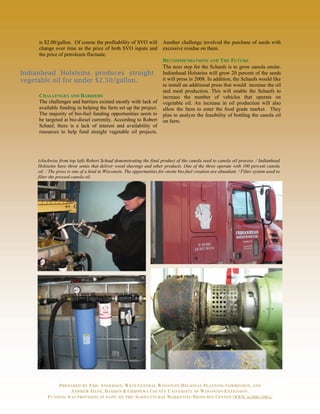
     (clockwise from top left) Robert Schauf demonstrating the final product of the canola seed to canola oil process. / Indianhead
     Holsteins have three semis that deliver wood shavings and other products. One of the three operate with 100 percent canola
     oil. / The press is one of a kind in Wisconsin. The opportunities for onsite bio-fuel creation are abundant. / Filter system used to
     filter the pressed canola oil.


              PREPARED BY ERIC ANDERSON, WEST CENTRAL WISCONSIN REGIONAL PLANNING COMMISSION, AND
                   ANDREW DANE, BARRON & CHIPPEWA COUNTY UNIVERSITY OF WISCONSIN-EXTENSION.
          FUNDING WAS PROVIDED, IN PART, BY THE AGRICULTURAL MARKETING RESOURCE CENTER (WWW.AGMRC.ORG).
*Canola or “rapeseed” is grown through-
                                                                                  out the world. In 2005, China led the
                                                                                  world in production of rapeseed with 13.0
                                                                                  million metric tons. It was followed by
                                                                                  Canada (8.4), India (6.4), Germany(4.7),
                                                                                  and France(4.4). Europe produces just
                                                                                  over 15 million tons of rapeseed in total.

                                                                                  *An internationally regulated definition
                                                                                  of canola differentiates it from rapeseed,
                                                                                  based upon its having less than two per-
                                                                                  cent erucic acid and less than 30 umoles
                                                                                  glucosinolates. Oilseed products that do
                                                                                  not meet this standard cannot use the
                                                                                  trademarked term canola.


      A key recommendation to potential SVO producers is        A goal of Indianhead Holsteins is to be self dependent in
      making sure that the canola seeds are clean and do not    regards to fuel. Part of this process involves increasing
      have any residue on them. Producers should start their    the amount of canola seeds that are pressed into oil. At
      process with clean seeds, which will eliminate any need   this time, the desire is to double the amount of oil
                                                                produced. The Schaufs do not plan to make their own
Indianhead Holsteins is an example of                           bio-diesel. The methanol and lye inputs; and the addi-
how a farm operation that is not                                tional maintenance and observation that bio-diesel re-
significantly large can quickly address                         quires make it less attractive to them than straight vege-
                                                                table oil production.
reducing their dependence on fossil fuel.
                                                              SVO production at Indianhead Holsteins is an example
      to switch seed providers and associated costs that go of how a smaller farm operation can quickly reduce their
      along with the switch. Also, a quality filter should be dependence on fossil fuel. The Schaufs have success-
      used that can ensure a quality feedstock.               fully transitioned a portion of their fleet to run on
                                                              blended SVO/diesel and 100% straight vegetable oil.


             PREPARED BY ERIC ANDERSON, WEST CENTRAL WISCONSIN REGIONAL PLANNING COMMISSION, AND
                  ANDREW DANE, BARRON & CHIPPEWA COUNTY UNIVERSITY OF WISCONSIN-EXTENSION.
         FUNDING WAS PROVIDED, IN PART, BY THE AGRICULTURAL MARKETING RESOURCE CENTER (WWW.AGMRC.ORG).

Straight Vegetable Oil: On-Site Energy Self-Sufficiency

  • 1.
    INDIANHEAD HOLSTEINS BARRON, WISCONSIN Straight Vegetable Oil— On-site energy self-sufficiency “80% of diesel engines in Europe are burning straight vegetable oil because of the simplicity of production...I think there is a real future in it.” Bob Schauf - Indianhead Holsteins SUMMARY HISTORY AND BACKGROUND Indianhead Holsteins is located between Barron and Robert and Karyn Schauf have operated Indianhead Cumberland, in rural northwest Wisconsin. It is owned Holsteins since 1981. The 100 milking cows produce by Robert and Karyn Schauf and has 100 milking cows. 30,000 pounds of milk a day. During the summer of The farm deals in the sale of registered Holsteins and 2006, due primarily to increasing fuel prices, they first Holstein embryos and sells wood shavings for bedding. decided to look into how the farm could implement a In addition, the farm also grows alfalfa, canning beans, bioenergy technology to reduce the farm’s dependence corn, and wheat. In 2007, it started purchasing canola on fossil fuels while not negatively impacting profits. seeds and pressing them to make straight vegetable oil Initial discussion steered them towards bio-diesel. How- (SVO) for on-site fuel; and using the meal as a dietary ever, after discussions with a German counterpart, it supplement for the cows. As a result, the farm is in the was decided to focus on straight vegetable oil. They process of becoming energy self-sufficient. The Schaufs decided to look at vegetable oil, as opposed to bio- are currently working cooperatively with partners in diesel, for several reasons. For one, vegetable oil is a Germany to create an even more efficient and effective less intensive operation, which limits the need for addi- on-site energy system. tional staff and for additional chemicals. PREPARED BY ERIC ANDERSON, WEST CENTRAL WISCONSIN REGIONAL PLANNING COMMISSION, AND ANDREW DANE, BARRON & CHIPPEWA COUNTY UNIVERSITY OF WISCONSIN-EXTENSION. FUNDING WAS PROVIDED, IN PART, BY THE AGRICULTURAL MARKETING RESOURCE CENTER (WWW.AGMRC.ORG).
  • 2.
    OPERATION also allow for a winter wheat CATEGORY The farm has had a press to make canola oil and the by- planting after the canola has Vegetable Oil product canola meal since January 2007. Canola was been harvested. PROJECT START DATE chosen as a feedstock due to its flash point of five de- 2007 grees Fahrenheit and the quality of the meal by-product Before processing, the canola that is produced during the press process. Additionally, seeds are stored in a steel bin. CO2 AND N20 REDUCTIONS canola contains approximately 40 percent to 50 percent They are transported inside by Not available of its weight in oil. This compares to only 20 percent a flex auger to a loft where the FINANCIAL SAVINGS for soybeans and less for corn. Furthermore, canola has seeds are pre-heated. The heat- Over $2/gal. of fuel (based a low percent of saturated fat (seven percent), which ing of the seeds increases yield on $4.50/gal. for diesel) makes it a good choice to run vehicles on. five to six percent when the seeds are pressed. The seeds INITIAL INVESTMENTS The meal that is produced on the farm consists of 38-42 are then dropped down into the Storage bin = $20,000 percent protein and 12-14 percent energy. It also has press. Press = $28,000 high levels of beta carotene and protein. Currently, the Additional = $50,000 cows receive three pounds of canola meal a day. The The press is 10 horsepower farm has noticed increased milk production and has a three phase, variable POSSIBLE ADJACENCIES (approximately three additional pounds a day) since the speed motor. The press grinds Cow feed, alternating crops introduction of the canola meal into the cows’ diet. the seeds, producing both ca- PROJECT FUNDING nola oil and canola meal. The Self financing oil is transported via short pip- Positives of using canola include a ing to four 250 gallon tanks PROJECT STATUS located in the adjacent room. A Ongoing low flashpoint, a high quality meal, 5,000 gallon tank is used to CONTACT and a short growing season. store the vegetable oil after the Robert Schauf filtration process which occurs bob@indianheadfarms.com Another positive aspect of canola is its short growing as the oil passes from the season, which runs from April to July. The shorter sea- smaller tanks into the 5,000 son reduces risk when compared with planting a more gallon tank. traditional summer crop with a longer growing season. These risks include weather, insects, and other vari- One ton of seed is currently producing around 80 gal- ables. At Indianhead Holsteins, planting canola will lons of oil. The operation is pressing a ton and half of seeds per day yielding approximately 125 gallons of oil. (left to right) Robert Schauf from Indianhead Holsteins in Barron County. / The fuel tank for one of the two tractors and one semi at Indianhead Holsteins that operate on 100 percent canola oil. PREPARED BY ERIC ANDERSON, WEST CENTRAL WISCONSIN REGIONAL PLANNING COMMISSION, AND ANDREW DANE, BARRON & CHIPPEWA COUNTY UNIVERSITY OF WISCONSIN-EXTENSION. FUNDING WAS PROVIDED, IN PART, BY THE AGRICULTURAL MARKETING RESOURCE CENTER (WWW.AGMRC.ORG).
  • 3.
    (clockwise from left)The storage bin and flex auger at Indianhead Holsteins. The bin holds canola seeds and one to one and half tons are processed each day./ The storage container area. The containers are located on the opposite side of the wall of the press. / The four 250 gallon bins. The bins store the oil after the seeds are pressed and before they go through the filtration process (see filter bottom right). Working backwards, one acre of canola produces be- ture. The goal is to convert an additional two vehicles a tween 1,700 and 2,000 pounds of canola seeds, which year. yields roughly 70 - 80 gallons of oil. The meal that is produced during the process is used in two ways. It is used on site and it is also sold. The farm Thus far, two farm tractors and one semi have been sells 50 percent of the meal that is produced for ap- fully converted to run on 100 percent straight vegetable proximately $325/ton. Currently, the farm produces 400 oil. If the oil temperature dips below 50F degrees, the pounds of meal a day. Indianhead Holsteins is also sav- vehicles need to start on diesel. After the vehicle ing money and being more resource conscious by using warms up, the vegetable oil processor (VOP) unit kicks the waste oil from the farm’s shop, along with occa- in and the engine switches from diesel to straight vege- sional canola oil to heat the farm’s shop and parts of the table oil. This is done by flipping a switch in the cab. The other vehicles on the farm operate on 1/3 canola oil Two tractors and one semi have been and 2/3 diesel during the summer months (May through fully converted to 100% canola oil. September). The temperature needs to be at least 50F degrees to incorporate the 1/3 canola oil. The Schauf’s house. vision is to convert all vehicles to canola oil in the fu- PREPARED BY ERIC ANDERSON, WEST CENTRAL WISCONSIN REGIONAL PLANNING COMMISSION, AND ANDREW DANE, BARRON & CHIPPEWA COUNTY UNIVERSITY OF WISCONSIN-EXTENSION. FUNDING WAS PROVIDED, IN PART, BY THE AGRICULTURAL MARKETING RESOURCE CENTER (WWW.AGMRC.ORG).
  • 4.
    (clockwise from topleft) Two drill bits that grind the canola seeds. / A close-up of The Schaufs are planting 60 acres of canola on three of the operating drills located at the rear of the press. / The canola seed press. their farm this year. In addition to growing their The 10 horsepower press can operate at varying speeds. first crop of canola, they will be purchasing ca- nola seeds from a nearby farm. This will allow the farm to have more control over the quality of the canola seeds that they use in the process and help ensure a steady supply of feedstock. GOVERNMENT AND COMMUNITY RELATIONS There was no opposition to the bio-fuel project at Indianhead Holsteins. Compared with bio- diesel, there are fewer requirements to operate a SVO operation. A bio-diesel operation would have required significantly more governmental oversight and regulation. ENERGY AND GHG REDUCTION The farm produces approx. 125 gallons of bio- fuel a day. The growing and transporting of the canola seeds to Indianhead Holsteins takes significantly less energy than acquiring and transporting fossil fuel to the farm. The Schaufs hope to conduct research in 2008 to determine the level of CO2 and other emissions they are generating using SVO compared with those lev- els prior to utilizing SVO on the farm. COSTS AND FUNDING The cost of the project was approximately $100,000. This includes the seed storage bin, the flex auger, press, heater for the seeds, and storage equipment for the oil. All of the equipment was purchased by the Schauf family. The Schaufs are looking into possible grants, which would help them expand their SVO opera- tion by helping them pay for an additional press and oil storage equipment. Due to the initial capital investments, there was not a significant increase in profits during 2007 The farm is producing 125 gallons of bio- fuel a day. The short term goal is to double production. due to the SVO operation. The Schaufs do an- ticipate an increase in profitability as they begin to grow more canola on-site and as energy prices rise over time. The Schaufs hope to increase their net profit per cow through their use of straight vegetable oil. The cost for Indianhead Holsteins to produce a gallon of canola oil is currently just under $2.50/gallon. The current savings for fuel between vegetable oil and diesel PREPARED BY ERIC ANDERSON, WEST CENTRAL WISCONSIN REGIONAL PLANNING COMMISSION, AND ANDREW DANE, BARRON & CHIPPEWA COUNTY UNIVERSITY OF WISCONSIN-EXTENSION. FUNDING WAS PROVIDED, IN PART, BY THE AGRICULTURAL MARKETING RESOURCE CENTER (WWW.AGMRC.ORG).
  • 5.
    is $2.00/gallon. Ofcourse the profitability of SVO will Another challenge involved the purchase of seeds with change over time as the price of both SVO inputs and excessive residue on them. the price of petroleum fluctuate. RECOMMENDATIONS AND THE FUTURE The next step for the Schaufs is to grow canola onsite. Indianhead Holsteins produces straight Indianhead Holsteins will grow 20 percent of the seeds vegetable oil for under $2.50/gallon. it will press in 2008. In addition, the Schaufs would like to install an additional press that would increase the oil and meal production. This will enable the Schaufs to CHALLENGES AND BARRIERS increase the number of vehicles that operate on The challenges and barriers existed mostly with lack of vegetable oil. An increase in oil production will also available funding in helping the farm set up the project. allow the farm to enter the food grade market. They The majority of bio-fuel funding opportunities seem to plan to analyze the feasibility of bottling the canola oil be targeted at bio-diesel currently. According to Robert on farm. Schauf, there is a lack of interest and availability of resources to help fund straight vegetable oil projects. (clockwise from top left) Robert Schauf demonstrating the final product of the canola seed to canola oil process. / Indianhead Holsteins have three semis that deliver wood shavings and other products. One of the three operate with 100 percent canola oil. / The press is one of a kind in Wisconsin. The opportunities for onsite bio-fuel creation are abundant. / Filter system used to filter the pressed canola oil. PREPARED BY ERIC ANDERSON, WEST CENTRAL WISCONSIN REGIONAL PLANNING COMMISSION, AND ANDREW DANE, BARRON & CHIPPEWA COUNTY UNIVERSITY OF WISCONSIN-EXTENSION. FUNDING WAS PROVIDED, IN PART, BY THE AGRICULTURAL MARKETING RESOURCE CENTER (WWW.AGMRC.ORG).
  • 6.
    *Canola or “rapeseed”is grown through- out the world. In 2005, China led the world in production of rapeseed with 13.0 million metric tons. It was followed by Canada (8.4), India (6.4), Germany(4.7), and France(4.4). Europe produces just over 15 million tons of rapeseed in total. *An internationally regulated definition of canola differentiates it from rapeseed, based upon its having less than two per- cent erucic acid and less than 30 umoles glucosinolates. Oilseed products that do not meet this standard cannot use the trademarked term canola. A key recommendation to potential SVO producers is A goal of Indianhead Holsteins is to be self dependent in making sure that the canola seeds are clean and do not regards to fuel. Part of this process involves increasing have any residue on them. Producers should start their the amount of canola seeds that are pressed into oil. At process with clean seeds, which will eliminate any need this time, the desire is to double the amount of oil produced. The Schaufs do not plan to make their own Indianhead Holsteins is an example of bio-diesel. The methanol and lye inputs; and the addi- how a farm operation that is not tional maintenance and observation that bio-diesel re- significantly large can quickly address quires make it less attractive to them than straight vege- table oil production. reducing their dependence on fossil fuel. SVO production at Indianhead Holsteins is an example to switch seed providers and associated costs that go of how a smaller farm operation can quickly reduce their along with the switch. Also, a quality filter should be dependence on fossil fuel. The Schaufs have success- used that can ensure a quality feedstock. fully transitioned a portion of their fleet to run on blended SVO/diesel and 100% straight vegetable oil. PREPARED BY ERIC ANDERSON, WEST CENTRAL WISCONSIN REGIONAL PLANNING COMMISSION, AND ANDREW DANE, BARRON & CHIPPEWA COUNTY UNIVERSITY OF WISCONSIN-EXTENSION. FUNDING WAS PROVIDED, IN PART, BY THE AGRICULTURAL MARKETING RESOURCE CENTER (WWW.AGMRC.ORG).