Powered by Waste Vegetable Oil (WVO)
                                         2002 Volkswagen Jetta
                                    1.9 Liter TDI Stock Diesel Engine

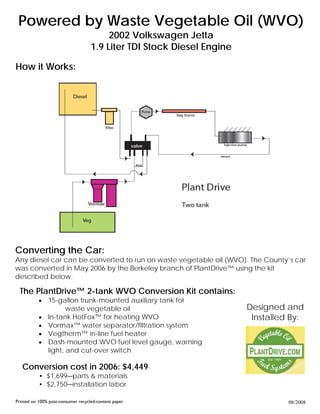
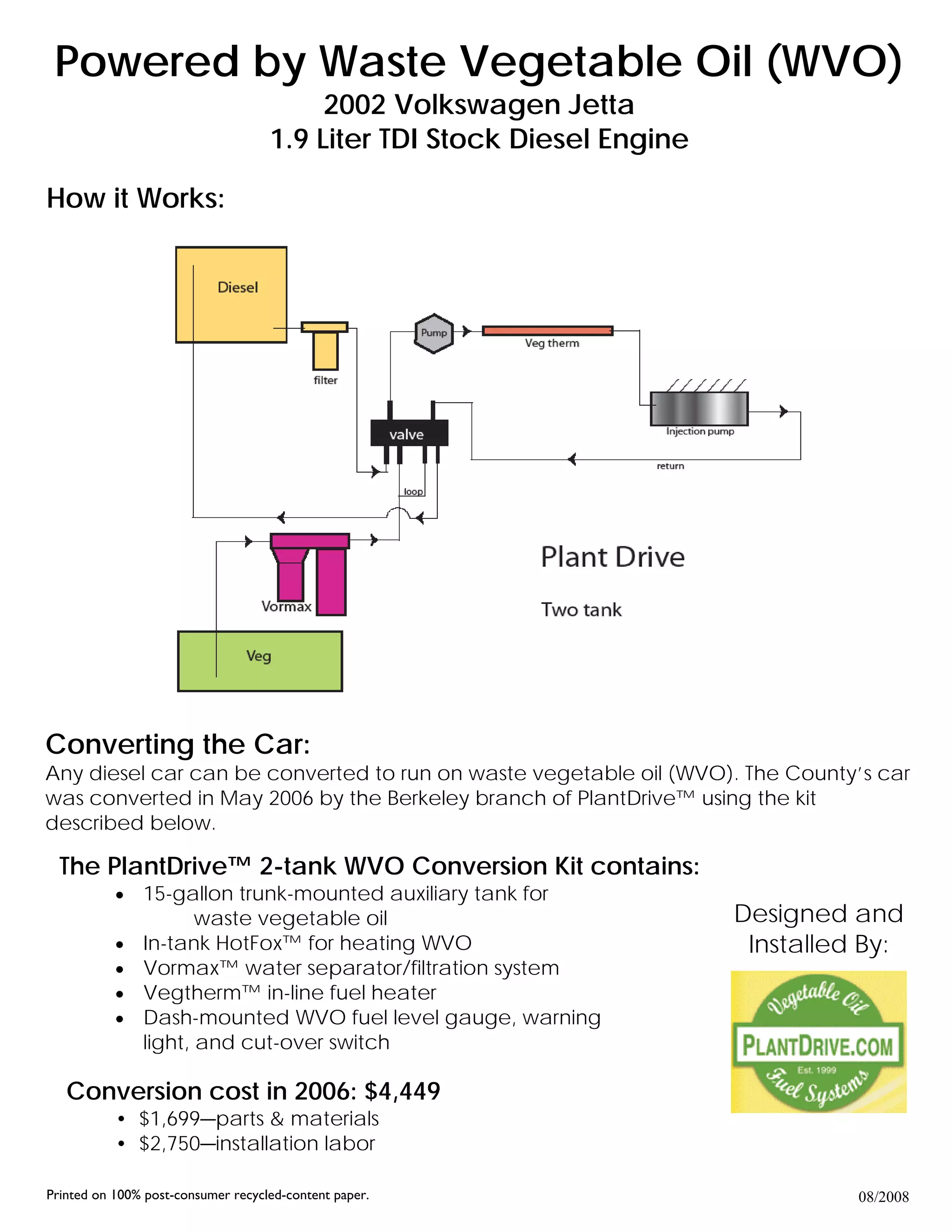
How it Works:


Converting the Car:
Any diesel car can be converted to run on waste vegetable oil (WVO). The County’s car
was converted in May 2006 by the Berkeley branch of PlantDrive™ using the kit
described below.

  The PlantDrive™ 2-tank WVO Conversion Kit contains:
           •   15-gallon trunk-mounted auxiliary tank for
                      waste vegetable oil                               Designed and
           •   In-tank HotFox™ for heating WVO                           Installed By:
           •   Vormax™ water separator/filtration system
           •   Vegtherm™ in-line fuel heater
           •   Dash-mounted WVO fuel level gauge, warning
               light, and cut-over switch

   Conversion cost in 2006: $4,449
           • $1,699―parts & materials
           • $2,750―installation labor

Printed on 100% post-consumer recycled-content paper.                             08/2008
ABOUT THE WASTE VEGETABLE OIL CAR

The Oil...                                                Does the car get
                                                          good mileage? The
What’s the difference between Waste Vegetable             car gets about 40
Oil and Biodiesel?                                        miles per gallon—
                                                          about the same as it
Waste Vegetable Oil is used vegetable oil that            would running on
would otherwise be disposed of as waste.                  diesel.
Biodiesel is a form of diesel fuel manufactured from
vegetable oils (used or new) or animal fats. Bio-         Is there a “French-
diesel can be used in its pure form or blended with       fry” smell when the car runs? There is a mild scent
petroleum diesel in various proportions.                  of cooking oil when the car is running.

Where does the County get the oil from and how            Environmental Benefits...
much does it cost? Alameda County gets its
waste veggie oil for free from two local
                                                          Why is Waste Vegetable Oil considered “carbon
restaurants. The County’s only cost is
                                                          neutral”? As a renewable fuel, vegetable oils are
the staff time to pick up the oil.
                                                          considered to be "CO2-neutral." Carbon dioxide is
What would happen to the oil if you                       captured when the plants are growing, released
                                                          when the plant fuel is burning, and recaptured dur-
didn’t use it for fuel? Waste vegetable
                                                          ing the next growing season. By contrast, fossil fuels
oil, while safe to use in a car, is consid-
                                                          release carbon that has been stored for hundreds
ered hazardous waste. Restaurant owners pay to
                                                          of millions of years.
dispose of their waste vegetable oil properly.
                                                          Should we all drive Waste Vegetable Oil cars?
Does the oil have to be specially processed? No.
                                                          While Waste Vegetable Oil cars are a good option,
Unlike biodiesel, which has to be refined, the oil only
                                                          we need diversity and choice in fuels. There are
has to be filtered before use. First, solids in the oil
                                                          several options for alternative fuel vehicles. The
are allowed to settle to the bottom. Then, the oil is
                                                          County owns more than 100 gas-electric hybrid
transferred to a simple filtering system. The car also
                                                          vehicles and 4 waste vegetable oil vehicles. For
has a final, internal fuel filter.
                                                          more information on alternative fuel options, visit
Which oil is best for fuel? PlantDrive™, who con-         http://fueleconomy.gov
verted the County’s car, recommends canola oil; it
can be located in most areas of Canada and the            Cost Savings...
United States as used cooking oil.
                                                          How long would it take to earn back the cost of
                                                          converting the car and start saving?
Performance...
                                                          Mileage                                                  ~40 mpg
Does it drive like a regular car? The car drives just     Conversion Cost in 2008                                      $4,699
like it did before conversion. The only difference is
the engine needs to run on diesel for a minute or         Annual Savings on Fuel Costs*                                $1,440
two at the beginning and end of each trip. The            (assuming U.S. average of 12,000 miles
                                                          driven per year, 2008 CA diesel prices
driver uses a simple switch to control which tank         and 95% of fuel use from waste vegetable oil)
(diesel or waste veggie oil) the car uses.
                                                          Estimated Break-Even Point                                3.3 years
                                                          *The County’s cost savings to date have been lower as the car is
                                                          driven less frequently (only ~10,500 miles in the more than 2 years
                                                          since conversion).


                     Alameda County General Services Agency
                                   Motor Vehicle Department

Converting my Volkswagen Jetta to a Vegetable Oil Car

  • 1.
    Powered by WasteVegetable Oil (WVO) 2002 Volkswagen Jetta 1.9 Liter TDI Stock Diesel Engine How it Works: Converting the Car: Any diesel car can be converted to run on waste vegetable oil (WVO). The County’s car was converted in May 2006 by the Berkeley branch of PlantDrive™ using the kit described below. The PlantDrive™ 2-tank WVO Conversion Kit contains: • 15-gallon trunk-mounted auxiliary tank for waste vegetable oil Designed and • In-tank HotFox™ for heating WVO Installed By: • Vormax™ water separator/filtration system • Vegtherm™ in-line fuel heater • Dash-mounted WVO fuel level gauge, warning light, and cut-over switch Conversion cost in 2006: $4,449 • $1,699―parts & materials • $2,750―installation labor Printed on 100% post-consumer recycled-content paper. 08/2008
  • 2.
    ABOUT THE WASTEVEGETABLE OIL CAR The Oil... Does the car get good mileage? The What’s the difference between Waste Vegetable car gets about 40 Oil and Biodiesel? miles per gallon— about the same as it Waste Vegetable Oil is used vegetable oil that would running on would otherwise be disposed of as waste. diesel. Biodiesel is a form of diesel fuel manufactured from vegetable oils (used or new) or animal fats. Bio- Is there a “French- diesel can be used in its pure form or blended with fry” smell when the car runs? There is a mild scent petroleum diesel in various proportions. of cooking oil when the car is running. Where does the County get the oil from and how Environmental Benefits... much does it cost? Alameda County gets its waste veggie oil for free from two local Why is Waste Vegetable Oil considered “carbon restaurants. The County’s only cost is neutral”? As a renewable fuel, vegetable oils are the staff time to pick up the oil. considered to be "CO2-neutral." Carbon dioxide is What would happen to the oil if you captured when the plants are growing, released when the plant fuel is burning, and recaptured dur- didn’t use it for fuel? Waste vegetable ing the next growing season. By contrast, fossil fuels oil, while safe to use in a car, is consid- release carbon that has been stored for hundreds ered hazardous waste. Restaurant owners pay to of millions of years. dispose of their waste vegetable oil properly. Should we all drive Waste Vegetable Oil cars? Does the oil have to be specially processed? No. While Waste Vegetable Oil cars are a good option, Unlike biodiesel, which has to be refined, the oil only we need diversity and choice in fuels. There are has to be filtered before use. First, solids in the oil several options for alternative fuel vehicles. The are allowed to settle to the bottom. Then, the oil is County owns more than 100 gas-electric hybrid transferred to a simple filtering system. The car also vehicles and 4 waste vegetable oil vehicles. For has a final, internal fuel filter. more information on alternative fuel options, visit Which oil is best for fuel? PlantDrive™, who con- http://fueleconomy.gov verted the County’s car, recommends canola oil; it can be located in most areas of Canada and the Cost Savings... United States as used cooking oil. How long would it take to earn back the cost of converting the car and start saving? Performance... Mileage ~40 mpg Does it drive like a regular car? The car drives just Conversion Cost in 2008 $4,699 like it did before conversion. The only difference is the engine needs to run on diesel for a minute or Annual Savings on Fuel Costs* $1,440 two at the beginning and end of each trip. The (assuming U.S. average of 12,000 miles driven per year, 2008 CA diesel prices driver uses a simple switch to control which tank and 95% of fuel use from waste vegetable oil) (diesel or waste veggie oil) the car uses. Estimated Break-Even Point 3.3 years *The County’s cost savings to date have been lower as the car is driven less frequently (only ~10,500 miles in the more than 2 years since conversion). Alameda County General Services Agency Motor Vehicle Department