Esraa Nazmy Ahmed Elhelow
147
Alzheimer’s Disease
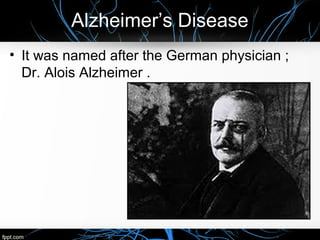
• It was named after the German physician ;
Dr. Alois Alzheimer .
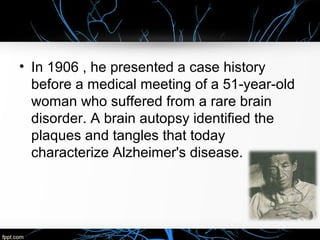
• In 1906 , he presented a case history
before a medical meeting of a 51-year-old
woman who suffered from a rare brain
disorder. A brain autopsy identified the
plaques and tangles that today
characterize Alzheimer's disease.
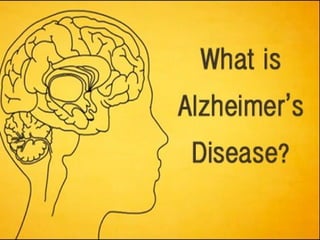
Alzheimer's disease is a progressive,
degenerative disorder that attacks the
brain's nerve cells, or neurons, resulting in
loss of memory, thinking and language
skills, and behavioral changes.
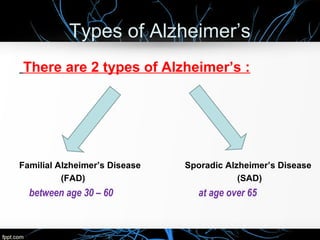
Types of Alzheimer’s
There are 2 types of Alzheimer’s :

Familial Alzheimer’s Disease
(FAD)

between age 30 – 60

Sporadic Alzheimer’s Disease
(SAD)

at age over 65
How does Alzheimer’s take place !!
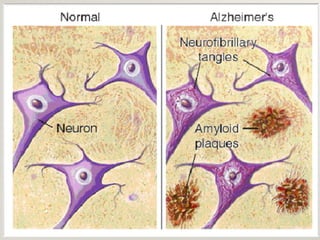
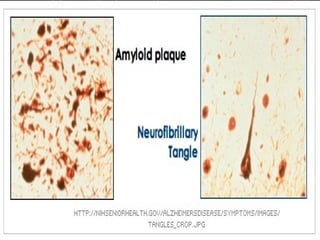
Two types of abnormal lesions clog the
brains of individuals with Alzheimer's
disease:
Beta-amyloid plaques
Neurofibillary tangles
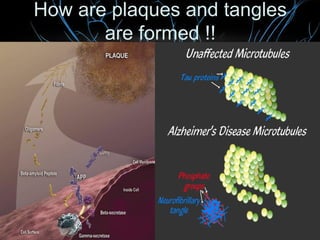
How are plaques and tangles
are formed !!
How plaques and tangles are
formed !!
To watch this video online please visit :
http://www.youtube.com/watch?
v=dj3GGDuu15I
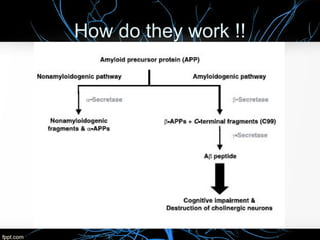
How do they work !!
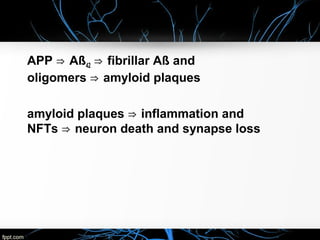
APP ⇒  Aß42 ⇒  fibrillar Aß and 
oligomers ⇒  amyloid plaques
amyloid plaques ⇒  inflammation and 
NFTs ⇒  neuron death and synapse loss
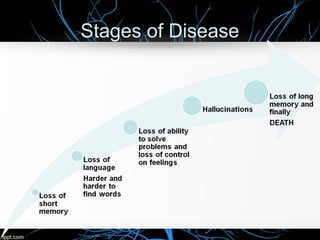
Stages of disease
To watch this video online please visit :
http://www.youtube.com/watch?v=9Wv9jrkgXc
Stages of Disease
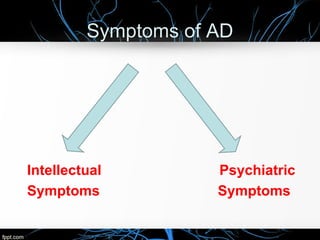
Symptoms of AD

Intellectual
Symptoms

Psychiatric
Symptoms
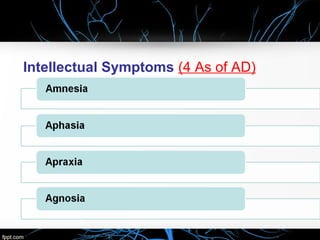
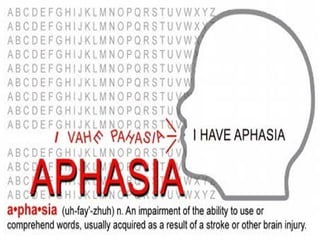
Intellectual Symptoms (4 As of AD)
AMNESIA
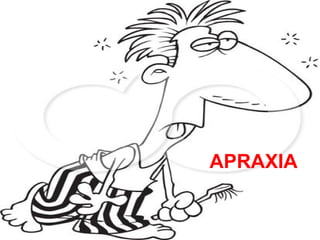
APRAXIA
AGNOSIA
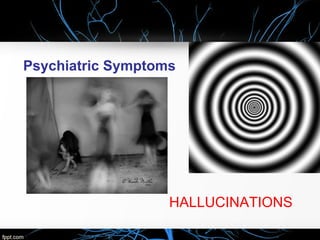
Psychiatric Symptoms

HALLUCINATIONS
Diagnosis of AD
• Taking complete medical history .
• Conducting lab autopsy (which
pathologists look for the disease's
characteristic plaques and tangles in brain
tissue) .
• Neuro-psychological tests .
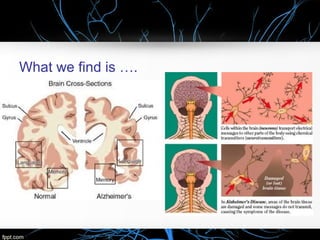
What we find is ….
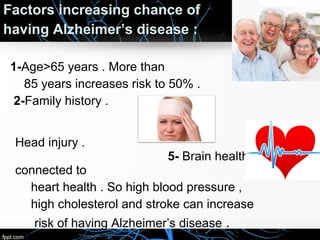
Factors increasing chance of
having Alzheimer’s disease :
1-Age>65 years . More than
85 years increases risk to 50% .
2-Family history .
3-Genes .
Head injury .

5- Brain health is

connected to
heart health . So high blood pressure ,
high cholesterol and stroke can increase
risk of having Alzheimer’s disease .

4-
Treatment of AD
• Till now there is NO cure for Alzheimer’s.
• But the (FDA) has approved several
medications for the treatment of
Alzheimer’s disease which may help slow
progression of symptoms and improve
quality of life.
References :
• Smith 1998a
• Liu etali 2005; Marlattetal 2005
• Human Physiology ;2010 , 2009 , 2007
Pearson Education , Inc. , publishing as
Pearson Benjamin Cummings,
1301Sansome St. , San Francisco .
Alzheimer's Disease

Alzheimer's Disease