Alzheimer’s Disease By: Kara Seddon
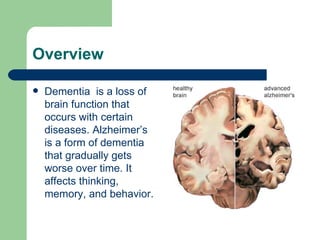
Overview Dementia  is a loss of brain function that occurs with certain diseases. Alzheimer’s is a form of dementia that gradually gets worse over time. It affects thinking, memory, and behavior.
Risk Factors  Family history and aging are risk factors for Alzheimer's disease.  As you age your risks of Alzheimer’s disease goes up. However it is not a part of normal aging.  Having a close blood relative, such as a sister, brother, or parent who developed Alzheimer’s increases your risk.
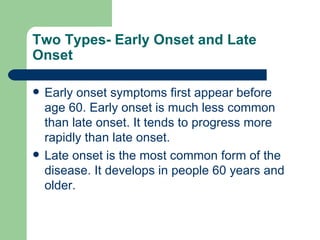
Two Types- Early Onset and Late Onset Early onset symptoms first appear before age 60. Early onset is much less common than late onset. It tends to progress more rapidly than late onset.  Late onset is the most common form of the disease. It develops in people 60 years and older.
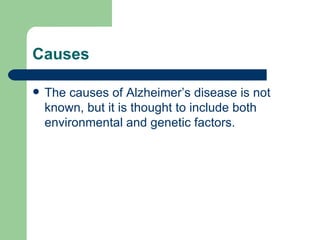
Causes The causes of Alzheimer’s disease is not known, but it is thought to include both environmental and genetic factors.
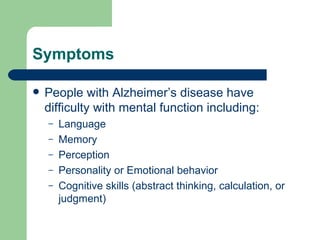
Symptoms People with Alzheimer’s disease have difficulty with mental function including: Language Memory Perception Personality or Emotional behavior Cognitive skills (abstract thinking, calculation, or judgment)
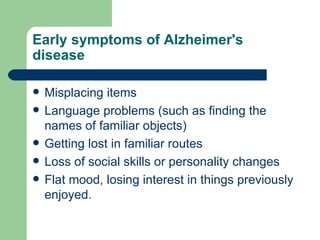
Early symptoms of Alzheimer's disease Misplacing items Language problems (such as finding the names of familiar objects) Getting lost in familiar routes Loss of social skills or personality changes Flat mood, losing interest in things previously enjoyed.
Treatment There is not cure for Alzheimer’s disease. The goals in treating Alzheimer’s disease are to slow the progression of the disease (Although this is different to do), manage behavior problems, sleep problems, confusion, and agitation.
Medication Donepezil,Rivastigmine,Galantamine- affect the level of acetylcholine in the brain.  Memantine- is another type of drug used for the treatment of Alzheimer's
Working with Alzheimer’s disease Medical clearance is required when working with people with Alzheimer’s disease. The majority of people with Alzheimer’s are older so you want to work with them at a low to moderate intensity, depending on the physical fitness level.  Physical activity should be continued to prevent muscle weakness and health complications associated with inactivity.
Exercise Repetitive exercises are suggested for people with Alzheimer’s disease, such as indoor bicycling, walking, and activities such as folding laundry. These exercises may decrease anxiety because they don’t have to make decisions about the activity or remember what to do next. Exercise will not stop Alzheimer’s disease from progressing, but it does give the patients a emotional satisfaction of feeling they have accomplished something.
References &quot;Alzheimer's Disease and Exercise: Safety Tips, Activities, and More.&quot;  WebMD - Better Information. Better Health.  2009. Web. 13 Apr. 2011. <http://www.webmd.com/alzheimers/guide/alzheimers-exercise>. &quot;Alzheimer's Disease - PubMed Health.&quot; Web. 13 Apr. 2011. <http://www.ncbi.nlm.nih.gov/pubmedhealth/PMH0001767/>.

Alzh

  • 1.
  • 2.
    Overview Dementia is a loss of brain function that occurs with certain diseases. Alzheimer’s is a form of dementia that gradually gets worse over time. It affects thinking, memory, and behavior.
  • 3.
    Risk Factors Family history and aging are risk factors for Alzheimer's disease. As you age your risks of Alzheimer’s disease goes up. However it is not a part of normal aging. Having a close blood relative, such as a sister, brother, or parent who developed Alzheimer’s increases your risk.
  • 4.
    Two Types- EarlyOnset and Late Onset Early onset symptoms first appear before age 60. Early onset is much less common than late onset. It tends to progress more rapidly than late onset. Late onset is the most common form of the disease. It develops in people 60 years and older.
  • 5.
    Causes The causesof Alzheimer’s disease is not known, but it is thought to include both environmental and genetic factors.
  • 6.
    Symptoms People withAlzheimer’s disease have difficulty with mental function including: Language Memory Perception Personality or Emotional behavior Cognitive skills (abstract thinking, calculation, or judgment)
  • 7.
    Early symptoms ofAlzheimer's disease Misplacing items Language problems (such as finding the names of familiar objects) Getting lost in familiar routes Loss of social skills or personality changes Flat mood, losing interest in things previously enjoyed.
  • 8.
    Treatment There isnot cure for Alzheimer’s disease. The goals in treating Alzheimer’s disease are to slow the progression of the disease (Although this is different to do), manage behavior problems, sleep problems, confusion, and agitation.
  • 9.
    Medication Donepezil,Rivastigmine,Galantamine- affectthe level of acetylcholine in the brain. Memantine- is another type of drug used for the treatment of Alzheimer's
  • 10.
    Working with Alzheimer’sdisease Medical clearance is required when working with people with Alzheimer’s disease. The majority of people with Alzheimer’s are older so you want to work with them at a low to moderate intensity, depending on the physical fitness level. Physical activity should be continued to prevent muscle weakness and health complications associated with inactivity.
  • 11.
    Exercise Repetitive exercisesare suggested for people with Alzheimer’s disease, such as indoor bicycling, walking, and activities such as folding laundry. These exercises may decrease anxiety because they don’t have to make decisions about the activity or remember what to do next. Exercise will not stop Alzheimer’s disease from progressing, but it does give the patients a emotional satisfaction of feeling they have accomplished something.
  • 12.
    References &quot;Alzheimer's Diseaseand Exercise: Safety Tips, Activities, and More.&quot; WebMD - Better Information. Better Health. 2009. Web. 13 Apr. 2011. <http://www.webmd.com/alzheimers/guide/alzheimers-exercise>. &quot;Alzheimer's Disease - PubMed Health.&quot; Web. 13 Apr. 2011. <http://www.ncbi.nlm.nih.gov/pubmedhealth/PMH0001767/>.