BUDGETING
BY
AKOL PETER PEDO
2013-MHP-FT-005
www.ihsu.ac.ug
31-Mar-14 Akol Pedo Peter
PRESENTATION OUTLINE
• Definition of Budgeting,
• Significance of Budgeting,
• Approaches to Budgeting, merits and demerits
• Types of Budgets,
• Outline of the Budgetary process,
• Features of an effective Budget
• Link between budget planning and project
activity(Earned Value Analysis-EVA).
31-Mar-14 Akol Pedo Peter
BUDGETING
• A plan translated in financial terms for the
resource and operations of a business,
organisation or project for a stated period
in the future.
• Or simply a statement of incomes and
expenditures.
• Budget = Quantitative expression of a plan
31-Mar-14 Akol Pedo Peter
SIGNIFICANCE OF
BUDGETING
• To help management in the planning of
annual operations.
• To co-ordinate the activities of the various
parts of the organisation/project and ensure
that the parts are in harmony with each
other.
• To communicate plans to the various
responsibility centre managers.
31-Mar-14 Akol Pedo Peter
SIGNIFICANCE…………2
• To motivate managers to strive to achieve
the organisational/project goals/objectives
• To control activities (organisational or
project)
• To evaluate the performance of managers,
• To generate activity schedule forecasts
31-Mar-14 Akol Pedo Peter
Approaches to Budgeting
• There are three common budgeting
methods:
Top-down Budgeting,
Bottom-up Budgeting,
Iterative Budgeting,
31-Mar-14 Akol Pedo Peter
Top Down Budgeting(TDB)
is the term given to a budgeting process based
on estimating the cost of higher level tasks first
and using these estimates to constrain the
estimates for lower level tasks.
A crucial factor for successfully implementing
this method for estimating budgets is the
experience and judgment of those involved in
producing the overall budget estimate.
31-Mar-14 Akol Pedo Peter
MERITS OF TDB
Takes less time
Promotes upper-level commitment
Involves no multilevel participation
Lower management better understands
what upper management expects
Individual activities need not to be
identified prior to approval
Aggregate budget can be reasonably
accurate.31-Mar-14 Akol Pedo Peter
DEMERITS OF TDB
Translating long-range budgets into short-
range budgets.
Problems scheduling projects in a "sub-
optimal way" to meet the strategic goals
Result of top management's limited
knowledge of specifics of project tasks and
activities
31-Mar-14 Akol Pedo Peter
Bottom Up Budgeting(BUB)
• Sometimes called Zero Based Budgeting
(ZBB)
• Bottom-up budgeting begins with
identifying all the constituent tasks that are
involved in implementing a project and
working out the resources and funding
required for each activity.
31-Mar-14 Akol Pedo Peter
BUB….2
• Provides the opportunity to create
organisation level budgets by rolling up
project budgets.
• Create centralized project level budgets
from their sub-project budgets (WBS)
• Applicable to recurring programmes in the
public sector.
31-Mar-14 Akol Pedo Peter
ADVANTAGES OF BUB
 accuracy of the budgets for individual tasks is
enhanced
Clear flow of information
Use of detailed data available at project
management level as basic source of cost,
schedule, and resource requirement
information.
Participation in the process leads to ownership
and acceptance
31-Mar-14 Akol Pedo Peter
DISADVANTAGES OF BUB
More persuasive managers sometimes get a
disproportionate share of resources
A significant portion of budget building is in the
hands of the junior personnel in the organisation
Sometimes critical activities are missed and left
unbudgeted
Difficult to control aggregate spending
Allocations may not be optimal
Hard to keep multi-year perspective
Tendency to overstate the needs is common
31-Mar-14 Akol Pedo Peter
Bottom-up and Top-down
compared
• Bottom-up • Top-down
- Multi-year - Annual
 Delegated authority - Time consuming
joint ownership - ownership of proposal
specific
 Proactive - Reactive
31-Mar-14 Akol Pedo Peter
ITERATIVE BUDGETING(IB)
Iterative – to repeat or do again
A combination of top-down and bottom-up
budget building
Higher project level estimated (top down)
Lower level costed (bottom up)
The two costs negotiated and reconciled
31-Mar-14 Akol Pedo Peter
ADVANTAGES OF IB
• It promotes employee involvement and
stimulates a high degree of information
flow between those involved in the project
at different levels
• Both senior management and lower level
managers closer to the actual process
participate in the budgeting process
31-Mar-14 Akol Pedo Peter
DISADVANTAGES OF IB
• there’re relative inefficiencies and time
consuming nature of the negotiations over
the budgets.
• Process may not work well when
communication channels are either
informal or blocked between lower-level
managers and senior management
31-Mar-14 Akol Pedo Peter
TYPES OF BUDGETS
Operating Budgets – Recurrent
Capital Budgets – Development
Financial Budgets (cash budgets, projected
income and expenditure statement and
projected balance sheet).
31-Mar-14 Akol Pedo Peter
SCOPE BUDGET PLANNING
Scoping can be an expression of a budget.
Budgets of specify the following;
Performance measures
Incentives for efficiency
Project selection criteria i.e. numeric &
non-numeric
Expression of organizational policy &
commitment
31-Mar-14 Akol Pedo Peter
..2
Plans for how resources are to be expended
Catalyst for productivity improvement
Control basis for mangers and
administrators
Standardization of operations within a
given horizon.
31-Mar-14 Akol Pedo Peter
BUDGETARY PROCESS
A budgetary process is a system of rules
governing the decision-making that leads to a
budget, from its formulation, through its
legislative approval, to its execution.
31-Mar-14 Akol Pedo Peter
Budgetary Process outline
a. Identification of the budget committee
b. Derive key forecasts,
c. Prepare “quantity” budgets with appropriate
Managers,
d. Check for feasibility to policies,
e. Amend if necessary,
f. Produce financial budget,
g. Submit budget to CEO for approval
31-Mar-14 Akol Pedo Peter
Features of an effective budget
1. Accurate forecasting
2. Based on organisational goals
3. Information is timely and accurate
4. Formed with multilevel input
5. Regular reviews are built-in
31-Mar-14 Akol Pedo Peter
Problems with budgeting
a) The process is too long
b) There is a lot of game playing
c) Business decisions change but the budget
does not
d) People in charge of budget are held
accountable in areas where they have no
responsibility
e) Applying an arbitrary percentage to prior
actual period.
31-Mar-14 Akol Pedo Peter
Budgetary control
• Publish agreed budgets
• Recording of actual results
• Comparison and identification of variances
• Reporting to budget holders and senior
management about existing variances
• Variance investigation
• Developing solutions to problems revealed
by budgetary control.
31-Mar-14 Akol Pedo Peter
Linking Budgets and Activities
Budget deviation analysis (variance analysis)
regularly compares what you expected or
planned to earn and spend with what you
actually spent and earned.
Variation analysis can help greatly when
detecting how well you’re tracking your plans,
how much to accurately budget in the future,
where there might be upcoming problems in
spending.
31-Mar-14 Akol Pedo Peter
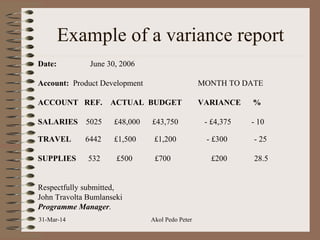
Example of a variance report
Date: June 30, 2006
Account: Product Development MONTH TO DATE
ACCOUNT REF. ACTUAL BUDGET VARIANCE %
SALARIES 5025 £48,000 £43,750 - £4,375 - 10
TRAVEL 6442 £1,500 £1,200 - £300 - 25
SUPPLIES 532 £500 £700 £200 28.5
Respectfully submitted,
John Travolta Bumlanseki
Programme Manager.
31-Mar-14 Akol Pedo Peter
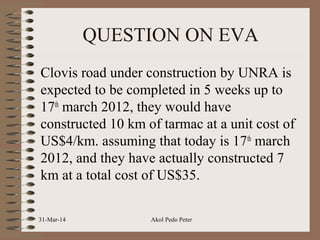
QUESTION ON EVA
Clovis road under construction by UNRA is
expected to be completed in 5 weeks up to
17th
march 2012, they would have
constructed 10 km of tarmac at a unit cost of
US$4/km. assuming that today is 17th
march
2012, and they have actually constructed 7
km at a total cost of US$35.
31-Mar-14 Akol Pedo Peter
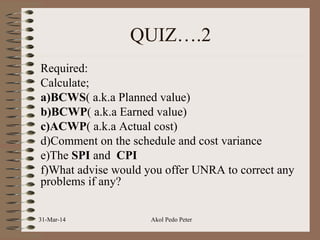
QUIZ….2
Required:
Calculate;
a)BCWS( a.k.a Planned value)
b)BCWP( a.k.a Earned value)
c)ACWP( a.k.a Actual cost)
d)Comment on the schedule and cost variance
e)The SPI and CPI
f)What advise would you offer UNRA to correct any
problems if any?
31-Mar-14 Akol Pedo Peter
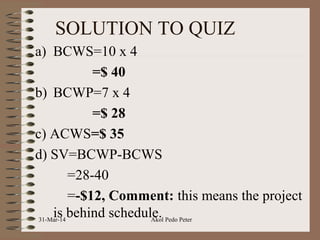
SOLUTION TO QUIZ
a) BCWS=10 x 4
=$ 40
b) BCWP=7 x 4
=$ 28
c) ACWS=$ 35
d) SV=BCWP-BCWS
=28-40
=-$12, Comment: this means the project
is behind schedule.31-Mar-14 Akol Pedo Peter
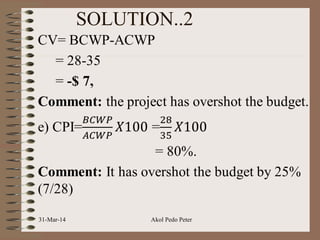
SOLUTION..2
31-Mar-14 Akol Pedo Peter
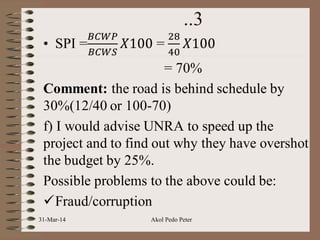
..3
31-Mar-14 Akol Pedo Peter
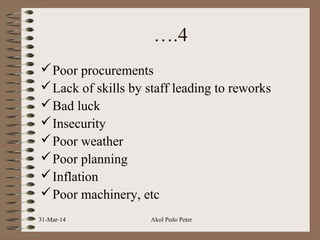
….4
Poor procurements
Lack of skills by staff leading to reworks
Bad luck
Insecurity
Poor weather
Poor planning
Inflation
Poor machinery, etc
31-Mar-14 Akol Pedo Peter
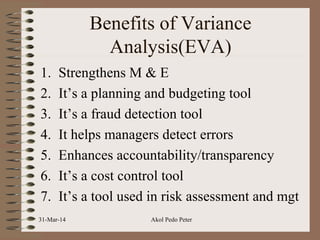
Benefits of Variance
Analysis(EVA)
1. Strengthens M & E
2. It’s a planning and budgeting tool
3. It’s a fraud detection tool
4. It helps managers detect errors
5. Enhances accountability/transparency
6. It’s a cost control tool
7. It’s a tool used in risk assessment and mgt
31-Mar-14 Akol Pedo Peter
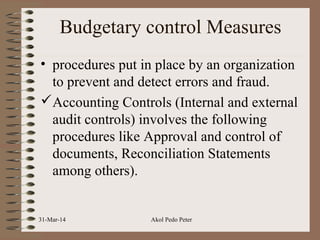
Budgetary control Measures
• procedures put in place by an organization
to prevent and detect errors and fraud.
Accounting Controls (Internal and external
audit controls) involves the following
procedures like Approval and control of
documents, Reconciliation Statements
among others).
31-Mar-14 Akol Pedo Peter
…..2
Administrative Controls (Quality Controls,
Stated conflict of interest policy,
Performance statistics checks, Annual
leave and job rotation among others)
31-Mar-14 Akol Pedo Peter
REFERENCES
1. Karl-Martin, et al, November 2000:
Budget Processes: Theory and
Experimental Evidence, Harvard school
of Business, Massachusetts. USA
2. Wright.D 1994 :“A practical foundation
in costing” ,Routledge, London
3. MOFPED, 2007: The Local
Governments Financial and Accounting
Manual. Kampala.
31-Mar-14 Akol Pedo Peter

Budgeting. at District level and Management

  • 1.
  • 2.
    PRESENTATION OUTLINE • Definitionof Budgeting, • Significance of Budgeting, • Approaches to Budgeting, merits and demerits • Types of Budgets, • Outline of the Budgetary process, • Features of an effective Budget • Link between budget planning and project activity(Earned Value Analysis-EVA). 31-Mar-14 Akol Pedo Peter
  • 3.
    BUDGETING • A plantranslated in financial terms for the resource and operations of a business, organisation or project for a stated period in the future. • Or simply a statement of incomes and expenditures. • Budget = Quantitative expression of a plan 31-Mar-14 Akol Pedo Peter
  • 4.
    SIGNIFICANCE OF BUDGETING • Tohelp management in the planning of annual operations. • To co-ordinate the activities of the various parts of the organisation/project and ensure that the parts are in harmony with each other. • To communicate plans to the various responsibility centre managers. 31-Mar-14 Akol Pedo Peter
  • 5.
    SIGNIFICANCE…………2 • To motivatemanagers to strive to achieve the organisational/project goals/objectives • To control activities (organisational or project) • To evaluate the performance of managers, • To generate activity schedule forecasts 31-Mar-14 Akol Pedo Peter
  • 6.
    Approaches to Budgeting •There are three common budgeting methods: Top-down Budgeting, Bottom-up Budgeting, Iterative Budgeting, 31-Mar-14 Akol Pedo Peter
  • 7.
    Top Down Budgeting(TDB) isthe term given to a budgeting process based on estimating the cost of higher level tasks first and using these estimates to constrain the estimates for lower level tasks. A crucial factor for successfully implementing this method for estimating budgets is the experience and judgment of those involved in producing the overall budget estimate. 31-Mar-14 Akol Pedo Peter
  • 8.
    MERITS OF TDB Takesless time Promotes upper-level commitment Involves no multilevel participation Lower management better understands what upper management expects Individual activities need not to be identified prior to approval Aggregate budget can be reasonably accurate.31-Mar-14 Akol Pedo Peter
  • 9.
    DEMERITS OF TDB Translatinglong-range budgets into short- range budgets. Problems scheduling projects in a "sub- optimal way" to meet the strategic goals Result of top management's limited knowledge of specifics of project tasks and activities 31-Mar-14 Akol Pedo Peter
  • 10.
    Bottom Up Budgeting(BUB) •Sometimes called Zero Based Budgeting (ZBB) • Bottom-up budgeting begins with identifying all the constituent tasks that are involved in implementing a project and working out the resources and funding required for each activity. 31-Mar-14 Akol Pedo Peter
  • 11.
    BUB….2 • Provides theopportunity to create organisation level budgets by rolling up project budgets. • Create centralized project level budgets from their sub-project budgets (WBS) • Applicable to recurring programmes in the public sector. 31-Mar-14 Akol Pedo Peter
  • 12.
    ADVANTAGES OF BUB accuracy of the budgets for individual tasks is enhanced Clear flow of information Use of detailed data available at project management level as basic source of cost, schedule, and resource requirement information. Participation in the process leads to ownership and acceptance 31-Mar-14 Akol Pedo Peter
  • 13.
    DISADVANTAGES OF BUB Morepersuasive managers sometimes get a disproportionate share of resources A significant portion of budget building is in the hands of the junior personnel in the organisation Sometimes critical activities are missed and left unbudgeted Difficult to control aggregate spending Allocations may not be optimal Hard to keep multi-year perspective Tendency to overstate the needs is common 31-Mar-14 Akol Pedo Peter
  • 14.
    Bottom-up and Top-down compared •Bottom-up • Top-down - Multi-year - Annual  Delegated authority - Time consuming joint ownership - ownership of proposal specific  Proactive - Reactive 31-Mar-14 Akol Pedo Peter
  • 15.
    ITERATIVE BUDGETING(IB) Iterative –to repeat or do again A combination of top-down and bottom-up budget building Higher project level estimated (top down) Lower level costed (bottom up) The two costs negotiated and reconciled 31-Mar-14 Akol Pedo Peter
  • 16.
    ADVANTAGES OF IB •It promotes employee involvement and stimulates a high degree of information flow between those involved in the project at different levels • Both senior management and lower level managers closer to the actual process participate in the budgeting process 31-Mar-14 Akol Pedo Peter
  • 17.
    DISADVANTAGES OF IB •there’re relative inefficiencies and time consuming nature of the negotiations over the budgets. • Process may not work well when communication channels are either informal or blocked between lower-level managers and senior management 31-Mar-14 Akol Pedo Peter
  • 18.
    TYPES OF BUDGETS OperatingBudgets – Recurrent Capital Budgets – Development Financial Budgets (cash budgets, projected income and expenditure statement and projected balance sheet). 31-Mar-14 Akol Pedo Peter
  • 19.
    SCOPE BUDGET PLANNING Scopingcan be an expression of a budget. Budgets of specify the following; Performance measures Incentives for efficiency Project selection criteria i.e. numeric & non-numeric Expression of organizational policy & commitment 31-Mar-14 Akol Pedo Peter
  • 20.
    ..2 Plans for howresources are to be expended Catalyst for productivity improvement Control basis for mangers and administrators Standardization of operations within a given horizon. 31-Mar-14 Akol Pedo Peter
  • 21.
    BUDGETARY PROCESS A budgetaryprocess is a system of rules governing the decision-making that leads to a budget, from its formulation, through its legislative approval, to its execution. 31-Mar-14 Akol Pedo Peter
  • 22.
    Budgetary Process outline a.Identification of the budget committee b. Derive key forecasts, c. Prepare “quantity” budgets with appropriate Managers, d. Check for feasibility to policies, e. Amend if necessary, f. Produce financial budget, g. Submit budget to CEO for approval 31-Mar-14 Akol Pedo Peter
  • 23.
    Features of aneffective budget 1. Accurate forecasting 2. Based on organisational goals 3. Information is timely and accurate 4. Formed with multilevel input 5. Regular reviews are built-in 31-Mar-14 Akol Pedo Peter
  • 24.
    Problems with budgeting a)The process is too long b) There is a lot of game playing c) Business decisions change but the budget does not d) People in charge of budget are held accountable in areas where they have no responsibility e) Applying an arbitrary percentage to prior actual period. 31-Mar-14 Akol Pedo Peter
  • 25.
    Budgetary control • Publishagreed budgets • Recording of actual results • Comparison and identification of variances • Reporting to budget holders and senior management about existing variances • Variance investigation • Developing solutions to problems revealed by budgetary control. 31-Mar-14 Akol Pedo Peter
  • 26.
    Linking Budgets andActivities Budget deviation analysis (variance analysis) regularly compares what you expected or planned to earn and spend with what you actually spent and earned. Variation analysis can help greatly when detecting how well you’re tracking your plans, how much to accurately budget in the future, where there might be upcoming problems in spending. 31-Mar-14 Akol Pedo Peter
  • 27.
    Example of avariance report Date: June 30, 2006 Account: Product Development MONTH TO DATE ACCOUNT REF. ACTUAL BUDGET VARIANCE % SALARIES 5025 £48,000 £43,750 - £4,375 - 10 TRAVEL 6442 £1,500 £1,200 - £300 - 25 SUPPLIES 532 £500 £700 £200 28.5 Respectfully submitted, John Travolta Bumlanseki Programme Manager. 31-Mar-14 Akol Pedo Peter
  • 28.
    QUESTION ON EVA Clovisroad under construction by UNRA is expected to be completed in 5 weeks up to 17th march 2012, they would have constructed 10 km of tarmac at a unit cost of US$4/km. assuming that today is 17th march 2012, and they have actually constructed 7 km at a total cost of US$35. 31-Mar-14 Akol Pedo Peter
  • 29.
    QUIZ….2 Required: Calculate; a)BCWS( a.k.a Plannedvalue) b)BCWP( a.k.a Earned value) c)ACWP( a.k.a Actual cost) d)Comment on the schedule and cost variance e)The SPI and CPI f)What advise would you offer UNRA to correct any problems if any? 31-Mar-14 Akol Pedo Peter
  • 30.
    SOLUTION TO QUIZ a)BCWS=10 x 4 =$ 40 b) BCWP=7 x 4 =$ 28 c) ACWS=$ 35 d) SV=BCWP-BCWS =28-40 =-$12, Comment: this means the project is behind schedule.31-Mar-14 Akol Pedo Peter
  • 31.
  • 32.
  • 33.
    ….4 Poor procurements Lack ofskills by staff leading to reworks Bad luck Insecurity Poor weather Poor planning Inflation Poor machinery, etc 31-Mar-14 Akol Pedo Peter
  • 34.
    Benefits of Variance Analysis(EVA) 1.Strengthens M & E 2. It’s a planning and budgeting tool 3. It’s a fraud detection tool 4. It helps managers detect errors 5. Enhances accountability/transparency 6. It’s a cost control tool 7. It’s a tool used in risk assessment and mgt 31-Mar-14 Akol Pedo Peter
  • 35.
    Budgetary control Measures •procedures put in place by an organization to prevent and detect errors and fraud. Accounting Controls (Internal and external audit controls) involves the following procedures like Approval and control of documents, Reconciliation Statements among others). 31-Mar-14 Akol Pedo Peter
  • 36.
    …..2 Administrative Controls (QualityControls, Stated conflict of interest policy, Performance statistics checks, Annual leave and job rotation among others) 31-Mar-14 Akol Pedo Peter
  • 37.
    REFERENCES 1. Karl-Martin, etal, November 2000: Budget Processes: Theory and Experimental Evidence, Harvard school of Business, Massachusetts. USA 2. Wright.D 1994 :“A practical foundation in costing” ,Routledge, London 3. MOFPED, 2007: The Local Governments Financial and Accounting Manual. Kampala. 31-Mar-14 Akol Pedo Peter