Low Voiding Reliable
Solder Interconnects for
LED Packages on Metal
Core PCBs
PRIVILEGED AND CONFIDENTIAL MATERIALS
Outline/Agenda
• Introduction
• Assembly
• Components
• Materials
• Process
• Results of Experiments
• Conclusions
• Q & A
PRIVILEGED AND CONFIDENTIAL MATERIALS
Introduction – LED Packages
• Lumen maintenance requirement for LED
packages used in commercial & outdoor
residential lighting is 70% lumen maintenance for
50% of population after 35,000 hours and 3 year
warranty (Energy Star A; IESNA LM-80)
• Good thermal management is key to long term
stability of light output (brightness) and color
temperature of LED lights
– Solder joints with low voiding for low thermal
resistance
PRIVILEGED AND CONFIDENTIAL MATERIALS
Package Assembly
• For this study used commercially available LED
package, metal core boards and solder pastes
– Luxeon Rebel LED
– Metal Core PCB substrate w/ Aluminum core, Copper
circuitry and 2 dielectric types
– 4 solder pastes – Pb-free; no clean; zero halogen; 4
alloy types
PRIVILEGED AND CONFIDENTIAL MATERIALS
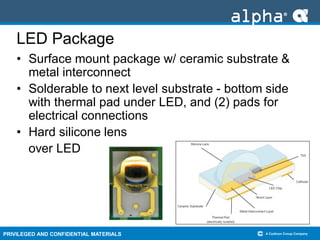
LED Package
• Surface mount package w/ ceramic substrate &
metal interconnect
• Solderable to next level substrate - bottom side
with thermal pad under LED, and (2) pads for
electrical connections
• Hard silicone lens
over LED
PRIVILEGED AND CONFIDENTIAL MATERIALS
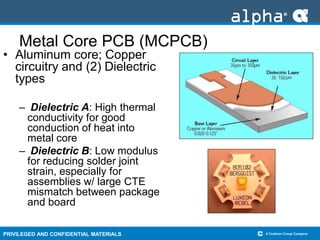
Metal Core PCB (MCPCB)
• Aluminum core; Copper
circuitry and (2) Dielectric
types
– Dielectric A: High thermal
conductivity for good
conduction of heat into
metal core
– Dielectric B: Low modulus
for reducing solder joint
strain, especially for
assemblies w/ large CTE
mismatch between package
and board
PRIVILEGED AND CONFIDENTIAL MATERIALS
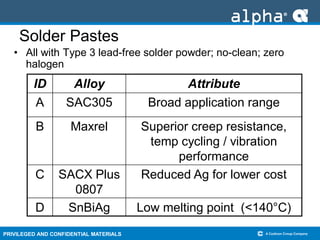
Solder Pastes
• All with Type 3 lead-free solder powder; no-clean; zero
halogen
ID Alloy Attribute
A SAC305 Broad application range
B Maxrel Superior creep resistance,
temp cycling / vibration
performance
C SACX Plus
0807
Reduced Ag for lower cost
D SnBiAg Low melting point (<140°C)
PRIVILEGED AND CONFIDENTIAL MATERIALS
Assembly Process & Testing
• Assembled 36 LEDs per board; (5) boards per
solder paste and dielectric type
• Standard SMT equipment – printing, P/P, reflow
• Solder paste printing: 5 mil stencil, on-contact
printing at 2.54 cm/sec; 268 gr/cm pressure;
0.051 cm/sec stencil release
• Reflow in air with high soak profiles
• % Voids by Xray; 50% solder joints per board
measured
PRIVILEGED AND CONFIDENTIAL MATERIALS
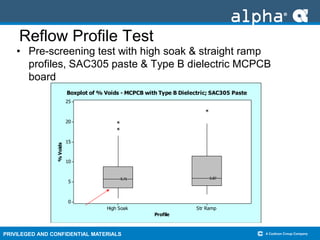
Reflow Profile Test
• Pre-screening test with high soak & straight ramp
profiles, SAC305 paste & Type B dielectric MCPCB
board
Str RampHigh Soak
25
20
15
10
5
0
Profile
%Voids
5.875.71
Boxplot of % Voids - MCPCB with Type B Dielectric; SAC305 Paste
PRIVILEGED AND CONFIDENTIAL MATERIALS
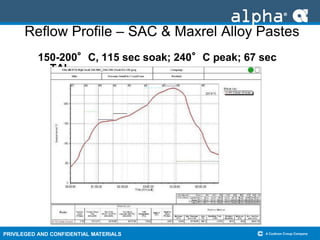
Reflow Profile – SAC & Maxrel Alloy Pastes
150-200°C, 115 sec soak; 240°C peak; 67 sec
TAL
PRIVILEGED AND CONFIDENTIAL MATERIALS
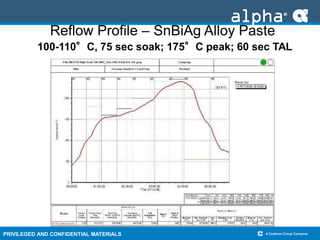
Reflow Profile – SnBiAg Alloy Paste
100-110°C, 75 sec soak; 175°C peak; 60 sec TAL
PRIVILEGED AND CONFIDENTIAL MATERIALS
Test Results
PRIVILEGED AND CONFIDENTIAL MATERIALS
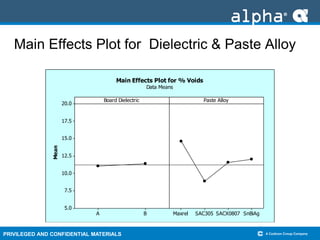
Main Effects Plot for Dielectric & Paste Alloy
BA
20.0
17.5
15.0
12.5
10.0
7.5
5.0
SnBiAgSACX0807SAC305Maxrel
Board Dielectric
Mean
Paste Alloy
Main Effects Plot for % Voids
Data Means
PRIVILEGED AND CONFIDENTIAL MATERIALS
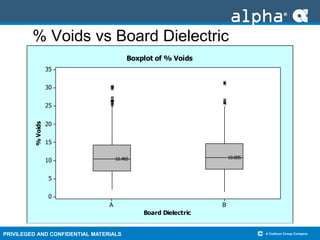
% Voids vs Board Dielectric
BA
35
30
25
20
15
10
5
0
Board Dielectric
%Voids
10.80510.465
Boxplot of % Voids
PRIVILEGED AND CONFIDENTIAL MATERIALS
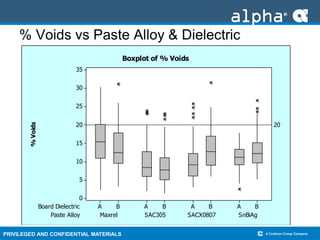
% Voids vs Paste Alloy & Dielectric
Paste Alloy
Board Dielectric
SnBiAgSACX0807SAC305Maxrel
BABABABA
35
30
25
20
15
10
5
0
%Voids
20
Boxplot of % Voids
PRIVILEGED AND CONFIDENTIAL MATERIALS
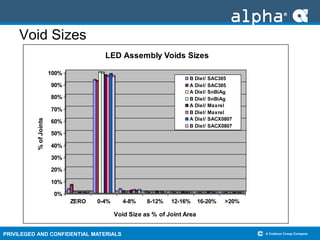
Void Sizes
0%
10%
20%
30%
40%
50%
60%
70%
80%
90%
100%
%ofJoints
ZERO 0-4% 4-8% 8-12% 12-16% 16-20% >20%
Void Size as % of Joint Area
LED Assembly Voids Sizes
B Diel/ SAC305
A Diel/ SAC305
A Diel/ SnBiAg
B Diel/ SnBiAg
A Diel/ Maxrel
B Diel/ Maxrel
A Diel/ SACX0807
B Diel/ SACX0807
PRIVILEGED AND CONFIDENTIAL MATERIALS
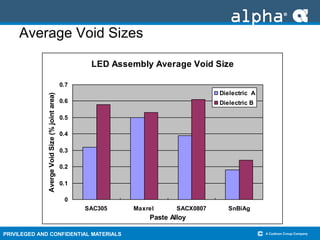
Average Void Sizes
LED Assembly Average Void Size
0
0.1
0.2
0.3
0.4
0.5
0.6
0.7
SAC305 Maxrel SACX0807 SnBiAg
Paste Alloy
AvergeVoidSize(%jointarea)
Dielectric A
Dielectric B
PRIVILEGED AND CONFIDENTIAL MATERIALS
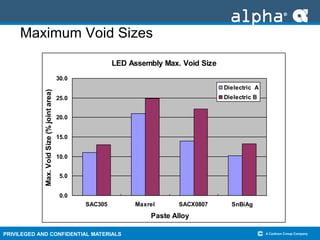
Maximum Void Sizes
LED Assembly Max. Void Size
0.0
5.0
10.0
15.0
20.0
25.0
30.0
SAC305 Maxrel SACX0807 SnBiAg
Paste Alloy
Max.VoidSize(%jointarea)
Dielectric A
Dielectric B
PRIVILEGED AND CONFIDENTIAL MATERIALS
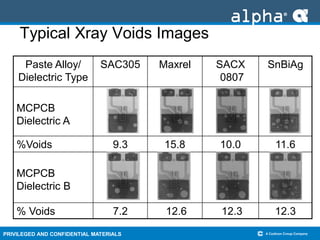
Typical Xray Voids Images
Paste Alloy/
Dielectric Type
SAC305 Maxrel SACX
0807
SnBiAg
MCPCB
Dielectric A
%Voids 9.3 15.8 10.0 11.6
MCPCB
Dielectric B
% Voids 7.2 12.6 12.3 12.3
PRIVILEGED AND CONFIDENTIAL MATERIALS
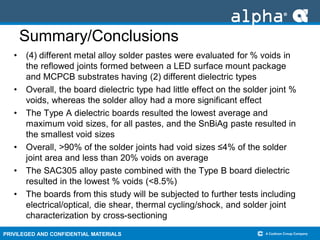
Summary/Conclusions
• (4) different metal alloy solder pastes were evaluated for % voids in
the reflowed joints formed between a LED surface mount package
and MCPCB substrates having (2) different dielectric types
• Overall, the board dielectric type had little effect on the solder joint %
voids, whereas the solder alloy had a more significant effect
• The Type A dielectric boards resulted the lowest average and
maximum void sizes, for all pastes, and the SnBiAg paste resulted in
the smallest void sizes
• Overall, >90% of the solder joints had void sizes ≤4% of the solder
joint area and less than 20% voids on average
• The SAC305 alloy paste combined with the Type B board dielectric
resulted in the lowest % voids (<8.5%)
• The boards from this study will be subjected to further tests including
electrical/optical, die shear, thermal cycling/shock, and solder joint
characterization by cross-sectioning
PRIVILEGED AND CONFIDENTIAL MATERIALS
For More Information Please Contact:
Ravi Bhatkal – VP, Energy Technologies
Rbhatkal@cookson.com
+1-908-791-3013
Amit Patel – Technology Analyst
Apatel@cookson.com
+1-908-791-3051

Low Voiding Reliable Solder Interconnects for LED Packages on Metal Core PCBs (English)

  • 1.
    Low Voiding Reliable SolderInterconnects for LED Packages on Metal Core PCBs
  • 2.
    PRIVILEGED AND CONFIDENTIALMATERIALS Outline/Agenda • Introduction • Assembly • Components • Materials • Process • Results of Experiments • Conclusions • Q & A
  • 3.
    PRIVILEGED AND CONFIDENTIALMATERIALS Introduction – LED Packages • Lumen maintenance requirement for LED packages used in commercial & outdoor residential lighting is 70% lumen maintenance for 50% of population after 35,000 hours and 3 year warranty (Energy Star A; IESNA LM-80) • Good thermal management is key to long term stability of light output (brightness) and color temperature of LED lights – Solder joints with low voiding for low thermal resistance
  • 4.
    PRIVILEGED AND CONFIDENTIALMATERIALS Package Assembly • For this study used commercially available LED package, metal core boards and solder pastes – Luxeon Rebel LED – Metal Core PCB substrate w/ Aluminum core, Copper circuitry and 2 dielectric types – 4 solder pastes – Pb-free; no clean; zero halogen; 4 alloy types
  • 5.
    PRIVILEGED AND CONFIDENTIALMATERIALS LED Package • Surface mount package w/ ceramic substrate & metal interconnect • Solderable to next level substrate - bottom side with thermal pad under LED, and (2) pads for electrical connections • Hard silicone lens over LED
  • 6.
    PRIVILEGED AND CONFIDENTIALMATERIALS Metal Core PCB (MCPCB) • Aluminum core; Copper circuitry and (2) Dielectric types – Dielectric A: High thermal conductivity for good conduction of heat into metal core – Dielectric B: Low modulus for reducing solder joint strain, especially for assemblies w/ large CTE mismatch between package and board
  • 7.
    PRIVILEGED AND CONFIDENTIALMATERIALS Solder Pastes • All with Type 3 lead-free solder powder; no-clean; zero halogen ID Alloy Attribute A SAC305 Broad application range B Maxrel Superior creep resistance, temp cycling / vibration performance C SACX Plus 0807 Reduced Ag for lower cost D SnBiAg Low melting point (<140°C)
  • 8.
    PRIVILEGED AND CONFIDENTIALMATERIALS Assembly Process & Testing • Assembled 36 LEDs per board; (5) boards per solder paste and dielectric type • Standard SMT equipment – printing, P/P, reflow • Solder paste printing: 5 mil stencil, on-contact printing at 2.54 cm/sec; 268 gr/cm pressure; 0.051 cm/sec stencil release • Reflow in air with high soak profiles • % Voids by Xray; 50% solder joints per board measured
  • 9.
    PRIVILEGED AND CONFIDENTIALMATERIALS Reflow Profile Test • Pre-screening test with high soak & straight ramp profiles, SAC305 paste & Type B dielectric MCPCB board Str RampHigh Soak 25 20 15 10 5 0 Profile %Voids 5.875.71 Boxplot of % Voids - MCPCB with Type B Dielectric; SAC305 Paste
  • 10.
    PRIVILEGED AND CONFIDENTIALMATERIALS Reflow Profile – SAC & Maxrel Alloy Pastes 150-200°C, 115 sec soak; 240°C peak; 67 sec TAL
  • 11.
    PRIVILEGED AND CONFIDENTIALMATERIALS Reflow Profile – SnBiAg Alloy Paste 100-110°C, 75 sec soak; 175°C peak; 60 sec TAL
  • 12.
    PRIVILEGED AND CONFIDENTIALMATERIALS Test Results
  • 13.
    PRIVILEGED AND CONFIDENTIALMATERIALS Main Effects Plot for Dielectric & Paste Alloy BA 20.0 17.5 15.0 12.5 10.0 7.5 5.0 SnBiAgSACX0807SAC305Maxrel Board Dielectric Mean Paste Alloy Main Effects Plot for % Voids Data Means
  • 14.
    PRIVILEGED AND CONFIDENTIALMATERIALS % Voids vs Board Dielectric BA 35 30 25 20 15 10 5 0 Board Dielectric %Voids 10.80510.465 Boxplot of % Voids
  • 15.
    PRIVILEGED AND CONFIDENTIALMATERIALS % Voids vs Paste Alloy & Dielectric Paste Alloy Board Dielectric SnBiAgSACX0807SAC305Maxrel BABABABA 35 30 25 20 15 10 5 0 %Voids 20 Boxplot of % Voids
  • 16.
    PRIVILEGED AND CONFIDENTIALMATERIALS Void Sizes 0% 10% 20% 30% 40% 50% 60% 70% 80% 90% 100% %ofJoints ZERO 0-4% 4-8% 8-12% 12-16% 16-20% >20% Void Size as % of Joint Area LED Assembly Voids Sizes B Diel/ SAC305 A Diel/ SAC305 A Diel/ SnBiAg B Diel/ SnBiAg A Diel/ Maxrel B Diel/ Maxrel A Diel/ SACX0807 B Diel/ SACX0807
  • 17.
    PRIVILEGED AND CONFIDENTIALMATERIALS Average Void Sizes LED Assembly Average Void Size 0 0.1 0.2 0.3 0.4 0.5 0.6 0.7 SAC305 Maxrel SACX0807 SnBiAg Paste Alloy AvergeVoidSize(%jointarea) Dielectric A Dielectric B
  • 18.
    PRIVILEGED AND CONFIDENTIALMATERIALS Maximum Void Sizes LED Assembly Max. Void Size 0.0 5.0 10.0 15.0 20.0 25.0 30.0 SAC305 Maxrel SACX0807 SnBiAg Paste Alloy Max.VoidSize(%jointarea) Dielectric A Dielectric B
  • 19.
    PRIVILEGED AND CONFIDENTIALMATERIALS Typical Xray Voids Images Paste Alloy/ Dielectric Type SAC305 Maxrel SACX 0807 SnBiAg MCPCB Dielectric A %Voids 9.3 15.8 10.0 11.6 MCPCB Dielectric B % Voids 7.2 12.6 12.3 12.3
  • 20.
    PRIVILEGED AND CONFIDENTIALMATERIALS Summary/Conclusions • (4) different metal alloy solder pastes were evaluated for % voids in the reflowed joints formed between a LED surface mount package and MCPCB substrates having (2) different dielectric types • Overall, the board dielectric type had little effect on the solder joint % voids, whereas the solder alloy had a more significant effect • The Type A dielectric boards resulted the lowest average and maximum void sizes, for all pastes, and the SnBiAg paste resulted in the smallest void sizes • Overall, >90% of the solder joints had void sizes ≤4% of the solder joint area and less than 20% voids on average • The SAC305 alloy paste combined with the Type B board dielectric resulted in the lowest % voids (<8.5%) • The boards from this study will be subjected to further tests including electrical/optical, die shear, thermal cycling/shock, and solder joint characterization by cross-sectioning
  • 21.
    PRIVILEGED AND CONFIDENTIALMATERIALS For More Information Please Contact: Ravi Bhatkal – VP, Energy Technologies Rbhatkal@cookson.com +1-908-791-3013 Amit Patel – Technology Analyst Apatel@cookson.com +1-908-791-3051