IT Outsourcing and Core IS Capabilities: Challenges and Lessons at Dupont
Action Learning Project
By: Monzer AL-Shaikh Warak
Fegbada Jude
Under supervision of Dr. Wing Lam
The content
1. Introduction
2. Key lessons from Dupont’s experience
3. Conclusion
Introduction
Dupont is a chemicals, health care, materials, and energy multinational
company operating in a range of segments.
By the end of 2004 Dupont had $US 27.3 billion revenues and 55,000
employees worldwide.
Dupont focused on reduction of overhead costs
and increased capital efficiency, including IT outsourcing.
In 1997 Dupont signed a series of ten-year IT outsourcing contracts,
worth $US 4 billion.
Introduction
The Dupont case provides considerable rich
insight into how the core IS capabilities can
be applied, their relevance, the challenges
that can arise under large-scale IS
outsourcing arrangements, and how these
can be handled by an organization.
Key lessons from Dupont’s experience
1. Informed buying and vendor development must be considered
To avoid the business unit IT leaders move from strategic focus into firefighting
strategy.
Weakness in informed buying led to limited sourcing vision,
limited learning, and limited future sourcing flexibility.
In Dupont case, The vendor relationship had not evolved to
a more strategic role, and this inhibited Dupont’s ability to
tap into the suppliers’ intellectual capital.
2. Outsourcing doesn’t mean ignoring or less caring IT matters
After outsourcing 80 percent of its IT budget, Dupont discovered it had retained
inadequate management and technical expertise to control its IT destiny.
Key lessons from Dupont’s experience
3. Issues of core capability development and succession that emerge over
time need careful management.
4. Keeping the good quality IT employees is essential when outsourcing
Dupont had not retained enough technical or architecture
planning capability either centrally or locally, Which was
create risks at big projects. Moreover, the company
discovered that IT leaders in the business unit got pulled too
much into operational issues
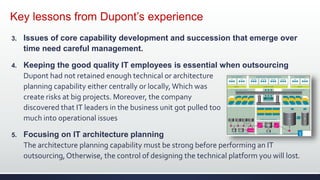
5. Focusing on IT architecture planning
The architecture planning capability must be strong before performing an IT
outsourcing, Otherwise, the control of designing the technical platform you will lost.
Key lessons from Dupont’s experience
6. Know the required IT capability by adopting a proper framework
A core IS capability is a capability needed to facilitate the exploitation of IT, measurable
in terms of IT activities supported, and resulting business performance, the
Feeny/Willcocks (1998) framework is an example
7. Dupont need to develop a long-term strategic core capability rather
than being drawn into firefighting and focusing only on the
shorter term capabilities in Feeny / Willcocks framework
8. Getting innovation and added business value from outsourcing
requires organized, proactive, in-house core IS capabilities being
applied to the task.
Key lessons from Dupont’s experience
6. IT managers must be involved in critical business discussions and
decisions.
7. The IT leadership capability and the business-facing capabilities in the IT
function is important to get the business units and power brokers engaged
with IT issues, because however empowered, the IT function cannot do it
alone
8. IS Capability with longer term effect was not integrated as part of the
outsourcing process. IS capability long term effect include: Business
system thinking, leadership, architecture planning
Key lessons from Dupont’s experience
9. High performers with distinctive skills, capabilities, and orientations need to
be appointed. They also need to be able to operate as a team.
10. Project management capability must be considered as
one of the IT core capabilities.
11. Core capability development and succession that
emerge over time need careful management
12. Business units needs to be fully engaged with the IT
issues as the outsourcing project is detected by the
Business.
Key lessons from Dupont’s experience
13. The CIO needs to be highly experienced in building technical service
capability
14. In the reorientation phase, the IT function needs to become more business
focused; therefore, relationship building and business systems thinking and
a business-oriented CIO become critical.
15. Selective outsourcing is the lower risk sourcing approach and requires a
buildup of informed buying and contract monitoring capabilities.
16. Technical ability is no longer sufficient: the IT function now requires
distinctive mixes of business and interpersonal as well as technical skills in
nearly all roles.
The Conclusion
A successful IT outsourcing process requires the following:
• Effective Business engagement in IT outsourcing processes.
• Leadership involvement in outsourcing process.
• Identification critical areas for risk management.
• Long term strategic goal of IT outsourcing initiatives must be
clearly align with the business.
Thanks ..

IT Outsourcing and Core IS Capabilities: Challenges and Lessons at Dupont

  • 1.
    IT Outsourcing andCore IS Capabilities: Challenges and Lessons at Dupont Action Learning Project By: Monzer AL-Shaikh Warak Fegbada Jude Under supervision of Dr. Wing Lam
  • 2.
    The content 1. Introduction 2.Key lessons from Dupont’s experience 3. Conclusion
  • 3.
    Introduction Dupont is achemicals, health care, materials, and energy multinational company operating in a range of segments. By the end of 2004 Dupont had $US 27.3 billion revenues and 55,000 employees worldwide. Dupont focused on reduction of overhead costs and increased capital efficiency, including IT outsourcing. In 1997 Dupont signed a series of ten-year IT outsourcing contracts, worth $US 4 billion.
  • 4.
    Introduction The Dupont caseprovides considerable rich insight into how the core IS capabilities can be applied, their relevance, the challenges that can arise under large-scale IS outsourcing arrangements, and how these can be handled by an organization.
  • 5.
    Key lessons fromDupont’s experience 1. Informed buying and vendor development must be considered To avoid the business unit IT leaders move from strategic focus into firefighting strategy. Weakness in informed buying led to limited sourcing vision, limited learning, and limited future sourcing flexibility. In Dupont case, The vendor relationship had not evolved to a more strategic role, and this inhibited Dupont’s ability to tap into the suppliers’ intellectual capital. 2. Outsourcing doesn’t mean ignoring or less caring IT matters After outsourcing 80 percent of its IT budget, Dupont discovered it had retained inadequate management and technical expertise to control its IT destiny.
  • 6.
    Key lessons fromDupont’s experience 3. Issues of core capability development and succession that emerge over time need careful management. 4. Keeping the good quality IT employees is essential when outsourcing Dupont had not retained enough technical or architecture planning capability either centrally or locally, Which was create risks at big projects. Moreover, the company discovered that IT leaders in the business unit got pulled too much into operational issues 5. Focusing on IT architecture planning The architecture planning capability must be strong before performing an IT outsourcing, Otherwise, the control of designing the technical platform you will lost.
  • 7.
    Key lessons fromDupont’s experience 6. Know the required IT capability by adopting a proper framework A core IS capability is a capability needed to facilitate the exploitation of IT, measurable in terms of IT activities supported, and resulting business performance, the Feeny/Willcocks (1998) framework is an example 7. Dupont need to develop a long-term strategic core capability rather than being drawn into firefighting and focusing only on the shorter term capabilities in Feeny / Willcocks framework 8. Getting innovation and added business value from outsourcing requires organized, proactive, in-house core IS capabilities being applied to the task.
  • 8.
    Key lessons fromDupont’s experience 6. IT managers must be involved in critical business discussions and decisions. 7. The IT leadership capability and the business-facing capabilities in the IT function is important to get the business units and power brokers engaged with IT issues, because however empowered, the IT function cannot do it alone 8. IS Capability with longer term effect was not integrated as part of the outsourcing process. IS capability long term effect include: Business system thinking, leadership, architecture planning
  • 9.
    Key lessons fromDupont’s experience 9. High performers with distinctive skills, capabilities, and orientations need to be appointed. They also need to be able to operate as a team. 10. Project management capability must be considered as one of the IT core capabilities. 11. Core capability development and succession that emerge over time need careful management 12. Business units needs to be fully engaged with the IT issues as the outsourcing project is detected by the Business.
  • 10.
    Key lessons fromDupont’s experience 13. The CIO needs to be highly experienced in building technical service capability 14. In the reorientation phase, the IT function needs to become more business focused; therefore, relationship building and business systems thinking and a business-oriented CIO become critical. 15. Selective outsourcing is the lower risk sourcing approach and requires a buildup of informed buying and contract monitoring capabilities. 16. Technical ability is no longer sufficient: the IT function now requires distinctive mixes of business and interpersonal as well as technical skills in nearly all roles.
  • 11.
    The Conclusion A successfulIT outsourcing process requires the following: • Effective Business engagement in IT outsourcing processes. • Leadership involvement in outsourcing process. • Identification critical areas for risk management. • Long term strategic goal of IT outsourcing initiatives must be clearly align with the business.
  • 12.

Editor's Notes

  • #4 May require more than one slide
  • #5 May require more than one slide