Alnor® HVAC
                      Handbook


     A Practical Guide to Performance
   Measurements in Mechanical Heating,
  Ventilating and Air Conditioning Systems


P/N 2980562 Rev A.   Copyright © 2007 by TSI Incorporated   All Rights Reserved
Contents

Contents........................................................................................................................................... i


Introduction .................................................................................................................................... 1
    General ........................................................................................................................................ 1
    HVAC Systems, Comfort, and Energy Management................................................................... 1
    TAB: Testing, Adjusting, and Balancing ...................................................................................... 2
    Certification and Clean-air Measurements .................................................................................. 2
    IAQ............................................................................................................................................... 3
    Combustion Analysis ................................................................................................................... 3

Measurement Instrumentation...................................................................................................... 4
    Capture Hoods............................................................................................................................. 4
      Mechanical (Analog) Capture Hoods ......................................................................................4
      Digital Capture Hoods ............................................................................................................. 5
      Digital Capture Hoods with Differential Pressure Sensor........................................................ 6
    Thermo-Anemometers (Hot-Wires) ............................................................................................. 6
      Basic Thermo-Anemometers................................................................................................... 7
      Thermo-Anemometers with Mathematical Calculations.......................................................... 7
      Comprehensive Thermo-Anemometers ..................................................................................7
    Rotating Vane Anemometers....................................................................................................... 8
      Mechanical Rotating Vanes.....................................................................................................8
      Digital Rotating Vanes............................................................................................................. 8
    Deflecting Vane (Swinging Vane) Anemometers ........................................................................ 9
      6000AP Velometer ................................................................................................................ 10
      Velometer Jr .......................................................................................................................... 10
    Manometers ............................................................................................................................... 10
      Inclined Gauge Manometer ...................................................................................................11
      Digital Micromanometer ........................................................................................................11
      Digital Auto-Zeroing Micromanometer...................................................................................12
      Pitot Tube .............................................................................................................................. 13
    Hydronics ................................................................................................................................... 14
      Mechanical Gauges............................................................................................................... 14
      Digital Hydronic Manometers ................................................................................................15
    IAQ: Ventilation and Carbon Dioxide......................................................................................... 15
      Basic CO2 Instrumentation.....................................................................................................15
      CO2 and Comfort Instrumentation .........................................................................................16
    Thermo-Hygrometers: Temperature and Relative Humidity...................................................... 16
      Basic Thermo-Hygrometers ..................................................................................................17
      Datalogging Thermo-Hygrometers ........................................................................................17
    Manual Gas Measurements (Combustion System)................................................................... 17
    Portable Electronic Combustion Analysis Instruments .............................................................. 18
    Continuous Emission Monitors .................................................................................................. 18

Measurement Basics ................................................................................................................... 19
    HVAC System Performance ...................................................................................................... 19
      Measuring Air Velocity and Air Volume at Supply Grilles/Diffusers ...................................... 19
      Nonuniform Flow Corrections................................................................................................20
      Static Pressure Measurement ...............................................................................................21
      Exhaust Grille Measurements ...............................................................................................21
      Duct Traversing: Low to High Velocities and at High Air Temperatures ...............................22
      Measuring Air Velocity in Open Areas...................................................................................23
Alnor HVAC Handbook                                                                                                                                    i
Alnor HVAC Handbook


     Testing and Certification ............................................................................................................ 23
       Differential Pressure Measurement Between Two Rooms or Areas..................................... 23
       Spray Booths ......................................................................................................................... 24
       Laboratory Hoods .................................................................................................................. 24
       Unit Ventilators ...................................................................................................................... 25
       Measuring Slot Velocities ...................................................................................................... 25
       Clean Room Testing and Certification .................................................................................. 26
     Thermal Comfort and IAQ.......................................................................................................... 26
       Air Temperature Measurement ............................................................................................. 26
       Relative Humidity Measurement ...........................................................................................27
       CO2 Measurements ............................................................................................................... 27
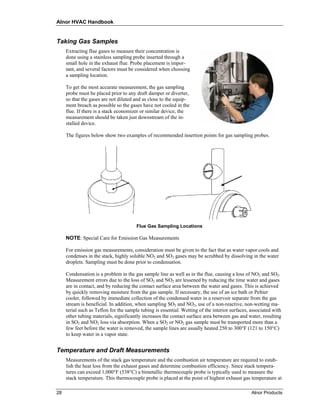
     Taking Gas Samples ................................................................................................................. 28
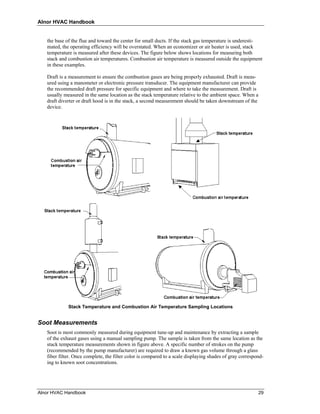
     Temperature and Draft Measurements ..................................................................................... 28
     Soot Measurements................................................................................................................... 29

Appendixes................................................................................................................................... 30
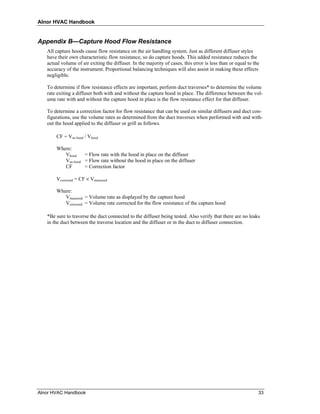
     Appendix A—Performing a Duct Traverse ................................................................................ 30
       Where to Take the Measurement..........................................................................................30
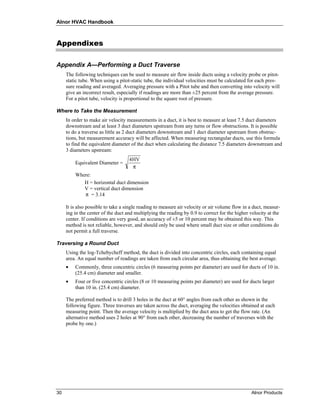
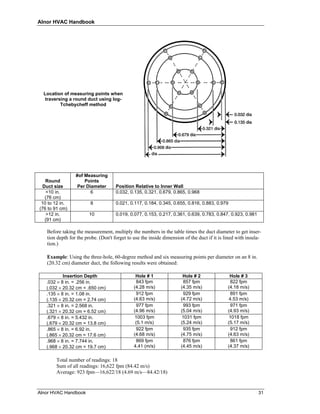
       Traversing a Round Duct ...................................................................................................... 30
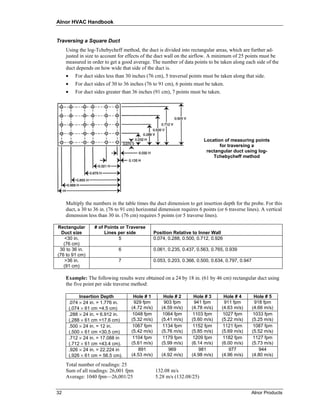
       Traversing a Square Duct ..................................................................................................... 32
     Appendix B—Capture Hood Flow Resistance........................................................................... 33
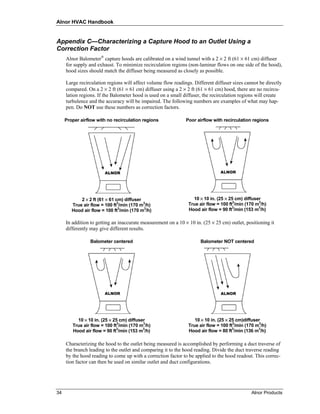
     Appendix C—Characterizing a Capture Hood to an Outlet Using a Correction Factor............. 34
     Appendix D—Determining the Percentage of Outside Air Using Either Temperature or
       CO2 Measurements.............................................................................................................. 36
     Appendix E—Air Changes per Hour (ACH)............................................................................... 38
     Appendix F—Thermal Comfort: Temperature and Humidity ..................................................... 39
     Appendix G—Density Correction............................................................................................... 40
       Density Correction for Thermo-Anemometers ...................................................................... 40
       Density Correction for Pressure Based Manometers or Deflecting Vane Anemometers ..... 40
     Appendix H—Useful Calculations.............................................................................................. 43
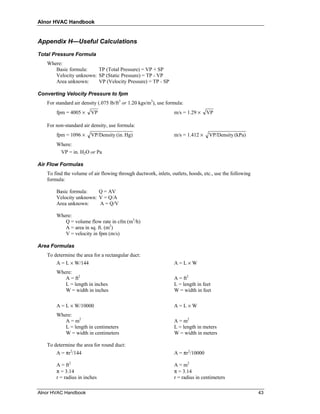
       Total Pressure Formula......................................................................................................... 43
       Converting Velocity Pressure to fpm ..................................................................................... 43
       Air Flow Formulas ................................................................................................................. 43
       Area Formulas ....................................................................................................................... 43
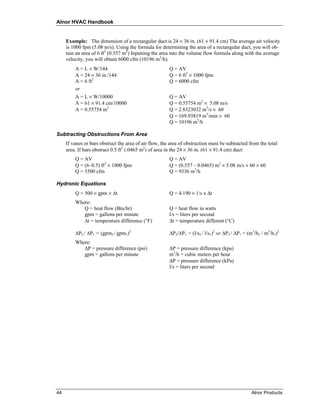
       Subtracting Obstructions From Area ..................................................................................... 44
       Hydronic Equations ............................................................................................................... 44
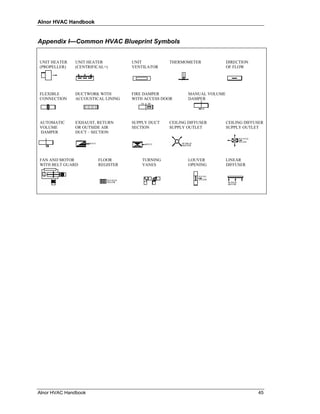
     Appendix I—Common HVAC Blueprint Symbols ...................................................................... 45
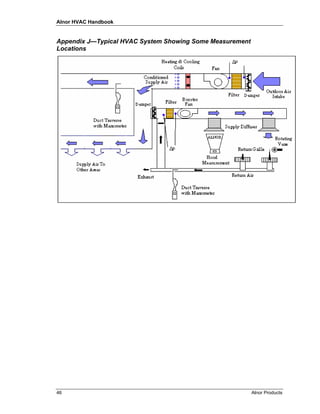
     Appendix J—Typical HVAC System Showing Some Measurement Locations........................ 46
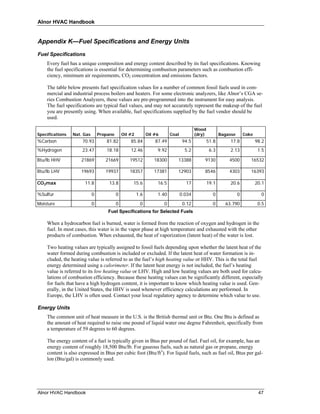
     Appendix K—Fuel Specifications and Energy Units.................................................................. 47
       Fuel Specifications ................................................................................................................ 47
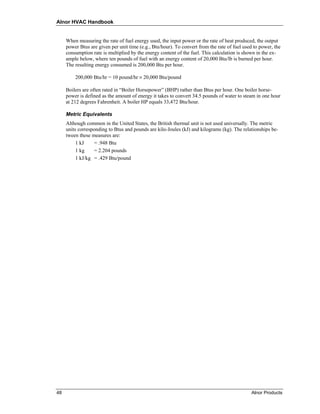
       Energy Units .......................................................................................................................... 47
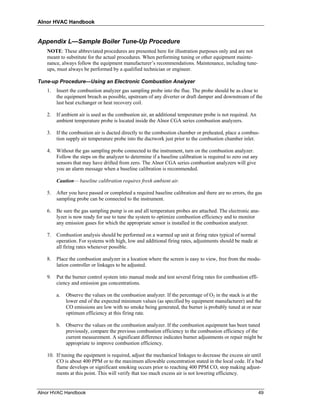
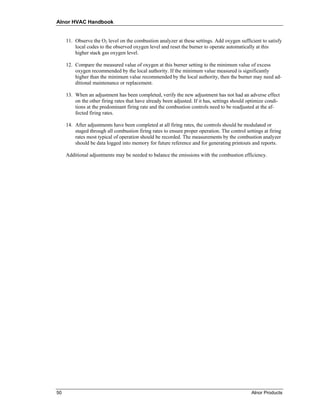
     Appendix L—Sample Boiler Tune-Up Procedure ...................................................................... 49
       Tune-up Procedure—Using an Electronic Combustion Analyzer ......................................... 49

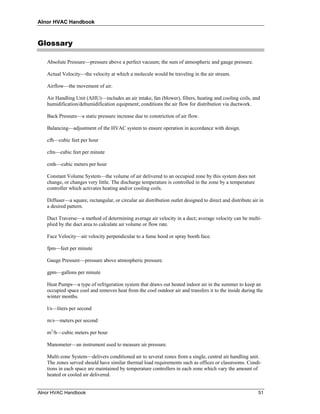
Glossary........................................................................................................................................ 51


References.................................................................................................................................... 53


Notes ............................................................................................................................................. 54


ii                                                                                                                               Alnor Products
Alnor HVAC Handbook


Introduction

General
   This handbook has been developed as a tool to assist you in the field and also as a training aid for
   newer technicians. The contents cover a wide variety of heating and air conditioning ventilation
   measurement applications and technologies.

   Air measurements are a critical concern for a wide range of applications. Facility Managers have long
   recognized the value of air readings in ensuring the balance, efficiency, and cost effectiveness of a
   facility’s heating, cooling, and ventilation systems. Air flow, temperature, and humidity affect
   occupant comfort, productivity, and physical health in hospitals, schools, commercial, and industrial
   facilities. Indoor Air Quality (IAQ) and thermal comfort have become increasingly important in
   promoting healthy and comfortable work environments in today’s workplace.


HVAC Systems, Comfort, and Energy Management
   Energy management is central to all building functions. HVAC systems typically account for over one-
   third of a facility’s energy consumption, so it is imperative to properly manage the operation of HVAC
   systems to ensure economical operation while providing a comfortable, safe environment for occupants.

   One group of tools widely recommended for HVAC system performance testing, verification, and en-
   ergy audits are test and balance instrumentation. These tools are designed to measure air velocity, air
   volume, temperature, humidity, CO2, and noise level from heating and air conditioning ventilation
   ducts to identify problems with airflows, outside air mixing, system balancing, indoor air quality, and
   occupant comfort. Test instruments provide a means to properly measure and document key HVAC
   parameters by identifying potential energy conservation measures that can significantly reduce facility
   energy expenditures.

   Measurement tools will help assess the operating efficiencies and discover system problems such as
   clogged filters, dirty coils, inoperative dampers, improperly programmed building control system
   loops, excessive outside air, defective thermostats and sensors, and simultaneous heating and cool-
   ing—all of which contribute to inefficient HVAC system operation, wasting considerable money. In-
   formation from testing is used in building and HVAC system commissioning reports, used to
   benchmark system performance, and to identify areas of energy waste.

   Today’s HVAC systems must be energy efficient, satisfy stringent indoor air quality and comfort ex-
   pectations, and still be designed/constructed within tight budgets. System designs meeting these de-
   mands have many components, sub-systems, and controls. Building construction involves many
   specialized trades that often work independently of one another which can produce HVAC systems
   that may not perform properly. Without measurement and verification of the optimum operation of
   systems, performance will fall far short of design specifications, increasing building operating costs
   needlessly while wasting energy.

   Alnor products are ideal for commissioning projects since they are portable and have datalogging ca-
   pabilities, making it easy to document system performance on a regular basis. Alnor test instruments
   are available for many different measurement applications and are designed to save money and mini-
   mize testing time. These tools can quickly pay for themselves when properly used to measure, diag-
   nose, and correct building HVAC system performance. In addition, these tools can be used to
   periodically spot-check systems to confirm efficient and economical operation as part of a building-
   wide, systematic, preventative maintenance program.


Alnor HVAC Handbook                                                                                         1
Alnor HVAC Handbook


TAB: Testing, Adjusting, and Balancing
    Testing, adjusting, and balancing (TAB) are specific steps and processes that typically consist of set-
    ting volumes (flow), temperatures, pressures, velocities (speed); recording data; making tests; and pre-
    paring reports. These activities are performed on building environmental systems including, but not
    limited to, air distribution systems, hydronic distribution systems, and the equipment and apparatus in-
    terconnected to these systems.

    All test instruments used for measurement must be accurate and calibration histories for each instru-
    ment must be available for examination. Calibration and maintenance of all instruments must be in ac-
    cordance with the requirements of the applicable TAB certification agency affiliated with the TAB
    firm performing the work.

    Testing—the use of dedicated instruments to measure rotational speed, temperature, pressure, noise
    level, velocity, and volumetric flow rates to evaluate mechanical equipment and system performance.

    Adjusting—the final set point of control or balancing devices such as dampers, valves, thermostats,
    pressure controllers, pumps, and computer controls.

    Balancing—the regulation of air or water system flows through the use of acceptable industry proce-
    dures to achieve the designed flow in cubic feet per minute (cfm), gallons per minute (gpm), and air
    changes per hour (ACH).

    HVAC systems initially installed in a building will usually not function at design specifications auto-
    matically upon startup. Adjusting a system to function at design conditions requires testing, adjusting
    and balancing of control devices. Testing, adjusting, and balancing (TAB) is the method used to cali-
    brate the environmental settings within the building. Some of the main goals of TAB include the fol-
    lowing:
    •   Satisfying the occupants’ comfort.
    •   Achieving the conditions of the HVAC system design specifications.
    •   Extending maintenance intervals and equipment life.
    •   Meeting energy conservation requirements.
    •   Operating in an efficient and economical manner.

    Many existing buildings have experienced some type of change from their original design. Examples
    include renovation work, new construction, and activities which may be drastically different from the
    original intended usage. In these cases, new testing and balancing is critical to ensure maximum oper-
    ating efficiency while providing comfort to the occupants. Some buildings also may require balancing
    throughout the year as the system switches from heating to cooling mode and vice versa.


Certification and Clean-air Measurements
    Monitoring air conditions is a major concern in clean environments since they need to meet more strin-
    gent requirements. Air measurement verification has become mandatory for many laboratories and fa-
    cilities, and can be subject to government regulation and inspection.

    For critical electronic component manufacturing, food and beverage processing, pharmaceutical pro-
    duction, and other critical environments, quality of ambient air can directly impact product quality and
    economic bottom line.

    Laboratory fume hoods, biological safety cabinets, industrial hoods, and spray-paint booths are typical
    applications where measuring and maintaining proper air velocities are critical to safe, healthy working
    conditions. Beyond the need for human comfort and safety, exposure to dangerous, infectious or con-
    tagious material must be controlled. Ventilation and correct air flow distribution are vital to maintain-
    ing product quality and yield.

2                                                                                             Alnor Products
Alnor HVAC Handbook


IAQ
   Indoor Air Quality is another significant factor that may impact occupant comfort-productivity-health,
   product quality, and in some cases affect building structural integrity. Indoor Air Quality encompasses
   a number of air parameters including, but not limited to, relative humidity, temperature, air circulation,
   outside air concentration, volatile organic compound concentration, and fume/vapor dispersal.

   Humidity should be periodically monitored to ensure it stays between 20 and 60 percent, the generally
   accepted ASHRAE guidelines. CO2 levels are an important indicator of indoor air quality. Elevated
   CO2 levels can be indicative of inadequate ventilation which can also increase the levels of volatile or-
   ganic compounds which may affect the health and safety of building occupants.

   There are a number of instruments on the market today that accurately measure humidity and CO2
   levels. Many incorporate multiple air measurement parameters, maximizing their value and
   minimizing the impact on your equipment budget.


Combustion Analysis
   Combustion occurs when fossil fuels, such as natural gas, fuel oil, coal or gasoline, react with oxygen
   in the air to produce heat. The heat from burning fossil fuels is used for industrial processes, environ-
   mental heating or to expand gases in a cylinder and push a piston. Boilers, furnaces and engines are
   important users of fossil fuels.

   Fossil fuels are hydrocarbons composed of primarily carbon and hydrogen. When fossil fuels are
   burned, carbon dioxide (CO2) and water (H2O) are the principle byproducts formed from the carbon
   and hydrogen in the fuel and oxygen (O2) in the air.

   Combustion analysis is part of a process intended to improve fuel economy, reduce undesirable ex-
   haust emissions and improve the safety of fuel burning equipment. Combustion analysis begins with
   the measurement of flue gas concentrations and gas temperature, and may include the measurement of
   draft pressure and soot level.

   The purpose of this handbook is to inform readers of the variety of instrumentation technologies
   available for ventilation and hydronic testing and which instruments are best suited for a particular
   measurement application. Since no one product is suited for every type of job, it is important to
   carefully analyze the measurement requirements and select an instrument that best suits the particular
   application.


Alnor HVAC Handbook                                                                                            3
Alnor HVAC Handbook


Measurement Instrumentation

Capture Hoods
    The volume of air emerging from grilles and diffusers is a critical measurement in HVAC systems.
    Such measurements were traditionally taken using a deflecting vane anemometer with a diffuser probe
    and applying the diffuser manufacturer’s “Ak” factors. Capture hoods have replaced the deflecting
    vane anemometer with diffuser probes due to their ease of use, quick measurements, and near elimi-
    nation of the need to apply grille manufacturers “Ak” factors. It still may be necessary, however, to
    develop a correction factor to apply to the measured reading to compensate for the varying duct and
    diffuser outlets encountered in the field (see Appendix C). Primary benefits for air balancing using
    capture hoods include one-step direct volume measurement, time savings, ease of use, and
    convenience.

    Capture hoods can be configured with various sizes of fabric skirts and frame supports to fit different
    diffuser and grille configurations. The hood “captures” all air exiting from a diffuser or grille and
    guides it through a sampling manifold which has evenly spaced inlets to average the flow through the
    manifold. These instruments are used on both supply and exhaust outlets with separate calibrations for
    each mode performed at the factory.

Mechanical (Analog) Capture Hoods
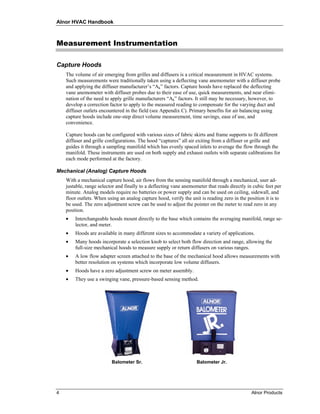
    With a mechanical capture hood, air flows from the sensing manifold through a mechanical, user ad-
    justable, range selector and finally to a deflecting vane anemometer that reads directly in cubic feet per
    minute. Analog models require no batteries or power supply and can be used on ceiling, sidewall, and
    floor outlets. When using an analog capture hood, verify the unit is reading zero in the position it is to
    be used. The zero adjustment screw can be used to adjust the pointer on the meter to read zero in any
    position.
    •   Interchangeable hoods mount directly to the base which contains the averaging manifold, range se-
        lector, and meter.
    •   Hoods are available in many different sizes to accommodate a variety of applications.
    •   Many hoods incorporate a selection knob to select both flow direction and range, allowing the
        full-size mechanical hoods to measure supply or return diffusers on various ranges.
    •   A low flow adapter screen attached to the base of the mechanical hood allows measurements with
        better resolution on systems which incorporate low volume diffusers.
    •   Hoods have a zero adjustment screw on meter assembly.
    •   They use a swinging vane, pressure-based sensing method.


                          Balometer Sr.                             Balometer Jr.


4                                                                                              Alnor Products
Alnor HVAC Handbook


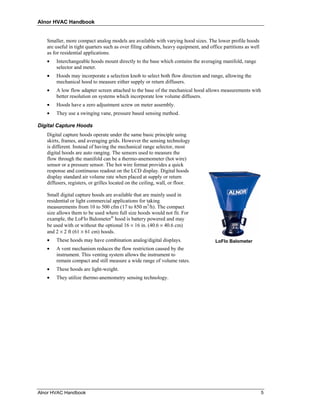
   Smaller, more compact analog models are available with varying hood sizes. The lower profile hoods
   are useful in tight quarters such as over filing cabinets, heavy equipment, and office partitions as well
   as for residential applications.
   •   Interchangeable hoods mount directly to the base which contains the averaging manifold, range
       selector and meter.
   •   Hoods may incorporate a selection knob to select both flow direction and range, allowing the
       mechanical hood to measure either supply or return diffusers.
   •   A low flow adapter screen attached to the base of the mechanical hood allows measurements with
       better resolution on systems which incorporate low volume diffusers.
   •   Hoods have a zero adjustment screw on meter assembly.
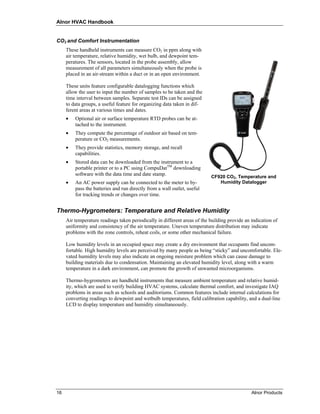
   •   They use a swinging vane, pressure based sensing method.

Digital Capture Hoods
   Digital capture hoods operate under the same basic principle using
   skirts, frames, and averaging grids. However the sensing technology
   is different. Instead of having the mechanical range selector, most
   digital hoods are auto ranging. The sensors used to measure the
   flow through the manifold can be a thermo-anemometer (hot wire)
   sensor or a pressure sensor. The hot wire format provides a quick
   response and continuous readout on the LCD display. Digital hoods
   display standard air volume rate when placed at supply or return
   diffusers, registers, or grilles located on the ceiling, wall, or floor.

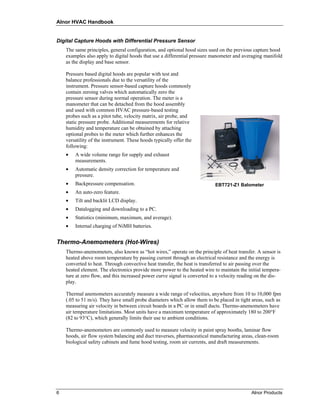
   Small digital capture hoods are available that are mainly used in
   residential or light commercial applications for taking
   measurements from 10 to 500 cfm (17 to 850 m3/h). The compact
   size allows them to be used where full size hoods would not fit. For
   example, the LoFlo Balometer® hood is battery powered and may
   be used with or without the optional 16 × 16 in. (40.6 × 40.6 cm)
   and 2 × 2 ft (61 × 61 cm) hoods.
   •   These hoods may have combination analog/digital displays.                      LoFlo Balometer
   •   A vent mechanism reduces the flow restriction caused by the
       instrument. This venting system allows the instrument to
       remain compact and still measure a wide range of volume rates.
   •   These hoods are light-weight.
   •   They utilize thermo-anemometry sensing technology.


Alnor HVAC Handbook                                                                                            5
Alnor HVAC Handbook


Digital Capture Hoods with Differential Pressure Sensor
    The same principles, general configuration, and optional hood sizes used on the previous capture hood
    examples also apply to digital hoods that use a differential pressure manometer and averaging manifold
    as the display and base sensor.

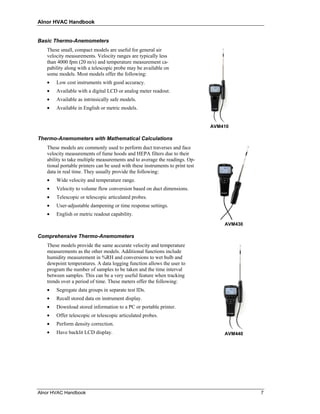
    Pressure based digital hoods are popular with test and
    balance professionals due to the versatility of the
    instrument. Pressure sensor-based capture hoods commonly
    contain zeroing valves which automatically zero the
    pressure sensor during normal operation. The meter is a
    manometer that can be detached from the hood assembly
    and used with common HVAC pressure-based testing
    probes such as a pitot tube, velocity matrix, air probe, and
    static pressure probe. Additional measurements for relative
    humidity and temperature can be obtained by attaching
    optional probes to the meter which further enhances the
    versatility of the instrument. These hoods typically offer the
    following:
    •   A wide volume range for supply and exhaust
        measurements.
    •   Automatic density correction for temperature and
        pressure.
    •   Backpressure compensation.                                         EBT721-Z1 Balometer
    •   An auto-zero feature.
    •   Tilt and backlit LCD display.
    •   Datalogging and downloading to a PC.
    •   Statistics (minimum, maximum, and average).
    •   Internal charging of NiMH batteries.


Thermo-Anemometers (Hot-Wires)
    Thermo-anemometers, also known as “hot wires,” operate on the principle of heat transfer. A sensor is
    heated above room temperature by passing current through an electrical resistance and the energy is
    converted to heat. Through convective heat transfer, the heat is transferred to air passing over the
    heated element. The electronics provide more power to the heated wire to maintain the initial tempera-
    ture at zero flow, and this increased power curve signal is converted to a velocity reading on the dis-
    play.

    Thermal anemometers accurately measure a wide range of velocities, anywhere from 10 to 10,000 fpm
    (.05 to 51 m/s). They have small probe diameters which allow them to be placed in tight areas, such as
    measuring air velocity in between circuit boards in a PC or in small ducts. Thermo-anemometers have
    air temperature limitations. Most units have a maximum temperature of approximately 180 to 200°F
    (82 to 93°C), which generally limits their use to ambient conditions.

    Thermo-anemometers are commonly used to measure velocity in paint spray booths, laminar flow
    hoods, air flow system balancing and duct traverses, pharmaceutical manufacturing areas, clean-room
    biological safety cabinets and fume hood testing, room air currents, and draft measurements.


6                                                                                            Alnor Products
Alnor HVAC Handbook


Basic Thermo-Anemometers
   These small, compact models are useful for general air
   velocity measurements. Velocity ranges are typically less
   than 4000 fpm (20 m/s) and temperature measurement ca-
   pability along with a telescopic probe may be available on
   some models. Most models offer the following:
   •   Low cost instruments with good accuracy.
   •   Available with a digital LCD or analog meter readout.
   •   Available as intrinsically safe models.
   •   Available in English or metric models.


                                                                               AVM410

Thermo-Anemometers with Mathematical Calculations
   These models are commonly used to perform duct traverses and face
   velocity measurements of fume hoods and HEPA filters due to their
   ability to take multiple measurements and to average the readings. Op-
   tional portable printers can be used with these instruments to print test
   data in real time. They usually provide the following:
   •   Wide velocity and temperature range.
   •   Velocity to volume flow conversion based on duct dimensions.
   •   Telescopic or telescopic articulated probes.
   •   User-adjustable dampening or time response settings.
   •   English or metric readout capability.
                                                                                   AVM430

Comprehensive Thermo-Anemometers
   These models provide the same accurate velocity and temperature
   measurements as the other models. Additional functions include
   humidity measurement in %RH and conversions to wet bulb and
   dewpoint temperatures. A data logging function allows the user to
   program the number of samples to be taken and the time interval
   between samples. This can be a very useful feature when tracking
   trends over a period of time. These meters offer the following:
   •   Segregate data groups in separate test IDs.
   •   Recall stored data on instrument display.
   •   Download stored information to a PC or portable printer.
   •   Offer telescopic or telescopic articulated probes.
   •   Perform density correction.
   •   Have backlit LCD display.                                                   AVM440


Alnor HVAC Handbook                                                                         7
Alnor HVAC Handbook


Rotating Vane Anemometers
    A rotating vane anemometer is similar to a small windmill where airflow impinges on the vane
    creating rotation. It is useful for measuring air velocity at supply openings, but not for multiple throw
    diffusers. A characteristic of the rotating vane anemometer is its ability to average air velocities over
    an area. It is most commonly manufactured in four-inch-diameter versions which generally prevents its
    use for measuring duct velocity. However, it has been found useful in walk-in ducts and on large filter
    banks.

    Like most air measuring instruments, the rotating vane anemometer is subject to errors due to angle of
    attack, but these errors are small. A one percent error is typical for ±12 degrees. These instruments
    read in actual feet of air at its existing density which results in actual fpm (m/s). If standard fpm (m/s)
    is desired, simply multiply the anemometer reading by the actual density divided by standard density.
    The rotating vane anemometer must be handled with care, since it cannot survive rough treatment.
    Likewise, it should not be used in dusty or corrosive environments.

Mechanical Rotating Vanes
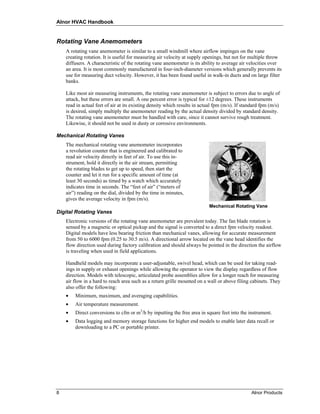
    The mechanical rotating vane anemometer incorporates
    a revolution counter that is engineered and calibrated to
    read air velocity directly in feet of air. To use this in-
    strument, hold it directly in the air stream, permitting
    the rotating blades to get up to speed, then start the
    counter and let it run for a specific amount of time (at
    least 30 seconds) as timed by a watch which accurately
    indicates time in seconds. The “feet of air” (“meters of
    air”) reading on the dial, divided by the time in minutes,
    gives the average velocity in fpm (m/s).
                                                                           Mechanical Rotating Vane
Digital Rotating Vanes
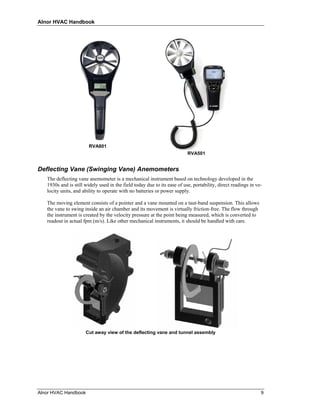
    Electronic versions of the rotating vane anemometer are prevalent today. The fan blade rotation is
    sensed by a magnetic or optical pickup and the signal is converted to a direct fpm velocity readout.
    Digital models have less bearing friction than mechanical vanes, allowing for accurate measurement
    from 50 to 6000 fpm (0.25 to 30.5 m/s). A directional arrow located on the vane head identifies the
    flow direction used during factory calibration and should always be pointed in the direction the airflow
    is traveling when used in field applications.

    Handheld models may incorporate a user-adjustable, swivel head, which can be used for taking read-
    ings in supply or exhaust openings while allowing the operator to view the display regardless of flow
    direction. Models with telescopic, articulated probe assemblies allow for a longer reach for measuring
    air flow in a hard to reach area such as a return grille mounted on a wall or above filing cabinets. They
    also offer the following:
    •   Minimum, maximum, and averaging capabilities.
    •   Air temperature measurement.
    •   Direct conversions to cfm or m3/h by inputting the free area in square feet into the instrument.
    •   Data logging and memory storage functions for higher end models to enable later data recall or
        downloading to a PC or portable printer.


8                                                                                               Alnor Products
Alnor HVAC Handbook


                        RVA801
                                                                          RVA501


Deflecting Vane (Swinging Vane) Anemometers
   The deflecting vane anemometer is a mechanical instrument based on technology developed in the
   1930s and is still widely used in the field today due to its ease of use, portability, direct readings in ve-
   locity units, and ability to operate with no batteries or power supply.

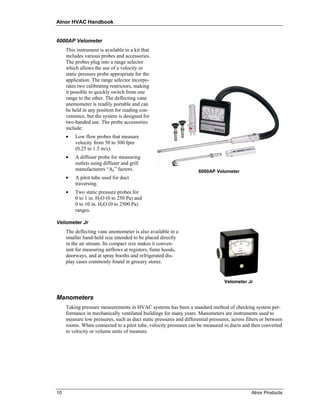
   The moving element consists of a pointer and a vane mounted on a taut-band suspension. This allows
   the vane to swing inside an air chamber and its movement is virtually friction-free. The flow through
   the instrument is created by the velocity pressure at the point being measured, which is converted to
   readout in actual fpm (m/s). Like other mechanical instruments, it should be handled with care.


                      Cut away view of the deflecting vane and tunnel assembly


Alnor HVAC Handbook                                                                                            9
Alnor HVAC Handbook


6000AP Velometer
     This instrument is available in a kit that
     includes various probes and accessories.
     The probes plug into a range selector
     which allows the use of a velocity or
     static pressure probe appropriate for the
     application. The range selector incorpo-
     rates two calibrating restrictors, making
     it possible to quickly switch from one
     range to the other. The deflecting vane
     anemometer is readily portable and can
     be held in any position for reading con-
     venience, but the system is designed for
     two-handed use. The probe accessories
     include:
     •   Low flow probes that measure
         velocity from 50 to 300 fpm
         (0.25 to 1.5 m/s).
     •   A diffuser probe for measuring
         outlets using diffuser and grill
         manufacturers “Ak” factors.                                 6000AP Velometer
     •   A pitot tube used for duct
         traversing.
     •   Two static pressure probes for
         0 to 1 in. H2O (0 to 250 Pa) and
         0 to 10 in. H2O (0 to 2500 Pa)
         ranges.

Velometer Jr
     The deflecting vane anemometer is also available in a
     smaller hand-held size intended to be placed directly
     in the air stream. Its compact size makes it conven-
     ient for measuring airflows at registers, fume hoods,
     doorways, and at spray booths and refrigerated dis-
     play cases commonly found in grocery stores.


                                                                                  Velometer Jr


Manometers
     Taking pressure measurements in HVAC systems has been a standard method of checking system per-
     formance in mechanically ventilated buildings for many years. Manometers are instruments used to
     measure low pressures, such as duct static pressures and differential pressures, across filters or between
     rooms. When connected to a pitot tube, velocity pressures can be measured in ducts and then converted
     to velocity or volume units of measure.


10                                                                                             Alnor Products
Alnor HVAC Handbook


Inclined Gauge Manometer
   The traditional method of measuring pressure is to
   use a liquid manometer known as an inclined
   gauge or incline manometer. To get a good set of
   readings in the field, the instrument must be prop-
   erly positioned (mounted on a wall, duct, or set on
   a steady table) and leveled carefully. It also must
   be zeroed and all of the bubbles in the liquid re-
   moved. Attaching, leveling, and zeroing must be
   done at each location where measurements are
   taken.


                                                                       Incline Manometer

Digital Micromanometer
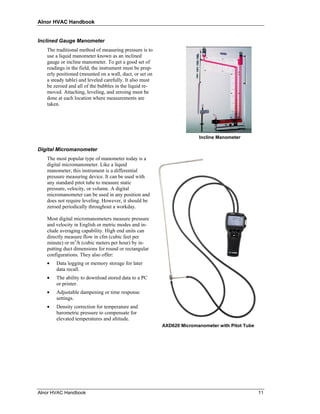
   The most popular type of manometer today is a
   digital micromanometer. Like a liquid
   manometer, this instrument is a differential
   pressure measuring device. It can be used with
   any standard pitot tube to measure static
   pressure, velocity, or volume. A digital
   micromanometer can be used in any position and
   does not require leveling. However, it should be
   zeroed periodically throughout a workday.

   Most digital micromanometers measure pressure
   and velocity in English or metric modes and in-
   clude averaging capability. High end units can
   directly measure flow in cfm (cubic feet per
   minute) or m3/h (cubic meters per hour) by in-
   putting duct dimensions for round or rectangular
   configurations. They also offer:
   •   Data logging or memory storage for later
       data recall.
   •   The ability to download stored data to a PC
       or printer.
   •   Adjustable dampening or time response
       settings.
   •   Density correction for temperature and
       barometric pressure to compensate for
       elevated temperatures and altitude.
                                                         AXD620 Micromanometer with Pitot Tube


Alnor HVAC Handbook                                                                              11
Alnor HVAC Handbook


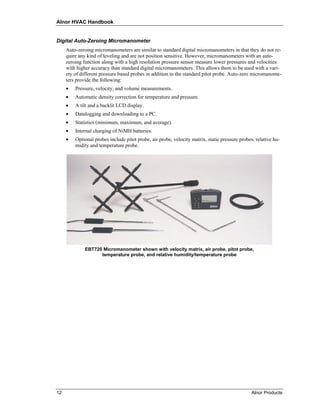
Digital Auto-Zeroing Micromanometer
     Auto-zeroing micromanometers are similar to standard digital micromanometers in that they do not re-
     quire any kind of leveling and are not position sensitive. However, micromanometers with an auto-
     zeroing function along with a high resolution pressure sensor measure lower pressures and velocities
     with higher accuracy than standard digital micromanometers. This allows them to be used with a vari-
     ety of different pressure based probes in addition to the standard pitot probe. Auto-zero micromanome-
     ters provide the following:
     •   Pressure, velocity, and volume measurements.
     •   Automatic density correction for temperature and pressure.
     •   A tilt and a backlit LCD display.
     •   Datalogging and downloading to a PC.
     •   Statistics (minimum, maximum, and average).
     •   Internal charging of NiMH batteries.
     •   Optional probes include pitot probe, air probe, velocity matrix, static pressure probes, relative hu-
         midity and temperature probe.


              EBT720 Micromanometer shown with velocity matrix, air probe, pitot probe,
                    temperature probe, and relative humidity/temperature probe


12                                                                                              Alnor Products
Alnor HVAC Handbook


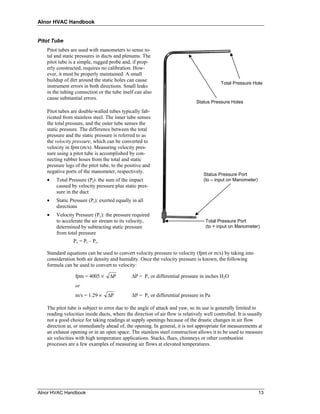
Pitot Tube
   Pitot tubes are used with manometers to sense to-
   tal and static pressures in ducts and plenums. The
   pitot tube is a simple, rugged probe and, if prop-
   erly constructed, requires no calibration. How-
   ever, it must be properly maintained. A small
   buildup of dirt around the static holes can cause
                                                                                          Total Pressure Hole
   instrument errors in both directions. Small leaks
   in the tubing connection or the tube itself can also
   cause substantial errors.
                                                                              Status Pressure Holes

   Pitot tubes are double-walled tubes typically fab-
   ricated from stainless steel. The inner tube senses
   the total pressure, and the outer tube senses the
   static pressure. The difference between the total
   pressure and the static pressure is referred to as
   the velocity pressure, which can be converted to
   velocity in fpm (m/s). Measuring velocity pres-
   sure using a pitot tube is accomplished by con-
   necting rubber hoses from the total and static
   pressure legs of the pitot tube, to the positive and
   negative ports of the manometer, respectively.
                                                                                  Status Pressure Port
   •   Total Pressure (Pt): the sum of the impact                                 (to – input on Manometer)
       caused by velocity pressure plus static pres-
       sure in the duct
   •   Static Pressure (Ps): exerted equally in all
       directions
   •   Velocity Pressure (Pv): the pressure required
       to accelerate the air stream to its velocity,                               Total Pressure Port
       determined by subtracting static pressure                                   (to + input on Manometer)
       from total pressure
                Pv = Pt – Ps.

   Standard equations can be used to convert velocity pressure to velocity (fpm or m/s) by taking into
   consideration both air density and humidity. Once the velocity pressure is known, the following
   formula can be used to convert to velocity:

                 fpm = 4005 ×     ΔP         ∆P = Pv or differential pressure in inches H2O
                 or
                 m/s = 1.29 ×    ΔP          ∆P = Pv or differential pressure in Pa

   The pitot tube is subject to error due to the angle of attack and yaw, so its use is generally limited to
   reading velocities inside ducts, where the direction of air flow is relatively well controlled. It is usually
   not a good choice for taking readings at supply openings because of the drastic changes in air flow
   direction at, or immediately ahead of, the opening. In general, it is not appropriate for measurements at
   an exhaust opening or in an open space. The stainless steel construction allows it to be used to measure
   air velocities with high temperature applications. Stacks, flues, chimneys or other combustion
   processes are a few examples of measuring air flows at elevated temperatures.


Alnor HVAC Handbook                                                                                           13
Alnor HVAC Handbook


Hydronics
     Hydronic systems found in HVAC configurations primarily use hot and chilled water as the means for
     heat transfer. The hydronic system must be able to efficiently distribute water to all terminal devices
     under design load and part load conditions to be considered operating properly. If the system is not
     balanced for design conditions, then the cost to operate the system will be higher than anticipated.

     Correctly balancing a hydronic system requires the proper tools and procedures. Manual balancing
     valves installed in the system are typically used to regulate flow to all points to achieve design condi-
     tions. Flow control through the balancing valve is accomplished by adjusting a valve to vary the differ-
     ential pressure across it.

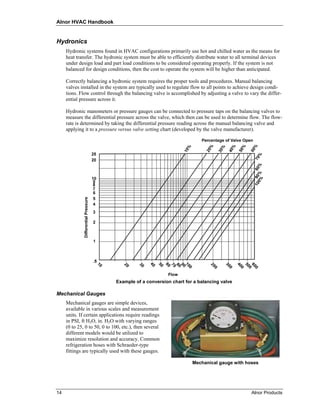
     Hydronic manometers or pressure gauges can be connected to pressure taps on the balancing valves to
     measure the differential pressure across the valve, which then can be used to determine flow. The flow-
     rate is determined by taking the differential pressure reading across the manual balancing valve and
     applying it to a pressure versus valve setting chart (developed by the valve manufacturer).


                              Example of a conversion chart for a balancing valve

Mechanical Gauges
     Mechanical gauges are simple devices,
     available in various scales and measurement
     units. If certain applications require readings
     in PSI, ft H2O, in. H2O with varying ranges
     (0 to 25, 0 to 50, 0 to 100, etc.), then several
     different models would be utilized to
     maximize resolution and accuracy. Common
     refrigeration hoses with Schraeder-type
     fittings are typically used with these gauges.

                                                                  Mechanical gauge with hoses


14                                                                                             Alnor Products
Alnor HVAC Handbook


Digital Hydronic Manometers
   Digital hydronic manometers have features such as multiple units of measurement in English or metric,
   wider ranges with good accuracy and resolution, and large LCD displays. A single unit replaces multi-
   ple mechanical gauges. Digital models require a power source such as a plug-in AC power supply, dis-
   posable alkaline batteries, or rechargeable batteries with separate charging station. Standard
   refrigeration grade hoses and fittings with shut off valves are also used with digital models.
   •   These units have a backlit display for poorly lit areas.
   •   They offer memory, recall, datalogging, and downloading functions.
   •   They have user-adjustable dampening or time response settings.
   •   Some hydronic meters also perform flow and other calculations.


 Hydronic Manometer measuring the pressure                             HM680 with hoses
            rise across a pump


IAQ: Ventilation and Carbon Dioxide
   A good indicator of proper ventilation is the level of CO2 present in a space. Carbon dioxide is a nor-
   mal byproduct of respiration, combustion and other processes. Elevated levels of CO2 may indicate
   that additional ventilation is required. Higher CO2 levels may also indicate more investigation is re-
   quired regarding ventilation, thermal comfort, or source control. Inadequate ventilation can increase
   volatile organic compound levels in the ambient air which can affect occupant comfort and health.

   The measurement of carbon dioxide concentration relies on one of the natural properties of CO2 mole-
   cules: they absorb light at a specific wavelength of 4.26 µm, a wavelength in the infrared (IR) range.
   High concentrations of CO2 molecules absorb more light than low concentrations. The technique used
   to measure CO2 in handheld instrumentation is called non-dispersive infrared (NDIR) detection.

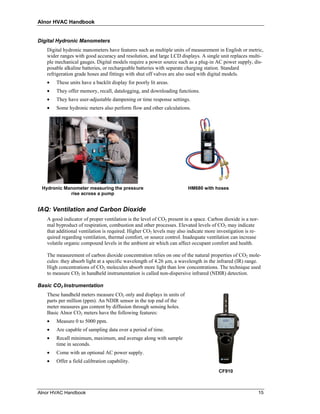
Basic CO2 Instrumentation
   These handheld meters measure CO2 only and displays in units of
   parts per million (ppm). An NDIR sensor in the top end of the
   meter measures gas content by diffusion through sensing holes.
   Basic Alnor CO2 meters have the following features:
   •   Measure 0 to 5000 ppm.
   •   Are capable of sampling data over a period of time.
   •   Recall minimum, maximum, and average along with sample
       time in seconds.
   •   Come with an optional AC power supply.
   •   Offer a field calibration capability.
                                                                                      CF910


Alnor HVAC Handbook                                                                                      15
Alnor HVAC Handbook


CO2 and Comfort Instrumentation
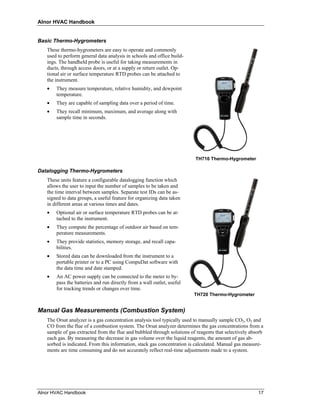
     These handheld instruments can measure CO2 in ppm along with
     air temperature, relative humidity, wet bulb, and dewpoint tem-
     peratures. The sensors, located in the probe assembly, allow
     measurement of all parameters simultaneously when the probe is
     placed in an air-stream within a duct or in an open environment.

     These units feature configurable datalogging functions which
     allow the user to input the number of samples to be taken and the
     time interval between samples. Separate test IDs can be assigned
     to data groups, a useful feature for organizing data taken in dif-
     ferent areas at various times and dates.
     •   Optional air or surface temperature RTD probes can be at-
         tached to the instrument.
     •   They compute the percentage of outdoor air based on tem-
         perature or CO2 measurements.
     •   They provide statistics, memory storage, and recall
         capabilities.
     •   Stored data can be downloaded from the instrument to a
         portable printer or to a PC using CompuDatTM downloading
         software with the data time and date stamp.                       CF920 CO2, Temperature and
     •   An AC power supply can be connected to the meter to by-              Humidity Datalogger
         pass the batteries and run directly from a wall outlet, useful
         for tracking trends or changes over time.


Thermo-Hygrometers: Temperature and Relative Humidity
     Air temperature readings taken periodically in different areas of the building provide an indication of
     uniformity and consistency of the air temperature. Uneven temperature distribution may indicate
     problems with the zone controls, reheat coils, or some other mechanical failure.

     Low humidity levels in an occupied space may create a dry environment that occupants find uncom-
     fortable. High humidity levels are perceived by many people as being “sticky” and uncomfortable. Ele-
     vated humidity levels may also indicate an ongoing moisture problem which can cause damage to
     building materials due to condensation. Maintaining an elevated humidity level, along with a warm
     temperature in a dark environment, can promote the growth of unwanted microorganisms.

     Thermo-hygrometers are handheld instruments that measure ambient temperature and relative humid-
     ity, which are used to verify building HVAC systems, calculate thermal comfort, and investigate IAQ
     problems in areas such as schools and auditoriums. Common features include internal calculations for
     converting readings to dewpoint and wetbulb temperatures, field calibration capability, and a dual-line
     LCD to display temperature and humidity simultaneously.


16                                                                                             Alnor Products
Alnor HVAC Handbook


Basic Thermo-Hygrometers
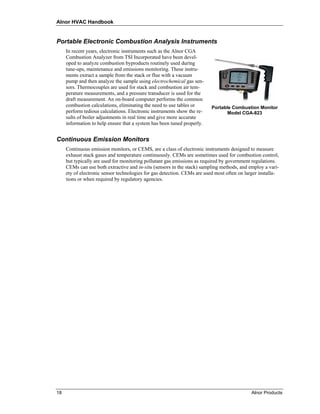
   These thermo-hygrometers are easy to operate and commonly
   used to perform general data analysis in schools and office build-
   ings. The handheld probe is useful for taking measurements in
   ducts, through access doors, or at a supply or return outlet. Op-
   tional air or surface temperature RTD probes can be attached to
   the instrument.
   •   They measure temperature, relative humidity, and dewpoint
       temperature.
   •   They are capable of sampling data over a period of time.
   •   They recall minimum, maximum, and average along with
       sample time in seconds.


                                                                         TH710 Thermo-Hygrometer

Datalogging Thermo-Hygrometers
   These units feature a configurable datalogging function which
   allows the user to input the number of samples to be taken and
   the time interval between samples. Separate test IDs can be as-
   signed to data groups, a useful feature for organizing data taken
   in different areas at various times and dates.
   •   Optional air or surface temperature RTD probes can be at-
       tached to the instrument.
   •   They compute the percentage of outdoor air based on tem-
       perature measurements.
   •   They provide statistics, memory storage, and recall capa-
       bilities.
   •   Stored data can be downloaded from the instrument to a
       portable printer or to a PC using CompuDat software with
       the data time and date stamped.
   •   An AC power supply can be connected to the meter to by-
       pass the batteries and run directly from a wall outlet, useful
       for tracking trends or changes over time.
                                                                         TH720 Thermo-Hygrometer


Manual Gas Measurements (Combustion System)
   The Orsat analyzer is a gas concentration analysis tool typically used to manually sample CO2, O2 and
   CO from the flue of a combustion system. The Orsat analyzer determines the gas concentrations from a
   sample of gas extracted from the flue and bubbled through solutions of reagents that selectively absorb
   each gas. By measuring the decrease in gas volume over the liquid reagents, the amount of gas ab-
   sorbed is indicated. From this information, stack gas concentration is calculated. Manual gas measure-
   ments are time consuming and do not accurately reflect real-time adjustments made to a system.


Alnor HVAC Handbook                                                                                    17
Alnor HVAC Handbook


Portable Electronic Combustion Analysis Instruments
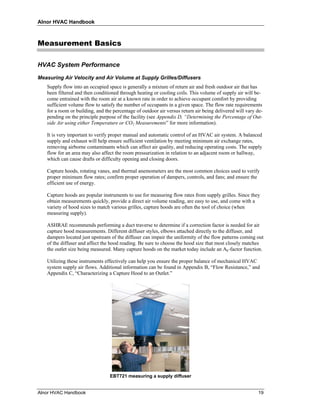
     In recent years, electronic instruments such as the Alnor CGA
     Combustion Analyzer from TSI Incorporated have been devel-
     oped to analyze combustion byproducts routinely used during
     tune-ups, maintenance and emissions monitoring. These instru-
     ments extract a sample from the stack or flue with a vacuum
     pump and then analyze the sample using electrochemical gas sen-
     sors. Thermocouples are used for stack and combustion air tem-
     perature measurements, and a pressure transducer is used for the
     draft measurement. An on-board computer performs the common
     combustion calculations, eliminating the need to use tables or       Portable Combustion Monitor
     perform tedious calculations. Electronic instruments show the re-           Model CGA-823
     sults of boiler adjustments in real time and give more accurate
     information to help ensure that a system has been tuned properly.


Continuous Emission Monitors
     Continuous emission monitors, or CEMS, are a class of electronic instruments designed to measure
     exhaust stack gases and temperature continuously. CEMs are sometimes used for combustion control,
     but typically are used for monitoring pollutant gas emissions as required by government regulations.
     CEMs can use both extractive and in-situ (sensors in the stack) sampling methods, and employ a vari-
     ety of electronic sensor technologies for gas detection. CEMs are used most often on larger installa-
     tions or when required by regulatory agencies.


18                                                                                           Alnor Products
Alnor HVAC Handbook


Measurement Basics

HVAC System Performance

Measuring Air Velocity and Air Volume at Supply Grilles/Diffusers
   Supply flow into an occupied space is generally a mixture of return air and fresh outdoor air that has
   been filtered and then conditioned through heating or cooling coils. This volume of supply air will be-
   come entrained with the room air at a known rate in order to achieve occupant comfort by providing
   sufficient volume flow to satisfy the number of occupants in a given space. The flow rate requirements
   for a room or building, and the percentage of outdoor air versus return air being delivered will vary de-
   pending on the principle purpose of the facility (see Appendix D, “Determining the Percentage of Out-
   side Air using either Temperature or CO2 Measurements” for more information).

   It is very important to verify proper manual and automatic control of an HVAC air system. A balanced
   supply and exhaust will help ensure sufficient ventilation by meeting minimum air exchange rates,
   removing airborne contaminants which can affect air quality, and reducing operating costs. The supply
   flow for an area may also affect the room pressurization in relation to an adjacent room or hallway,
   which can cause drafts or difficulty opening and closing doors.

   Capture hoods, rotating vanes, and thermal anemometers are the most common choices used to verify
   proper minimum flow rates; confirm proper operation of dampers, controls, and fans; and ensure the
   efficient use of energy.

   Capture hoods are popular instruments to use for measuring flow rates from supply grilles. Since they
   obtain measurements quickly, provide a direct air volume reading, are easy to use, and come with a
   variety of hood sizes to match various grilles, capture hoods are often the tool of choice (when
   measuring supply).

   ASHRAE recommends performing a duct traverse to determine if a correction factor is needed for air
   capture hood measurements. Different diffuser styles, elbows attached directly to the diffuser, and
   dampers located just upstream of the diffuser can impair the uniformity of the flow patterns coming out
   of the diffuser and affect the hood reading. Be sure to choose the hood size that most closely matches
   the outlet size being measured. Many capture hoods on the market today include an Ak-factor function.

   Utilizing these instruments effectively can help you ensure the proper balance of mechanical HVAC
   system supply air flows. Additional information can be found in Appendix B, “Flow Resistance,” and
   Appendix C, “Characterizing a Capture Hood to an Outlet.”


                                 EBT721 measuring a supply diffuser


Alnor HVAC Handbook                                                                                      19
Alnor HVAC Handbook


Nonuniform Flow Corrections
     Using a capture hood on a supply opening with no diffuser or de-
     flecting vanes may not provide accurate results due to a nonuni-
     form air pattern and jet effects. Capture hoods are generally
     calibrated on a wind tunnel with a 2 × 2 ft (61 × 61 cm) hood at-
     tached to a diffuser or grille. The diffuser or grille spreads out
     the air flow and the capture hood will see more uniform flow.
     Other instruments are often used instead of capture hoods for
     nonuniform air flow applications.

     Other suitable instrument types for this application include rotat-
     ing vane, thermal anemometer, velocity matrix and swinging-
     vane anemometers.

     Measuring air velocities at a supply opening is easily accom-
     plished when no grille or louvers cover the opening. Divide the
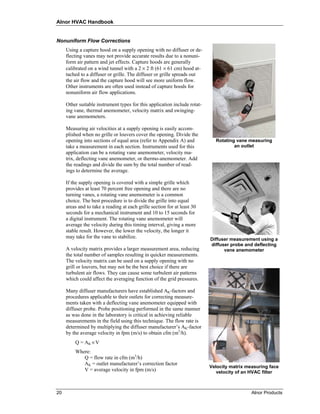
     opening into sections of equal area (refer to Appendix A) and           Rotating vane measuring
     take a measurement in each section. Instruments used for this                   an outlet
     application can be a rotating vane anemometer, velocity ma-
     trix, deflecting vane anemometer, or thermo-anemometer. Add
     the readings and divide the sum by the total number of read-
     ings to determine the average.

     If the supply opening is covered with a simple grille which
     provides at least 70 percent free opening and there are no
     turning vanes, a rotating vane anemometer is a common
     choice. The best procedure is to divide the grille into equal
     areas and to take a reading at each grille section for at least 30
     seconds for a mechanical instrument and 10 to 15 seconds for
     a digital instrument. The rotating vane anemometer will
     average the velocity during this timing interval, giving a more
     stable result. However, the lower the velocity, the longer it
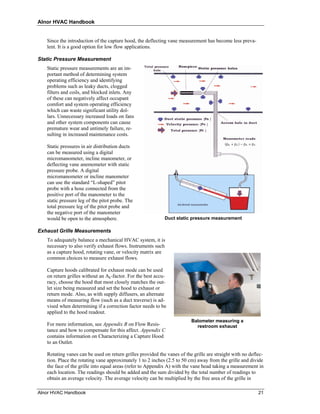
     may take for the vane to stabilize.                                   Diffuser measurement using a
                                                                           diffuser probe and deflecting
     A velocity matrix provides a larger measurement area, reducing              vane anemometer
     the total number of samples resulting in quicker measurements.
     The velocity matrix can be used on a supply opening with no
     grill or louvers, but may not be the best choice if there are
     turbulent air flows. They can cause some turbulent air patterns
     which could affect the averaging function of the grid pressures.

     Many diffuser manufacturers have established AK-factors and
     procedures applicable to their outlets for correcting measure-
     ments taken with a deflecting vane anemometer equipped with
     diffuser probe. Probe positioning performed in the same manner
     as was done in the laboratory is critical in achieving reliable
     measurements in the field using this technique. The flow rate is
     determined by multiplying the diffuser manufacturer’s AK-factor
     by the average velocity in fpm (m/s) to obtain cfm (m3/h).
         Q = AK × V
         Where:
            Q = flow rate in cfm (m3/h)
            AK = outlet manufacturer’s correction factor
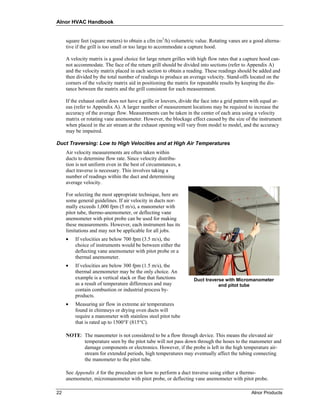
                                                                           Velocity matrix measuring face
            V = average velocity in fpm (m/s)                                 velocity of an HVAC filter


20                                                                                           Alnor Products
Alnor HVAC Handbook


   Since the introduction of the capture hood, the deflecting vane measurement has become less preva-
   lent. It is a good option for low flow applications.

Static Pressure Measurement
   Static pressure measurements are an im-
   portant method of determining system
   operating efficiency and identifying
   problems such as leaky ducts, clogged
   filters and coils, and blocked inlets. Any
   of these can negatively affect occupant
   comfort and system operating efficiency
   which can waste significant utility dol-
   lars. Unnecessary increased loads on fans
   and other system components can cause
   premature wear and untimely failure, re-
   sulting in increased maintenance costs.

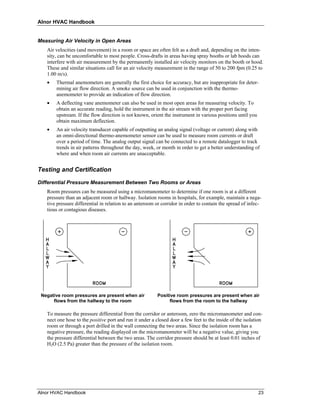
   Static pressures in air distribution ducts
   can be measured using a digital
   micromanometer, incline manometer, or
   deflecting vane anemometer with static
   pressure probe. A digital
   micromanometer or incline manometer
   can use the standard “L-shaped” pitot
   probe with a hose connected from the
   positive port of the manometer to the
   static pressure leg of the pitot probe. The
   total pressure leg of the pitot probe and
   the negative port of the manometer
   would be open to the atmosphere.                         Duct static pressure measurement

Exhaust Grille Measurements
   To adequately balance a mechanical HVAC system, it is
   necessary to also verify exhaust flows. Instruments such
   as a capture hood, rotating vane, or velocity matrix are
   common choices to measure exhaust flows.

   Capture hoods calibrated for exhaust mode can be used
   on return grilles without an Ak-factor. For the best accu-
   racy, choose the hood that most closely matches the out-
   let size being measured and set the hood to exhaust or
   return mode. Also, as with supply diffusers, an alternate
   means of measuring flow (such as a duct traverse) is ad-
   vised when determining if a correction factor needs to be
   applied to the hood readout.
                                                                         Balometer measuring a
   For more information, see Appendix B on Flow Resis-                     restroom exhaust
   tance and how to compensate for this affect. Appendix C
   contains information on Characterizing a Capture Hood
   to an Outlet.

   Rotating vanes can be used on return grilles provided the vanes of the grille are straight with no deflec-
   tion. Place the rotating vane approximately 1 to 2 inches (2.5 to 50 cm) away from the grille and divide
   the face of the grille into equal areas (refer to Appendix A) with the vane head taking a measurement in
   each location. The readings should be added and the sum divided by the total number of readings to
   obtain an average velocity. The average velocity can be multiplied by the free area of the grille in

Alnor HVAC Handbook                                                                                       21
Alnor HVAC Handbook


     square feet (square meters) to obtain a cfm (m3/h) volumetric value. Rotating vanes are a good alterna-
     tive if the grill is too small or too large to accommodate a capture hood.

     A velocity matrix is a good choice for large return grilles with high flow rates that a capture hood can-
     not accommodate. The face of the return grill should be divided into sections (refer to Appendix A)
     and the velocity matrix placed in each section to obtain a reading. These readings should be added and
     then divided by the total number of readings to produce an average velocity. Stand-offs located on the
     corners of the velocity matrix aid in positioning the matrix for repeatable results by keeping the dis-
     tance between the matrix and the grill consistent for each measurement.

     If the exhaust outlet does not have a grille or louvers, divide the face into a grid pattern with equal ar-
     eas (refer to Appendix A). A larger number of measurement locations may be required to increase the
     accuracy of the average flow. Measurements can be taken in the center of each area using a velocity
     matrix or rotating vane anemometer. However, the blockage effect caused by the size of the instrument
     when placed in the air stream at the exhaust opening will vary from model to model, and the accuracy
     may be impaired.

Duct Traversing: Low to High Velocities and at High Air Temperatures
     Air velocity measurements are often taken within
     ducts to determine flow rate. Since velocity distribu-
     tion is not uniform even in the best of circumstances, a
     duct traverse is necessary. This involves taking a
     number of readings within the duct and determining
     average velocity.

     For selecting the most appropriate technique, here are
     some general guidelines. If air velocity in ducts nor-
     mally exceeds 1,000 fpm (5 m/s), a manometer with
     pitot tube, thermo-anemometer, or deflecting vane
     anemometer with pitot probe can be used for making
     these measurements. However, each instrument has its
     limitations and may not be applicable for all jobs.
     •   If velocities are below 700 fpm (3.5 m/s), the
         choice of instruments would be between either the
         deflecting vane anemometer with pitot probe or a
         thermal anemometer.
     •   If velocities are below 300 fpm (1.5 m/s), the
         thermal anemometer may be the only choice. An
         example is a vertical stack or flue that functions         Duct traverse with Micromanometer
         as a result of temperature differences and may                        and pitot tube
         contain combustion or industrial process by-
         products.
     •   Measuring air flow in extreme air temperatures
         found in chimneys or drying oven ducts will
         require a manometer with stainless steel pitot tube
         that is rated up to 1500°F (815°C).

     NOTE: The manometer is not considered to be a flow through device. This means the elevated air
           temperature seen by the pitot tube will not pass down through the hoses to the manometer and
           damage components or electronics. However, if the probe is left in the high temperature air-
           stream for extended periods, high temperatures may eventually affect the tubing connecting
           the manometer to the pitot tube.

     See Appendix A for the procedure on how to perform a duct traverse using either a thermo-
     anemometer, micromanometer with pitot probe, or deflecting vane anemometer with pitot probe.

22                                                                                               Alnor Products
Alnor HVAC Handbook


Measuring Air Velocity in Open Areas
   Air velocities (and movement) in a room or space are often felt as a draft and, depending on the inten-
   sity, can be uncomfortable to most people. Cross-drafts in areas having spray booths or lab hoods can
   interfere with air measurement by the permanently installed air velocity monitors on the booth or hood.
   These and similar situations call for an air velocity measurement in the range of 50 to 200 fpm (0.25 to
   1.00 m/s).
   •   Thermal anemometers are generally the first choice for accuracy, but are inappropriate for deter-
       mining air flow direction. A smoke source can be used in conjunction with the thermo-
       anemometer to provide an indication of flow direction.
   •   A deflecting vane anemometer can also be used in most open areas for measuring velocity. To
       obtain an accurate reading, hold the instrument in the air stream with the proper port facing
       upstream. If the flow direction is not known, orient the instrument in various positions until you
       obtain maximum deflection.
   •   An air velocity transducer capable of outputting an analog signal (voltage or current) along with
       an omni-directional thermo-anemometer sensor can be used to measure room currents or draft
       over a period of time. The analog output signal can be connected to a remote datalogger to track
       trends in air patterns throughout the day, week, or month in order to get a better understanding of
       where and when room air currents are unacceptable.


Testing and Certification

Differential Pressure Measurement Between Two Rooms or Areas
   Room pressures can be measured using a micromanometer to determine if one room is at a different
   pressure than an adjacent room or hallway. Isolation rooms in hospitals, for example, maintain a nega-
   tive pressure differential in relation to an anteroom or corridor in order to contain the spread of infec-
   tious or contagious diseases.


 Negative room pressures are present when air            Positive room pressures are present when air
      flows from the hallway to the room                       flows from the room to the hallway

   To measure the pressure differential from the corridor or anteroom, zero the micromanometer and con-
   nect one hose to the positive port and run it under a closed door a few feet to the inside of the isolation
   room or through a port drilled in the wall connecting the two areas. Since the isolation room has a
   negative pressure, the reading displayed on the micromanometer will be a negative value, giving you
   the pressure differential between the two areas. The corridor pressure should be at least 0.01 inches of
   H2O (2.5 Pa) greater than the pressure of the isolation room.


Alnor HVAC Handbook                                                                                         23
Alnor HVAC Handbook


Spray Booths
     There are a number of applications in industrial plants
     which require air flow measurements at exhaust openings
     to satisfy minimum requirements for comfort or safety.
     The most common is a spray booth where the generally
     acceptable average velocity is 100 fpm (0.51 m/s) and air
     must be moving into the booth at that velocity. An exhaust
     fan connected to the spray booth duct creates a negative
     pressure in the booth, resulting in ambient air outside the
     booth being drawn into the booth to mix with the vapors.
     The combined air mix then flows up the exhaust duct.

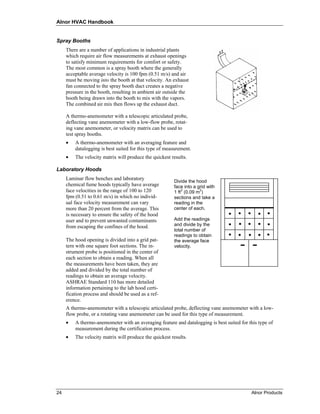
     A thermo-anemometer with a telescopic articulated probe,
     deflecting vane anemometer with a low-flow probe, rotat-
     ing vane anemometer, or velocity matrix can be used to
     test spray booths.
     •   A thermo-anemometer with an averaging feature and
         datalogging is best suited for this type of measurement.
     •   The velocity matrix will produce the quickest results.

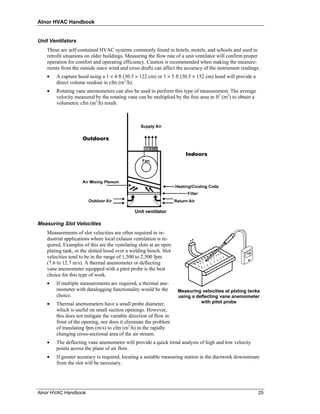
Laboratory Hoods
     Laminar flow benches and laboratory
                                                         Divide the hood
     chemical fume hoods typically have average          face into a grid with
     face velocities in the range of 100 to 120          1 ft2 (0.09 m2)
     fpm (0.51 to 0.61 m/s) in which no individ-         sections and take a
     ual face velocity measurement can vary              reading in the
     more than 20 percent from the average. This         center of each.
     is necessary to ensure the safety of the hood
     user and to prevent unwanted contaminants           Add the readings
     from escaping the confines of the hood.             and divide by the
                                                         total number of
                                                         readings to obtain
     The hood opening is divided into a grid pat-        the average face
     tern with one square foot sections. The in-         velocity.
     strument probe is positioned in the center of
     each section to obtain a reading. When all
     the measurements have been taken, they are
     added and divided by the total number of
     readings to obtain an average velocity.
     ASHRAE Standard 110 has more detailed
     information pertaining to the lab hood certi-
     fication process and should be used as a ref-
     erence.
     A thermo-anemometer with a telescopic articulated probe, deflecting vane anemometer with a low-
     flow probe, or a rotating vane anemometer can be used for this type of measurement.
     •   A thermo-anemometer with an averaging feature and datalogging is best suited for this type of
         measurement during the certification process.
     •   The velocity matrix will produce the quickest results.


24                                                                                         Alnor Products
Alnor HVAC Handbook


Unit Ventilators
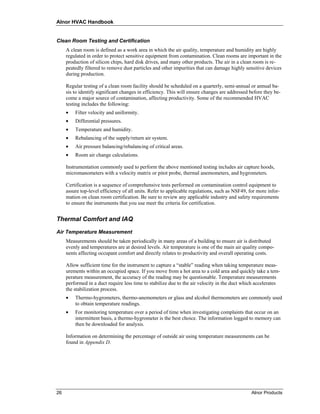
   These are self-contained HVAC systems commonly found in hotels, motels, and schools and used in
   retrofit situations on older buildings. Measuring the flow rate of a unit ventilator will confirm proper
   operation for comfort and operating efficiency. Caution is recommended when making the measure-
   ments from the outside since wind and cross drafts can affect the accuracy of the instrument readings.
   •   A capture hood using a 1 × 4 ft (30.5 × 122 cm) or 1 × 5 ft (30.5 × 152 cm) hood will provide a
       direct volume readout in cfm (m3/h).
   •   Rotating vane anemometers can also be used to perform this type of measurement. The average
       velocity measured by the rotating vane can be multiplied by the free area in ft2 (m2) to obtain a
       volumetric cfm (m3/h) result.


                                              Unit ventilator

Measuring Slot Velocities
   Measurements of slot velocities are often required in in-
   dustrial applications where local exhaust ventilation is re-
   quired. Examples of this are the ventilating slots at an open
   plating tank, or the slotted hood over a welding bench. Slot
   velocities tend to be in the range of 1,500 to 2,500 fpm
   (7.6 to 12.7 m/s). A thermal anemometer or deflecting
   vane anemometer equipped with a pitot probe is the best
   choice for this type of work.
   •   If multiple measurements are required, a thermal ane-
       mometer with datalogging functionality would be the         Measuring velocities at plating tanks
       choice.                                                     using a deflecting vane anemometer
   •   Thermal anemometers have a small probe diameter,                      with pitot probe
       which is useful on small suction openings. However,
       this does not mitigate the variable direction of flow in
       front of the opening, nor does it eliminate the problem
       of translating fpm (m/s) to cfm (m3/h) in the rapidly
       changing cross-sectional area of the air stream.
   •   The deflecting vane anemometer will provide a quick trend analysis of high and low velocity
       points across the plane of air flow.
   •   If greater accuracy is required, locating a suitable measuring station in the ductwork downstream
       from the slot will be necessary.


Alnor HVAC Handbook                                                                                        25
Alnor HVAC Handbook


Clean Room Testing and Certification
     A clean room is defined as a work area in which the air quality, temperature and humidity are highly
     regulated in order to protect sensitive equipment from contamination. Clean rooms are important in the
     production of silicon chips, hard disk drives, and many other products. The air in a clean room is re-
     peatedly filtered to remove dust particles and other impurities that can damage highly sensitive devices
     during production.

     Regular testing of a clean room facility should be scheduled on a quarterly, semi-annual or annual ba-
     sis to identify significant changes in efficiency. This will ensure changes are addressed before they be-
     come a major source of contamination, affecting productivity. Some of the recommended HVAC
     testing includes the following:
     •   Filter velocity and uniformity.
     •   Differential pressures.
     •   Temperature and humidity.
     •   Rebalancing of the supply/return air system.
     •   Air pressure balancing/rebalancing of critical areas.
     •   Room air change calculations.

     Instrumentation commonly used to perform the above mentioned testing includes air capture hoods,
     micromanometers with a velocity matrix or pitot probe, thermal anemometers, and hygrometers.

     Certification is a sequence of comprehensive tests performed on contamination control equipment to
     assure top-level efficiency of all units. Refer to applicable regulations, such as NSF49, for more infor-
     mation on clean room certification. Be sure to review any applicable industry and safety requirements
     to ensure the instruments that you use meet the criteria for certification.


Thermal Comfort and IAQ

Air Temperature Measurement
     Measurements should be taken periodically in many areas of a building to ensure air is distributed
     evenly and temperatures are at desired levels. Air temperature is one of the main air quality compo-
     nents affecting occupant comfort and directly relates to productivity and overall operating costs.

     Allow sufficient time for the instrument to capture a “stable” reading when taking temperature meas-
     urements within an occupied space. If you move from a hot area to a cold area and quickly take a tem-
     perature measurement, the accuracy of the reading may be questionable. Temperature measurements
     performed in a duct require less time to stabilize due to the air velocity in the duct which accelerates
     the stabilization process.
     •   Thermo-hygrometers, thermo-anemometers or glass and alcohol thermometers are commonly used
         to obtain temperature readings.
     •   For monitoring temperature over a period of time when investigating complaints that occur on an
         intermittent basis, a thermo-hygrometer is the best choice. The information logged to memory can
         then be downloaded for analysis.

     Information on determining the percentage of outside air using temperature measurements can be
     found in Appendix D.


26                                                                                              Alnor Products
Alnor HVAC Handbook


Relative Humidity Measurement
   Relative humidity also affects occupant comfort, productivity and operating costs. Relative humidity
   measurements taken in various areas within a building are influenced by outdoor air conditions, human
   activity, HVAC controls, and other factors. A single indoor measurement might not reflect what is
   happening in all areas and does not provide a good indication of long-term relative humidity trends.

   Measurements should be taken within ductwork as well as in open spaces at varying heights to achieve
   greater accuracy. When the instrument is moved from one area to another with different ambient con-
   ditions, it needs to stabilize for a period of time before taking measurements. Humidity measurements
   performed in a duct require less time to stabilize due to the air velocity in the duct accelerating the sta-
   bilization process.
   •   High end thermo-anemometers with humidity sensor or thermo-hygrometers with data logging
       features can be used to monitor temperature or humidity conditions as they change over time. This
       data can then be downloaded for analysis.

CO2 Measurements
   CO2 measurements are widely used to gauge the adequacy of the ventilation provided to an occupied
   space by an HVAC system. High CO2 levels can be indicative of abnormal levels of VOCs which may
   affect occupant comfort and health, directly affecting productivity and operating costs. Diagnosing and
   identifying building ventilation problems can be done by comparing peak CO2 readings between air
   handling zones or between rooms.

   If the number of occupants in the space is consistent during the day, CO2 levels will rise in the morning
   hours, fall during the lunch hour when people leave the area, and then rise again in the afternoon to a
   peak level. CO2 measurements should be performed throughout the day to track trends or changes in
   ventilation. Measurements should be taken in different areas, in different air distribution zones, at
   varying heights and in both indoor and outdoor areas to ensure that the building is properly ventilated.
   •   High end IAQ monitors capable of datalogging CO2 along with temperature and humidity
       throughout the day or week are important tools for IAQ investigations.
   •   High end IAQ monitors also are capable of computing the percentage of outside air based on sup-
       ply, return, and outdoor air CO2 levels.

   Information on determining the percentage of outside air using CO2 measurements can be found in
   Appendix D.


Alnor HVAC Handbook                                                                                         27
Alnor HVAC Handbook


Taking Gas Samples
     Extracting flue gases to measure their concentration is
     done using a stainless sampling probe inserted through a
     small hole in the exhaust flue. Probe placement is impor-
     tant, and several factors must be considered when choosing
     a sampling location.

     To get the most accurate measurement, the gas sampling
     probe must be placed prior to any draft damper or diverter,
     so that the gases are not diluted and as close to the equip-
     ment breach as possible so the gases have not cooled in the
     flue. If there is a stack economizer or similar device, the
     measurement should be taken just downstream of the in-
     stalled device.

     The figures below show two examples of recommended insertion points for gas sampling probes.


                                        Flue Gas Sampling Locations

     NOTE: Special Care for Emission Gas Measurements

     For emission gas measurements, consideration must be given to the fact that as water vapor cools and
     condenses in the stack, highly soluble NO2 and SO2 gases may be scrubbed by dissolving in the water
     droplets. Sampling must be done prior to condensation.

     Condensation is a problem in the gas sample line as well as in the flue, causing a loss of NO2 and SO2.
     Measurement errors due to the loss of SO2 and NO2 are lessened by reducing the time water and gases
     are in contact, and by reducing the contact surface area between the water and gases. This is achieved
     by quickly removing moisture from the gas sample. If necessary, the use of an ice bath or Peltier
     cooler, followed by immediate collection of the condensed water in a reservoir separate from the gas
     stream is beneficial. In addition, when sampling SO2 and NO2, use of a non-reactive, non-wetting ma-
     terial such as Teflon for the sample tubing is essential. Wetting of the interior surfaces, associated with
     other tubing materials, significantly increases the contact surface area between gas and water, resulting
     in SO2 and NO2 loss via absorption. When a SO2 or NO2 gas sample must be transported more than a
     few feet before the water is removed, the sample lines are usually heated 250 to 300°F (121 to 150°C)
     to keep water in a vapor state.


Temperature and Draft Measurements
     Measurements of the stack gas temperature and the combustion air temperature are required to estab-
     lish the heat loss from the exhaust gases and determine combustion efficiency. Since stack tempera-
     tures can exceed 1,000°F (538°C) a bimetallic thermocouple probe is typically used to measure the
     stack temperature. This thermocouple probe is placed at the point of highest exhaust gas temperature at

28                                                                                               Alnor Products
Alnor HVAC Handbook


   the base of the flue and toward the center for small ducts. If the stack gas temperature is underesti-
   mated, the operating efficiency will be overstated. When an economizer or air heater is used, stack
   temperature is measured after these devices. The figure below shows locations for measuring both
   stack and combustion air temperatures. Combustion air temperature is measured outside the equipment
   in these examples.

   Draft is a measurement to ensure the combustion gases are being properly exhausted. Draft is meas-
   ured using a manometer or electronic pressure transducer. The equipment manufacturer can provide
   the recommended draft pressure for specific equipment and where to take the measurement. Draft is
   usually measured in the same location as the stack temperature relative to the ambient space. When a
   draft diverter or draft hood is in the stack, a second measurement should be taken downstream of the
   device.


             Stack Temperature and Combustion Air Temperature Sampling Locations


Soot Measurements
   Soot is most commonly measured during equipment tune-up and maintenance by extracting a sample
   of the exhaust gases using a manual sampling pump. The sample is taken from the same location as the
   stack temperature measurements shown in figure above. A specific number of strokes on the pump
   (recommended by the pump manufacturer) are required to draw a known gas volume through a glass
   fiber filter. Once complete, the filter color is compared to a scale displaying shades of gray correspond-
   ing to known soot concentrations.


Alnor HVAC Handbook                                                                                       29
Alnor HVAC Handbook


Appendixes

Appendix A—Performing a Duct Traverse
     The following techniques can be used to measure air flow inside ducts using a velocity probe or pitot-
     static tube. When using a pitot-static tube, the individual velocities must be calculated for each pres-
     sure reading and averaged. Averaging pressure with a Pitot tube and then converting into velocity will
     give an incorrect result, especially if readings are more than ±25 percent from the average pressure.
     For a pitot tube, velocity is proportional to the square root of pressure.

Where to Take the Measurement
     In order to make air velocity measurements in a duct, it is best to measure at least 7.5 duct diameters
     downstream and at least 3 duct diameters upstream from any turns or flow obstructions. It is possible
     to do a traverse as little as 2 duct diameters downstream and 1 duct diameter upstream from obstruc-
     tions, but measurement accuracy will be affected. When measuring rectangular ducts, use this formula
     to find the equivalent diameter of the duct when calculating the distance 7.5 diameters downstream and
     3 diameters upstream:
                                    4 HV
         Equivalent Diameter =
                                      π
         Where:
            H = horizontal duct dimension
            V = vertical duct dimension
            π = 3.14

     It is also possible to take a single reading to measure air velocity or air volume flow in a duct, measur-
     ing in the center of the duct and multiplying the reading by 0.9 to correct for the higher velocity at the
     center. If conditions are very good, an accuracy of ±5 or 10 percent may be obtained this way. This
     method is not reliable, however, and should only be used where small duct size or other conditions do
     not permit a full traverse.

Traversing a Round Duct
     Using the log-Tchebycheff method, the duct is divided into concentric circles, each containing equal
     area. An equal number of readings are taken from each circular area, thus obtaining the best average.
     •   Commonly, three concentric circles (6 measuring points per diameter) are used for ducts of 10 in.
         (25.4 cm) diameter and smaller.
     •   Four or five concentric circles (8 or 10 measuring points per diameter) are used for ducts larger
         than 10 in. (25.4 cm) diameter.

     The preferred method is to drill 3 holes in the duct at 60° angles from each other as shown in the
     following figure. Three traverses are taken across the duct, averaging the velocities obtained at each
     measuring point. Then the average velocity is multiplied by the duct area to get the flow rate. (An
     alternative method uses 2 holes at 90° from each other, decreasing the number of traverses with the
     probe by one.)


30                                                                                              Alnor Products
Alnor HVAC Handbook


  Location of measuring points when
   traversing a round duct using log-
          Tchebycheff method


                 #of Measuring
   Round             Points
  Duct size       Per Diameter       Position Relative to Inner Wall
    <10 in.             6            0.032, 0.135, 0.321, 0.679, 0.865, 0.968
   (76 cm)
 10 to 12 in.           8            0.021, 0.117, 0.184, 0.345, 0.655, 0.816, 0.883, 0.979
(76 to 91 cm)
    >12 in.             10           0.019, 0.077, 0.153, 0.217, 0.361, 0.639, 0.783, 0.847, 0.923, 0.981
   (91 cm)

   Before taking the measurement, multiply the numbers in the table times the duct diameter to get inser-
   tion depth for the probe. (Don't forget to use the inside dimension of the duct if it is lined with insula-
   tion.)

   Example: Using the three-hole, 60-degree method and six measuring points per diameter on an 8 in.
   (20.32 cm) diameter duct, the following results were obtained:

           Insertion Depth                     Hole # 1               Hole # 2                Hole # 3
   .032 × 8 in. = .256 in.                      843 fpm                857 fpm                 822 fpm
   (.032 × 20.32 cm = .650 cm)                (4.28 m/s)             (4.35 m/s)              (4.18 m/s)
   .135 × 8 in. = 1.08 in.                      912 fpm                929 fpm                 891 fpm
   (.135 × 20.32 cm = 2.74 cm)                (4.63 m/s)             (4.72 m/s)               4.53 m/s)
   .321 × 8 in. = 2.568 in.                     977 fpm                993 fpm                 971 fpm
   (.321 × 20.32 cm = 6.52 cm)                (4.96 m/s)             (5.04 m/s)              (4.93 m/s)
   .679 × 8 in. = 5.432 in.                    1003 fpm               1031 fpm                1018 fpm
   (.679 × 20.32 cm = 13.8 cm)                 (5.1 m/s)             (5.24 m/s)              (5.17 m/s)
   .865 × 8 in. = 6.92 in.                      922 fpm                935 fpm                 912 fpm
   (.865 × 20.32 cm = 17.6 cm)                (4.68 m/s)             (4.75 m/s)              (4.63 m/s)
   .968 × 8 in. = 7.744 in.                     869 fpm                876 fpm                 861 fpm
   (.968 × 20.32 cm = 19.7 cm)                4.41 (m/s)             (4.45 m/s)              (4.37 m/s)

       Total number of readings: 18
       Sum of all readings: 16,622 fpm (84.42 m/s)
       Average: 923 fpm—16,622/18 (4.69 m/s—84.42/18)


Alnor HVAC Handbook                                                                                         31
Alnor HVAC Handbook


Traversing a Square Duct
     Using the log-Tchebycheff method, the duct is divided into rectangular areas, which are further ad-
     justed in size to account for effects of the duct wall on the airflow. A minimum of 25 points must be
     measured in order to get a good average. The number of data points to be taken along each side of the
     duct depends on how wide that side of the duct is.
     •      For duct sides less than 30 inches (76 cm), 5 traversal points must be taken along that side.
     •      For duct sides of 30 to 36 inches (76 to 91 cm), 6 points must be taken.
     •      For duct sides greater than 36 inches (91 cm), 7 points must be taken.


                                                                            Location of measuring points
                                                                                   for traversing a
                                                                             rectangular duct using log-
                                                                                Tchebycheff method


     Multiply the numbers in the table times the duct dimension to get insertion depth for the probe. For this
     duct, a 30 to 36 in. (76 to 91 cm) horizontal dimension requires 6 points (or 6 traverse lines). A vertical
     dimension less than 30 in. (76 cm) requires 5 points (or 5 traverse lines).

Rectangular          # of Points or Traverse
  Duct size               Lines per side            Position Relative to Inner Wall
    <30 in.                     5                   0.074, 0.288, 0.500, 0.712, 0.926
   (76 cm)
 30 to 36 in.                    6                  0.061, 0.235, 0.437, 0.563, 0.765, 0.939
(76 to 91 cm)
    >36 in.                      7                  0.053, 0.203, 0.366, 0.500, 0.634, 0.797, 0.947
   (91 cm)

     Example: The following results were obtained on a 24 by 18 in. (61 by 46 cm) rectangular duct using
     the five point per side traverse method:

              Insertion Depth           Hole # 1        Hole # 2       Hole # 3       Hole # 4         Hole # 5
         .074 × 24 in. = 1.776 in.       929 fpm         903 fpm        941 fpm        911 fpm          918 fpm
         (.074 × 61 cm =4.5 cm)        (4.72 m/s)      (4.59 m/s)     (4.78 m/s)     (4.63 m/s)       (4.66 m/s)
         .288 × 24 in. = 6.912 in.      1048 fpm        1064 fpm       1103 fpm       1027 fpm         1033 fpm
         (.288 × 61 cm =17.6 cm)       (5.32 m/s)      (5.41 m/s)     (5.60 m/s)     (5.22 m/s)       (5.25 m/s)
         .500 × 24 in. = 12 in.         1067 fpm        1134 fpm       1152 fpm       1121 fpm         1087 fpm
         (.500 × 61 cm =30.5 cm)       (5.42 m/s)      (5.76 m/s)     (5.85 m/s)     (5.69 m/s)       (5.52 m/s)
         .712 × 24 in. = 17.088 in      1104 fpm        1179 fpm       1209 fpm       1182 fpm         1127 fpm
         (.712 × 61 cm =43.4 cm).      (5.61 m/s)      (5.99 m/s)     (6.14 m/s)     (6.00 m/s)       (5.73 m/s)
         .926 × 24 in. = 22.224 in         891             969            981            977              944
         (.926 × 61 cm = 56.5 cm).     (4.53 m/s)      (4.92 m/s)     (4.98 m/s)     (4.96 m/s)       (4.80 m/s)

     Total number of readings: 25
     Sum of all readings: 26,001 fpm                132.08 m/s
     Average: 1040 fpm—26,001/25                    5.28 m/s (132.08/25)


32                                                                                                Alnor Products
Alnor HVAC Handbook


Appendix B—Capture Hood Flow Resistance
   All capture hoods cause flow resistance on the air handling system. Just as different diffuser styles
   have their own characteristic flow resistance, so do capture hoods. This added resistance reduces the
   actual volume of air exiting the diffuser. In the majority of cases, this error is less than or equal to the
   accuracy of the instrument. Proportional balancing techniques will also assist in making these effects
   negligible.

   To determine if flow resistance effects are important, perform duct traverses* to determine the volume
   rate exiting a diffuser both with and without the capture hood in place. The difference between the vol-
   ume rate with and without the capture hood in place is the flow resistance effect for that diffuser.

   To determine a correction factor for flow resistance that can be used on similar diffusers and duct con-
   figurations, use the volume rates as determined from the duct traverses when performed with and with-
   out the hood applied to the diffuser or grill as follows.

       CF = Vno hood / Vhood

       Where:
          Vhood    = Flow rate with the hood in place on the diffuser
          Vno hood = Flow rate without the hood in place on the diffuser
          CF       = Correction factor

       Vcorrected = CF × Vmeasured

       Where:
          Vmeasured = Volume rate as displayed by the capture hood
          Vcorrected = Volume rate corrected for the flow resistance of the capture hood

   *Be sure to traverse the duct connected to the diffuser being tested. Also verify that there are no leaks
   in the duct between the traverse location and the diffuser or in the duct to diffuser connection.


Alnor HVAC Handbook                                                                                           33
Alnor HVAC Handbook


Appendix C—Characterizing a Capture Hood to an Outlet Using a
Correction Factor
     Alnor Balometer® capture hoods are calibrated on a wind tunnel with a 2 × 2 ft (61 × 61 cm) diffuser
     for supply and exhaust. To minimize recirculation regions (non-laminar flows on one side of the hood),
     hood sizes should match the diffuser being measured as closely as possible.

     Large recirculation regions will affect volume flow readings. Different diffuser sizes cannot be directly
     compared. On a 2 × 2 ft (61 × 61 cm) diffuser using a 2 × 2 ft (61 × 61 cm) hood, there are no recircu-
     lation regions. If the Balometer hood is used on a small diffuser, the recirculation regions will create
     turbulence and the accuracy will be impaired. The following numbers are examples of what may hap-
     pen. Do NOT use these numbers as correction factors.

     Proper airflow with no recirculation regions              Poor airflow with recirculation regions


            2 × 2 ft (61 × 61 cm) diffuser                        10 × 10 in. (25 × 25 cm) diffuser
        True air flow = 100 ft3/min (170 m3/h)                  True air flow = 100 ft3/min (170 m3/h)
                               3           3                                          3           3
        Hood air flow = 100 ft /min (170 m /h)                  Hood air flow = 90 ft /min (153 m /h)

     In addition to getting an inaccurate measurement on a 10 × 10 in. (25 × 25 cm) outlet, positioning it
     differently may give different results.

                 Balometer centered                                   Balometer NOT centered


          10 × 10 in. (25 × 25 cm) diffuser                        10 × 10 in. (25 × 25 cm)diffuser
                              3           3
        True air flow = 100 ft /min (170 m /h)                  True air flow = 100 ft3/min (170 m3/h)
                                                                                      3           3
        Hood air flow = 90 ft3/min (153 m3/h)                   Hood air flow = 80 ft /min (136 m /h)

     Characterizing the hood to the outlet being measured is accomplished by performing a duct traverse of
     the branch leading to the outlet and comparing it to the hood reading. Divide the duct traverse reading
     by the hood reading to come up with a correction factor to be applied to the hood readout. This correc-
     tion factor can then be used on similar outlet and duct configurations.


34                                                                                             Alnor Products
Alnor HVAC Handbook


   To determine a correction factor for the hood to match a duct traverse, use the following formula:

       CF = Dtr / Hr

       Where:
          CF = Correction Factor
          Dtr = Duct Traverse Reading
          Hr = Hood Reading

       To apply the correction factor to the hood readout, use the following formula:
           Hc = Hr × CF

       Where:
          Hc = Corrected Hood Reading
          Hr = Hood Reading
          CF = Correction Factor


Alnor HVAC Handbook                                                                                     35
Alnor HVAC Handbook


Appendix D—Determining the Percentage of Outside Air Using Either
Temperature or CO2 Measurements
     The introduction of fresh air helps dilute unwanted pollutants and get them out of the building faster.
     ASHRAE Standard 62 presents recommendations pertaining to ventilation, or the amount of fresh air
     introduced into a given area. The Standard recommends that indoor CO2 concentrations not exceed
     700 ppm (parts per million) above the outside value. It also recommends a minimum volume of outside
     air to be supplied to each person over time, depending on the type of space and activity being per-
     formed, expressed in cubic feet per minute per person.

     The amount of outside air entering the building or an occupied space can be calculated as a percentage
     of the total air volume. Three measurements need to be taken: supply air, return air and outside air. The
     supply air must be measured before it enters the room and is diluted. This can be accomplished by
     placing the probe inside the supply register/diffuser. The return air can be measured at the face of the
     return grille or inside the return duct. If more than one return, measure at each and sum the results.
     This calculation can be done using either temperature or CO2 measurements.
     •   Using temperature to determine the percentage of outside air is not an ideal method to use in mild
         climates when the inside and outside temperatures are too close to each other.
     •   CO2 measurements should not be used if there are not enough occupants to generate sufficient
         CO2.

     The equation to determine the percentage of outdoor air is as follows:

                             RAM * −SAM *
     Percent Outside Air =                × 100
                             RAM * −OAM *

     *measurement refers to either CO2 or temperature

     Where:
        RAM = Return Air Measure
        SAM = Supply Air Measure
        OAM = Outside Air Measure

     The percentage of outdoor air calculated in a ventilation assessment can be multiplied by the volume of
     air entering a space to determine the amount of fresh air, in cubic feet per minute.

                                     %OA
         Air flow (cfm or m3/h) ×        = OA% cfm or m3/h
                                     100

     Divide this result by the number of occupants to determine the volume of outdoor air per person.

          OA% cfm
                      = volume of OA per person (in cfm or m3/h)
          # of people

     This calculation can be compared to the table in ASHRAE Standard 62 to determine if an adequate
     amount of outside air per person is being supplied for a particular type of space. The following table
     lists a few examples taken from Table 2 in the Standard.


36                                                                                             Alnor Products
Alnor HVAC Handbook


                                                                                 cfm/person
                    Application                                                 (outdoor air)
                    Dinning areas                                                     20
                    Kitchens                                                          15
                    Hotel/motel rooms                                                 15
                    Parking garages                                               1.5 cfm/ft2
                    Office spaces                                                     20
                    Conference rooms                                                  20
                    Public rest rooms                                                 50
                    Smoking areas                                                     60
                    Retail stores (typical)                                           15
                    Gymnasium                                                         20
                    School classroom                                                  15
                    School laboratories                                               20
                    Auditoriums/theaters                                              15
                    Libraries                                                         15
                    Patient rooms                                                     25
                    Health procedure & recovery rooms                                 15
                    Operating rooms                                                   30
                    Residential living areas                                          15
                    Residential kitchens                                              25
                    Residential bath                                                  20
                    Residential garage                                         100 cfm/vehicle

   Dampers controlling the air intake can be adjusted to allow more or less outside air into the system in
   order to achieve these target levels.


Alnor HVAC Handbook                                                                                      37
Alnor HVAC Handbook


Appendix E—Air Changes per Hour (ACH)
     Air flow can also be used to determine the number of air changes that occur in a space over a period of
     one hour. This is accomplished by determining the supply cfh (cubic feet per hour) or cmh (cubic me-
     ters per hour) and dividing it by the total volume of a space (length × width × height) to come up with
     the number of air exchanges per hour. Likewise, the calculated fresh air percentage can be applied to
     this air changes calculation to determine changes of fresh air over time in a given space. The exchange
     of air between inside and outside is important in diluting and removing unwanted contaminants. These
     calculations are essential to properly maintain a comfortable, safe environment for building occupants,
     to help optimize the efficiency of the HVAC system, and to control operating costs.

     Example:
        Total supply air is 225 cfm (382 m3/h)
        Total supply air in one hour = 13,500 cfh (225 cfm × 60 min/hr), (382 m3/h)
        Room dimensions are 16 × 12 × 8 ft = 1536 ft3 (4.88 × 3.66 × 2.44 m = 43.58 m3)
        13,500 cfh / 1536 ft3 = 8.78 ACH (382 m3/h/43.58 m3 = 8.77 ACH)

     Assume the outside air is 25% of the total volume.

         8.78 ACH × .25 = 2.2 ACH of outside air


38                                                                                           Alnor Products
Alnor HVAC Handbook


Appendix F—Thermal Comfort: Temperature and Humidity
   Thermal comfort is a combination of temperature,
   humidity, air velocity, activity, clothing, and physi-
   ology. The main indicators of thermal comfort are
   temperature and humidity measurements. The rec-
   ommended temperature range perceived as com-
   fortable is 73 to 79°F (22.7 to 26.1°C) during the
   summer and 68 to 76°F (20 to 24.4°C) in the win-
   ter. Indoor humidity levels should be maintained
   between 30 to 60 percent for optimum comfort
   (ASHRAE Standard 55).

   ASHRAE Standard 55 links temperature and hu-
   midity together to provide a measure of thermal
   comfort. The objective should be to set the appro-
   priate temperature and humidity levels to maximize
   occupant comfort and to satisfy at least 80 percent
   of the occupants while controlling energy consump-
   tion. The "comfort zone" shown on the graph is
   based on the subjective response of people tested
   under a variety of conditions and their perception of
   what was or was not comfortable.


Alnor HVAC Handbook                                         39
Alnor HVAC Handbook


Appendix G—Density Correction
     Velocity is generally expressed in one of two ways: actual (true) velocity or standard velocity. Actual
     velocity is the average speed at which the molecules are traveling. Standard velocity is referenced to
     standard conditions (using a reference of 70°F [21.1°C] and 29.92 in. Hg [101.4 kPa]) and is equal to
     the actual velocity of the air only when the air is at standard density. The Alnor calibration facilities
     adjust the actual velocity so that the same number of molecules per unit time are passing over the
     probe, as if the density were standard density. This makes the instruments display standard velocity.

     As a practical matter, many users do not concern themselves with standard versus actual air velocity
     corrections unless the density of air in their application is more than 10 percent different from standard
     air density.

Density Correction for Thermo-Anemometers
     Thermo-anemometer sensors measure mass air flow velocity which is a measurement of the air mass
     moving past the sensor and is displayed as standard velocity. Air mass is what gives air its heat holding
     capacity. Since thermal anemometers measure air mass and display it as standard velocity, many peo-
     ple doing measurements on indoor air are more concerned with standard air velocity.

     Standard readings can be converted to actual air velocity to compensate for temperature and barometric
     pressures. Actual or standard measurements will give the same readings at standard conditions (using a
     reference of 70°F [21.1°C] and 29.92 in. Hg [101.4 kPa]), but not if pressure or temperature stray from
     standard conditions.

     To calculate actual air velocity, multiply the standard velocity reading indicated by the thermo-
     anemometer by the following density correction factor:

         Actual Velocity = (Standard Velocity) [(460 + T) / (460 + 70)] × 29.92 / Pm
         or
         Actual Velocity = (Standard Velocity) [(273 + Tm) / (273 + 21.1)] × 101.4 / P

         Where:
            T     = Ambient temperature in degrees Fahrenheit
            Pm    = Ambient pressure in inches of Hg.
            Tm    = Ambient temperature in degrees Centigrade
            P     = Ambient pressure in kPa

Density Correction for Pressure Based Manometers or Deflecting Vane Anemometers
     Manometers and deflecting vane anemometers read a nominal velocity that is neither standard nor ac-
     tual, but a combination of both. This is the velocity read by any Pitot tube and pressure device that
     does not perform a density correction.

     When Bernoulli’s equation is applied to the Pitot-static probe, the resultant equation has the form
                                  (                     )
     fpm = 4005 ΔP (in. H 2 O) m/s = 1.29 ΔP (Pa) when the density of the air is 0.075 lb/ft2
     (0.366 kgs/m3). The velocity values displayed by the pressure instrument are the actual velocities only
     if the density where the Pitot probe measurements are being taken is 0.075 lb/ft2 (0.366 kgs/m3).
     Otherwise, a correction step must be performed to obtain a correct value.

     Nominal velocity is a velocity reading that is between actual and standard velocity. It is a good estima-
     tion of the actual or standard velocity. Nominal measurements are made using a pitot tube.

     Actual velocity is the velocity at which a molecule would be traveling in the air stream.

     Standard velocity is the velocity as if the measurement was taken with a thermal anemometer at stan-
     dard temperature and barometric pressure.

40                                                                                               Alnor Products
Alnor HVAC Handbook


                     Standard (or mass) velocity in imperial units may be calculated by applying the following formula.

                             V (standard) = V (displayed) × [P(actual) / P(standard)]½

                             Where:
                                V (displayed) = Velocity displayed by manometer
                                P (standard) = 29.92 in. Hg
                                P (actual)    = Density of air where the pitot tube is located

                     Actual (or True) velocity may be calculated by applying the following formula.

                             V (actual) = V (displayed) × [P(standard) / P(actual)]½

                             Where:
                                V (displayed) = Velocity displayed by manometer
                                P (standard) = 29.92 in. Hg
                                P (actual)    = Density of air where the pitot tube is located

                                                                    Altitude versus Barometric Pressure

                   7200
                   6900
                   6600
                   6300
                   6000
                   5700
                   5400
                   5100
                   4800
                   4500
Altitude in Feet


                   4200
                   3900
                   3600
                   3300
                   3000
                   2700
                   2400
                   2100
                   1800
                   1500
                   1200
                    900
                    600
                    300
                      0
                             .6


                                                                                                     .8


                                                                                                                  .7
                       2


                                      8

                                      6

                                      4

                                      3

                                      2

                                      2

                                      1

                                      1

                                      1

                                      2

                                      2

                                      3

                                      5

                                      6

                                      8


                                                                                                      2

                                                                                                      5

                                                                                                      7


                                                                                                                   4

                                                                                                                   7

                                                                                                                   1
                     .9


                                    .2

                                    .9

                                    .6

                                    .3

                                    .0

                                    .7

                                    .4

                                    .1

                                    .8

                                    .5

                                    .2

                                    .9

                                    .6

                                    .3

                                    .0


                                                                                                   .5

                                                                                                   .2

                                                                                                   .9


                                                                                                                .4

                                                                                                                .1

                                                                                                                .9
                           29


                                                                                                  24


                                                                                                               23
                   29


                                  29

                                  28

                                  28

                                  28

                                  28

                                  27

                                  27

                                  27

                                  26

                                  26

                                  26

                                  25

                                  25

                                  25

                                  25


                                                                                                 24

                                                                                                 24

                                                                                                 23


                                                                                                              23

                                                                                                              23

                                                                                                              22


                                                                   Barom etric Pressure, InHg

                     Note: This chart is intended to give the general indication of pressure at various altitudes when refer-
                     enced to sea level. This chart does not take into consideration the day-to-day variations of barometric
                     pressure.


                     In the United States, the barometric pressure reported by the National Weather Service is corrected to
                     sea level and, therefore, cannot be used unless your measurements are taken at sea level. The pre-
                     ferred method is to use the atmospheric pressure at the location of the measurement.


Alnor HVAC Handbook                                                                                                             41
Alnor HVAC Handbook


                      Standard (or mass) velocity in metric units may be calculated by applying the following formula.

                             V (standard) = V (displayed) × [P(actual) / P(standard)]½

                             Where:
                                V (displayed) = Velocity displayed by manometer
                                P (standard) = 101.4 kPa
                                P (actual)    = Density of air where the pitot tube is located

                      Actual (or True) velocity may be calculated by applying the following formula.

                             V (actual) = V (displayed) × [P(standard) / P(actual)]½

                             Where:
                                V (displayed) = Velocity displayed by manometer
                                P (standard) = 101.4 kPa
                                P (actual)    = Density of air where the pitot tube is located

                                                                                   Altitude versus Barometric Chart


                      2500
                      2400
                      2300
                      2200
                      2100
                      2000
                      1900
                      1800
                      1700
                      1600
                      1500
 Altitude in Meters


                      1400
                      1300
                      1200
                      1100
                      1000
                       900
                       800
                       700
                       600
                       500
                       400
                       300
                       200
                       100
                         0
                                                                              91


                                                                                                                                                                  .6

                                                                                                                                                                        .6

                                                                                                                                                                              .7
                                                                                                                                          .5

                                                                                                                                                .5

                                                                                                                                                      .5

                                                                                                                                                            .5
                         4

                                1

                                     .9

                                           .8

                                                 .6


                                                                                                      .6

                                                                                                            .6

                                                                                                                  .5

                                                                                                                        .5

                                                                                                                              .5

                                                                                                                                    .5
                                                       .5

                                                             .3

                                                                   .2

                                                                         .1


                                                                                    .9

                                                                                          .8

                                                                                                .7
                       1.

                              0.


                                                                                                                                                                             74
                                                                                                                                                     78

                                                                                                                                                           77

                                                                                                                                                                 76

                                                                                                                                                                       75
                                                                                                           85


                                                                                                                       83

                                                                                                                             82

                                                                                                                                   81

                                                                                                                                         80

                                                                                                                                               79
                                    98

                                          97

                                                96

                                                      95

                                                            94

                                                                  93

                                                                        92


                                                                                   89

                                                                                         88

                                                                                               87

                                                                                                     86


                                                                                                                 84
                      10

                             10


                                                                                        Barometric Pressure, kPa


                      In the United States, the barometric pressure reported by the National Weather Service is corrected to
                      sea level and, therefore, cannot be used unless your measurements are taken at sea level. The pre-
                      ferred method is to use the atmospheric pressure at the location of the measurement.


42                                                                                                                                                               Alnor Products
Alnor HVAC Handbook


Appendix H—Useful Calculations

Total Pressure Formula
   Where:
      Basic formula:    TP (Total Pressure) = VP + SP
      Velocity unknown: SP (Static Pressure) = TP - VP
      Area unknown:     VP (Velocity Pressure) = TP - SP

Converting Velocity Pressure to fpm
   For standard air density (.075 lb/ft3 or 1.20 kgs/m3), use formula:
       fpm = 4005 ×     VP                                       m/s = 1.29 ×    VP

   For non-standard air density, use formula:
       fpm = 1096 ×     VP/Density (in. Hg)                      m/s = 1.412 ×    VP/Density (kPa)
       Where:
        VP = in. H2O or Pa

Air Flow Formulas
   To find the volume of air flowing through ductwork, inlets, outlets, hoods, etc., use the following
   formula:

       Basic formula:    Q = AV
       Velocity unknown: V = Q/A
       Area unknown:     A = Q/V

       Where:
          Q = volume flow rate in cfm (m3/h)
          A = area in sq. ft. (m2)
          V = velocity in fpm (m/s)

Area Formulas
   To determine the area for a rectangular duct:
       A = L × W/144                                             A=L×W
       Where:
          A = ft2                                                A = ft2
          L = length in inches                                   L = length in feet
          W = width in inches                                    W = width in feet

       A = L × W/10000                                           A=L×W
       Where:
          A = m2                                                 A = m2
          L = length in centimeters                              L = length in meters
          W = width in centimeters                               W = width in meters

   To determine the area for round duct:
       A = πr2/144                                               A = πr2/10000

       A = ft2                                                   A = m2
       π = 3.14                                                  π = 3.14
       r = radius in inches                                      r = radius in centimeters

Alnor HVAC Handbook                                                                                      43
Alnor HVAC Handbook


     Example: The dimension of a rectangular duct is 24 × 36 in. (61 × 91.4 cm) The average air velocity
     is 1000 fpm (5.08 m/s). Using the formula for determining the area of a rectangular duct, you will ob-
     tain an area of 6 ft2 (0.557 m2) Inputting the area into the volume flow formula along with the average
     velocity, you will obtain 6000 cfm (10196 m3/h).
         A = L × W/144                                  Q = AV
         A = 24 × 36 in./144                            Q = 6 ft2 × 1000 fpm
         A = 6 ft2                                      Q = 6000 cfm
         or
         A = L × W/10000                                Q = AV
         A = 61 × 91.4 cm/10000                         Q = 0.55754 m2 × 5.08 m/s
         A = 0.55754 m2                                 Q = 2.8323032 m3/s × 60
                                                        Q = 169.93819 m3/min × 60
                                                        Q = 10196 m3/h

Subtracting Obstructions From Area
     If vanes or bars obstruct the area of air flow, the area of obstruction must be subtracted from the total
     area. If bars obstruct 0.5 ft2 (.0465 m2) of area in the 24 × 36 in. (61 × 91.4 cm) duct:
         Q = AV                                         Q = AV
         Q = (6–0.5) ft2 × 1000 fpm                     Q = (0.557 – 0.0465) m2 × 5.08 m/s × 60 × 60
         Q = 5500 cfm                                   Q = 9336 m3/h

Hydronic Equations
         Q = 500 × gpm × ∆t                             Q = 4.190 × 1/s x Δt
         Where:
            Q = heat flow (Btu/hr)                      Q = heat flow in watts
            gpm = gallons per minute                    l/s = liters per second
            ∆t = temperature difference (°F)            Δt = temperature different (°C)

         ∆P2 / ∆P1 = (gpm2 / gpm1)2                     ∆P2/∆P1 = (l/s2 / l/s1)2 or ΔP2 / ΔP1 = (m3/h2 / m3/h1)2
         Where:
            ∆P = pressure difference (psi)              ∆P = pressure difference (kpu)
            gpm = gallons per minute                    m3/h = cubic meters per hour
                                                        ΔP = pressure difference (kPa)
                                                        l/s = liters per second


44                                                                                               Alnor Products
Alnor HVAC Handbook


Appendix I—Common HVAC Blueprint Symbols


UNIT HEATER   UNIT HEATER          UNIT          THERMOMETER             DIRECTION
(PROPELLER)   (CENTRIFICAL+)       VENTILATOR                            OF FLOW


FLEXIBLE      DUCTWORK WITH        FIRE DAMPER           MANUAL VOLUME
CONNECTION    ACCOUSTICAL LINING   WITH ACCESS DOOR      DAMPER


AUTOMATIC     EXHAUST, RETURN      SUPPLY DUCT   CEILING DIFFUSER        CEILING DIFFUSER
VOLUME        OR OUTSIDE AIR       SECTION       SUPPLY OUTLET           SUPPLY OUTLET
DAMPER        DUCT – SECTION


FAN AND MOTOR          FLOOR           TURNING           LOUVER          LINEAR
WITH BELT GUARD        REGISTER        VANES             OPENING         DIFFUSER


Alnor HVAC Handbook                                                                   45
Alnor HVAC Handbook


Appendix J—Typical HVAC System Showing Some Measurement
Locations


46                                                        Alnor Products
Alnor HVAC Handbook


Appendix K—Fuel Specifications and Energy Units

Fuel Specifications
    Every fuel has a unique composition and energy content described by its fuel specifications. Knowing
    the fuel specifications is essential for determining combustion parameters such as combustion effi-
    ciency, minimum air requirements, CO2 concentration and emissions factors.

    The table below presents fuel specification values for a number of common fossil fuels used in com-
    mercial and industrial process boilers and heaters. For some electronic analyzers, like Alnor’s CGA se-
    ries Combustion Analyzers, these values are pre-programmed into the instrument for easy analysis.
    The fuel specifications are typical fuel values, and may not accurately represent the makeup of the fuel
    you are presently using. When available, fuel specifications supplied by the fuel vendor should be
    used.

                                                                                         Wood
Specifications   Nat. Gas       Propane       Oil #2         Oil #6       Coal           (dry)          Bagasse       Coke
%Carbon              70.93         81.82          85.84          87.49            94.5           51.8       17.8             98.2
%Hydrogen            23.47         18.18          12.46           9.92             5.2            6.3       2.13              1.5

Btu/lb HHV           21869         21669         19512          18300        13388           9130           4500         16532

Btu/lb LHV           19693         19937         18357          17381        12903           8546           4303         16393

CO2max                 11.8         13.8           15.6           16.5             17            19.1       20.6             20.1

%Sulfur                     0             0            1.6        1.40           0.034             0              0            0

Moisture                    0             0             0             0           0.12             0      63.790              0.5
                                    Fuel Specifications for Selected Fuels

    When a hydrocarbon fuel is burned, water is formed from the reaction of oxygen and hydrogen in the
    fuel. In most cases, this water is in the vapor phase at high temperature and exhausted with the other
    products of combustion. When exhausted, the heat of vaporization (latent heat) of the water is lost.

    Two heating values are typically assigned to fossil fuels depending upon whether the latent heat of the
    water formed during combustion is included or excluded. If the latent heat of water formation is in-
    cluded, the heating value is referred to as the fuel’s high heating value or HHV. This is the total fuel
    energy determined using a calorimeter. If the latent heat energy is not included, the fuel’s heating
    value is referred to its low heating value or LHV. High and low heating values are both used for calcu-
    lations of combustion efficiency. Because these heating values can be significantly different, especially
    for fuels that have a high hydrogen content, it is important to know which heating value is used. Gen-
    erally, in the United States, the HHV is used whenever efficiency calculations are performed. In
    Europe, the LHV is often used. Contact your local regulatory agency to determine which value to use.

Energy Units
    The common unit of heat measure in the U.S. is the British thermal unit or Btu. One Btu is defined as
    the amount of heat required to raise one pound of liquid water one degree Fahrenheit, specifically from
    a temperature of 59 degrees to 60 degrees.

    The energy content of a fuel is typically given in Btus per pound of fuel. Fuel oil, for example, has an
    energy content of roughly 18,500 Btu/lb. For gaseous fuels, such as natural gas or propane, energy
    content is also expressed in Btus per cubic foot (Btu/ft3). For liquid fuels, such as fuel oil, Btus per gal-
    lon (Btu/gal) is commonly used.


Alnor HVAC Handbook                                                                                                           47
Alnor HVAC Handbook


     When measuring the rate of fuel energy used, the input power or the rate of heat produced, the output
     power Btus are given per unit time (e.g., Btu/hour). To convert from the rate of fuel used to power, the
     consumption rate is multiplied by the energy content of the fuel. This calculation is shown in the ex-
     ample below, where ten pounds of fuel with an energy content of 20,000 Btu/lb is burned per hour.
     The resulting energy consumed is 200,000 Btu per hour.

         200,000 Btu/hr = 10 pound/hr × 20,000 Btu/pound

     Boilers are often rated in “Boiler Horsepower” (BHP) rather than Btus per hour. One boiler horse-
     power is defined as the amount of energy it takes to convert 34.5 pounds of water to steam in one hour
     at 212 degrees Fahrenheit. A boiler HP equals 33,472 Btu/hour.

     Metric Equivalents
     Although common in the United States, the British thermal unit is not used universally. The metric
     units corresponding to Btus and pounds are kilo-Joules (kJ) and kilograms (kg). The relationships be-
     tween these measures are:
          1 kJ     = .948 Btu
          1 kg     = 2.204 pounds
          1 kJ/kg = .429 Btu/pound


48                                                                                            Alnor Products
Alnor HVAC Handbook


Appendix L—Sample Boiler Tune-Up Procedure
   NOTE: These abbreviated procedures are presented here for illustration purposes only and are not
   meant to substitute for the actual procedures. When performing tuning or other equipment mainte-
   nance, always follow the equipment manufacturer’s recommendations. Maintenance, including tune-
   ups, must always be performed by a qualified technician or engineer.

Tune-up Procedure—Using an Electronic Combustion Analyzer
   1.   Insert the combustion analyzer gas sampling probe into the flue. The probe should be as close to
        the equipment breach as possible, upstream of any diverter or draft damper and downstream of the
        last heat exchanger or heat recovery coil.

   2.   If ambient air is used as the combustion air, an additional temperature probe is not required. An
        ambient temperature probe is located inside the Alnor CGA series combustion analyzers.

   3.   If the combustion air is ducted directly to the combustion chamber or preheated, place a combus-
        tion supply air temperature probe into the ductwork just prior to the combustion chamber inlet.

   4.   Without the gas sampling probe connected to the instrument, turn on the combustion analyzer.
        Follow the steps on the analyzer to determine if a baseline calibration is required to zero out any
        sensors that may have drifted from zero. The Alnor CGA series combustion analyzers will give
        you an alarm message when a baseline calibration is recommended.

        Caution— baseline calibration requires fresh ambient air.

   5.   After you have passed or completed a required baseline calibration and there are no errors, the gas
        sampling probe can be connected to the instrument.

   6.   Be sure the gas sampling pump is on and all temperature probes are attached. The electronic ana-
        lyzer is now ready for use to tune the system to optimize combustion efficiency and to monitor
        any emission gases for which the appropriate sensor is installed in the combustion analyzer.

   7.   Combustion analysis should be performed on a warmed up unit at firing rates typical of normal
        operation. For systems with high, low and additional firing rates, adjustments should be made at
        all firing rates whenever possible.

   8.   Place the combustion analyzer in a location where the screen is easy to view, free from the modu-
        lation controller or linkages to be adjusted.

   9.   Put the burner control system into manual mode and test several firing rates for combustion effi-
        ciency and emission gas concentrations.

        a.   Observe the values on the combustion analyzer. If the percentage of O2 in the stack is at the
             lower end of the expected minimum values (as specified by equipment manufacturer) and the
             CO emissions are low with no smoke being generated, the burner is probably tuned at or near
             optimum efficiency at this firing rate.

        b.   Observe the values on the combustion analyzer. If the combustion equipment has been tuned
             previously, compare the previous combustion efficiency to the combustion efficiency of the
             current measurement. A significant difference indicates burner adjustments or repair might be
             appropriate to improve combustion efficiency.

   10. If tuning the equipment is required, adjust the mechanical linkages to decrease the excess air until
       CO is about 400 PPM or to the maximum allowable concentration stated in the local code. If a bad
       flame develops or significant smoking occurs prior to reaching 400 PPM CO, stop making adjust-
       ments at this point. This will verify that too much excess air is not lowering efficiency.


Alnor HVAC Handbook                                                                                           49
Alnor HVAC Handbook


     11. Observe the O2 level on the combustion analyzer at these settings. Add oxygen sufficient to satisfy
         local codes to the observed oxygen level and reset the burner to operate automatically at this
         higher stack gas oxygen level.

     12. Compare the measured value of oxygen at this burner setting to the minimum value of excess
         oxygen recommended by the local authority. If the minimum value measured is significantly
         higher than the minimum value recommended by the local authority, then the burner may need ad-
         ditional maintenance or replacement.

     13. When an adjustment has been completed, verify the new adjustment has not had an adverse effect
         on the other firing rates that have already been adjusted. If it has, settings should optimize condi-
         tions at the predominant firing rate and the combustion controls need to be readjusted at the af-
         fected firing rates.

     14. After adjustments have been completed at all firing rates, the controls should be modulated or
         staged through all combustion firing rates to ensure proper operation. The control settings at firing
         rates most typical of operation should be recorded. The measurements by the combustion analyzer
         should be data logged into memory for future reference and for generating printouts and reports.

     Additional adjustments may be needed to balance the emissions with the combustion efficiency.


50                                                                                              Alnor Products
Alnor HVAC Handbook


Glossary

   Absolute Pressure—pressure above a perfect vacuum; the sum of atmospheric and gauge pressure.

   Actual Velocity—the velocity at which a molecule would be traveling in the air stream.

   Airflow—the movement of air.

   Air Handling Unit (AHU)—includes an air intake, fan (blower), filters, heating and cooling coils, and
   humidification/dehumidification equipment; conditions the air flow for distribution via ductwork.

   Back Pressure—a static pressure increase due to constriction of air flow.

   Balancing—adjustment of the HVAC system to ensure operation in accordance with design.

   cfh—cubic feet per hour

   cfm—cubic feet per minute

   cmh—cubic meters per hour

   Constant Volume System—the volume of air delivered to an occupied zone by this system does not
   change, or changes very little. The discharge temperature is controlled in the zone by a temperature
   controller which activates heating and/or cooling coils.

   Diffuser—a square, rectangular, or circular air distribution outlet designed to direct and distribute air in
   a desired pattern.

   Duct Traverse—a method of determining average air velocity in a duct; average velocity can be multi-
   plied by the duct area to calculate air volume or flow rate.

   Face Velocity—air velocity perpendicular to a fume hood or spray booth face.

   fpm—feet per minute

   Gauge Pressure—pressure above atmospheric pressure.

   gpm—gallons per minute

   Heat Pumps—a type of refrigeration system that draws out heated indoor air in the summer to keep an
   occupied space cool and removes heat from the cool outdoor air and transfers it to the inside during the
   winter months.

   l/s—liters per second

   m/s—meters per second

   m3/h—cubic meters per hour

   Manometer—an instrument used to measure air pressure.

   Multi-zone System—delivers conditioned air to several zones from a single, central air handling unit.
   The zones served should have similar thermal load requirements such as offices or classrooms. Condi-
   tions in each space are maintained by temperature controllers in each zone which vary the amount of
   heated or cooled air delivered.


Alnor HVAC Handbook                                                                                         51
Alnor HVAC Handbook


     Nominal Velocity—a velocity reading that is between actual and standard velocity. It is a good estima-
     tion of the actual or standard velocity. Nominal measurements are made using a pitot tube.

     Pitot Tube—a small bent tube which measures velocity pressure by means of the differential pressure
     between total and static pressure.

     Return—the half of an HVAC system which exhausts air from various areas of a building back to
     some type of air handler or out of a building.

     Rotating Vane Anemometer—an instrument for measuring air velocity related to revolutions over
     time.

     RTD—resistive temperature detector.

     Single-zone System—serves a single, temperature controlled zone. Typically found in small shops or
     computer rooms where the environment and usage generally remains the same.

     Standard Velocity—the velocity measured with a thermal anemometer at standard temperature and
     barometric pressure.

     Static Pressure—pressure exerted by a fluid; total pressure minus velocity pressure.

     Supply—the half of an HVAC system which delivers air from some type of air handler to various areas
     of a building.

     Thermal Anemometry—a means of detecting air velocity related to the heat loss of a heated wire or
     film.

     Thermocouple Effect—voltage developed by joining two dissimilar metals to measure temperature dif-
     ferential.

     Thermometer—a device used to measure temperature.

     Unit Ventilator—single, self-contained system typically found in hotel/motel rooms, schools, garages,
     and other applications requiring individual room environments to be separately maintained.

     VAV (Variable Air Volume) System—air volume to a zone is adjusted via a damper that responds to a
     zone thermostat controlling heating and cooling coils. VAV boxes can be found on multi-zone system
     duct runs that are new to the building or are considerably far away from the central air handler unit.

     Velocity Pressure—positive pressure caused by moving air; related to air speed squared; total pressure
     minus static pressure.


52                                                                                           Alnor Products
Alnor HVAC Handbook


References

   The following is a partial list of organizations offering information on ventilation:

   Air Conditioning Contractors of America (ACCA)—www.acca.org
   Air Conditioning and Refrigeration Institute (ARI)—www.ari.org
   Air Diffusion Council (ADC)—www.flexibleduct.org
   American Board of Industrial Hygienists (ABIH)—www.abih.org
   American Indoor Air Quality Council (AmIAQ)—www.iaqcouncil.org
   American National Standards Institute (ANSI)—www.ansi.org
   American Society of Heating, Refrigeration and Air-Conditioning Engineers (ASHRAE)—
       www.ashrae.org
   ASHRAE Fundamentals Handbook—www.ashrae.org
   ASHRAE Standard 55, Thermal Environmental Conditions for Human Occupancy
   ASHRAE Standard 62, Ventilation for Acceptable Air Quality
   ASHRAE Standard 111, Practices for Measuring, Testing, Adjusting, and Balancing of Building Heat-
       ing, Ventilation, Air-Conditioning, and Refrigeration Systems
   American Society of Safety Engineers (ASSE)—www.asse.org
   Building Owners and Managers Association (BOMA)—www.boma.org
   Healthy Buildings International (HBI)—www.hbi.com.au
   Indoor Air Quality Association (IAQA)—www.iaqa.org
   National Air Filtration Association (NAFA)—www.nafahq.org
   National Institute for Occupational Safety and Health (NIOSH)—www.cdc.gov/niosh/homepage.html
   National Institutes of Health (NIH)—www.nih.gov
   National Safety Council (NSC)—www.nsc.org
   The Association of Energy Engineers—www.aee.com
   Guide to Energy Management, 2nd edition
   Energy Management Handbook, 3rd edition
   U.S. Department of Health and Human Services (HHS)—www.hhs.gov
   U.S. Department of Labor Occupational Health and Safety Administration (OSHA)—www.osha.gov
   National Environmental Balancing Bureau (NEBB)—www.nebb.org
   Associated Air Balance Council (AABC)—www.aabchq.com
   Sheet Metal and Air Conditioning Contractors National Association (SMACNA)—www.smacna.org
   U.S. Environmental Protection Agency (EPA)—www.epa.gov
   U.S. Public Health Service (PHS)—www.hhs.gov/phs

   A host of trade publications, books and web sites dedicated to ventilation issues also are excellent
   sources of information but are far too numerous to mention here.


Alnor HVAC Handbook                                                                                       53
Alnor HVAC Handbook


Notes

________________________________________________________________________
________________________________________________________________________
________________________________________________________________________
________________________________________________________________________
________________________________________________________________________
________________________________________________________________________
________________________________________________________________________
________________________________________________________________________
________________________________________________________________________
________________________________________________________________________
________________________________________________________________________
________________________________________________________________________
________________________________________________________________________
________________________________________________________________________
________________________________________________________________________
________________________________________________________________________
________________________________________________________________________
________________________________________________________________________
________________________________________________________________________
________________________________________________________________________
________________________________________________________________________
________________________________________________________________________
________________________________________________________________________
________________________________________________________________________
________________________________________________________________________
________________________________________________________________________
________________________________________________________________________
________________________________________________________________________
________________________________________________________________________
________________________________________________________________________


54                                                            Alnor Products
Alnor hvac handbook

Alnor hvac handbook

  • 3.
    Alnor® HVAC Handbook A Practical Guide to Performance Measurements in Mechanical Heating, Ventilating and Air Conditioning Systems P/N 2980562 Rev A. Copyright © 2007 by TSI Incorporated All Rights Reserved
  • 5.
    Contents Contents........................................................................................................................................... i Introduction ....................................................................................................................................1 General ........................................................................................................................................ 1 HVAC Systems, Comfort, and Energy Management................................................................... 1 TAB: Testing, Adjusting, and Balancing ...................................................................................... 2 Certification and Clean-air Measurements .................................................................................. 2 IAQ............................................................................................................................................... 3 Combustion Analysis ................................................................................................................... 3 Measurement Instrumentation...................................................................................................... 4 Capture Hoods............................................................................................................................. 4 Mechanical (Analog) Capture Hoods ......................................................................................4 Digital Capture Hoods ............................................................................................................. 5 Digital Capture Hoods with Differential Pressure Sensor........................................................ 6 Thermo-Anemometers (Hot-Wires) ............................................................................................. 6 Basic Thermo-Anemometers................................................................................................... 7 Thermo-Anemometers with Mathematical Calculations.......................................................... 7 Comprehensive Thermo-Anemometers ..................................................................................7 Rotating Vane Anemometers....................................................................................................... 8 Mechanical Rotating Vanes.....................................................................................................8 Digital Rotating Vanes............................................................................................................. 8 Deflecting Vane (Swinging Vane) Anemometers ........................................................................ 9 6000AP Velometer ................................................................................................................ 10 Velometer Jr .......................................................................................................................... 10 Manometers ............................................................................................................................... 10 Inclined Gauge Manometer ...................................................................................................11 Digital Micromanometer ........................................................................................................11 Digital Auto-Zeroing Micromanometer...................................................................................12 Pitot Tube .............................................................................................................................. 13 Hydronics ................................................................................................................................... 14 Mechanical Gauges............................................................................................................... 14 Digital Hydronic Manometers ................................................................................................15 IAQ: Ventilation and Carbon Dioxide......................................................................................... 15 Basic CO2 Instrumentation.....................................................................................................15 CO2 and Comfort Instrumentation .........................................................................................16 Thermo-Hygrometers: Temperature and Relative Humidity...................................................... 16 Basic Thermo-Hygrometers ..................................................................................................17 Datalogging Thermo-Hygrometers ........................................................................................17 Manual Gas Measurements (Combustion System)................................................................... 17 Portable Electronic Combustion Analysis Instruments .............................................................. 18 Continuous Emission Monitors .................................................................................................. 18 Measurement Basics ................................................................................................................... 19 HVAC System Performance ...................................................................................................... 19 Measuring Air Velocity and Air Volume at Supply Grilles/Diffusers ...................................... 19 Nonuniform Flow Corrections................................................................................................20 Static Pressure Measurement ...............................................................................................21 Exhaust Grille Measurements ...............................................................................................21 Duct Traversing: Low to High Velocities and at High Air Temperatures ...............................22 Measuring Air Velocity in Open Areas...................................................................................23 Alnor HVAC Handbook i
  • 6.
    Alnor HVAC Handbook Testing and Certification ............................................................................................................ 23 Differential Pressure Measurement Between Two Rooms or Areas..................................... 23 Spray Booths ......................................................................................................................... 24 Laboratory Hoods .................................................................................................................. 24 Unit Ventilators ...................................................................................................................... 25 Measuring Slot Velocities ...................................................................................................... 25 Clean Room Testing and Certification .................................................................................. 26 Thermal Comfort and IAQ.......................................................................................................... 26 Air Temperature Measurement ............................................................................................. 26 Relative Humidity Measurement ...........................................................................................27 CO2 Measurements ............................................................................................................... 27 Taking Gas Samples ................................................................................................................. 28 Temperature and Draft Measurements ..................................................................................... 28 Soot Measurements................................................................................................................... 29 Appendixes................................................................................................................................... 30 Appendix A—Performing a Duct Traverse ................................................................................ 30 Where to Take the Measurement..........................................................................................30 Traversing a Round Duct ...................................................................................................... 30 Traversing a Square Duct ..................................................................................................... 32 Appendix B—Capture Hood Flow Resistance........................................................................... 33 Appendix C—Characterizing a Capture Hood to an Outlet Using a Correction Factor............. 34 Appendix D—Determining the Percentage of Outside Air Using Either Temperature or CO2 Measurements.............................................................................................................. 36 Appendix E—Air Changes per Hour (ACH)............................................................................... 38 Appendix F—Thermal Comfort: Temperature and Humidity ..................................................... 39 Appendix G—Density Correction............................................................................................... 40 Density Correction for Thermo-Anemometers ...................................................................... 40 Density Correction for Pressure Based Manometers or Deflecting Vane Anemometers ..... 40 Appendix H—Useful Calculations.............................................................................................. 43 Total Pressure Formula......................................................................................................... 43 Converting Velocity Pressure to fpm ..................................................................................... 43 Air Flow Formulas ................................................................................................................. 43 Area Formulas ....................................................................................................................... 43 Subtracting Obstructions From Area ..................................................................................... 44 Hydronic Equations ............................................................................................................... 44 Appendix I—Common HVAC Blueprint Symbols ...................................................................... 45 Appendix J—Typical HVAC System Showing Some Measurement Locations........................ 46 Appendix K—Fuel Specifications and Energy Units.................................................................. 47 Fuel Specifications ................................................................................................................ 47 Energy Units .......................................................................................................................... 47 Appendix L—Sample Boiler Tune-Up Procedure ...................................................................... 49 Tune-up Procedure—Using an Electronic Combustion Analyzer ......................................... 49 Glossary........................................................................................................................................ 51 References.................................................................................................................................... 53 Notes ............................................................................................................................................. 54 ii Alnor Products
  • 7.
    Alnor HVAC Handbook Introduction General This handbook has been developed as a tool to assist you in the field and also as a training aid for newer technicians. The contents cover a wide variety of heating and air conditioning ventilation measurement applications and technologies. Air measurements are a critical concern for a wide range of applications. Facility Managers have long recognized the value of air readings in ensuring the balance, efficiency, and cost effectiveness of a facility’s heating, cooling, and ventilation systems. Air flow, temperature, and humidity affect occupant comfort, productivity, and physical health in hospitals, schools, commercial, and industrial facilities. Indoor Air Quality (IAQ) and thermal comfort have become increasingly important in promoting healthy and comfortable work environments in today’s workplace. HVAC Systems, Comfort, and Energy Management Energy management is central to all building functions. HVAC systems typically account for over one- third of a facility’s energy consumption, so it is imperative to properly manage the operation of HVAC systems to ensure economical operation while providing a comfortable, safe environment for occupants. One group of tools widely recommended for HVAC system performance testing, verification, and en- ergy audits are test and balance instrumentation. These tools are designed to measure air velocity, air volume, temperature, humidity, CO2, and noise level from heating and air conditioning ventilation ducts to identify problems with airflows, outside air mixing, system balancing, indoor air quality, and occupant comfort. Test instruments provide a means to properly measure and document key HVAC parameters by identifying potential energy conservation measures that can significantly reduce facility energy expenditures. Measurement tools will help assess the operating efficiencies and discover system problems such as clogged filters, dirty coils, inoperative dampers, improperly programmed building control system loops, excessive outside air, defective thermostats and sensors, and simultaneous heating and cool- ing—all of which contribute to inefficient HVAC system operation, wasting considerable money. In- formation from testing is used in building and HVAC system commissioning reports, used to benchmark system performance, and to identify areas of energy waste. Today’s HVAC systems must be energy efficient, satisfy stringent indoor air quality and comfort ex- pectations, and still be designed/constructed within tight budgets. System designs meeting these de- mands have many components, sub-systems, and controls. Building construction involves many specialized trades that often work independently of one another which can produce HVAC systems that may not perform properly. Without measurement and verification of the optimum operation of systems, performance will fall far short of design specifications, increasing building operating costs needlessly while wasting energy. Alnor products are ideal for commissioning projects since they are portable and have datalogging ca- pabilities, making it easy to document system performance on a regular basis. Alnor test instruments are available for many different measurement applications and are designed to save money and mini- mize testing time. These tools can quickly pay for themselves when properly used to measure, diag- nose, and correct building HVAC system performance. In addition, these tools can be used to periodically spot-check systems to confirm efficient and economical operation as part of a building- wide, systematic, preventative maintenance program. Alnor HVAC Handbook 1
  • 8.
    Alnor HVAC Handbook TAB:Testing, Adjusting, and Balancing Testing, adjusting, and balancing (TAB) are specific steps and processes that typically consist of set- ting volumes (flow), temperatures, pressures, velocities (speed); recording data; making tests; and pre- paring reports. These activities are performed on building environmental systems including, but not limited to, air distribution systems, hydronic distribution systems, and the equipment and apparatus in- terconnected to these systems. All test instruments used for measurement must be accurate and calibration histories for each instru- ment must be available for examination. Calibration and maintenance of all instruments must be in ac- cordance with the requirements of the applicable TAB certification agency affiliated with the TAB firm performing the work. Testing—the use of dedicated instruments to measure rotational speed, temperature, pressure, noise level, velocity, and volumetric flow rates to evaluate mechanical equipment and system performance. Adjusting—the final set point of control or balancing devices such as dampers, valves, thermostats, pressure controllers, pumps, and computer controls. Balancing—the regulation of air or water system flows through the use of acceptable industry proce- dures to achieve the designed flow in cubic feet per minute (cfm), gallons per minute (gpm), and air changes per hour (ACH). HVAC systems initially installed in a building will usually not function at design specifications auto- matically upon startup. Adjusting a system to function at design conditions requires testing, adjusting and balancing of control devices. Testing, adjusting, and balancing (TAB) is the method used to cali- brate the environmental settings within the building. Some of the main goals of TAB include the fol- lowing: • Satisfying the occupants’ comfort. • Achieving the conditions of the HVAC system design specifications. • Extending maintenance intervals and equipment life. • Meeting energy conservation requirements. • Operating in an efficient and economical manner. Many existing buildings have experienced some type of change from their original design. Examples include renovation work, new construction, and activities which may be drastically different from the original intended usage. In these cases, new testing and balancing is critical to ensure maximum oper- ating efficiency while providing comfort to the occupants. Some buildings also may require balancing throughout the year as the system switches from heating to cooling mode and vice versa. Certification and Clean-air Measurements Monitoring air conditions is a major concern in clean environments since they need to meet more strin- gent requirements. Air measurement verification has become mandatory for many laboratories and fa- cilities, and can be subject to government regulation and inspection. For critical electronic component manufacturing, food and beverage processing, pharmaceutical pro- duction, and other critical environments, quality of ambient air can directly impact product quality and economic bottom line. Laboratory fume hoods, biological safety cabinets, industrial hoods, and spray-paint booths are typical applications where measuring and maintaining proper air velocities are critical to safe, healthy working conditions. Beyond the need for human comfort and safety, exposure to dangerous, infectious or con- tagious material must be controlled. Ventilation and correct air flow distribution are vital to maintain- ing product quality and yield. 2 Alnor Products
  • 9.
    Alnor HVAC Handbook IAQ Indoor Air Quality is another significant factor that may impact occupant comfort-productivity-health, product quality, and in some cases affect building structural integrity. Indoor Air Quality encompasses a number of air parameters including, but not limited to, relative humidity, temperature, air circulation, outside air concentration, volatile organic compound concentration, and fume/vapor dispersal. Humidity should be periodically monitored to ensure it stays between 20 and 60 percent, the generally accepted ASHRAE guidelines. CO2 levels are an important indicator of indoor air quality. Elevated CO2 levels can be indicative of inadequate ventilation which can also increase the levels of volatile or- ganic compounds which may affect the health and safety of building occupants. There are a number of instruments on the market today that accurately measure humidity and CO2 levels. Many incorporate multiple air measurement parameters, maximizing their value and minimizing the impact on your equipment budget. Combustion Analysis Combustion occurs when fossil fuels, such as natural gas, fuel oil, coal or gasoline, react with oxygen in the air to produce heat. The heat from burning fossil fuels is used for industrial processes, environ- mental heating or to expand gases in a cylinder and push a piston. Boilers, furnaces and engines are important users of fossil fuels. Fossil fuels are hydrocarbons composed of primarily carbon and hydrogen. When fossil fuels are burned, carbon dioxide (CO2) and water (H2O) are the principle byproducts formed from the carbon and hydrogen in the fuel and oxygen (O2) in the air. Combustion analysis is part of a process intended to improve fuel economy, reduce undesirable ex- haust emissions and improve the safety of fuel burning equipment. Combustion analysis begins with the measurement of flue gas concentrations and gas temperature, and may include the measurement of draft pressure and soot level. The purpose of this handbook is to inform readers of the variety of instrumentation technologies available for ventilation and hydronic testing and which instruments are best suited for a particular measurement application. Since no one product is suited for every type of job, it is important to carefully analyze the measurement requirements and select an instrument that best suits the particular application. Alnor HVAC Handbook 3
  • 10.
    Alnor HVAC Handbook MeasurementInstrumentation Capture Hoods The volume of air emerging from grilles and diffusers is a critical measurement in HVAC systems. Such measurements were traditionally taken using a deflecting vane anemometer with a diffuser probe and applying the diffuser manufacturer’s “Ak” factors. Capture hoods have replaced the deflecting vane anemometer with diffuser probes due to their ease of use, quick measurements, and near elimi- nation of the need to apply grille manufacturers “Ak” factors. It still may be necessary, however, to develop a correction factor to apply to the measured reading to compensate for the varying duct and diffuser outlets encountered in the field (see Appendix C). Primary benefits for air balancing using capture hoods include one-step direct volume measurement, time savings, ease of use, and convenience. Capture hoods can be configured with various sizes of fabric skirts and frame supports to fit different diffuser and grille configurations. The hood “captures” all air exiting from a diffuser or grille and guides it through a sampling manifold which has evenly spaced inlets to average the flow through the manifold. These instruments are used on both supply and exhaust outlets with separate calibrations for each mode performed at the factory. Mechanical (Analog) Capture Hoods With a mechanical capture hood, air flows from the sensing manifold through a mechanical, user ad- justable, range selector and finally to a deflecting vane anemometer that reads directly in cubic feet per minute. Analog models require no batteries or power supply and can be used on ceiling, sidewall, and floor outlets. When using an analog capture hood, verify the unit is reading zero in the position it is to be used. The zero adjustment screw can be used to adjust the pointer on the meter to read zero in any position. • Interchangeable hoods mount directly to the base which contains the averaging manifold, range se- lector, and meter. • Hoods are available in many different sizes to accommodate a variety of applications. • Many hoods incorporate a selection knob to select both flow direction and range, allowing the full-size mechanical hoods to measure supply or return diffusers on various ranges. • A low flow adapter screen attached to the base of the mechanical hood allows measurements with better resolution on systems which incorporate low volume diffusers. • Hoods have a zero adjustment screw on meter assembly. • They use a swinging vane, pressure-based sensing method. Balometer Sr. Balometer Jr. 4 Alnor Products
  • 11.
    Alnor HVAC Handbook Smaller, more compact analog models are available with varying hood sizes. The lower profile hoods are useful in tight quarters such as over filing cabinets, heavy equipment, and office partitions as well as for residential applications. • Interchangeable hoods mount directly to the base which contains the averaging manifold, range selector and meter. • Hoods may incorporate a selection knob to select both flow direction and range, allowing the mechanical hood to measure either supply or return diffusers. • A low flow adapter screen attached to the base of the mechanical hood allows measurements with better resolution on systems which incorporate low volume diffusers. • Hoods have a zero adjustment screw on meter assembly. • They use a swinging vane, pressure based sensing method. Digital Capture Hoods Digital capture hoods operate under the same basic principle using skirts, frames, and averaging grids. However the sensing technology is different. Instead of having the mechanical range selector, most digital hoods are auto ranging. The sensors used to measure the flow through the manifold can be a thermo-anemometer (hot wire) sensor or a pressure sensor. The hot wire format provides a quick response and continuous readout on the LCD display. Digital hoods display standard air volume rate when placed at supply or return diffusers, registers, or grilles located on the ceiling, wall, or floor. Small digital capture hoods are available that are mainly used in residential or light commercial applications for taking measurements from 10 to 500 cfm (17 to 850 m3/h). The compact size allows them to be used where full size hoods would not fit. For example, the LoFlo Balometer® hood is battery powered and may be used with or without the optional 16 × 16 in. (40.6 × 40.6 cm) and 2 × 2 ft (61 × 61 cm) hoods. • These hoods may have combination analog/digital displays. LoFlo Balometer • A vent mechanism reduces the flow restriction caused by the instrument. This venting system allows the instrument to remain compact and still measure a wide range of volume rates. • These hoods are light-weight. • They utilize thermo-anemometry sensing technology. Alnor HVAC Handbook 5
  • 12.
    Alnor HVAC Handbook DigitalCapture Hoods with Differential Pressure Sensor The same principles, general configuration, and optional hood sizes used on the previous capture hood examples also apply to digital hoods that use a differential pressure manometer and averaging manifold as the display and base sensor. Pressure based digital hoods are popular with test and balance professionals due to the versatility of the instrument. Pressure sensor-based capture hoods commonly contain zeroing valves which automatically zero the pressure sensor during normal operation. The meter is a manometer that can be detached from the hood assembly and used with common HVAC pressure-based testing probes such as a pitot tube, velocity matrix, air probe, and static pressure probe. Additional measurements for relative humidity and temperature can be obtained by attaching optional probes to the meter which further enhances the versatility of the instrument. These hoods typically offer the following: • A wide volume range for supply and exhaust measurements. • Automatic density correction for temperature and pressure. • Backpressure compensation. EBT721-Z1 Balometer • An auto-zero feature. • Tilt and backlit LCD display. • Datalogging and downloading to a PC. • Statistics (minimum, maximum, and average). • Internal charging of NiMH batteries. Thermo-Anemometers (Hot-Wires) Thermo-anemometers, also known as “hot wires,” operate on the principle of heat transfer. A sensor is heated above room temperature by passing current through an electrical resistance and the energy is converted to heat. Through convective heat transfer, the heat is transferred to air passing over the heated element. The electronics provide more power to the heated wire to maintain the initial tempera- ture at zero flow, and this increased power curve signal is converted to a velocity reading on the dis- play. Thermal anemometers accurately measure a wide range of velocities, anywhere from 10 to 10,000 fpm (.05 to 51 m/s). They have small probe diameters which allow them to be placed in tight areas, such as measuring air velocity in between circuit boards in a PC or in small ducts. Thermo-anemometers have air temperature limitations. Most units have a maximum temperature of approximately 180 to 200°F (82 to 93°C), which generally limits their use to ambient conditions. Thermo-anemometers are commonly used to measure velocity in paint spray booths, laminar flow hoods, air flow system balancing and duct traverses, pharmaceutical manufacturing areas, clean-room biological safety cabinets and fume hood testing, room air currents, and draft measurements. 6 Alnor Products
  • 13.
    Alnor HVAC Handbook BasicThermo-Anemometers These small, compact models are useful for general air velocity measurements. Velocity ranges are typically less than 4000 fpm (20 m/s) and temperature measurement ca- pability along with a telescopic probe may be available on some models. Most models offer the following: • Low cost instruments with good accuracy. • Available with a digital LCD or analog meter readout. • Available as intrinsically safe models. • Available in English or metric models. AVM410 Thermo-Anemometers with Mathematical Calculations These models are commonly used to perform duct traverses and face velocity measurements of fume hoods and HEPA filters due to their ability to take multiple measurements and to average the readings. Op- tional portable printers can be used with these instruments to print test data in real time. They usually provide the following: • Wide velocity and temperature range. • Velocity to volume flow conversion based on duct dimensions. • Telescopic or telescopic articulated probes. • User-adjustable dampening or time response settings. • English or metric readout capability. AVM430 Comprehensive Thermo-Anemometers These models provide the same accurate velocity and temperature measurements as the other models. Additional functions include humidity measurement in %RH and conversions to wet bulb and dewpoint temperatures. A data logging function allows the user to program the number of samples to be taken and the time interval between samples. This can be a very useful feature when tracking trends over a period of time. These meters offer the following: • Segregate data groups in separate test IDs. • Recall stored data on instrument display. • Download stored information to a PC or portable printer. • Offer telescopic or telescopic articulated probes. • Perform density correction. • Have backlit LCD display. AVM440 Alnor HVAC Handbook 7
  • 14.
    Alnor HVAC Handbook RotatingVane Anemometers A rotating vane anemometer is similar to a small windmill where airflow impinges on the vane creating rotation. It is useful for measuring air velocity at supply openings, but not for multiple throw diffusers. A characteristic of the rotating vane anemometer is its ability to average air velocities over an area. It is most commonly manufactured in four-inch-diameter versions which generally prevents its use for measuring duct velocity. However, it has been found useful in walk-in ducts and on large filter banks. Like most air measuring instruments, the rotating vane anemometer is subject to errors due to angle of attack, but these errors are small. A one percent error is typical for ±12 degrees. These instruments read in actual feet of air at its existing density which results in actual fpm (m/s). If standard fpm (m/s) is desired, simply multiply the anemometer reading by the actual density divided by standard density. The rotating vane anemometer must be handled with care, since it cannot survive rough treatment. Likewise, it should not be used in dusty or corrosive environments. Mechanical Rotating Vanes The mechanical rotating vane anemometer incorporates a revolution counter that is engineered and calibrated to read air velocity directly in feet of air. To use this in- strument, hold it directly in the air stream, permitting the rotating blades to get up to speed, then start the counter and let it run for a specific amount of time (at least 30 seconds) as timed by a watch which accurately indicates time in seconds. The “feet of air” (“meters of air”) reading on the dial, divided by the time in minutes, gives the average velocity in fpm (m/s). Mechanical Rotating Vane Digital Rotating Vanes Electronic versions of the rotating vane anemometer are prevalent today. The fan blade rotation is sensed by a magnetic or optical pickup and the signal is converted to a direct fpm velocity readout. Digital models have less bearing friction than mechanical vanes, allowing for accurate measurement from 50 to 6000 fpm (0.25 to 30.5 m/s). A directional arrow located on the vane head identifies the flow direction used during factory calibration and should always be pointed in the direction the airflow is traveling when used in field applications. Handheld models may incorporate a user-adjustable, swivel head, which can be used for taking read- ings in supply or exhaust openings while allowing the operator to view the display regardless of flow direction. Models with telescopic, articulated probe assemblies allow for a longer reach for measuring air flow in a hard to reach area such as a return grille mounted on a wall or above filing cabinets. They also offer the following: • Minimum, maximum, and averaging capabilities. • Air temperature measurement. • Direct conversions to cfm or m3/h by inputting the free area in square feet into the instrument. • Data logging and memory storage functions for higher end models to enable later data recall or downloading to a PC or portable printer. 8 Alnor Products
  • 15.
    Alnor HVAC Handbook RVA801 RVA501 Deflecting Vane (Swinging Vane) Anemometers The deflecting vane anemometer is a mechanical instrument based on technology developed in the 1930s and is still widely used in the field today due to its ease of use, portability, direct readings in ve- locity units, and ability to operate with no batteries or power supply. The moving element consists of a pointer and a vane mounted on a taut-band suspension. This allows the vane to swing inside an air chamber and its movement is virtually friction-free. The flow through the instrument is created by the velocity pressure at the point being measured, which is converted to readout in actual fpm (m/s). Like other mechanical instruments, it should be handled with care. Cut away view of the deflecting vane and tunnel assembly Alnor HVAC Handbook 9
  • 16.
    Alnor HVAC Handbook 6000APVelometer This instrument is available in a kit that includes various probes and accessories. The probes plug into a range selector which allows the use of a velocity or static pressure probe appropriate for the application. The range selector incorpo- rates two calibrating restrictors, making it possible to quickly switch from one range to the other. The deflecting vane anemometer is readily portable and can be held in any position for reading con- venience, but the system is designed for two-handed use. The probe accessories include: • Low flow probes that measure velocity from 50 to 300 fpm (0.25 to 1.5 m/s). • A diffuser probe for measuring outlets using diffuser and grill manufacturers “Ak” factors. 6000AP Velometer • A pitot tube used for duct traversing. • Two static pressure probes for 0 to 1 in. H2O (0 to 250 Pa) and 0 to 10 in. H2O (0 to 2500 Pa) ranges. Velometer Jr The deflecting vane anemometer is also available in a smaller hand-held size intended to be placed directly in the air stream. Its compact size makes it conven- ient for measuring airflows at registers, fume hoods, doorways, and at spray booths and refrigerated dis- play cases commonly found in grocery stores. Velometer Jr Manometers Taking pressure measurements in HVAC systems has been a standard method of checking system per- formance in mechanically ventilated buildings for many years. Manometers are instruments used to measure low pressures, such as duct static pressures and differential pressures, across filters or between rooms. When connected to a pitot tube, velocity pressures can be measured in ducts and then converted to velocity or volume units of measure. 10 Alnor Products
  • 17.
    Alnor HVAC Handbook InclinedGauge Manometer The traditional method of measuring pressure is to use a liquid manometer known as an inclined gauge or incline manometer. To get a good set of readings in the field, the instrument must be prop- erly positioned (mounted on a wall, duct, or set on a steady table) and leveled carefully. It also must be zeroed and all of the bubbles in the liquid re- moved. Attaching, leveling, and zeroing must be done at each location where measurements are taken. Incline Manometer Digital Micromanometer The most popular type of manometer today is a digital micromanometer. Like a liquid manometer, this instrument is a differential pressure measuring device. It can be used with any standard pitot tube to measure static pressure, velocity, or volume. A digital micromanometer can be used in any position and does not require leveling. However, it should be zeroed periodically throughout a workday. Most digital micromanometers measure pressure and velocity in English or metric modes and in- clude averaging capability. High end units can directly measure flow in cfm (cubic feet per minute) or m3/h (cubic meters per hour) by in- putting duct dimensions for round or rectangular configurations. They also offer: • Data logging or memory storage for later data recall. • The ability to download stored data to a PC or printer. • Adjustable dampening or time response settings. • Density correction for temperature and barometric pressure to compensate for elevated temperatures and altitude. AXD620 Micromanometer with Pitot Tube Alnor HVAC Handbook 11
  • 18.
    Alnor HVAC Handbook DigitalAuto-Zeroing Micromanometer Auto-zeroing micromanometers are similar to standard digital micromanometers in that they do not re- quire any kind of leveling and are not position sensitive. However, micromanometers with an auto- zeroing function along with a high resolution pressure sensor measure lower pressures and velocities with higher accuracy than standard digital micromanometers. This allows them to be used with a vari- ety of different pressure based probes in addition to the standard pitot probe. Auto-zero micromanome- ters provide the following: • Pressure, velocity, and volume measurements. • Automatic density correction for temperature and pressure. • A tilt and a backlit LCD display. • Datalogging and downloading to a PC. • Statistics (minimum, maximum, and average). • Internal charging of NiMH batteries. • Optional probes include pitot probe, air probe, velocity matrix, static pressure probes, relative hu- midity and temperature probe. EBT720 Micromanometer shown with velocity matrix, air probe, pitot probe, temperature probe, and relative humidity/temperature probe 12 Alnor Products
  • 19.
    Alnor HVAC Handbook PitotTube Pitot tubes are used with manometers to sense to- tal and static pressures in ducts and plenums. The pitot tube is a simple, rugged probe and, if prop- erly constructed, requires no calibration. How- ever, it must be properly maintained. A small buildup of dirt around the static holes can cause Total Pressure Hole instrument errors in both directions. Small leaks in the tubing connection or the tube itself can also cause substantial errors. Status Pressure Holes Pitot tubes are double-walled tubes typically fab- ricated from stainless steel. The inner tube senses the total pressure, and the outer tube senses the static pressure. The difference between the total pressure and the static pressure is referred to as the velocity pressure, which can be converted to velocity in fpm (m/s). Measuring velocity pres- sure using a pitot tube is accomplished by con- necting rubber hoses from the total and static pressure legs of the pitot tube, to the positive and negative ports of the manometer, respectively. Status Pressure Port • Total Pressure (Pt): the sum of the impact (to – input on Manometer) caused by velocity pressure plus static pres- sure in the duct • Static Pressure (Ps): exerted equally in all directions • Velocity Pressure (Pv): the pressure required to accelerate the air stream to its velocity, Total Pressure Port determined by subtracting static pressure (to + input on Manometer) from total pressure Pv = Pt – Ps. Standard equations can be used to convert velocity pressure to velocity (fpm or m/s) by taking into consideration both air density and humidity. Once the velocity pressure is known, the following formula can be used to convert to velocity: fpm = 4005 × ΔP ∆P = Pv or differential pressure in inches H2O or m/s = 1.29 × ΔP ∆P = Pv or differential pressure in Pa The pitot tube is subject to error due to the angle of attack and yaw, so its use is generally limited to reading velocities inside ducts, where the direction of air flow is relatively well controlled. It is usually not a good choice for taking readings at supply openings because of the drastic changes in air flow direction at, or immediately ahead of, the opening. In general, it is not appropriate for measurements at an exhaust opening or in an open space. The stainless steel construction allows it to be used to measure air velocities with high temperature applications. Stacks, flues, chimneys or other combustion processes are a few examples of measuring air flows at elevated temperatures. Alnor HVAC Handbook 13
  • 20.
    Alnor HVAC Handbook Hydronics Hydronic systems found in HVAC configurations primarily use hot and chilled water as the means for heat transfer. The hydronic system must be able to efficiently distribute water to all terminal devices under design load and part load conditions to be considered operating properly. If the system is not balanced for design conditions, then the cost to operate the system will be higher than anticipated. Correctly balancing a hydronic system requires the proper tools and procedures. Manual balancing valves installed in the system are typically used to regulate flow to all points to achieve design condi- tions. Flow control through the balancing valve is accomplished by adjusting a valve to vary the differ- ential pressure across it. Hydronic manometers or pressure gauges can be connected to pressure taps on the balancing valves to measure the differential pressure across the valve, which then can be used to determine flow. The flow- rate is determined by taking the differential pressure reading across the manual balancing valve and applying it to a pressure versus valve setting chart (developed by the valve manufacturer). Example of a conversion chart for a balancing valve Mechanical Gauges Mechanical gauges are simple devices, available in various scales and measurement units. If certain applications require readings in PSI, ft H2O, in. H2O with varying ranges (0 to 25, 0 to 50, 0 to 100, etc.), then several different models would be utilized to maximize resolution and accuracy. Common refrigeration hoses with Schraeder-type fittings are typically used with these gauges. Mechanical gauge with hoses 14 Alnor Products
  • 21.
    Alnor HVAC Handbook DigitalHydronic Manometers Digital hydronic manometers have features such as multiple units of measurement in English or metric, wider ranges with good accuracy and resolution, and large LCD displays. A single unit replaces multi- ple mechanical gauges. Digital models require a power source such as a plug-in AC power supply, dis- posable alkaline batteries, or rechargeable batteries with separate charging station. Standard refrigeration grade hoses and fittings with shut off valves are also used with digital models. • These units have a backlit display for poorly lit areas. • They offer memory, recall, datalogging, and downloading functions. • They have user-adjustable dampening or time response settings. • Some hydronic meters also perform flow and other calculations. Hydronic Manometer measuring the pressure HM680 with hoses rise across a pump IAQ: Ventilation and Carbon Dioxide A good indicator of proper ventilation is the level of CO2 present in a space. Carbon dioxide is a nor- mal byproduct of respiration, combustion and other processes. Elevated levels of CO2 may indicate that additional ventilation is required. Higher CO2 levels may also indicate more investigation is re- quired regarding ventilation, thermal comfort, or source control. Inadequate ventilation can increase volatile organic compound levels in the ambient air which can affect occupant comfort and health. The measurement of carbon dioxide concentration relies on one of the natural properties of CO2 mole- cules: they absorb light at a specific wavelength of 4.26 µm, a wavelength in the infrared (IR) range. High concentrations of CO2 molecules absorb more light than low concentrations. The technique used to measure CO2 in handheld instrumentation is called non-dispersive infrared (NDIR) detection. Basic CO2 Instrumentation These handheld meters measure CO2 only and displays in units of parts per million (ppm). An NDIR sensor in the top end of the meter measures gas content by diffusion through sensing holes. Basic Alnor CO2 meters have the following features: • Measure 0 to 5000 ppm. • Are capable of sampling data over a period of time. • Recall minimum, maximum, and average along with sample time in seconds. • Come with an optional AC power supply. • Offer a field calibration capability. CF910 Alnor HVAC Handbook 15
  • 22.
    Alnor HVAC Handbook CO2and Comfort Instrumentation These handheld instruments can measure CO2 in ppm along with air temperature, relative humidity, wet bulb, and dewpoint tem- peratures. The sensors, located in the probe assembly, allow measurement of all parameters simultaneously when the probe is placed in an air-stream within a duct or in an open environment. These units feature configurable datalogging functions which allow the user to input the number of samples to be taken and the time interval between samples. Separate test IDs can be assigned to data groups, a useful feature for organizing data taken in dif- ferent areas at various times and dates. • Optional air or surface temperature RTD probes can be at- tached to the instrument. • They compute the percentage of outdoor air based on tem- perature or CO2 measurements. • They provide statistics, memory storage, and recall capabilities. • Stored data can be downloaded from the instrument to a portable printer or to a PC using CompuDatTM downloading software with the data time and date stamp. CF920 CO2, Temperature and • An AC power supply can be connected to the meter to by- Humidity Datalogger pass the batteries and run directly from a wall outlet, useful for tracking trends or changes over time. Thermo-Hygrometers: Temperature and Relative Humidity Air temperature readings taken periodically in different areas of the building provide an indication of uniformity and consistency of the air temperature. Uneven temperature distribution may indicate problems with the zone controls, reheat coils, or some other mechanical failure. Low humidity levels in an occupied space may create a dry environment that occupants find uncom- fortable. High humidity levels are perceived by many people as being “sticky” and uncomfortable. Ele- vated humidity levels may also indicate an ongoing moisture problem which can cause damage to building materials due to condensation. Maintaining an elevated humidity level, along with a warm temperature in a dark environment, can promote the growth of unwanted microorganisms. Thermo-hygrometers are handheld instruments that measure ambient temperature and relative humid- ity, which are used to verify building HVAC systems, calculate thermal comfort, and investigate IAQ problems in areas such as schools and auditoriums. Common features include internal calculations for converting readings to dewpoint and wetbulb temperatures, field calibration capability, and a dual-line LCD to display temperature and humidity simultaneously. 16 Alnor Products
  • 23.
    Alnor HVAC Handbook BasicThermo-Hygrometers These thermo-hygrometers are easy to operate and commonly used to perform general data analysis in schools and office build- ings. The handheld probe is useful for taking measurements in ducts, through access doors, or at a supply or return outlet. Op- tional air or surface temperature RTD probes can be attached to the instrument. • They measure temperature, relative humidity, and dewpoint temperature. • They are capable of sampling data over a period of time. • They recall minimum, maximum, and average along with sample time in seconds. TH710 Thermo-Hygrometer Datalogging Thermo-Hygrometers These units feature a configurable datalogging function which allows the user to input the number of samples to be taken and the time interval between samples. Separate test IDs can be as- signed to data groups, a useful feature for organizing data taken in different areas at various times and dates. • Optional air or surface temperature RTD probes can be at- tached to the instrument. • They compute the percentage of outdoor air based on tem- perature measurements. • They provide statistics, memory storage, and recall capa- bilities. • Stored data can be downloaded from the instrument to a portable printer or to a PC using CompuDat software with the data time and date stamped. • An AC power supply can be connected to the meter to by- pass the batteries and run directly from a wall outlet, useful for tracking trends or changes over time. TH720 Thermo-Hygrometer Manual Gas Measurements (Combustion System) The Orsat analyzer is a gas concentration analysis tool typically used to manually sample CO2, O2 and CO from the flue of a combustion system. The Orsat analyzer determines the gas concentrations from a sample of gas extracted from the flue and bubbled through solutions of reagents that selectively absorb each gas. By measuring the decrease in gas volume over the liquid reagents, the amount of gas ab- sorbed is indicated. From this information, stack gas concentration is calculated. Manual gas measure- ments are time consuming and do not accurately reflect real-time adjustments made to a system. Alnor HVAC Handbook 17
  • 24.
    Alnor HVAC Handbook PortableElectronic Combustion Analysis Instruments In recent years, electronic instruments such as the Alnor CGA Combustion Analyzer from TSI Incorporated have been devel- oped to analyze combustion byproducts routinely used during tune-ups, maintenance and emissions monitoring. These instru- ments extract a sample from the stack or flue with a vacuum pump and then analyze the sample using electrochemical gas sen- sors. Thermocouples are used for stack and combustion air tem- perature measurements, and a pressure transducer is used for the draft measurement. An on-board computer performs the common combustion calculations, eliminating the need to use tables or Portable Combustion Monitor perform tedious calculations. Electronic instruments show the re- Model CGA-823 sults of boiler adjustments in real time and give more accurate information to help ensure that a system has been tuned properly. Continuous Emission Monitors Continuous emission monitors, or CEMS, are a class of electronic instruments designed to measure exhaust stack gases and temperature continuously. CEMs are sometimes used for combustion control, but typically are used for monitoring pollutant gas emissions as required by government regulations. CEMs can use both extractive and in-situ (sensors in the stack) sampling methods, and employ a vari- ety of electronic sensor technologies for gas detection. CEMs are used most often on larger installa- tions or when required by regulatory agencies. 18 Alnor Products
  • 25.
    Alnor HVAC Handbook MeasurementBasics HVAC System Performance Measuring Air Velocity and Air Volume at Supply Grilles/Diffusers Supply flow into an occupied space is generally a mixture of return air and fresh outdoor air that has been filtered and then conditioned through heating or cooling coils. This volume of supply air will be- come entrained with the room air at a known rate in order to achieve occupant comfort by providing sufficient volume flow to satisfy the number of occupants in a given space. The flow rate requirements for a room or building, and the percentage of outdoor air versus return air being delivered will vary de- pending on the principle purpose of the facility (see Appendix D, “Determining the Percentage of Out- side Air using either Temperature or CO2 Measurements” for more information). It is very important to verify proper manual and automatic control of an HVAC air system. A balanced supply and exhaust will help ensure sufficient ventilation by meeting minimum air exchange rates, removing airborne contaminants which can affect air quality, and reducing operating costs. The supply flow for an area may also affect the room pressurization in relation to an adjacent room or hallway, which can cause drafts or difficulty opening and closing doors. Capture hoods, rotating vanes, and thermal anemometers are the most common choices used to verify proper minimum flow rates; confirm proper operation of dampers, controls, and fans; and ensure the efficient use of energy. Capture hoods are popular instruments to use for measuring flow rates from supply grilles. Since they obtain measurements quickly, provide a direct air volume reading, are easy to use, and come with a variety of hood sizes to match various grilles, capture hoods are often the tool of choice (when measuring supply). ASHRAE recommends performing a duct traverse to determine if a correction factor is needed for air capture hood measurements. Different diffuser styles, elbows attached directly to the diffuser, and dampers located just upstream of the diffuser can impair the uniformity of the flow patterns coming out of the diffuser and affect the hood reading. Be sure to choose the hood size that most closely matches the outlet size being measured. Many capture hoods on the market today include an Ak-factor function. Utilizing these instruments effectively can help you ensure the proper balance of mechanical HVAC system supply air flows. Additional information can be found in Appendix B, “Flow Resistance,” and Appendix C, “Characterizing a Capture Hood to an Outlet.” EBT721 measuring a supply diffuser Alnor HVAC Handbook 19
  • 26.
    Alnor HVAC Handbook NonuniformFlow Corrections Using a capture hood on a supply opening with no diffuser or de- flecting vanes may not provide accurate results due to a nonuni- form air pattern and jet effects. Capture hoods are generally calibrated on a wind tunnel with a 2 × 2 ft (61 × 61 cm) hood at- tached to a diffuser or grille. The diffuser or grille spreads out the air flow and the capture hood will see more uniform flow. Other instruments are often used instead of capture hoods for nonuniform air flow applications. Other suitable instrument types for this application include rotat- ing vane, thermal anemometer, velocity matrix and swinging- vane anemometers. Measuring air velocities at a supply opening is easily accom- plished when no grille or louvers cover the opening. Divide the opening into sections of equal area (refer to Appendix A) and Rotating vane measuring take a measurement in each section. Instruments used for this an outlet application can be a rotating vane anemometer, velocity ma- trix, deflecting vane anemometer, or thermo-anemometer. Add the readings and divide the sum by the total number of read- ings to determine the average. If the supply opening is covered with a simple grille which provides at least 70 percent free opening and there are no turning vanes, a rotating vane anemometer is a common choice. The best procedure is to divide the grille into equal areas and to take a reading at each grille section for at least 30 seconds for a mechanical instrument and 10 to 15 seconds for a digital instrument. The rotating vane anemometer will average the velocity during this timing interval, giving a more stable result. However, the lower the velocity, the longer it may take for the vane to stabilize. Diffuser measurement using a diffuser probe and deflecting A velocity matrix provides a larger measurement area, reducing vane anemometer the total number of samples resulting in quicker measurements. The velocity matrix can be used on a supply opening with no grill or louvers, but may not be the best choice if there are turbulent air flows. They can cause some turbulent air patterns which could affect the averaging function of the grid pressures. Many diffuser manufacturers have established AK-factors and procedures applicable to their outlets for correcting measure- ments taken with a deflecting vane anemometer equipped with diffuser probe. Probe positioning performed in the same manner as was done in the laboratory is critical in achieving reliable measurements in the field using this technique. The flow rate is determined by multiplying the diffuser manufacturer’s AK-factor by the average velocity in fpm (m/s) to obtain cfm (m3/h). Q = AK × V Where: Q = flow rate in cfm (m3/h) AK = outlet manufacturer’s correction factor Velocity matrix measuring face V = average velocity in fpm (m/s) velocity of an HVAC filter 20 Alnor Products
  • 27.
    Alnor HVAC Handbook Since the introduction of the capture hood, the deflecting vane measurement has become less preva- lent. It is a good option for low flow applications. Static Pressure Measurement Static pressure measurements are an im- portant method of determining system operating efficiency and identifying problems such as leaky ducts, clogged filters and coils, and blocked inlets. Any of these can negatively affect occupant comfort and system operating efficiency which can waste significant utility dol- lars. Unnecessary increased loads on fans and other system components can cause premature wear and untimely failure, re- sulting in increased maintenance costs. Static pressures in air distribution ducts can be measured using a digital micromanometer, incline manometer, or deflecting vane anemometer with static pressure probe. A digital micromanometer or incline manometer can use the standard “L-shaped” pitot probe with a hose connected from the positive port of the manometer to the static pressure leg of the pitot probe. The total pressure leg of the pitot probe and the negative port of the manometer would be open to the atmosphere. Duct static pressure measurement Exhaust Grille Measurements To adequately balance a mechanical HVAC system, it is necessary to also verify exhaust flows. Instruments such as a capture hood, rotating vane, or velocity matrix are common choices to measure exhaust flows. Capture hoods calibrated for exhaust mode can be used on return grilles without an Ak-factor. For the best accu- racy, choose the hood that most closely matches the out- let size being measured and set the hood to exhaust or return mode. Also, as with supply diffusers, an alternate means of measuring flow (such as a duct traverse) is ad- vised when determining if a correction factor needs to be applied to the hood readout. Balometer measuring a For more information, see Appendix B on Flow Resis- restroom exhaust tance and how to compensate for this affect. Appendix C contains information on Characterizing a Capture Hood to an Outlet. Rotating vanes can be used on return grilles provided the vanes of the grille are straight with no deflec- tion. Place the rotating vane approximately 1 to 2 inches (2.5 to 50 cm) away from the grille and divide the face of the grille into equal areas (refer to Appendix A) with the vane head taking a measurement in each location. The readings should be added and the sum divided by the total number of readings to obtain an average velocity. The average velocity can be multiplied by the free area of the grille in Alnor HVAC Handbook 21
  • 28.
    Alnor HVAC Handbook square feet (square meters) to obtain a cfm (m3/h) volumetric value. Rotating vanes are a good alterna- tive if the grill is too small or too large to accommodate a capture hood. A velocity matrix is a good choice for large return grilles with high flow rates that a capture hood can- not accommodate. The face of the return grill should be divided into sections (refer to Appendix A) and the velocity matrix placed in each section to obtain a reading. These readings should be added and then divided by the total number of readings to produce an average velocity. Stand-offs located on the corners of the velocity matrix aid in positioning the matrix for repeatable results by keeping the dis- tance between the matrix and the grill consistent for each measurement. If the exhaust outlet does not have a grille or louvers, divide the face into a grid pattern with equal ar- eas (refer to Appendix A). A larger number of measurement locations may be required to increase the accuracy of the average flow. Measurements can be taken in the center of each area using a velocity matrix or rotating vane anemometer. However, the blockage effect caused by the size of the instrument when placed in the air stream at the exhaust opening will vary from model to model, and the accuracy may be impaired. Duct Traversing: Low to High Velocities and at High Air Temperatures Air velocity measurements are often taken within ducts to determine flow rate. Since velocity distribu- tion is not uniform even in the best of circumstances, a duct traverse is necessary. This involves taking a number of readings within the duct and determining average velocity. For selecting the most appropriate technique, here are some general guidelines. If air velocity in ducts nor- mally exceeds 1,000 fpm (5 m/s), a manometer with pitot tube, thermo-anemometer, or deflecting vane anemometer with pitot probe can be used for making these measurements. However, each instrument has its limitations and may not be applicable for all jobs. • If velocities are below 700 fpm (3.5 m/s), the choice of instruments would be between either the deflecting vane anemometer with pitot probe or a thermal anemometer. • If velocities are below 300 fpm (1.5 m/s), the thermal anemometer may be the only choice. An example is a vertical stack or flue that functions Duct traverse with Micromanometer as a result of temperature differences and may and pitot tube contain combustion or industrial process by- products. • Measuring air flow in extreme air temperatures found in chimneys or drying oven ducts will require a manometer with stainless steel pitot tube that is rated up to 1500°F (815°C). NOTE: The manometer is not considered to be a flow through device. This means the elevated air temperature seen by the pitot tube will not pass down through the hoses to the manometer and damage components or electronics. However, if the probe is left in the high temperature air- stream for extended periods, high temperatures may eventually affect the tubing connecting the manometer to the pitot tube. See Appendix A for the procedure on how to perform a duct traverse using either a thermo- anemometer, micromanometer with pitot probe, or deflecting vane anemometer with pitot probe. 22 Alnor Products
  • 29.
    Alnor HVAC Handbook MeasuringAir Velocity in Open Areas Air velocities (and movement) in a room or space are often felt as a draft and, depending on the inten- sity, can be uncomfortable to most people. Cross-drafts in areas having spray booths or lab hoods can interfere with air measurement by the permanently installed air velocity monitors on the booth or hood. These and similar situations call for an air velocity measurement in the range of 50 to 200 fpm (0.25 to 1.00 m/s). • Thermal anemometers are generally the first choice for accuracy, but are inappropriate for deter- mining air flow direction. A smoke source can be used in conjunction with the thermo- anemometer to provide an indication of flow direction. • A deflecting vane anemometer can also be used in most open areas for measuring velocity. To obtain an accurate reading, hold the instrument in the air stream with the proper port facing upstream. If the flow direction is not known, orient the instrument in various positions until you obtain maximum deflection. • An air velocity transducer capable of outputting an analog signal (voltage or current) along with an omni-directional thermo-anemometer sensor can be used to measure room currents or draft over a period of time. The analog output signal can be connected to a remote datalogger to track trends in air patterns throughout the day, week, or month in order to get a better understanding of where and when room air currents are unacceptable. Testing and Certification Differential Pressure Measurement Between Two Rooms or Areas Room pressures can be measured using a micromanometer to determine if one room is at a different pressure than an adjacent room or hallway. Isolation rooms in hospitals, for example, maintain a nega- tive pressure differential in relation to an anteroom or corridor in order to contain the spread of infec- tious or contagious diseases. Negative room pressures are present when air Positive room pressures are present when air flows from the hallway to the room flows from the room to the hallway To measure the pressure differential from the corridor or anteroom, zero the micromanometer and con- nect one hose to the positive port and run it under a closed door a few feet to the inside of the isolation room or through a port drilled in the wall connecting the two areas. Since the isolation room has a negative pressure, the reading displayed on the micromanometer will be a negative value, giving you the pressure differential between the two areas. The corridor pressure should be at least 0.01 inches of H2O (2.5 Pa) greater than the pressure of the isolation room. Alnor HVAC Handbook 23
  • 30.
    Alnor HVAC Handbook SprayBooths There are a number of applications in industrial plants which require air flow measurements at exhaust openings to satisfy minimum requirements for comfort or safety. The most common is a spray booth where the generally acceptable average velocity is 100 fpm (0.51 m/s) and air must be moving into the booth at that velocity. An exhaust fan connected to the spray booth duct creates a negative pressure in the booth, resulting in ambient air outside the booth being drawn into the booth to mix with the vapors. The combined air mix then flows up the exhaust duct. A thermo-anemometer with a telescopic articulated probe, deflecting vane anemometer with a low-flow probe, rotat- ing vane anemometer, or velocity matrix can be used to test spray booths. • A thermo-anemometer with an averaging feature and datalogging is best suited for this type of measurement. • The velocity matrix will produce the quickest results. Laboratory Hoods Laminar flow benches and laboratory Divide the hood chemical fume hoods typically have average face into a grid with face velocities in the range of 100 to 120 1 ft2 (0.09 m2) fpm (0.51 to 0.61 m/s) in which no individ- sections and take a ual face velocity measurement can vary reading in the more than 20 percent from the average. This center of each. is necessary to ensure the safety of the hood user and to prevent unwanted contaminants Add the readings from escaping the confines of the hood. and divide by the total number of readings to obtain The hood opening is divided into a grid pat- the average face tern with one square foot sections. The in- velocity. strument probe is positioned in the center of each section to obtain a reading. When all the measurements have been taken, they are added and divided by the total number of readings to obtain an average velocity. ASHRAE Standard 110 has more detailed information pertaining to the lab hood certi- fication process and should be used as a ref- erence. A thermo-anemometer with a telescopic articulated probe, deflecting vane anemometer with a low- flow probe, or a rotating vane anemometer can be used for this type of measurement. • A thermo-anemometer with an averaging feature and datalogging is best suited for this type of measurement during the certification process. • The velocity matrix will produce the quickest results. 24 Alnor Products
  • 31.
    Alnor HVAC Handbook UnitVentilators These are self-contained HVAC systems commonly found in hotels, motels, and schools and used in retrofit situations on older buildings. Measuring the flow rate of a unit ventilator will confirm proper operation for comfort and operating efficiency. Caution is recommended when making the measure- ments from the outside since wind and cross drafts can affect the accuracy of the instrument readings. • A capture hood using a 1 × 4 ft (30.5 × 122 cm) or 1 × 5 ft (30.5 × 152 cm) hood will provide a direct volume readout in cfm (m3/h). • Rotating vane anemometers can also be used to perform this type of measurement. The average velocity measured by the rotating vane can be multiplied by the free area in ft2 (m2) to obtain a volumetric cfm (m3/h) result. Unit ventilator Measuring Slot Velocities Measurements of slot velocities are often required in in- dustrial applications where local exhaust ventilation is re- quired. Examples of this are the ventilating slots at an open plating tank, or the slotted hood over a welding bench. Slot velocities tend to be in the range of 1,500 to 2,500 fpm (7.6 to 12.7 m/s). A thermal anemometer or deflecting vane anemometer equipped with a pitot probe is the best choice for this type of work. • If multiple measurements are required, a thermal ane- mometer with datalogging functionality would be the Measuring velocities at plating tanks choice. using a deflecting vane anemometer • Thermal anemometers have a small probe diameter, with pitot probe which is useful on small suction openings. However, this does not mitigate the variable direction of flow in front of the opening, nor does it eliminate the problem of translating fpm (m/s) to cfm (m3/h) in the rapidly changing cross-sectional area of the air stream. • The deflecting vane anemometer will provide a quick trend analysis of high and low velocity points across the plane of air flow. • If greater accuracy is required, locating a suitable measuring station in the ductwork downstream from the slot will be necessary. Alnor HVAC Handbook 25
  • 32.
    Alnor HVAC Handbook CleanRoom Testing and Certification A clean room is defined as a work area in which the air quality, temperature and humidity are highly regulated in order to protect sensitive equipment from contamination. Clean rooms are important in the production of silicon chips, hard disk drives, and many other products. The air in a clean room is re- peatedly filtered to remove dust particles and other impurities that can damage highly sensitive devices during production. Regular testing of a clean room facility should be scheduled on a quarterly, semi-annual or annual ba- sis to identify significant changes in efficiency. This will ensure changes are addressed before they be- come a major source of contamination, affecting productivity. Some of the recommended HVAC testing includes the following: • Filter velocity and uniformity. • Differential pressures. • Temperature and humidity. • Rebalancing of the supply/return air system. • Air pressure balancing/rebalancing of critical areas. • Room air change calculations. Instrumentation commonly used to perform the above mentioned testing includes air capture hoods, micromanometers with a velocity matrix or pitot probe, thermal anemometers, and hygrometers. Certification is a sequence of comprehensive tests performed on contamination control equipment to assure top-level efficiency of all units. Refer to applicable regulations, such as NSF49, for more infor- mation on clean room certification. Be sure to review any applicable industry and safety requirements to ensure the instruments that you use meet the criteria for certification. Thermal Comfort and IAQ Air Temperature Measurement Measurements should be taken periodically in many areas of a building to ensure air is distributed evenly and temperatures are at desired levels. Air temperature is one of the main air quality compo- nents affecting occupant comfort and directly relates to productivity and overall operating costs. Allow sufficient time for the instrument to capture a “stable” reading when taking temperature meas- urements within an occupied space. If you move from a hot area to a cold area and quickly take a tem- perature measurement, the accuracy of the reading may be questionable. Temperature measurements performed in a duct require less time to stabilize due to the air velocity in the duct which accelerates the stabilization process. • Thermo-hygrometers, thermo-anemometers or glass and alcohol thermometers are commonly used to obtain temperature readings. • For monitoring temperature over a period of time when investigating complaints that occur on an intermittent basis, a thermo-hygrometer is the best choice. The information logged to memory can then be downloaded for analysis. Information on determining the percentage of outside air using temperature measurements can be found in Appendix D. 26 Alnor Products
  • 33.
    Alnor HVAC Handbook RelativeHumidity Measurement Relative humidity also affects occupant comfort, productivity and operating costs. Relative humidity measurements taken in various areas within a building are influenced by outdoor air conditions, human activity, HVAC controls, and other factors. A single indoor measurement might not reflect what is happening in all areas and does not provide a good indication of long-term relative humidity trends. Measurements should be taken within ductwork as well as in open spaces at varying heights to achieve greater accuracy. When the instrument is moved from one area to another with different ambient con- ditions, it needs to stabilize for a period of time before taking measurements. Humidity measurements performed in a duct require less time to stabilize due to the air velocity in the duct accelerating the sta- bilization process. • High end thermo-anemometers with humidity sensor or thermo-hygrometers with data logging features can be used to monitor temperature or humidity conditions as they change over time. This data can then be downloaded for analysis. CO2 Measurements CO2 measurements are widely used to gauge the adequacy of the ventilation provided to an occupied space by an HVAC system. High CO2 levels can be indicative of abnormal levels of VOCs which may affect occupant comfort and health, directly affecting productivity and operating costs. Diagnosing and identifying building ventilation problems can be done by comparing peak CO2 readings between air handling zones or between rooms. If the number of occupants in the space is consistent during the day, CO2 levels will rise in the morning hours, fall during the lunch hour when people leave the area, and then rise again in the afternoon to a peak level. CO2 measurements should be performed throughout the day to track trends or changes in ventilation. Measurements should be taken in different areas, in different air distribution zones, at varying heights and in both indoor and outdoor areas to ensure that the building is properly ventilated. • High end IAQ monitors capable of datalogging CO2 along with temperature and humidity throughout the day or week are important tools for IAQ investigations. • High end IAQ monitors also are capable of computing the percentage of outside air based on sup- ply, return, and outdoor air CO2 levels. Information on determining the percentage of outside air using CO2 measurements can be found in Appendix D. Alnor HVAC Handbook 27
  • 34.
    Alnor HVAC Handbook TakingGas Samples Extracting flue gases to measure their concentration is done using a stainless sampling probe inserted through a small hole in the exhaust flue. Probe placement is impor- tant, and several factors must be considered when choosing a sampling location. To get the most accurate measurement, the gas sampling probe must be placed prior to any draft damper or diverter, so that the gases are not diluted and as close to the equip- ment breach as possible so the gases have not cooled in the flue. If there is a stack economizer or similar device, the measurement should be taken just downstream of the in- stalled device. The figures below show two examples of recommended insertion points for gas sampling probes. Flue Gas Sampling Locations NOTE: Special Care for Emission Gas Measurements For emission gas measurements, consideration must be given to the fact that as water vapor cools and condenses in the stack, highly soluble NO2 and SO2 gases may be scrubbed by dissolving in the water droplets. Sampling must be done prior to condensation. Condensation is a problem in the gas sample line as well as in the flue, causing a loss of NO2 and SO2. Measurement errors due to the loss of SO2 and NO2 are lessened by reducing the time water and gases are in contact, and by reducing the contact surface area between the water and gases. This is achieved by quickly removing moisture from the gas sample. If necessary, the use of an ice bath or Peltier cooler, followed by immediate collection of the condensed water in a reservoir separate from the gas stream is beneficial. In addition, when sampling SO2 and NO2, use of a non-reactive, non-wetting ma- terial such as Teflon for the sample tubing is essential. Wetting of the interior surfaces, associated with other tubing materials, significantly increases the contact surface area between gas and water, resulting in SO2 and NO2 loss via absorption. When a SO2 or NO2 gas sample must be transported more than a few feet before the water is removed, the sample lines are usually heated 250 to 300°F (121 to 150°C) to keep water in a vapor state. Temperature and Draft Measurements Measurements of the stack gas temperature and the combustion air temperature are required to estab- lish the heat loss from the exhaust gases and determine combustion efficiency. Since stack tempera- tures can exceed 1,000°F (538°C) a bimetallic thermocouple probe is typically used to measure the stack temperature. This thermocouple probe is placed at the point of highest exhaust gas temperature at 28 Alnor Products
  • 35.
    Alnor HVAC Handbook the base of the flue and toward the center for small ducts. If the stack gas temperature is underesti- mated, the operating efficiency will be overstated. When an economizer or air heater is used, stack temperature is measured after these devices. The figure below shows locations for measuring both stack and combustion air temperatures. Combustion air temperature is measured outside the equipment in these examples. Draft is a measurement to ensure the combustion gases are being properly exhausted. Draft is meas- ured using a manometer or electronic pressure transducer. The equipment manufacturer can provide the recommended draft pressure for specific equipment and where to take the measurement. Draft is usually measured in the same location as the stack temperature relative to the ambient space. When a draft diverter or draft hood is in the stack, a second measurement should be taken downstream of the device. Stack Temperature and Combustion Air Temperature Sampling Locations Soot Measurements Soot is most commonly measured during equipment tune-up and maintenance by extracting a sample of the exhaust gases using a manual sampling pump. The sample is taken from the same location as the stack temperature measurements shown in figure above. A specific number of strokes on the pump (recommended by the pump manufacturer) are required to draw a known gas volume through a glass fiber filter. Once complete, the filter color is compared to a scale displaying shades of gray correspond- ing to known soot concentrations. Alnor HVAC Handbook 29
  • 36.
    Alnor HVAC Handbook Appendixes AppendixA—Performing a Duct Traverse The following techniques can be used to measure air flow inside ducts using a velocity probe or pitot- static tube. When using a pitot-static tube, the individual velocities must be calculated for each pres- sure reading and averaged. Averaging pressure with a Pitot tube and then converting into velocity will give an incorrect result, especially if readings are more than ±25 percent from the average pressure. For a pitot tube, velocity is proportional to the square root of pressure. Where to Take the Measurement In order to make air velocity measurements in a duct, it is best to measure at least 7.5 duct diameters downstream and at least 3 duct diameters upstream from any turns or flow obstructions. It is possible to do a traverse as little as 2 duct diameters downstream and 1 duct diameter upstream from obstruc- tions, but measurement accuracy will be affected. When measuring rectangular ducts, use this formula to find the equivalent diameter of the duct when calculating the distance 7.5 diameters downstream and 3 diameters upstream: 4 HV Equivalent Diameter = π Where: H = horizontal duct dimension V = vertical duct dimension π = 3.14 It is also possible to take a single reading to measure air velocity or air volume flow in a duct, measur- ing in the center of the duct and multiplying the reading by 0.9 to correct for the higher velocity at the center. If conditions are very good, an accuracy of ±5 or 10 percent may be obtained this way. This method is not reliable, however, and should only be used where small duct size or other conditions do not permit a full traverse. Traversing a Round Duct Using the log-Tchebycheff method, the duct is divided into concentric circles, each containing equal area. An equal number of readings are taken from each circular area, thus obtaining the best average. • Commonly, three concentric circles (6 measuring points per diameter) are used for ducts of 10 in. (25.4 cm) diameter and smaller. • Four or five concentric circles (8 or 10 measuring points per diameter) are used for ducts larger than 10 in. (25.4 cm) diameter. The preferred method is to drill 3 holes in the duct at 60° angles from each other as shown in the following figure. Three traverses are taken across the duct, averaging the velocities obtained at each measuring point. Then the average velocity is multiplied by the duct area to get the flow rate. (An alternative method uses 2 holes at 90° from each other, decreasing the number of traverses with the probe by one.) 30 Alnor Products
  • 37.
    Alnor HVAC Handbook Location of measuring points when traversing a round duct using log- Tchebycheff method #of Measuring Round Points Duct size Per Diameter Position Relative to Inner Wall <10 in. 6 0.032, 0.135, 0.321, 0.679, 0.865, 0.968 (76 cm) 10 to 12 in. 8 0.021, 0.117, 0.184, 0.345, 0.655, 0.816, 0.883, 0.979 (76 to 91 cm) >12 in. 10 0.019, 0.077, 0.153, 0.217, 0.361, 0.639, 0.783, 0.847, 0.923, 0.981 (91 cm) Before taking the measurement, multiply the numbers in the table times the duct diameter to get inser- tion depth for the probe. (Don't forget to use the inside dimension of the duct if it is lined with insula- tion.) Example: Using the three-hole, 60-degree method and six measuring points per diameter on an 8 in. (20.32 cm) diameter duct, the following results were obtained: Insertion Depth Hole # 1 Hole # 2 Hole # 3 .032 × 8 in. = .256 in. 843 fpm 857 fpm 822 fpm (.032 × 20.32 cm = .650 cm) (4.28 m/s) (4.35 m/s) (4.18 m/s) .135 × 8 in. = 1.08 in. 912 fpm 929 fpm 891 fpm (.135 × 20.32 cm = 2.74 cm) (4.63 m/s) (4.72 m/s) 4.53 m/s) .321 × 8 in. = 2.568 in. 977 fpm 993 fpm 971 fpm (.321 × 20.32 cm = 6.52 cm) (4.96 m/s) (5.04 m/s) (4.93 m/s) .679 × 8 in. = 5.432 in. 1003 fpm 1031 fpm 1018 fpm (.679 × 20.32 cm = 13.8 cm) (5.1 m/s) (5.24 m/s) (5.17 m/s) .865 × 8 in. = 6.92 in. 922 fpm 935 fpm 912 fpm (.865 × 20.32 cm = 17.6 cm) (4.68 m/s) (4.75 m/s) (4.63 m/s) .968 × 8 in. = 7.744 in. 869 fpm 876 fpm 861 fpm (.968 × 20.32 cm = 19.7 cm) 4.41 (m/s) (4.45 m/s) (4.37 m/s) Total number of readings: 18 Sum of all readings: 16,622 fpm (84.42 m/s) Average: 923 fpm—16,622/18 (4.69 m/s—84.42/18) Alnor HVAC Handbook 31
  • 38.
    Alnor HVAC Handbook Traversinga Square Duct Using the log-Tchebycheff method, the duct is divided into rectangular areas, which are further ad- justed in size to account for effects of the duct wall on the airflow. A minimum of 25 points must be measured in order to get a good average. The number of data points to be taken along each side of the duct depends on how wide that side of the duct is. • For duct sides less than 30 inches (76 cm), 5 traversal points must be taken along that side. • For duct sides of 30 to 36 inches (76 to 91 cm), 6 points must be taken. • For duct sides greater than 36 inches (91 cm), 7 points must be taken. Location of measuring points for traversing a rectangular duct using log- Tchebycheff method Multiply the numbers in the table times the duct dimension to get insertion depth for the probe. For this duct, a 30 to 36 in. (76 to 91 cm) horizontal dimension requires 6 points (or 6 traverse lines). A vertical dimension less than 30 in. (76 cm) requires 5 points (or 5 traverse lines). Rectangular # of Points or Traverse Duct size Lines per side Position Relative to Inner Wall <30 in. 5 0.074, 0.288, 0.500, 0.712, 0.926 (76 cm) 30 to 36 in. 6 0.061, 0.235, 0.437, 0.563, 0.765, 0.939 (76 to 91 cm) >36 in. 7 0.053, 0.203, 0.366, 0.500, 0.634, 0.797, 0.947 (91 cm) Example: The following results were obtained on a 24 by 18 in. (61 by 46 cm) rectangular duct using the five point per side traverse method: Insertion Depth Hole # 1 Hole # 2 Hole # 3 Hole # 4 Hole # 5 .074 × 24 in. = 1.776 in. 929 fpm 903 fpm 941 fpm 911 fpm 918 fpm (.074 × 61 cm =4.5 cm) (4.72 m/s) (4.59 m/s) (4.78 m/s) (4.63 m/s) (4.66 m/s) .288 × 24 in. = 6.912 in. 1048 fpm 1064 fpm 1103 fpm 1027 fpm 1033 fpm (.288 × 61 cm =17.6 cm) (5.32 m/s) (5.41 m/s) (5.60 m/s) (5.22 m/s) (5.25 m/s) .500 × 24 in. = 12 in. 1067 fpm 1134 fpm 1152 fpm 1121 fpm 1087 fpm (.500 × 61 cm =30.5 cm) (5.42 m/s) (5.76 m/s) (5.85 m/s) (5.69 m/s) (5.52 m/s) .712 × 24 in. = 17.088 in 1104 fpm 1179 fpm 1209 fpm 1182 fpm 1127 fpm (.712 × 61 cm =43.4 cm). (5.61 m/s) (5.99 m/s) (6.14 m/s) (6.00 m/s) (5.73 m/s) .926 × 24 in. = 22.224 in 891 969 981 977 944 (.926 × 61 cm = 56.5 cm). (4.53 m/s) (4.92 m/s) (4.98 m/s) (4.96 m/s) (4.80 m/s) Total number of readings: 25 Sum of all readings: 26,001 fpm 132.08 m/s Average: 1040 fpm—26,001/25 5.28 m/s (132.08/25) 32 Alnor Products
  • 39.
    Alnor HVAC Handbook AppendixB—Capture Hood Flow Resistance All capture hoods cause flow resistance on the air handling system. Just as different diffuser styles have their own characteristic flow resistance, so do capture hoods. This added resistance reduces the actual volume of air exiting the diffuser. In the majority of cases, this error is less than or equal to the accuracy of the instrument. Proportional balancing techniques will also assist in making these effects negligible. To determine if flow resistance effects are important, perform duct traverses* to determine the volume rate exiting a diffuser both with and without the capture hood in place. The difference between the vol- ume rate with and without the capture hood in place is the flow resistance effect for that diffuser. To determine a correction factor for flow resistance that can be used on similar diffusers and duct con- figurations, use the volume rates as determined from the duct traverses when performed with and with- out the hood applied to the diffuser or grill as follows. CF = Vno hood / Vhood Where: Vhood = Flow rate with the hood in place on the diffuser Vno hood = Flow rate without the hood in place on the diffuser CF = Correction factor Vcorrected = CF × Vmeasured Where: Vmeasured = Volume rate as displayed by the capture hood Vcorrected = Volume rate corrected for the flow resistance of the capture hood *Be sure to traverse the duct connected to the diffuser being tested. Also verify that there are no leaks in the duct between the traverse location and the diffuser or in the duct to diffuser connection. Alnor HVAC Handbook 33
  • 40.
    Alnor HVAC Handbook AppendixC—Characterizing a Capture Hood to an Outlet Using a Correction Factor Alnor Balometer® capture hoods are calibrated on a wind tunnel with a 2 × 2 ft (61 × 61 cm) diffuser for supply and exhaust. To minimize recirculation regions (non-laminar flows on one side of the hood), hood sizes should match the diffuser being measured as closely as possible. Large recirculation regions will affect volume flow readings. Different diffuser sizes cannot be directly compared. On a 2 × 2 ft (61 × 61 cm) diffuser using a 2 × 2 ft (61 × 61 cm) hood, there are no recircu- lation regions. If the Balometer hood is used on a small diffuser, the recirculation regions will create turbulence and the accuracy will be impaired. The following numbers are examples of what may hap- pen. Do NOT use these numbers as correction factors. Proper airflow with no recirculation regions Poor airflow with recirculation regions 2 × 2 ft (61 × 61 cm) diffuser 10 × 10 in. (25 × 25 cm) diffuser True air flow = 100 ft3/min (170 m3/h) True air flow = 100 ft3/min (170 m3/h) 3 3 3 3 Hood air flow = 100 ft /min (170 m /h) Hood air flow = 90 ft /min (153 m /h) In addition to getting an inaccurate measurement on a 10 × 10 in. (25 × 25 cm) outlet, positioning it differently may give different results. Balometer centered Balometer NOT centered 10 × 10 in. (25 × 25 cm) diffuser 10 × 10 in. (25 × 25 cm)diffuser 3 3 True air flow = 100 ft /min (170 m /h) True air flow = 100 ft3/min (170 m3/h) 3 3 Hood air flow = 90 ft3/min (153 m3/h) Hood air flow = 80 ft /min (136 m /h) Characterizing the hood to the outlet being measured is accomplished by performing a duct traverse of the branch leading to the outlet and comparing it to the hood reading. Divide the duct traverse reading by the hood reading to come up with a correction factor to be applied to the hood readout. This correc- tion factor can then be used on similar outlet and duct configurations. 34 Alnor Products
  • 41.
    Alnor HVAC Handbook To determine a correction factor for the hood to match a duct traverse, use the following formula: CF = Dtr / Hr Where: CF = Correction Factor Dtr = Duct Traverse Reading Hr = Hood Reading To apply the correction factor to the hood readout, use the following formula: Hc = Hr × CF Where: Hc = Corrected Hood Reading Hr = Hood Reading CF = Correction Factor Alnor HVAC Handbook 35
  • 42.
    Alnor HVAC Handbook AppendixD—Determining the Percentage of Outside Air Using Either Temperature or CO2 Measurements The introduction of fresh air helps dilute unwanted pollutants and get them out of the building faster. ASHRAE Standard 62 presents recommendations pertaining to ventilation, or the amount of fresh air introduced into a given area. The Standard recommends that indoor CO2 concentrations not exceed 700 ppm (parts per million) above the outside value. It also recommends a minimum volume of outside air to be supplied to each person over time, depending on the type of space and activity being per- formed, expressed in cubic feet per minute per person. The amount of outside air entering the building or an occupied space can be calculated as a percentage of the total air volume. Three measurements need to be taken: supply air, return air and outside air. The supply air must be measured before it enters the room and is diluted. This can be accomplished by placing the probe inside the supply register/diffuser. The return air can be measured at the face of the return grille or inside the return duct. If more than one return, measure at each and sum the results. This calculation can be done using either temperature or CO2 measurements. • Using temperature to determine the percentage of outside air is not an ideal method to use in mild climates when the inside and outside temperatures are too close to each other. • CO2 measurements should not be used if there are not enough occupants to generate sufficient CO2. The equation to determine the percentage of outdoor air is as follows: RAM * −SAM * Percent Outside Air = × 100 RAM * −OAM * *measurement refers to either CO2 or temperature Where: RAM = Return Air Measure SAM = Supply Air Measure OAM = Outside Air Measure The percentage of outdoor air calculated in a ventilation assessment can be multiplied by the volume of air entering a space to determine the amount of fresh air, in cubic feet per minute. %OA Air flow (cfm or m3/h) × = OA% cfm or m3/h 100 Divide this result by the number of occupants to determine the volume of outdoor air per person. OA% cfm = volume of OA per person (in cfm or m3/h) # of people This calculation can be compared to the table in ASHRAE Standard 62 to determine if an adequate amount of outside air per person is being supplied for a particular type of space. The following table lists a few examples taken from Table 2 in the Standard. 36 Alnor Products
  • 43.
    Alnor HVAC Handbook cfm/person Application (outdoor air) Dinning areas 20 Kitchens 15 Hotel/motel rooms 15 Parking garages 1.5 cfm/ft2 Office spaces 20 Conference rooms 20 Public rest rooms 50 Smoking areas 60 Retail stores (typical) 15 Gymnasium 20 School classroom 15 School laboratories 20 Auditoriums/theaters 15 Libraries 15 Patient rooms 25 Health procedure & recovery rooms 15 Operating rooms 30 Residential living areas 15 Residential kitchens 25 Residential bath 20 Residential garage 100 cfm/vehicle Dampers controlling the air intake can be adjusted to allow more or less outside air into the system in order to achieve these target levels. Alnor HVAC Handbook 37
  • 44.
    Alnor HVAC Handbook AppendixE—Air Changes per Hour (ACH) Air flow can also be used to determine the number of air changes that occur in a space over a period of one hour. This is accomplished by determining the supply cfh (cubic feet per hour) or cmh (cubic me- ters per hour) and dividing it by the total volume of a space (length × width × height) to come up with the number of air exchanges per hour. Likewise, the calculated fresh air percentage can be applied to this air changes calculation to determine changes of fresh air over time in a given space. The exchange of air between inside and outside is important in diluting and removing unwanted contaminants. These calculations are essential to properly maintain a comfortable, safe environment for building occupants, to help optimize the efficiency of the HVAC system, and to control operating costs. Example: Total supply air is 225 cfm (382 m3/h) Total supply air in one hour = 13,500 cfh (225 cfm × 60 min/hr), (382 m3/h) Room dimensions are 16 × 12 × 8 ft = 1536 ft3 (4.88 × 3.66 × 2.44 m = 43.58 m3) 13,500 cfh / 1536 ft3 = 8.78 ACH (382 m3/h/43.58 m3 = 8.77 ACH) Assume the outside air is 25% of the total volume. 8.78 ACH × .25 = 2.2 ACH of outside air 38 Alnor Products
  • 45.
    Alnor HVAC Handbook AppendixF—Thermal Comfort: Temperature and Humidity Thermal comfort is a combination of temperature, humidity, air velocity, activity, clothing, and physi- ology. The main indicators of thermal comfort are temperature and humidity measurements. The rec- ommended temperature range perceived as com- fortable is 73 to 79°F (22.7 to 26.1°C) during the summer and 68 to 76°F (20 to 24.4°C) in the win- ter. Indoor humidity levels should be maintained between 30 to 60 percent for optimum comfort (ASHRAE Standard 55). ASHRAE Standard 55 links temperature and hu- midity together to provide a measure of thermal comfort. The objective should be to set the appro- priate temperature and humidity levels to maximize occupant comfort and to satisfy at least 80 percent of the occupants while controlling energy consump- tion. The "comfort zone" shown on the graph is based on the subjective response of people tested under a variety of conditions and their perception of what was or was not comfortable. Alnor HVAC Handbook 39
  • 46.
    Alnor HVAC Handbook AppendixG—Density Correction Velocity is generally expressed in one of two ways: actual (true) velocity or standard velocity. Actual velocity is the average speed at which the molecules are traveling. Standard velocity is referenced to standard conditions (using a reference of 70°F [21.1°C] and 29.92 in. Hg [101.4 kPa]) and is equal to the actual velocity of the air only when the air is at standard density. The Alnor calibration facilities adjust the actual velocity so that the same number of molecules per unit time are passing over the probe, as if the density were standard density. This makes the instruments display standard velocity. As a practical matter, many users do not concern themselves with standard versus actual air velocity corrections unless the density of air in their application is more than 10 percent different from standard air density. Density Correction for Thermo-Anemometers Thermo-anemometer sensors measure mass air flow velocity which is a measurement of the air mass moving past the sensor and is displayed as standard velocity. Air mass is what gives air its heat holding capacity. Since thermal anemometers measure air mass and display it as standard velocity, many peo- ple doing measurements on indoor air are more concerned with standard air velocity. Standard readings can be converted to actual air velocity to compensate for temperature and barometric pressures. Actual or standard measurements will give the same readings at standard conditions (using a reference of 70°F [21.1°C] and 29.92 in. Hg [101.4 kPa]), but not if pressure or temperature stray from standard conditions. To calculate actual air velocity, multiply the standard velocity reading indicated by the thermo- anemometer by the following density correction factor: Actual Velocity = (Standard Velocity) [(460 + T) / (460 + 70)] × 29.92 / Pm or Actual Velocity = (Standard Velocity) [(273 + Tm) / (273 + 21.1)] × 101.4 / P Where: T = Ambient temperature in degrees Fahrenheit Pm = Ambient pressure in inches of Hg. Tm = Ambient temperature in degrees Centigrade P = Ambient pressure in kPa Density Correction for Pressure Based Manometers or Deflecting Vane Anemometers Manometers and deflecting vane anemometers read a nominal velocity that is neither standard nor ac- tual, but a combination of both. This is the velocity read by any Pitot tube and pressure device that does not perform a density correction. When Bernoulli’s equation is applied to the Pitot-static probe, the resultant equation has the form ( ) fpm = 4005 ΔP (in. H 2 O) m/s = 1.29 ΔP (Pa) when the density of the air is 0.075 lb/ft2 (0.366 kgs/m3). The velocity values displayed by the pressure instrument are the actual velocities only if the density where the Pitot probe measurements are being taken is 0.075 lb/ft2 (0.366 kgs/m3). Otherwise, a correction step must be performed to obtain a correct value. Nominal velocity is a velocity reading that is between actual and standard velocity. It is a good estima- tion of the actual or standard velocity. Nominal measurements are made using a pitot tube. Actual velocity is the velocity at which a molecule would be traveling in the air stream. Standard velocity is the velocity as if the measurement was taken with a thermal anemometer at stan- dard temperature and barometric pressure. 40 Alnor Products
  • 47.
    Alnor HVAC Handbook Standard (or mass) velocity in imperial units may be calculated by applying the following formula. V (standard) = V (displayed) × [P(actual) / P(standard)]½ Where: V (displayed) = Velocity displayed by manometer P (standard) = 29.92 in. Hg P (actual) = Density of air where the pitot tube is located Actual (or True) velocity may be calculated by applying the following formula. V (actual) = V (displayed) × [P(standard) / P(actual)]½ Where: V (displayed) = Velocity displayed by manometer P (standard) = 29.92 in. Hg P (actual) = Density of air where the pitot tube is located Altitude versus Barometric Pressure 7200 6900 6600 6300 6000 5700 5400 5100 4800 4500 Altitude in Feet 4200 3900 3600 3300 3000 2700 2400 2100 1800 1500 1200 900 600 300 0 .6 .8 .7 2 8 6 4 3 2 2 1 1 1 2 2 3 5 6 8 2 5 7 4 7 1 .9 .2 .9 .6 .3 .0 .7 .4 .1 .8 .5 .2 .9 .6 .3 .0 .5 .2 .9 .4 .1 .9 29 24 23 29 29 28 28 28 28 27 27 27 26 26 26 25 25 25 25 24 24 23 23 23 22 Barom etric Pressure, InHg Note: This chart is intended to give the general indication of pressure at various altitudes when refer- enced to sea level. This chart does not take into consideration the day-to-day variations of barometric pressure. In the United States, the barometric pressure reported by the National Weather Service is corrected to sea level and, therefore, cannot be used unless your measurements are taken at sea level. The pre- ferred method is to use the atmospheric pressure at the location of the measurement. Alnor HVAC Handbook 41
  • 48.
    Alnor HVAC Handbook Standard (or mass) velocity in metric units may be calculated by applying the following formula. V (standard) = V (displayed) × [P(actual) / P(standard)]½ Where: V (displayed) = Velocity displayed by manometer P (standard) = 101.4 kPa P (actual) = Density of air where the pitot tube is located Actual (or True) velocity may be calculated by applying the following formula. V (actual) = V (displayed) × [P(standard) / P(actual)]½ Where: V (displayed) = Velocity displayed by manometer P (standard) = 101.4 kPa P (actual) = Density of air where the pitot tube is located Altitude versus Barometric Chart 2500 2400 2300 2200 2100 2000 1900 1800 1700 1600 1500 Altitude in Meters 1400 1300 1200 1100 1000 900 800 700 600 500 400 300 200 100 0 91 .6 .6 .7 .5 .5 .5 .5 4 1 .9 .8 .6 .6 .6 .5 .5 .5 .5 .5 .3 .2 .1 .9 .8 .7 1. 0. 74 78 77 76 75 85 83 82 81 80 79 98 97 96 95 94 93 92 89 88 87 86 84 10 10 Barometric Pressure, kPa In the United States, the barometric pressure reported by the National Weather Service is corrected to sea level and, therefore, cannot be used unless your measurements are taken at sea level. The pre- ferred method is to use the atmospheric pressure at the location of the measurement. 42 Alnor Products
  • 49.
    Alnor HVAC Handbook AppendixH—Useful Calculations Total Pressure Formula Where: Basic formula: TP (Total Pressure) = VP + SP Velocity unknown: SP (Static Pressure) = TP - VP Area unknown: VP (Velocity Pressure) = TP - SP Converting Velocity Pressure to fpm For standard air density (.075 lb/ft3 or 1.20 kgs/m3), use formula: fpm = 4005 × VP m/s = 1.29 × VP For non-standard air density, use formula: fpm = 1096 × VP/Density (in. Hg) m/s = 1.412 × VP/Density (kPa) Where: VP = in. H2O or Pa Air Flow Formulas To find the volume of air flowing through ductwork, inlets, outlets, hoods, etc., use the following formula: Basic formula: Q = AV Velocity unknown: V = Q/A Area unknown: A = Q/V Where: Q = volume flow rate in cfm (m3/h) A = area in sq. ft. (m2) V = velocity in fpm (m/s) Area Formulas To determine the area for a rectangular duct: A = L × W/144 A=L×W Where: A = ft2 A = ft2 L = length in inches L = length in feet W = width in inches W = width in feet A = L × W/10000 A=L×W Where: A = m2 A = m2 L = length in centimeters L = length in meters W = width in centimeters W = width in meters To determine the area for round duct: A = πr2/144 A = πr2/10000 A = ft2 A = m2 π = 3.14 π = 3.14 r = radius in inches r = radius in centimeters Alnor HVAC Handbook 43
  • 50.
    Alnor HVAC Handbook Example: The dimension of a rectangular duct is 24 × 36 in. (61 × 91.4 cm) The average air velocity is 1000 fpm (5.08 m/s). Using the formula for determining the area of a rectangular duct, you will ob- tain an area of 6 ft2 (0.557 m2) Inputting the area into the volume flow formula along with the average velocity, you will obtain 6000 cfm (10196 m3/h). A = L × W/144 Q = AV A = 24 × 36 in./144 Q = 6 ft2 × 1000 fpm A = 6 ft2 Q = 6000 cfm or A = L × W/10000 Q = AV A = 61 × 91.4 cm/10000 Q = 0.55754 m2 × 5.08 m/s A = 0.55754 m2 Q = 2.8323032 m3/s × 60 Q = 169.93819 m3/min × 60 Q = 10196 m3/h Subtracting Obstructions From Area If vanes or bars obstruct the area of air flow, the area of obstruction must be subtracted from the total area. If bars obstruct 0.5 ft2 (.0465 m2) of area in the 24 × 36 in. (61 × 91.4 cm) duct: Q = AV Q = AV Q = (6–0.5) ft2 × 1000 fpm Q = (0.557 – 0.0465) m2 × 5.08 m/s × 60 × 60 Q = 5500 cfm Q = 9336 m3/h Hydronic Equations Q = 500 × gpm × ∆t Q = 4.190 × 1/s x Δt Where: Q = heat flow (Btu/hr) Q = heat flow in watts gpm = gallons per minute l/s = liters per second ∆t = temperature difference (°F) Δt = temperature different (°C) ∆P2 / ∆P1 = (gpm2 / gpm1)2 ∆P2/∆P1 = (l/s2 / l/s1)2 or ΔP2 / ΔP1 = (m3/h2 / m3/h1)2 Where: ∆P = pressure difference (psi) ∆P = pressure difference (kpu) gpm = gallons per minute m3/h = cubic meters per hour ΔP = pressure difference (kPa) l/s = liters per second 44 Alnor Products
  • 51.
    Alnor HVAC Handbook AppendixI—Common HVAC Blueprint Symbols UNIT HEATER UNIT HEATER UNIT THERMOMETER DIRECTION (PROPELLER) (CENTRIFICAL+) VENTILATOR OF FLOW FLEXIBLE DUCTWORK WITH FIRE DAMPER MANUAL VOLUME CONNECTION ACCOUSTICAL LINING WITH ACCESS DOOR DAMPER AUTOMATIC EXHAUST, RETURN SUPPLY DUCT CEILING DIFFUSER CEILING DIFFUSER VOLUME OR OUTSIDE AIR SECTION SUPPLY OUTLET SUPPLY OUTLET DAMPER DUCT – SECTION FAN AND MOTOR FLOOR TURNING LOUVER LINEAR WITH BELT GUARD REGISTER VANES OPENING DIFFUSER Alnor HVAC Handbook 45
  • 52.
    Alnor HVAC Handbook AppendixJ—Typical HVAC System Showing Some Measurement Locations 46 Alnor Products
  • 53.
    Alnor HVAC Handbook AppendixK—Fuel Specifications and Energy Units Fuel Specifications Every fuel has a unique composition and energy content described by its fuel specifications. Knowing the fuel specifications is essential for determining combustion parameters such as combustion effi- ciency, minimum air requirements, CO2 concentration and emissions factors. The table below presents fuel specification values for a number of common fossil fuels used in com- mercial and industrial process boilers and heaters. For some electronic analyzers, like Alnor’s CGA se- ries Combustion Analyzers, these values are pre-programmed into the instrument for easy analysis. The fuel specifications are typical fuel values, and may not accurately represent the makeup of the fuel you are presently using. When available, fuel specifications supplied by the fuel vendor should be used. Wood Specifications Nat. Gas Propane Oil #2 Oil #6 Coal (dry) Bagasse Coke %Carbon 70.93 81.82 85.84 87.49 94.5 51.8 17.8 98.2 %Hydrogen 23.47 18.18 12.46 9.92 5.2 6.3 2.13 1.5 Btu/lb HHV 21869 21669 19512 18300 13388 9130 4500 16532 Btu/lb LHV 19693 19937 18357 17381 12903 8546 4303 16393 CO2max 11.8 13.8 15.6 16.5 17 19.1 20.6 20.1 %Sulfur 0 0 1.6 1.40 0.034 0 0 0 Moisture 0 0 0 0 0.12 0 63.790 0.5 Fuel Specifications for Selected Fuels When a hydrocarbon fuel is burned, water is formed from the reaction of oxygen and hydrogen in the fuel. In most cases, this water is in the vapor phase at high temperature and exhausted with the other products of combustion. When exhausted, the heat of vaporization (latent heat) of the water is lost. Two heating values are typically assigned to fossil fuels depending upon whether the latent heat of the water formed during combustion is included or excluded. If the latent heat of water formation is in- cluded, the heating value is referred to as the fuel’s high heating value or HHV. This is the total fuel energy determined using a calorimeter. If the latent heat energy is not included, the fuel’s heating value is referred to its low heating value or LHV. High and low heating values are both used for calcu- lations of combustion efficiency. Because these heating values can be significantly different, especially for fuels that have a high hydrogen content, it is important to know which heating value is used. Gen- erally, in the United States, the HHV is used whenever efficiency calculations are performed. In Europe, the LHV is often used. Contact your local regulatory agency to determine which value to use. Energy Units The common unit of heat measure in the U.S. is the British thermal unit or Btu. One Btu is defined as the amount of heat required to raise one pound of liquid water one degree Fahrenheit, specifically from a temperature of 59 degrees to 60 degrees. The energy content of a fuel is typically given in Btus per pound of fuel. Fuel oil, for example, has an energy content of roughly 18,500 Btu/lb. For gaseous fuels, such as natural gas or propane, energy content is also expressed in Btus per cubic foot (Btu/ft3). For liquid fuels, such as fuel oil, Btus per gal- lon (Btu/gal) is commonly used. Alnor HVAC Handbook 47
  • 54.
    Alnor HVAC Handbook When measuring the rate of fuel energy used, the input power or the rate of heat produced, the output power Btus are given per unit time (e.g., Btu/hour). To convert from the rate of fuel used to power, the consumption rate is multiplied by the energy content of the fuel. This calculation is shown in the ex- ample below, where ten pounds of fuel with an energy content of 20,000 Btu/lb is burned per hour. The resulting energy consumed is 200,000 Btu per hour. 200,000 Btu/hr = 10 pound/hr × 20,000 Btu/pound Boilers are often rated in “Boiler Horsepower” (BHP) rather than Btus per hour. One boiler horse- power is defined as the amount of energy it takes to convert 34.5 pounds of water to steam in one hour at 212 degrees Fahrenheit. A boiler HP equals 33,472 Btu/hour. Metric Equivalents Although common in the United States, the British thermal unit is not used universally. The metric units corresponding to Btus and pounds are kilo-Joules (kJ) and kilograms (kg). The relationships be- tween these measures are: 1 kJ = .948 Btu 1 kg = 2.204 pounds 1 kJ/kg = .429 Btu/pound 48 Alnor Products
  • 55.
    Alnor HVAC Handbook AppendixL—Sample Boiler Tune-Up Procedure NOTE: These abbreviated procedures are presented here for illustration purposes only and are not meant to substitute for the actual procedures. When performing tuning or other equipment mainte- nance, always follow the equipment manufacturer’s recommendations. Maintenance, including tune- ups, must always be performed by a qualified technician or engineer. Tune-up Procedure—Using an Electronic Combustion Analyzer 1. Insert the combustion analyzer gas sampling probe into the flue. The probe should be as close to the equipment breach as possible, upstream of any diverter or draft damper and downstream of the last heat exchanger or heat recovery coil. 2. If ambient air is used as the combustion air, an additional temperature probe is not required. An ambient temperature probe is located inside the Alnor CGA series combustion analyzers. 3. If the combustion air is ducted directly to the combustion chamber or preheated, place a combus- tion supply air temperature probe into the ductwork just prior to the combustion chamber inlet. 4. Without the gas sampling probe connected to the instrument, turn on the combustion analyzer. Follow the steps on the analyzer to determine if a baseline calibration is required to zero out any sensors that may have drifted from zero. The Alnor CGA series combustion analyzers will give you an alarm message when a baseline calibration is recommended. Caution— baseline calibration requires fresh ambient air. 5. After you have passed or completed a required baseline calibration and there are no errors, the gas sampling probe can be connected to the instrument. 6. Be sure the gas sampling pump is on and all temperature probes are attached. The electronic ana- lyzer is now ready for use to tune the system to optimize combustion efficiency and to monitor any emission gases for which the appropriate sensor is installed in the combustion analyzer. 7. Combustion analysis should be performed on a warmed up unit at firing rates typical of normal operation. For systems with high, low and additional firing rates, adjustments should be made at all firing rates whenever possible. 8. Place the combustion analyzer in a location where the screen is easy to view, free from the modu- lation controller or linkages to be adjusted. 9. Put the burner control system into manual mode and test several firing rates for combustion effi- ciency and emission gas concentrations. a. Observe the values on the combustion analyzer. If the percentage of O2 in the stack is at the lower end of the expected minimum values (as specified by equipment manufacturer) and the CO emissions are low with no smoke being generated, the burner is probably tuned at or near optimum efficiency at this firing rate. b. Observe the values on the combustion analyzer. If the combustion equipment has been tuned previously, compare the previous combustion efficiency to the combustion efficiency of the current measurement. A significant difference indicates burner adjustments or repair might be appropriate to improve combustion efficiency. 10. If tuning the equipment is required, adjust the mechanical linkages to decrease the excess air until CO is about 400 PPM or to the maximum allowable concentration stated in the local code. If a bad flame develops or significant smoking occurs prior to reaching 400 PPM CO, stop making adjust- ments at this point. This will verify that too much excess air is not lowering efficiency. Alnor HVAC Handbook 49
  • 56.
    Alnor HVAC Handbook 11. Observe the O2 level on the combustion analyzer at these settings. Add oxygen sufficient to satisfy local codes to the observed oxygen level and reset the burner to operate automatically at this higher stack gas oxygen level. 12. Compare the measured value of oxygen at this burner setting to the minimum value of excess oxygen recommended by the local authority. If the minimum value measured is significantly higher than the minimum value recommended by the local authority, then the burner may need ad- ditional maintenance or replacement. 13. When an adjustment has been completed, verify the new adjustment has not had an adverse effect on the other firing rates that have already been adjusted. If it has, settings should optimize condi- tions at the predominant firing rate and the combustion controls need to be readjusted at the af- fected firing rates. 14. After adjustments have been completed at all firing rates, the controls should be modulated or staged through all combustion firing rates to ensure proper operation. The control settings at firing rates most typical of operation should be recorded. The measurements by the combustion analyzer should be data logged into memory for future reference and for generating printouts and reports. Additional adjustments may be needed to balance the emissions with the combustion efficiency. 50 Alnor Products
  • 57.
    Alnor HVAC Handbook Glossary Absolute Pressure—pressure above a perfect vacuum; the sum of atmospheric and gauge pressure. Actual Velocity—the velocity at which a molecule would be traveling in the air stream. Airflow—the movement of air. Air Handling Unit (AHU)—includes an air intake, fan (blower), filters, heating and cooling coils, and humidification/dehumidification equipment; conditions the air flow for distribution via ductwork. Back Pressure—a static pressure increase due to constriction of air flow. Balancing—adjustment of the HVAC system to ensure operation in accordance with design. cfh—cubic feet per hour cfm—cubic feet per minute cmh—cubic meters per hour Constant Volume System—the volume of air delivered to an occupied zone by this system does not change, or changes very little. The discharge temperature is controlled in the zone by a temperature controller which activates heating and/or cooling coils. Diffuser—a square, rectangular, or circular air distribution outlet designed to direct and distribute air in a desired pattern. Duct Traverse—a method of determining average air velocity in a duct; average velocity can be multi- plied by the duct area to calculate air volume or flow rate. Face Velocity—air velocity perpendicular to a fume hood or spray booth face. fpm—feet per minute Gauge Pressure—pressure above atmospheric pressure. gpm—gallons per minute Heat Pumps—a type of refrigeration system that draws out heated indoor air in the summer to keep an occupied space cool and removes heat from the cool outdoor air and transfers it to the inside during the winter months. l/s—liters per second m/s—meters per second m3/h—cubic meters per hour Manometer—an instrument used to measure air pressure. Multi-zone System—delivers conditioned air to several zones from a single, central air handling unit. The zones served should have similar thermal load requirements such as offices or classrooms. Condi- tions in each space are maintained by temperature controllers in each zone which vary the amount of heated or cooled air delivered. Alnor HVAC Handbook 51
  • 58.
    Alnor HVAC Handbook Nominal Velocity—a velocity reading that is between actual and standard velocity. It is a good estima- tion of the actual or standard velocity. Nominal measurements are made using a pitot tube. Pitot Tube—a small bent tube which measures velocity pressure by means of the differential pressure between total and static pressure. Return—the half of an HVAC system which exhausts air from various areas of a building back to some type of air handler or out of a building. Rotating Vane Anemometer—an instrument for measuring air velocity related to revolutions over time. RTD—resistive temperature detector. Single-zone System—serves a single, temperature controlled zone. Typically found in small shops or computer rooms where the environment and usage generally remains the same. Standard Velocity—the velocity measured with a thermal anemometer at standard temperature and barometric pressure. Static Pressure—pressure exerted by a fluid; total pressure minus velocity pressure. Supply—the half of an HVAC system which delivers air from some type of air handler to various areas of a building. Thermal Anemometry—a means of detecting air velocity related to the heat loss of a heated wire or film. Thermocouple Effect—voltage developed by joining two dissimilar metals to measure temperature dif- ferential. Thermometer—a device used to measure temperature. Unit Ventilator—single, self-contained system typically found in hotel/motel rooms, schools, garages, and other applications requiring individual room environments to be separately maintained. VAV (Variable Air Volume) System—air volume to a zone is adjusted via a damper that responds to a zone thermostat controlling heating and cooling coils. VAV boxes can be found on multi-zone system duct runs that are new to the building or are considerably far away from the central air handler unit. Velocity Pressure—positive pressure caused by moving air; related to air speed squared; total pressure minus static pressure. 52 Alnor Products
  • 59.
    Alnor HVAC Handbook References The following is a partial list of organizations offering information on ventilation: Air Conditioning Contractors of America (ACCA)—www.acca.org Air Conditioning and Refrigeration Institute (ARI)—www.ari.org Air Diffusion Council (ADC)—www.flexibleduct.org American Board of Industrial Hygienists (ABIH)—www.abih.org American Indoor Air Quality Council (AmIAQ)—www.iaqcouncil.org American National Standards Institute (ANSI)—www.ansi.org American Society of Heating, Refrigeration and Air-Conditioning Engineers (ASHRAE)— www.ashrae.org ASHRAE Fundamentals Handbook—www.ashrae.org ASHRAE Standard 55, Thermal Environmental Conditions for Human Occupancy ASHRAE Standard 62, Ventilation for Acceptable Air Quality ASHRAE Standard 111, Practices for Measuring, Testing, Adjusting, and Balancing of Building Heat- ing, Ventilation, Air-Conditioning, and Refrigeration Systems American Society of Safety Engineers (ASSE)—www.asse.org Building Owners and Managers Association (BOMA)—www.boma.org Healthy Buildings International (HBI)—www.hbi.com.au Indoor Air Quality Association (IAQA)—www.iaqa.org National Air Filtration Association (NAFA)—www.nafahq.org National Institute for Occupational Safety and Health (NIOSH)—www.cdc.gov/niosh/homepage.html National Institutes of Health (NIH)—www.nih.gov National Safety Council (NSC)—www.nsc.org The Association of Energy Engineers—www.aee.com Guide to Energy Management, 2nd edition Energy Management Handbook, 3rd edition U.S. Department of Health and Human Services (HHS)—www.hhs.gov U.S. Department of Labor Occupational Health and Safety Administration (OSHA)—www.osha.gov National Environmental Balancing Bureau (NEBB)—www.nebb.org Associated Air Balance Council (AABC)—www.aabchq.com Sheet Metal and Air Conditioning Contractors National Association (SMACNA)—www.smacna.org U.S. Environmental Protection Agency (EPA)—www.epa.gov U.S. Public Health Service (PHS)—www.hhs.gov/phs A host of trade publications, books and web sites dedicated to ventilation issues also are excellent sources of information but are far too numerous to mention here. Alnor HVAC Handbook 53
  • 60.
    Alnor HVAC Handbook Notes ________________________________________________________________________ ________________________________________________________________________ ________________________________________________________________________ ________________________________________________________________________ ________________________________________________________________________ ________________________________________________________________________ ________________________________________________________________________ ________________________________________________________________________ ________________________________________________________________________ ________________________________________________________________________ ________________________________________________________________________ ________________________________________________________________________ ________________________________________________________________________ ________________________________________________________________________ ________________________________________________________________________ ________________________________________________________________________ ________________________________________________________________________ ________________________________________________________________________ ________________________________________________________________________ ________________________________________________________________________ ________________________________________________________________________ ________________________________________________________________________ ________________________________________________________________________ ________________________________________________________________________ ________________________________________________________________________ ________________________________________________________________________ ________________________________________________________________________ ________________________________________________________________________ ________________________________________________________________________ ________________________________________________________________________ 54 Alnor Products