Cosets
Lagrange's Theorem
• The most important single theorem in
group theory. It helps answer:
– How large is the symmetry group of a
volleyball? A soccer ball?
– How many groups of order 2p where p is
prime? (4, 6, 10, 14, 22, 26, …)
– Is 2257-1 prime?
– Is computer security possible?
– etc.
Cosets
• Definition:
Let H ≤ G and a in G.
The left coset of H containing a is the set
aH = {ah | h in H}
The right coset of H containing a is the set
Ha = {ha | h in H}
• In additive groups use a+H and H+a.
• a is called the coset representative of aH.
• Similarly, aHa-1 ={aha-1 | h in H}
Cosets of K = {R0, V} in D4
• Some left cosets of K:
DK = {DR0, DV} = {D,R90}
R180K = {R180R0, R180V} = {R180, H}
• Some right cosets of K:
KD = {R0D, VD} = {D, R270}
KR180 = {R0R180,VR180} = {R180, H}
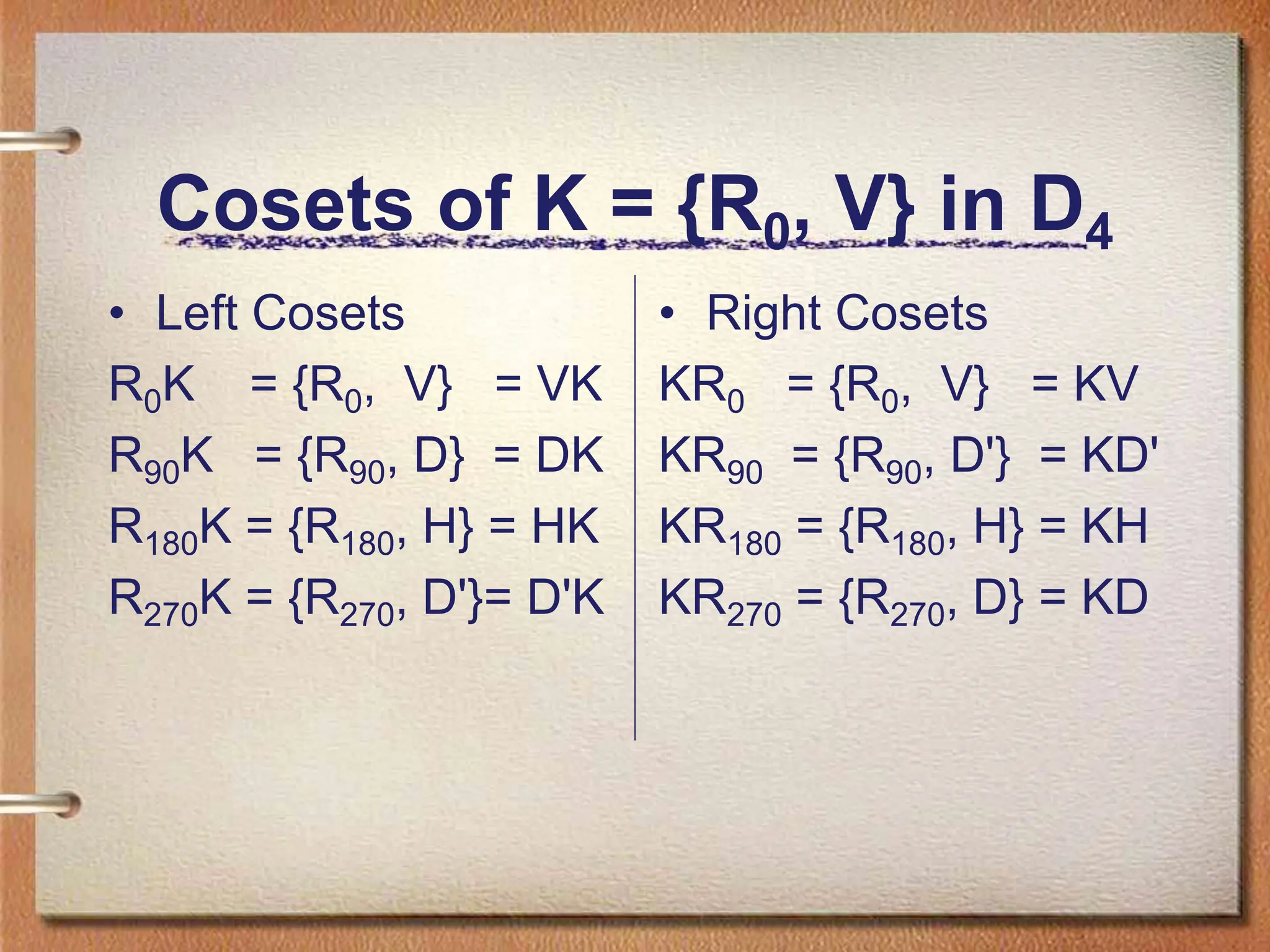
Cosets of K = {R0, V} in D4
• Left Cosets
R0K = {R0, V} = VK
R90K = {R90, D} = DK
R180K = {R180, H} = HK
R270K = {R270, D'}= D'K
• Right Cosets
KR0 = {R0, V} = KV
KR90 = {R90, D'} = KD'
KR180 = {R180, H} = KH
KR270 = {R270, D} = KD
More cosets
• Vectors under addition are a group:
(a,b) + (c,d) = (a+c,b+d)
Identity is (0,0)
Inverse of (a,b) is (-a,-b)
Associativity is easy to verify.
• H = {(2t,t) | t in R} is a subgroup.
Proof: (2a,a) - (2b,b) = (2(a-b),a-b)
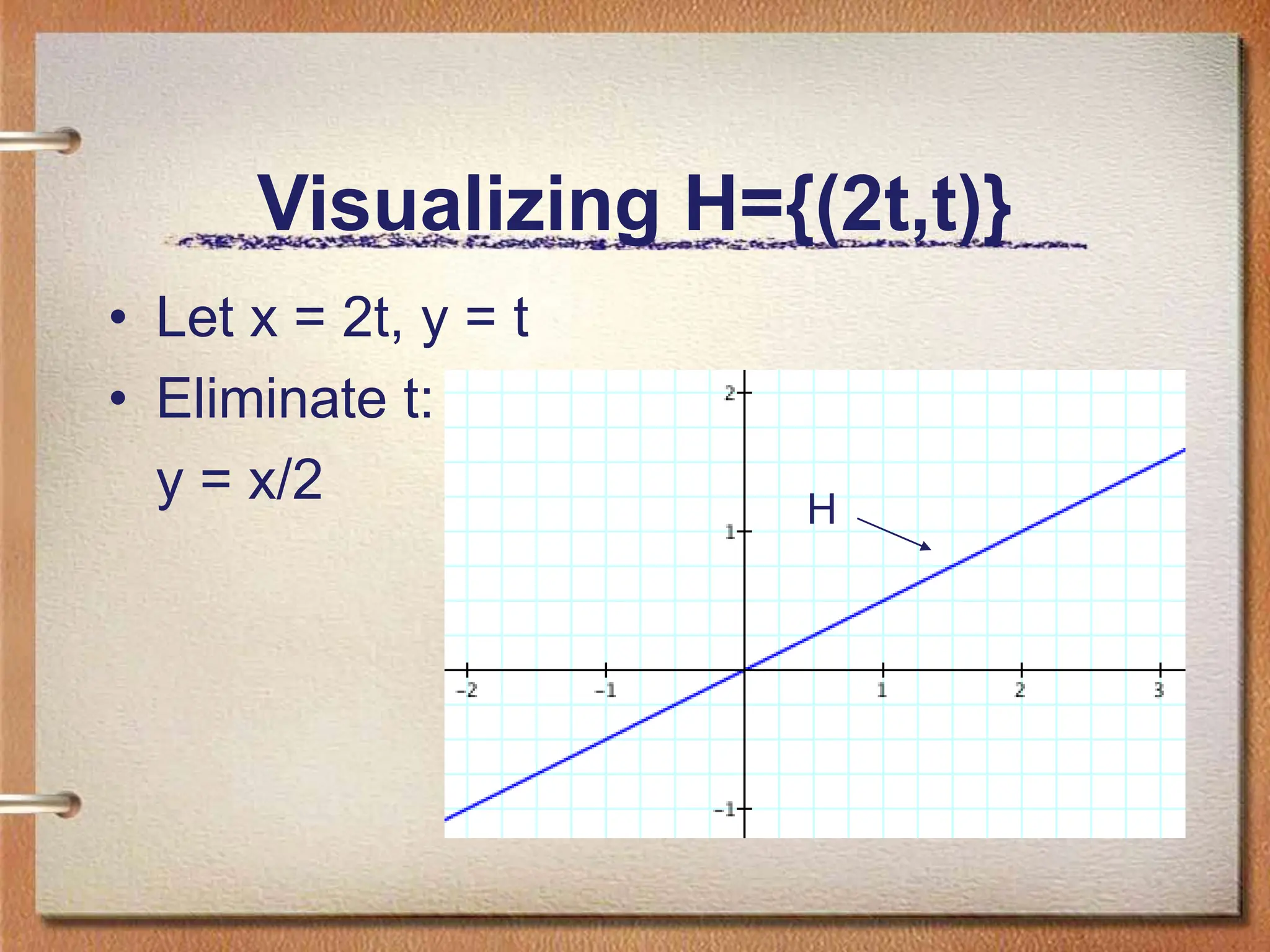
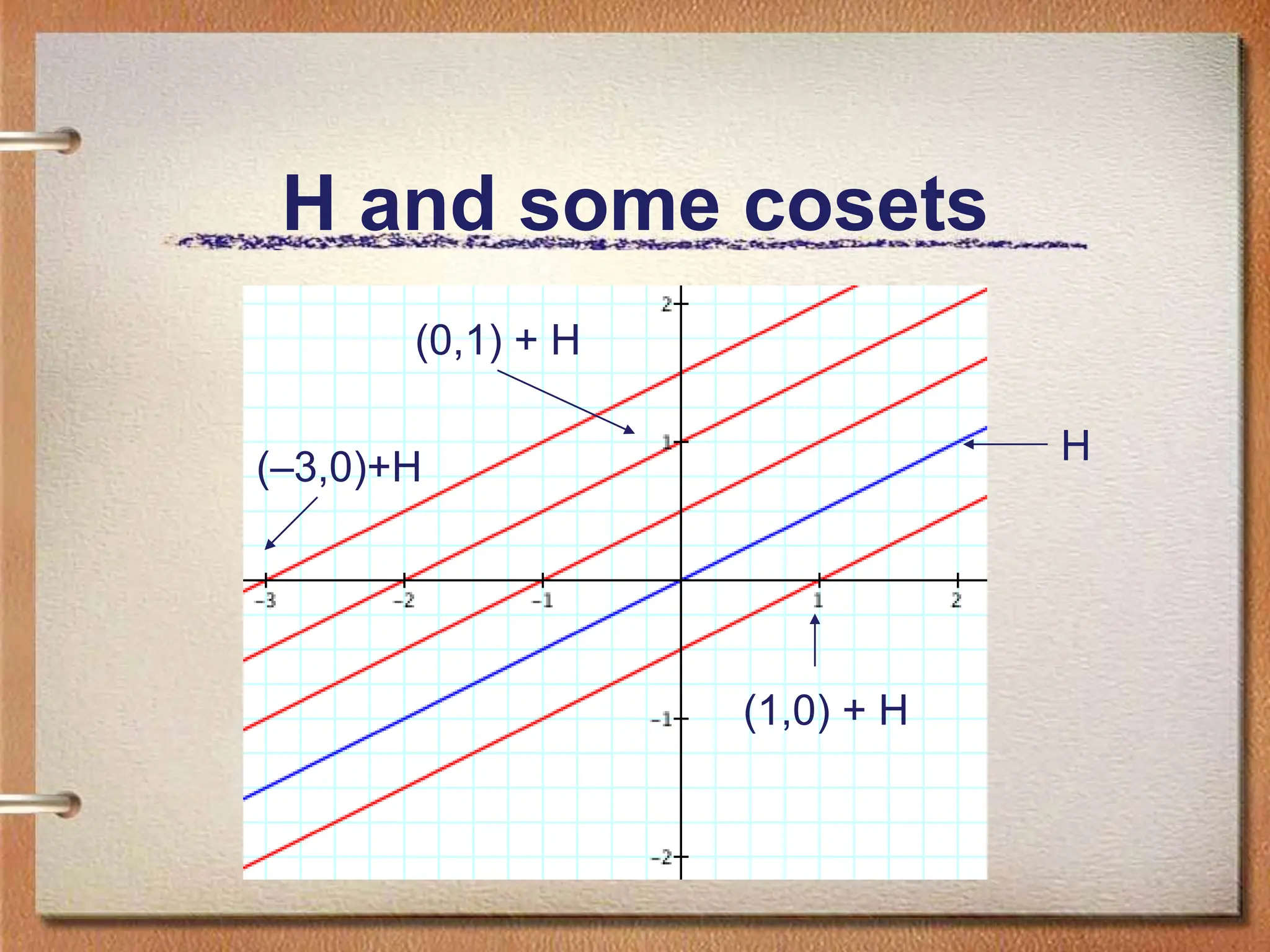
Visualizing H={(2t,t)}
• Let x = 2t, y = t
• Eliminate t:
y = x/2 H
Cosets of H={(2t,t) | t in R}
• (a,b) + H = {(a+2t,b+t)}
Set x = a+2t, y = b+t and eliminate t:
y = b + (x-a)/2
The subgroup H is the line y = x/2.
The cosets are lines parallel to y = x/2 !
H and some cosets
H
(1,0) + H
(–3,0)+H
(0,1) + H
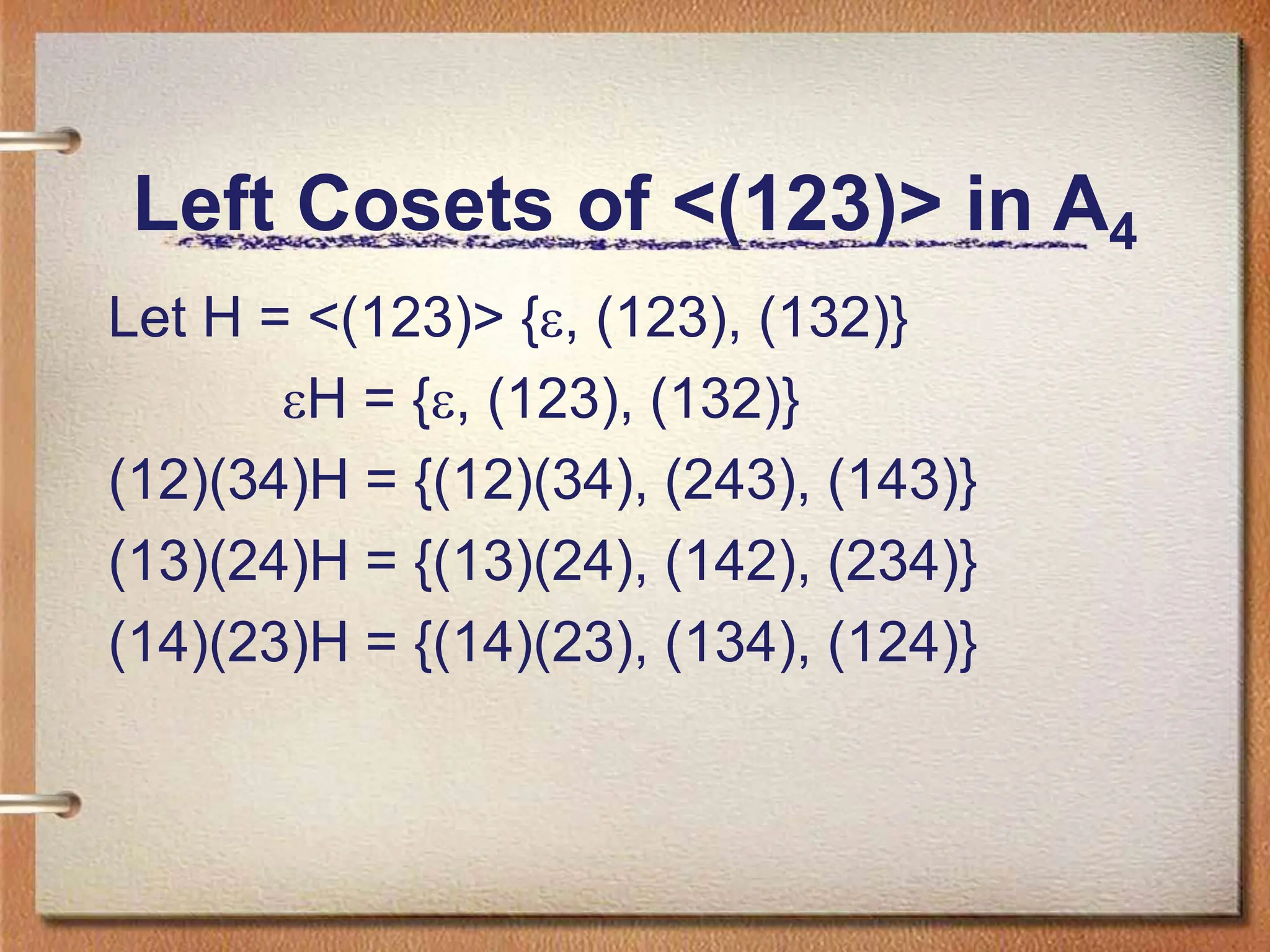
Left Cosets of <(123)> in A4
Let H = <(123)> {, (123), (132)}
H = {, (123), (132)}
(12)(34)H = {(12)(34), (243), (143)}
(13)(24)H = {(13)(24), (142), (234)}
(14)(23)H = {(14)(23), (134), (124)}
Properties of Cosets:
• Let H be a subgroup of G, and a,b in G.
• 1. a belongs to aH
• 2. aH = H iff a belongs to H
• 3. aH = bH iff a belongs to bH
• 4. aH and bH are either equal or disjoint
• 5. aH = bH iff a-1b belongs to H
• 6. |aH| = |bH|
• 7. aH = Ha iff H = aHa-1
• 8. aH ≤ G iff a belongs to H
1. a belongs to aH
• Proof: a = ae belongs to aH.
2. aH=H iff a in H
• Proof: (=>) Given aH = H.
By (1), a is in aH = H.
(<=) Given a belongs to H. Then
(i) aH is contained in H by closure.
(ii) Choose any h in H.
Note that a-1 is in H since a is.
Let b = a-1h. Note that b is in H. So
h = (aa-1)h = a(a-1h) = ab is in aH
It follows that H is contained in aH
By (i) and (ii), aH = H
3. aH = bH iff a in bH
• Proof: (=>) Suppose aH = bH. Then
a = ae in aH = bH.
(<=) Suppose a is in bH. Then
a = bh for some h in H.
so aH = (bh)H = b(hH) = bH by (2).
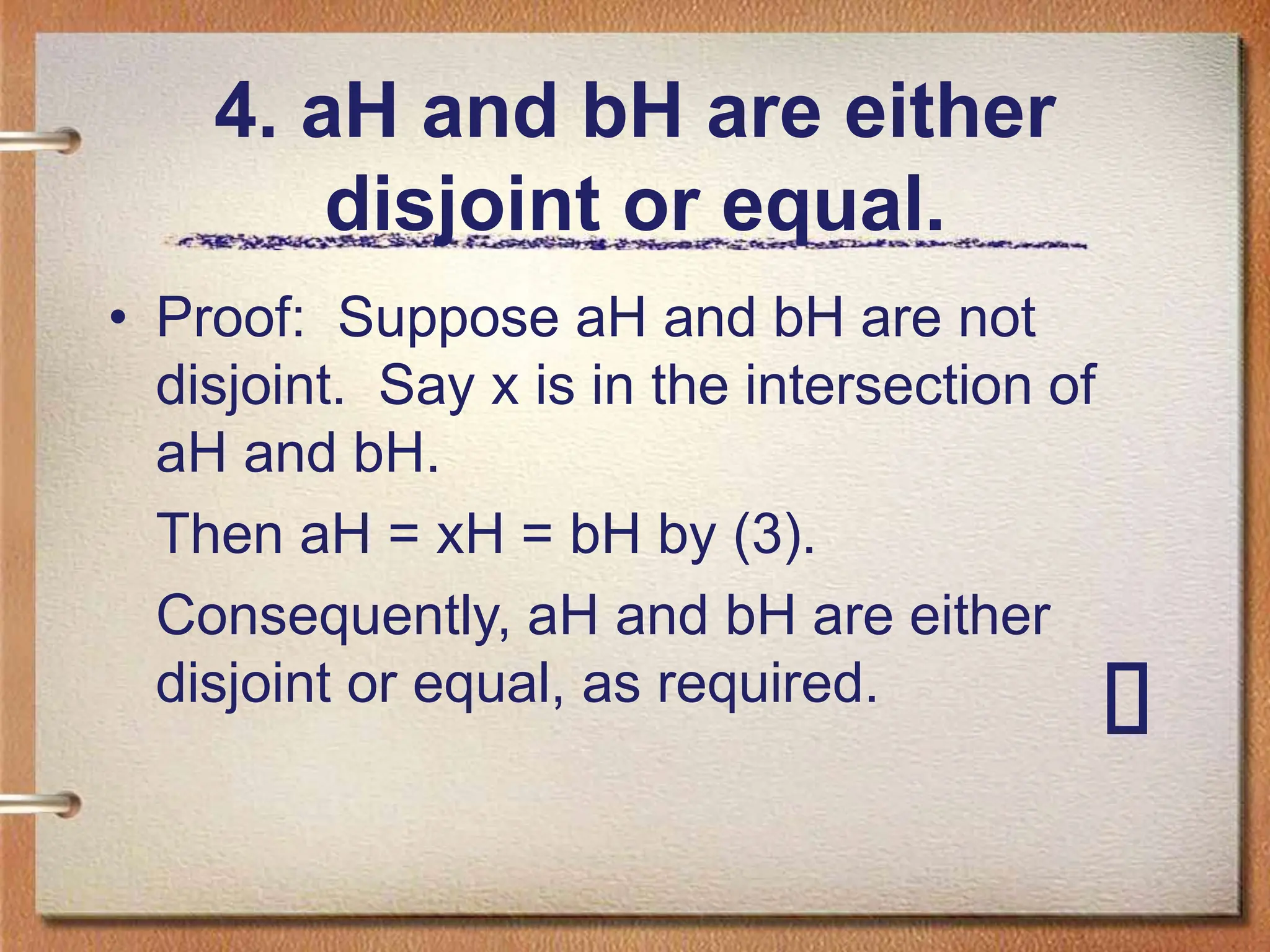
4. aH and bH are either
disjoint or equal.
• Proof: Suppose aH and bH are not
disjoint. Say x is in the intersection of
aH and bH.
Then aH = xH = bH by (3).
Consequently, aH and bH are either
disjoint or equal, as required.
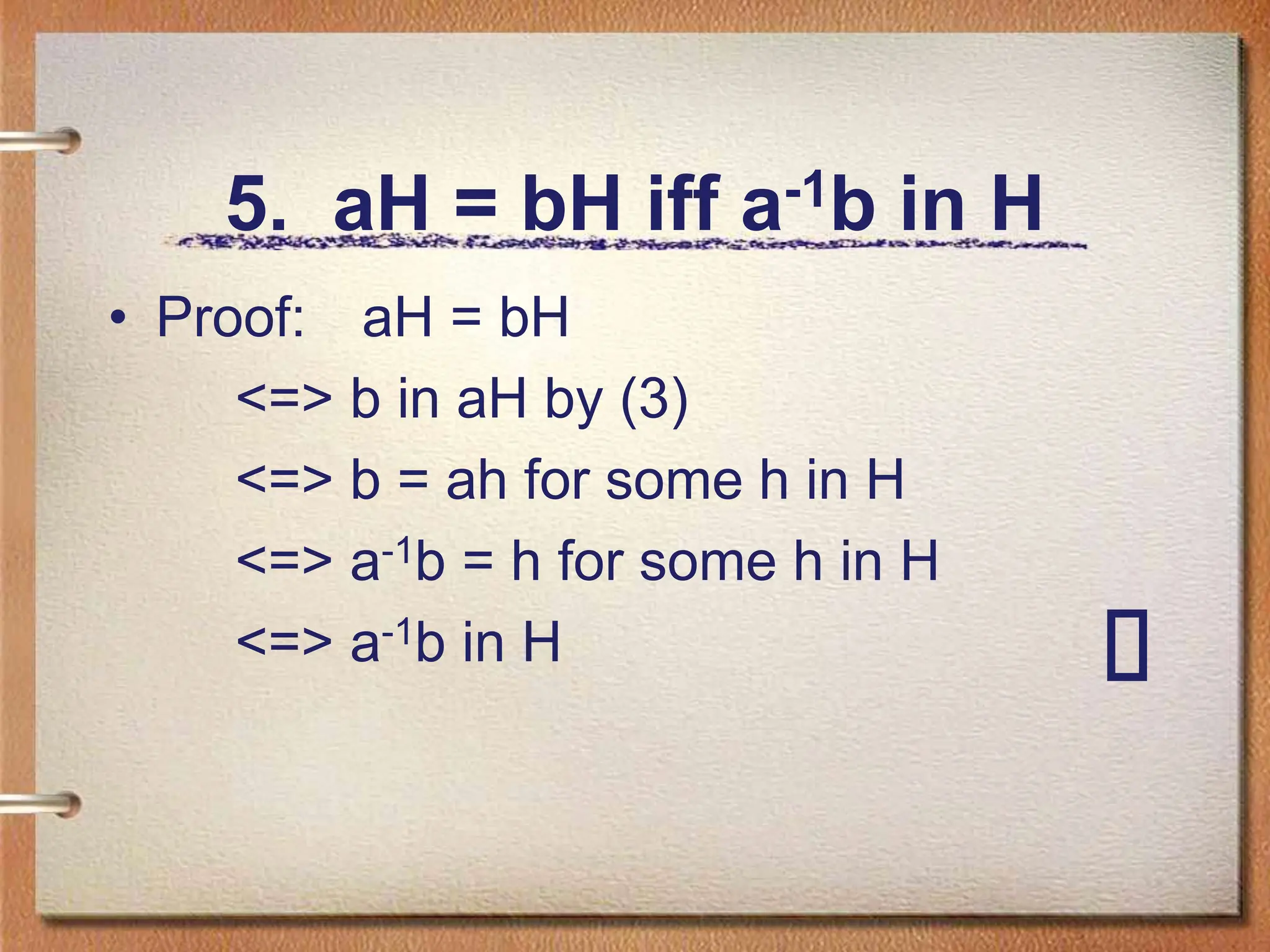
5. aH = bH iff a-1b in H
• Proof: aH = bH
<=> b in aH by (3)
<=> b = ah for some h in H
<=> a-1b = h for some h in H
<=> a-1b in H
6. |aH| = |bH|
• Proof: Let ø: aH –>bH be given by
ø(ah) = bh for all h in H.
We claim ø is one to one and onto.
If ø(ah1) = ø(ah2), then bh1 = bh2
so h1 = h2. Therefore ah1 = ah2.
Hence ø is one-to-one.
ø is clearly onto.
It follows that |aH| = |bH| as required.
aH = Ha iff H = aHa-1
• Proof: aH = Ha
<=> each ah = h'a for some h' in H
<=> aha-1 = h' for some h' in H
<=> H = aHa-1.
aH≤G iff a in H
• Proof: (=>) Suppose aH ≤ G.
Then e in aH.
But e in eH, so eH and aH are not
disjoint. By (4), aH = eH = H.
(<=) Suppose a in H.
Then aH = H ≤ G.

All about a cosets and Lagrange's theorem

  • 1.
  • 2.
    Lagrange's Theorem • Themost important single theorem in group theory. It helps answer: – How large is the symmetry group of a volleyball? A soccer ball? – How many groups of order 2p where p is prime? (4, 6, 10, 14, 22, 26, …) – Is 2257-1 prime? – Is computer security possible? – etc.
  • 3.
    Cosets • Definition: Let H≤ G and a in G. The left coset of H containing a is the set aH = {ah | h in H} The right coset of H containing a is the set Ha = {ha | h in H} • In additive groups use a+H and H+a. • a is called the coset representative of aH. • Similarly, aHa-1 ={aha-1 | h in H}
  • 4.
    Cosets of K= {R0, V} in D4 • Some left cosets of K: DK = {DR0, DV} = {D,R90} R180K = {R180R0, R180V} = {R180, H} • Some right cosets of K: KD = {R0D, VD} = {D, R270} KR180 = {R0R180,VR180} = {R180, H}
  • 5.
    Cosets of K= {R0, V} in D4 • Left Cosets R0K = {R0, V} = VK R90K = {R90, D} = DK R180K = {R180, H} = HK R270K = {R270, D'}= D'K • Right Cosets KR0 = {R0, V} = KV KR90 = {R90, D'} = KD' KR180 = {R180, H} = KH KR270 = {R270, D} = KD
  • 6.
    More cosets • Vectorsunder addition are a group: (a,b) + (c,d) = (a+c,b+d) Identity is (0,0) Inverse of (a,b) is (-a,-b) Associativity is easy to verify. • H = {(2t,t) | t in R} is a subgroup. Proof: (2a,a) - (2b,b) = (2(a-b),a-b)
  • 7.
    Visualizing H={(2t,t)} • Letx = 2t, y = t • Eliminate t: y = x/2 H
  • 8.
    Cosets of H={(2t,t)| t in R} • (a,b) + H = {(a+2t,b+t)} Set x = a+2t, y = b+t and eliminate t: y = b + (x-a)/2 The subgroup H is the line y = x/2. The cosets are lines parallel to y = x/2 !
  • 9.
    H and somecosets H (1,0) + H (–3,0)+H (0,1) + H
  • 10.
    Left Cosets of<(123)> in A4 Let H = <(123)> {, (123), (132)} H = {, (123), (132)} (12)(34)H = {(12)(34), (243), (143)} (13)(24)H = {(13)(24), (142), (234)} (14)(23)H = {(14)(23), (134), (124)}
  • 11.
    Properties of Cosets: •Let H be a subgroup of G, and a,b in G. • 1. a belongs to aH • 2. aH = H iff a belongs to H • 3. aH = bH iff a belongs to bH • 4. aH and bH are either equal or disjoint • 5. aH = bH iff a-1b belongs to H • 6. |aH| = |bH| • 7. aH = Ha iff H = aHa-1 • 8. aH ≤ G iff a belongs to H
  • 12.
    1. a belongsto aH • Proof: a = ae belongs to aH.
  • 13.
    2. aH=H iffa in H • Proof: (=>) Given aH = H. By (1), a is in aH = H. (<=) Given a belongs to H. Then (i) aH is contained in H by closure. (ii) Choose any h in H. Note that a-1 is in H since a is. Let b = a-1h. Note that b is in H. So h = (aa-1)h = a(a-1h) = ab is in aH It follows that H is contained in aH By (i) and (ii), aH = H
  • 14.
    3. aH =bH iff a in bH • Proof: (=>) Suppose aH = bH. Then a = ae in aH = bH. (<=) Suppose a is in bH. Then a = bh for some h in H. so aH = (bh)H = b(hH) = bH by (2).
  • 15.
    4. aH andbH are either disjoint or equal. • Proof: Suppose aH and bH are not disjoint. Say x is in the intersection of aH and bH. Then aH = xH = bH by (3). Consequently, aH and bH are either disjoint or equal, as required.
  • 16.
    5. aH =bH iff a-1b in H • Proof: aH = bH <=> b in aH by (3) <=> b = ah for some h in H <=> a-1b = h for some h in H <=> a-1b in H
  • 17.
    6. |aH| =|bH| • Proof: Let ø: aH –>bH be given by ø(ah) = bh for all h in H. We claim ø is one to one and onto. If ø(ah1) = ø(ah2), then bh1 = bh2 so h1 = h2. Therefore ah1 = ah2. Hence ø is one-to-one. ø is clearly onto. It follows that |aH| = |bH| as required.
  • 18.
    aH = Haiff H = aHa-1 • Proof: aH = Ha <=> each ah = h'a for some h' in H <=> aha-1 = h' for some h' in H <=> H = aHa-1.
  • 19.
    aH≤G iff ain H • Proof: (=>) Suppose aH ≤ G. Then e in aH. But e in eH, so eH and aH are not disjoint. By (4), aH = eH = H. (<=) Suppose a in H. Then aH = H ≤ G.