ALIMENTARY TRACT
Clinical Anatomy
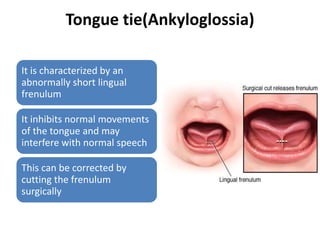
Tongue tie(Ankyloglossia)
It is characterized by an
abnormally short lingual
frenulum
It inhibits normal movements
of the tongue and may
interfere with normal speech
This can be corrected by
cutting the frenulum
surgically
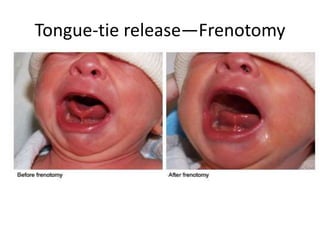
Tongue-tie release—Frenotomy
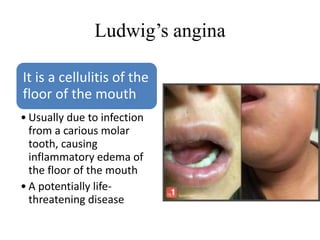
Ludwig’s angina
It is a cellulitis of the
floor of the mouth
• Usually due to infection
from a carious molar
tooth, causing
inflammatory edema of
the floor of the mouth
• A potentially life-
threatening disease
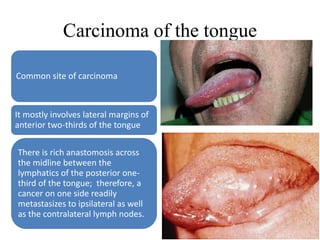
Carcinoma of the tongue
Common site of carcinoma
It mostly involves lateral margins of
anterior two-thirds of the tongue
There is rich anastomosis across
the midline between the
lymphatics of the posterior one-
third of the tongue; therefore, a
cancer on one side readily
metastasizes to ipsilateral as well
as the contralateral lymph nodes.
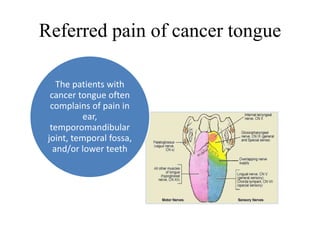
Referred pain of cancer tongue
The patients with
cancer tongue often
complains of pain in
ear,
temporomandibular
joint, temporal fossa,
and/or lower teeth
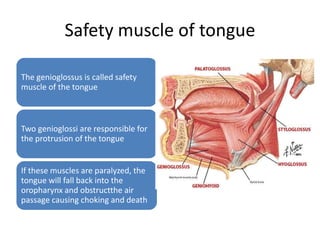
Safety muscle of tongue
The genioglossus is called safety
muscle of the tongue
Two genioglossi are responsible for
the protrusion of the tongue
If these muscles are paralyzed, the
tongue will fall back into the
oropharynx and obstructthe air
passage causing choking and death
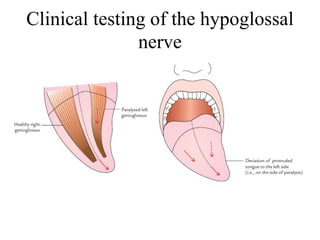
Clinical testing of the hypoglossal
nerve
The genioglossi are commonly used for clinical testing of
the hypoglossal nerve
The muscles of both sides acting together protrude the
tongue whereas single muscle deviate the tongue to the
opposite side
When patient is asked to protrude his tongue, the tongue
deviates to the paralyzed side
Clinical testing of the hypoglossal
nerve
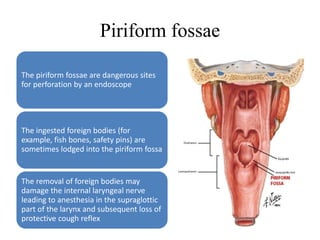
Piriform fossae
The piriform fossae are dangerous sites
for perforation by an endoscope
The ingested foreign bodies (for
example, fish bones, safety pins) are
sometimes lodged into the piriform fossa
The removal of foreign bodies may
damage the internal laryngeal nerve
leading to anesthesia in the supraglottic
part of the larynx and subsequent loss of
protective cough reflex
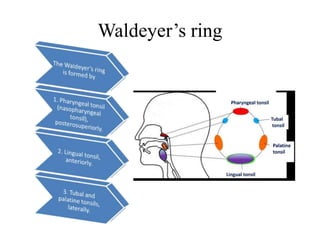
Waldeyer’s ring
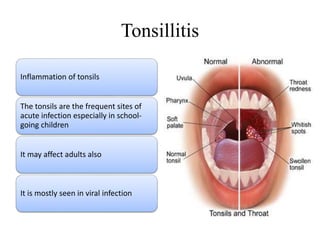
Tonsillitis
Inflammation of tonsils
The tonsils are the frequent sites of
acute infection especially in school-
going children
It may affect adults also
It is mostly seen in viral infection
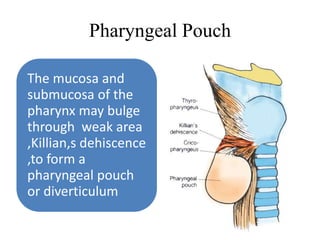
Pharyngeal Pouch
The mucosa and
submucosa of the
pharynx may bulge
through weak area
,Killian,s dehiscence
,to form a
pharyngeal pouch
or diverticulum
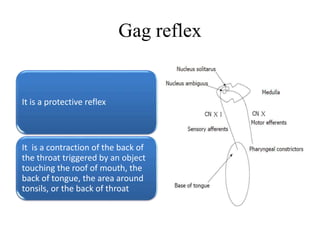
Gag reflex
It is a protective reflex
It is a contraction of the back of
the throat triggered by an object
touching the roof of mouth, the
back of tongue, the area around
tonsils, or the back of throat
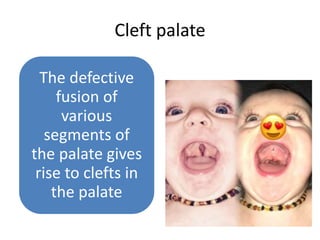
Cleft palate
The defective
fusion of
various
segments of
the palate gives
rise to clefts in
the palate
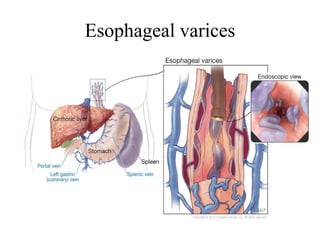
Esophageal varices
Esophageal varices
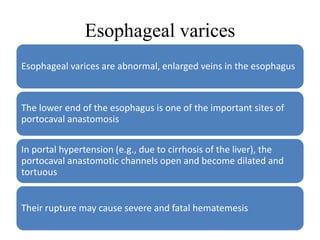
Esophageal varices are abnormal, enlarged veins in the esophagus
The lower end of the esophagus is one of the important sites of
portocaval anastomosis
In portal hypertension (e.g., due to cirrhosis of the liver), the
portocaval anastomotic channels open and become dilated and
tortuous
Their rupture may cause severe and fatal hematemesis
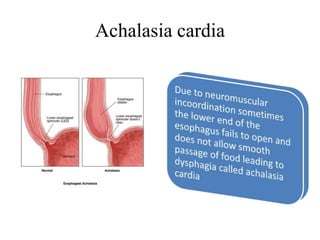
Achalasia cardia
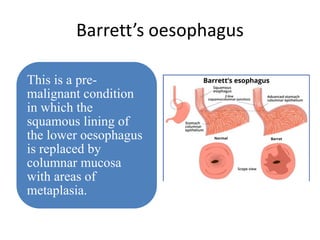
Barrett’s oesophagus
This is a pre-
malignant condition
in which the
squamous lining of
the lower oesophagus
is replaced by
columnar mucosa
with areas of
metaplasia.
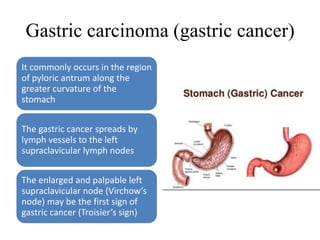
Gastric carcinoma (gastric cancer)
It commonly occurs in the region
of pyloric antrum along the
greater curvature of the
stomach
The gastric cancer spreads by
lymph vessels to the left
supraclavicular lymph nodes
The enlarged and palpable left
supraclavicular node (Virchow’s
node) may be the first sign of
gastric cancer (Troisier’s sign)
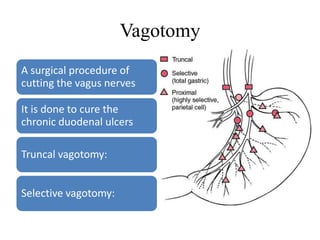
A surgical procedure of
cutting the vagus nerves
It is done to cure the
chronic duodenal ulcers
Truncal vagotomy:
Selective vagotomy:
Vagotomy
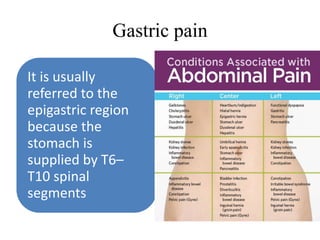
Gastric pain
It is usually
referred to the
epigastric region
because the
stomach is
supplied by T6–
T10 spinal
segments
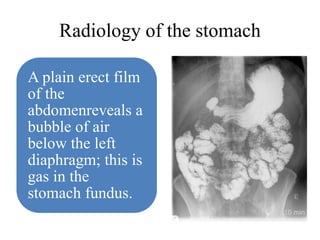
Radiology of the stomach
A plain erect film
of the
abdomenreveals a
bubble of air
below the left
diaphragm; this is
gas in the
stomach fundus.
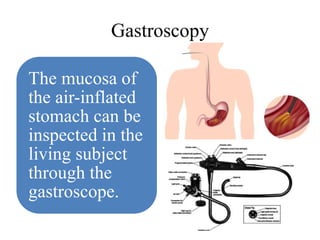
Gastroscopy
The mucosa of
the air-inflated
stomach can be
inspected in the
living subject
through the
gastroscope.
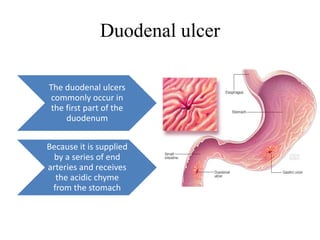
Duodenal ulcer
The duodenal ulcers
commonly occur in
the first part of the
duodenum
Because it is supplied
by a series of end
arteries and receives
the acidic chyme
from the stomach
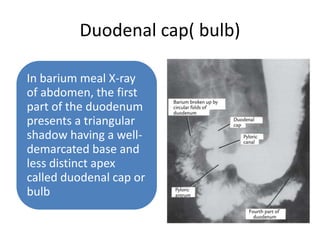
Duodenal cap( bulb)
In barium meal X-ray
of abdomen, the first
part of the duodenum
presents a triangular
shadow having a well-
demarcated base and
less distinct apex
called duodenal cap or
bulb
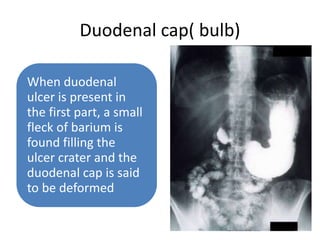
Duodenal cap( bulb)
When duodenal
ulcer is present in
the first part, a small
fleck of barium is
found filling the
ulcer crater and the
duodenal cap is said
to be deformed
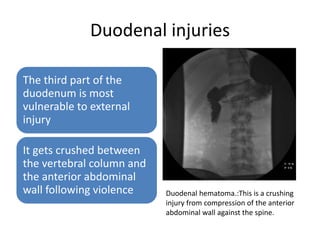
Duodenal injuries
The third part of the
duodenum is most
vulnerable to external
injury
It gets crushed between
the vertebral column and
the anterior abdominal
wall following violence Duodenal hematoma.:This is a crushing
injury from compression of the anterior
abdominal wall against the spine.
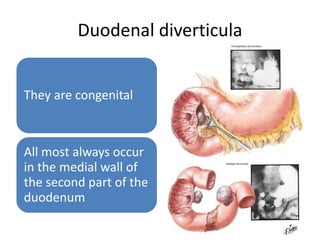
Duodenal diverticula
They are congenital
All most always occur
in the medial wall of
the second part of the
duodenum
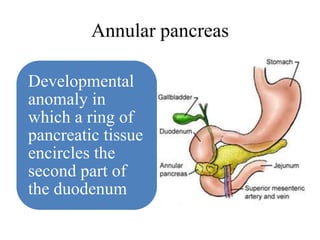
Annular pancreas
Developmental
anomaly in
which a ring of
pancreatic tissue
encircles the
second part of
the duodenum
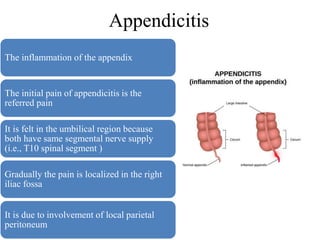
Appendicitis
The inflammation of the appendix
The initial pain of appendicitis is the
referred pain
It is felt in the umbilical region because
both have same segmental nerve supply
(i.e., T10 spinal segment )
Gradually the pain is localized in the right
iliac fossa
It is due to involvement of local parietal
peritoneum
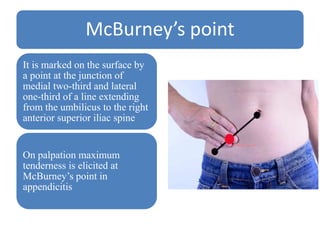
McBurney’s point
It is marked on the surface by
a point at the junction of
medial two-third and lateral
one-third of a line extending
from the umbilicus to the right
anterior superior iliac spine
On palpation maximum
tenderness is elicited at
McBurney’s point in
appendicitis
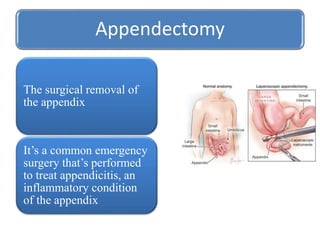
Appendectomy
The surgical removal of
the appendix
It’s a common emergency
surgery that’s performed
to treat appendicitis, an
inflammatory condition
of the appendix
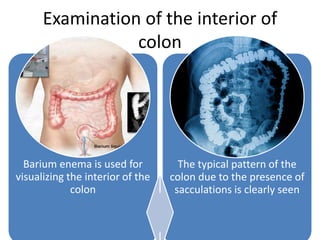
Examination of the interior of
colon
Barium enema is used for
visualizing the interior of the
colon
The typical pattern of the
colon due to the presence of
sacculations is clearly seen
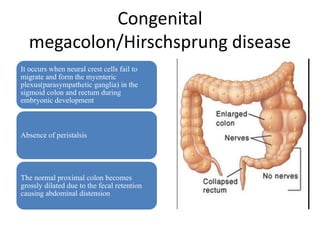
Congenital
megacolon/Hirschsprung disease
It occurs when neural crest cells fail to
migrate and form the myenteric
plexus(parasympathetic ganglia) in the
sigmoid colon and rectum during
embryonic development
Absence of peristalsis
The normal proximal colon becomes
grossly dilated due to the fecal retention
causing abdominal distension
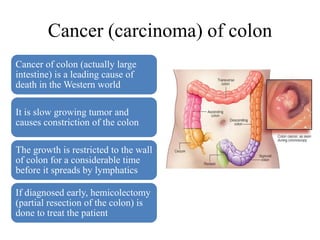
Cancer (carcinoma) of colon
Cancer of colon (actually large
intestine) is a leading cause of
death in the Western world
It is slow growing tumor and
causes constriction of the colon
The growth is restricted to the wall
of colon for a considerable time
before it spreads by lymphatics
If diagnosed early, hemicolectomy
(partial resection of the colon) is
done to treat the patient
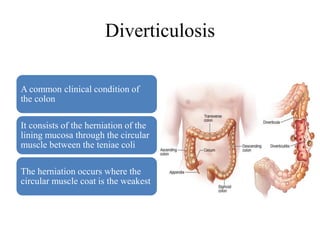
Diverticulosis
A common clinical condition of
the colon
It consists of the herniation of the
lining mucosa through the circular
muscle between the teniae coli
The herniation occurs where the
circular muscle coat is the weakest
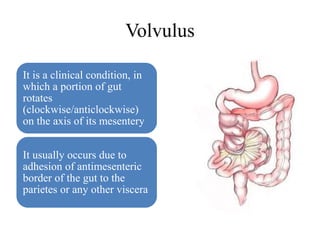
Volvulus
It is a clinical condition, in
which a portion of gut
rotates
(clockwise/anticlockwise)
on the axis of its mesentery
It usually occurs due to
adhesion of antimesenteric
border of the gut to the
parietes or any other viscera
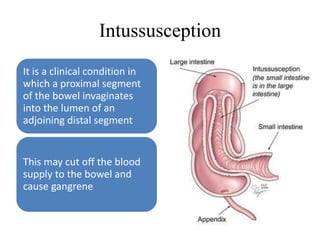
Intussusception
It is a clinical condition in
which a proximal segment
of the bowel invaginates
into the lumen of an
adjoining distal segment
This may cut off the blood
supply to the bowel and
cause gangrene
Rectum
The lymphatics of the rectum are mostly arranged
longitudinally in contrast to the lymphatics of
most of the small and large intestines, where they
are arranged transversely around the gut
Therefore, when the carcinoma of the rectum
spreads along lymphatics it does not cause rectal
obstruction unlike the rest of the gut
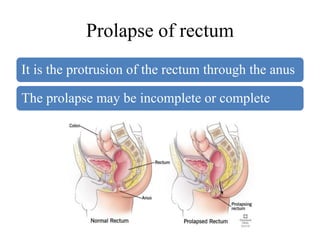
Prolapse of rectum
It is the protrusion of the rectum through the anus
The prolapse may be incomplete or complete
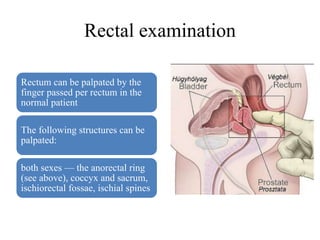
Rectal examination
Rectum can be palpated by the
finger passed per rectum in the
normal patient
The following structures can be
palpated:
both sexes — the anorectal ring
(see above), coccyx and sacrum,
ischiorectal fossae, ischial spines
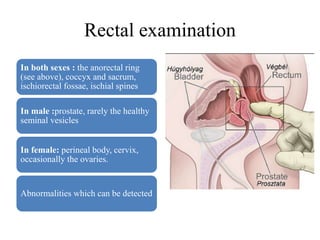
Rectal examination
In both sexes : the anorectal ring
(see above), coccyx and sacrum,
ischiorectal fossae, ischial spines
In male :prostate, rarely the healthy
seminal vesicles
In female: perineal body, cervix,
occasionally the ovaries.
Abnormalities which can be detected
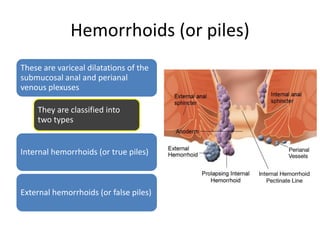
Hemorrhoids (or piles)
These are variceal dilatations of the
submucosal anal and perianal
venous plexuses
They are classified into
two types
Internal hemorrhoids (or true piles)
External hemorrhoids (or false piles)
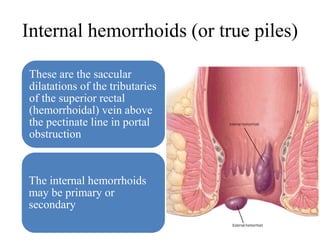
Internal hemorrhoids (or true piles)
These are the saccular
dilatations of the tributaries
of the superior rectal
(hemorrhoidal) vein above
the pectinate line in portal
obstruction
The internal hemorrhoids
may be primary or
secondary
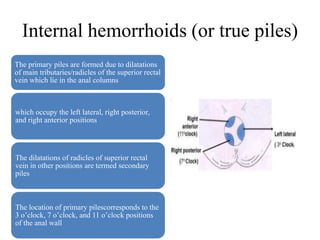
Internal hemorrhoids (or true piles)
The primary piles are formed due to dilatations
of main tributaries/radicles of the superior rectal
vein which lie in the anal columns
which occupy the left lateral, right posterior,
and right anterior positions
The dilatations of radicles of superior rectal
vein in other positions are termed secondary
piles
The location of primary pilescorresponds to the
3 o’clock, 7 o’clock, and 11 o’clock positions
of the anal wall
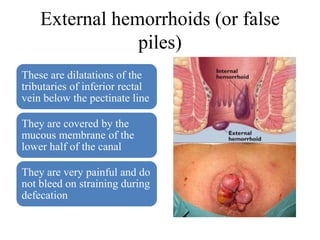
External hemorrhoids (or false
piles)
These are dilatations of the
tributaries of inferior rectal
vein below the pectinate line
They are covered by the
mucous membrane of the
lower half of the canal
They are very painful and do
not bleed on straining during
defecation
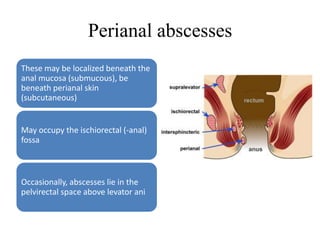
Perianal abscesses
These may be localized beneath the
anal mucosa (submucous), be
beneath perianal skin
(subcutaneous)
May occupy the ischiorectal (-anal)
fossa
Occasionally, abscesses lie in the
pelvirectal space above levator ani
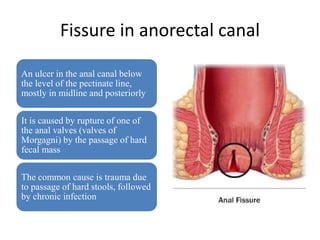
Fissure in anorectal canal
An ulcer in the anal canal below
the level of the pectinate line,
mostly in midline and posteriorly
It is caused by rupture of one of
the anal valves (valves of
Morgagni) by the passage of hard
fecal mass
The common cause is trauma due
to passage of hard stools, followed
by chronic infection
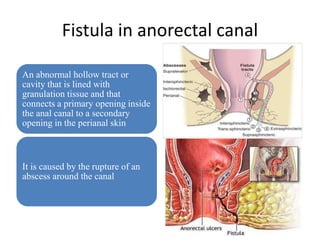
Fistula in anorectal canal
An abnormal hollow tract or
cavity that is lined with
granulation tissue and that
connects a primary opening inside
the anal canal to a secondary
opening in the perianal skin
It is caused by the rupture of an
abscess around the canal
Any questions ?
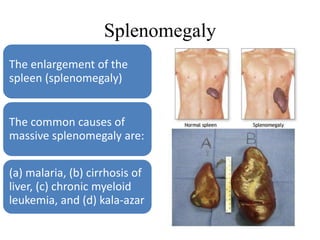
Splenomegaly
The enlargement of the
spleen (splenomegaly)
The common causes of
massive splenomegaly are:
(a) malaria, (b) cirrhosis of
liver, (c) chronic myeloid
leukemia, and (d) kala-azar
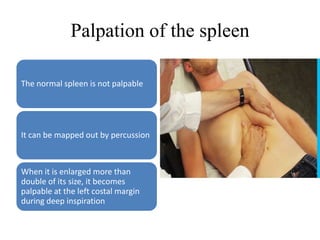
Palpation of the spleen
The normal spleen is not palpable
It can be mapped out by percussion
When it is enlarged more than
double of its size, it becomes
palpable at the left costal margin
during deep inspiration
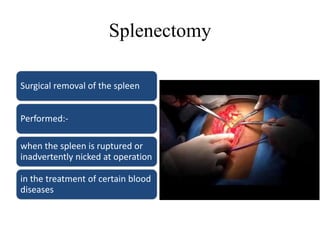
Splenectomy
Surgical removal of the spleen
Performed:-
when the spleen is ruptured or
inadvertently nicked at operation
in the treatment of certain blood
diseases
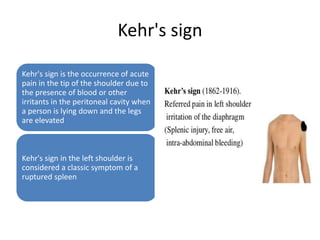
Kehr's sign
Kehr's sign is the occurrence of acute
pain in the tip of the shoulder due to
the presence of blood or other
irritants in the peritoneal cavity when
a person is lying down and the legs
are elevated
Kehr's sign in the left shoulder is
considered a classic symptom of a
ruptured spleen

Alimentary tract (clinical anatomy)

  • 1.
  • 2.
    Tongue tie(Ankyloglossia) It ischaracterized by an abnormally short lingual frenulum It inhibits normal movements of the tongue and may interfere with normal speech This can be corrected by cutting the frenulum surgically
  • 3.
  • 4.
    Ludwig’s angina It isa cellulitis of the floor of the mouth • Usually due to infection from a carious molar tooth, causing inflammatory edema of the floor of the mouth • A potentially life- threatening disease
  • 5.
    Carcinoma of thetongue Common site of carcinoma It mostly involves lateral margins of anterior two-thirds of the tongue There is rich anastomosis across the midline between the lymphatics of the posterior one- third of the tongue; therefore, a cancer on one side readily metastasizes to ipsilateral as well as the contralateral lymph nodes.
  • 6.
    Referred pain ofcancer tongue The patients with cancer tongue often complains of pain in ear, temporomandibular joint, temporal fossa, and/or lower teeth
  • 7.
    Safety muscle oftongue The genioglossus is called safety muscle of the tongue Two genioglossi are responsible for the protrusion of the tongue If these muscles are paralyzed, the tongue will fall back into the oropharynx and obstructthe air passage causing choking and death
  • 8.
    Clinical testing ofthe hypoglossal nerve The genioglossi are commonly used for clinical testing of the hypoglossal nerve The muscles of both sides acting together protrude the tongue whereas single muscle deviate the tongue to the opposite side When patient is asked to protrude his tongue, the tongue deviates to the paralyzed side
  • 9.
    Clinical testing ofthe hypoglossal nerve
  • 10.
    Piriform fossae The piriformfossae are dangerous sites for perforation by an endoscope The ingested foreign bodies (for example, fish bones, safety pins) are sometimes lodged into the piriform fossa The removal of foreign bodies may damage the internal laryngeal nerve leading to anesthesia in the supraglottic part of the larynx and subsequent loss of protective cough reflex
  • 11.
  • 12.
    Tonsillitis Inflammation of tonsils Thetonsils are the frequent sites of acute infection especially in school- going children It may affect adults also It is mostly seen in viral infection
  • 13.
    Pharyngeal Pouch The mucosaand submucosa of the pharynx may bulge through weak area ,Killian,s dehiscence ,to form a pharyngeal pouch or diverticulum
  • 14.
    Gag reflex It isa protective reflex It is a contraction of the back of the throat triggered by an object touching the roof of mouth, the back of tongue, the area around tonsils, or the back of throat
  • 15.
    Cleft palate The defective fusionof various segments of the palate gives rise to clefts in the palate
  • 16.
  • 17.
    Esophageal varices Esophageal varicesare abnormal, enlarged veins in the esophagus The lower end of the esophagus is one of the important sites of portocaval anastomosis In portal hypertension (e.g., due to cirrhosis of the liver), the portocaval anastomotic channels open and become dilated and tortuous Their rupture may cause severe and fatal hematemesis
  • 18.
  • 19.
    Barrett’s oesophagus This isa pre- malignant condition in which the squamous lining of the lower oesophagus is replaced by columnar mucosa with areas of metaplasia.
  • 20.
    Gastric carcinoma (gastriccancer) It commonly occurs in the region of pyloric antrum along the greater curvature of the stomach The gastric cancer spreads by lymph vessels to the left supraclavicular lymph nodes The enlarged and palpable left supraclavicular node (Virchow’s node) may be the first sign of gastric cancer (Troisier’s sign)
  • 21.
    A surgical procedureof cutting the vagus nerves It is done to cure the chronic duodenal ulcers Truncal vagotomy: Selective vagotomy: Vagotomy
  • 22.
    Gastric pain It isusually referred to the epigastric region because the stomach is supplied by T6– T10 spinal segments
  • 23.
    Radiology of thestomach A plain erect film of the abdomenreveals a bubble of air below the left diaphragm; this is gas in the stomach fundus.
  • 24.
    Gastroscopy The mucosa of theair-inflated stomach can be inspected in the living subject through the gastroscope.
  • 25.
    Duodenal ulcer The duodenalulcers commonly occur in the first part of the duodenum Because it is supplied by a series of end arteries and receives the acidic chyme from the stomach
  • 26.
    Duodenal cap( bulb) Inbarium meal X-ray of abdomen, the first part of the duodenum presents a triangular shadow having a well- demarcated base and less distinct apex called duodenal cap or bulb
  • 27.
    Duodenal cap( bulb) Whenduodenal ulcer is present in the first part, a small fleck of barium is found filling the ulcer crater and the duodenal cap is said to be deformed
  • 28.
    Duodenal injuries The thirdpart of the duodenum is most vulnerable to external injury It gets crushed between the vertebral column and the anterior abdominal wall following violence Duodenal hematoma.:This is a crushing injury from compression of the anterior abdominal wall against the spine.
  • 29.
    Duodenal diverticula They arecongenital All most always occur in the medial wall of the second part of the duodenum
  • 30.
    Annular pancreas Developmental anomaly in whicha ring of pancreatic tissue encircles the second part of the duodenum
  • 31.
    Appendicitis The inflammation ofthe appendix The initial pain of appendicitis is the referred pain It is felt in the umbilical region because both have same segmental nerve supply (i.e., T10 spinal segment ) Gradually the pain is localized in the right iliac fossa It is due to involvement of local parietal peritoneum
  • 32.
    McBurney’s point It ismarked on the surface by a point at the junction of medial two-third and lateral one-third of a line extending from the umbilicus to the right anterior superior iliac spine On palpation maximum tenderness is elicited at McBurney’s point in appendicitis
  • 33.
    Appendectomy The surgical removalof the appendix It’s a common emergency surgery that’s performed to treat appendicitis, an inflammatory condition of the appendix
  • 34.
    Examination of theinterior of colon Barium enema is used for visualizing the interior of the colon The typical pattern of the colon due to the presence of sacculations is clearly seen
  • 35.
    Congenital megacolon/Hirschsprung disease It occurswhen neural crest cells fail to migrate and form the myenteric plexus(parasympathetic ganglia) in the sigmoid colon and rectum during embryonic development Absence of peristalsis The normal proximal colon becomes grossly dilated due to the fecal retention causing abdominal distension
  • 36.
    Cancer (carcinoma) ofcolon Cancer of colon (actually large intestine) is a leading cause of death in the Western world It is slow growing tumor and causes constriction of the colon The growth is restricted to the wall of colon for a considerable time before it spreads by lymphatics If diagnosed early, hemicolectomy (partial resection of the colon) is done to treat the patient
  • 37.
    Diverticulosis A common clinicalcondition of the colon It consists of the herniation of the lining mucosa through the circular muscle between the teniae coli The herniation occurs where the circular muscle coat is the weakest
  • 38.
    Volvulus It is aclinical condition, in which a portion of gut rotates (clockwise/anticlockwise) on the axis of its mesentery It usually occurs due to adhesion of antimesenteric border of the gut to the parietes or any other viscera
  • 39.
    Intussusception It is aclinical condition in which a proximal segment of the bowel invaginates into the lumen of an adjoining distal segment This may cut off the blood supply to the bowel and cause gangrene
  • 40.
    Rectum The lymphatics ofthe rectum are mostly arranged longitudinally in contrast to the lymphatics of most of the small and large intestines, where they are arranged transversely around the gut Therefore, when the carcinoma of the rectum spreads along lymphatics it does not cause rectal obstruction unlike the rest of the gut
  • 41.
    Prolapse of rectum Itis the protrusion of the rectum through the anus The prolapse may be incomplete or complete
  • 42.
    Rectal examination Rectum canbe palpated by the finger passed per rectum in the normal patient The following structures can be palpated: both sexes — the anorectal ring (see above), coccyx and sacrum, ischiorectal fossae, ischial spines
  • 43.
    Rectal examination In bothsexes : the anorectal ring (see above), coccyx and sacrum, ischiorectal fossae, ischial spines In male :prostate, rarely the healthy seminal vesicles In female: perineal body, cervix, occasionally the ovaries. Abnormalities which can be detected
  • 44.
    Hemorrhoids (or piles) Theseare variceal dilatations of the submucosal anal and perianal venous plexuses They are classified into two types Internal hemorrhoids (or true piles) External hemorrhoids (or false piles)
  • 45.
    Internal hemorrhoids (ortrue piles) These are the saccular dilatations of the tributaries of the superior rectal (hemorrhoidal) vein above the pectinate line in portal obstruction The internal hemorrhoids may be primary or secondary
  • 46.
    Internal hemorrhoids (ortrue piles) The primary piles are formed due to dilatations of main tributaries/radicles of the superior rectal vein which lie in the anal columns which occupy the left lateral, right posterior, and right anterior positions The dilatations of radicles of superior rectal vein in other positions are termed secondary piles The location of primary pilescorresponds to the 3 o’clock, 7 o’clock, and 11 o’clock positions of the anal wall
  • 47.
    External hemorrhoids (orfalse piles) These are dilatations of the tributaries of inferior rectal vein below the pectinate line They are covered by the mucous membrane of the lower half of the canal They are very painful and do not bleed on straining during defecation
  • 48.
    Perianal abscesses These maybe localized beneath the anal mucosa (submucous), be beneath perianal skin (subcutaneous) May occupy the ischiorectal (-anal) fossa Occasionally, abscesses lie in the pelvirectal space above levator ani
  • 49.
    Fissure in anorectalcanal An ulcer in the anal canal below the level of the pectinate line, mostly in midline and posteriorly It is caused by rupture of one of the anal valves (valves of Morgagni) by the passage of hard fecal mass The common cause is trauma due to passage of hard stools, followed by chronic infection
  • 50.
    Fistula in anorectalcanal An abnormal hollow tract or cavity that is lined with granulation tissue and that connects a primary opening inside the anal canal to a secondary opening in the perianal skin It is caused by the rupture of an abscess around the canal
  • 51.
  • 53.
    Splenomegaly The enlargement ofthe spleen (splenomegaly) The common causes of massive splenomegaly are: (a) malaria, (b) cirrhosis of liver, (c) chronic myeloid leukemia, and (d) kala-azar
  • 54.
    Palpation of thespleen The normal spleen is not palpable It can be mapped out by percussion When it is enlarged more than double of its size, it becomes palpable at the left costal margin during deep inspiration
  • 55.
    Splenectomy Surgical removal ofthe spleen Performed:- when the spleen is ruptured or inadvertently nicked at operation in the treatment of certain blood diseases
  • 56.
    Kehr's sign Kehr's signis the occurrence of acute pain in the tip of the shoulder due to the presence of blood or other irritants in the peritoneal cavity when a person is lying down and the legs are elevated Kehr's sign in the left shoulder is considered a classic symptom of a ruptured spleen