15 October 2016
Bernhard Sterchi
Aligned Autonomy
How to systematically manage contextual behavior in an
organization.
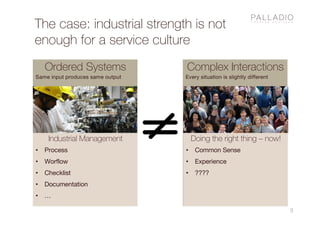
The case: industrial strength is not
enough for a service culture
3
Ordered Systems
Same input produces same output
Complex Interactions
Every situation is slightly different
Industrial Management
• Process
• Worflow
• Checklist
• Documentation
• …
Doing the right thing – now!
• Common Sense
• Experience
• ????
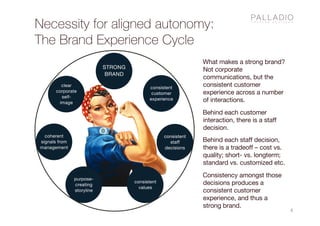
Necessity for aligned autonomy:
The Brand Experience Cycle
4
coherent
signals from
management
STRONG
BRAND
consistent
customer
experience
consistent
values
purpose-
creating
storyline
clear
corporate
self-
image
consistent
staff
decisions
What makes a strong brand?
Not corporate
communications, but the
consistent customer
experience across a number
of interactions.
Behind each customer
interaction, there is a staff
decision.
Behind each staff decision,
there is a tradeoff – cost vs.
quality; short- vs. longterm;
standard vs. customized etc.
Consistency amongst those
decisions produces a
consistent customer
experience, and thus a
strong brand.
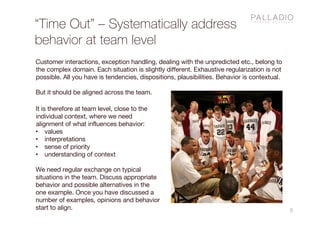
“Time Out” – Systematically address
behavior at team level
5
Customer interactions, exception handling, dealing with the unpredicted etc., belong to
the complex domain. Each situation is slightly different. Exhaustive regularization is not
possible. All you have is tendencies, dispositions, plausibilities. Behavior is contextual.
But it should be aligned across the team.
It is therefore at team level, close to the
individual context, where we need
alignment of what influences behavior:
• values
• interpretations
• sense of priority
• understanding of context
We need regular exchange on typical
situations in the team. Discuss appropriate
behavior and possible alternatives in the
one example. Once you have discussed a
number of examples, opinions and behavior
start to align.
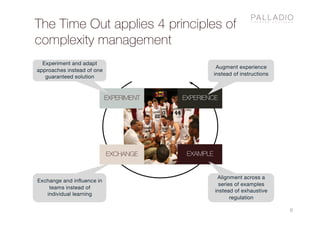
The Time Out applies 4 principles of
complexity management
6
EXPERIENCE
EXCHANGE EXAMPLE
Augment experience
instead of instructions
Alignment across a
series of examples
instead of exhaustive
regulation
EXPERIMENT
Experiment and adapt
approaches instead of one
guaranteed solution
Exchange and influence in
teams instead of
individual learning
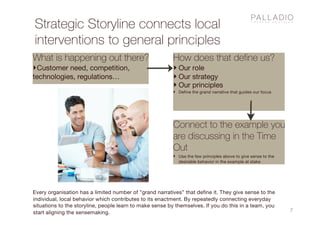
Strategic Storyline connects local
interventions to general principles
77
What is happening out there?
‣Customer need, competition,
technologies, regulations…
How does that define us?
‣ Our role
‣ Our strategy
‣ Our principles
‣ Define the grand narrative that guides our focus
Connect to the example you
are discussing in the Time
Out
‣ Use the few principles above to give sense to the
desirable behavior in the example at stake
Every organisation has a limited number of ”grand narratives” that define it. They give sense to the
individual, local behavior which contributes to its enactment. By repeatedly connecting everyday
situations to the storyline, people learn to make sense by themselves. If you do this in a team, you
start aligning the sensemaking.
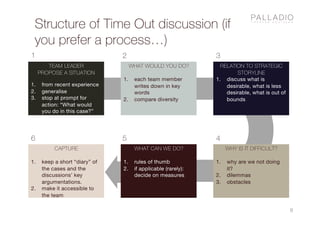
Structure of Time Out discussion (if
you prefer a process…)
8
TEAM LEADER
PROPOSE A SITUATION
1. from recent experience
2. generalise
3. stop at prompt for
action: “What would
you do in this case?”
WHAT WOULD YOU DO?
1. each team member
writes down in key
words
2. compare diversity
RELATION TO STRATEGIC
STORYLINE
1. discuss what is
desirable, what is less
desirable, what is out of
bounds
CAPTURE
1. keep a short “diary” of
the cases and the
discussions’ key
argumentations.
2. make it accessible to
the team
WHAT CAN WE DO?
1. rules of thumb
2. if applicable (rarely):
decide on measures
WHY IS IT DIFFICULT?
1. why are we not doing
it?
2. dilemmas
3. obstacles
1
6 5 4
32
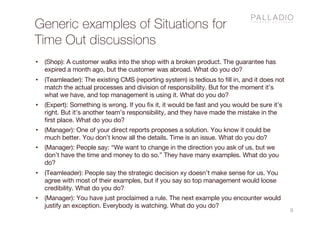
Generic examples of Situations for
Time Out discussions
9
• (Shop): A customer walks into the shop with a broken product. The guarantee has
expired a month ago, but the customer was abroad. What do you do?
• (Teamleader): The existing CMS (reporting system) is tedious to fill in, and it does not
match the actual processes and division of responsibility. But for the moment it’s
what we have, and top management is using it. What do you do?
• (Expert): Something is wrong. If you fix it, it would be fast and you would be sure it’s
right. But it’s another team’s responsibility, and they have made the mistake in the
first place. What do you do?
• (Manager): One of your direct reports proposes a solution. You know it could be
much better. You don’t know all the details. Time is an issue. What do you do?
• (Manager): People say: “We want to change in the direction you ask of us, but we
don’t have the time and money to do so.” They have many examples. What do you
do?
• (Teamleader): People say the strategic decision xy doesn’t make sense for us. You
agree with most of their examples, but if you say so top management would loose
credibility. What do you do?
• (Manager): You have just proclaimed a rule. The next example you encounter would
justify an exception. Everybody is watching. What do you do?
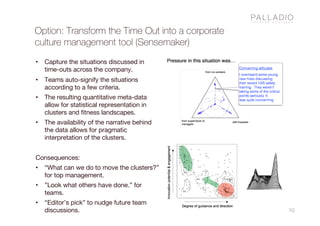
Option: Transform the Time Out into a corporate
culture management tool (Sensemaker)
10
• Capture the situations discussed in
time-outs across the company.
• Teams auto-signify the situations
according to a few criteria.
• The resulting quantitative meta-data
allow for statistical representation in
clusters and fitness landscapes.
• The availability of the narrative behind
the data allows for pragmatic
interpretation of the clusters.
Consequences:
• “What can we do to move the clusters?”
for top management.
• ”Look what others have done.” for
teams.
• “Editor’s pick” to nudge future team
discussions.
11
www.theleadersfairytales.com
Subscribe, or follow on Facebook, LinkedIn etc.
Bernhard Sterchi, Palladio Trusted Advisers, Gerbergasse 30, Postfach, CH-4001 Basel, +41 78 783 72 44, bernhard.sterchi@palladio.net, www.palladio.net
THANK YOU TO OUR
THANK YOU TO OUR
PARTNERS

Aligned autonomy | Bernhard Sterchi

  • 2.
    15 October 2016 BernhardSterchi Aligned Autonomy How to systematically manage contextual behavior in an organization.
  • 3.
    The case: industrialstrength is not enough for a service culture 3 Ordered Systems Same input produces same output Complex Interactions Every situation is slightly different Industrial Management • Process • Worflow • Checklist • Documentation • … Doing the right thing – now! • Common Sense • Experience • ????
  • 4.
    Necessity for alignedautonomy: The Brand Experience Cycle 4 coherent signals from management STRONG BRAND consistent customer experience consistent values purpose- creating storyline clear corporate self- image consistent staff decisions What makes a strong brand? Not corporate communications, but the consistent customer experience across a number of interactions. Behind each customer interaction, there is a staff decision. Behind each staff decision, there is a tradeoff – cost vs. quality; short- vs. longterm; standard vs. customized etc. Consistency amongst those decisions produces a consistent customer experience, and thus a strong brand.
  • 5.
    “Time Out” –Systematically address behavior at team level 5 Customer interactions, exception handling, dealing with the unpredicted etc., belong to the complex domain. Each situation is slightly different. Exhaustive regularization is not possible. All you have is tendencies, dispositions, plausibilities. Behavior is contextual. But it should be aligned across the team. It is therefore at team level, close to the individual context, where we need alignment of what influences behavior: • values • interpretations • sense of priority • understanding of context We need regular exchange on typical situations in the team. Discuss appropriate behavior and possible alternatives in the one example. Once you have discussed a number of examples, opinions and behavior start to align.
  • 6.
    The Time Outapplies 4 principles of complexity management 6 EXPERIENCE EXCHANGE EXAMPLE Augment experience instead of instructions Alignment across a series of examples instead of exhaustive regulation EXPERIMENT Experiment and adapt approaches instead of one guaranteed solution Exchange and influence in teams instead of individual learning
  • 7.
    Strategic Storyline connectslocal interventions to general principles 77 What is happening out there? ‣Customer need, competition, technologies, regulations… How does that define us? ‣ Our role ‣ Our strategy ‣ Our principles ‣ Define the grand narrative that guides our focus Connect to the example you are discussing in the Time Out ‣ Use the few principles above to give sense to the desirable behavior in the example at stake Every organisation has a limited number of ”grand narratives” that define it. They give sense to the individual, local behavior which contributes to its enactment. By repeatedly connecting everyday situations to the storyline, people learn to make sense by themselves. If you do this in a team, you start aligning the sensemaking.
  • 8.
    Structure of TimeOut discussion (if you prefer a process…) 8 TEAM LEADER PROPOSE A SITUATION 1. from recent experience 2. generalise 3. stop at prompt for action: “What would you do in this case?” WHAT WOULD YOU DO? 1. each team member writes down in key words 2. compare diversity RELATION TO STRATEGIC STORYLINE 1. discuss what is desirable, what is less desirable, what is out of bounds CAPTURE 1. keep a short “diary” of the cases and the discussions’ key argumentations. 2. make it accessible to the team WHAT CAN WE DO? 1. rules of thumb 2. if applicable (rarely): decide on measures WHY IS IT DIFFICULT? 1. why are we not doing it? 2. dilemmas 3. obstacles 1 6 5 4 32
  • 9.
    Generic examples ofSituations for Time Out discussions 9 • (Shop): A customer walks into the shop with a broken product. The guarantee has expired a month ago, but the customer was abroad. What do you do? • (Teamleader): The existing CMS (reporting system) is tedious to fill in, and it does not match the actual processes and division of responsibility. But for the moment it’s what we have, and top management is using it. What do you do? • (Expert): Something is wrong. If you fix it, it would be fast and you would be sure it’s right. But it’s another team’s responsibility, and they have made the mistake in the first place. What do you do? • (Manager): One of your direct reports proposes a solution. You know it could be much better. You don’t know all the details. Time is an issue. What do you do? • (Manager): People say: “We want to change in the direction you ask of us, but we don’t have the time and money to do so.” They have many examples. What do you do? • (Teamleader): People say the strategic decision xy doesn’t make sense for us. You agree with most of their examples, but if you say so top management would loose credibility. What do you do? • (Manager): You have just proclaimed a rule. The next example you encounter would justify an exception. Everybody is watching. What do you do?
  • 10.
    Option: Transform theTime Out into a corporate culture management tool (Sensemaker) 10 • Capture the situations discussed in time-outs across the company. • Teams auto-signify the situations according to a few criteria. • The resulting quantitative meta-data allow for statistical representation in clusters and fitness landscapes. • The availability of the narrative behind the data allows for pragmatic interpretation of the clusters. Consequences: • “What can we do to move the clusters?” for top management. • ”Look what others have done.” for teams. • “Editor’s pick” to nudge future team discussions.
  • 11.
  • 12.
    Bernhard Sterchi, PalladioTrusted Advisers, Gerbergasse 30, Postfach, CH-4001 Basel, +41 78 783 72 44, bernhard.sterchi@palladio.net, www.palladio.net
  • 13.
  • 14.
    THANK YOU TOOUR PARTNERS