Friday, June 25, 2010Cereal Production and Technology Adoption in EthiopiaBingxinYu Alejandro Nin-Pratt José FunesSinafikehAsratJune 2010
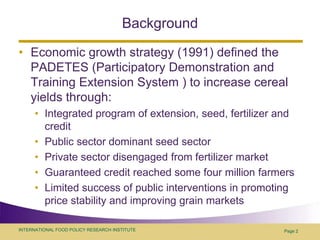
BackgroundEconomic growth strategy (1991) defined the PADETES (Participatory Demonstration and Training Extension System ) to increase cereal yields through:Integrated program of extension, seed, fertilizer and creditPublic sector dominant seed sectorPrivate sector disengaged from fertilizer marketGuaranteed credit reached some four million farmersLimited success of public interventions in promoting price stability and improving grain marketsPage 2
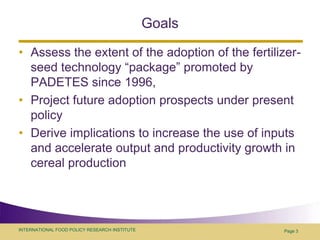
GoalsAssess the extent of the adoption of the fertilizer-seed technology “package” promoted by PADETES since 1996, Project future adoption prospects under present policyDerive implications to increase the use of inputs and accelerate output and productivity growth in cereal production Page 3
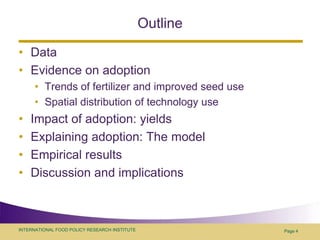
OutlineDataEvidence on adoptionTrends of fertilizer and improved seed useSpatial distribution of technology useImpact of adoption: yieldsExplaining adoption: The modelEmpirical resultsDiscussion and implicationsPage 4
Data CSA Annual Sample Surveys 2003/04 – 2007/08Nationally representative annual seriesData available at plot levelDetailed information on area, production and input use for all cropsWereda level information, accounting for heterogeneity in spatial distribution of: Natural resourcesInfrastructuremarket access.  Page 5
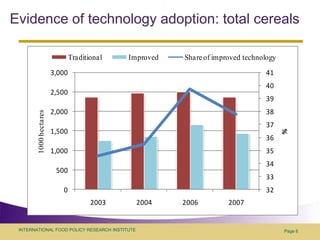
Evidence of technology adoption: total cerealsPage 6
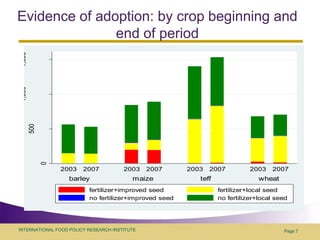
Evidence of adoption: by crop beginning and end of periodPage 7
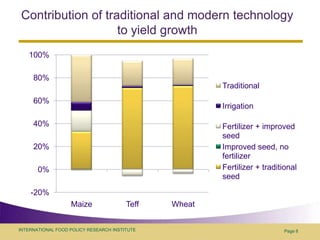
Contribution of traditional and modern technology to yield growthPage 8
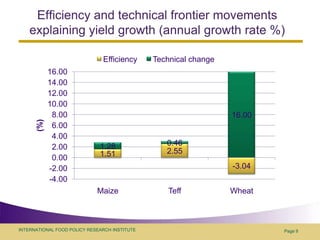
Efficiency and technical frontier movements explaining yield growth (annual growth rate %)Page 9
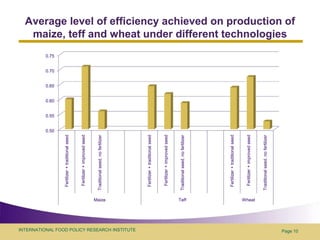
Average level of efficiency achieved on production of maize, teff and wheat under different technologiesPage 10
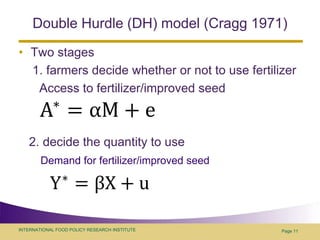
Double Hurdle (DH) model (Cragg 1971)Two stages    1. farmers decide whether or not to use fertilizer      Access to fertilizer/improved seed   2. decide the quantity to usePage 11Demand for fertilizer/improved seed
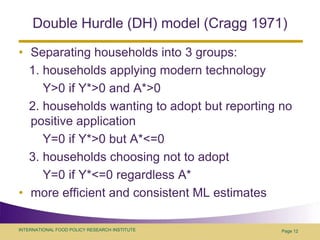
Double Hurdle (DH) model (Cragg 1971)Separating households into 3 groups:    1. households applying modern technology       Y>0 if Y*>0 and A*>0   2. households wanting to adopt but reporting no positive application       Y=0 if Y*>0 but A*<=0   3. households choosing not to adopt       Y=0 if Y*<=0 regardless A*more efficient and consistent ML estimatesPage 12
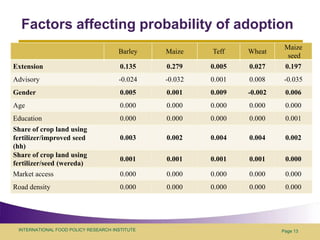
Factors affecting probability of adoptionPage 13
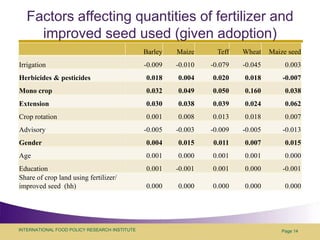
Factors affecting quantities of fertilizer and improved seed used (given adoption)Page 14
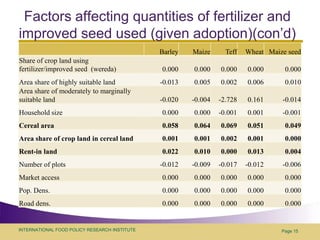
Factors affecting quantities of fertilizer and improved seed used (given adoption)(con’d)Page 15
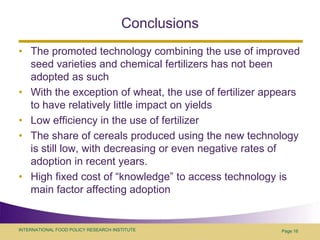
ConclusionsThe promoted technology combining the use of improved seed varieties and chemical fertilizers has not been adopted as suchWith the exception of wheat, the use of fertilizer appears to have relatively little impact on yieldsLow efficiency in the use of fertilizerThe share of cereals produced using the new technology is still low, with decreasing or even negative rates of adoption in recent years. High fixed cost of “knowledge” to access technology is main factor affecting adoptionPage 16

Cereal Production and Technology Adoption in Ethiopia

  • 1.
    Friday, June 25,2010Cereal Production and Technology Adoption in EthiopiaBingxinYu Alejandro Nin-Pratt José FunesSinafikehAsratJune 2010
  • 2.
    BackgroundEconomic growth strategy(1991) defined the PADETES (Participatory Demonstration and Training Extension System ) to increase cereal yields through:Integrated program of extension, seed, fertilizer and creditPublic sector dominant seed sectorPrivate sector disengaged from fertilizer marketGuaranteed credit reached some four million farmersLimited success of public interventions in promoting price stability and improving grain marketsPage 2
  • 3.
    GoalsAssess the extentof the adoption of the fertilizer-seed technology “package” promoted by PADETES since 1996, Project future adoption prospects under present policyDerive implications to increase the use of inputs and accelerate output and productivity growth in cereal production Page 3
  • 4.
    OutlineDataEvidence on adoptionTrendsof fertilizer and improved seed useSpatial distribution of technology useImpact of adoption: yieldsExplaining adoption: The modelEmpirical resultsDiscussion and implicationsPage 4
  • 5.
    Data CSA AnnualSample Surveys 2003/04 – 2007/08Nationally representative annual seriesData available at plot levelDetailed information on area, production and input use for all cropsWereda level information, accounting for heterogeneity in spatial distribution of: Natural resourcesInfrastructuremarket access. Page 5
  • 6.
    Evidence of technologyadoption: total cerealsPage 6
  • 7.
    Evidence of adoption:by crop beginning and end of periodPage 7
  • 8.
    Contribution of traditionaland modern technology to yield growthPage 8
  • 9.
    Efficiency and technicalfrontier movements explaining yield growth (annual growth rate %)Page 9
  • 10.
    Average level ofefficiency achieved on production of maize, teff and wheat under different technologiesPage 10
  • 11.
    Double Hurdle (DH)model (Cragg 1971)Two stages 1. farmers decide whether or not to use fertilizer Access to fertilizer/improved seed 2. decide the quantity to usePage 11Demand for fertilizer/improved seed
  • 12.
    Double Hurdle (DH)model (Cragg 1971)Separating households into 3 groups: 1. households applying modern technology Y>0 if Y*>0 and A*>0 2. households wanting to adopt but reporting no positive application Y=0 if Y*>0 but A*<=0 3. households choosing not to adopt Y=0 if Y*<=0 regardless A*more efficient and consistent ML estimatesPage 12
  • 13.
  • 14.
    Factors affecting quantitiesof fertilizer and improved seed used (given adoption)Page 14
  • 15.
    Factors affecting quantitiesof fertilizer and improved seed used (given adoption)(con’d)Page 15
  • 16.
    ConclusionsThe promoted technologycombining the use of improved seed varieties and chemical fertilizers has not been adopted as suchWith the exception of wheat, the use of fertilizer appears to have relatively little impact on yieldsLow efficiency in the use of fertilizerThe share of cereals produced using the new technology is still low, with decreasing or even negative rates of adoption in recent years. High fixed cost of “knowledge” to access technology is main factor affecting adoptionPage 16