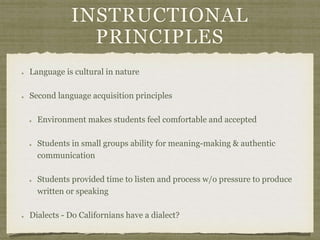
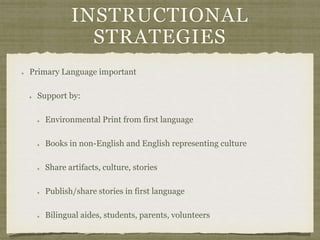
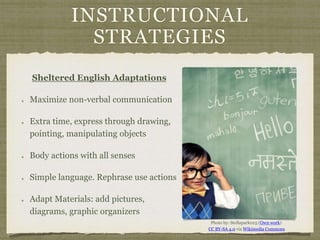
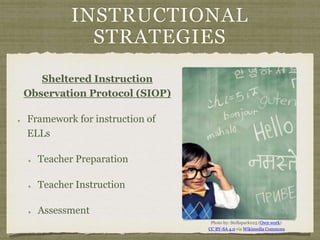
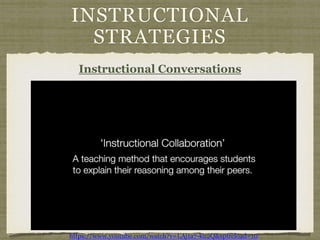
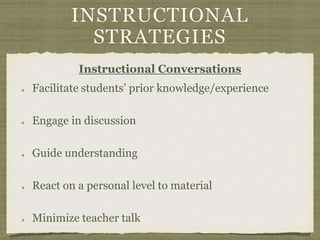
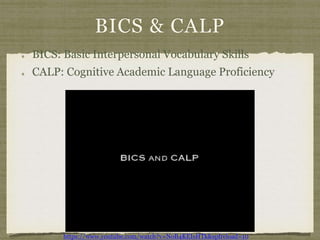
This document discusses strategies for meeting the needs of diverse learners in the classroom. It addresses linguistic, cultural, and cognitive diversity. Some key points include: building relationships with students; using primary language support, sheltered instruction, and instructional conversations; understanding the differences between basic interpersonal communication skills and cognitive academic language proficiency; promoting inclusion and considering students' least restrictive environments; and using assessments to inform instructional practices. The overall message is the importance of utilizing a variety of instructional strategies and beliefs to effectively educate students with diverse needs and backgrounds.

![LINGUISTIC DIVERSITY
Wide range of cultures within
your classroom
Build Relationships
Factors that contribute to diverse
classrooms:
Linguistic Diversity
Cultural Diversity
Cognitive & Academic
Diversity
Photo By hepingting (CB106492) [CC BY-SA 2.0 (http://creativecommons.org/licenses/by-sa/2.0)], via Wikimedia Commons](https://image.slidesharecdn.com/edug543session2wick-170127201945/85/Edug-543-session-2-Dr-Wick-spring-2017-2-320.jpg)

![INSTRUCTIONAL
PRINCIPLES
IDEA & LRE
IDEA defines Least Restrictive Environment as "to the maximum
extent appropriate, children with disabilities, including children in
public or private institutions or other care facilities, are educated
with children who are not disabled, and special classes, separate
schooling, or other removal of children with with disabilities from
the regular educational environment occurs only when the nature
or severity of the disability of a child is such that education in
regular classes with the use of supplementary aids and services
cannot be achieved satisfactorily" (Sec. 612 (a)[5]).
www.twu.edu/inspire/least-restrictive.asp](https://image.slidesharecdn.com/edug543session2wick-170127201945/85/Edug-543-session-2-Dr-Wick-spring-2017-19-320.jpg)



![Greg welle ppt_sped_413[1]](https://cdn.slidesharecdn.com/ss_thumbnails/gregwellepptsped4131-110520213426-phpapp02-thumbnail.jpg?width=640&height=640&fit=bounds)


