

Preparing Master Teachers in Bilingual Education and ESL A Presentation at the Annual Conference of the New York State Association for Bilingual Education Tarrytown, NY March 14, 2009 Presenters:  Francis Timothy Walsh, Ph.D. (Timshanny@hotmail.com) and  Doris Cintron, Ed.D. (dcintron@ccny.cuny.edu)
Getting Started
Getting Started: A Title VII Teachers and Personnel Competitive Grant, Department of Education, United States Government DEPARTMENT OF EDUCATION (CFDA No.:  84.195A) Bilingual Education:  Teachers and Personnel Grants Notice inviting applications for new awards for fiscal year (FY) 1995. PURPOSE OF PROGRAM:  The purpose of this program is to provide grants for preservice and inservice professional development for bilingual education teachers, administrators, pupil services personnel, and other educational personnel who are either involved in, or preparing to be involved in, the provision of educational services for children and youth of limited English proficiency (LEP). --excerpted from the Request for Proposals, Office of Bilingual Education and Minority Languages Affairs (OBEMLA)
I.Goals and Objectives of the Second Language Learning Master Teacher Development Project Goal :  To provide integrated ESL/Bilingual Education training to New York City Teachers Objective  #1 :  Recruit  72 inservice and 8 preservice bilingual teachers for training in a three-year Masters program in Bilingual Education with additional training in ESL. Objective  #2 :  Train  72 inservice and 8 preservice bilingual teachers in an intensive three-year Masters degree program in bilingual education, with special emphasis upon course work in ESL theory, teaching methods, and materials. Objective  #3 :  Confer  Masters degrees upon, and grant provisional New York State certification in Elementary Education with a Bilingual Extension to, 1 preservice and 19 inservice teachers. Objective  #4 :  Place  20 Master Teachers in  New York City’s public schools.
II. The Proposed Curriculum   Building upon the success of the Bilingual Education Program at The City College in preparing teachers for service with LEP children, the curriculum will respond to the special needs teachers of English to Speakers of Other Languages. Distribution of courses will be as follows: I  Bilingual Education core courses   9  credits II  English Language courses     6  credits III Specialized ESL courses     15  credits IV Practice/Internship   3  credits V  Content Research Seminar   4  credits   TOTAL  37 credits --from the grant application
Project Admissions Requirements Personal Admissions Interview  with Project Faculty or Staff High Standards for Admission 3.0 Undergraduate GPA Language other than English Acceptable study in Education or Related Field Passing grade on English Proficiency Exam Acceptable completion of entrance essay Three letters of recommendation
Project Exit Requirements Exit Interview Successful Completion of Course of Study Successful Completion of  Action Research  Project Acceptable Attendance at Leadership Seminar, Annual “Events”
Some Outstanding Features of the Project
III. Outstanding Features of the Second Language Learning Master Teacher Development Project Student-Directed Leadership Seminar Annual “Events” Open to the Larger Community Action Research A Teacher-Friendly Comprehensive Examination
IV. The Leadership Seminar Originally suggested by an outside evaluator Focus on  Teacher Empowerment : Teachers organized and directed monthly meetings.   Teachers offered  workshops  to one another in areas such as the use of computers in the classroom.  Teachers initiated a  speaker series  with experts from the local Board of Education, the College faculty, and elsewhere. Each year, teachers elected a  representative  to serve on the Project’s Advisory Committee. Teachers used the seminar to provide  feedback on curriculum , such as the required practicum.   Teachers shared lessons and activities which they had developed at their school sites
 
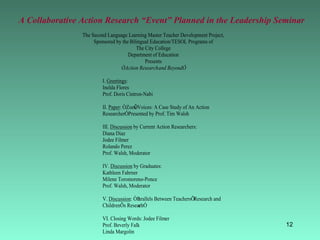
A Collaborative Action Research “Event” Planned in the Leadership Seminar
The Action Research Sequence A two-semester experience First semester : learn about action research methods, identify a study topic, create a research proposal Second semester : implement, analyze the project, submit the final project, meet with colleagues to discuss projects Originally resisted by some teachers, due to the amount of time involved, and the approach’s lack of conformity with research practices in other programs However, design has been disseminated to other programs
V. Some Action Research Topics Learner strategies: A case study of two high school ESL students Journal writing in Kindergarten and first grades Implementing cooperative learning in the ESL classroom A case study of an intermediate public school teacher responding to problems of adolescent motivation in an ESL classroom Perceptions of cluster teachers: Comparative and contrastive view[s] of bilingual children Phonics: A tool for first grade bilingual students to learn how to read and write A case study of Elias Santos and the factors that influence his biliteracy and code-switching in the L2 acquisition The effects on the writing style in English of a bilingual fourth grade student when exposed to fiction and discussion around the literature Acculturation: A possible cause for Kindergarteners’ varying attitudes toward ESL
A Student-Centered Comprehensive Examination Teachers met with the project director on a monthly basis prior to the examination Teachers generated the content of the questions on the examination in their monthly meetings
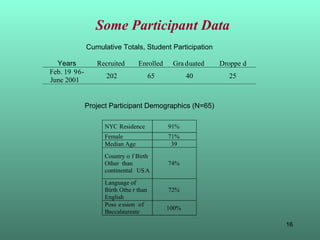
Some Participant Data
VI. Crossing Boundaries: Effects of the Project on Participants Linking Practice and Research The best part of it is that it actually got me to start thinking like a researcher. A researcher teacher.   -- “Ellen,” exit interview Crossing Disciplines I guess, the stress, the schooling, and everything else, has bonded us? We did study groups together, we met at different houses, we met at restaurants. We really bonded.   --”Alba,” exit interview Crossing the Theory-Practice Divide Usually when you do papers it's about other people's theories. It [action research] helped me get going on a plan to solve this situation [in her classroom]. It's reality. This is what it's like to have a maraca in your hand. In the beginning when I was writing the theories, it didn't hit me. It [understanding the purpose of the research] really started with the interviews.   --“Zoe,” exit interview
Obstacles Overcome, Lessons Learned
Obstacles Overcome Government De-funding in Year One Bureaucratic Obstacles to Institutionalization of the Program State-Mandated Re-certification of the Program Early Attrition Due to Retarded Approval by State Agency
Accomplishments of the Project Institutionalization of the Program Bilingual/ESL training provided for sixty-five teachers from some of the most needy communities in New York City  Positive effect on over 3000 English Language Learners in the public schools, over the six-year period Empowerment of teachers via unique curriculum and program design
CCNY submits Letter of Intent to create new program to the CUNY Office of Academic Affairs. CUNY circulates Letter of Intent to other campuses for critique. CUNY authorizes full proposal development. Proposal (full curriculum) developed and sent out for external evaluation. Proposal and external evaluations presented to School of Education Curriculum Committee for approval. Proposal presented to faculty for approval to add program to School of Education  offerings. Proposal submitted to CUNY Board of Trustees. Proposal sent to State Education Department for review Program given Hegis Code by the State Education Department = Institutionalization. VII. Institutionalization of The Project
Participants’ Suggestions for Change Scheduling The action research. It would flow a lot easier. Instead of having that summer between, and then, as teachers, a whole new, different group of children, and so on. --“Alba,” exit interview Project Content I can’t decide about the leadership. I have to say this. Don’t require it. But yet, I suppose we never would have had that event happen, if we hadn’t had the leadership class. -- “Ellen,” exit interview
VIII. Lessons Learned Be Prepared  for the Unthinkable (funding, changing certification requirements)  Adapt  as Circumstances Demand Design  with Student Involvement in Mind (Advisory Committee, Leadership Seminar) Identify  Participants Who are Willing to “Go the Extra Mile” in Educating Themselves Be   flexible , responsive, and caring Include   Follow-up  in Program Design
A Final Question Can you identify enablers of and obstacles to implementation of similar multi-faceted programs of teacher education in New York State?
Fin

Preparing Master Teachers...

  • 1.
    Preparing Master Teachersin Bilingual Education and ESL A Presentation at the Annual Conference of the New York State Association for Bilingual Education Tarrytown, NY March 14, 2009 Presenters: Francis Timothy Walsh, Ph.D. (Timshanny@hotmail.com) and Doris Cintron, Ed.D. (dcintron@ccny.cuny.edu)
  • 2.
  • 3.
    Getting Started: ATitle VII Teachers and Personnel Competitive Grant, Department of Education, United States Government DEPARTMENT OF EDUCATION (CFDA No.: 84.195A) Bilingual Education: Teachers and Personnel Grants Notice inviting applications for new awards for fiscal year (FY) 1995. PURPOSE OF PROGRAM: The purpose of this program is to provide grants for preservice and inservice professional development for bilingual education teachers, administrators, pupil services personnel, and other educational personnel who are either involved in, or preparing to be involved in, the provision of educational services for children and youth of limited English proficiency (LEP). --excerpted from the Request for Proposals, Office of Bilingual Education and Minority Languages Affairs (OBEMLA)
  • 4.
    I.Goals and Objectivesof the Second Language Learning Master Teacher Development Project Goal : To provide integrated ESL/Bilingual Education training to New York City Teachers Objective #1 : Recruit 72 inservice and 8 preservice bilingual teachers for training in a three-year Masters program in Bilingual Education with additional training in ESL. Objective #2 : Train 72 inservice and 8 preservice bilingual teachers in an intensive three-year Masters degree program in bilingual education, with special emphasis upon course work in ESL theory, teaching methods, and materials. Objective #3 : Confer Masters degrees upon, and grant provisional New York State certification in Elementary Education with a Bilingual Extension to, 1 preservice and 19 inservice teachers. Objective #4 : Place 20 Master Teachers in New York City’s public schools.
  • 5.
    II. The ProposedCurriculum Building upon the success of the Bilingual Education Program at The City College in preparing teachers for service with LEP children, the curriculum will respond to the special needs teachers of English to Speakers of Other Languages. Distribution of courses will be as follows: I Bilingual Education core courses 9 credits II English Language courses 6 credits III Specialized ESL courses 15 credits IV Practice/Internship 3 credits V Content Research Seminar 4 credits TOTAL 37 credits --from the grant application
  • 6.
    Project Admissions RequirementsPersonal Admissions Interview with Project Faculty or Staff High Standards for Admission 3.0 Undergraduate GPA Language other than English Acceptable study in Education or Related Field Passing grade on English Proficiency Exam Acceptable completion of entrance essay Three letters of recommendation
  • 7.
    Project Exit RequirementsExit Interview Successful Completion of Course of Study Successful Completion of Action Research Project Acceptable Attendance at Leadership Seminar, Annual “Events”
  • 8.
  • 9.
    III. Outstanding Featuresof the Second Language Learning Master Teacher Development Project Student-Directed Leadership Seminar Annual “Events” Open to the Larger Community Action Research A Teacher-Friendly Comprehensive Examination
  • 10.
    IV. The LeadershipSeminar Originally suggested by an outside evaluator Focus on Teacher Empowerment : Teachers organized and directed monthly meetings. Teachers offered workshops to one another in areas such as the use of computers in the classroom. Teachers initiated a speaker series with experts from the local Board of Education, the College faculty, and elsewhere. Each year, teachers elected a representative to serve on the Project’s Advisory Committee. Teachers used the seminar to provide feedback on curriculum , such as the required practicum. Teachers shared lessons and activities which they had developed at their school sites
  • 11.
  • 12.
    A Collaborative ActionResearch “Event” Planned in the Leadership Seminar
  • 13.
    The Action ResearchSequence A two-semester experience First semester : learn about action research methods, identify a study topic, create a research proposal Second semester : implement, analyze the project, submit the final project, meet with colleagues to discuss projects Originally resisted by some teachers, due to the amount of time involved, and the approach’s lack of conformity with research practices in other programs However, design has been disseminated to other programs
  • 14.
    V. Some ActionResearch Topics Learner strategies: A case study of two high school ESL students Journal writing in Kindergarten and first grades Implementing cooperative learning in the ESL classroom A case study of an intermediate public school teacher responding to problems of adolescent motivation in an ESL classroom Perceptions of cluster teachers: Comparative and contrastive view[s] of bilingual children Phonics: A tool for first grade bilingual students to learn how to read and write A case study of Elias Santos and the factors that influence his biliteracy and code-switching in the L2 acquisition The effects on the writing style in English of a bilingual fourth grade student when exposed to fiction and discussion around the literature Acculturation: A possible cause for Kindergarteners’ varying attitudes toward ESL
  • 15.
    A Student-Centered ComprehensiveExamination Teachers met with the project director on a monthly basis prior to the examination Teachers generated the content of the questions on the examination in their monthly meetings
  • 16.
  • 17.
    VI. Crossing Boundaries:Effects of the Project on Participants Linking Practice and Research The best part of it is that it actually got me to start thinking like a researcher. A researcher teacher. -- “Ellen,” exit interview Crossing Disciplines I guess, the stress, the schooling, and everything else, has bonded us? We did study groups together, we met at different houses, we met at restaurants. We really bonded. --”Alba,” exit interview Crossing the Theory-Practice Divide Usually when you do papers it's about other people's theories. It [action research] helped me get going on a plan to solve this situation [in her classroom]. It's reality. This is what it's like to have a maraca in your hand. In the beginning when I was writing the theories, it didn't hit me. It [understanding the purpose of the research] really started with the interviews. --“Zoe,” exit interview
  • 18.
  • 19.
    Obstacles Overcome GovernmentDe-funding in Year One Bureaucratic Obstacles to Institutionalization of the Program State-Mandated Re-certification of the Program Early Attrition Due to Retarded Approval by State Agency
  • 20.
    Accomplishments of theProject Institutionalization of the Program Bilingual/ESL training provided for sixty-five teachers from some of the most needy communities in New York City Positive effect on over 3000 English Language Learners in the public schools, over the six-year period Empowerment of teachers via unique curriculum and program design
  • 21.
    CCNY submits Letterof Intent to create new program to the CUNY Office of Academic Affairs. CUNY circulates Letter of Intent to other campuses for critique. CUNY authorizes full proposal development. Proposal (full curriculum) developed and sent out for external evaluation. Proposal and external evaluations presented to School of Education Curriculum Committee for approval. Proposal presented to faculty for approval to add program to School of Education offerings. Proposal submitted to CUNY Board of Trustees. Proposal sent to State Education Department for review Program given Hegis Code by the State Education Department = Institutionalization. VII. Institutionalization of The Project
  • 22.
    Participants’ Suggestions forChange Scheduling The action research. It would flow a lot easier. Instead of having that summer between, and then, as teachers, a whole new, different group of children, and so on. --“Alba,” exit interview Project Content I can’t decide about the leadership. I have to say this. Don’t require it. But yet, I suppose we never would have had that event happen, if we hadn’t had the leadership class. -- “Ellen,” exit interview
  • 23.
    VIII. Lessons LearnedBe Prepared for the Unthinkable (funding, changing certification requirements) Adapt as Circumstances Demand Design with Student Involvement in Mind (Advisory Committee, Leadership Seminar) Identify Participants Who are Willing to “Go the Extra Mile” in Educating Themselves Be flexible , responsive, and caring Include Follow-up in Program Design
  • 24.
    A Final QuestionCan you identify enablers of and obstacles to implementation of similar multi-faceted programs of teacher education in New York State?
  • 25.